Refutations on “Debunking the Myths of
Influence Maximization: A Benchmarking Study”
Wei Lu (Rupert Labs), Xiaokui Xiao (Nanyang Technological Univ.),
Amit Goyal (Google), Keke Huang (Nanyang Technological Univ.),
Laks V.S. Lakshmanan (UBC)
https://arxiv.org/abs/1705.05144
Background & Overview
● “Debunking the Myths of Influence Maximization: A Benchmarking Study” [1] is a
SIGMOD 2017 paper by Arora, Galhotra, and Ranu. That paper:
○ undertakes a benchmarking performance study on the problem of Influence
Maximization
○ claims to unearth and debunks many “myths” around Influence Maximization
research over the years
● Our article (https://arxiv.org/abs/1705.05144 ):
○ examines fundamental flaws of their experimental design & methodology
○ points out unreproducible result in critical experiments
○ refutes 11 mis-claims in [1]
Our goals and contributions
● Objectively, critically, and thoroughly review Arora et al. [1]
● Identify fundamental flaws in [1]’s experimental design/methodology, which:
○ fails to understand the trade-off between efficiency and solution quality
○ when generalized, leads to obviously incorrect conclusions such as the
Chebyshev’s inequality is better than Chernoff bound
● Identify unreproducible, but critical experiments which are used to determine
benchmarking parameters. By design, this has serious implications of the
correctness of all experiments in Arora et al. [1]
● Refute 11 mis-claims by Arora et al. [1] on previously published papers,
including then state-of-the-art approximation algorithms
Influence Maximization: Brief Recap
● A well-studied optimization problem in data mining, first defined by Kempe et
al. (KDD 2003)
● Given a social network graph G, a positive integer k, an underlying influence
diffusion model M, find a seed set S of size k, such that under model M, the
spread of influence on G is maximized through the initial activation of S
● This problem is NP-hard, and involves #P-hardness in spread computation for
many diffusion models, including well-studied ones: Independent Cascade (IC)
and Linear Thresholds (LT)
● Many algorithms have been designed toward the goal of scalable IM solutions
Flaws in
Experimental Design & Methodology
Flawed Design & Methodology
● Arora et al.’s design question: “How long does it take for each algorithm to
reach its ‘near-optimal’ empirical accuracy”
● Their experimental design/methodology is:
○ For each influence maximization Algorithm-A,
○ Identify a parameter p that controls the trade-off between running time and spread
achieved.
○ Choose value p* for the parameter, such that in a given “reasonable time limit” T (not
defined in [1]), Algorithm-A can achieve its best spread.
○ Compare all algorithms’ running time at their each individual p*.
● This is a flawed methodology that will lead to scientifically incorrect results (see
next few slides)
(Sec 2.2 of our tech report)
Why it’s flawed?
● Direct consequence of Arora et al’s approach: In the comparison of running
time, different algorithms are held to different bars.
● Consider this example:
○ Algo-A has “near-optimal” spread of 100, and takes 10 mins to reach that solution.
○ Algo-B has “near-optimal” spread of 10, and takes 1 min to reach solution.
○ But Algo-A needs only 0.1 mins to reach spread 10, the “near-optimality” of Algo-B.
● Arora et al.’s methodology will conclude that B is more efficient than A
● This is obviously wrong, as A is 10x faster than B to reach B’s bar
● One more example next slide
(Sec 2.2 of our tech report)
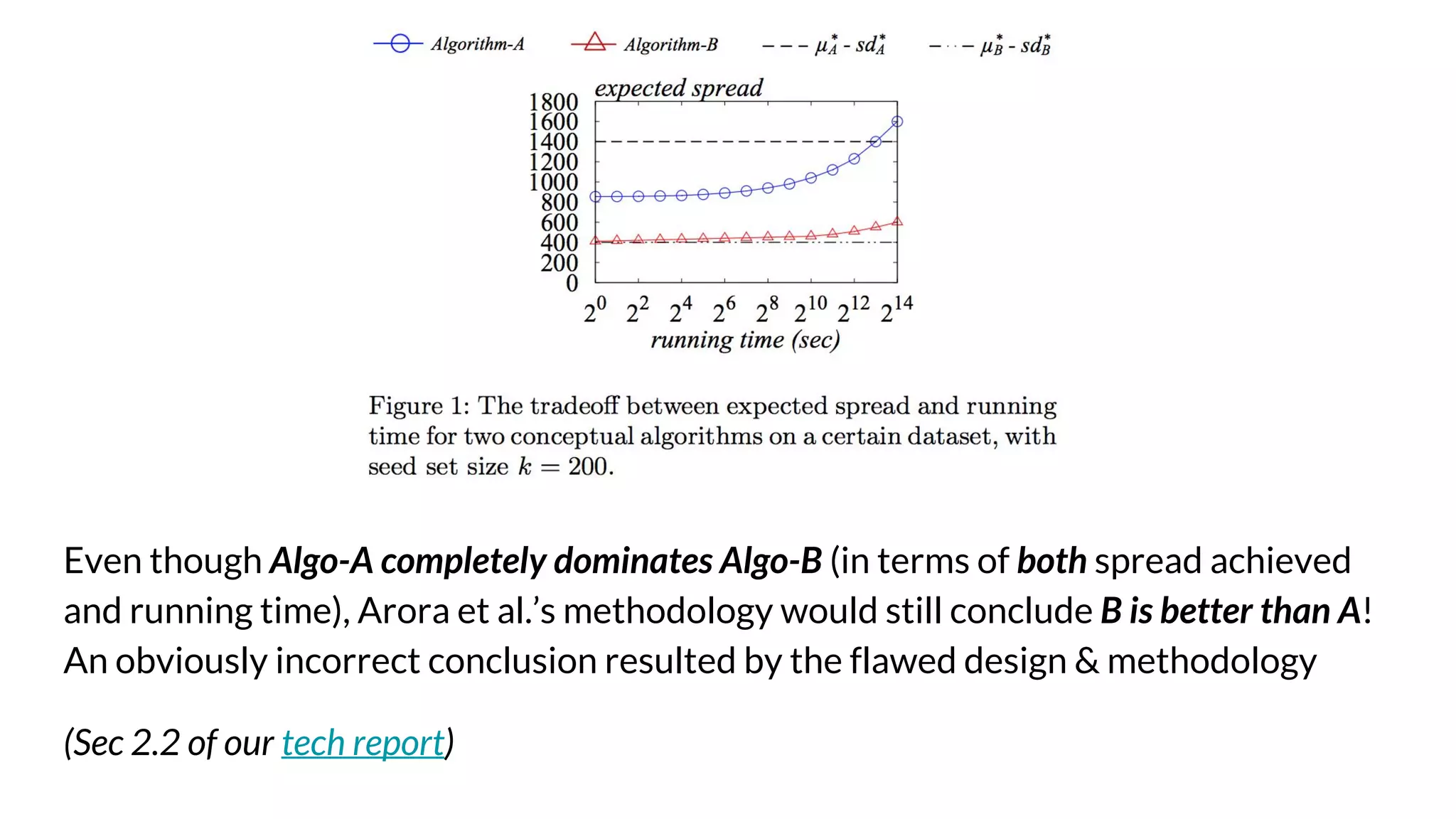
Even though Algo-A completely dominates Algo-B (in terms of both spread achieved
and running time), Arora et al.’s methodology would still conclude B is better than A!
An obviously incorrect conclusion resulted by the flawed design & methodology
(Sec 2.2 of our tech report)
Unreproducible Results for Parameter Selection
● We are unable to reproduce Figure 12 in Arora et al, which are experiments for
determining the optimal parameter p* for each algorithm
● In a nutshell, Figure 12 presented standard deviations values with 10K samples
in each setting (per algo/model/dataset combo)
● We obtained standard deviations values are 10 times larger than Arora et al.’s
○ Validated with both UBC and NTU servers
● Impact: Incorrect Figure 12 results → all benchmarking experiments can be
wrong & need to be re-run, as the parameter setup are erroneous in the first
place
(See Sec 2.3 of our tech report for details on why discrepancies occurred)
Questionable Method for Parameter Tuning
● To tune parameter for each benchmarked algorithm, Arora et al. defines
an algorithm’s “near-optimal quality” to be that achievable within a
“reasonable time limit”
● However, no clear definition of this limit is given in the paper
● Such an ill-defined method can lead to arbitrarily bad experiments
● Gravity of the issue: Two identical replicas of the same algorithm would
be concluded as having different efficiency performance
○ Next slide has details
Questionable Method for Parameter Tuning
● Thought experiment: Let’s have two identical replicas of the same algorithm A
● Assume the methodology is unaware that two replicas are the identical
● Replica A1 is allowed time limit T1, while replica A2 is allowed T2
○ but somehow, T1 != T2
● Then the parameters (bars) for A1 and A2 would be different
● As a result, their running time performance will be different
● Arora et al.’s methodology would then conclude one replica is faster than the
other, even though they are exactly the same
Misclaims related to IMM algorithm [3]
and TIM+ algorithm [2]
TIM+ and IMM algorithms
● Both are fast and highly scalable (1-1/e-epsilon)-approximation algorithms
○ Underlying methodology: Sampling reverse-reachable set for seed selection
● IMM improves upon TIM+ by using martingale theory to draw much fewer
samples, for any given epsilon (i.e., same worst-case performance guarantee)
● Both papers [2][3] showed that very small epsilon (< 0.1) increases running time
a lot but does not further improve quality too much (i.e., the trade-off at that
point isn’t worth it)
● Running time (left Y-axis) sharply
decreases as epsilon goes up.
● Solution quality (right Y-axis) is
only marginally affected.
● E.g., epsilon at 0.05 vs. 0.5, the
running time difference is 68x, but
accuracy difference is only 2.1%.
● Quite similar trend for TIM+
● See original papers [2][3] for
details.
Efficiency & quality tradeoff for IMM
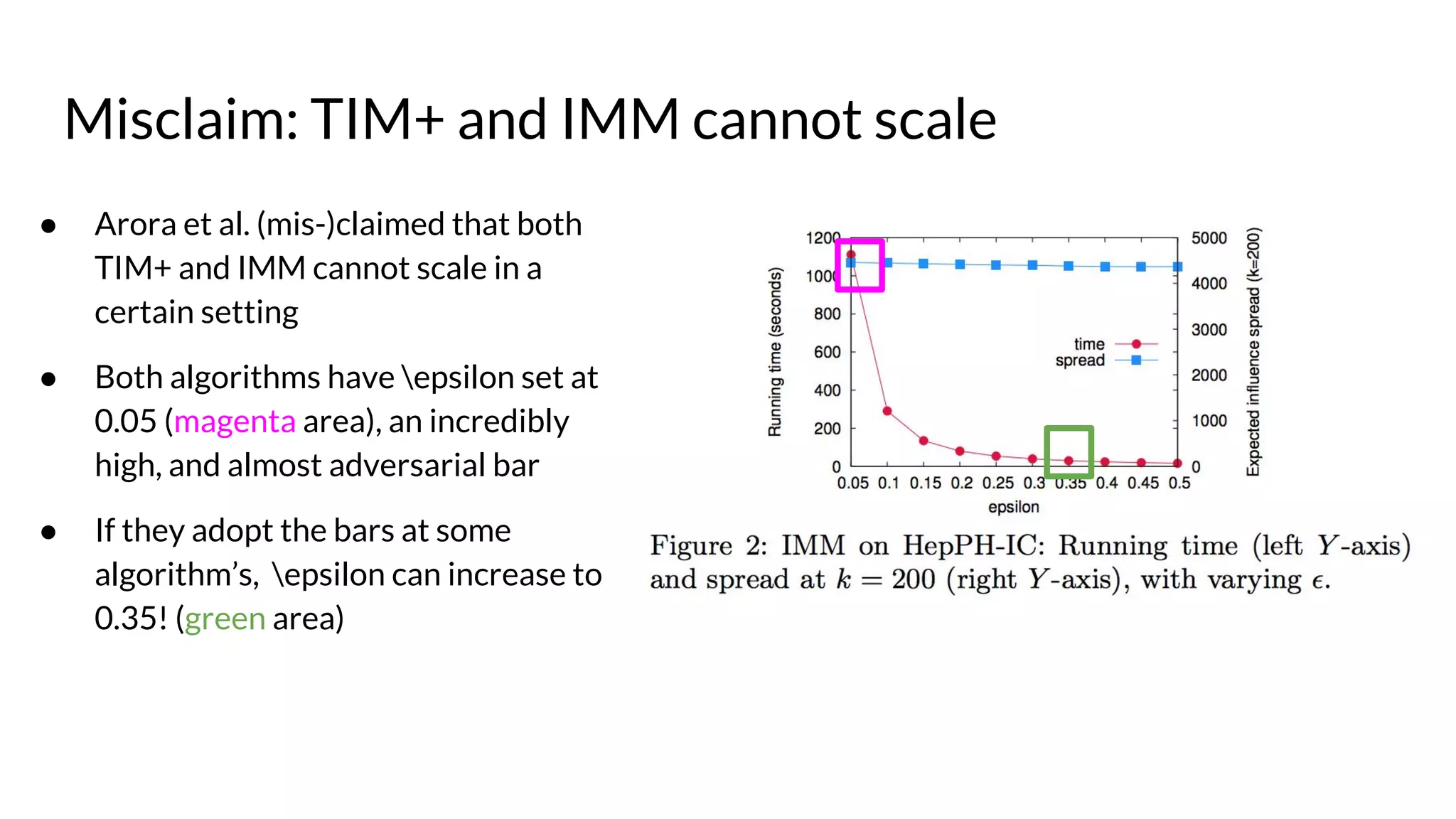
Misclaim: TIM+ and IMM cannot scale
● Arora et al. (mis-)claimed that both
TIM+ and IMM cannot scale in a
certain setting
● Both algorithms have epsilon set at
0.05 (magenta area), an incredibly
high, and almost adversarial bar
● If they adopt the bars at some
algorithm’s, epsilon can increase to
0.35! (green area)
Misclaim: TIM+ is better than IMM on LT model
● Arora et al. ignored theoretical guarantees but opted for empirical accuracies,
yet again with different bars of accuracy.
● For LT model, they set the bar of IMM (epsilon = 0.05) much higher than TIM+
(epsilon = 0.1)
○ See previous slide for illustration
● Erroneously conclude IMM is not as scalable as TIM+
● Analogy of their error: Chebyshev’s inequality is empirically more efficient than
Chernoff bound!
(See Sec 3.1 of our tech report on the Chernoff vs. Chebyshev example)
Misclaims related to SimPath [4]
Mis-claims based on infinite loops
● Arora et al [1] stated that the SimPath algorithm [4] fails to finish on two
datasets after 2400 hours (100 days), using code released by authors of [4].
● Our attempts to reproduce found that SimPath finishes within 8.6 and 667
minutes respectively on those two datasets (UBC server)
○ 8.6 minutes = 0.006% of 2400 hours
○ 667 minutes = 0.463% of 2400 hours
● Reasons for discrepancies: Arora et al. [1] failed to preprocess datasets
correctly as per the source code released by [4], and ran into infinite loops and
got stuck for 100 days
(Sec 3.2 of our tech report)
More mis-claims on SimPath
● Misclaim: LDAG [5] is better than SimPath on “LT-uniform” model
● Refutation: The two datasets where Arora et al. stuck in infinite loops happen
to be prepared according to “LT-uniform” model. This is a corollary of the
previous misclaim
● Misclaim: LDAG is overall better than SimPath
● Refutation: This is a blanket statement contradicting experimental results:
Other Misclaims
“EaSyIM [6] is one of the best IM algorithm”
● Arora et al. recommends that EaSyIM heuristic [6] as one of the best IM
algorithms, comparable to IMM and TIM+
○ EaSyIM [6] and this SIGMOD paper [1] share two co-authors: Arora, Galhotra
● However, their own Table 3 (see below) illustrates EaSyIM is not scalable at all,
providing a refutation to this misleading claim
○ In both WC and LT settings, EaSyIM failed to finish on 3 largest datasets after 40 hours, while
IMM and TIM finished on all datasets. In IC setting, it failed on 2 largest datasets
“EaSyIM is Most Memory-Efficient”
● Misclaim: EaSyIM [6] is the “most-memory efficient” algorithm
● Their justification: EaSyIM only stores a scalar-value per each node in graph
● Refutation: A meaningless statement that ignores the trade-off between
memory consumption and quality of solution:
○ E.g., many more advanced algorithms such as IMM [3] and TIM+ [2] utilizes more
memory to achieve better solutions
○ The same “one scalar per node” argument can be used for arguing that a naive algorithm that
randomly select k seeds is the most memory efficient, but is this useful at all?
Conclusions and Key Takeaways
● Our technical report critically reviews the SIGMOD benchmarking paper by
Arora et al. [1], claiming to debunk “myths” of influence maximization research
● We found that Arora et al. [1] is riddled with problematic issues, including:
○ ill-designed and flawed experimental methodology
○ unreproducible results in critical experiments
○ more than 10 mis-claims on a variety of previously published algorithms
○ misleading conclusions in support of an unscalable heuristic (EaSyIM)
References
[1]. A. Arora, S. Galhotra, and S. Ranu. Debunking the myths of influence maximization: An in-depth
benchmarking study. In SIGMOD 2017.
[2]. Y. Tang, X. Xiao, and Y. Shi. Influence maximization: near-optimal time complexity meets practical
efficiency. In SIGMOD, pages 75–86, 2014.
[3]. Y. Tang, Y. Shi, and X. Xiao. Influence maximization in near-linear time: a martingale approach. In
SIGMOD, pages 1539–1554, 2015.
[4]. A. Goyal, W. Lu, and L. V. S. Lakshmanan. SimPath: An efficient algorithm for influence maximization
under the linear threshold model. In ICDM, pages 211–220, 2011.
[5]. W. Chen, Y. Yuan, and L. Zhang. Scalable influence maximization in social networks under the linear
threshold model. In ICDM, pages 88–97, 2010.
[6]. S. Galhotra, A. Arora, and S. Roy. Holistic influence maximization: Combining scalability and efficiency
with opinion-aware models. In SIGMOD, pages 743–758, 2016.
For more details of all refutations, please check out:
https://arxiv.org/abs/1705.05144

Refutations on "Debunking the Myths of Influence Maximization: An In-Depth Benchmarking Study"

  • 1.
    Refutations on “Debunkingthe Myths of Influence Maximization: A Benchmarking Study” Wei Lu (Rupert Labs), Xiaokui Xiao (Nanyang Technological Univ.), Amit Goyal (Google), Keke Huang (Nanyang Technological Univ.), Laks V.S. Lakshmanan (UBC) https://arxiv.org/abs/1705.05144
  • 2.
    Background & Overview ●“Debunking the Myths of Influence Maximization: A Benchmarking Study” [1] is a SIGMOD 2017 paper by Arora, Galhotra, and Ranu. That paper: ○ undertakes a benchmarking performance study on the problem of Influence Maximization ○ claims to unearth and debunks many “myths” around Influence Maximization research over the years ● Our article (https://arxiv.org/abs/1705.05144 ): ○ examines fundamental flaws of their experimental design & methodology ○ points out unreproducible result in critical experiments ○ refutes 11 mis-claims in [1]
  • 3.
    Our goals andcontributions ● Objectively, critically, and thoroughly review Arora et al. [1] ● Identify fundamental flaws in [1]’s experimental design/methodology, which: ○ fails to understand the trade-off between efficiency and solution quality ○ when generalized, leads to obviously incorrect conclusions such as the Chebyshev’s inequality is better than Chernoff bound ● Identify unreproducible, but critical experiments which are used to determine benchmarking parameters. By design, this has serious implications of the correctness of all experiments in Arora et al. [1] ● Refute 11 mis-claims by Arora et al. [1] on previously published papers, including then state-of-the-art approximation algorithms
  • 4.
    Influence Maximization: BriefRecap ● A well-studied optimization problem in data mining, first defined by Kempe et al. (KDD 2003) ● Given a social network graph G, a positive integer k, an underlying influence diffusion model M, find a seed set S of size k, such that under model M, the spread of influence on G is maximized through the initial activation of S ● This problem is NP-hard, and involves #P-hardness in spread computation for many diffusion models, including well-studied ones: Independent Cascade (IC) and Linear Thresholds (LT) ● Many algorithms have been designed toward the goal of scalable IM solutions
  • 5.
  • 6.
    Flawed Design &Methodology ● Arora et al.’s design question: “How long does it take for each algorithm to reach its ‘near-optimal’ empirical accuracy” ● Their experimental design/methodology is: ○ For each influence maximization Algorithm-A, ○ Identify a parameter p that controls the trade-off between running time and spread achieved. ○ Choose value p* for the parameter, such that in a given “reasonable time limit” T (not defined in [1]), Algorithm-A can achieve its best spread. ○ Compare all algorithms’ running time at their each individual p*. ● This is a flawed methodology that will lead to scientifically incorrect results (see next few slides) (Sec 2.2 of our tech report)
  • 7.
    Why it’s flawed? ●Direct consequence of Arora et al’s approach: In the comparison of running time, different algorithms are held to different bars. ● Consider this example: ○ Algo-A has “near-optimal” spread of 100, and takes 10 mins to reach that solution. ○ Algo-B has “near-optimal” spread of 10, and takes 1 min to reach solution. ○ But Algo-A needs only 0.1 mins to reach spread 10, the “near-optimality” of Algo-B. ● Arora et al.’s methodology will conclude that B is more efficient than A ● This is obviously wrong, as A is 10x faster than B to reach B’s bar ● One more example next slide (Sec 2.2 of our tech report)
  • 8.
    Even though Algo-Acompletely dominates Algo-B (in terms of both spread achieved and running time), Arora et al.’s methodology would still conclude B is better than A! An obviously incorrect conclusion resulted by the flawed design & methodology (Sec 2.2 of our tech report)
  • 9.
    Unreproducible Results forParameter Selection ● We are unable to reproduce Figure 12 in Arora et al, which are experiments for determining the optimal parameter p* for each algorithm ● In a nutshell, Figure 12 presented standard deviations values with 10K samples in each setting (per algo/model/dataset combo) ● We obtained standard deviations values are 10 times larger than Arora et al.’s ○ Validated with both UBC and NTU servers ● Impact: Incorrect Figure 12 results → all benchmarking experiments can be wrong & need to be re-run, as the parameter setup are erroneous in the first place (See Sec 2.3 of our tech report for details on why discrepancies occurred)
  • 10.
    Questionable Method forParameter Tuning ● To tune parameter for each benchmarked algorithm, Arora et al. defines an algorithm’s “near-optimal quality” to be that achievable within a “reasonable time limit” ● However, no clear definition of this limit is given in the paper ● Such an ill-defined method can lead to arbitrarily bad experiments ● Gravity of the issue: Two identical replicas of the same algorithm would be concluded as having different efficiency performance ○ Next slide has details
  • 11.
    Questionable Method forParameter Tuning ● Thought experiment: Let’s have two identical replicas of the same algorithm A ● Assume the methodology is unaware that two replicas are the identical ● Replica A1 is allowed time limit T1, while replica A2 is allowed T2 ○ but somehow, T1 != T2 ● Then the parameters (bars) for A1 and A2 would be different ● As a result, their running time performance will be different ● Arora et al.’s methodology would then conclude one replica is faster than the other, even though they are exactly the same
  • 12.
    Misclaims related toIMM algorithm [3] and TIM+ algorithm [2]
  • 13.
    TIM+ and IMMalgorithms ● Both are fast and highly scalable (1-1/e-epsilon)-approximation algorithms ○ Underlying methodology: Sampling reverse-reachable set for seed selection ● IMM improves upon TIM+ by using martingale theory to draw much fewer samples, for any given epsilon (i.e., same worst-case performance guarantee) ● Both papers [2][3] showed that very small epsilon (< 0.1) increases running time a lot but does not further improve quality too much (i.e., the trade-off at that point isn’t worth it)
  • 14.
    ● Running time(left Y-axis) sharply decreases as epsilon goes up. ● Solution quality (right Y-axis) is only marginally affected. ● E.g., epsilon at 0.05 vs. 0.5, the running time difference is 68x, but accuracy difference is only 2.1%. ● Quite similar trend for TIM+ ● See original papers [2][3] for details. Efficiency & quality tradeoff for IMM
  • 15.
    Misclaim: TIM+ andIMM cannot scale ● Arora et al. (mis-)claimed that both TIM+ and IMM cannot scale in a certain setting ● Both algorithms have epsilon set at 0.05 (magenta area), an incredibly high, and almost adversarial bar ● If they adopt the bars at some algorithm’s, epsilon can increase to 0.35! (green area)
  • 16.
    Misclaim: TIM+ isbetter than IMM on LT model ● Arora et al. ignored theoretical guarantees but opted for empirical accuracies, yet again with different bars of accuracy. ● For LT model, they set the bar of IMM (epsilon = 0.05) much higher than TIM+ (epsilon = 0.1) ○ See previous slide for illustration ● Erroneously conclude IMM is not as scalable as TIM+ ● Analogy of their error: Chebyshev’s inequality is empirically more efficient than Chernoff bound! (See Sec 3.1 of our tech report on the Chernoff vs. Chebyshev example)
  • 17.
  • 18.
    Mis-claims based oninfinite loops ● Arora et al [1] stated that the SimPath algorithm [4] fails to finish on two datasets after 2400 hours (100 days), using code released by authors of [4]. ● Our attempts to reproduce found that SimPath finishes within 8.6 and 667 minutes respectively on those two datasets (UBC server) ○ 8.6 minutes = 0.006% of 2400 hours ○ 667 minutes = 0.463% of 2400 hours ● Reasons for discrepancies: Arora et al. [1] failed to preprocess datasets correctly as per the source code released by [4], and ran into infinite loops and got stuck for 100 days (Sec 3.2 of our tech report)
  • 19.
    More mis-claims onSimPath ● Misclaim: LDAG [5] is better than SimPath on “LT-uniform” model ● Refutation: The two datasets where Arora et al. stuck in infinite loops happen to be prepared according to “LT-uniform” model. This is a corollary of the previous misclaim ● Misclaim: LDAG is overall better than SimPath ● Refutation: This is a blanket statement contradicting experimental results:
  • 20.
  • 21.
    “EaSyIM [6] isone of the best IM algorithm” ● Arora et al. recommends that EaSyIM heuristic [6] as one of the best IM algorithms, comparable to IMM and TIM+ ○ EaSyIM [6] and this SIGMOD paper [1] share two co-authors: Arora, Galhotra ● However, their own Table 3 (see below) illustrates EaSyIM is not scalable at all, providing a refutation to this misleading claim ○ In both WC and LT settings, EaSyIM failed to finish on 3 largest datasets after 40 hours, while IMM and TIM finished on all datasets. In IC setting, it failed on 2 largest datasets
  • 22.
    “EaSyIM is MostMemory-Efficient” ● Misclaim: EaSyIM [6] is the “most-memory efficient” algorithm ● Their justification: EaSyIM only stores a scalar-value per each node in graph ● Refutation: A meaningless statement that ignores the trade-off between memory consumption and quality of solution: ○ E.g., many more advanced algorithms such as IMM [3] and TIM+ [2] utilizes more memory to achieve better solutions ○ The same “one scalar per node” argument can be used for arguing that a naive algorithm that randomly select k seeds is the most memory efficient, but is this useful at all?
  • 23.
    Conclusions and KeyTakeaways ● Our technical report critically reviews the SIGMOD benchmarking paper by Arora et al. [1], claiming to debunk “myths” of influence maximization research ● We found that Arora et al. [1] is riddled with problematic issues, including: ○ ill-designed and flawed experimental methodology ○ unreproducible results in critical experiments ○ more than 10 mis-claims on a variety of previously published algorithms ○ misleading conclusions in support of an unscalable heuristic (EaSyIM)
  • 24.
    References [1]. A. Arora,S. Galhotra, and S. Ranu. Debunking the myths of influence maximization: An in-depth benchmarking study. In SIGMOD 2017. [2]. Y. Tang, X. Xiao, and Y. Shi. Influence maximization: near-optimal time complexity meets practical efficiency. In SIGMOD, pages 75–86, 2014. [3]. Y. Tang, Y. Shi, and X. Xiao. Influence maximization in near-linear time: a martingale approach. In SIGMOD, pages 1539–1554, 2015. [4]. A. Goyal, W. Lu, and L. V. S. Lakshmanan. SimPath: An efficient algorithm for influence maximization under the linear threshold model. In ICDM, pages 211–220, 2011. [5]. W. Chen, Y. Yuan, and L. Zhang. Scalable influence maximization in social networks under the linear threshold model. In ICDM, pages 88–97, 2010. [6]. S. Galhotra, A. Arora, and S. Roy. Holistic influence maximization: Combining scalability and efficiency with opinion-aware models. In SIGMOD, pages 743–758, 2016.
  • 25.
    For more detailsof all refutations, please check out: https://arxiv.org/abs/1705.05144