Saige Rutherford
University of Michigan
Department of Psychiatry
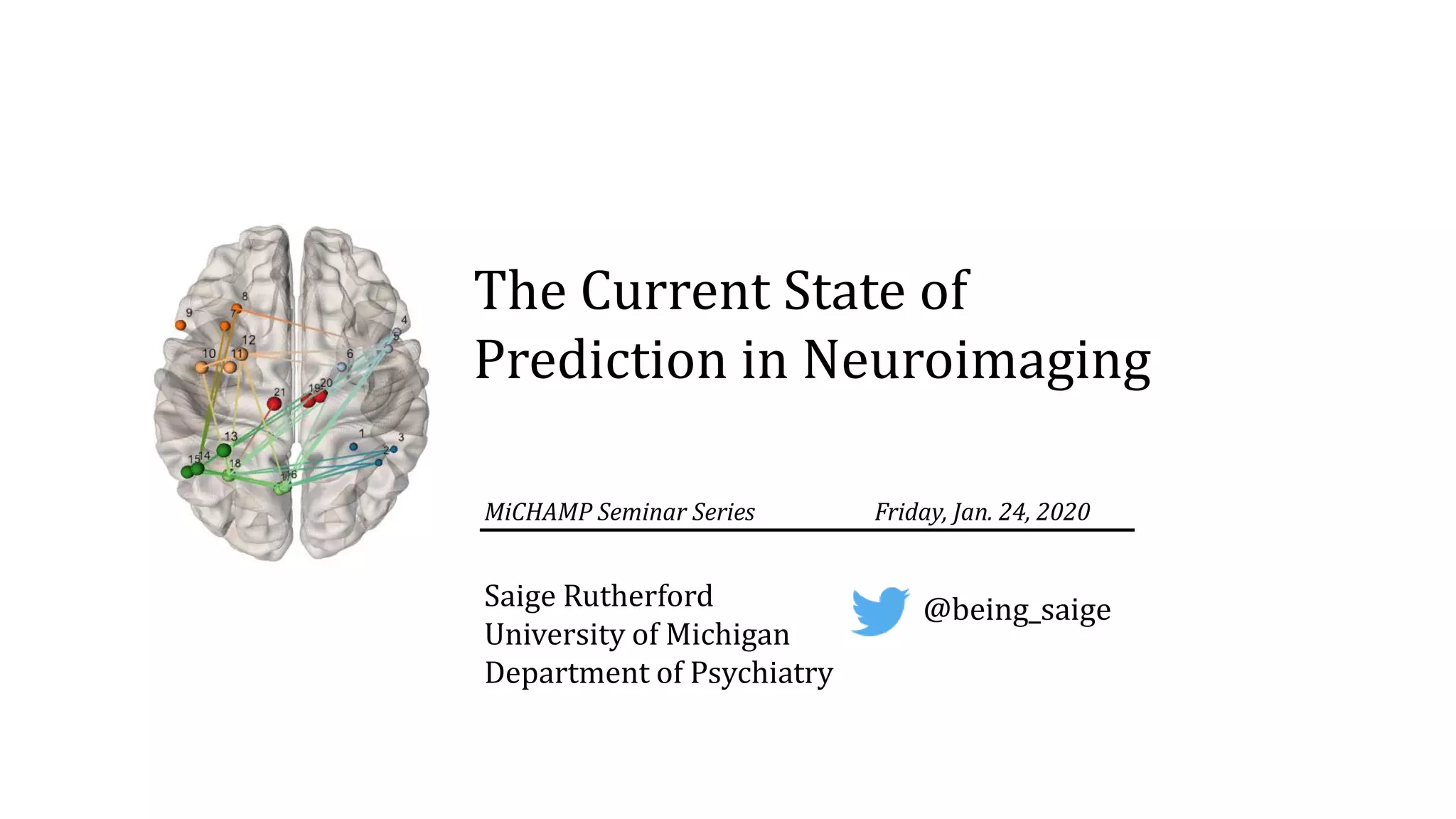
The Current State of
Prediction in Neuroimaging
MiCHAMP Seminar Series Friday, Jan. 24, 2020
@being_saige
Acknowledgements
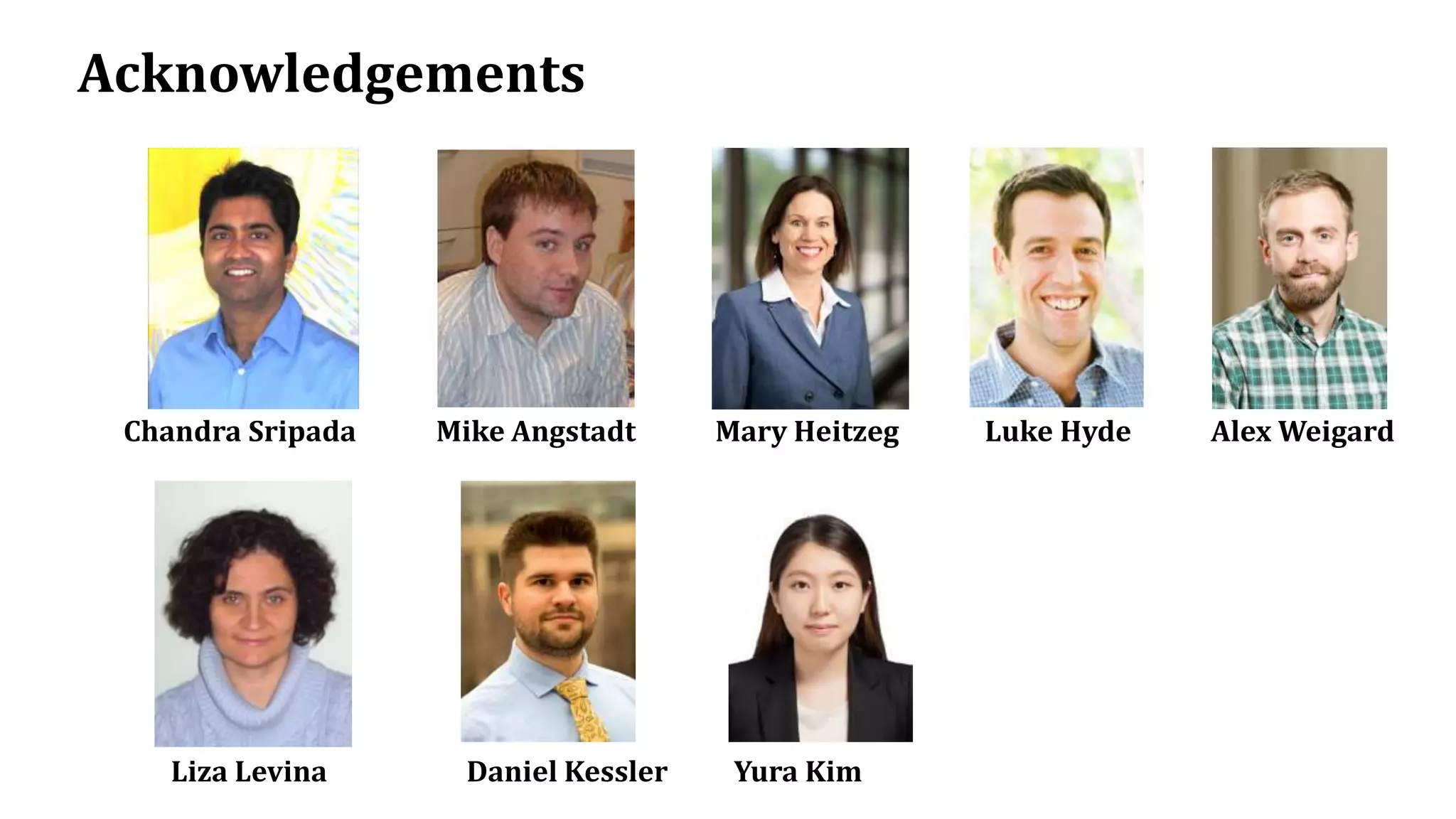
Liza Levina Daniel Kessler Yura Kim
Chandra Sripada Mike Angstadt Mary Heitzeg Luke Hyde Alex Weigard
Road Map
• Neuroimaging data 101
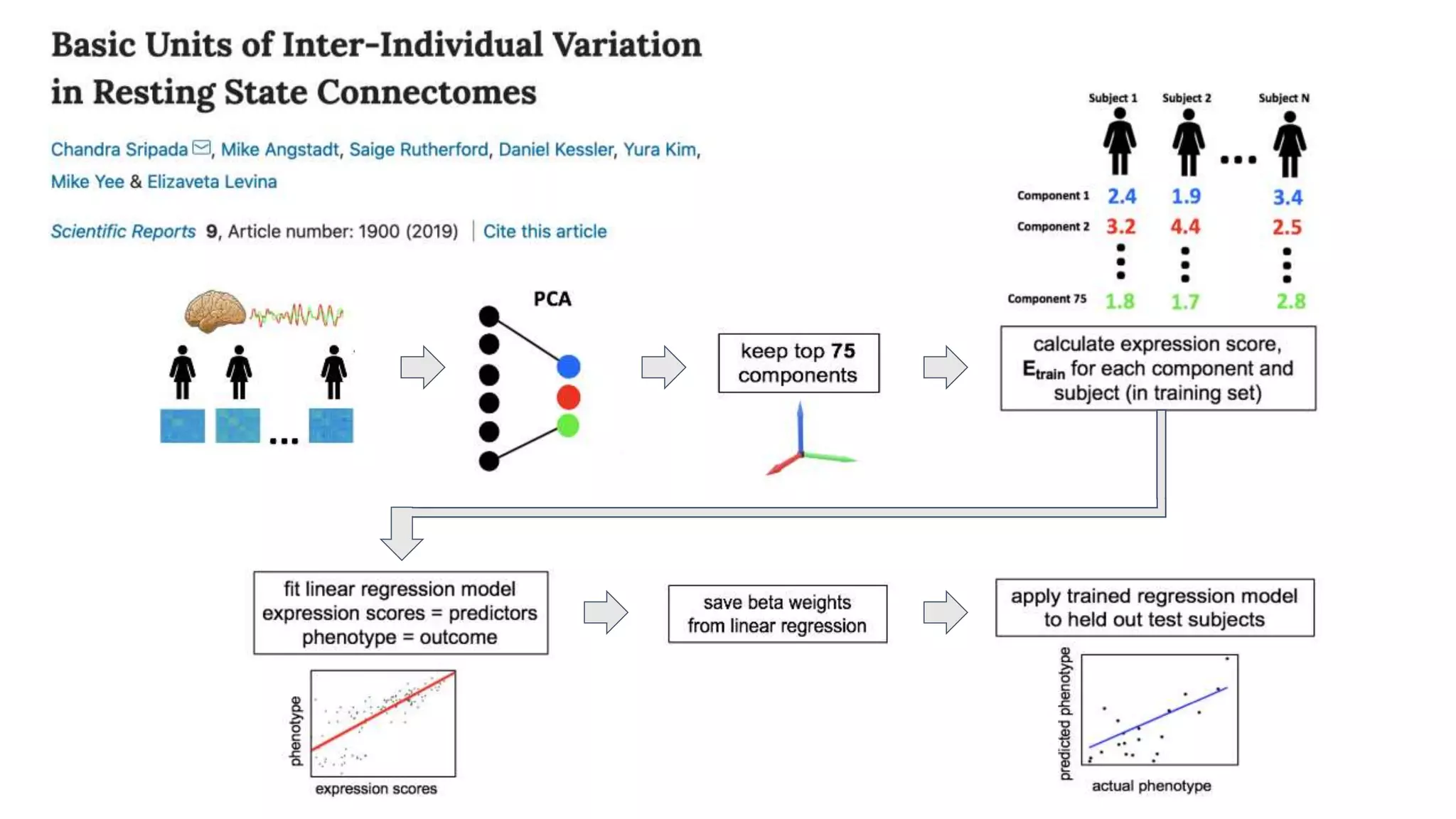
• Brain-behavior predictive modeling methodology
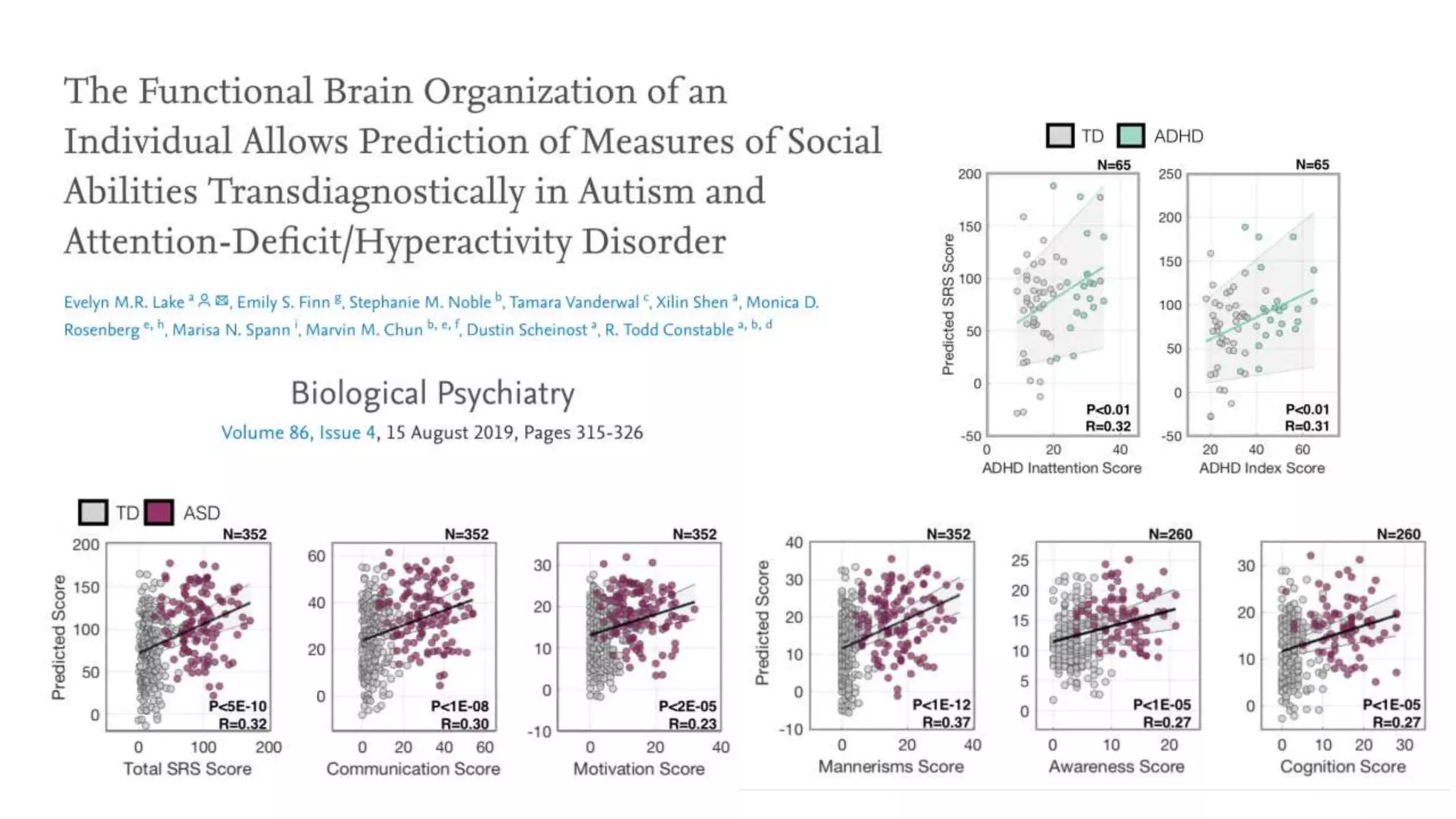
• Which traits and behaviors can we (reliably) predict
from brain images?
• Where are we going with this?
Neuroimaging 101
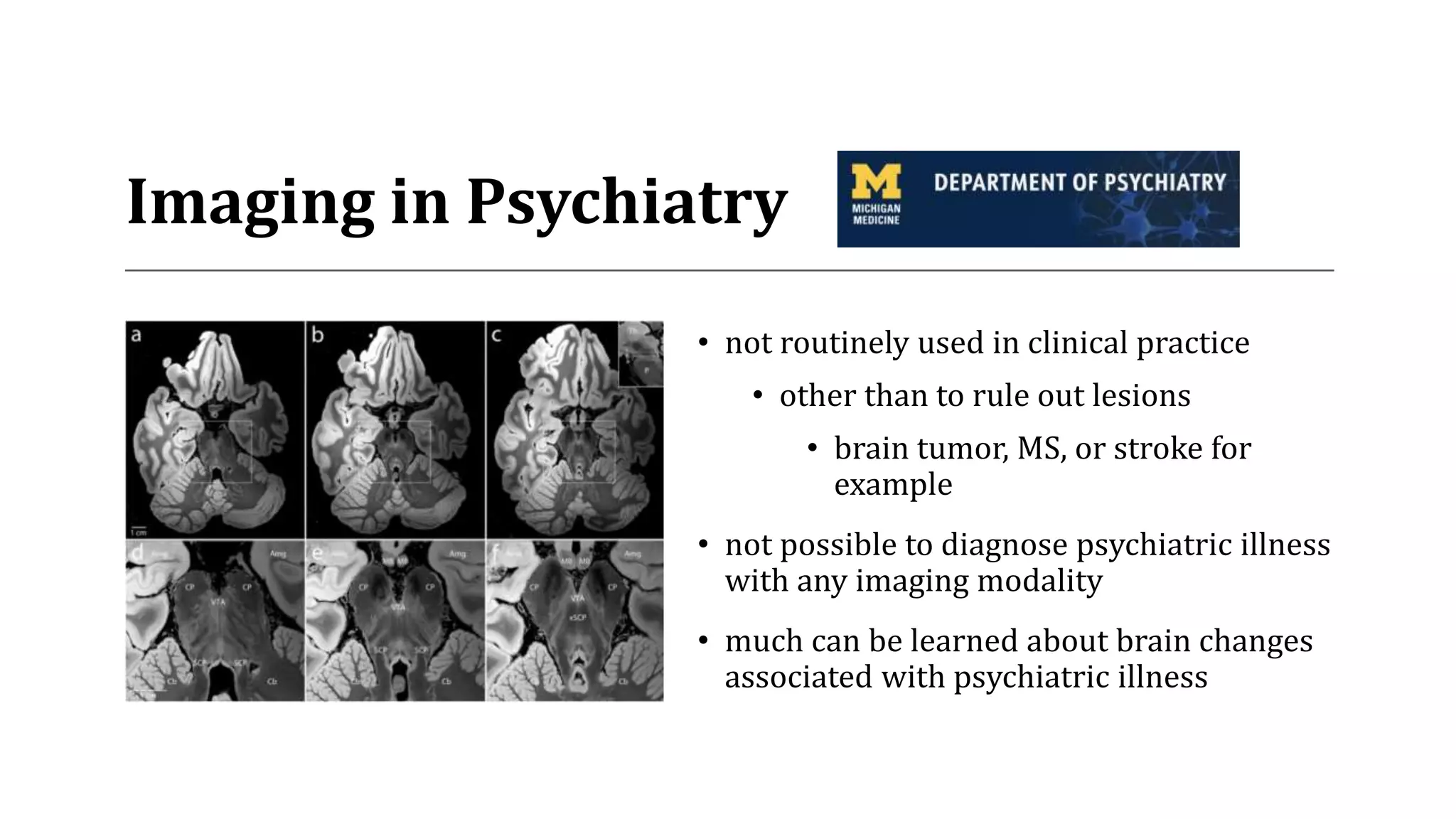
Imaging in Psychiatry
• not routinely used in clinical practice
• other than to rule out lesions
• brain tumor, MS, or stroke for
example
• not possible to diagnose psychiatric illness
with any imaging modality
• much can be learned about brain changes
associated with psychiatric illness
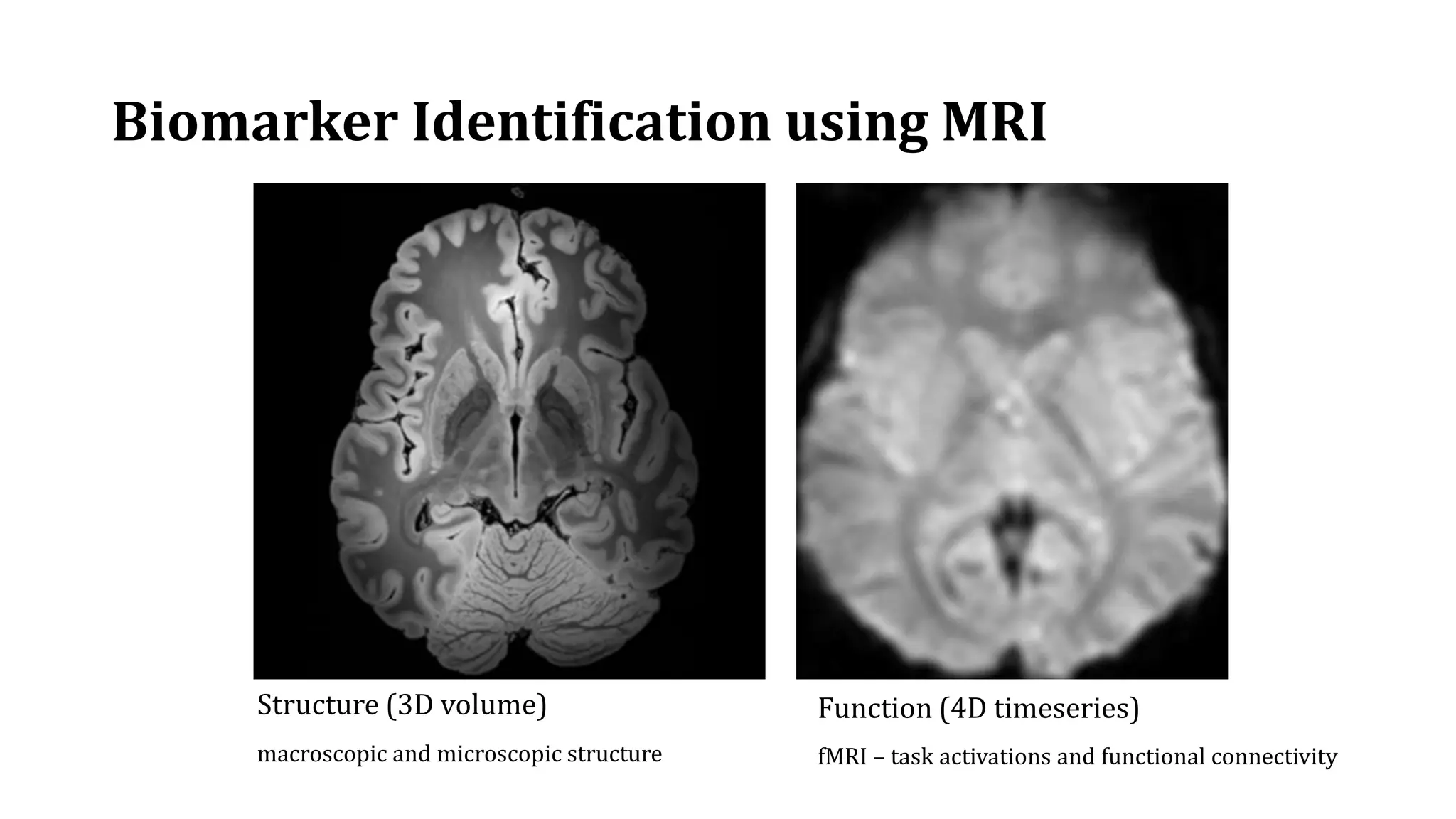
Biomarker Identification using MRI
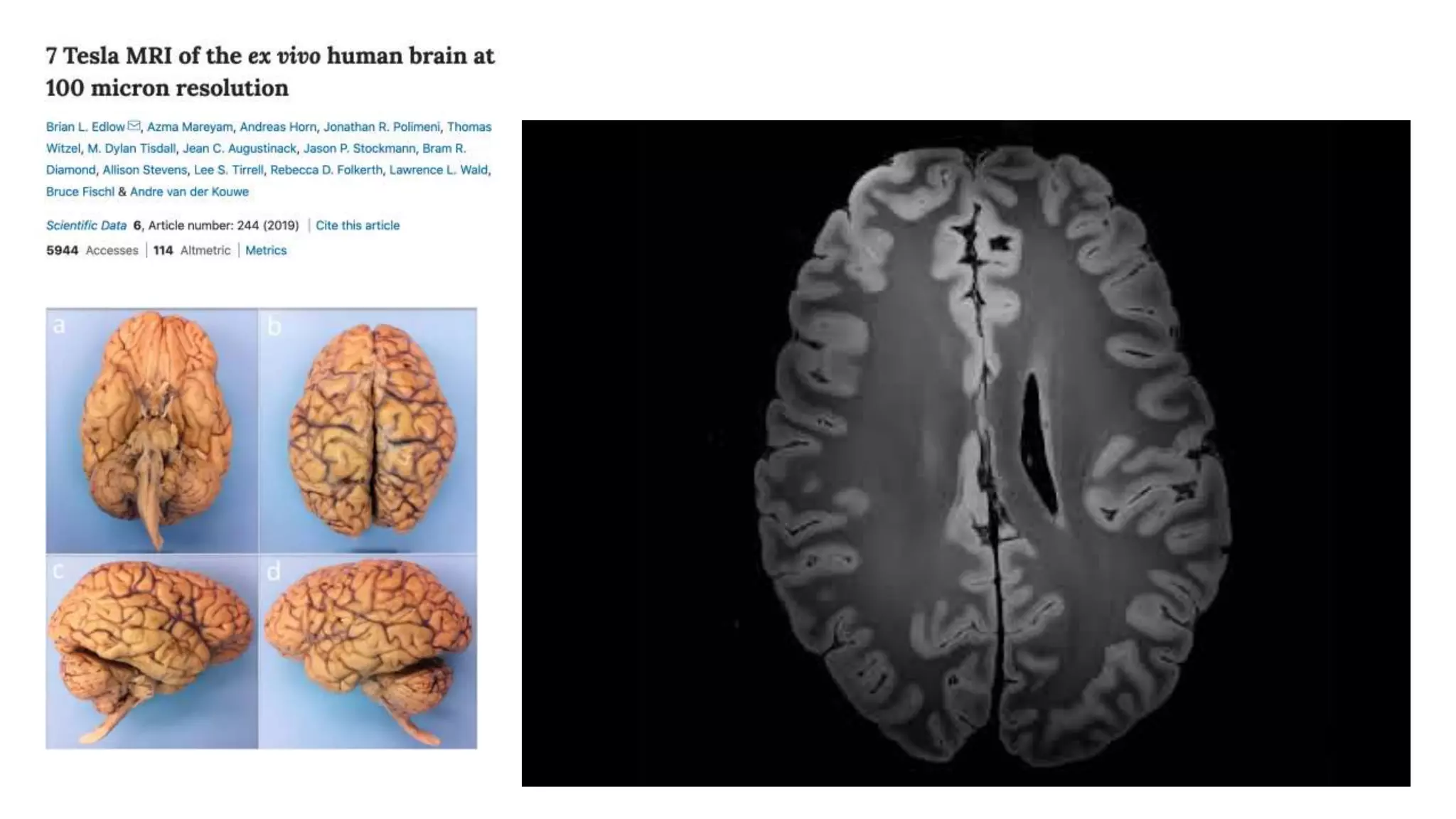
Structure (3D volume)
macroscopic and microscopic structure
Function (4D timeseries)
fMRI – task activations and functional connectivity
fMRI: What are we measuring?
• Neurons fire
• significant blood flow response associate with firing
• provides energy to neurons
• Primarily measure BOLD contrast in fMRI
• Blood Oxygenation Level Dependent contrast
• magnetic susceptibility of oxygenated and deoxygenated
blood are different
• local oxygenation of blood changes upon
activation leading to a change in local
magnetic field which leads to signal
change
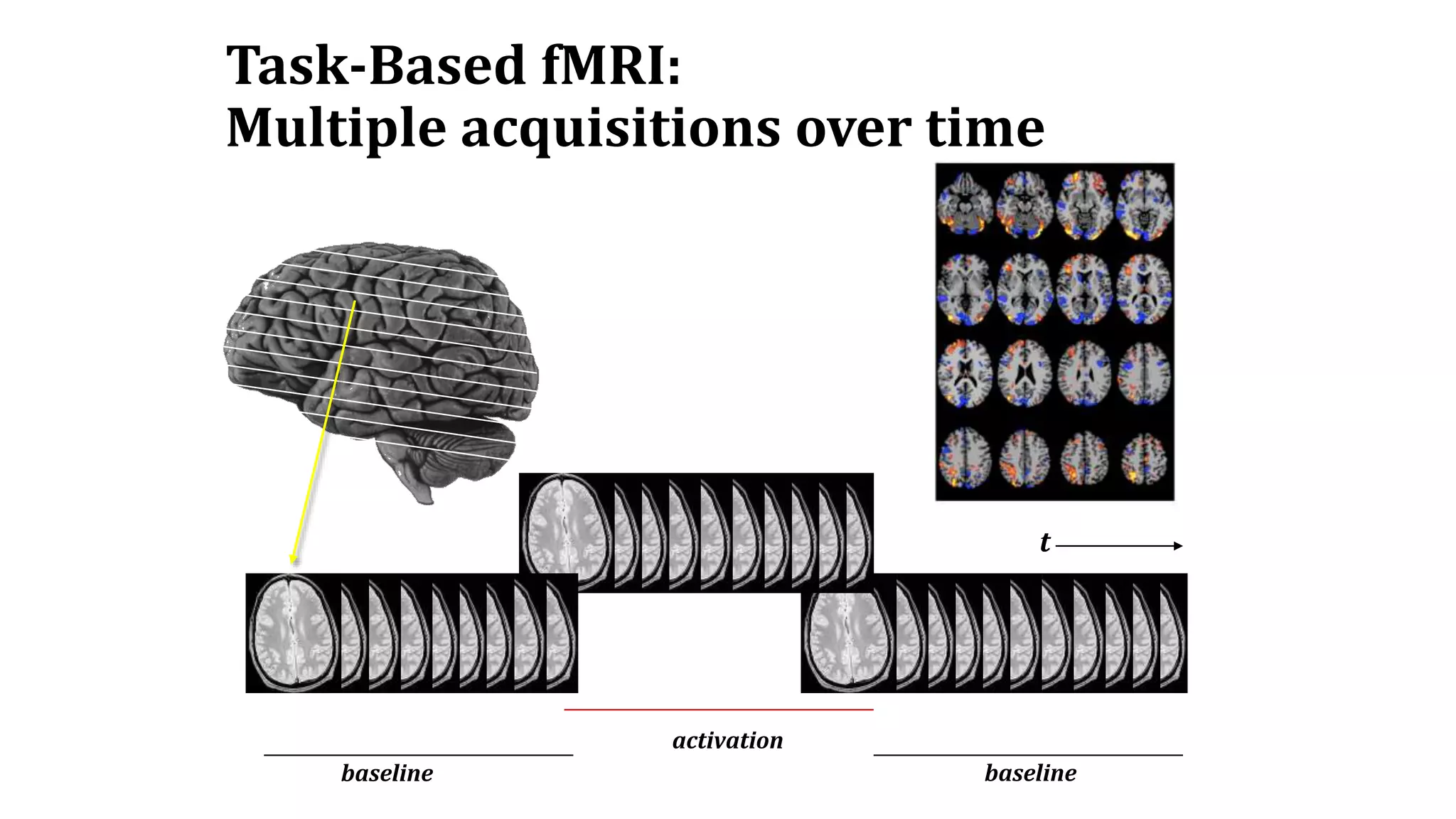
Task-Based fMRI:
Multiple acquisitions over time
t
baseline
activation
baseline
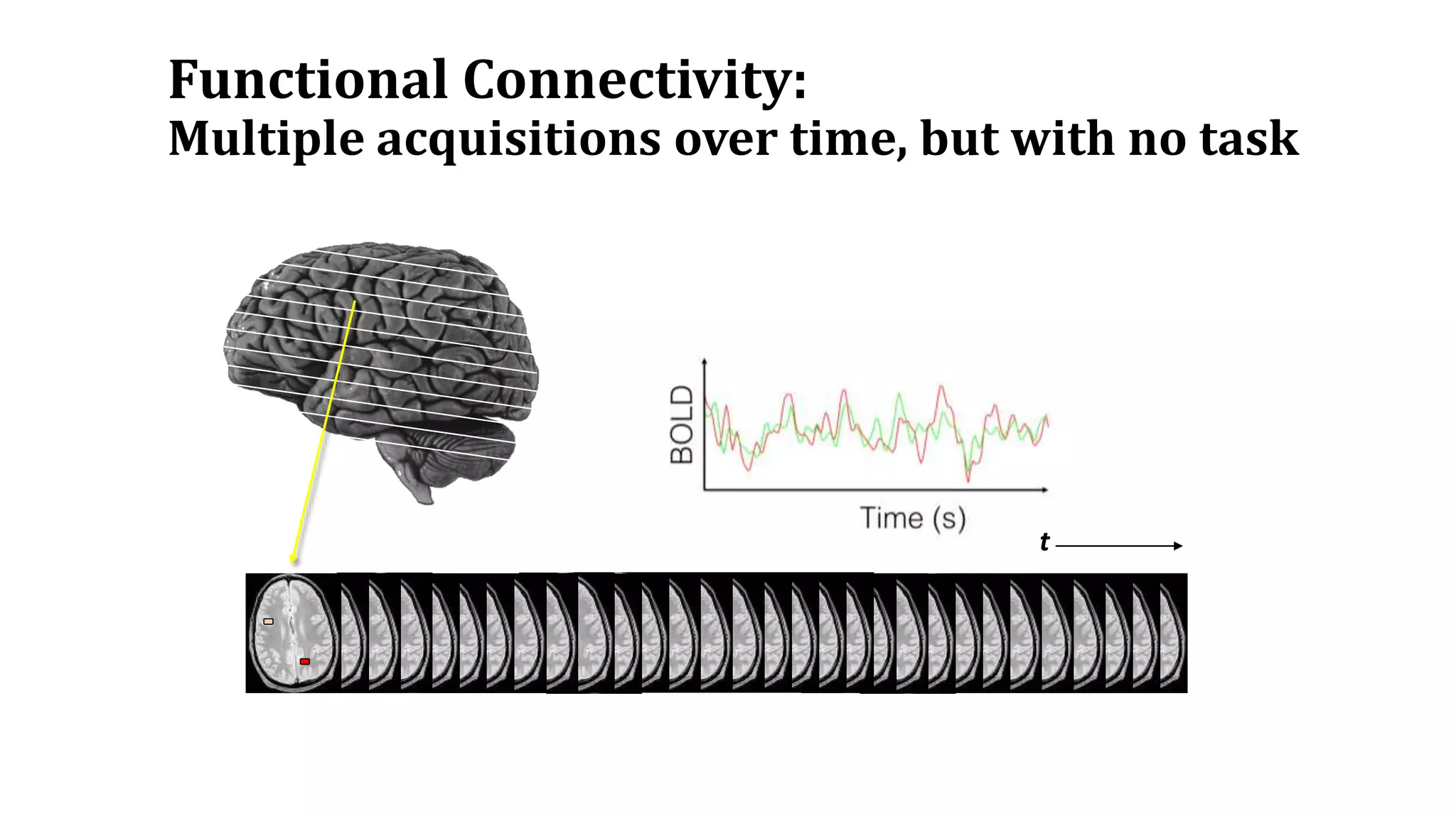
Functional Connectivity:
Multiple acquisitions over time, but with no task
t
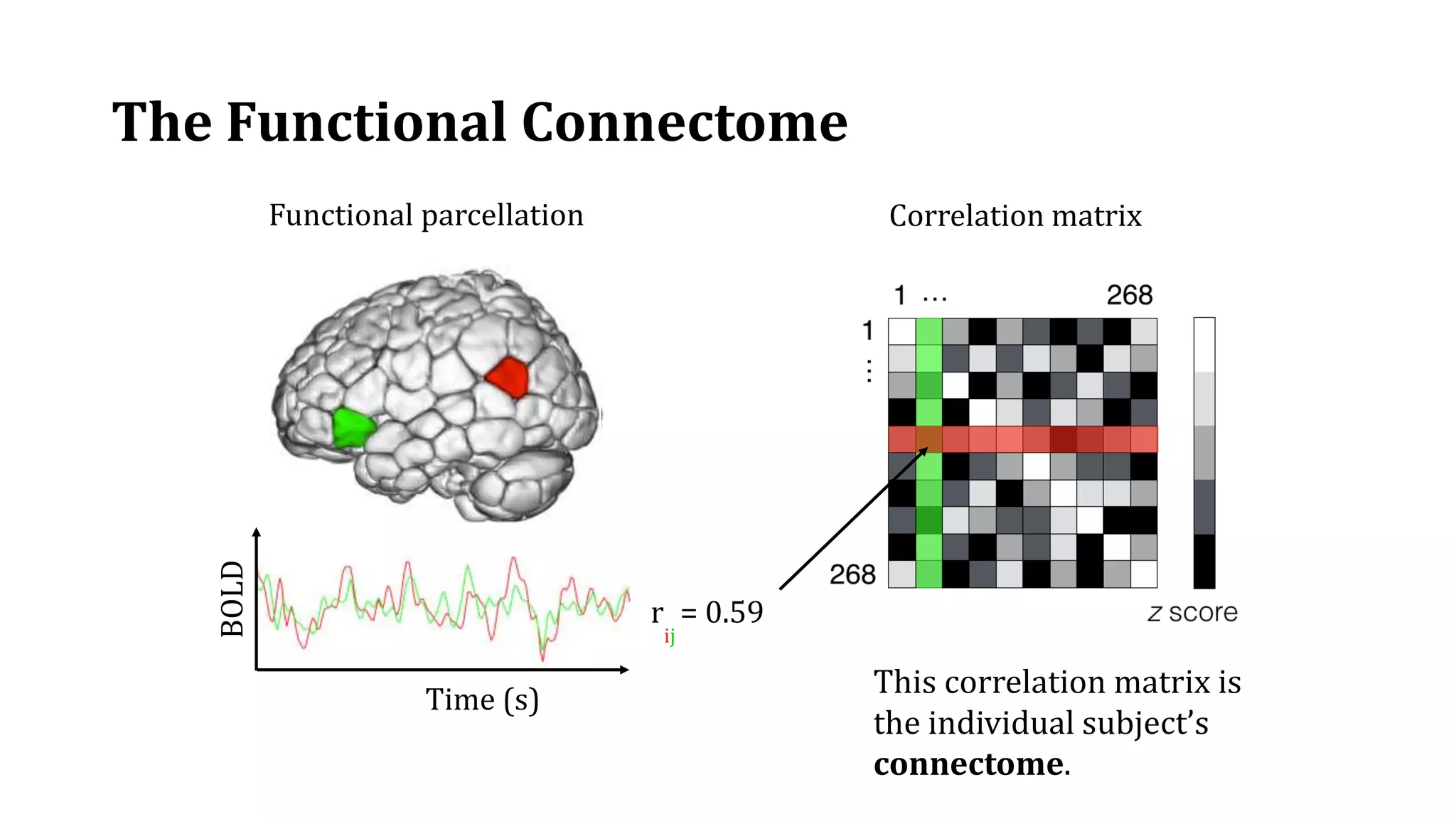
The Functional Connectome
Functional parcellation
BOLD
Time (s)
Correlation matrix
r
ij
= 0.59
This correlation matrix is
the individual subject’s
connectome.
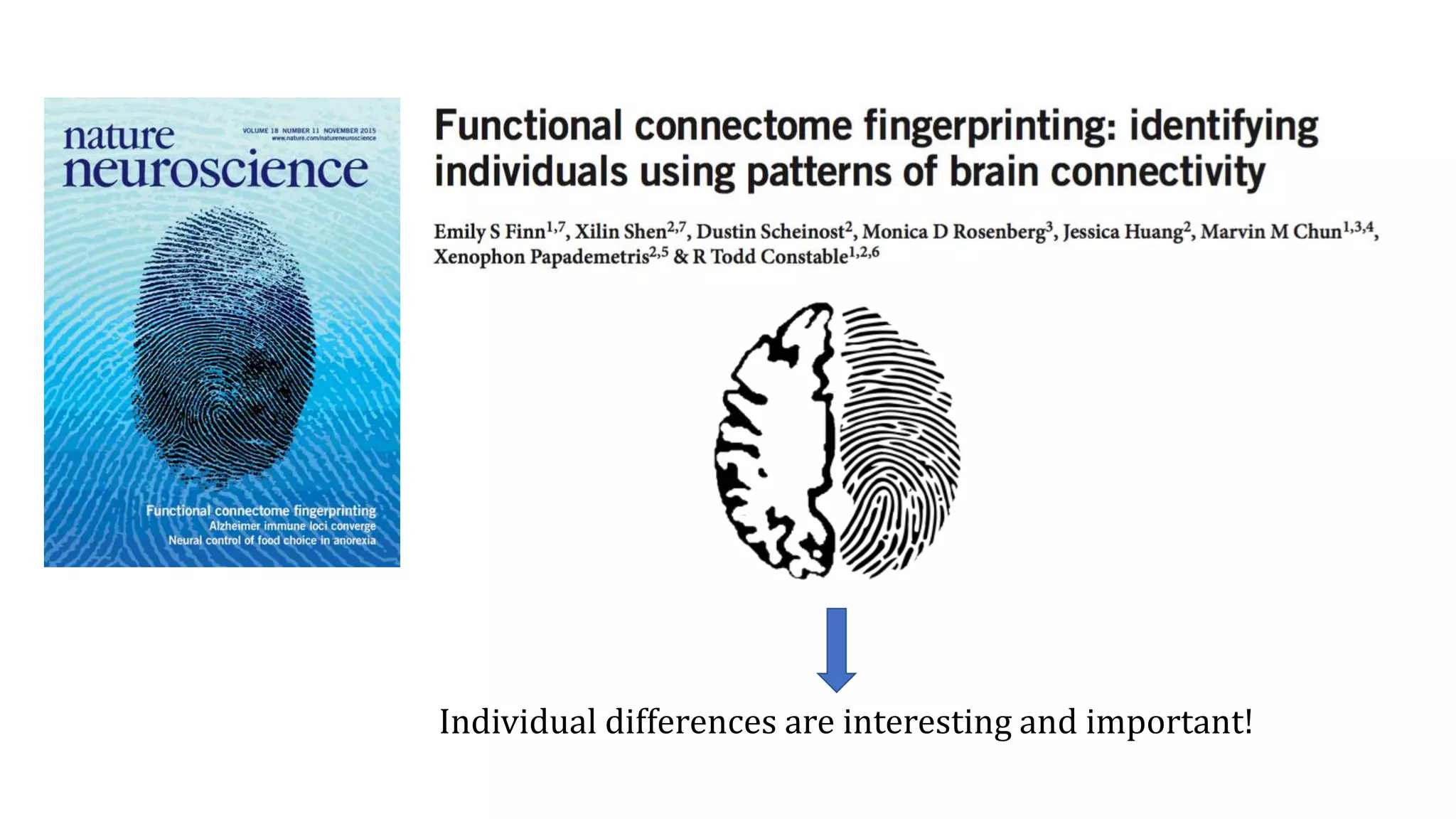
Individual differences are interesting and important!
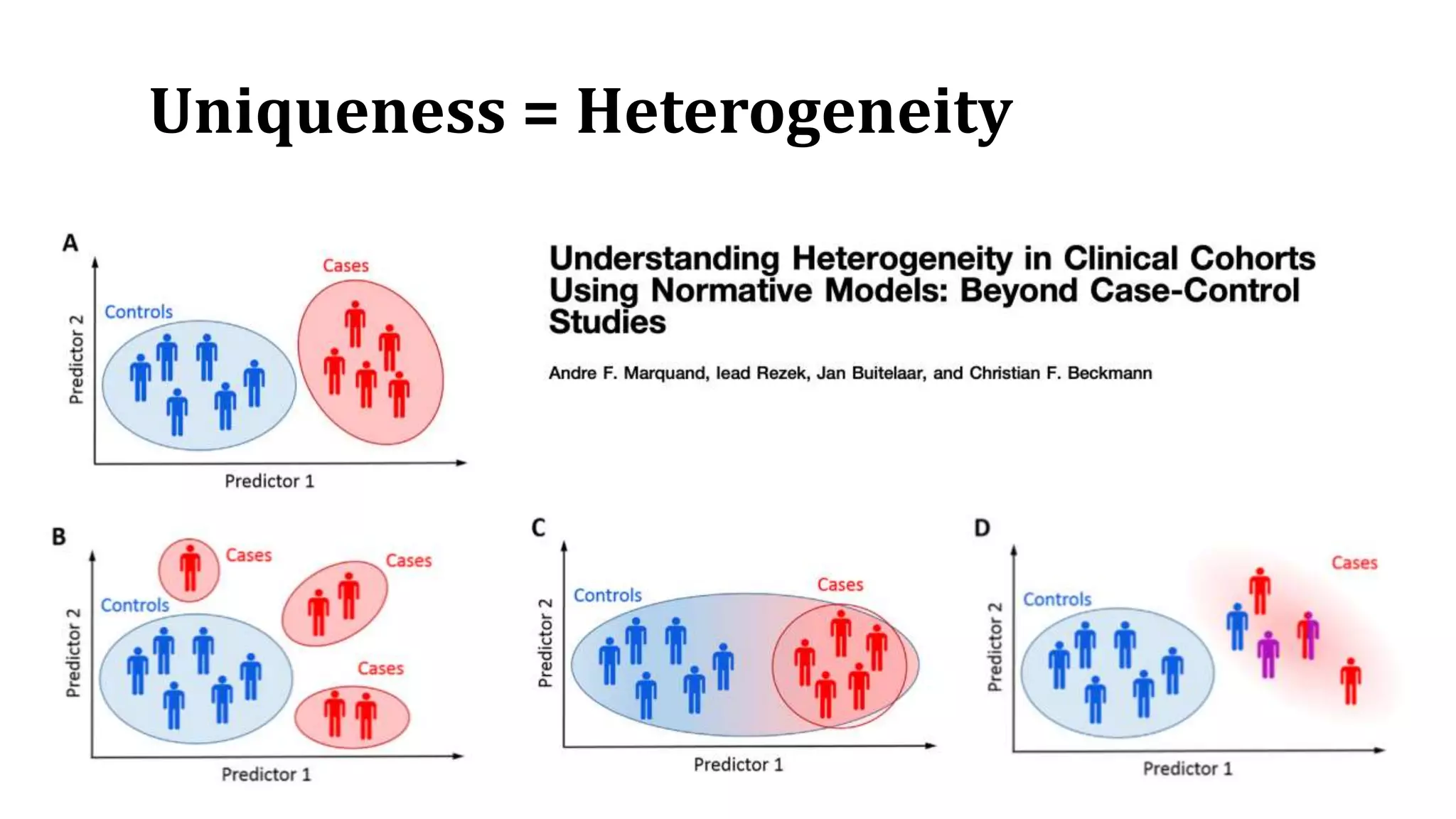
Uniqueness = Heterogeneity
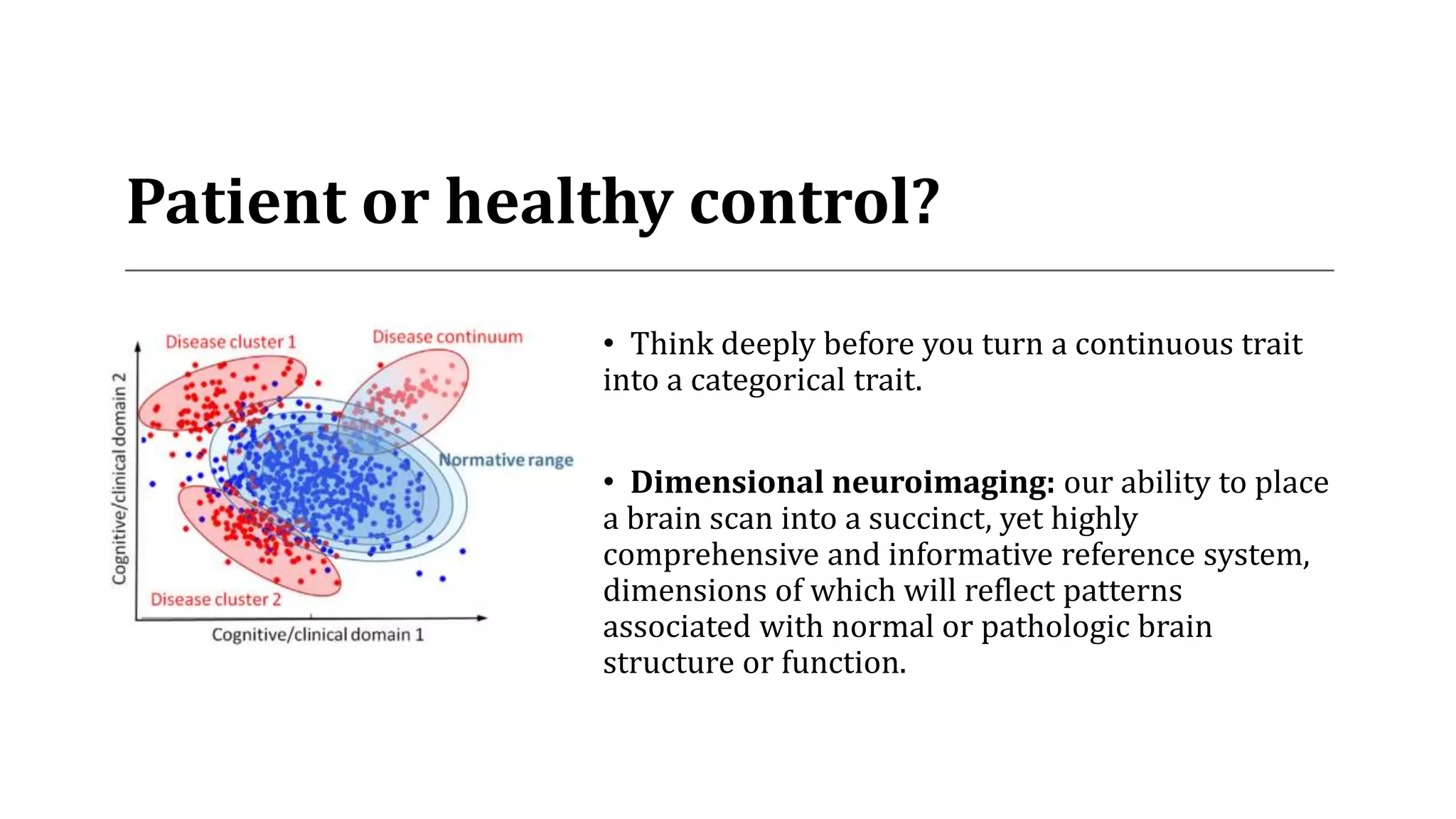
Patient or healthy control?
• Think deeply before you turn a continuous trait
into a categorical trait.
• Dimensional neuroimaging: our ability to place
a brain scan into a succinct, yet highly
comprehensive and informative reference system,
dimensions of which will reflect patterns
associated with normal or pathologic brain
structure or function.
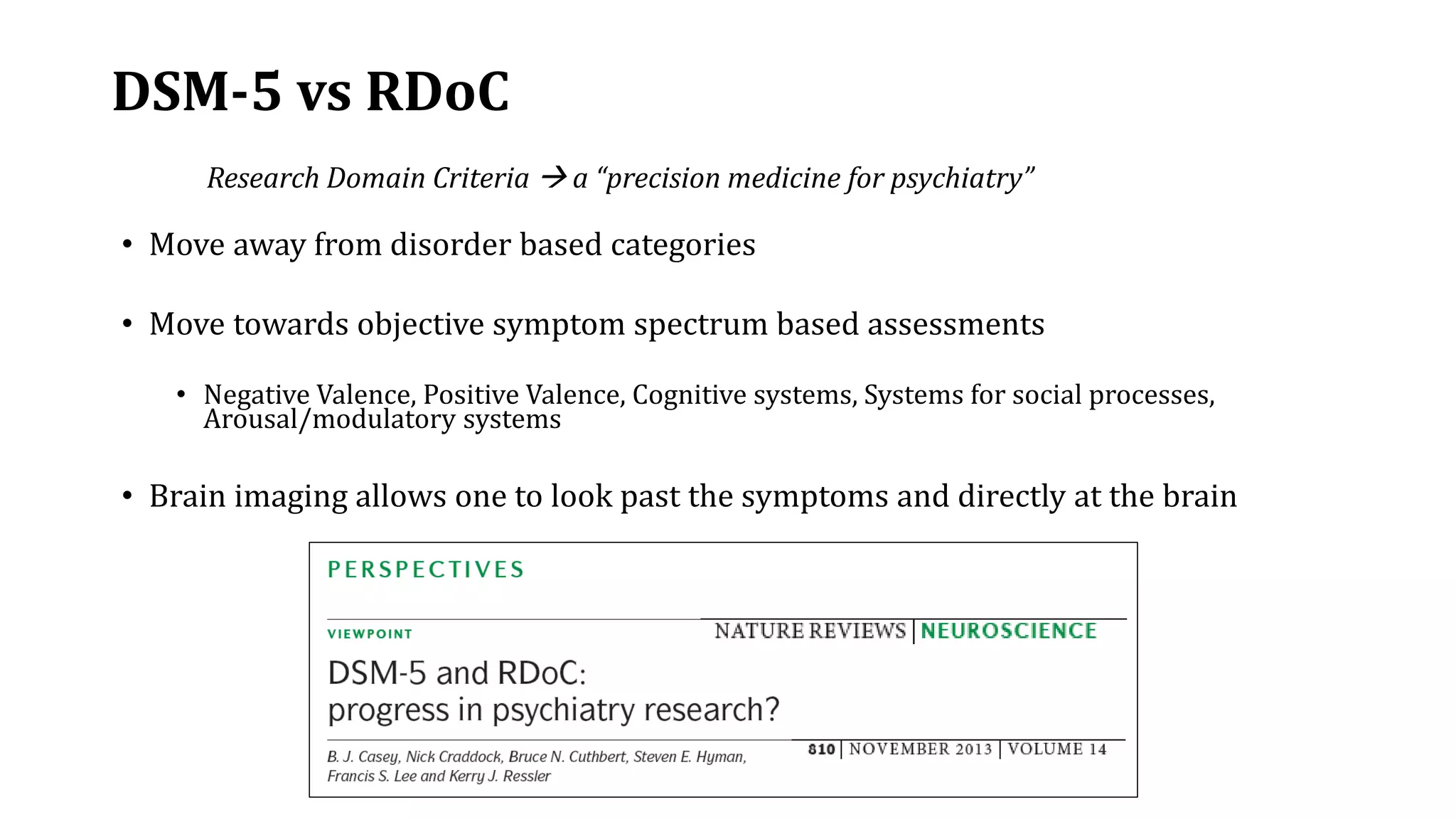
DSM-5 vs RDoC
• Move away from disorder based categories
• Move towards objective symptom spectrum based assessments
• Negative Valence, Positive Valence, Cognitive systems, Systems for social processes,
Arousal/modulatory systems
• Brain imaging allows one to look past the symptoms and directly at the brain
Research Domain Criteria  a “precision medicine for psychiatry”
Brain-Behavior Predictive Modeling
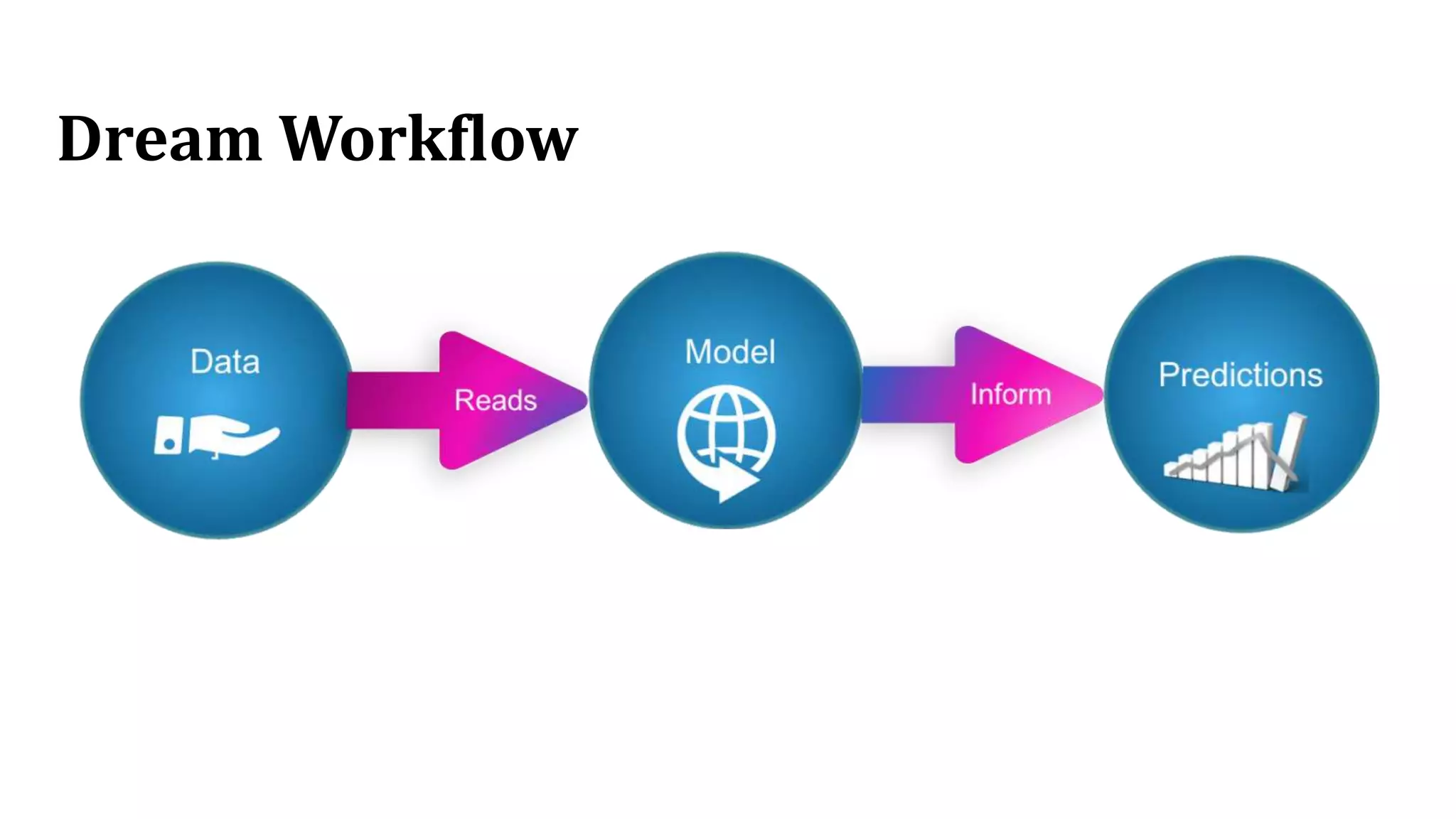
Dream Workflow
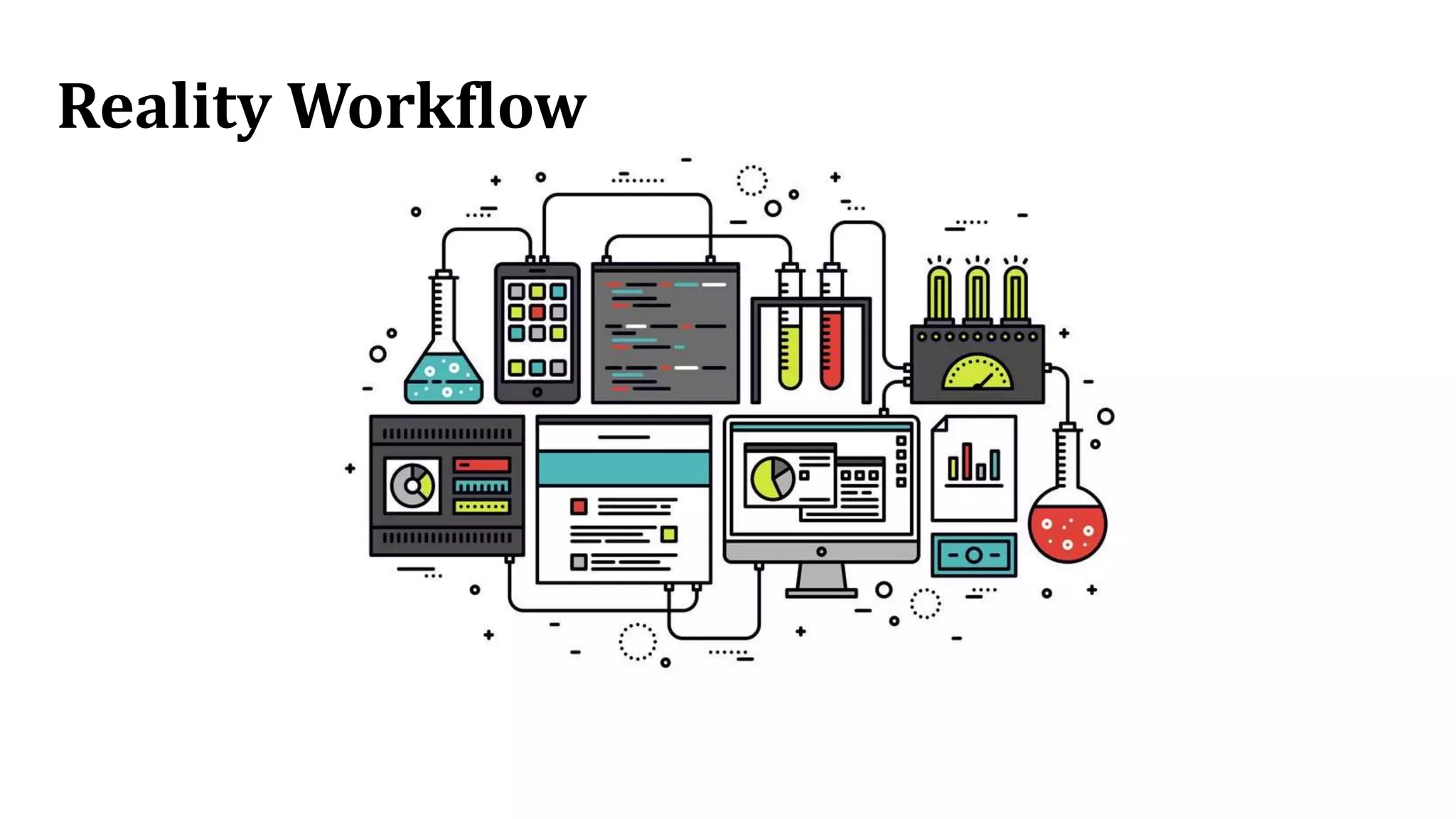
Reality Workflow
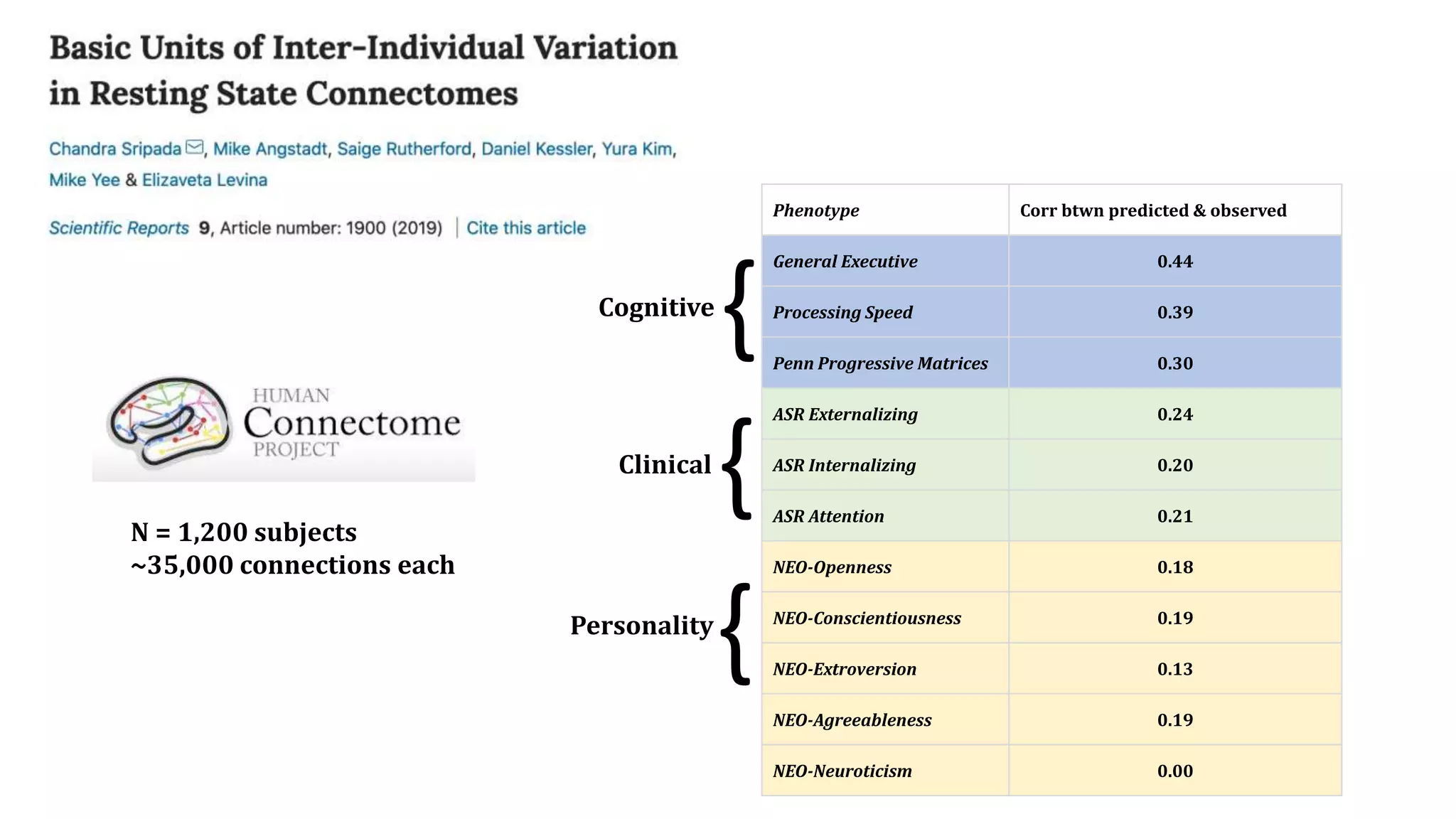
Phenotype Corr btwn predicted & observed
General Executive 0.44
Processing Speed 0.39
Penn Progressive Matrices 0.30
ASR Externalizing 0.24
ASR Internalizing 0.20
ASR Attention 0.21
NEO-Openness 0.18
NEO-Conscientiousness 0.19
NEO-Extroversion 0.13
NEO-Agreeableness 0.19
NEO-Neuroticism 0.00
{
{
{
Cognitive
Personality
Clinical
N = 1,200 subjects
~35,000 connections each
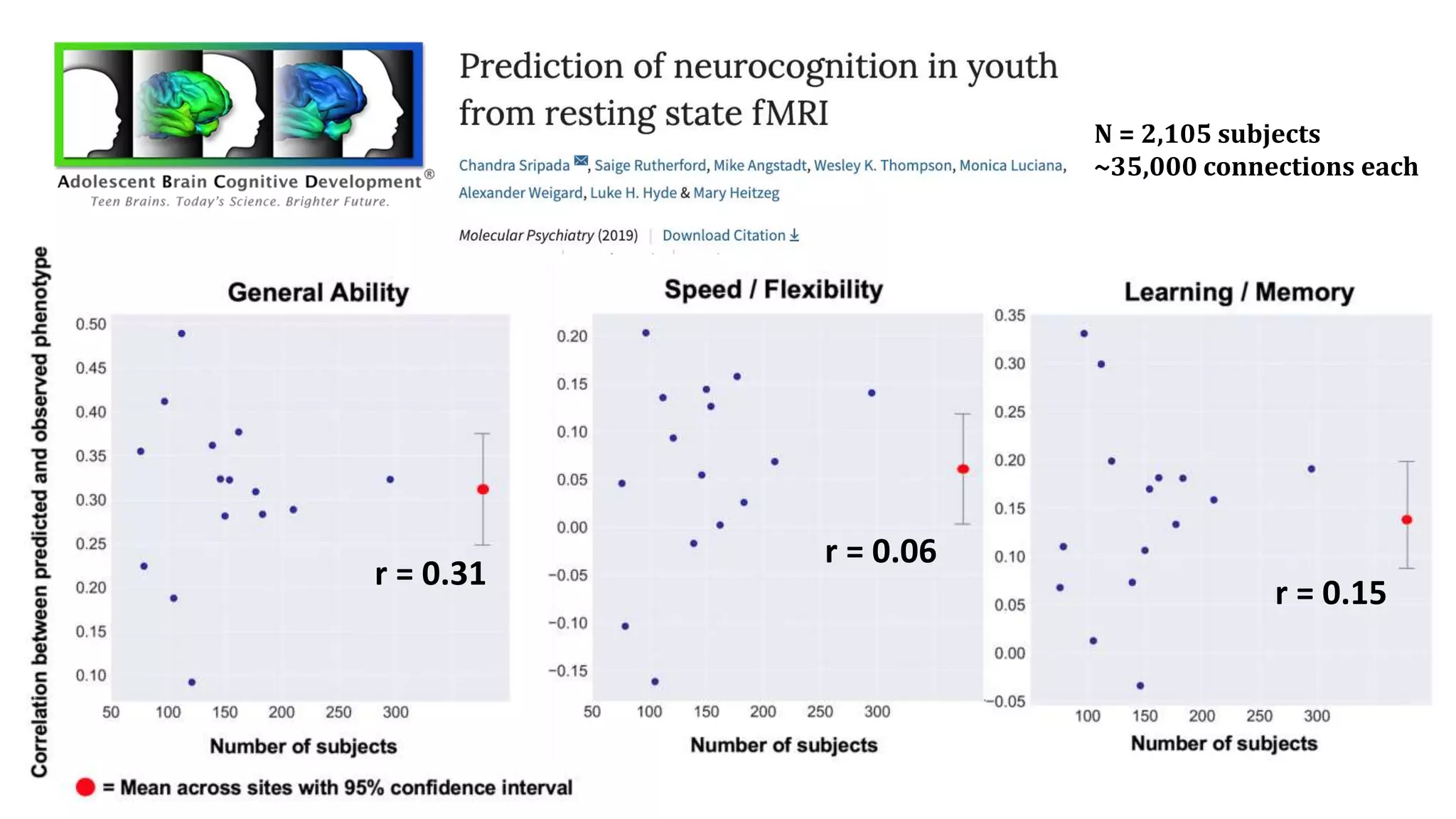
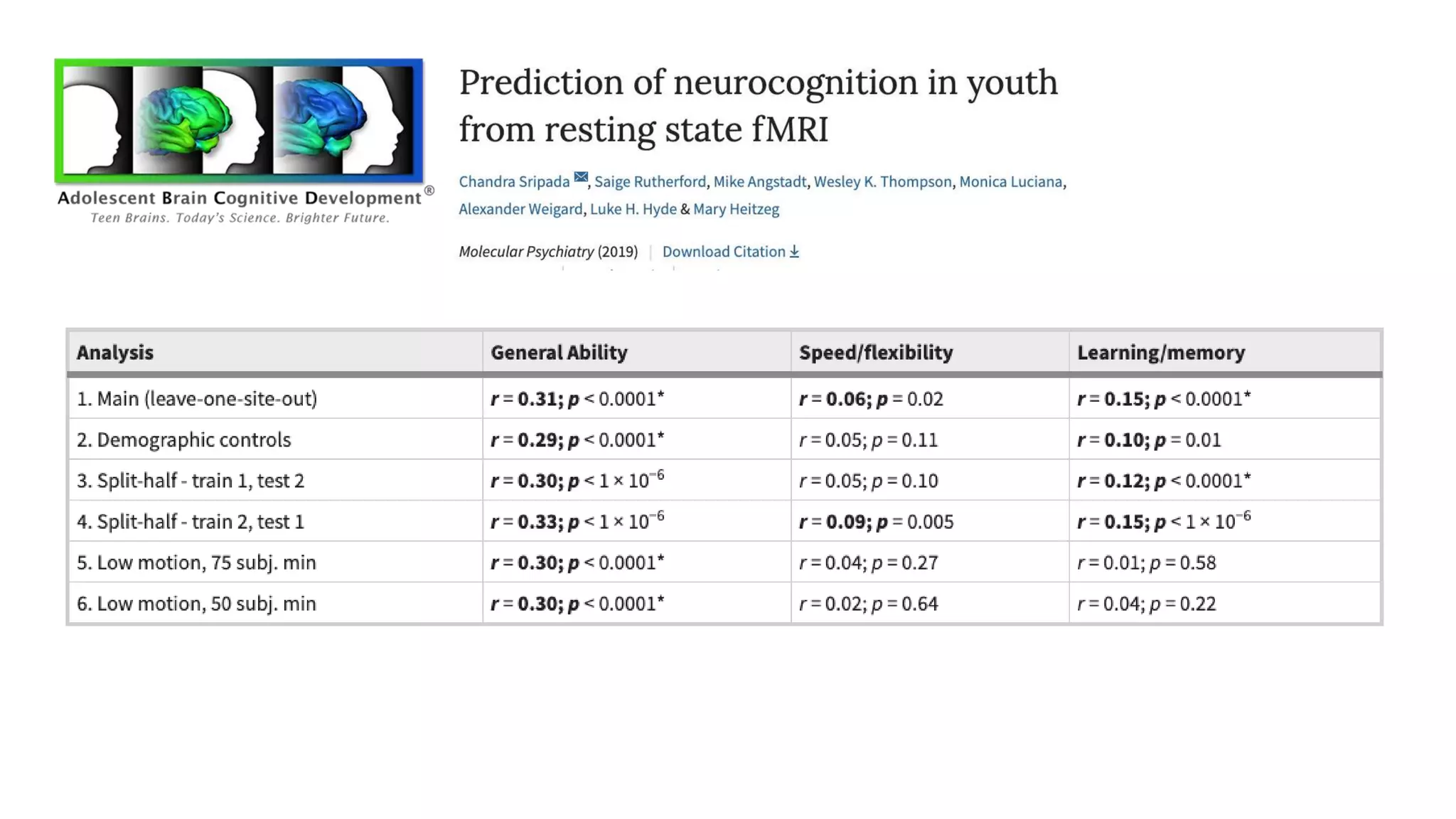
r = 0.31
r = 0.06
r = 0.15
N = 2,105 subjects
~35,000 connections each
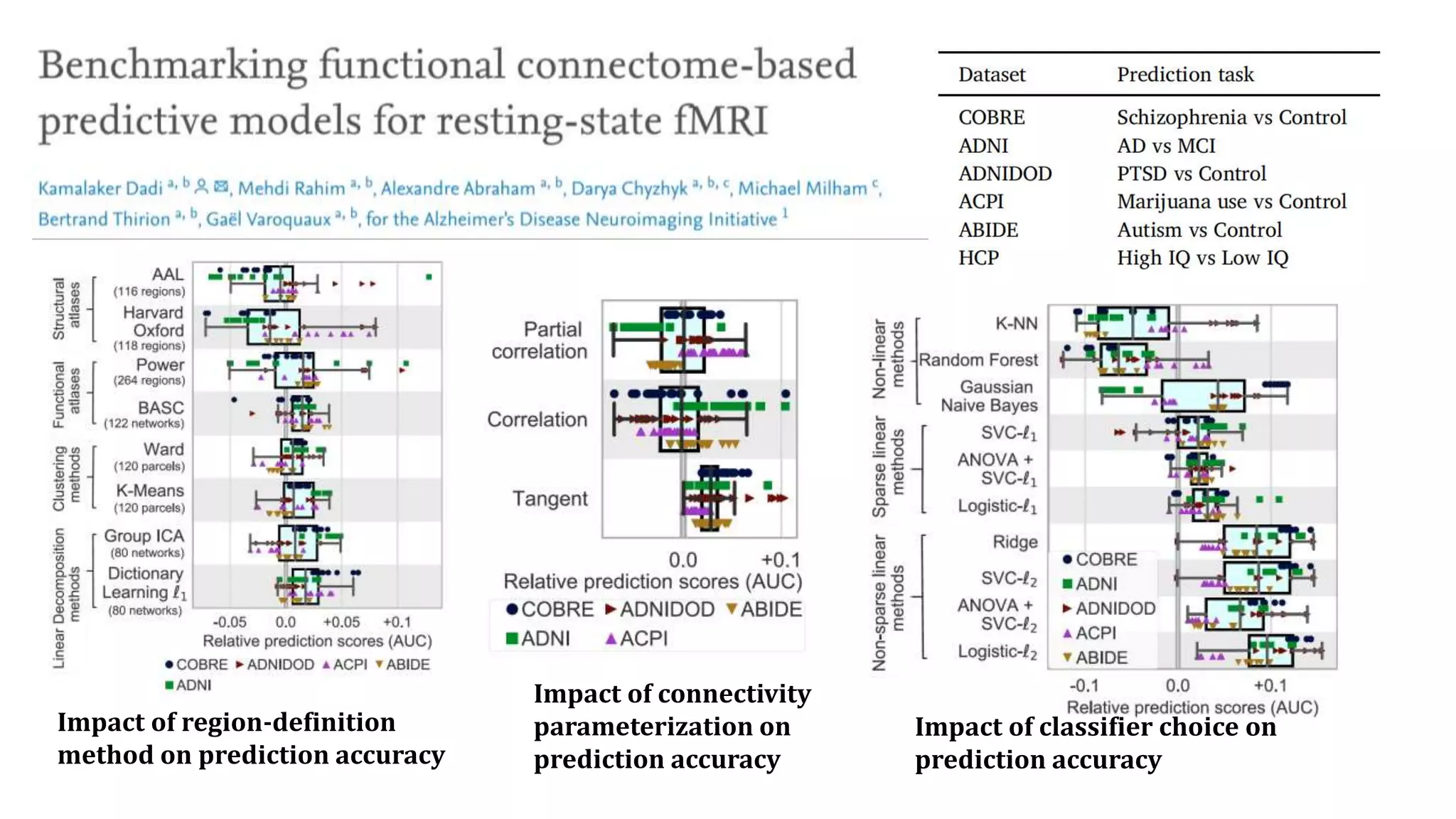
Impact of region-definition
method on prediction accuracy
Impact of connectivity
parameterization on
prediction accuracy
Impact of classifier choice on
prediction accuracy
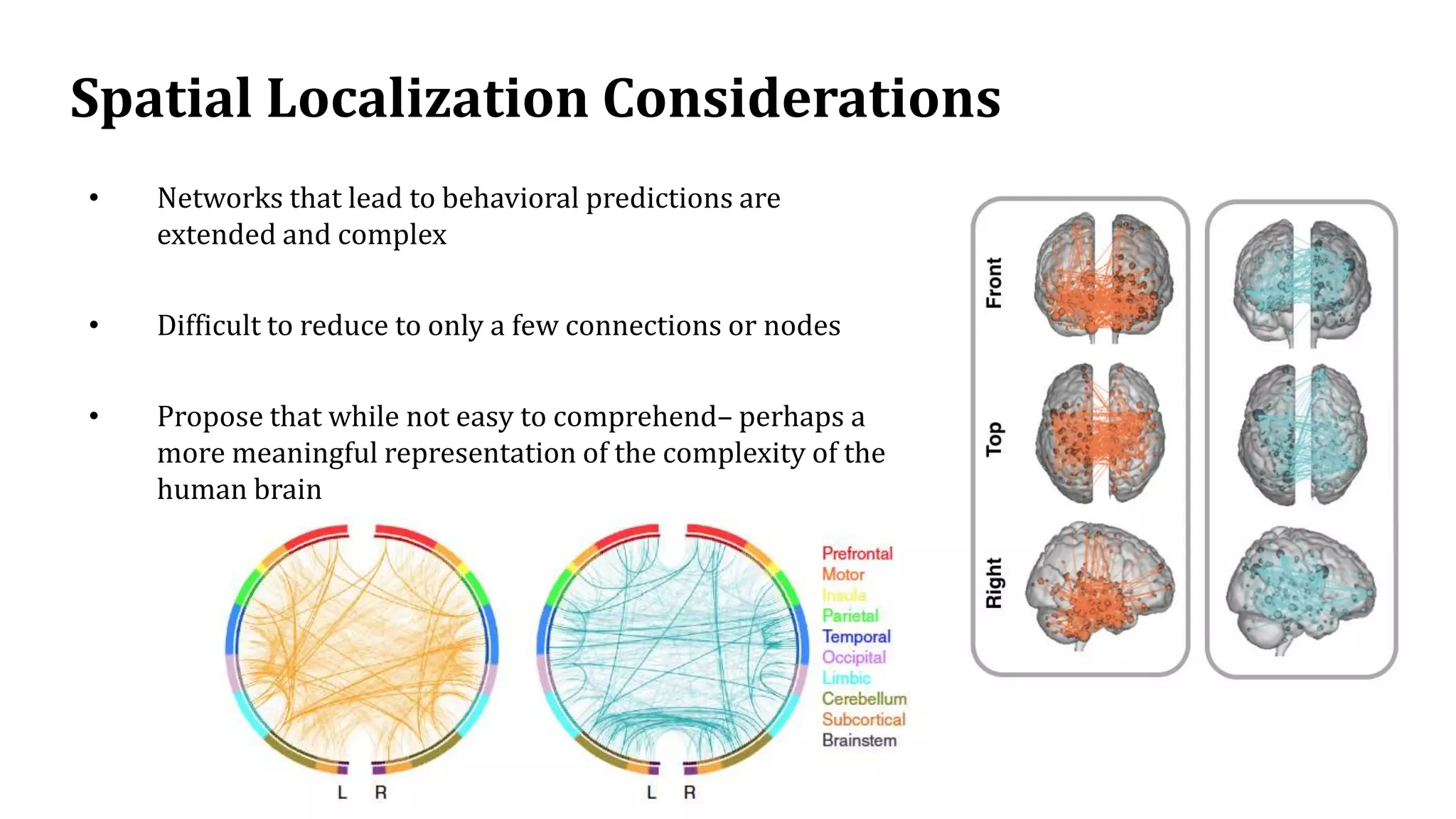
Spatial Localization Considerations
• Networks that lead to behavioral predictions are
extended and complex
• Difficult to reduce to only a few connections or nodes
• Propose that while not easy to comprehend– perhaps a
more meaningful representation of the complexity of the
human brain
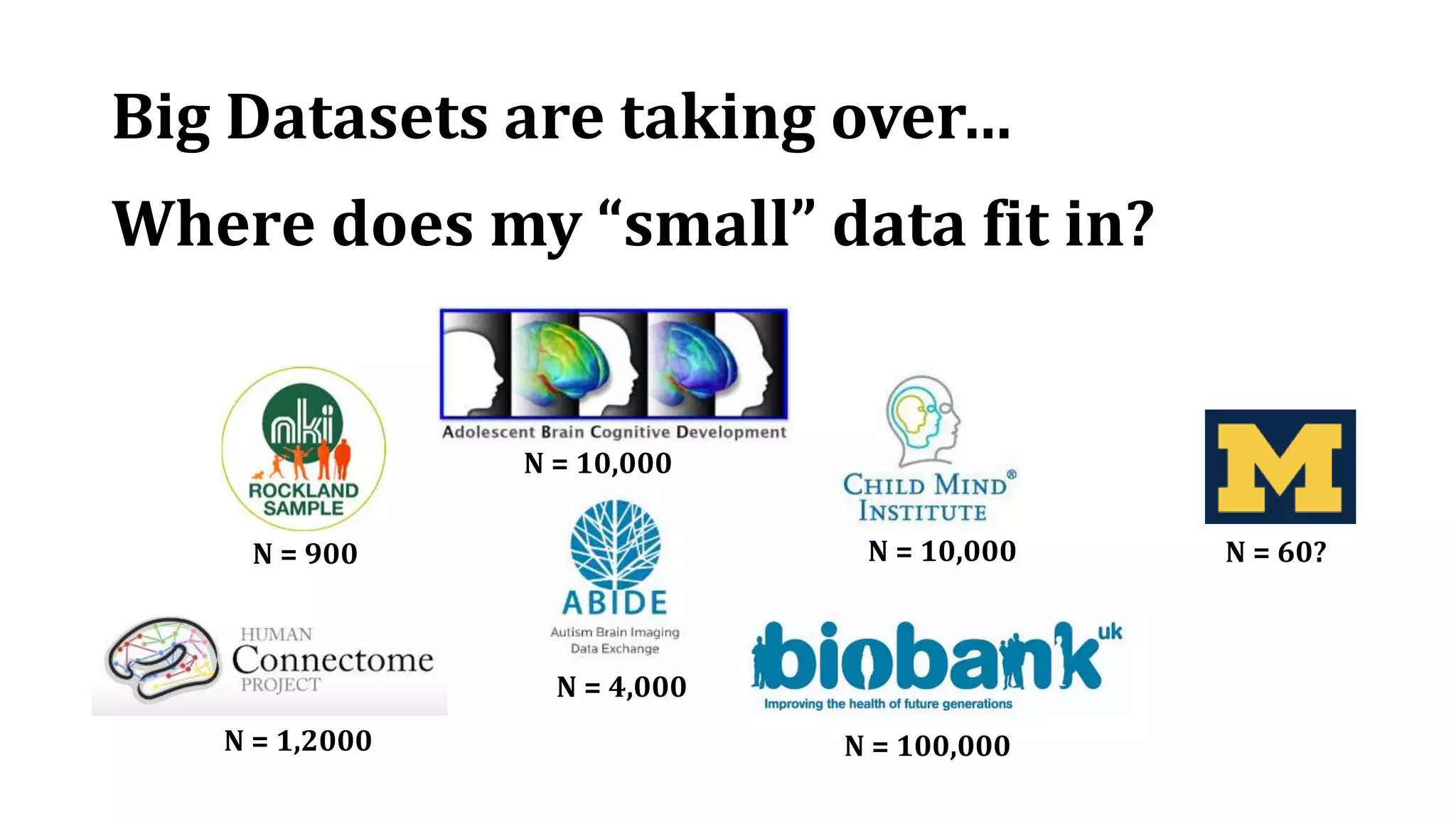
Big Datasets are taking over…
Where does my “small” data fit in?
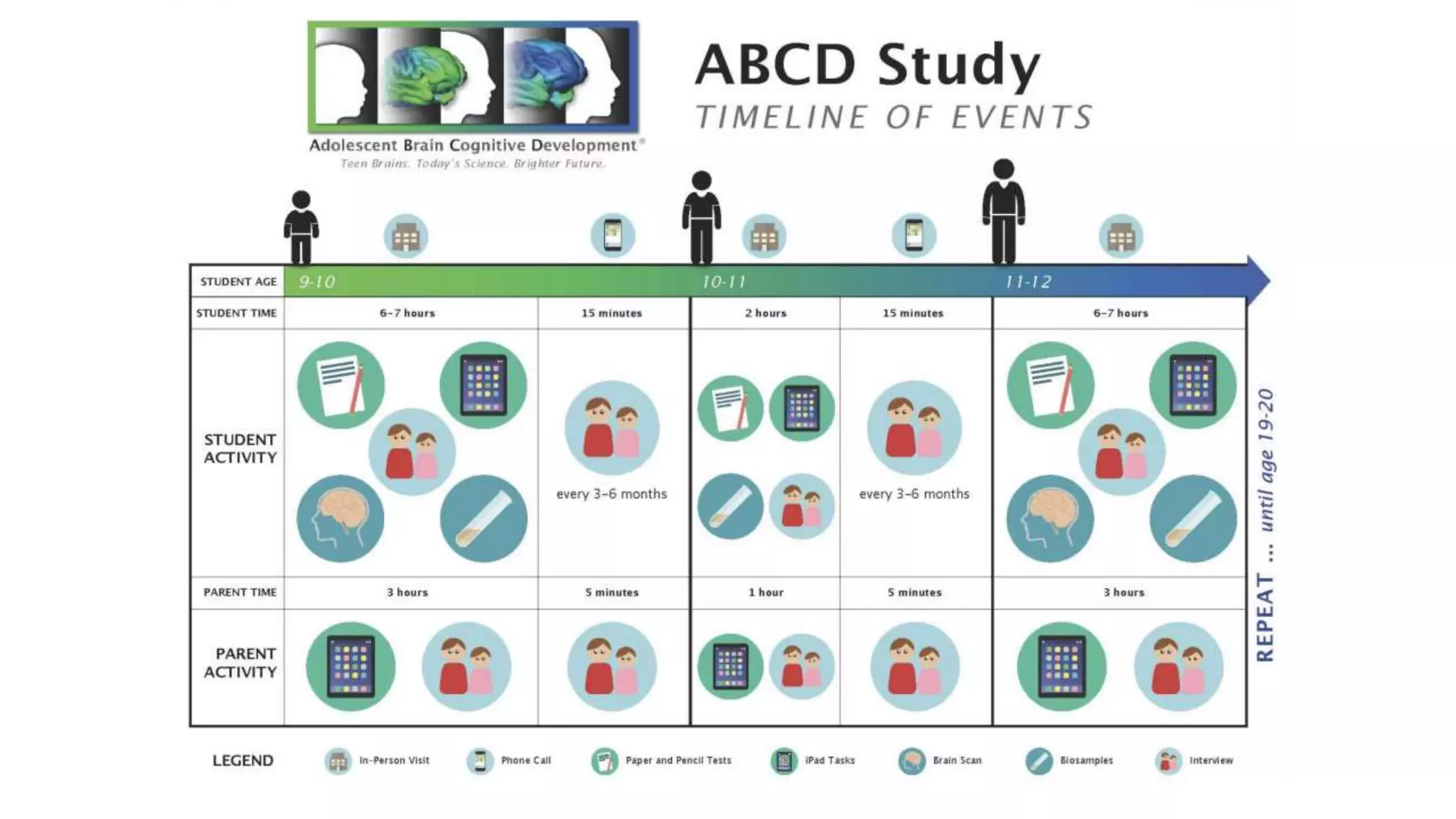
N = 10,000
N = 100,000
N = 10,000
N = 1,2000
N = 900
N = 4,000
N = 60?
Big Datasets are taking over…
Where does my “small” data fit in?
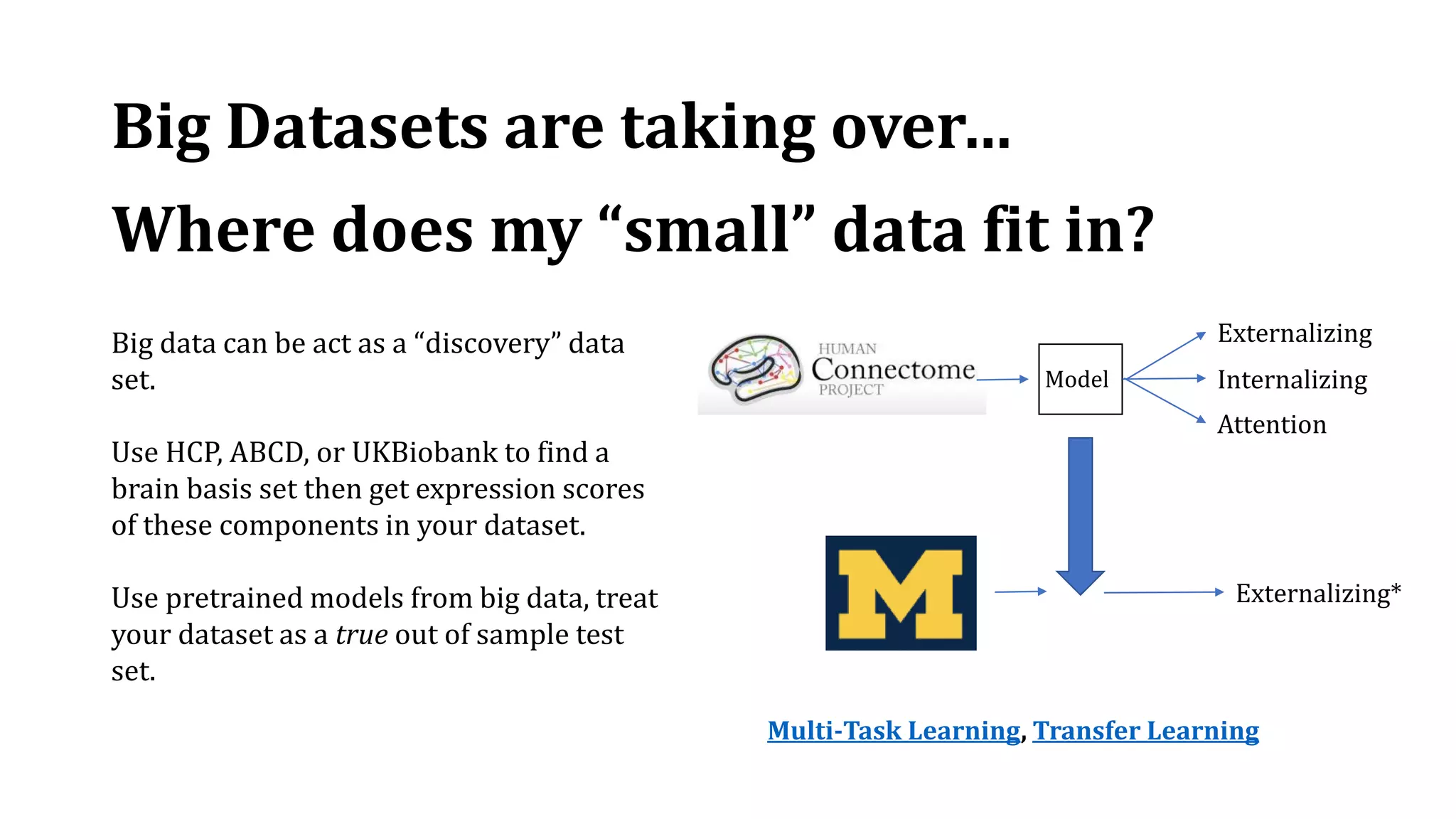
Big data can be act as a “discovery” data
set.
Use HCP, ABCD, or UKBiobank to find a
brain basis set then get expression scores
of these components in your dataset.
Use pretrained models from big data, treat
your dataset as a true out of sample test
set.
Externalizing
Internalizing
Attention
Model
Externalizing*
Multi-Task Learning, Transfer Learning
How can we improve prediction?
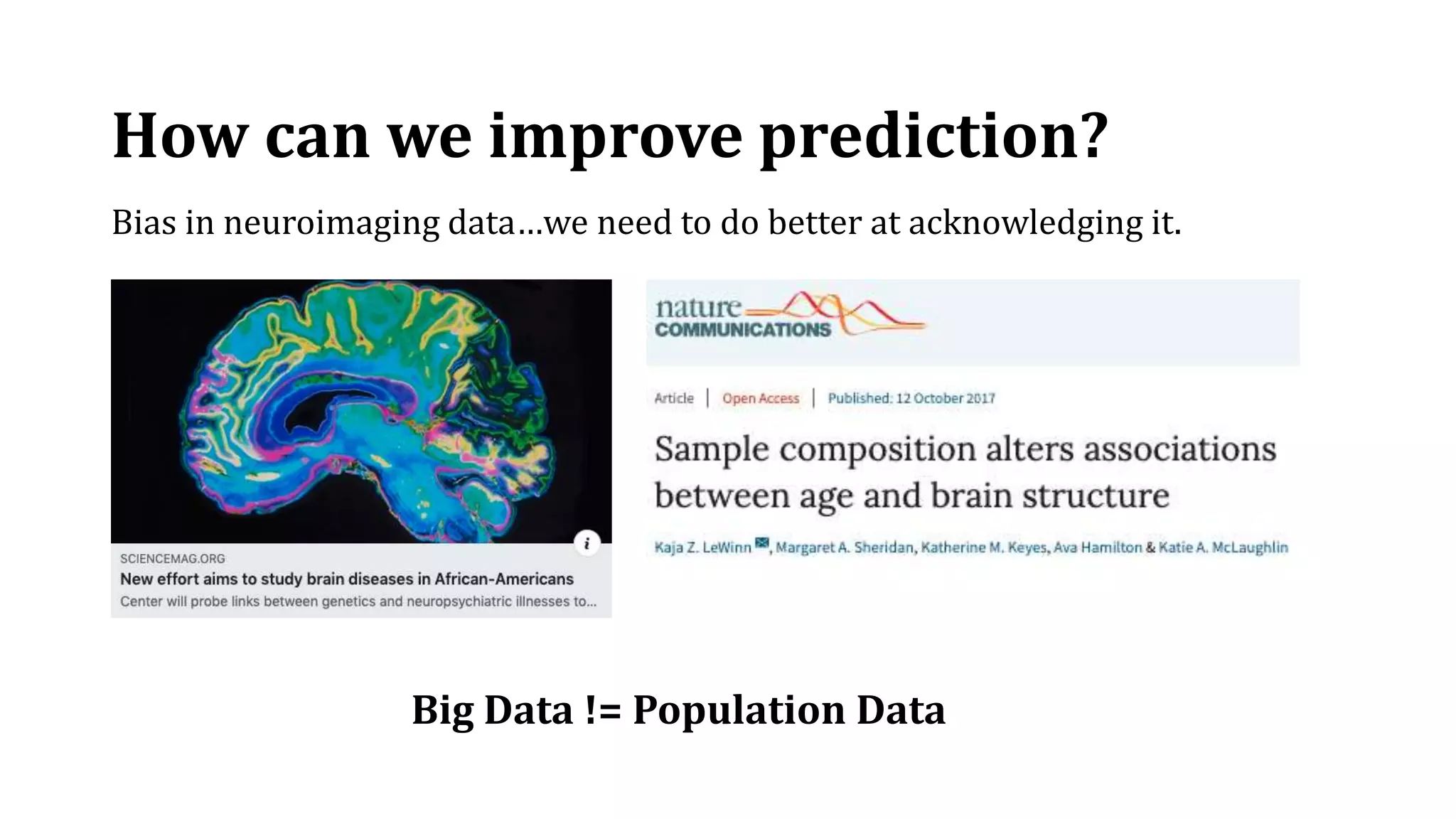
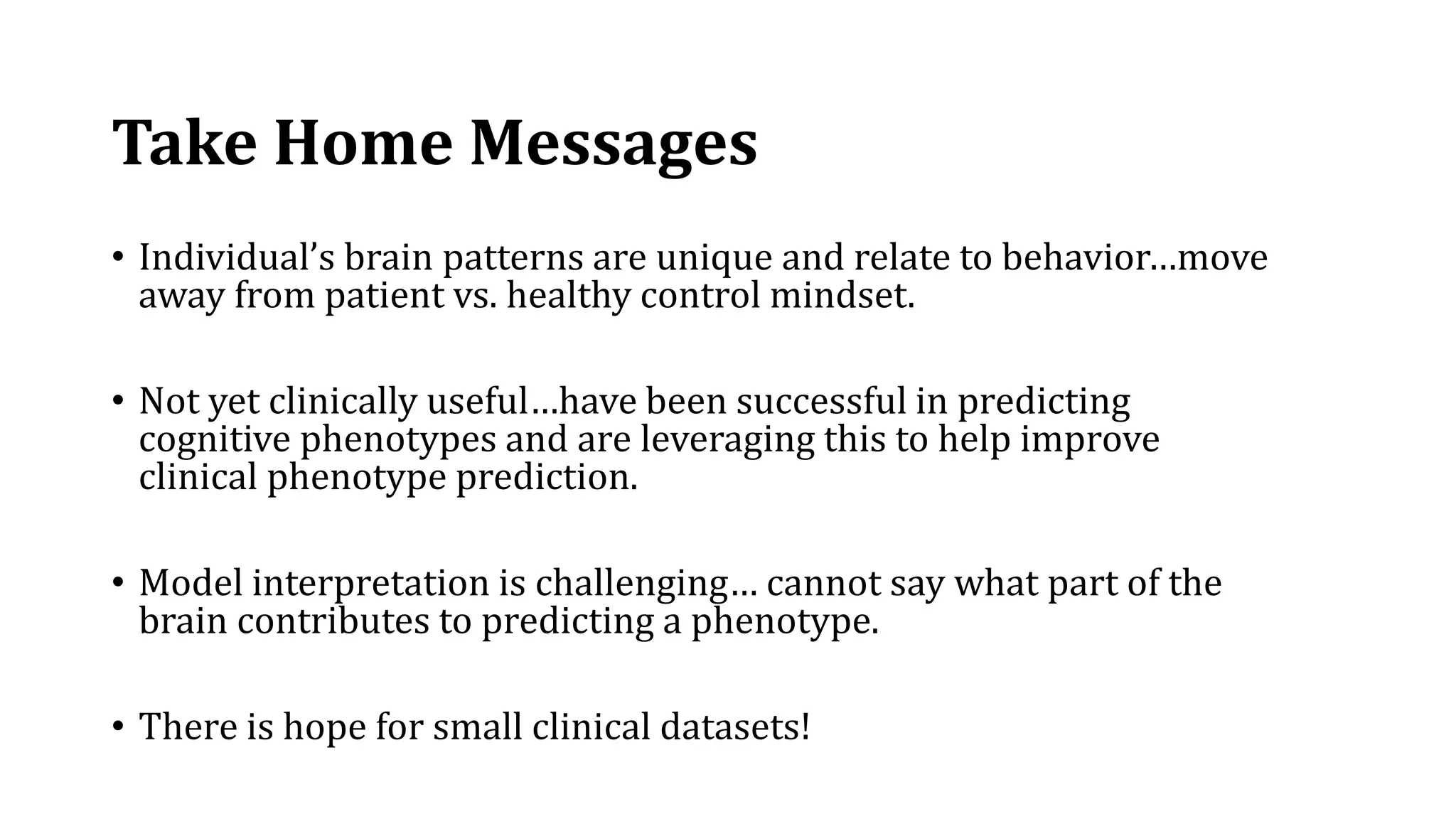
Bias in neuroimaging data…we need to do better at acknowledging it.
Big Data != Population Data
Take Home Messages
• Individual’s brain patterns are unique and relate to behavior…move
away from patient vs. healthy control mindset.
• Not yet clinically useful…have been successful in predicting
cognitive phenotypes and are leveraging this to help improve
clinical phenotype prediction.
• Model interpretation is challenging… cannot say what part of the
brain contributes to predicting a phenotype.
• There is hope for small clinical datasets!
Future Directions & Open Questions
• Build larger clinical datasets
• Better models to handle heterogeneity…normative modeling.
• Should we keep investing so much money in trying to understand
the biology of the brain? Or should there be more efforts focused
on clinical research that could immediately be impactful?
Thank you!
All who have supported/inspired me on my learning journey.
Mike Angstadt, Chandra Sripada, Jenna Wiens, Daniel Kessler, Ivy Tso, Soo-Eun
Chang, Steve Taylor, the entire University of Michigan community!
@being_saige
www.beingsaige.com
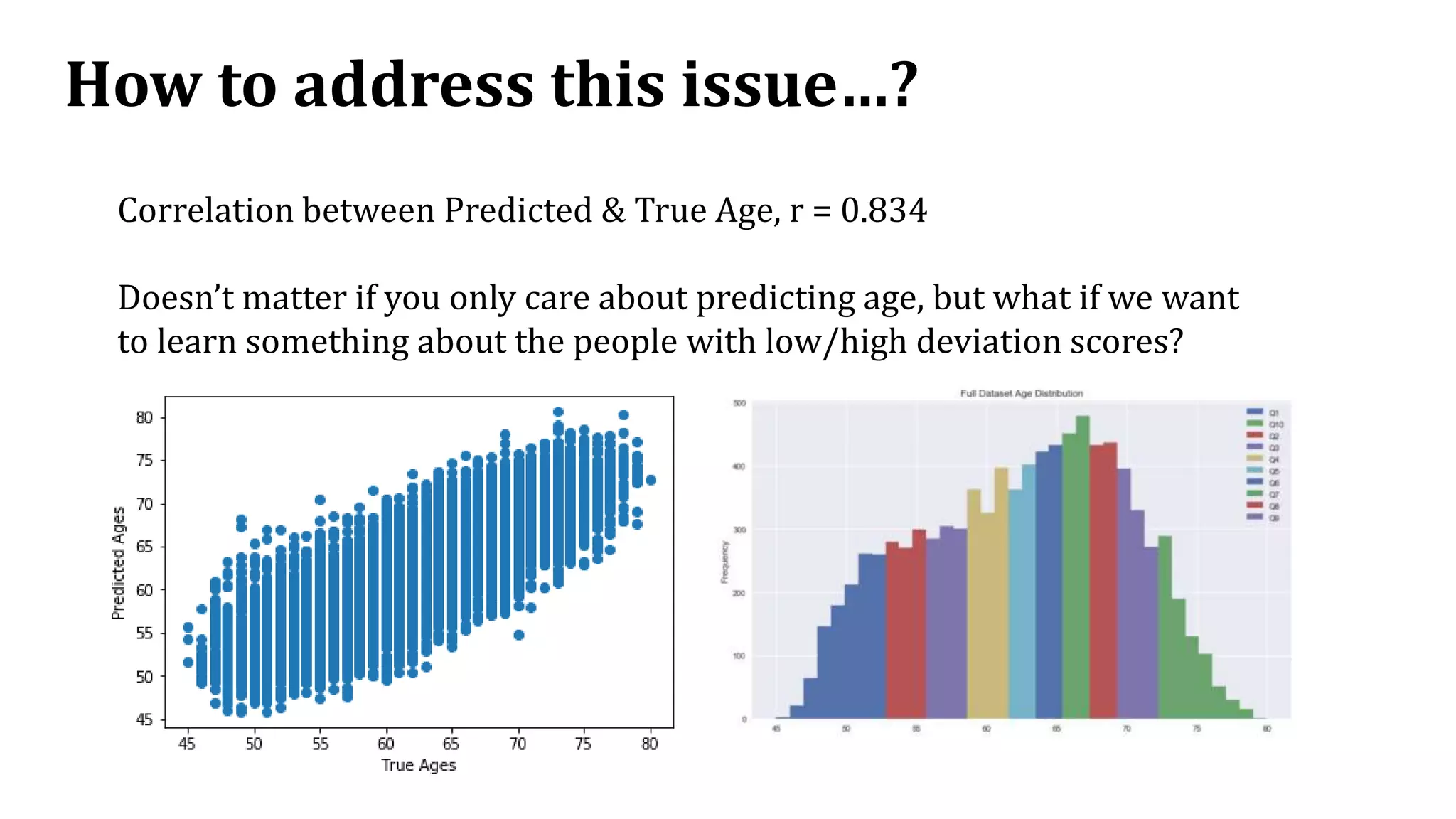
How to address this issue…?
Correlation between Predicted & True Age, r = 0.834
Doesn’t matter if you only care about predicting age, but what if we want
to learn something about the people with low/high deviation scores?
Rutherford_MiCHAMP2020.pptx

Rutherford_MiCHAMP2020.pptx

  • 1.
    Saige Rutherford University ofMichigan Department of Psychiatry The Current State of Prediction in Neuroimaging MiCHAMP Seminar Series Friday, Jan. 24, 2020 @being_saige
  • 2.
    Acknowledgements Liza Levina DanielKessler Yura Kim Chandra Sripada Mike Angstadt Mary Heitzeg Luke Hyde Alex Weigard
  • 3.
    Road Map • Neuroimagingdata 101 • Brain-behavior predictive modeling methodology • Which traits and behaviors can we (reliably) predict from brain images? • Where are we going with this?
  • 4.
  • 5.
    Imaging in Psychiatry •not routinely used in clinical practice • other than to rule out lesions • brain tumor, MS, or stroke for example • not possible to diagnose psychiatric illness with any imaging modality • much can be learned about brain changes associated with psychiatric illness
  • 6.
    Biomarker Identification usingMRI Structure (3D volume) macroscopic and microscopic structure Function (4D timeseries) fMRI – task activations and functional connectivity
  • 7.
    fMRI: What arewe measuring? • Neurons fire • significant blood flow response associate with firing • provides energy to neurons • Primarily measure BOLD contrast in fMRI • Blood Oxygenation Level Dependent contrast • magnetic susceptibility of oxygenated and deoxygenated blood are different • local oxygenation of blood changes upon activation leading to a change in local magnetic field which leads to signal change
  • 8.
    Task-Based fMRI: Multiple acquisitionsover time t baseline activation baseline
  • 9.
  • 10.
    The Functional Connectome Functionalparcellation BOLD Time (s) Correlation matrix r ij = 0.59 This correlation matrix is the individual subject’s connectome.
  • 11.
    Individual differences areinteresting and important!
  • 12.
  • 13.
    Patient or healthycontrol? • Think deeply before you turn a continuous trait into a categorical trait. • Dimensional neuroimaging: our ability to place a brain scan into a succinct, yet highly comprehensive and informative reference system, dimensions of which will reflect patterns associated with normal or pathologic brain structure or function.
  • 14.
    DSM-5 vs RDoC •Move away from disorder based categories • Move towards objective symptom spectrum based assessments • Negative Valence, Positive Valence, Cognitive systems, Systems for social processes, Arousal/modulatory systems • Brain imaging allows one to look past the symptoms and directly at the brain Research Domain Criteria  a “precision medicine for psychiatry”
  • 15.
  • 16.
  • 17.
  • 19.
    Phenotype Corr btwnpredicted & observed General Executive 0.44 Processing Speed 0.39 Penn Progressive Matrices 0.30 ASR Externalizing 0.24 ASR Internalizing 0.20 ASR Attention 0.21 NEO-Openness 0.18 NEO-Conscientiousness 0.19 NEO-Extroversion 0.13 NEO-Agreeableness 0.19 NEO-Neuroticism 0.00 { { { Cognitive Personality Clinical N = 1,200 subjects ~35,000 connections each
  • 21.
    r = 0.31 r= 0.06 r = 0.15 N = 2,105 subjects ~35,000 connections each
  • 24.
    Impact of region-definition methodon prediction accuracy Impact of connectivity parameterization on prediction accuracy Impact of classifier choice on prediction accuracy
  • 26.
    Spatial Localization Considerations •Networks that lead to behavioral predictions are extended and complex • Difficult to reduce to only a few connections or nodes • Propose that while not easy to comprehend– perhaps a more meaningful representation of the complexity of the human brain
  • 27.
    Big Datasets aretaking over… Where does my “small” data fit in? N = 10,000 N = 100,000 N = 10,000 N = 1,2000 N = 900 N = 4,000 N = 60?
  • 28.
    Big Datasets aretaking over… Where does my “small” data fit in? Big data can be act as a “discovery” data set. Use HCP, ABCD, or UKBiobank to find a brain basis set then get expression scores of these components in your dataset. Use pretrained models from big data, treat your dataset as a true out of sample test set. Externalizing Internalizing Attention Model Externalizing* Multi-Task Learning, Transfer Learning
  • 29.
    How can weimprove prediction? Bias in neuroimaging data…we need to do better at acknowledging it. Big Data != Population Data
  • 30.
    Take Home Messages •Individual’s brain patterns are unique and relate to behavior…move away from patient vs. healthy control mindset. • Not yet clinically useful…have been successful in predicting cognitive phenotypes and are leveraging this to help improve clinical phenotype prediction. • Model interpretation is challenging… cannot say what part of the brain contributes to predicting a phenotype. • There is hope for small clinical datasets!
  • 31.
    Future Directions &Open Questions • Build larger clinical datasets • Better models to handle heterogeneity…normative modeling. • Should we keep investing so much money in trying to understand the biology of the brain? Or should there be more efforts focused on clinical research that could immediately be impactful?
  • 32.
    Thank you! All whohave supported/inspired me on my learning journey. Mike Angstadt, Chandra Sripada, Jenna Wiens, Daniel Kessler, Ivy Tso, Soo-Eun Chang, Steve Taylor, the entire University of Michigan community! @being_saige www.beingsaige.com
  • 33.
    How to addressthis issue…? Correlation between Predicted & True Age, r = 0.834 Doesn’t matter if you only care about predicting age, but what if we want to learn something about the people with low/high deviation scores?