Control	
  your	
  data	
  right	
  way	
  
TPL	
  Dataflow	
  
crash	
  course	
  
Mikhail	
  Veselov	
  
Moscow	
  
20	
  Апрель	
  2015	
  
2
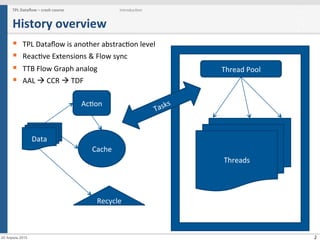
History	
  overview	
  
§  TPL	
  Dataflow	
  is	
  another	
  abstracGon	
  level	
  
§  ReacGve	
  Extensions	
  &	
  Flow	
  sync	
  
§  TTB	
  Flow	
  Graph	
  analog	
  
§  AAL	
  à	
  CCR	
  à	
  TDF	
  
TPL	
  Dataflow	
  –	
  crash	
  course	
   IntroducGon	
  
20 Апрель 2015
Data	
  
AcGon	
  
Recycle	
  
Cache	
  
Thread	
  Pool	
  
Threads	
  
3
Main	
  idea	
  -­‐	
  why	
  Dataflow?	
  
§  Define	
  your	
  applicaGon	
  dataflow	
  
§  Async	
  I/O	
  and	
  CPU-­‐oriented	
  code,	
  high-­‐throughput	
  &	
  low-­‐latency	
  
§  Random,	
  unstructured	
  data	
  (compare	
  with	
  Parallel	
  and	
  PLINQ)	
  
§  Rx	
  IObservable<T>	
  support	
  
§  Easy	
  start:	
  ActionBlock<T>	
  &	
  BufferBlock<T>	
  
TPL	
  Dataflow	
  –	
  crash	
  course	
   IntroducGon	
  
20 Апрель 2015
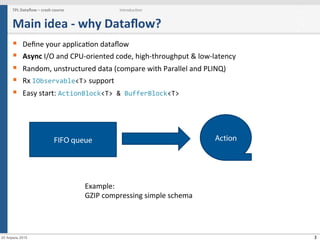
FIFO queue Action
Example:	
  	
  
GZIP	
  compressing	
  simple	
  schema	
  
4
Interfaces	
  -­‐	
  IDataflowBlock	
  
public	
  interface	
  IDataflowBlock	
  
{	


  void	
  Complete();	


  void	
  Fault(Exception	
  error);	


  Task	
  Completion	
  {	
  get;	
  }	
  
}	


block.Completion.ContinueWith(t	
  =>	
  	
  
{	


  if	
  (t.IsFaulted)	


  ((IDataflowBlock)nextBlock).Fault(t.Exception);	


  else	


  nextBlock.Complete();	
  
});	
  
TPL	
  Dataflow	
  –	
  crash	
  course	
   Fundamental	
  Interfaces	
  
20 Апрель 2015
§  IDataflowBlock	
  –	
  base	
  interface,	
  no	
  abstract	
  
implementaGon	
  
§  Task	
  CompleGon	
  staGc	
  methods:	
  
§  WhenAll	
  
§  ContinueWith	
  
§  AggregateException	
  with	
  previous	
  block’s	
  fault	
  
§  CancellationToken	
  
5
Interfaces	
  -­‐	
  ITargetBlock	
  
public	
  interface	
  ITargetBlock<in	
  TInput>	
  :	
  IDataflowBlock	
  
{	


  DataflowMessageStatus	
  OfferMessage(	


  DataflowMessageHeader	
  messageHeader,	
  TInput	
  messageValue,	


  ISourceBlock<TInput>	
  source,	
  bool	
  consumeToAccept);	
  
}	


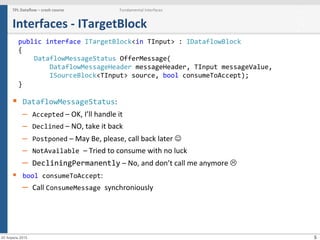
§  DataflowMessageStatus:	
  
–  Accepted	
  –	
  OK,	
  I’ll	
  handle	
  it	
  
–  Declined	
  –	
  NO,	
  take	
  it	
  back	
  
–  Postponed	
  –	
  May	
  Be,	
  please,	
  call	
  back	
  later	
  J	
  
–  NotAvailable	
  –	
  Tried	
  to	
  consume	
  with	
  no	
  luck	
  
–  DecliningPermanently	
  –	
  No,	
  and	
  don’t	
  call	
  me	
  anymore	
  L	
  
§  bool	
  consumeToAccept:	
  
–  Call	
  ConsumeMessage	
  synchroniously	
  
TPL	
  Dataflow	
  –	
  crash	
  course	
   Fundamental	
  Interfaces
20 Апрель 2015
6
Interfaces	
  -­‐	
  ISourceBlock	
  
public	
  interface	
  ISourceBlock<out	
  TOutput>	
  :	
  IDataflowBlock	
  
{	


  IDisposable	
  LinkTo(ITargetBlock<TOutput>	
  target,	
  bool	
  unlinkAfterOne);	


  bool	
  ReserveMessage(	
  //	
  prepare	


  DataflowMessageHeader	
  messageHeader,	
  ITargetBlock<TOutput>	
  target);	


  TOutput	
  ConsumeMessage(	
  //	
  commit	


  DataflowMessageHeader	
  messageHeader,	
  ITargetBlock<TOutput>	
  target,	


  out	
  bool	
  messageConsumed);	


  void	
  ReleaseReservation(	
  //rollback	


  DataflowMessageHeader	
  messageHeader,	
  ITargetBlock<TOutput>	
  target);	
  
}	


§  2-­‐phase	
  commit	
  protocol	
  (a.k.a.	
  transacGon)	
  
TPL	
  Dataflow	
  –	
  crash	
  course	
   Fundamental	
  Interfaces
20 Апрель 2015
7
Advanced	
  Interfaces	
  
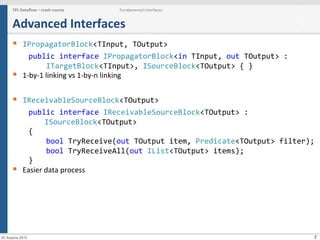
§  IPropagatorBlock<TInput,	
  TOutput>	
  
public	
  interface	
  IPropagatorBlock<in	
  TInput,	
  out	
  TOutput>	
  :	


  ITargetBlock<TInput>,	
  ISourceBlock<TOutput>	
  {	
  }	
  
§  1-­‐by-­‐1	
  linking	
  vs	
  1-­‐by-­‐n	
  linking	
  
§  IReceivableSourceBlock<TOutput>	
  
public	
  interface	
  IReceivableSourceBlock<TOutput>	
  :	
  
	
  ISourceBlock<TOutput>	
  
{	


  bool	
  TryReceive(out	
  TOutput	
  item,	
  Predicate<TOutput>	
  filter);	


  bool	
  TryReceiveAll(out	
  IList<TOutput>	
  items);	
  
}	
  
§  Easier	
  data	
  process	
  
TPL	
  Dataflow	
  –	
  crash	
  course	
   Fundamental	
  Interfaces
20 Апрель 2015
8
Pure	
  Buffering	
  Blocks	
  
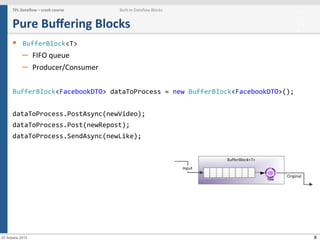
§  BufferBlock<T>	
  
–  FIFO	
  queue	
  
–  Producer/Consumer	


BufferBlock<FacebookDTO>	
  dataToProcess	
  =	
  new	
  BufferBlock<FacebookDTO>();	


dataToProcess.PostAsync(newVideo);	
  
dataToProcess.Post(newRepost);	
  
dataToProcess.SendAsync(newLike);	
  
TPL	
  Dataflow	
  –	
  crash	
  course	
   Built-­‐in	
  Dataflow	
  Blocks
20 Апрель 2015
9
Pure	
  Buffering	
  Blocks	
  
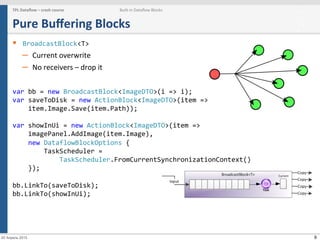
§  BroadcastBlock<T>	
  
–  Current	
  overwrite	
  
–  No	
  receivers	
  –	
  drop	
  it	


var	
  bb	
  =	
  new	
  BroadcastBlock<ImageDTO>(i	
  =>	
  i);	
  
var	
  saveToDisk	
  =	
  new	
  ActionBlock<ImageDTO>(item	
  =>	


  item.Image.Save(item.Path));	


var	
  showInUi	
  =	
  new	
  ActionBlock<ImageDTO>(item	
  =>	


  imagePanel.AddImage(item.Image),	


  new	
  DataflowBlockOptions	
  {	


  TaskScheduler	
  =	


  TaskScheduler.FromCurrentSynchronizationContext()	


  });	


bb.LinkTo(saveToDisk);	
  
bb.LinkTo(showInUi);	
  
TPL	
  Dataflow	
  –	
  crash	
  course	
   Built-­‐in	
  Dataflow	
  Blocks
20 Апрель 2015
10
Pure	
  Buffering	
  Blocks	
  
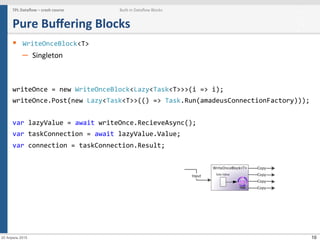
§  WriteOnceBlock<T>	
  
–  Singleton	
  
writeOnce	
  =	
  new	
  WriteOnceBlock<Lazy<Task<T>>>(i	
  =>	
  i);	
  
writeOnce.Post(new	
  Lazy<Task<T>>(()	
  =>	
  Task.Run(amadeusConnectionFactory)));	


var	
  lazyValue	
  =	
  await	
  writeOnce.RecieveAsync();	
  
var	
  taskConnection	
  =	
  await	
  lazyValue.Value;	
  
var	
  connection	
  =	
  taskConnection.Result;	
  
TPL	
  Dataflow	
  –	
  crash	
  course	
   Built-­‐in	
  Dataflow	
  Blocks
20 Апрель 2015
11
Executor	
  Blocks	
  
§  ActionBlock<TInput>	
  
var	
  chooser	
  =	
  new	
  ActionBlock<PostDTO>(post	
  =>	
  
{	


  Process(post);	
  
});	


var	
  threeMessageAtOnce	
  =	
  new	
  DataflowBlockOptions	
  {	
  BoundedCapacity	
  =	
  3,	


  TaskScheduler	
  =	
  TaskScheduler.Current	
  };	
  
var	
  threePerTask	
  =	
  new	
  DataflowBlockOptions	
  {	
  MaxMessagesPerTask	
  =	
  3	
  };	
  
TPL	
  Dataflow	
  –	
  crash	
  course	
   Built-­‐in	
  Dataflow	
  Blocks
20 Апрель 2015
12
Executor	
  Blocks	
  
§  TransformBlock<TInput,	
  TOutput>	
  
–  Output	
  ordering-­‐safe	
  queue	


var	
  gzipper	
  =	
  new	
  TransformBlock<byte[],	
  Task<byte[]>>	


  (b	
  =>	
  Task.Run(()	
  =>	
  Compress(b));	
  
var	
  RSAEncryptor	
  =	
  new	
  TransformBlock<byte[],	
  byte[]>(z	
  =>	
  RSA(z));	


gzipper.LinkTo(RSAEncryptor);	
  	
  
TPL	
  Dataflow	
  –	
  crash	
  course	
   Built-­‐in	
  Dataflow	
  Blocks
20 Апрель 2015
13
Executor	
  Blocks	
  
§  TransformManyBlock<TInput,	
  TOutput>	
  
–  Produce	
  zero	
  or	
  more	
  items	
  per	
  1	
  input	
  message	
  
–  Output	
  can	
  be	
  a	
  Task	


//	
  .SelectMany()	
  analog	
  
var	
  tagCloudAggregator	
  =	
  new	
  TransformManyBlock<TagFromPost[],	
  TagFromPost>	


  (arrayOfTags	
  =>	
  arrayOfTags);	
  
var	
  filteringTags	
  =	
  return	
  new	
  TransformManyBlock<T,	
  T>(async	
  tag	
  =>	


  await	
  filter(tag)	
  ?	
  new	
  []	
  {	
  tag	
  }	
  :	
  Enumerable.Empty<T>());	
  
tagCloudAggregator.LinkTo(filteringTags);	


//	
  provide	
  info	
  to	
  UI	
  
filteringTags.TryRecieveAll(out	
  tagDataSource);	
  
tagCloudControl.Show(tagDataSource);	
  
TPL	
  Dataflow	
  –	
  crash	
  course	
   Built-­‐in	
  Dataflow	
  Blocks
20 Апрель 2015
14
Executor	
  Blocks	
  
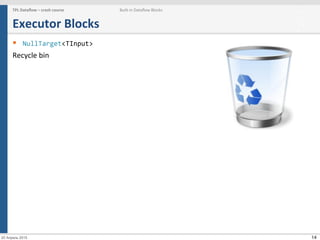
§  NullTarget<TInput>	
  
Recycle	
  bin	
  
TPL	
  Dataflow	
  –	
  crash	
  course	
   Built-­‐in	
  Dataflow	
  Blocks
20 Апрель 2015
15
Joining	
  Blocks	
  
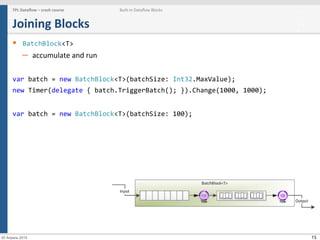
§  BatchBlock<T>	
  
–  accumulate	
  and	
  run	


var	
  batch	
  =	
  new	
  BatchBlock<T>(batchSize:	
  Int32.MaxValue);	
  
new	
  Timer(delegate	
  {	
  batch.TriggerBatch();	
  }).Change(1000,	
  1000);	


var	
  batch	
  =	
  new	
  BatchBlock<T>(batchSize:	
  100);	
  
TPL	
  Dataflow	
  –	
  crash	
  course	
   Built-­‐in	
  Dataflow	
  Blocks
20 Апрель 2015
16
Joining	
  Blocks	
  
§  JoinBlock<T1,	
  T2,	
  …>	
  
–  make	
  a	
  Tuple	
  
–  StarvaGon	
  problem	
  
var	
  throttle	
  =	
  new	
  JoinBlock<SyntaxTree,	
  Request>();	
  
for	
  (int	
  i	
  =	
  0;	
  i	
  <	
  10;	
  ++i)	


  throttle.Target1.Post(new	
  SyntaxTree());	
  	
  
var	
  processor	
  =	


  new	
  TransformBlock<Tuple<SyntaxTree,	
  Request>,	
  SyntaxTree>	


  (pair	
  =>	


  {	


  var	
  request	
  =	
  pair.Item2;	


  var	
  resource	
  =	
  pair.Item1;	


  request.ProcessWith(resource);	


  return	
  resource;	


  });	
  
throttle.LinkTo(processor);	
  
processor.LinkTo(throttle.Target1);	
  	
  
TPL	
  Dataflow	
  –	
  crash	
  course	
   Built-­‐in	
  Dataflow	
  Blocks
20 Апрель 2015
17
Joining	
  Blocks	
  
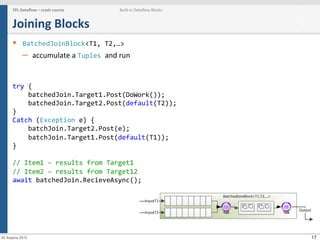
§  BatchedJoinBlock<T1,	
  T2,…>	
  
–  accumulate	
  a	
  Tuples	
  and	
  run	


try	
  {	


  batchedJoin.Target1.Post(DoWork());	


  batchedJoin.Target2.Post(default(T2));	
  
}	
  
Catch	
  (Exception	
  e)	
  {	


  batchJoin.Target2.Post(e);	


  batchJoin.Target1.Post(default(T1));	
  
}	


//	
  Item1	
  –	
  results	
  from	
  Target1	
  
//	
  Item2	
  –	
  results	
  from	
  Target12	
  
await	
  batchedJoin.RecieveAsync();	
  
TPL	
  Dataflow	
  –	
  crash	
  course	
   Built-­‐in	
  Dataflow	
  Blocks
20 Апрель 2015
18
ConfiguraKon	
  OpKons	
  –	
  TPL	
  support	
  
§  TaskScheduler	
  	
  &	
  SynchronizationContext	
  
–  TaskScheduler.Default	
  is	
  default	
  
–  TaskScheduler.Current	
  is	
  not	
  a	
  default	
  
–  ConcurrentExclusiveSchedulerPair	
  
§  MaxDegreeOfParallelism	
  
–  ExecuGonDataflowBlockOpGons	
  
–  All	
  operaGons	
  are	
  not	
  concurrent	
  by	
  default	
  
§  CancellationToken	
  
TPL	
  Dataflow	
  –	
  crash	
  course	
   Advanced topics
20 Апрель 2015
19
ConfiguraKon	
  OpKons	
  –	
  load	
  balancing	
  
§  MaxMessagesPerTask	
  
–  Blocks	
  try	
  to	
  minimize	
  number	
  of	
  Tasks	
  
§  MaxNumberOfGroups	
  
–  Grouping	
  blocks	
  autocomplete	
  
§  Greedy	
  
–  How	
  to	
  create	
  batches	
  and	
  join	
  
§  BoundedCapacity	
  
–  load	
  balancing	
  –	
  queue	
  size	


var	
  taskSchedulerPair	
  =	
  new	
  ConcurrentExclusiveSchedulerPair();	
  
var	
  readerActions	
  =	
  from	
  checkBox	
  in	
  new[]	
  {	
  checkBox1,	
  checkBox2,	
  checkBox3	
  }	


  select	
  new	
  ActionBlock<int>(milliseconds	
  =>	
  {	


  toggleCheckBox.Post(checkBox);	


  Thread.Sleep(milliseconds);	


  toggleCheckBox.Post(checkBox);	


  );},	
  new	
  ExecutionDataflowBlockOptions	
  {	


  TaskScheduler	
  =	
  taskSchedulerPair.ConcurrentScheduler	
  });	
  
TPL	
  Dataflow	
  –	
  crash	
  course	
   Advanced topics
20 Апрель 2015
20
StaKc	
  extension	
  methods	
  –	
  data	
  process	
  
§  Choose	
  
–  MulGple	
  sources	
  for	
  an	
  acGon	
  
–  There	
  will	
  be	
  only	
  one	
  message	
  processed	
  
§  OutputAvailableAsync	
  
–  Analog	
  of	
  Stack.Peek	
  operaGon	
  
§  Post/SendAsync	
  
–  Always	
  async	
  data	
  propagaGon	
  
–  You	
  can	
  postpone	
  the	
  message	
  with	
  	
  SendAsync	
  ,	
  not	
  with	
  Post	
  
§  Receive(Async)	
  
TPL	
  Dataflow	
  –	
  crash	
  course	
   Advanced topics
20 Апрель 2015
21
StaKc	
  extension	
  methods	
  –	
  outer	
  API	
  
§  Encapsulate	
  (propagator	
  block	
  factory	
  method)	
  
§  LinkTo	
  
–  Filter	
  the	
  message	
  propagaGon	
  
–  Link	
  opGons	
  	
  
–  Do	
  not	
  confuse	
  with	
  ISourceBlock<T>	
  method	
  
§  AsObsevable(er)	
  
–  Rx	
  extension	
  support,	
  no	
  holy	
  war	
  here	


new	
  DataflowLinkOptions	
  
{	


  MaxMessages	
  =	
  1,	


  Append	
  =	
  false,	


  PropagateCompletion	
  =	
  true	
  
}	
  
TPL	
  Dataflow	
  –	
  crash	
  course	
   Advanced topics
20 Апрель 2015
22
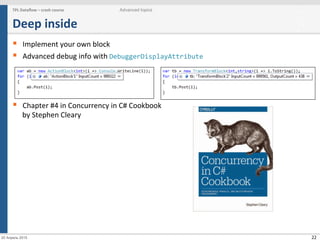
Deep	
  inside	
  
§  Implement	
  your	
  own	
  block	
  
§  Advanced	
  debug	
  info	
  with	
  DebuggerDisplayAttribute	
  	
  
§  Chapter	
  #4	
  in	
  Concurrency	
  in	
  C#	
  Cookbook	
  
by	
  Stephen	
  Cleary	
  
TPL	
  Dataflow	
  –	
  crash	
  course	
   Advanced topics
20 Апрель 2015
23
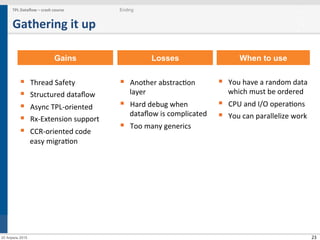
Gains When to useLosses
TPL	
  Dataflow	
  –	
  crash	
  course	
   Ending
20 Апрель 2015
Gathering	
  it	
  up	
  
§  Thread	
  Safety	
  
§  Structured	
  dataflow	
  
§  Async	
  TPL-­‐oriented	
  
§  Rx-­‐Extension	
  support	
  
§  CCR-­‐oriented	
  code	
  
easy	
  migraGon	
  
§  Another	
  abstracGon	
  
layer	
  
§  Hard	
  debug	
  when	
  
dataflow	
  is	
  complicated	
  
§  Too	
  many	
  generics	
  
§  You	
  have	
  a	
  random	
  data	
  
which	
  must	
  be	
  ordered	
  
§  CPU	
  and	
  I/O	
  operaGons	
  
§  You	
  can	
  parallelize	
  work	
  
Your
QR Code
I am at your disposal in case
of any questions or doubts
20 Апрель 2015
Mikhail Veselov
Moscow
MVeselov@luxoft.com
+7 911 951 42 98

TPL Dataflow – зачем и для кого?

  • 1.
    Control  your  data  right  way   TPL  Dataflow   crash  course   Mikhail  Veselov   Moscow   20  Апрель  2015  
  • 2.
    2 History  overview   § TPL  Dataflow  is  another  abstracGon  level   §  ReacGve  Extensions  &  Flow  sync   §  TTB  Flow  Graph  analog   §  AAL  à  CCR  à  TDF   TPL  Dataflow  –  crash  course   IntroducGon   20 Апрель 2015 Data   AcGon   Recycle   Cache   Thread  Pool   Threads  
  • 3.
    3 Main  idea  -­‐  why  Dataflow?   §  Define  your  applicaGon  dataflow   §  Async  I/O  and  CPU-­‐oriented  code,  high-­‐throughput  &  low-­‐latency   §  Random,  unstructured  data  (compare  with  Parallel  and  PLINQ)   §  Rx  IObservable<T>  support   §  Easy  start:  ActionBlock<T>  &  BufferBlock<T>   TPL  Dataflow  –  crash  course   IntroducGon   20 Апрель 2015 FIFO queue Action Example:     GZIP  compressing  simple  schema  
  • 4.
    4 Interfaces  -­‐  IDataflowBlock   public  interface  IDataflowBlock   {          void  Complete();          void  Fault(Exception  error);          Task  Completion  {  get;  }   }                   block.Completion.ContinueWith(t  =>     {          if  (t.IsFaulted)                  ((IDataflowBlock)nextBlock).Fault(t.Exception);          else                  nextBlock.Complete();   });   TPL  Dataflow  –  crash  course   Fundamental  Interfaces   20 Апрель 2015 §  IDataflowBlock  –  base  interface,  no  abstract   implementaGon   §  Task  CompleGon  staGc  methods:   §  WhenAll   §  ContinueWith   §  AggregateException  with  previous  block’s  fault   §  CancellationToken  
  • 5.
    5 Interfaces  -­‐  ITargetBlock   public  interface  ITargetBlock<in  TInput>  :  IDataflowBlock   {          DataflowMessageStatus  OfferMessage(                  DataflowMessageHeader  messageHeader,  TInput  messageValue,                    ISourceBlock<TInput>  source,  bool  consumeToAccept);   }     §  DataflowMessageStatus:   –  Accepted  –  OK,  I’ll  handle  it   –  Declined  –  NO,  take  it  back   –  Postponed  –  May  Be,  please,  call  back  later  J   –  NotAvailable  –  Tried  to  consume  with  no  luck   –  DecliningPermanently  –  No,  and  don’t  call  me  anymore  L   §  bool  consumeToAccept:   –  Call  ConsumeMessage  synchroniously   TPL  Dataflow  –  crash  course   Fundamental  Interfaces 20 Апрель 2015
  • 6.
    6 Interfaces  -­‐  ISourceBlock   public  interface  ISourceBlock<out  TOutput>  :  IDataflowBlock   {          IDisposable  LinkTo(ITargetBlock<TOutput>  target,  bool  unlinkAfterOne);              bool  ReserveMessage(  //  prepare                  DataflowMessageHeader  messageHeader,  ITargetBlock<TOutput>  target);          TOutput  ConsumeMessage(  //  commit                  DataflowMessageHeader  messageHeader,  ITargetBlock<TOutput>  target,                    out  bool  messageConsumed);          void  ReleaseReservation(  //rollback                  DataflowMessageHeader  messageHeader,  ITargetBlock<TOutput>  target);   }     §  2-­‐phase  commit  protocol  (a.k.a.  transacGon)   TPL  Dataflow  –  crash  course   Fundamental  Interfaces 20 Апрель 2015
  • 7.
    7 Advanced  Interfaces   § IPropagatorBlock<TInput,  TOutput>   public  interface  IPropagatorBlock<in  TInput,  out  TOutput>  :            ITargetBlock<TInput>,  ISourceBlock<TOutput>  {  }   §  1-­‐by-­‐1  linking  vs  1-­‐by-­‐n  linking   §  IReceivableSourceBlock<TOutput>   public  interface  IReceivableSourceBlock<TOutput>  :    ISourceBlock<TOutput>   {          bool  TryReceive(out  TOutput  item,  Predicate<TOutput>  filter);          bool  TryReceiveAll(out  IList<TOutput>  items);   }   §  Easier  data  process   TPL  Dataflow  –  crash  course   Fundamental  Interfaces 20 Апрель 2015
  • 8.
    8 Pure  Buffering  Blocks   §  BufferBlock<T>   –  FIFO  queue   –  Producer/Consumer     BufferBlock<FacebookDTO>  dataToProcess  =  new  BufferBlock<FacebookDTO>();     dataToProcess.PostAsync(newVideo);   dataToProcess.Post(newRepost);   dataToProcess.SendAsync(newLike);   TPL  Dataflow  –  crash  course   Built-­‐in  Dataflow  Blocks 20 Апрель 2015
  • 9.
    9 Pure  Buffering  Blocks   §  BroadcastBlock<T>   –  Current  overwrite   –  No  receivers  –  drop  it     var  bb  =  new  BroadcastBlock<ImageDTO>(i  =>  i);   var  saveToDisk  =  new  ActionBlock<ImageDTO>(item  =>          item.Image.Save(item.Path));       var  showInUi  =  new  ActionBlock<ImageDTO>(item  =>          imagePanel.AddImage(item.Image),            new  DataflowBlockOptions  {                        TaskScheduler  =                          TaskScheduler.FromCurrentSynchronizationContext()          });       bb.LinkTo(saveToDisk);   bb.LinkTo(showInUi);   TPL  Dataflow  –  crash  course   Built-­‐in  Dataflow  Blocks 20 Апрель 2015
  • 10.
    10 Pure  Buffering  Blocks   §  WriteOnceBlock<T>   –  Singleton   writeOnce  =  new  WriteOnceBlock<Lazy<Task<T>>>(i  =>  i);   writeOnce.Post(new  Lazy<Task<T>>(()  =>  Task.Run(amadeusConnectionFactory)));     var  lazyValue  =  await  writeOnce.RecieveAsync();   var  taskConnection  =  await  lazyValue.Value;   var  connection  =  taskConnection.Result;   TPL  Dataflow  –  crash  course   Built-­‐in  Dataflow  Blocks 20 Апрель 2015
  • 11.
    11 Executor  Blocks   § ActionBlock<TInput>   var  chooser  =  new  ActionBlock<PostDTO>(post  =>   {          Process(post);   });     var  threeMessageAtOnce  =  new  DataflowBlockOptions  {  BoundedCapacity  =  3,          TaskScheduler  =  TaskScheduler.Current  };   var  threePerTask  =  new  DataflowBlockOptions  {  MaxMessagesPerTask  =  3  };   TPL  Dataflow  –  crash  course   Built-­‐in  Dataflow  Blocks 20 Апрель 2015
  • 12.
    12 Executor  Blocks   § TransformBlock<TInput,  TOutput>   –  Output  ordering-­‐safe  queue     var  gzipper  =  new  TransformBlock<byte[],  Task<byte[]>>          (b  =>  Task.Run(()  =>  Compress(b));   var  RSAEncryptor  =  new  TransformBlock<byte[],  byte[]>(z  =>  RSA(z));     gzipper.LinkTo(RSAEncryptor);     TPL  Dataflow  –  crash  course   Built-­‐in  Dataflow  Blocks 20 Апрель 2015
  • 13.
    13 Executor  Blocks   § TransformManyBlock<TInput,  TOutput>   –  Produce  zero  or  more  items  per  1  input  message   –  Output  can  be  a  Task     //  .SelectMany()  analog   var  tagCloudAggregator  =  new  TransformManyBlock<TagFromPost[],  TagFromPost>          (arrayOfTags  =>  arrayOfTags);   var  filteringTags  =  return  new  TransformManyBlock<T,  T>(async  tag  =>          await  filter(tag)  ?  new  []  {  tag  }  :  Enumerable.Empty<T>());   tagCloudAggregator.LinkTo(filteringTags);     //  provide  info  to  UI   filteringTags.TryRecieveAll(out  tagDataSource);   tagCloudControl.Show(tagDataSource);   TPL  Dataflow  –  crash  course   Built-­‐in  Dataflow  Blocks 20 Апрель 2015
  • 14.
    14 Executor  Blocks   § NullTarget<TInput>   Recycle  bin   TPL  Dataflow  –  crash  course   Built-­‐in  Dataflow  Blocks 20 Апрель 2015
  • 15.
    15 Joining  Blocks   § BatchBlock<T>   –  accumulate  and  run     var  batch  =  new  BatchBlock<T>(batchSize:  Int32.MaxValue);   new  Timer(delegate  {  batch.TriggerBatch();  }).Change(1000,  1000);     var  batch  =  new  BatchBlock<T>(batchSize:  100);   TPL  Dataflow  –  crash  course   Built-­‐in  Dataflow  Blocks 20 Апрель 2015
  • 16.
    16 Joining  Blocks   § JoinBlock<T1,  T2,  …>   –  make  a  Tuple   –  StarvaGon  problem   var  throttle  =  new  JoinBlock<SyntaxTree,  Request>();   for  (int  i  =  0;  i  <  10;  ++i)            throttle.Target1.Post(new  SyntaxTree());     var  processor  =            new  TransformBlock<Tuple<SyntaxTree,  Request>,  SyntaxTree>          (pair  =>                  {                          var  request  =  pair.Item2;                          var  resource  =  pair.Item1;                          request.ProcessWith(resource);                          return  resource;                  });   throttle.LinkTo(processor);   processor.LinkTo(throttle.Target1);     TPL  Dataflow  –  crash  course   Built-­‐in  Dataflow  Blocks 20 Апрель 2015
  • 17.
    17 Joining  Blocks   § BatchedJoinBlock<T1,  T2,…>   –  accumulate  a  Tuples  and  run       try  {          batchedJoin.Target1.Post(DoWork());          batchedJoin.Target2.Post(default(T2));   }   Catch  (Exception  e)  {          batchJoin.Target2.Post(e);          batchJoin.Target1.Post(default(T1));   }     //  Item1  –  results  from  Target1   //  Item2  –  results  from  Target12   await  batchedJoin.RecieveAsync();   TPL  Dataflow  –  crash  course   Built-­‐in  Dataflow  Blocks 20 Апрель 2015
  • 18.
    18 ConfiguraKon  OpKons  –  TPL  support   §  TaskScheduler    &  SynchronizationContext   –  TaskScheduler.Default  is  default   –  TaskScheduler.Current  is  not  a  default   –  ConcurrentExclusiveSchedulerPair   §  MaxDegreeOfParallelism   –  ExecuGonDataflowBlockOpGons   –  All  operaGons  are  not  concurrent  by  default   §  CancellationToken   TPL  Dataflow  –  crash  course   Advanced topics 20 Апрель 2015
  • 19.
    19 ConfiguraKon  OpKons  –  load  balancing   §  MaxMessagesPerTask   –  Blocks  try  to  minimize  number  of  Tasks   §  MaxNumberOfGroups   –  Grouping  blocks  autocomplete   §  Greedy   –  How  to  create  batches  and  join   §  BoundedCapacity   –  load  balancing  –  queue  size       var  taskSchedulerPair  =  new  ConcurrentExclusiveSchedulerPair();   var  readerActions  =  from  checkBox  in  new[]  {  checkBox1,  checkBox2,  checkBox3  }          select  new  ActionBlock<int>(milliseconds  =>  {                  toggleCheckBox.Post(checkBox);                  Thread.Sleep(milliseconds);                  toggleCheckBox.Post(checkBox);          );},  new  ExecutionDataflowBlockOptions  {                  TaskScheduler  =  taskSchedulerPair.ConcurrentScheduler  });   TPL  Dataflow  –  crash  course   Advanced topics 20 Апрель 2015
  • 20.
    20 StaKc  extension  methods  –  data  process   §  Choose   –  MulGple  sources  for  an  acGon   –  There  will  be  only  one  message  processed   §  OutputAvailableAsync   –  Analog  of  Stack.Peek  operaGon   §  Post/SendAsync   –  Always  async  data  propagaGon   –  You  can  postpone  the  message  with    SendAsync  ,  not  with  Post   §  Receive(Async)   TPL  Dataflow  –  crash  course   Advanced topics 20 Апрель 2015
  • 21.
    21 StaKc  extension  methods  –  outer  API   §  Encapsulate  (propagator  block  factory  method)   §  LinkTo   –  Filter  the  message  propagaGon   –  Link  opGons     –  Do  not  confuse  with  ISourceBlock<T>  method   §  AsObsevable(er)   –  Rx  extension  support,  no  holy  war  here       new  DataflowLinkOptions   {          MaxMessages  =  1,          Append  =  false,          PropagateCompletion  =  true   }   TPL  Dataflow  –  crash  course   Advanced topics 20 Апрель 2015
  • 22.
    22 Deep  inside   § Implement  your  own  block   §  Advanced  debug  info  with  DebuggerDisplayAttribute     §  Chapter  #4  in  Concurrency  in  C#  Cookbook   by  Stephen  Cleary   TPL  Dataflow  –  crash  course   Advanced topics 20 Апрель 2015
  • 23.
    23 Gains When touseLosses TPL  Dataflow  –  crash  course   Ending 20 Апрель 2015 Gathering  it  up   §  Thread  Safety   §  Structured  dataflow   §  Async  TPL-­‐oriented   §  Rx-­‐Extension  support   §  CCR-­‐oriented  code   easy  migraGon   §  Another  abstracGon   layer   §  Hard  debug  when   dataflow  is  complicated   §  Too  many  generics   §  You  have  a  random  data   which  must  be  ordered   §  CPU  and  I/O  operaGons   §  You  can  parallelize  work  
  • 24.
    Your QR Code I amat your disposal in case of any questions or doubts 20 Апрель 2015 Mikhail Veselov Moscow MVeselov@luxoft.com +7 911 951 42 98