MultiCore Programming 1


Presented by:
Robin Aggarwal
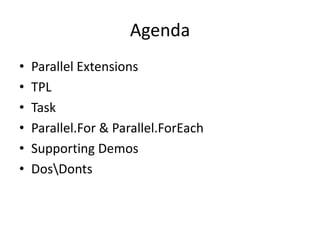
Agenda
•   Parallel Extensions
•   TPL
•   Task
•   Parallel.For & Parallel.ForEach
•   Supporting Demos
•   DosDonts
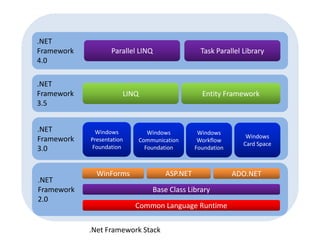
.NET
Framework          Parallel LINQ               Task Parallel Library
4.0

.NET
Framework              LINQ                    Entity Framework
3.5


.NET          Windows         Windows         Windows
Framework                                                     Windows
            Presentation   Communication      Workflow
                                                             Card Space
3.0          Foundation      Foundation      Foundation


              WinForms             ASP.NET                ADO.NET
.NET
Framework                      Base Class Library
2.0
                           Common Language Runtime


            .Net Framework Stack
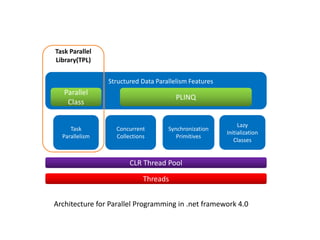
Task Parallel
Library(TPL)


                Structured Data Parallelism Features
   Parallel
                                       PLINQ
    Class

                                                            Lazy
     Task          Concurrent       Synchronization
                                                       Initialization
  Parallelism      Collections         Primitives
                                                          Classes


                        CLR Thread Pool

                             Threads


Architecture for Parallel Programming in .net framework 4.0
Parallel Extensions
• To the core libraries of Microsoft .Net
  Framework, set of APIs added collectively known
  Parallel Extensions.
• Makes it easy for developers to write programs
  for multicore processors by taking off the burden
  of dealing explicitly with complexities of threads
  and locks.
• Task Parallelism
      - Tasks
• Data Parallelism
      - Parallel.For(), Parallel.Foreach()
Tasks
• Task is unit of Async operation.
• Benefits
   – Scalable & efficient use of system resources.
   – More programmatic control is possible with “Tasks”
     than with a thread or work item. Eg. TPL1
• Features- Task waiting, Task cancellation, Task
  continutions, Exception Handling etc.
• Task.wait()
• task.ContinueWith(() => {
  Console.WriteLine("Computation completed"); });
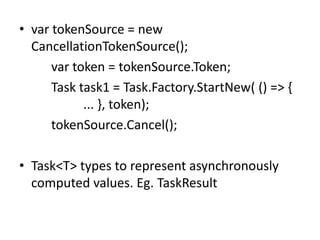
• var tokenSource = new
  CancellationTokenSource();
      var token = tokenSource.Token;
      Task task1 = Task.Factory.StartNew( () => {
            ... }, token);
      tokenSource.Cancel();

• Task<T> types to represent asynchronously
  computed values. Eg. TaskResult
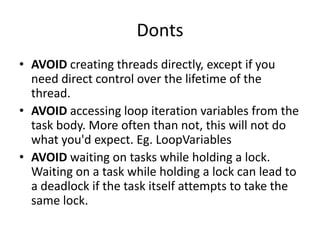
Donts
• AVOID creating threads directly, except if you
  need direct control over the lifetime of the
  thread.
• AVOID accessing loop iteration variables from the
  task body. More often than not, this will not do
  what you'd expect. Eg. LoopVariables
• AVOID waiting on tasks while holding a lock.
  Waiting on a task while holding a lock can lead to
  a deadlock if the task itself attempts to take the
  same lock.
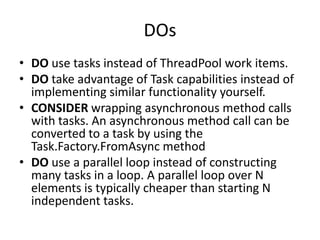
DOs
• DO use tasks instead of ThreadPool work items.
• DO take advantage of Task capabilities instead of
  implementing similar functionality yourself.
• CONSIDER wrapping asynchronous method calls
  with tasks. An asynchronous method call can be
  converted to a task by using the
  Task.Factory.FromAsync method
• DO use a parallel loop instead of constructing
  many tasks in a loop. A parallel loop over N
  elements is typically cheaper than starting N
  independent tasks.
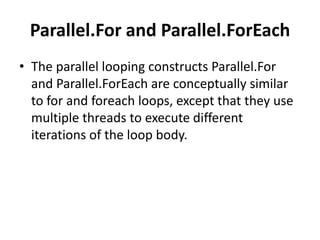
Parallel.For and Parallel.ForEach
• The parallel looping constructs Parallel.For
  and Parallel.ForEach are conceptually similar
  to for and foreach loops, except that they use
  multiple threads to execute different
  iterations of the loop body.
DOs
• DO use parallel loops Parallel.For and Parallel.ForEach to speed up
  operations where an expensive, independent operation needs to be
  performed for each input in a sequence.
• DO make sure that the loop body delegate is thread-safe, since it
  will be called from multiple threads concurrently.
• DO verify that the loop body delegate does not make assumptions
  about the order in which loop iterations will execute. For
  example, there is no guarantee that a thread will process its
  partition of input elements in the order in which they appear in the
  input, even though in the current version it will.
• CONSIDER increasing the work done by each iteration in a parallel
  loop if it is very low. The body of a parallel loop is a delegate, and
  invoking it incurs some overhead. If the work done by the loop
  body is very small, the delegate invocation overhead may dominate
  the running time.
• Parallel.For(0, arr.Length, i =>
• {
      arr[i] = (int)Math.Sqrt(arr[i]);
• });
• Parallel.ForEach(
   Partitioner.Create(0, arr.Length, 1024),
      range => {
            for (int i = range.Item1; i < range.Item2; i++)
            {
                  arr[i] = (int)Math.Sqrt(arr[i]);
            }
      });
PLINQ
• Parallel LINQ
• PLINQ executes LINQ queries, but distributes
  the evaluation of the user delegates over
  multiple threads.
• DO use PLINQ to express computations with
  an expensive operation applied over a
  sequence.
• BE AWARE that by default, PLINQ does not
  preserve ordering of elements in a query.
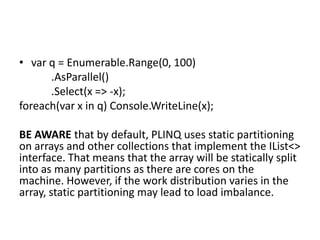
• var q = Enumerable.Range(0, 100)
      .AsParallel()
      .Select(x => -x);
foreach(var x in q) Console.WriteLine(x);

BE AWARE that by default, PLINQ uses static partitioning
on arrays and other collections that implement the IList<>
interface. That means that the array will be statically split
into as many partitions as there are cores on the
machine. However, if the work distribution varies in the
array, static partitioning may lead to load imbalance.
Correctness
• Thread Safety- DO make sure that if an object
  is accessed from multiple threads, all methods
  called on the object are thread-safe, or
  otherwise correctly protected by locks.
Concurrent Collections
•   ConcurrentQueue
•   ConcurrentStack
•   ConcurrentDictionary
•   Blocking Collection
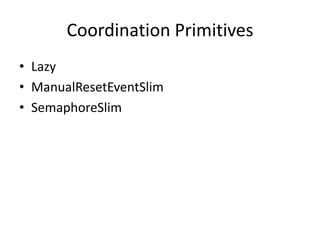
Coordination Primitives
• Lazy
• ManualResetEventSlim
• SemaphoreSlim

Multi core programming 1

  • 1.
  • 2.
    Agenda • Parallel Extensions • TPL • Task • Parallel.For & Parallel.ForEach • Supporting Demos • DosDonts
  • 3.
    .NET Framework Parallel LINQ Task Parallel Library 4.0 .NET Framework LINQ Entity Framework 3.5 .NET Windows Windows Windows Framework Windows Presentation Communication Workflow Card Space 3.0 Foundation Foundation Foundation WinForms ASP.NET ADO.NET .NET Framework Base Class Library 2.0 Common Language Runtime .Net Framework Stack
  • 4.
    Task Parallel Library(TPL) Structured Data Parallelism Features Parallel PLINQ Class Lazy Task Concurrent Synchronization Initialization Parallelism Collections Primitives Classes CLR Thread Pool Threads Architecture for Parallel Programming in .net framework 4.0
  • 5.
    Parallel Extensions • Tothe core libraries of Microsoft .Net Framework, set of APIs added collectively known Parallel Extensions. • Makes it easy for developers to write programs for multicore processors by taking off the burden of dealing explicitly with complexities of threads and locks. • Task Parallelism - Tasks • Data Parallelism - Parallel.For(), Parallel.Foreach()
  • 6.
    Tasks • Task isunit of Async operation. • Benefits – Scalable & efficient use of system resources. – More programmatic control is possible with “Tasks” than with a thread or work item. Eg. TPL1 • Features- Task waiting, Task cancellation, Task continutions, Exception Handling etc. • Task.wait() • task.ContinueWith(() => { Console.WriteLine("Computation completed"); });
  • 7.
    • var tokenSource= new CancellationTokenSource(); var token = tokenSource.Token; Task task1 = Task.Factory.StartNew( () => { ... }, token); tokenSource.Cancel(); • Task<T> types to represent asynchronously computed values. Eg. TaskResult
  • 8.
    Donts • AVOID creatingthreads directly, except if you need direct control over the lifetime of the thread. • AVOID accessing loop iteration variables from the task body. More often than not, this will not do what you'd expect. Eg. LoopVariables • AVOID waiting on tasks while holding a lock. Waiting on a task while holding a lock can lead to a deadlock if the task itself attempts to take the same lock.
  • 9.
    DOs • DO usetasks instead of ThreadPool work items. • DO take advantage of Task capabilities instead of implementing similar functionality yourself. • CONSIDER wrapping asynchronous method calls with tasks. An asynchronous method call can be converted to a task by using the Task.Factory.FromAsync method • DO use a parallel loop instead of constructing many tasks in a loop. A parallel loop over N elements is typically cheaper than starting N independent tasks.
  • 10.
    Parallel.For and Parallel.ForEach •The parallel looping constructs Parallel.For and Parallel.ForEach are conceptually similar to for and foreach loops, except that they use multiple threads to execute different iterations of the loop body.
  • 11.
    DOs • DO useparallel loops Parallel.For and Parallel.ForEach to speed up operations where an expensive, independent operation needs to be performed for each input in a sequence. • DO make sure that the loop body delegate is thread-safe, since it will be called from multiple threads concurrently. • DO verify that the loop body delegate does not make assumptions about the order in which loop iterations will execute. For example, there is no guarantee that a thread will process its partition of input elements in the order in which they appear in the input, even though in the current version it will. • CONSIDER increasing the work done by each iteration in a parallel loop if it is very low. The body of a parallel loop is a delegate, and invoking it incurs some overhead. If the work done by the loop body is very small, the delegate invocation overhead may dominate the running time.
  • 12.
    • Parallel.For(0, arr.Length,i => • { arr[i] = (int)Math.Sqrt(arr[i]); • }); • Parallel.ForEach( Partitioner.Create(0, arr.Length, 1024), range => { for (int i = range.Item1; i < range.Item2; i++) { arr[i] = (int)Math.Sqrt(arr[i]); } });
  • 13.
    PLINQ • Parallel LINQ •PLINQ executes LINQ queries, but distributes the evaluation of the user delegates over multiple threads. • DO use PLINQ to express computations with an expensive operation applied over a sequence. • BE AWARE that by default, PLINQ does not preserve ordering of elements in a query.
  • 14.
    • var q= Enumerable.Range(0, 100) .AsParallel() .Select(x => -x); foreach(var x in q) Console.WriteLine(x); BE AWARE that by default, PLINQ uses static partitioning on arrays and other collections that implement the IList<> interface. That means that the array will be statically split into as many partitions as there are cores on the machine. However, if the work distribution varies in the array, static partitioning may lead to load imbalance.
  • 15.
    Correctness • Thread Safety-DO make sure that if an object is accessed from multiple threads, all methods called on the object are thread-safe, or otherwise correctly protected by locks.
  • 16.
    Concurrent Collections • ConcurrentQueue • ConcurrentStack • ConcurrentDictionary • Blocking Collection
  • 17.
    Coordination Primitives • Lazy •ManualResetEventSlim • SemaphoreSlim