Toyota
ProductionSystem
Operations Management
Versión Final
Abraham Hernández
Ricardo Siller
Description of the Concept
• The world owes a great deal to Mr Taiichi Ohno.
He has shown us how to manufacture more
efficiently, reduce costs, produce greater
quality, and also take an important look at how we
as people work in a factory. (Ohno, Taiichi, 1978)
Description of the Concept
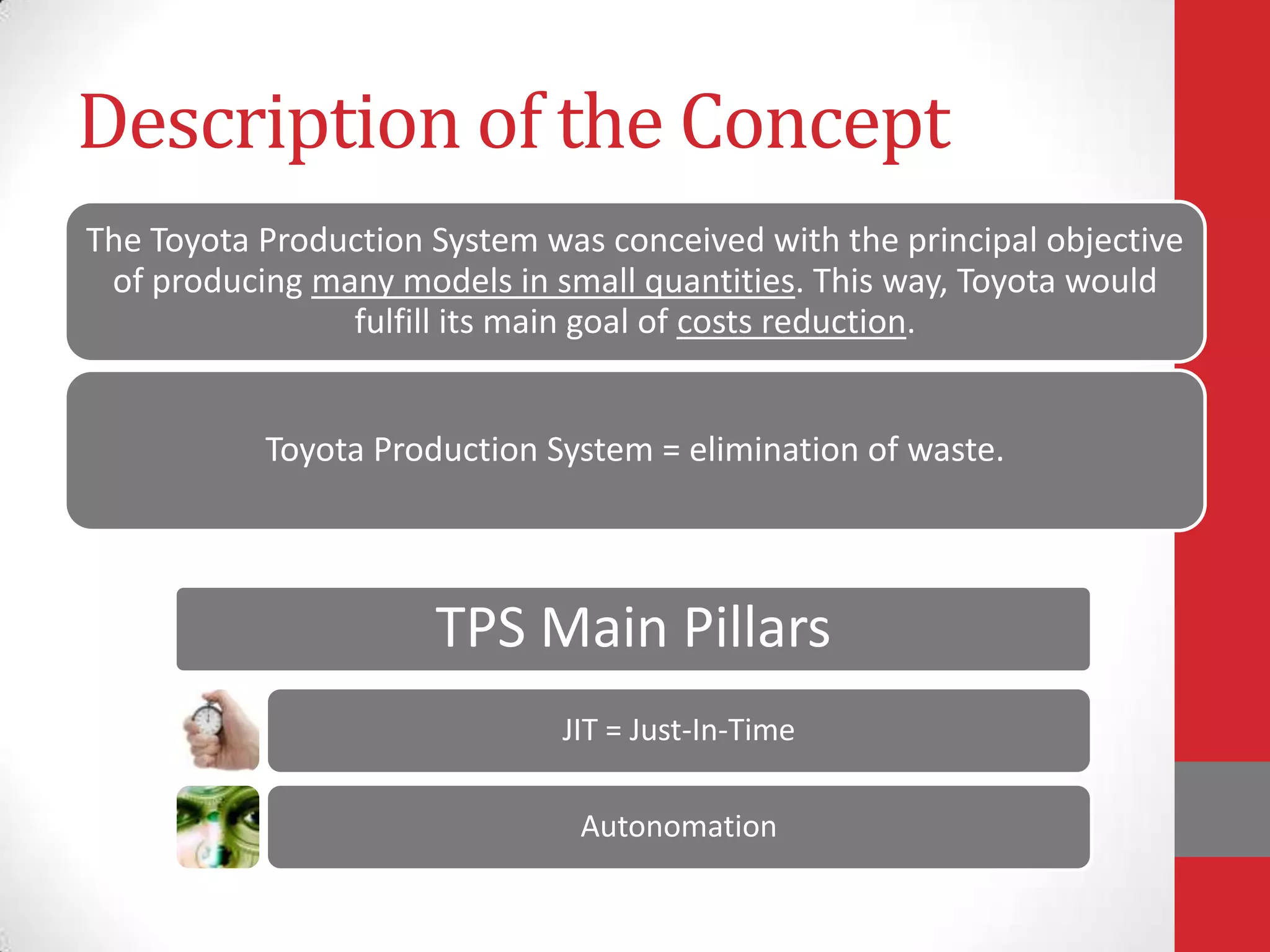
The Toyota Production System was conceived with the principal objective
of producing many models in small quantities. This way, Toyota would
fulfill its main goal of costs reduction.
Toyota Production System = elimination of waste.
TPS Main Pillars
JIT = Just-In-Time
Autonomation
Just-In-Time: An Ideal State
In a a flow process, the right parts needed in assembly
reach the assembly line at the time they are needed and
only in the amount needed. A company establishing this
flow throughout can approach zero inventory, which at
the same time, reduces waste and costs.
Just-In-Time: An Ideal State
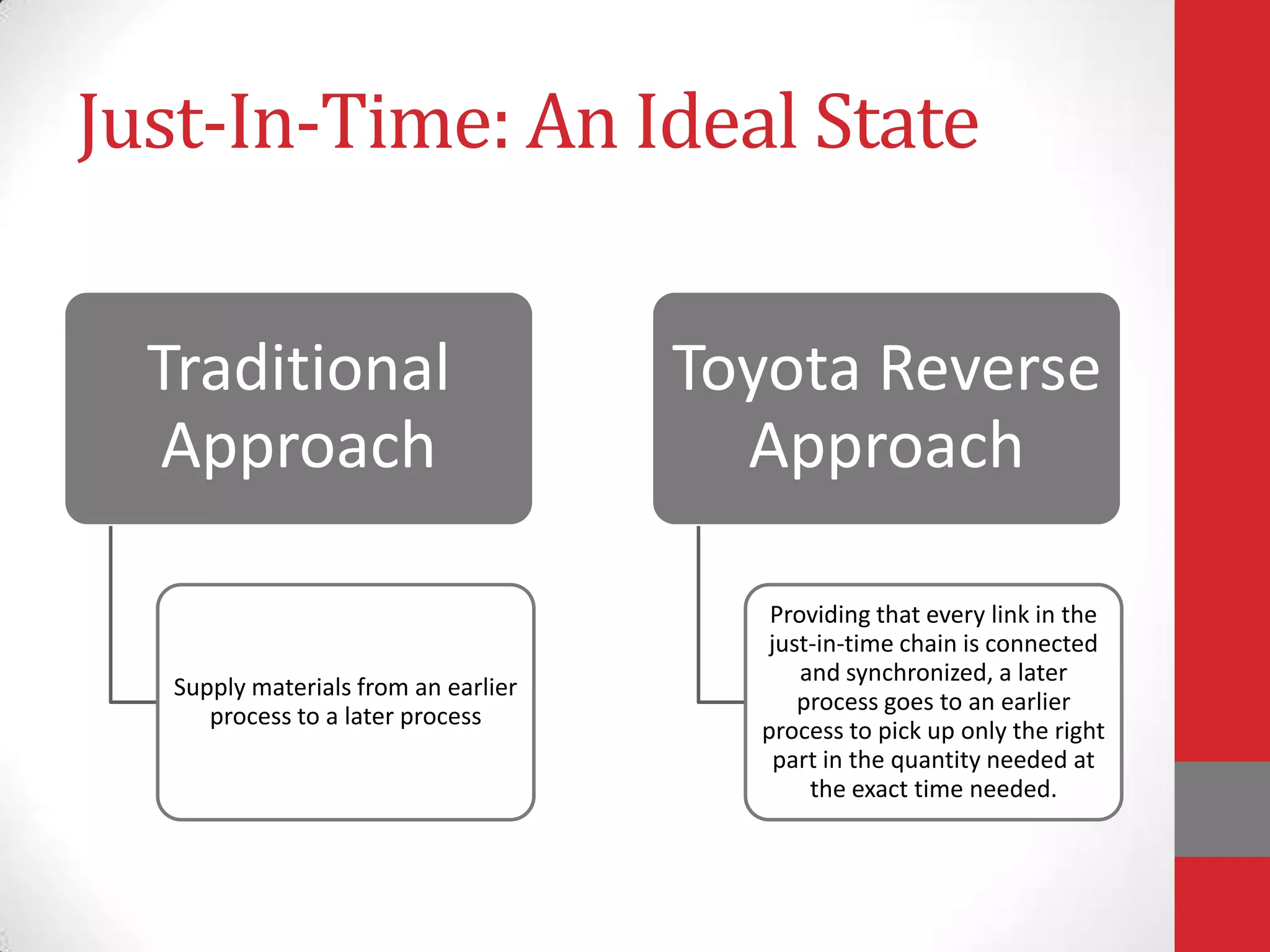
Traditional
Approach
Supply materials from an earlier
process to a later process
Toyota Reverse
Approach
Providing that every link in the
just-in-time chain is connected
and synchronized, a later
process goes to an earlier
process to pick up only the right
part in the quantity needed at
the exact time needed.
Autonomation; The Human Touch
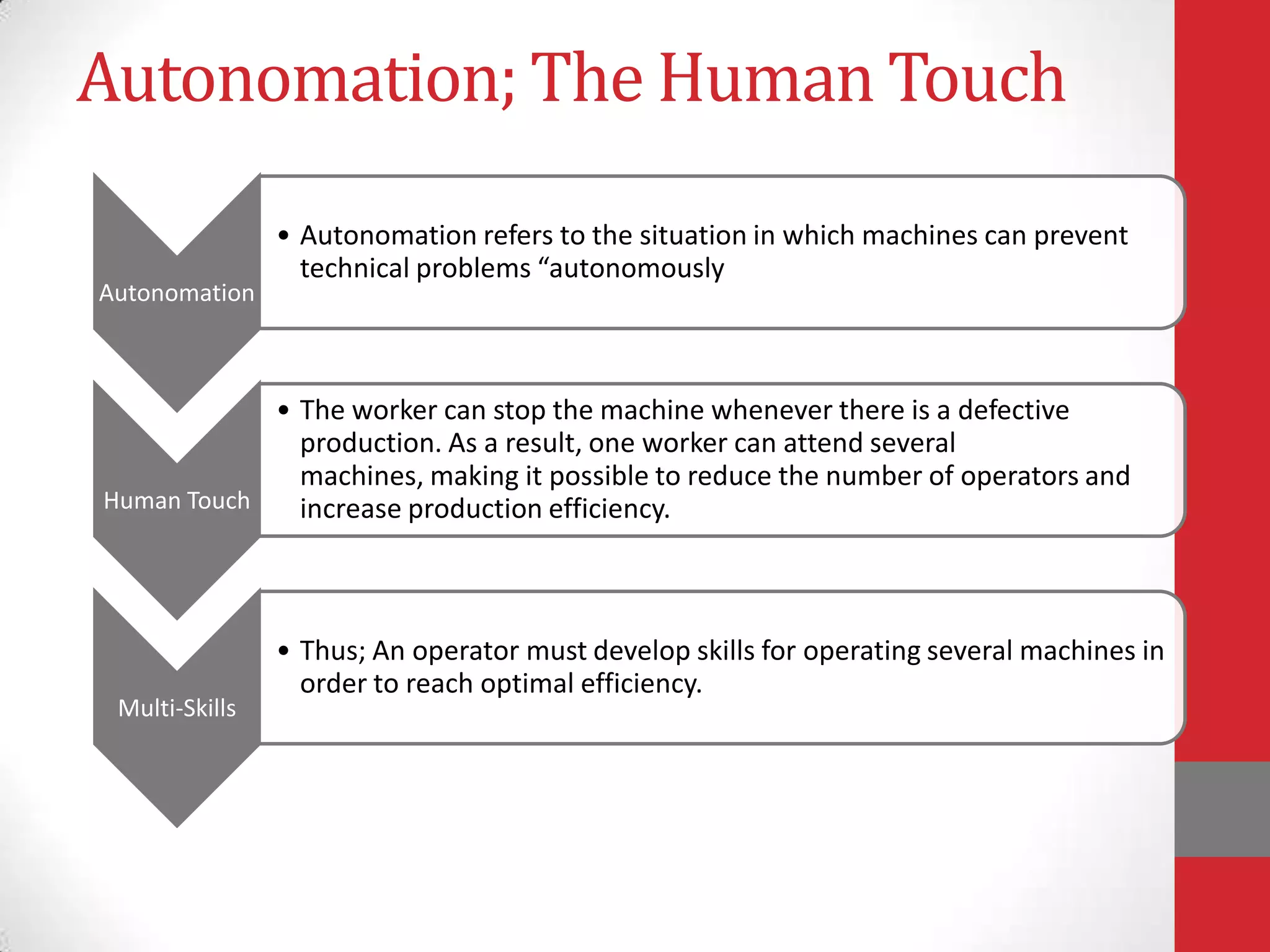
Autonomation
• Autonomation refers to the situation in which machines can prevent
technical problems “autonomously
Human Touch
• The worker can stop the machine whenever there is a defective
production. As a result, one worker can attend several
machines, making it possible to reduce the number of operators and
increase production efficiency.
Multi-Skills
• Thus; An operator must develop skills for operating several machines in
order to reach optimal efficiency.
TPS Was Born In Japan Out Of
Necessity
Two Economic
Originators of
the TPS:
Oil crisis of
1972.
Conseqent
Slow Growth
The American productionsystem;not well
suitablefor the Japanese needs
American
Production
System
Japanese
Problem
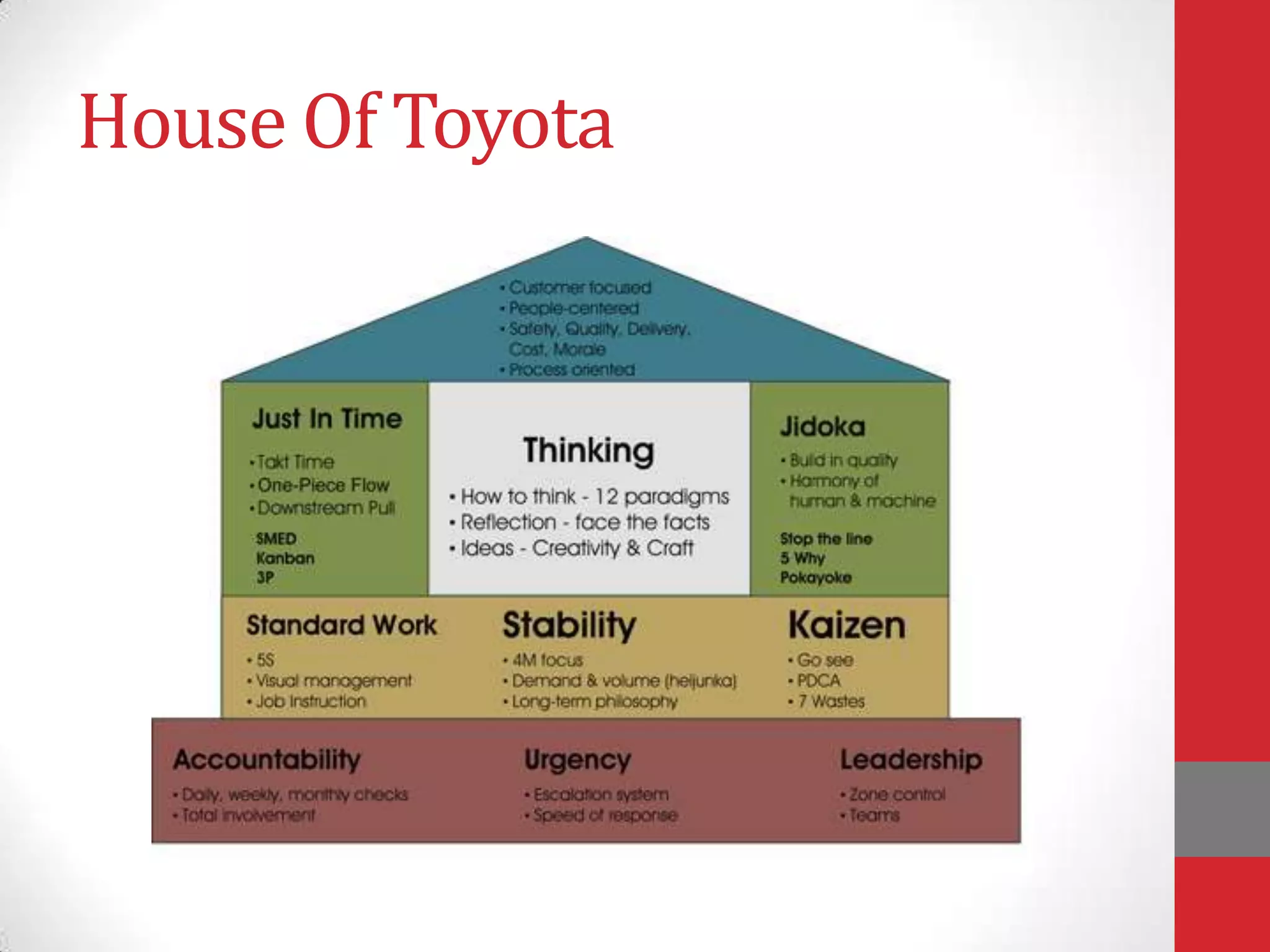
House Of Toyota
Potential Aplications
Of the Concept
TPS in Industries and Companies
Restaurants Example
Honey Industry Example
Companiesthathaveimplementedtheconcept
Hyundai And Their Results
Bibliography
• Hunter, S. L. (2008). The Toyota Production System Applied to
the Upholstery Furniture Manufaturing Industry.
Mississippi, Mississippi, USA: Taylor & Francis Group, LLC.
• Lee, H. B., & Jo, H. (2007). The mutation of the Toyota
Production System: adapting the TPS at Hyundai Motor
Company (Vol. 45). (T. &. LLC, Ed.) Nam-gu, Ulsan, South
Korea: International Journal of Production Research.
• Ohno, T. (1978). Toyota Production System. (P. Inc, Trans.)
Tokyo, Japan: Diamond Inc.

Toyota production system final

  • 1.
  • 2.
    Description of theConcept • The world owes a great deal to Mr Taiichi Ohno. He has shown us how to manufacture more efficiently, reduce costs, produce greater quality, and also take an important look at how we as people work in a factory. (Ohno, Taiichi, 1978)
  • 3.
    Description of theConcept The Toyota Production System was conceived with the principal objective of producing many models in small quantities. This way, Toyota would fulfill its main goal of costs reduction. Toyota Production System = elimination of waste. TPS Main Pillars JIT = Just-In-Time Autonomation
  • 4.
    Just-In-Time: An IdealState In a a flow process, the right parts needed in assembly reach the assembly line at the time they are needed and only in the amount needed. A company establishing this flow throughout can approach zero inventory, which at the same time, reduces waste and costs.
  • 5.
    Just-In-Time: An IdealState Traditional Approach Supply materials from an earlier process to a later process Toyota Reverse Approach Providing that every link in the just-in-time chain is connected and synchronized, a later process goes to an earlier process to pick up only the right part in the quantity needed at the exact time needed.
  • 6.
    Autonomation; The HumanTouch Autonomation • Autonomation refers to the situation in which machines can prevent technical problems “autonomously Human Touch • The worker can stop the machine whenever there is a defective production. As a result, one worker can attend several machines, making it possible to reduce the number of operators and increase production efficiency. Multi-Skills • Thus; An operator must develop skills for operating several machines in order to reach optimal efficiency.
  • 7.
    TPS Was BornIn Japan Out Of Necessity Two Economic Originators of the TPS: Oil crisis of 1972. Conseqent Slow Growth
  • 8.
    The American productionsystem;notwell suitablefor the Japanese needs American Production System Japanese Problem
  • 9.
  • 10.
    Potential Aplications Of theConcept TPS in Industries and Companies
  • 11.
  • 12.
  • 13.
  • 14.
  • 15.
  • 16.
  • 17.
  • 18.
    Bibliography • Hunter, S.L. (2008). The Toyota Production System Applied to the Upholstery Furniture Manufaturing Industry. Mississippi, Mississippi, USA: Taylor & Francis Group, LLC. • Lee, H. B., & Jo, H. (2007). The mutation of the Toyota Production System: adapting the TPS at Hyundai Motor Company (Vol. 45). (T. &. LLC, Ed.) Nam-gu, Ulsan, South Korea: International Journal of Production Research. • Ohno, T. (1978). Toyota Production System. (P. Inc, Trans.) Tokyo, Japan: Diamond Inc.