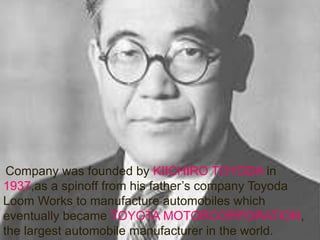
Company was founded by KIICHIRO TOYODA in
1937,as a spinoff from his father’s company Toyoda
Loom Works to manufacture automobiles which
eventually became TOYOTA MOTORCORPORATION,
the largest automobile manufacturer in the world.
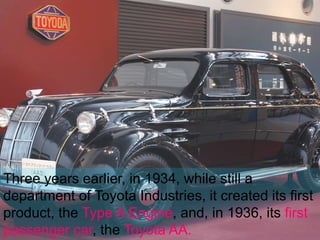
Three years earlier, in 1934, while still a
department of Toyota Industries, it created its first
product, the Type A Engine, and, in 1936, its first
passenger car, the Toyota AA.
TOYOTA
INTEGRATED
ASSEMBLY
NETWORKS
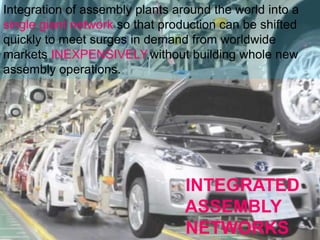
Integration of assembly plants around the world into a
single giant network so that production can be shifted
quickly to meet surges in demand from worldwide
markets INEXPENSIVELY,without building whole new
assembly operations.
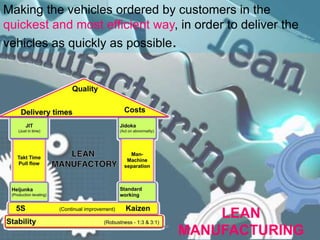
LEAN
MANUFACTURING
Making the vehicles ordered by customers in the
quickest and most efficient way, in order to deliver the
vehicles as quickly as possible.
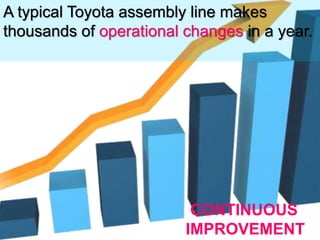
A typical Toyota assembly line makes
thousands of operational changes in a year.
CONTINUOUS
IMPROVEMENT
.
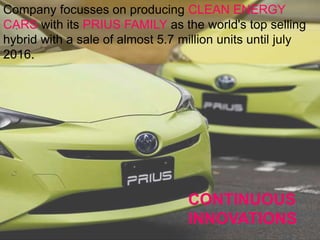
CONTINUOUS
INNOVATIONS
Company focusses on producing CLEAN ENERGY
CARS with its PRIUS FAMILY as the world's top selling
hybrid with a sale of almost 5.7 million units until july
2016.
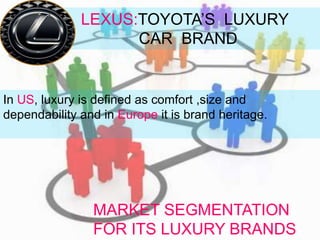
MARKET SEGMENTATION
FOR ITS LUXURY BRANDS
LEXUS:TOYOTA’S LUXURY
CAR BRAND
In US, luxury is defined as comfort ,size and
dependability and in Europe it is brand heritage.
GUARANTEED
AUTO
PROTECTION
•Provides insurance of the automobile and guaranteed
auto protection service .
•GAP is only available at the time of purchasing or
leasing new or used Toyota.
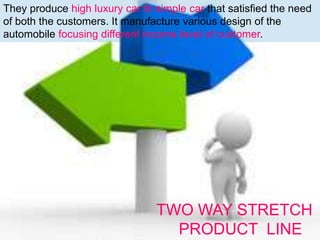
TWO WAY STRETCH
PRODUCT LINE
They produce high luxury car to simple car that satisfied the need
of both the customers. It manufacture various design of the
automobile focusing different income level of customer.
MARKET SEGMENT
Produces large range of subcompacts to luxury and
sports vehicles to SUVs, trucks, minivans, and buses.
They segment their product according to need of
customer.
LEXUS cars for high class people
SCION car for young adults, as this group
wanted more personalisation
Has Toyota done
the right thing by
manufacturing a car
brand for
everyone?
It has products for different price points demanded by consumers
and its plants can manufacture as many as 8 models at the same
time ,bringing huge increases in productivity and market
responsiveness.
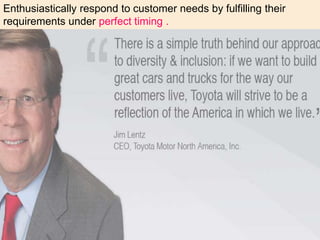
Enthusiastically respond to customer needs by fulfilling their
requirements under perfect timing .
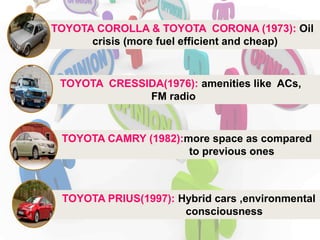
TOYOTA COROLLA & TOYOTA CORONA (1973): Oil
crisis (more fuel efficient and cheap)
TOYOTA CRESSIDA(1976): amenities like ACs,
FM radio
TOYOTA CAMRY (1982):more space as compared
to previous ones
TOYOTA PRIUS(1997): Hybrid cars ,environmental
consciousness
Toyota always keep their product selection
and quality very high for every price point
they offer.
S
U
M
M
A
R
Y
History of toyota
Why was it able to grow so much bigger
than any other auto manufacturer?
Has Toyota done the right thing by
manufacturing a car brand for
everyone? Why or why not?
Disclaimer
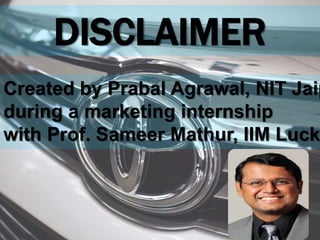
Created by Prabal Agrawal, NIT Jaip
during a marketing internship
with Prof. Sameer Mathur, IIM Luckn
DISCLAIMER

Toyota

  • 2.
    Company was foundedby KIICHIRO TOYODA in 1937,as a spinoff from his father’s company Toyoda Loom Works to manufacture automobiles which eventually became TOYOTA MOTORCORPORATION, the largest automobile manufacturer in the world.
  • 3.
    Three years earlier,in 1934, while still a department of Toyota Industries, it created its first product, the Type A Engine, and, in 1936, its first passenger car, the Toyota AA.
  • 4.
  • 5.
    INTEGRATED ASSEMBLY NETWORKS Integration of assemblyplants around the world into a single giant network so that production can be shifted quickly to meet surges in demand from worldwide markets INEXPENSIVELY,without building whole new assembly operations.
  • 6.
    LEAN MANUFACTURING Making the vehiclesordered by customers in the quickest and most efficient way, in order to deliver the vehicles as quickly as possible.
  • 7.
    A typical Toyotaassembly line makes thousands of operational changes in a year. CONTINUOUS IMPROVEMENT
  • 8.
    . CONTINUOUS INNOVATIONS Company focusses onproducing CLEAN ENERGY CARS with its PRIUS FAMILY as the world's top selling hybrid with a sale of almost 5.7 million units until july 2016.
  • 9.
    MARKET SEGMENTATION FOR ITSLUXURY BRANDS LEXUS:TOYOTA’S LUXURY CAR BRAND In US, luxury is defined as comfort ,size and dependability and in Europe it is brand heritage.
  • 10.
    GUARANTEED AUTO PROTECTION •Provides insurance ofthe automobile and guaranteed auto protection service . •GAP is only available at the time of purchasing or leasing new or used Toyota.
  • 11.
    TWO WAY STRETCH PRODUCTLINE They produce high luxury car to simple car that satisfied the need of both the customers. It manufacture various design of the automobile focusing different income level of customer.
  • 12.
    MARKET SEGMENT Produces largerange of subcompacts to luxury and sports vehicles to SUVs, trucks, minivans, and buses. They segment their product according to need of customer. LEXUS cars for high class people SCION car for young adults, as this group wanted more personalisation
  • 13.
    Has Toyota done theright thing by manufacturing a car brand for everyone?
  • 14.
    It has productsfor different price points demanded by consumers and its plants can manufacture as many as 8 models at the same time ,bringing huge increases in productivity and market responsiveness.
  • 15.
    Enthusiastically respond tocustomer needs by fulfilling their requirements under perfect timing .
  • 16.
    TOYOTA COROLLA &TOYOTA CORONA (1973): Oil crisis (more fuel efficient and cheap) TOYOTA CRESSIDA(1976): amenities like ACs, FM radio TOYOTA CAMRY (1982):more space as compared to previous ones TOYOTA PRIUS(1997): Hybrid cars ,environmental consciousness
  • 17.
    Toyota always keeptheir product selection and quality very high for every price point they offer.
  • 18.
    S U M M A R Y History of toyota Whywas it able to grow so much bigger than any other auto manufacturer? Has Toyota done the right thing by manufacturing a car brand for everyone? Why or why not? Disclaimer
  • 19.
    Created by PrabalAgrawal, NIT Jaip during a marketing internship with Prof. Sameer Mathur, IIM Luckn DISCLAIMER