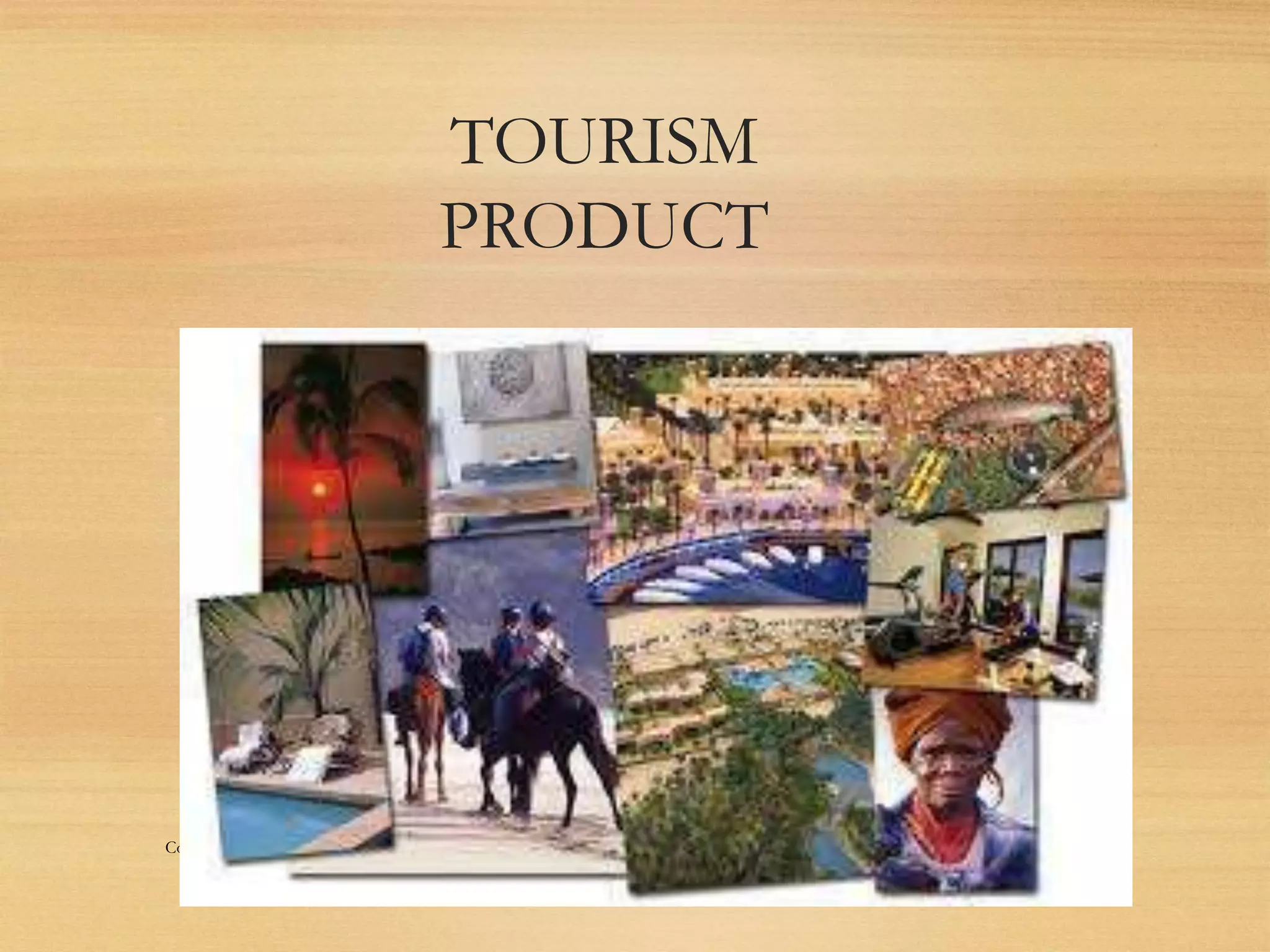
TOURISM
PRODUCT
Compiled by: Bhupender
PRODUCT
Anything that is offered in a market for use or consumption by
the consumers as per the market requirement is called a
Product.
According to Philip Kotler, “ A product is anything that can be
offered to a market for attention, acquisition, use or consumption
that might satisfy a want or need.”
Definition
Tourism product can be defined as the sum of physical &
psychological satisfaction it provides to tourists during
their travelling route to the destination.
What is TOURISM PRODUCT?
Compiled by: Bhupender
TOURISM
PRODUCT
• Tourism product is something that can be offered
to tourists to visit a tourist destination. The
products which satisfy the leisure, pleasure,
religious or business needs at places other than
the normal place of residence are known as
tourism products. Tourism products are offered in
the market with a cost. Tourism product are the
prime reason for tourist to choose a destination.
Tourism product helps in fetching revenue for the
destination. So they should be properly marketed
and preserved.
TOURISM
PRODUCT
• The tourist product focuses on facilities and
services designed to meet the needs of the
tourist. It can be seen as a composite product, as
the sum total of a country’s tourist attractions,
transport, and accommodation and of
entertainment which result in customer
satisfaction. Each of the components of a tourist
product is supplied by individual providers of
services like hotel companies, airlines, travel
agencies, etc. The tourist product can be analysed
in terms of its attraction, accessibility and
accommodation.
Component of Tourism Product
• Attractions
• Of the three basic components of a tourist product,
attractions are very important. Unless there is an
attraction, the tourist will not be motivated to go to a
particular place. Attractions are those elements in a
product which determine the choice made by particular
tourist to visit one particular destination rather than
another. The attractions could be cultural, like sites and
areas of archaeological interest, historical buildings and
monuments, flora and fauna, beach resorts, mountains,
national parks or events like trade fairs, exhibitions, arts
and music festivals, games, etc. Tourist demands are also
very much susceptible to changes in fashion.
Component of Tourism Product
• Accessibility
• It is a means by which a tourist can reach the area where
attractions are located. Tourist attractions of whatever type would
be of little importance if their locations are inaccessible by the
normal means of transport. A Tourist in order to get to his
destination needs some mode of transport. This mode maybe a
motor car, a coach, an aeroplane, a ship or a train which enables
him to reach his predetermined destination. If tourist destinations
are located at places where no transport can reach or where there
are inadequate transport facilities,they become of little value. The
tourist attractions, which are located near the tourist-generating
markets and are linked by a network of efficient means of
transport, receive the maximum number of tourists.
Component of Tourism Product
Accommodation
• The accommodation and other facilities
complement the attractions.
• Accommodation plays a central role and is
very basic to tourist destinations.
CHARACTERSTICS
1) Intangible
• Unlike a tangible product, say, a motor car or
refrigerator, no transfer of ownership of goods is
involved in tourism. The product here cannot be
seen or inspected before its purchase. Instead,
certain facilities, installations, items of equipment
are made available for a specified time and for a
specified use. For example, a seat in an aero
plane is provided only for a specified time.
CHARACTERSTICS
2) Psychological
• A large component of tourism product is the
satisfaction the consumer derives from its use.
A tourist acquires experiences while
interacting with the new environment and his
experiences help to attract and motivate
potential customers.
CHARACTERSTICS
• 3) Highly Perishable
• A travel agent or tour operator who sells a tourism
product cannot store it. Production can only take place
if the customer is actually present. And once
consumption begins, it cannot be stopped, interrupted
or modified. If the product remains unused, the
chances are lost i.e. if tourists do not visit particular
place, the opportunity at that time is lost. It is due to
this reason that heavy discount is offered by hotels and
transport generating organizations during off season.
CHARACTERSTICS
4) Composite Product
• The tourist product cannot be provided by a
single enterprise unlike a manufactured product.
The tourist product covers the complete
experience of a visit to a particular place. And
many providers contribute to this experience. For
instance, airline supplies seats, a hotel provides
rooms and restaurants, travel agents make
bookings for stay and sightseeing, etc.
CHARACTERSTICS
5) Unstable Demand
• Tourism demand is influenced by seasonal,
economic political and others suchfactors.
There are certain times of the year which see
a greater demand thanothers. At these times
there is a greater strain on services like hotel
bookings,employment, the transport system,
etc.
CHARACTERSTICS
6) Fixed supply in the short run
• The tourism product unlike a manufactured product
cannot be brought to the consumer; the consumer
must go to the product. This requires an in-depth study
of users’ behavior, taste preferences, likes and dislikes
so that expectations and realities coincide for the
maximum satisfaction of the consumer. The supply of a
tourism product is fixed in the short run and can
• only be increased in the long run following increased
demand patterns.
CHARACTERSTICS
7) Absence of ownership
• When you buy a car, the ownership of the car is
transferred to you, but when you hire a taxi youbuy the
right to be transported to a predetermined destination
at a predetermined price (fare). You neither own the
automobile nor the driver of the vehicle. Similarly,
hotel rooms, airline tickets, etc. can be used but not
owned. These services can be bought for consumption
but ownership remains with the provider of the
service. So, a dance can be enjoyed by viewing it, but
the dancer cannot be owned.
CHARACTERSTICS
8) Heterogeneous
• Tourism is not a homogeneous product since it
tends to vary in standard and quality over
time, unlike a T.V set or any other
manufactured product. A package tour or
even a flight on an aircraft can’t be consistent
at all times. The reason is that this product is a
service and services are people based. Due to
this, there is variability in this product.
CHARACTERSTICS
9) Risky
• The risk involved in the use of a tourism
product is heightened since it has to be
purchased before its consumption. An
element of chance is always present in its
consumption. Like, a show might not be as
entertaining as it promises to be or a beach
holiday might be disappointing due to heavy
rain.
CLASSIFICATION OF
TOURISM PRODUCT
• Natural tourism products- Beaches, islands,
mountains, hills, desert, wildlife (flora and
fauna), caves, glaciers, lakes, waterfalls, rivers.
• Examples: palm fringed beaches of Goa, snow
capped ountains in Kashmir, the flora and
fauna of Kaziranga National Park in Assam,
Dudhsagar fall in Goa, Thar Desert in Jaisalmer
etc. uct
• Man made tourism products- The manmade tourism products are
those which are built by humans. There can be manmade tourism
products which are purposely built for tourists. They can be
museums, casinos, theme parks. There are manmade attractions
which are not originally designed to attract tourists. They are forts,
palaces, temples etc.
• The manmade attractions also include customs and traditions of a
destination. Folk dance, classical dance, music, handicrafts, fairs and
festivals etc are other manmade attractions.
• Examples: Taj Mahal, Red Fort, India Gate, Lothal in Gujarat is an
important archaeological Indus Valley Site; National Museum in
New Delhi, Bhangra of Punjab, Madhubani paintings of Bihar, Brass
work of Muradabad etc.
• Site based tourism products- When attraction
is a place or site then it is site based tourism
product. Site of Taj Mahal, sunset at
Kanyakumari etc.
• Event based tourism product-Events attract
tourists as spectator and also as participants
in the events, sometimes both. Kite flying in
Ahmadabad attracts tourist both as spectators
and participants. Tourists can be spectators for
events like Olympics, Khajuraho dance festival.

Tourism Products.pptx

  • 1.
  • 2.
    PRODUCT Anything that isoffered in a market for use or consumption by the consumers as per the market requirement is called a Product. According to Philip Kotler, “ A product is anything that can be offered to a market for attention, acquisition, use or consumption that might satisfy a want or need.”
  • 3.
    Definition Tourism product canbe defined as the sum of physical & psychological satisfaction it provides to tourists during their travelling route to the destination. What is TOURISM PRODUCT? Compiled by: Bhupender
  • 4.
    TOURISM PRODUCT • Tourism productis something that can be offered to tourists to visit a tourist destination. The products which satisfy the leisure, pleasure, religious or business needs at places other than the normal place of residence are known as tourism products. Tourism products are offered in the market with a cost. Tourism product are the prime reason for tourist to choose a destination. Tourism product helps in fetching revenue for the destination. So they should be properly marketed and preserved.
  • 5.
    TOURISM PRODUCT • The touristproduct focuses on facilities and services designed to meet the needs of the tourist. It can be seen as a composite product, as the sum total of a country’s tourist attractions, transport, and accommodation and of entertainment which result in customer satisfaction. Each of the components of a tourist product is supplied by individual providers of services like hotel companies, airlines, travel agencies, etc. The tourist product can be analysed in terms of its attraction, accessibility and accommodation.
  • 6.
    Component of TourismProduct • Attractions • Of the three basic components of a tourist product, attractions are very important. Unless there is an attraction, the tourist will not be motivated to go to a particular place. Attractions are those elements in a product which determine the choice made by particular tourist to visit one particular destination rather than another. The attractions could be cultural, like sites and areas of archaeological interest, historical buildings and monuments, flora and fauna, beach resorts, mountains, national parks or events like trade fairs, exhibitions, arts and music festivals, games, etc. Tourist demands are also very much susceptible to changes in fashion.
  • 7.
    Component of TourismProduct • Accessibility • It is a means by which a tourist can reach the area where attractions are located. Tourist attractions of whatever type would be of little importance if their locations are inaccessible by the normal means of transport. A Tourist in order to get to his destination needs some mode of transport. This mode maybe a motor car, a coach, an aeroplane, a ship or a train which enables him to reach his predetermined destination. If tourist destinations are located at places where no transport can reach or where there are inadequate transport facilities,they become of little value. The tourist attractions, which are located near the tourist-generating markets and are linked by a network of efficient means of transport, receive the maximum number of tourists.
  • 8.
    Component of TourismProduct Accommodation • The accommodation and other facilities complement the attractions. • Accommodation plays a central role and is very basic to tourist destinations.
  • 9.
    CHARACTERSTICS 1) Intangible • Unlikea tangible product, say, a motor car or refrigerator, no transfer of ownership of goods is involved in tourism. The product here cannot be seen or inspected before its purchase. Instead, certain facilities, installations, items of equipment are made available for a specified time and for a specified use. For example, a seat in an aero plane is provided only for a specified time.
  • 10.
    CHARACTERSTICS 2) Psychological • Alarge component of tourism product is the satisfaction the consumer derives from its use. A tourist acquires experiences while interacting with the new environment and his experiences help to attract and motivate potential customers.
  • 11.
    CHARACTERSTICS • 3) HighlyPerishable • A travel agent or tour operator who sells a tourism product cannot store it. Production can only take place if the customer is actually present. And once consumption begins, it cannot be stopped, interrupted or modified. If the product remains unused, the chances are lost i.e. if tourists do not visit particular place, the opportunity at that time is lost. It is due to this reason that heavy discount is offered by hotels and transport generating organizations during off season.
  • 12.
    CHARACTERSTICS 4) Composite Product •The tourist product cannot be provided by a single enterprise unlike a manufactured product. The tourist product covers the complete experience of a visit to a particular place. And many providers contribute to this experience. For instance, airline supplies seats, a hotel provides rooms and restaurants, travel agents make bookings for stay and sightseeing, etc.
  • 13.
    CHARACTERSTICS 5) Unstable Demand •Tourism demand is influenced by seasonal, economic political and others suchfactors. There are certain times of the year which see a greater demand thanothers. At these times there is a greater strain on services like hotel bookings,employment, the transport system, etc.
  • 14.
    CHARACTERSTICS 6) Fixed supplyin the short run • The tourism product unlike a manufactured product cannot be brought to the consumer; the consumer must go to the product. This requires an in-depth study of users’ behavior, taste preferences, likes and dislikes so that expectations and realities coincide for the maximum satisfaction of the consumer. The supply of a tourism product is fixed in the short run and can • only be increased in the long run following increased demand patterns.
  • 15.
    CHARACTERSTICS 7) Absence ofownership • When you buy a car, the ownership of the car is transferred to you, but when you hire a taxi youbuy the right to be transported to a predetermined destination at a predetermined price (fare). You neither own the automobile nor the driver of the vehicle. Similarly, hotel rooms, airline tickets, etc. can be used but not owned. These services can be bought for consumption but ownership remains with the provider of the service. So, a dance can be enjoyed by viewing it, but the dancer cannot be owned.
  • 16.
    CHARACTERSTICS 8) Heterogeneous • Tourismis not a homogeneous product since it tends to vary in standard and quality over time, unlike a T.V set or any other manufactured product. A package tour or even a flight on an aircraft can’t be consistent at all times. The reason is that this product is a service and services are people based. Due to this, there is variability in this product.
  • 17.
    CHARACTERSTICS 9) Risky • Therisk involved in the use of a tourism product is heightened since it has to be purchased before its consumption. An element of chance is always present in its consumption. Like, a show might not be as entertaining as it promises to be or a beach holiday might be disappointing due to heavy rain.
  • 18.
    CLASSIFICATION OF TOURISM PRODUCT •Natural tourism products- Beaches, islands, mountains, hills, desert, wildlife (flora and fauna), caves, glaciers, lakes, waterfalls, rivers. • Examples: palm fringed beaches of Goa, snow capped ountains in Kashmir, the flora and fauna of Kaziranga National Park in Assam, Dudhsagar fall in Goa, Thar Desert in Jaisalmer etc. uct
  • 19.
    • Man madetourism products- The manmade tourism products are those which are built by humans. There can be manmade tourism products which are purposely built for tourists. They can be museums, casinos, theme parks. There are manmade attractions which are not originally designed to attract tourists. They are forts, palaces, temples etc. • The manmade attractions also include customs and traditions of a destination. Folk dance, classical dance, music, handicrafts, fairs and festivals etc are other manmade attractions. • Examples: Taj Mahal, Red Fort, India Gate, Lothal in Gujarat is an important archaeological Indus Valley Site; National Museum in New Delhi, Bhangra of Punjab, Madhubani paintings of Bihar, Brass work of Muradabad etc.
  • 20.
    • Site basedtourism products- When attraction is a place or site then it is site based tourism product. Site of Taj Mahal, sunset at Kanyakumari etc.
  • 21.
    • Event basedtourism product-Events attract tourists as spectator and also as participants in the events, sometimes both. Kite flying in Ahmadabad attracts tourist both as spectators and participants. Tourists can be spectators for events like Olympics, Khajuraho dance festival.