PRESENTATION TO THE TOURISM PORTFOLIO
COMMITTEE ON
TOURISM HUMAN RESOURCES DEVELOPMENT
STRATEGY (THRD)
13 APRIL 2010
Rationale for Tourism HRD Strategy
o There is a lack of service culture and ethos in the sector and in the
country in general.
o People development is fundamental to the success of public ,
private organizations and enterprises.
o It seeks to ensure that people are capable of undertaking their
responsibilities.
o Ensure a sustainable supply of talent to the organizations.
o It seeks to ensure that the sector is able to generate and sustain its
human capital needs.
o Skills development is able to keep pace with the growth in tourism
2
Methodology for Strategy Development
o To assess the status of Tourism Human Resources Development
(THRD) in the sector and determine the needs.
o To identify strategic focus areas for THRD that are responsive to
the tourism growth strategy and the overall strategic development
framework.
o To review the focus of the tourism industry and ensure that the
THRD strategy is responsive to the Sector’s strategic priorities.
o Alignment of the THRD with the National Human Resources
Development Strategy.
o Outline a comprehensive 5-year THRD strategy .
o To present an action plan and an implementation guide for the
adoption and roll out of the strategy in the sector.
3
Vision for Strategy
…Sustained and efficient human capital
formation to grow a service-oriented and
world class tourism destination …
4
Strategic Imperatives/Objectives for
HRD in Tourism
 A Service Ethos and Tourism Culture.
 Strengthening the Educational Foundation or Building Human
Capital in the Sector.
 Promoting Quality and Consistency in Training.
 Commitment, Collaboration and Joint Action to Minimize
Fragmentation. Training Interventions Designed to Foster
Transformation.
 Strengthen Private Sector Partnerships and Participation in Policy.
 Consolidating and Streamlining Disparate Initiatives into more
Coherent and Articulated Structures.
5
Strategic Imperatives/Objectives for
HRD in Tourism
 Ensure demand-led planning in skills development.
 Building competence in Tourism Management and Leadership in
public and private sector.
 Incentive-driven promotion of HRD for the sector.
 Building core and generic competencies as a stimulus for change.
 Building capacity in communities to assess, value and manage
tourism assets (building a tourism culture)
6
Strategic Initiatives
 National Tourism Careers Expo
 Educators seminar
 National Tourism Leadership Dialogue
 Tourism Service Excellence Initiative
 National Tourism Ambassador Programme
 Thematic Capacity Building (chefs, guides,
foreign language etc.)
 Tourism curriculum review
 Address matters related to conditions of
employment (decent work)
7
1. National Tourism Career Expo
 Serves as a platform
 to promote tourism as the career and profession of choice to the youth
and industry as an employer of choice to job seekers
 exchange of ideas, interests, need, requirements by both the industry and
the education sector
 Is the premier Tourism Human Resource Development event in the
country
 NTCE hosted twice (08 and 09) by NDT, DEDT-KZN & THETA
Partnership with a sum total of 29 000 participants and 100 exhibitors
 Additional arenas :
• recruitment clinic
• Adventure
• Conservation
8
6. Training Opportunities Domestically and
Internationally
 Partnership with the Deputy President`s Office on placement of unemployed graduates
established.
 64 unemployed tourism graduates placed at the Ritz Carlton Hotel in Canada for
experiential learning on hotel management.
 NDT provided Hospitality Youth Initiative with its database of unemployed graduates for their
3 months placement preparatory training
 32 youth from Gauteng are undergoing experiential learning at the City Lodge Hotel
Group
 102 Tourist Guides and frontline staff were trained on French, German, Spanish,
Portuguese during 2009,
 The project was implemented in partnership with Department of International Cooperation &
Organisation (DICO)
 About 40 tourist guides were placed in Spain for a period of 4 weeks during 2009
9
7. Tourism Leadership Dialogue
 This is a dialogue platform for industry captains from both public &
private sector to discuss pertinent industry issues affecting industry
growth and development.
 It has been successfully held on a quarterly basis since September 2008
with the sixth session held in March 2010
 It has drawn interest to an average of 50 participants per session
 It has led to Football Fridays Southern Sun idea being adopted by the
sector and the eventually the whole country followed suite.
 Minister`s round table discussions was also held with the Captain of the
industry to discuss and provide strategic leadership
10
9. Tourism Service Excellence
Initiative (TSEI)
 NDT launched Tourism Service Strategy during the Annual National
Tourism Conference held in 2008.
 The strategy has five implementation pillars namely: Research &
information; upskillling; public awareness; standards setting,
monitoring & measurement; and feedback mechanisms
 Key industry stakeholders and the public sector signed a pledge
committing to the provision of an excellent service through out the
tourism value chain
 The Research phase was conducted in 2009 with the view to
ascertain the levels and standards of service in South Africa.
11
9. Tourism Service Excellence
Initiative (TSEI)
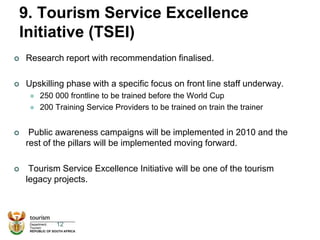
 Research report with recommendation finalised.
 Upskilling phase with a specific focus on front line staff underway.
 250 000 frontline to be trained before the World Cup
 200 Training Service Providers to be trained on train the trainer
 Public awareness campaigns will be implemented in 2010 and the
rest of the pillars will be implemented moving forward.
 Tourism Service Excellence Initiative will be one of the tourism
legacy projects.
12
10. Monitoring of THETA Sector
Skills Plan (SSP)
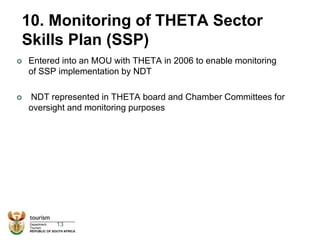
 Entered into an MOU with THETA in 2006 to enable monitoring
of SSP implementation by NDT
 NDT represented in THETA board and Chamber Committees for
oversight and monitoring purposes
13
Medium-term implementation Plan
14
Key Performance Areas
15
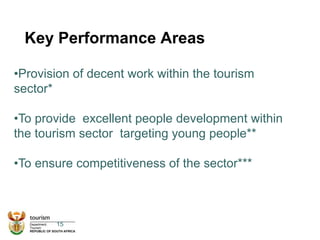
•Provision of decent work within the tourism
sector*
•To provide excellent people development within
the tourism sector targeting young people**
•To ensure competitiveness of the sector***
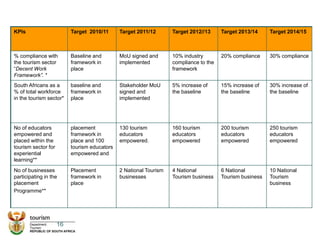
KPIs Target 2010/11 Target 2011/12 Target 2012//13 Target 2013/14 Target 2014/15
% compliance with
the tourism sector
“Decent Work
Framework”. *
Baseline and
framework in
place
MoU signed and
implemented
10% industry
compliance to the
framework
20% compliance 30% compliance
South Africans as a
% of total workforce
in the tourism sector*
baseline and
framework in
place
Stakeholder MoU
signed and
implemented
5% increase of
the baseline
15% increase of
the baseline
30% increase of
the baseline
No of educators
empowered and
placed within the
tourism sector for
experiential
learning**
placement
framework in
place and 100
tourism educators
empowered and
130 tourism
educators
empowered.
160 tourism
educators
empowered
200 tourism
educators
empowered
250 tourism
educators
empowered
No of businesses
participating in the
placement
Programme**
Placement
framework in
place
2 National Tourism
businesses
4 National
Tourism business
6 National
Tourism business
10 National
Tourism
business
16
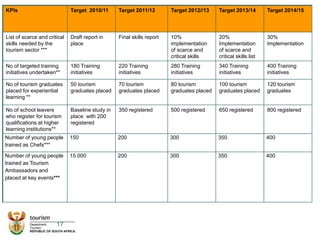
KPIs Target 2010/11 Target 2011/12 Target 2012//13 Target 2013/14 Target 2014/15
List of scarce and critical
skills needed by the
tourism sector ***
Draft report in
place
Final skills report 10%
implementation
of scarce and
critical skills
20%
Implementation
of scarce and
critical skills list
30%
Implementation
No of targeted training
initiatives undertaken**
180 Training
initiatives
220 Training
initiatives
280 Training
initiatives
340 Training
initiatives
400 Training
initiatives
No of tourism graduates
placed for experiential
learning **
50 tourism
graduates placed
70 tourism
graduates placed
80 tourism
graduates placed
100 tourism
graduates placed
120 tourism
graduates
No of school leavers
who register for tourism
qualifications at higher
learning institutions**
Baseline study in
place with 200
registered
350 registered 500 registered 650 registered 800 registered
Number of young people
trained as Chefs***
150 200 300 350 400
Number of young people
trained as Tourism
Ambassadors and
placed at key events***
15 000 200 300 350 400
17
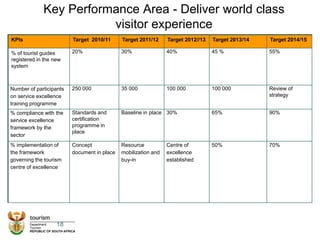
KPIs Target 2010/11 Target 2011/12 Target 2012//13 Target 2013/14 Target 2014/15
% of tourist guides
registered in the new
system
20% 30% 40% 45 % 55%
Number of participants
on service excellence
training programme
250 000 35 000 100 000 100 000 Review of
strategy
% compliance with the
service excellence
framework by the
sector
Standards and
certification
programme in
place
Baseline in place 30% 65% 90%
% implementation of
the framework
governing the tourism
centre of excellence
Concept
document in place
Resource
mobilization and
buy-in
Centre of
excellence
established
50% 70%
18
Key Performance Area - Deliver world class
visitor experience
THANK YOU
19

HRD In Tourism.ppt

  • 1.
    PRESENTATION TO THETOURISM PORTFOLIO COMMITTEE ON TOURISM HUMAN RESOURCES DEVELOPMENT STRATEGY (THRD) 13 APRIL 2010
  • 2.
    Rationale for TourismHRD Strategy o There is a lack of service culture and ethos in the sector and in the country in general. o People development is fundamental to the success of public , private organizations and enterprises. o It seeks to ensure that people are capable of undertaking their responsibilities. o Ensure a sustainable supply of talent to the organizations. o It seeks to ensure that the sector is able to generate and sustain its human capital needs. o Skills development is able to keep pace with the growth in tourism 2
  • 3.
    Methodology for StrategyDevelopment o To assess the status of Tourism Human Resources Development (THRD) in the sector and determine the needs. o To identify strategic focus areas for THRD that are responsive to the tourism growth strategy and the overall strategic development framework. o To review the focus of the tourism industry and ensure that the THRD strategy is responsive to the Sector’s strategic priorities. o Alignment of the THRD with the National Human Resources Development Strategy. o Outline a comprehensive 5-year THRD strategy . o To present an action plan and an implementation guide for the adoption and roll out of the strategy in the sector. 3
  • 4.
    Vision for Strategy …Sustainedand efficient human capital formation to grow a service-oriented and world class tourism destination … 4
  • 5.
    Strategic Imperatives/Objectives for HRDin Tourism  A Service Ethos and Tourism Culture.  Strengthening the Educational Foundation or Building Human Capital in the Sector.  Promoting Quality and Consistency in Training.  Commitment, Collaboration and Joint Action to Minimize Fragmentation. Training Interventions Designed to Foster Transformation.  Strengthen Private Sector Partnerships and Participation in Policy.  Consolidating and Streamlining Disparate Initiatives into more Coherent and Articulated Structures. 5
  • 6.
    Strategic Imperatives/Objectives for HRDin Tourism  Ensure demand-led planning in skills development.  Building competence in Tourism Management and Leadership in public and private sector.  Incentive-driven promotion of HRD for the sector.  Building core and generic competencies as a stimulus for change.  Building capacity in communities to assess, value and manage tourism assets (building a tourism culture) 6
  • 7.
    Strategic Initiatives  NationalTourism Careers Expo  Educators seminar  National Tourism Leadership Dialogue  Tourism Service Excellence Initiative  National Tourism Ambassador Programme  Thematic Capacity Building (chefs, guides, foreign language etc.)  Tourism curriculum review  Address matters related to conditions of employment (decent work) 7
  • 8.
    1. National TourismCareer Expo  Serves as a platform  to promote tourism as the career and profession of choice to the youth and industry as an employer of choice to job seekers  exchange of ideas, interests, need, requirements by both the industry and the education sector  Is the premier Tourism Human Resource Development event in the country  NTCE hosted twice (08 and 09) by NDT, DEDT-KZN & THETA Partnership with a sum total of 29 000 participants and 100 exhibitors  Additional arenas : • recruitment clinic • Adventure • Conservation 8
  • 9.
    6. Training OpportunitiesDomestically and Internationally  Partnership with the Deputy President`s Office on placement of unemployed graduates established.  64 unemployed tourism graduates placed at the Ritz Carlton Hotel in Canada for experiential learning on hotel management.  NDT provided Hospitality Youth Initiative with its database of unemployed graduates for their 3 months placement preparatory training  32 youth from Gauteng are undergoing experiential learning at the City Lodge Hotel Group  102 Tourist Guides and frontline staff were trained on French, German, Spanish, Portuguese during 2009,  The project was implemented in partnership with Department of International Cooperation & Organisation (DICO)  About 40 tourist guides were placed in Spain for a period of 4 weeks during 2009 9
  • 10.
    7. Tourism LeadershipDialogue  This is a dialogue platform for industry captains from both public & private sector to discuss pertinent industry issues affecting industry growth and development.  It has been successfully held on a quarterly basis since September 2008 with the sixth session held in March 2010  It has drawn interest to an average of 50 participants per session  It has led to Football Fridays Southern Sun idea being adopted by the sector and the eventually the whole country followed suite.  Minister`s round table discussions was also held with the Captain of the industry to discuss and provide strategic leadership 10
  • 11.
    9. Tourism ServiceExcellence Initiative (TSEI)  NDT launched Tourism Service Strategy during the Annual National Tourism Conference held in 2008.  The strategy has five implementation pillars namely: Research & information; upskillling; public awareness; standards setting, monitoring & measurement; and feedback mechanisms  Key industry stakeholders and the public sector signed a pledge committing to the provision of an excellent service through out the tourism value chain  The Research phase was conducted in 2009 with the view to ascertain the levels and standards of service in South Africa. 11
  • 12.
    9. Tourism ServiceExcellence Initiative (TSEI)  Research report with recommendation finalised.  Upskilling phase with a specific focus on front line staff underway.  250 000 frontline to be trained before the World Cup  200 Training Service Providers to be trained on train the trainer  Public awareness campaigns will be implemented in 2010 and the rest of the pillars will be implemented moving forward.  Tourism Service Excellence Initiative will be one of the tourism legacy projects. 12
  • 13.
    10. Monitoring ofTHETA Sector Skills Plan (SSP)  Entered into an MOU with THETA in 2006 to enable monitoring of SSP implementation by NDT  NDT represented in THETA board and Chamber Committees for oversight and monitoring purposes 13
  • 14.
  • 15.
    Key Performance Areas 15 •Provisionof decent work within the tourism sector* •To provide excellent people development within the tourism sector targeting young people** •To ensure competitiveness of the sector***
  • 16.
    KPIs Target 2010/11Target 2011/12 Target 2012//13 Target 2013/14 Target 2014/15 % compliance with the tourism sector “Decent Work Framework”. * Baseline and framework in place MoU signed and implemented 10% industry compliance to the framework 20% compliance 30% compliance South Africans as a % of total workforce in the tourism sector* baseline and framework in place Stakeholder MoU signed and implemented 5% increase of the baseline 15% increase of the baseline 30% increase of the baseline No of educators empowered and placed within the tourism sector for experiential learning** placement framework in place and 100 tourism educators empowered and 130 tourism educators empowered. 160 tourism educators empowered 200 tourism educators empowered 250 tourism educators empowered No of businesses participating in the placement Programme** Placement framework in place 2 National Tourism businesses 4 National Tourism business 6 National Tourism business 10 National Tourism business 16
  • 17.
    KPIs Target 2010/11Target 2011/12 Target 2012//13 Target 2013/14 Target 2014/15 List of scarce and critical skills needed by the tourism sector *** Draft report in place Final skills report 10% implementation of scarce and critical skills 20% Implementation of scarce and critical skills list 30% Implementation No of targeted training initiatives undertaken** 180 Training initiatives 220 Training initiatives 280 Training initiatives 340 Training initiatives 400 Training initiatives No of tourism graduates placed for experiential learning ** 50 tourism graduates placed 70 tourism graduates placed 80 tourism graduates placed 100 tourism graduates placed 120 tourism graduates No of school leavers who register for tourism qualifications at higher learning institutions** Baseline study in place with 200 registered 350 registered 500 registered 650 registered 800 registered Number of young people trained as Chefs*** 150 200 300 350 400 Number of young people trained as Tourism Ambassadors and placed at key events*** 15 000 200 300 350 400 17
  • 18.
    KPIs Target 2010/11Target 2011/12 Target 2012//13 Target 2013/14 Target 2014/15 % of tourist guides registered in the new system 20% 30% 40% 45 % 55% Number of participants on service excellence training programme 250 000 35 000 100 000 100 000 Review of strategy % compliance with the service excellence framework by the sector Standards and certification programme in place Baseline in place 30% 65% 90% % implementation of the framework governing the tourism centre of excellence Concept document in place Resource mobilization and buy-in Centre of excellence established 50% 70% 18 Key Performance Area - Deliver world class visitor experience
  • 19.