UNIT-I
INTRODUCTION TO RURAL
MARKETING
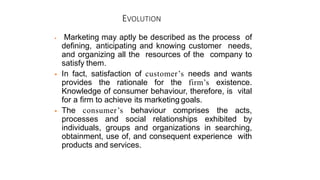
EVOLUTION
 Marketing may aptly be described as the process of
defining, anticipating and knowing customer needs,
and organizing all the resources of the company to
satisfy them.
 In fact, satisfaction of customer’s needs and wants
provides the rationale for the firm’s existence.
Knowledge of consumer behaviour, therefore, is vital
for a firm to achieve its marketing goals.
 The consumer’s behaviour comprises the acts,
processes and social relationships exhibited by
individuals, groups and organizations in searching,
obtainment, use of, and consequent experience with
products and services.
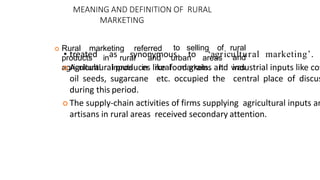
MEANING AND DEFINITION OF RURAL
MARKETING
 Rural marketing referred
products in rural and urban areas
to selling of rural
and
agricultural inputs in rural markets. It was
• treated as synonymous to ‘agricultural marketing’.
 Agricultural produces like food grains and industrial inputs like cot
oil seeds, sugarcane etc. occupied the central place of discus
during this period.
 The supply-chain activities of firms supplying agricultural inputs an
artisans in rural areas received secondary attention.
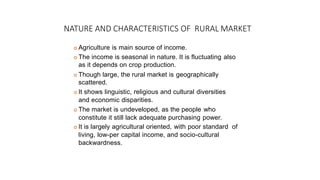
NATURE AND CHARACTERISTICS OF RURAL MARKET
 Agriculture is main source of income.
 The income is seasonal in nature. It is fluctuating also
as it depends on crop production.
 Though large, the rural market is geographically
scattered.
 It shows linguistic, religious and cultural diversities
and economic disparities.
 The market is undeveloped, as the people who
constitute it still lack adequate purchasing power.
 It is largely agricultural oriented, with poor standard of
living, low-per capital income, and socio-cultural
backwardness.
 It exhibits sharper and varied regional preferences with
distinct predilections, habit patterns and behavioral
characteristics.
 Rural marketing process is both a catalyst as well as an
outcome of the general rural development process.
Initiation and management of social and economic
change in the rural sector is the core of the rural
marketing process. It becomes in this process both
benefactor and beneficiary.
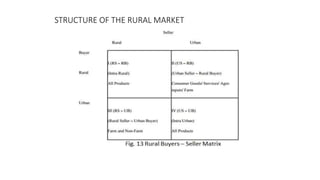
STRUCTURE OF THE RURAL MARKET
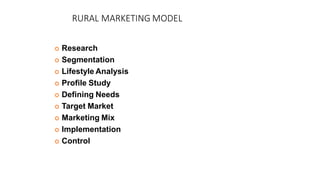
RURAL MARKETING MODEL
 Research
 Segmentation
 Lifestyle Analysis
 Profile Study
 Defining Needs
 Target Market
 Marketing Mix
 Implementation
 Control
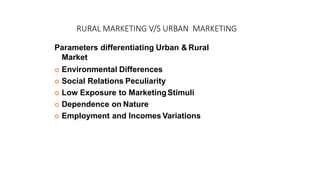
RURAL MARKETING V/S URBAN MARKETING
Parameters differentiating Urban & Rural
Market
 Environmental Differences
 Social Relations Peculiarity
 Low Exposure to MarketingStimuli
 Dependence on Nature
 Employment and Incomes Variations
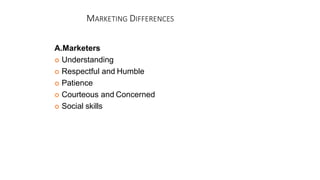
MARKETING DIFFERENCES
A.Marketers
 Understanding
 Respectful and Humble
 Patience
 Courteous and Concerned
 Social skills
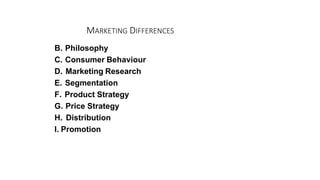
MARKETING DIFFERENCES
B. Philosophy
C. Consumer Behaviour
D. Marketing Research
E. Segmentation
F. Product Strategy
G. Price Strategy
H. Distribution
I. Promotion

RM-Unit -I.pptx

  • 2.
  • 3.
    EVOLUTION  Marketing mayaptly be described as the process of defining, anticipating and knowing customer needs, and organizing all the resources of the company to satisfy them.  In fact, satisfaction of customer’s needs and wants provides the rationale for the firm’s existence. Knowledge of consumer behaviour, therefore, is vital for a firm to achieve its marketing goals.  The consumer’s behaviour comprises the acts, processes and social relationships exhibited by individuals, groups and organizations in searching, obtainment, use of, and consequent experience with products and services.
  • 4.
    MEANING AND DEFINITIONOF RURAL MARKETING  Rural marketing referred products in rural and urban areas to selling of rural and agricultural inputs in rural markets. It was • treated as synonymous to ‘agricultural marketing’.  Agricultural produces like food grains and industrial inputs like cot oil seeds, sugarcane etc. occupied the central place of discus during this period.  The supply-chain activities of firms supplying agricultural inputs an artisans in rural areas received secondary attention.
  • 5.
    NATURE AND CHARACTERISTICSOF RURAL MARKET  Agriculture is main source of income.  The income is seasonal in nature. It is fluctuating also as it depends on crop production.  Though large, the rural market is geographically scattered.  It shows linguistic, religious and cultural diversities and economic disparities.  The market is undeveloped, as the people who constitute it still lack adequate purchasing power.  It is largely agricultural oriented, with poor standard of living, low-per capital income, and socio-cultural backwardness.
  • 6.
     It exhibitssharper and varied regional preferences with distinct predilections, habit patterns and behavioral characteristics.  Rural marketing process is both a catalyst as well as an outcome of the general rural development process. Initiation and management of social and economic change in the rural sector is the core of the rural marketing process. It becomes in this process both benefactor and beneficiary.
  • 7.
    STRUCTURE OF THERURAL MARKET
  • 8.
    RURAL MARKETING MODEL Research  Segmentation  Lifestyle Analysis  Profile Study  Defining Needs  Target Market  Marketing Mix  Implementation  Control
  • 9.
    RURAL MARKETING V/SURBAN MARKETING Parameters differentiating Urban & Rural Market  Environmental Differences  Social Relations Peculiarity  Low Exposure to MarketingStimuli  Dependence on Nature  Employment and Incomes Variations
  • 10.
    MARKETING DIFFERENCES A.Marketers  Understanding Respectful and Humble  Patience  Courteous and Concerned  Social skills
  • 11.
    MARKETING DIFFERENCES B. Philosophy C.Consumer Behaviour D. Marketing Research E. Segmentation F. Product Strategy G. Price Strategy H. Distribution I. Promotion