TOURISM IMPACTS
grade 11
Types of Tourism Impacts

ECONOMIC IMPACTS

SOCIO-CULTURAL IMPACTS

ENVIRONMENTAL IMPACTS
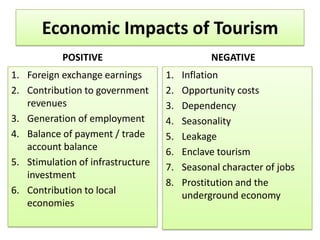
Economic Impacts of Tourism
POSITIVE
1. Foreign exchange earnings
2. Contribution to government
revenues
3. Generation of employment
4. Balance of payment / trade
account balance
5. Stimulation of infrastructure
investment
6. Contribution to local
economies

NEGATIVE
1.
2.
3.
4.
5.
6.
7.
8.

Inflation
Opportunity costs
Dependency
Seasonality
Leakage
Enclave tourism
Seasonal character of jobs
Prostitution and the
underground economy
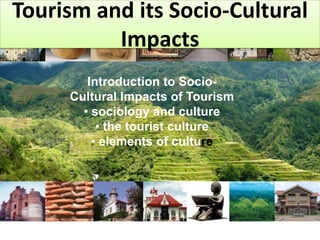
Tourism and its Socio-Cultural
Impacts
Introduction to SocioCultural Impacts of Tourism
• sociology and culture
• the tourist culture
• elements of culture
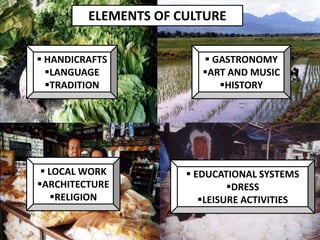
ELEMENTS OF CULTURE
 HANDICRAFTS
LANGUAGE
TRADITION

 GASTRONOMY
ART AND MUSIC
HISTORY

 LOCAL WORK
ARCHITECTURE
RELIGION

 EDUCATIONAL SYSTEMS
DRESS
LEISURE ACTIVITIES
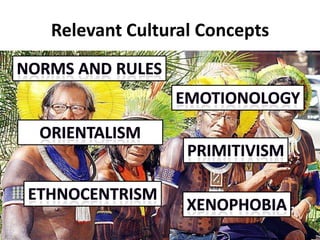
Relevant Cultural Concepts
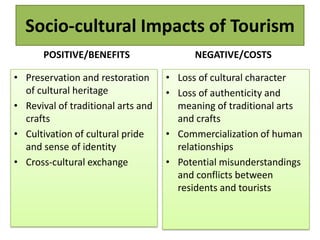
Socio-cultural Impacts of Tourism
POSITIVE/BENEFITS

• Preservation and restoration
of cultural heritage
• Revival of traditional arts and
crafts
• Cultivation of cultural pride
and sense of identity
• Cross-cultural exchange

NEGATIVE/COSTS

• Loss of cultural character
• Loss of authenticity and
meaning of traditional arts
and crafts
• Commercialization of human
relationships
• Potential misunderstandings
and conflicts between
residents and tourists
TOURISM & ITS
ENVIRONMENTAL IMPACTS
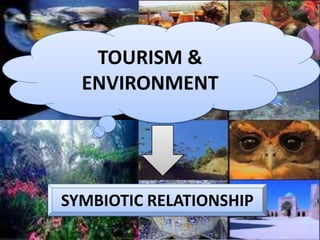
TOURISM &
ENVIRONMENT

SYMBIOTIC RELATIONSHIP
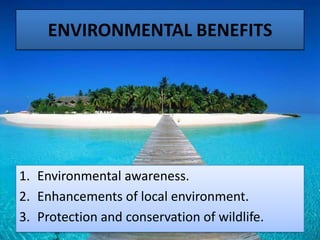
ENVIRONMENTAL BENEFITS

1. Environmental awareness.
2. Enhancements of local environment.
3. Protection and conservation of wildlife.
ENVIRONMENTAL COSTS
1.
2.
3.
4.
5.
6.

Inappropriate development
Loss of natural habitat and effects on wildlife
Pollution
Loss of spirit
Overcrowding and traffic congestion
Activities (affecting the natural environment)
Inappropriate development
• Tourism development may be classed as
inappropriate if it fails to be sensitive to the
natural environment.
• Long-term planning in environment terms should
be done.
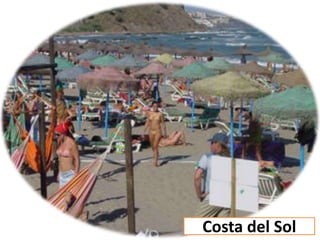
• Costa del Sol – had undergone a powerful
colonization of modern kind, it had robbed the
shore of its natural features, displaced headlands
and harbors with badly made structures.
• Resorts in Pattaya, Thailand – considered to be
overdeveloped.
Costa del Sol
“Environmental Awareness Raising”
• Tourism has the
potential to increase
public appreciation of
the environment and to
spread awareness of
environmental problems
when it brings people
into closer contact with
nature and the
environment.
Loss of natural habitat and
effects on wildlife
• Development of facilities and subsequent
tourist use may result in rapid or more gradual
effects on habitats.
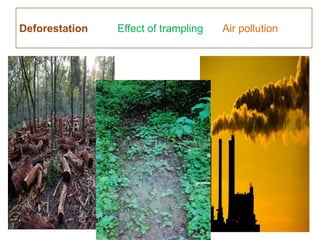
• Trampling causes disturbance to vegetation
and soil.
• Not unlike the Galapagos Island, 600 miles of
the coast of Ecuador.
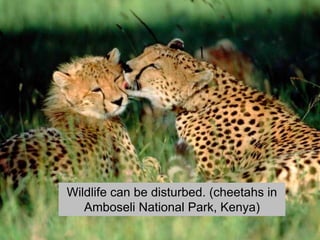
Wildlife can be disturbed. (cheetahs in
Amboseli National Park, Kenya)
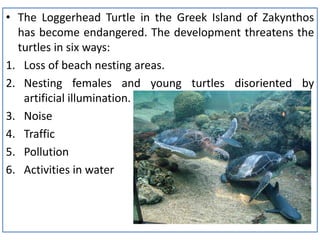
• The Loggerhead Turtle in the Greek Island of Zakynthos
has become endangered. The development threatens the
turtles in six ways:
1. Loss of beach nesting areas.
2. Nesting females and young turtles disoriented by
artificial illumination.
3. Noise
4. Traffic
5. Pollution
6. Activities in water
Deforestation

Effect of trampling

Air pollution
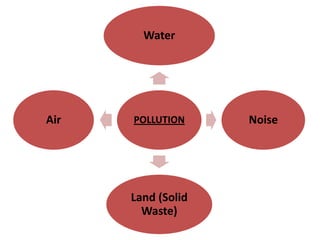
Water

Air

POLLUTION

Land (Solid
Waste)

Noise
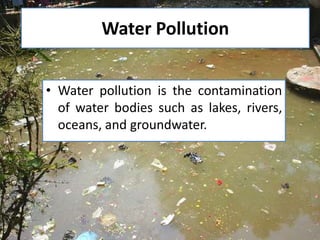
Water Pollution
• Water pollution is the contamination
of water bodies such as lakes, rivers,
oceans, and groundwater.
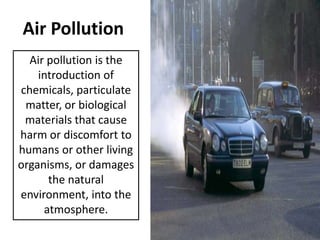
Air Pollution
Air pollution is the
introduction of
chemicals, particulate
matter, or biological
materials that cause
harm or discomfort to
humans or other living
organisms, or damages
the natural
environment, into the
atmosphere.
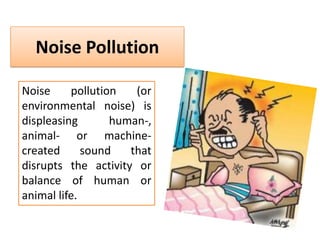
Noise Pollution
Noise
pollution
(or
environmental noise) is
displeasing
human-,
animal- or machinecreated
sound
that
disrupts the activity or
balance of human or
animal life.
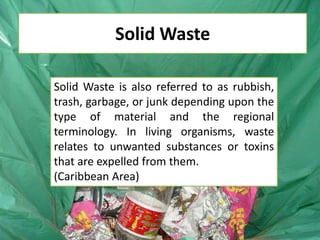
Solid Waste
Solid Waste is also referred to as rubbish,
trash, garbage, or junk depending upon the
type of material and the regional
terminology. In living organisms, waste
relates to unwanted substances or toxins
that are expelled from them.
(Caribbean Area)
Overcrowding and traffic congestion
• Happens when the volume of tourists exceeds
the capacity of an environment.
• Overcrowding poses an increased risk of
environmental damage through erosion and
restricts visitor appreciation of the
destination.
• Inappropriate parking
• Congestion damages vegetation, causes
erosion and adds to localized pollution.
Effects of activities
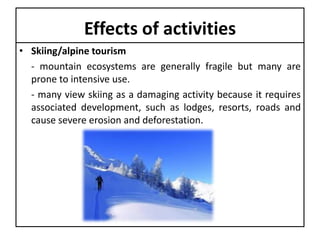
• Skiing/alpine tourism
- mountain ecosystems are generally fragile but many are
prone to intensive use.
- many view skiing as a damaging activity because it requires
associated development, such as lodges, resorts, roads and
cause severe erosion and deforestation.
Effects of activities

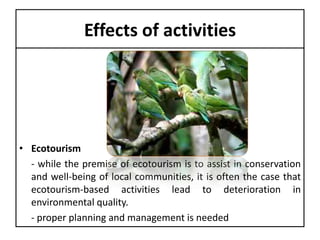
• Ecotourism
- while the premise of ecotourism is to assist in conservation
and well-being of local communities, it is often the case that
ecotourism-based activities lead to deterioration in
environmental quality.
- proper planning and management is needed
Tourism, Global
Warming and
Climate Change
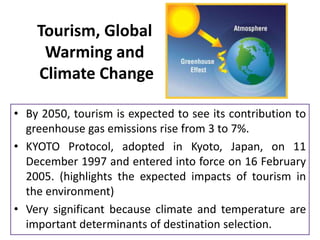
• By 2050, tourism is expected to see its contribution to
greenhouse gas emissions rise from 3 to 7%.
• KYOTO Protocol, adopted in Kyoto, Japan, on 11
December 1997 and entered into force on 16 February
2005. (highlights the expected impacts of tourism in
the environment)
• Very significant because climate and temperature are
important determinants of destination selection.
Tourism-related companies realized
that turning green makes good
business sense. The German tourism
industry experience.
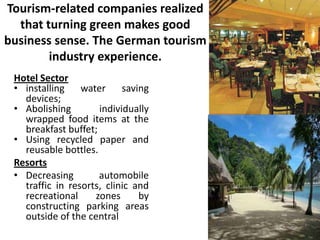
Hotel Sector
• installing
water
saving
devices;
• Abolishing
individually
wrapped food items at the
breakfast buffet;
• Using recycled paper and
reusable bottles.
Resorts
• Decreasing
automobile
traffic in resorts, clinic and
recreational
zones
by
constructing parking areas
outside of the central
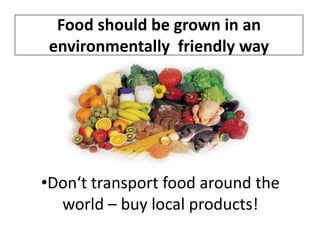
Food should be grown in an
environmentally friendly way

•Don‘t transport food around the
world – buy local products!
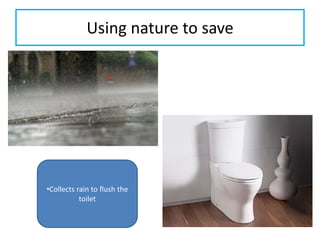
Using nature to save

•Collects rain to flush the
toilet
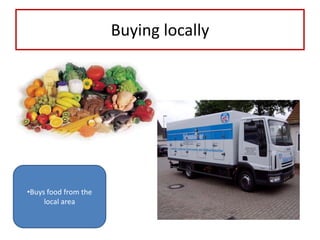
Buying locally

•Buys food from the
local area
Tourism-related companies realized that
turning green makes good business sense.

• Travel Agencies
- Publication of brochure
offering tips and
information on species
protection and
environmentally proper
behavior to vacationers.
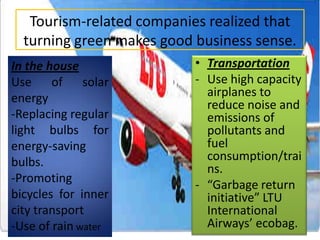
Tourism-related companies realized that
turning green makes good business sense.
In the house
Use of solar
energy
-Replacing regular
light bulbs for
energy-saving
bulbs.
-Promoting
bicycles for inner
city transport
-Use of rain water

• Transportation
- Use high capacity
airplanes to
reduce noise and
emissions of
pollutants and
fuel
consumption/trai
ns.
- “Garbage return
initiative” LTU
International
Airways’ ecobag.
Tourism-related companies realized that
turning green makes good business sense.
• Cities and Towns
- Use of solar energy
- Replacing regular light
bulbs for energy-saving
bulbs.
- Promoting bicycles for
inner city transport
- Use of rain water
Community
Dunedin City Council
• DCC hand out gloves and specially marked
rubbish bags to volunteers who offer to clean
up their area between August 22nd and
September 2nd for “Keep Dunedin beautiful”.
• Offer yellow lidded wheelie bins to Dunedin
households
References
Tourism impacts
• By Reymarie Oohlala, Lobby Ambassador at Pan
Pacific Hotel Singapore on Aug 04, 2013
http://www.slideshare.net/reymarieoohlala/chap5tourism-impacts?qid=2deaba2e-e6a5-4f47-9cf3bb17e75c41ac&v=qf1&b=&from_search=4
Comenius 2011-Sustainable Tourism in Nuremberg
• By Debreceni Bethlen Gábor Közgazdasági
Szakközépiskola on Oct 02, 2013
http://www.slideshare.net/dbgksz/comenius2011sustainable-tourism-innuremberg?qid=750b7567-2e11-4004-8319fb0ee0fc13d6&v=qf1&b=&from_search=12
• Energy Efficiency Dunedin City
http://www.slideshare.net/davidsonkate/responsible
-tourism-8889375?qid=0f2adbd0-34ea-4078-8054c05ba9653e88&v=default&b=&from_search=2
Responsible tourism
• By davidson kate on Aug 17, 2011
http://www.slideshare.net/davidsonkate/responsible
-tourism-8889375?qid=0f2adbd0-34ea-4078-8054c05ba9653e88&v=default&b=&from_search=2
Tourism impacts grade11

Tourism impacts grade11

  • 1.
  • 2.
    Types of TourismImpacts ECONOMIC IMPACTS SOCIO-CULTURAL IMPACTS ENVIRONMENTAL IMPACTS
  • 3.
    Economic Impacts ofTourism POSITIVE 1. Foreign exchange earnings 2. Contribution to government revenues 3. Generation of employment 4. Balance of payment / trade account balance 5. Stimulation of infrastructure investment 6. Contribution to local economies NEGATIVE 1. 2. 3. 4. 5. 6. 7. 8. Inflation Opportunity costs Dependency Seasonality Leakage Enclave tourism Seasonal character of jobs Prostitution and the underground economy
  • 4.
    Tourism and itsSocio-Cultural Impacts Introduction to SocioCultural Impacts of Tourism • sociology and culture • the tourist culture • elements of culture
  • 5.
    ELEMENTS OF CULTURE HANDICRAFTS LANGUAGE TRADITION  GASTRONOMY ART AND MUSIC HISTORY  LOCAL WORK ARCHITECTURE RELIGION  EDUCATIONAL SYSTEMS DRESS LEISURE ACTIVITIES
  • 6.
  • 7.
    Socio-cultural Impacts ofTourism POSITIVE/BENEFITS • Preservation and restoration of cultural heritage • Revival of traditional arts and crafts • Cultivation of cultural pride and sense of identity • Cross-cultural exchange NEGATIVE/COSTS • Loss of cultural character • Loss of authenticity and meaning of traditional arts and crafts • Commercialization of human relationships • Potential misunderstandings and conflicts between residents and tourists
  • 8.
  • 9.
  • 10.
    ENVIRONMENTAL BENEFITS 1. Environmentalawareness. 2. Enhancements of local environment. 3. Protection and conservation of wildlife.
  • 11.
    ENVIRONMENTAL COSTS 1. 2. 3. 4. 5. 6. Inappropriate development Lossof natural habitat and effects on wildlife Pollution Loss of spirit Overcrowding and traffic congestion Activities (affecting the natural environment)
  • 12.
    Inappropriate development • Tourismdevelopment may be classed as inappropriate if it fails to be sensitive to the natural environment. • Long-term planning in environment terms should be done. • Costa del Sol – had undergone a powerful colonization of modern kind, it had robbed the shore of its natural features, displaced headlands and harbors with badly made structures. • Resorts in Pattaya, Thailand – considered to be overdeveloped.
  • 13.
  • 14.
    “Environmental Awareness Raising” •Tourism has the potential to increase public appreciation of the environment and to spread awareness of environmental problems when it brings people into closer contact with nature and the environment.
  • 15.
    Loss of naturalhabitat and effects on wildlife • Development of facilities and subsequent tourist use may result in rapid or more gradual effects on habitats. • Trampling causes disturbance to vegetation and soil. • Not unlike the Galapagos Island, 600 miles of the coast of Ecuador.
  • 16.
    Wildlife can bedisturbed. (cheetahs in Amboseli National Park, Kenya)
  • 17.
    • The LoggerheadTurtle in the Greek Island of Zakynthos has become endangered. The development threatens the turtles in six ways: 1. Loss of beach nesting areas. 2. Nesting females and young turtles disoriented by artificial illumination. 3. Noise 4. Traffic 5. Pollution 6. Activities in water
  • 18.
  • 19.
  • 20.
    Water Pollution • Waterpollution is the contamination of water bodies such as lakes, rivers, oceans, and groundwater.
  • 21.
    Air Pollution Air pollutionis the introduction of chemicals, particulate matter, or biological materials that cause harm or discomfort to humans or other living organisms, or damages the natural environment, into the atmosphere.
  • 22.
    Noise Pollution Noise pollution (or environmental noise)is displeasing human-, animal- or machinecreated sound that disrupts the activity or balance of human or animal life.
  • 23.
    Solid Waste Solid Wasteis also referred to as rubbish, trash, garbage, or junk depending upon the type of material and the regional terminology. In living organisms, waste relates to unwanted substances or toxins that are expelled from them. (Caribbean Area)
  • 24.
    Overcrowding and trafficcongestion • Happens when the volume of tourists exceeds the capacity of an environment. • Overcrowding poses an increased risk of environmental damage through erosion and restricts visitor appreciation of the destination. • Inappropriate parking • Congestion damages vegetation, causes erosion and adds to localized pollution.
  • 25.
    Effects of activities •Skiing/alpine tourism - mountain ecosystems are generally fragile but many are prone to intensive use. - many view skiing as a damaging activity because it requires associated development, such as lodges, resorts, roads and cause severe erosion and deforestation.
  • 26.
    Effects of activities •Ecotourism - while the premise of ecotourism is to assist in conservation and well-being of local communities, it is often the case that ecotourism-based activities lead to deterioration in environmental quality. - proper planning and management is needed
  • 27.
    Tourism, Global Warming and ClimateChange • By 2050, tourism is expected to see its contribution to greenhouse gas emissions rise from 3 to 7%. • KYOTO Protocol, adopted in Kyoto, Japan, on 11 December 1997 and entered into force on 16 February 2005. (highlights the expected impacts of tourism in the environment) • Very significant because climate and temperature are important determinants of destination selection.
  • 28.
    Tourism-related companies realized thatturning green makes good business sense. The German tourism industry experience. Hotel Sector • installing water saving devices; • Abolishing individually wrapped food items at the breakfast buffet; • Using recycled paper and reusable bottles. Resorts • Decreasing automobile traffic in resorts, clinic and recreational zones by constructing parking areas outside of the central
  • 29.
    Food should begrown in an environmentally friendly way •Don‘t transport food around the world – buy local products!
  • 30.
    Using nature tosave •Collects rain to flush the toilet
  • 31.
    Buying locally •Buys foodfrom the local area
  • 32.
    Tourism-related companies realizedthat turning green makes good business sense. • Travel Agencies - Publication of brochure offering tips and information on species protection and environmentally proper behavior to vacationers.
  • 33.
    Tourism-related companies realizedthat turning green makes good business sense. In the house Use of solar energy -Replacing regular light bulbs for energy-saving bulbs. -Promoting bicycles for inner city transport -Use of rain water • Transportation - Use high capacity airplanes to reduce noise and emissions of pollutants and fuel consumption/trai ns. - “Garbage return initiative” LTU International Airways’ ecobag.
  • 34.
    Tourism-related companies realizedthat turning green makes good business sense. • Cities and Towns - Use of solar energy - Replacing regular light bulbs for energy-saving bulbs. - Promoting bicycles for inner city transport - Use of rain water
  • 35.
    Community Dunedin City Council •DCC hand out gloves and specially marked rubbish bags to volunteers who offer to clean up their area between August 22nd and September 2nd for “Keep Dunedin beautiful”. • Offer yellow lidded wheelie bins to Dunedin households
  • 36.
    References Tourism impacts • ByReymarie Oohlala, Lobby Ambassador at Pan Pacific Hotel Singapore on Aug 04, 2013 http://www.slideshare.net/reymarieoohlala/chap5tourism-impacts?qid=2deaba2e-e6a5-4f47-9cf3bb17e75c41ac&v=qf1&b=&from_search=4 Comenius 2011-Sustainable Tourism in Nuremberg • By Debreceni Bethlen Gábor Közgazdasági Szakközépiskola on Oct 02, 2013
  • 37.
    http://www.slideshare.net/dbgksz/comenius2011sustainable-tourism-innuremberg?qid=750b7567-2e11-4004-8319fb0ee0fc13d6&v=qf1&b=&from_search=12 • Energy EfficiencyDunedin City http://www.slideshare.net/davidsonkate/responsible -tourism-8889375?qid=0f2adbd0-34ea-4078-8054c05ba9653e88&v=default&b=&from_search=2 Responsible tourism • By davidson kate on Aug 17, 2011 http://www.slideshare.net/davidsonkate/responsible -tourism-8889375?qid=0f2adbd0-34ea-4078-8054c05ba9653e88&v=default&b=&from_search=2