
Tornado
 Rumsha Masood (11-ENV-22)
 Aleena Syed (11-ENV-28)
 Saira Shehzadi(11-ENV-06)
 AafiaTehrim (11-ENV-71)
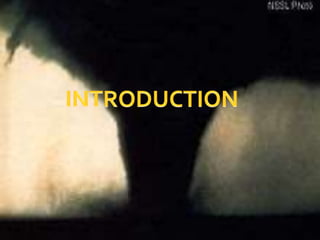
 A tornado is a violently rotating column of air
that is in contact with both the surface of the
earth and a cumulous cloud.
 Tornadoes come in many shapes and sizes,
but they are typically in the form of a
visible condensation funnel, whose narrow
end touches the earth and is often encircled
by a cloud of debris and dust.
 Most tornadoes have wind speeds less than
110 miles per hour (177 km/h) and travel a few
miles (several kilometers) before dissipating.
 The most extreme tornadoes can attain wind
speeds of more than 300 miles per hour
(483 km/h), stretch more than two miles (3.2
km) across, and stay on the ground for
dozens of miles (more than 100 km).
How do Tornadoes form?
Before thunderstorms
develop, a change in
wind direction and an
increase in wind speed
with increasing height
creates an invisible,
horizontal spinning
effect in the lower
atmosphere.
Rising air within the
thunderstorm
updraft tilts the
rotating air from
horizontal to
vertical.
An area of rotation,
2-6 miles wide,
now extends
through much of
the storm. Most
strong and violent
tornadoes form
within this area of
strong rotation.
 Various types of tornadoes include
 Land spout
 Multiple vortex tornado
 Waterspout
 Dust devil
 Steam devils
 RADAR
 Today, most developed countries have a network
of weather radar.
 In the United States and a few other countries,
Doppler weather radar stations are used.These
devices measure the velocity and radial
direction (towards or away from the radar) of the
winds in a storm, and so can spot evidence of
rotation in storms from more than a hundred
miles (160 km) away.
DETECTION
 Strength is measured by the Fujita Scale...
 F0 = weakest, F5 = Strongest
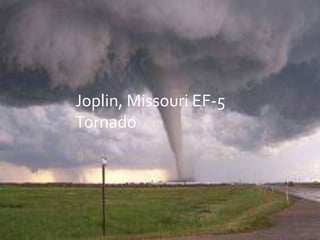
Joplin, Missouri EF-5
Tornado
Introduction
•Recorded on 22 May,2011.
•It hit the city name joplin,of the
Missouri a state of America.
•It came at 5:35 pm in the evening.
RANGE AND FREQUENCY
•Wind speed 210 mph.
•The tornado's total track length
was at least 22.1 miles (35.6 km)
long.
•It reached a width of atleast one
mile(1.6 km).
•It was recorded as EF-5 according
to Fujita scale.
DAMAGES
 Approximately 160 people died from this
tornado.
 The injuries were estimated to be around
1,000.
 7,000 houses and 2,000 buildings were
destroyed.
 An estimated 750 people have been treated
at area hospitals.
Note the pavement ripped up from the road and piled in front of the cars.
St John Regional Medical Centre
Note the pavement ripped up
from the road
 St John Regional Medical Centre
A church school in Joplin was also
flattened.
Aftermath and impact
 A preliminary survey of the tornado damage
by the National Weather Service, began on
May 23.
 According to National Weather Service ,
about 25% of Joplin was destroyed.
 The tornado caused $2.2 Billion Dollars in
damage.
Response
 Millions more dollars went to individuals for
temporary housing and other living expenses.
 Three temporary cell towers by May 24,
had been restored.
 President Obama greeted a tornado survivor
on May 29, 2011.
SIGNIFICANCE
 seventh deadliest tornado in U.S. history.
 26th-deadliest tornado inWorld history.
 It was the first EF5 tornado in Missouri
since 1957.
The Tri-State Tornado of 1925The Tri-State Tornado of 1925
Introduction
• Recorded on March 18, 1925.
• which roared through parts of
Missouri, Illinois, and Indiana.
• Tornado arrived in Indiana after
devastating parts of Missouri and
Illinois.
• This tornado occur at 11pm.
• Wind speed 73 mph, 117 km/h .
• longest path length (219 miles,
352 km).
• It was likely an F5.
• longest duration (about 3.5 hours)
RANGE AND FREQUENCY
Tornado Path
• 695 fatalities recorded.
DAMAGES
• The injuries were estimated near 2,027 .
• Thousands of homes and other
buildings in the tornado's path were
leveled.
• Over 15,000 homes and cities were
destroyed.
Significance
• It was the most extreme tornado in recorded
history of U.S.
• It was likely an F5, though tornadoes were not
ranked on any scale in that era.
• NOAA (National Oceanic and Atmospheric
Administration) resources say $16.5 million worth
of damage was caused by the tornado, but it does
not specify if that is modern amounts or the
amount in 1925.
Daultipur-SalturiaTornado
Bangladesh
Introduction
 It hit the city of Bangladesh that is Daulatpur-
Saturia and Dhaka.
 Recorded in April 26th , 1989.
 It took place at 6:30pm local time.
Range and Frequency
 It damaged the entire area of both cities of
Bangladesh.
 The tornado completely destroyed virtually
every structure it touched.
 It was estimated to be one mile wide and had a
path that was 50 miles north west and north of
Dhaka striking 5 districts through the poor slums
of Bangladesh.
Range and Frequency
 Wind speed 125mph.
 It lasted 20 minutes or longer.
 Fujita scale rating is unknown due to poor
housing construction and lack of data.
Damages
• Destroyed 90% of the homes and 153 villages.
• An estimated 1,300 people died from this
tornado.
• The injuries were estimated to be around
100,000.
• Damages occurred due to poor housing and
construction standards.
• 80,000 people were homeless by the storm.
Damages
Significance
 One of the extreme tornadoes in history.
 Even though it was deadliest but did not give a
proper name.
 Bangladesh is a country with highest frequency
Tornadoes after United States.
Aftermath and impacts
 According to recorded survey area had been in
the state of drought for six months after the
tornado hit.
 It was the costliest tornado in Bangladesh's
history.
 Due to it's big size it caused billions in damage.
Temporal spacing
 In Bangladesh, there are 2 tornado season
( March to May and October to November)
 About 25-30 local severe thunderstorms and
tornadoes lash the country during each of the
two tornado seasons
This tornado destroyed every
thing it touched.
TornadoSafetyRules
1. Seek shelter under a sturdy table in the basement.
2. If no basement is available, go to a first floor, small interior
room or a room on the opposite side from a tornado.
Stay away from windows.
3. In schools, churches, and shopping centers, go to designated
shelters away from outside walls, glass, and large rooms
(malls, auditoriums). Get under a table or counter or in a restroom
or small storeroom. DO NOT GOTOYOUR PARKED CAR
Tornado Safety Rules
4. In motels, lie down in the lowest-level interior hallway away
from glass. Dive under a bed or pull a mattress on top of you as
last resort.
5. In a vehicle, drive away at a right angle to the storm movement.
DO NOT GET CAUGHT INYOURVEHICLE. Abandon your
vehicle and lie in a ditch or culvert or under a low bridge.
Overall: Underground and under a table are the watchwords.
People who get under something usually survive.
References
 http://en.wikipedia.org/wiki/2011_Joplin_tornado
 http://en.wikipedia.org/wiki/Tri-State_Tornado
 http://www.crh.noaa.gov/pah/?n=1925tor
• http://wiki.answers.com/Q/How_much_did_the_Daulatpur-
_Saturia_tornado_cost
• http://en.wikipedia.org/wiki/Tornado
• http://www.tutorgigpedia.com/3dmaya+tornado+effect_es.html
• http://library.thinkquest.org/03oct/01424/how_do_tornadoes_form.htm
Tornadoes natural disaster

Tornadoes natural disaster

  • 2.
  • 3.
     Rumsha Masood(11-ENV-22)  Aleena Syed (11-ENV-28)  Saira Shehzadi(11-ENV-06)  AafiaTehrim (11-ENV-71)
  • 5.
     A tornadois a violently rotating column of air that is in contact with both the surface of the earth and a cumulous cloud.
  • 6.
     Tornadoes comein many shapes and sizes, but they are typically in the form of a visible condensation funnel, whose narrow end touches the earth and is often encircled by a cloud of debris and dust.
  • 7.
     Most tornadoeshave wind speeds less than 110 miles per hour (177 km/h) and travel a few miles (several kilometers) before dissipating.  The most extreme tornadoes can attain wind speeds of more than 300 miles per hour (483 km/h), stretch more than two miles (3.2 km) across, and stay on the ground for dozens of miles (more than 100 km).
  • 8.
    How do Tornadoesform? Before thunderstorms develop, a change in wind direction and an increase in wind speed with increasing height creates an invisible, horizontal spinning effect in the lower atmosphere. Rising air within the thunderstorm updraft tilts the rotating air from horizontal to vertical. An area of rotation, 2-6 miles wide, now extends through much of the storm. Most strong and violent tornadoes form within this area of strong rotation.
  • 9.
     Various typesof tornadoes include  Land spout  Multiple vortex tornado  Waterspout  Dust devil  Steam devils
  • 10.
     RADAR  Today,most developed countries have a network of weather radar.  In the United States and a few other countries, Doppler weather radar stations are used.These devices measure the velocity and radial direction (towards or away from the radar) of the winds in a storm, and so can spot evidence of rotation in storms from more than a hundred miles (160 km) away. DETECTION
  • 12.
     Strength ismeasured by the Fujita Scale...  F0 = weakest, F5 = Strongest
  • 14.
  • 15.
    Introduction •Recorded on 22May,2011. •It hit the city name joplin,of the Missouri a state of America. •It came at 5:35 pm in the evening.
  • 18.
    RANGE AND FREQUENCY •Windspeed 210 mph. •The tornado's total track length was at least 22.1 miles (35.6 km) long. •It reached a width of atleast one mile(1.6 km). •It was recorded as EF-5 according to Fujita scale.
  • 19.
    DAMAGES  Approximately 160people died from this tornado.  The injuries were estimated to be around 1,000.  7,000 houses and 2,000 buildings were destroyed.  An estimated 750 people have been treated at area hospitals.
  • 20.
    Note the pavementripped up from the road and piled in front of the cars.
  • 21.
    St John RegionalMedical Centre
  • 22.
    Note the pavementripped up from the road
  • 23.
     St JohnRegional Medical Centre
  • 25.
    A church schoolin Joplin was also flattened.
  • 26.
    Aftermath and impact A preliminary survey of the tornado damage by the National Weather Service, began on May 23.  According to National Weather Service , about 25% of Joplin was destroyed.  The tornado caused $2.2 Billion Dollars in damage.
  • 27.
    Response  Millions moredollars went to individuals for temporary housing and other living expenses.  Three temporary cell towers by May 24, had been restored.  President Obama greeted a tornado survivor on May 29, 2011.
  • 29.
    SIGNIFICANCE  seventh deadliesttornado in U.S. history.  26th-deadliest tornado inWorld history.  It was the first EF5 tornado in Missouri since 1957.
  • 30.
    The Tri-State Tornadoof 1925The Tri-State Tornado of 1925
  • 31.
    Introduction • Recorded onMarch 18, 1925. • which roared through parts of Missouri, Illinois, and Indiana. • Tornado arrived in Indiana after devastating parts of Missouri and Illinois. • This tornado occur at 11pm.
  • 32.
    • Wind speed73 mph, 117 km/h . • longest path length (219 miles, 352 km). • It was likely an F5. • longest duration (about 3.5 hours) RANGE AND FREQUENCY
  • 33.
  • 34.
    • 695 fatalitiesrecorded. DAMAGES • The injuries were estimated near 2,027 .
  • 35.
    • Thousands ofhomes and other buildings in the tornado's path were leveled. • Over 15,000 homes and cities were destroyed.
  • 36.
    Significance • It wasthe most extreme tornado in recorded history of U.S. • It was likely an F5, though tornadoes were not ranked on any scale in that era. • NOAA (National Oceanic and Atmospheric Administration) resources say $16.5 million worth of damage was caused by the tornado, but it does not specify if that is modern amounts or the amount in 1925.
  • 37.
  • 38.
    Introduction  It hitthe city of Bangladesh that is Daulatpur- Saturia and Dhaka.  Recorded in April 26th , 1989.  It took place at 6:30pm local time.
  • 40.
    Range and Frequency It damaged the entire area of both cities of Bangladesh.  The tornado completely destroyed virtually every structure it touched.  It was estimated to be one mile wide and had a path that was 50 miles north west and north of Dhaka striking 5 districts through the poor slums of Bangladesh.
  • 41.
    Range and Frequency Wind speed 125mph.  It lasted 20 minutes or longer.  Fujita scale rating is unknown due to poor housing construction and lack of data.
  • 42.
    Damages • Destroyed 90%of the homes and 153 villages. • An estimated 1,300 people died from this tornado. • The injuries were estimated to be around 100,000. • Damages occurred due to poor housing and construction standards. • 80,000 people were homeless by the storm.
  • 43.
  • 46.
    Significance  One ofthe extreme tornadoes in history.  Even though it was deadliest but did not give a proper name.  Bangladesh is a country with highest frequency Tornadoes after United States.
  • 47.
    Aftermath and impacts According to recorded survey area had been in the state of drought for six months after the tornado hit.  It was the costliest tornado in Bangladesh's history.  Due to it's big size it caused billions in damage.
  • 48.
    Temporal spacing  InBangladesh, there are 2 tornado season ( March to May and October to November)  About 25-30 local severe thunderstorms and tornadoes lash the country during each of the two tornado seasons
  • 49.
    This tornado destroyedevery thing it touched.
  • 51.
    TornadoSafetyRules 1. Seek shelterunder a sturdy table in the basement. 2. If no basement is available, go to a first floor, small interior room or a room on the opposite side from a tornado. Stay away from windows. 3. In schools, churches, and shopping centers, go to designated shelters away from outside walls, glass, and large rooms (malls, auditoriums). Get under a table or counter or in a restroom or small storeroom. DO NOT GOTOYOUR PARKED CAR
  • 52.
    Tornado Safety Rules 4.In motels, lie down in the lowest-level interior hallway away from glass. Dive under a bed or pull a mattress on top of you as last resort. 5. In a vehicle, drive away at a right angle to the storm movement. DO NOT GET CAUGHT INYOURVEHICLE. Abandon your vehicle and lie in a ditch or culvert or under a low bridge. Overall: Underground and under a table are the watchwords. People who get under something usually survive.
  • 53.
    References  http://en.wikipedia.org/wiki/2011_Joplin_tornado  http://en.wikipedia.org/wiki/Tri-State_Tornado http://www.crh.noaa.gov/pah/?n=1925tor • http://wiki.answers.com/Q/How_much_did_the_Daulatpur- _Saturia_tornado_cost • http://en.wikipedia.org/wiki/Tornado • http://www.tutorgigpedia.com/3dmaya+tornado+effect_es.html • http://library.thinkquest.org/03oct/01424/how_do_tornadoes_form.htm