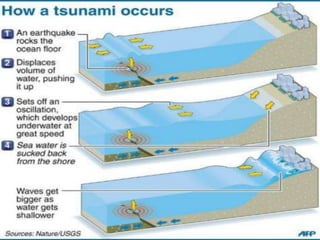
 The term tsunami comes from the Japanese 津波, tsu
  mean harbour and nami mean wave.
 A series of water waves caused by the displacement of
  a large volume of a body of water is known as tsunami.
 Tsunami waves do not resemble normal sea waves
  because their wavelength is far longer.
Tsunamis cause damage by two mechanisms

 The smashing force of a wall of water travelling at high
 speed,
 The destructive power of a large volume of water

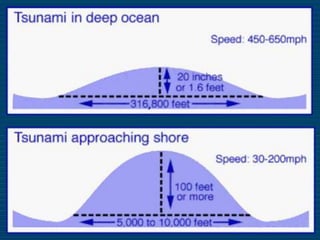
 While everyday wind waves have a wavelength of about
 100 metres and a height of roughly 2 metres, a tsunami
    in the deep ocean has a wavelength of about 200
     kilometres. Such a wave travels at well over 800
             kilometres per hour (500 mph).
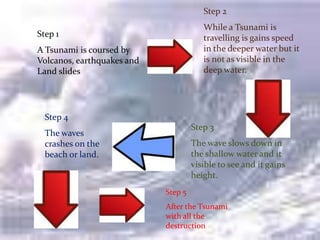
Step 2
                                        While a Tsunami is
Step 1                                  travelling is gains speed
A Tsunami is coursed by                 in the deeper water but it
Volcanos, earthquakes and               is not as visible in the
Land slides                             deep water.


  Step 4
                                     Step 3
  The waves
  crashes on the                     The wave slows down in
  beach or land.                     the shallow water and it
                                     visible to see and it gains
                                     height.
                            Step 5
                            After the Tsunami
                            with all the
                            destruction
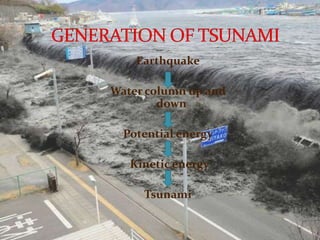
Earthquake

Water column up and
        down

  Potential energy

   Kinetic energy

     Tsunami
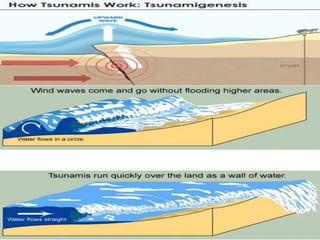
Get in a pool or the bath tub and put your hand a good
ways down and then pull it up quickly but not out of
the water, pull up strong but don't break the surface
and watch the result. Not exactly a tsunami, but a
simple version of the science.
Back
On December 26 ,
     2004
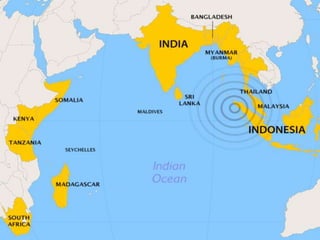
# It was an undersea earthquake.
# Occurred on December 26, 2004 of magnitude 9.3 with an
  epicentre off the west cost of Sumatra, Indonesia.
#Second deadliest earthquake of all time
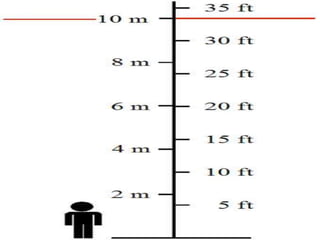
  observed up to 10 minutes
Date             26
                 December
                   2004

Magnitude      9.1–9.3 Mw[1]

   Depth        30 km
   Type        Undersea
                 Indonesia
Countries or
                 Sri Lanka
  regions
                   India
                  Thailand
                 Maldives
                 230,210 –
 Casualties    280,000 deaths
In an opinion piece in The Wall Street Journal, published
  five days after the tsunami, a journalist, Andrew
  Browne, argued that the human destruction of coral
  reefs may have played a role in exacerbating the
  destruction caused by the tsunami. Many countries
  across Asia, including Indonesia, Sri Lanka and
  Bangladesh, have put forth efforts to destroy the coral
  surrounding their beaches, and instead make way for
  shrimp farms and other economic choices.
Country
 where      Confirmed     Estimated1    Injured      Missing     Displaced
 deaths
occurred

Indonesia     130,736       167,799        n/a        37,063     500,000+[55]

Sri Lanka    35,322[56]     35,322      21,411[56]     n/a       516,150[56]

   India      12,405        18,045         n/a        5,640        647,599

 Thailand    5,3953[57]      8,212      8,457[58]    2,817[57]      7,000

 Somalia        78          289[59]        n/a         n/a        5,000[60]
Myanmar         61        400–600[61]      45         200[62]       3,200
(Burma)
Maldives       82[63]       108[64]        n/a          26        15,000+

Malaysia       68[65]         75         299[66]        6            n/a

Tanzania       10[67]         13           n/a         n/a           n/a
Seychelles       3[68]       3        57[68]      n/a      200[69]

Bangladesh        2          2         n/a        n/a        n/a

South Africa    24[70]       2         n/a        n/a        n/a

  Yemen          2[71]       2         n/a        n/a        n/a

  Kenya           1          1          2         n/a        n/a

Madagasca        n/a        n/a        n/a        n/a     1,000+[72]


  Total        ~184,167   ~230,273   ~125,000   ~45,752     ~1.69
                                                           million
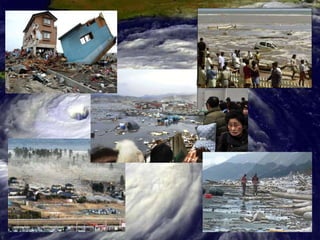
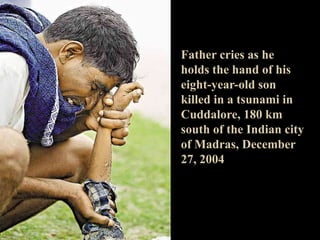
Father cries as he
holds the hand of his
eight-year-old son
killed in a tsunami in
Cuddalore, 180 km
south of the Indian city
of Madras, December
27, 2004
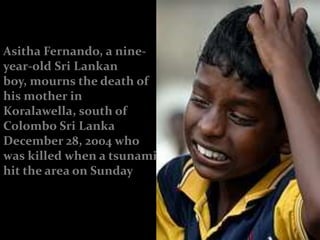
Asitha Fernando, a nine-
year-old Sri Lankan
boy, mourns the death of
his mother in
Koralawella, south of
Colombo Sri Lanka
December 28, 2004 who
was killed when a tsunami
hit the area on Sunday
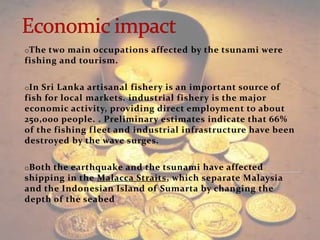
oThe two main occupations affected by the tsunami were
fishing and tourism.

oIn Sri Lanka artisanal fishery is an important source of
fish for local markets. industrial fishery is the major
economic activity, providing direct employment to about
250,000 people. . Preliminary estimates indicate that 66%
of the fishing f leet and industrial infrastructure have been
destroyed by the wave surges.

oBoth the earthquake and the tsunami have affected
shipping in the Malacca Straits, which separate Malaysia
and the Indonesian Island of Sumarta by changing the
depth of the seabed
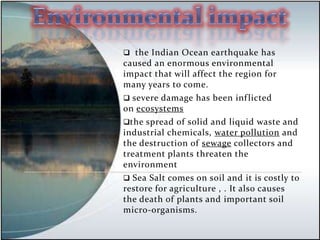
 the Indian Ocean earthquake has
caused an enormous environmental
impact that will affect the region for
many years to come.
 severe damage has been inf licted
on ecosystems
the spread of solid and liquid waste and
industrial chemicals, water pollution and
the destruction of sewage collectors and
treatment plants threaten the
environment
 Sea Salt comes on soil and it is costly to
restore for agriculture , . It also causes
the death of plants and important soil
micro-organisms.
 Contact friends and family immediately if possible
 It is important to stay calm during evacuation. Further, it is also
  important to remember that you should evacuate to a place of higher
  ground.
 If you are in a school, college or university do what the staff tell you to.
 If you are on the beach or somewhere within a tsunami zone and feel
  an earthquake, do not wait for a warning. Immediately move away from
  the low lying area to a higher one. Keep in mind that if this occurs, you
  may have only minutes to move to higher ground.
 In other words, stay calm but be quick! If there is a regional
  earthquake, sometimes a warning will not be posted before the
  tsunami hits home.
 Another well known precursor to a tsunami is that the
  tide will often roll out extremely quickly and far. Know
  this. However, if this occurs you likely have very little
  time before the tsunami hits. So, evacuate to higher
  ground immediately.
 6. If you are on the beach and an earthquake or some
  other tsunami warning sign occurs, it may be prudent
  to keep in mind that multi story hotels with concrete
  reinforcement may provide a safe haven.
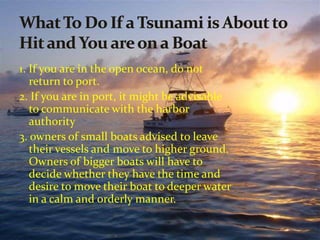
1. If you are in the open ocean, do not
   return to port.
2. If you are in port, it might be advisable
   to communicate with the harbor
   authority
3. owners of small boats advised to leave
   their vessels and move to higher ground.
   Owners of bigger boats will have to
   decide whether they have the time and
   desire to move their boat to deeper water
   in a calm and orderly manner.
Tsunami
Tsunami

Tsunami

  • 2.
     The termtsunami comes from the Japanese 津波, tsu mean harbour and nami mean wave.  A series of water waves caused by the displacement of a large volume of a body of water is known as tsunami.  Tsunami waves do not resemble normal sea waves because their wavelength is far longer.
  • 3.
    Tsunamis cause damageby two mechanisms  The smashing force of a wall of water travelling at high speed,  The destructive power of a large volume of water While everyday wind waves have a wavelength of about 100 metres and a height of roughly 2 metres, a tsunami in the deep ocean has a wavelength of about 200 kilometres. Such a wave travels at well over 800 kilometres per hour (500 mph).
  • 6.
    Step 2 While a Tsunami is Step 1 travelling is gains speed A Tsunami is coursed by in the deeper water but it Volcanos, earthquakes and is not as visible in the Land slides deep water. Step 4 Step 3 The waves crashes on the The wave slows down in beach or land. the shallow water and it visible to see and it gains height. Step 5 After the Tsunami with all the destruction
  • 7.
    Earthquake Water column upand down Potential energy Kinetic energy Tsunami
  • 9.
    Get in apool or the bath tub and put your hand a good ways down and then pull it up quickly but not out of the water, pull up strong but don't break the surface and watch the result. Not exactly a tsunami, but a simple version of the science.
  • 10.
  • 12.
    # It wasan undersea earthquake. # Occurred on December 26, 2004 of magnitude 9.3 with an epicentre off the west cost of Sumatra, Indonesia. #Second deadliest earthquake of all time observed up to 10 minutes
  • 13.
    Date 26 December 2004 Magnitude 9.1–9.3 Mw[1] Depth 30 km Type Undersea Indonesia Countries or Sri Lanka regions India Thailand Maldives 230,210 – Casualties 280,000 deaths
  • 15.
    In an opinionpiece in The Wall Street Journal, published five days after the tsunami, a journalist, Andrew Browne, argued that the human destruction of coral reefs may have played a role in exacerbating the destruction caused by the tsunami. Many countries across Asia, including Indonesia, Sri Lanka and Bangladesh, have put forth efforts to destroy the coral surrounding their beaches, and instead make way for shrimp farms and other economic choices.
  • 16.
    Country where Confirmed Estimated1 Injured Missing Displaced deaths occurred Indonesia 130,736 167,799 n/a 37,063 500,000+[55] Sri Lanka 35,322[56] 35,322 21,411[56] n/a 516,150[56] India 12,405 18,045 n/a 5,640 647,599 Thailand 5,3953[57] 8,212 8,457[58] 2,817[57] 7,000 Somalia 78 289[59] n/a n/a 5,000[60] Myanmar 61 400–600[61] 45 200[62] 3,200 (Burma) Maldives 82[63] 108[64] n/a 26 15,000+ Malaysia 68[65] 75 299[66] 6 n/a Tanzania 10[67] 13 n/a n/a n/a
  • 17.
    Seychelles 3[68] 3 57[68] n/a 200[69] Bangladesh 2 2 n/a n/a n/a South Africa 24[70] 2 n/a n/a n/a Yemen 2[71] 2 n/a n/a n/a Kenya 1 1 2 n/a n/a Madagasca n/a n/a n/a n/a 1,000+[72] Total ~184,167 ~230,273 ~125,000 ~45,752 ~1.69 million
  • 20.
    Father cries ashe holds the hand of his eight-year-old son killed in a tsunami in Cuddalore, 180 km south of the Indian city of Madras, December 27, 2004
  • 21.
    Asitha Fernando, anine- year-old Sri Lankan boy, mourns the death of his mother in Koralawella, south of Colombo Sri Lanka December 28, 2004 who was killed when a tsunami hit the area on Sunday
  • 22.
    oThe two mainoccupations affected by the tsunami were fishing and tourism. oIn Sri Lanka artisanal fishery is an important source of fish for local markets. industrial fishery is the major economic activity, providing direct employment to about 250,000 people. . Preliminary estimates indicate that 66% of the fishing f leet and industrial infrastructure have been destroyed by the wave surges. oBoth the earthquake and the tsunami have affected shipping in the Malacca Straits, which separate Malaysia and the Indonesian Island of Sumarta by changing the depth of the seabed
  • 23.
     the IndianOcean earthquake has caused an enormous environmental impact that will affect the region for many years to come.  severe damage has been inf licted on ecosystems the spread of solid and liquid waste and industrial chemicals, water pollution and the destruction of sewage collectors and treatment plants threaten the environment  Sea Salt comes on soil and it is costly to restore for agriculture , . It also causes the death of plants and important soil micro-organisms.
  • 25.
     Contact friendsand family immediately if possible  It is important to stay calm during evacuation. Further, it is also important to remember that you should evacuate to a place of higher ground.  If you are in a school, college or university do what the staff tell you to.  If you are on the beach or somewhere within a tsunami zone and feel an earthquake, do not wait for a warning. Immediately move away from the low lying area to a higher one. Keep in mind that if this occurs, you may have only minutes to move to higher ground.  In other words, stay calm but be quick! If there is a regional earthquake, sometimes a warning will not be posted before the tsunami hits home.
  • 26.
     Another wellknown precursor to a tsunami is that the tide will often roll out extremely quickly and far. Know this. However, if this occurs you likely have very little time before the tsunami hits. So, evacuate to higher ground immediately.  6. If you are on the beach and an earthquake or some other tsunami warning sign occurs, it may be prudent to keep in mind that multi story hotels with concrete reinforcement may provide a safe haven.
  • 27.
    1. If youare in the open ocean, do not return to port. 2. If you are in port, it might be advisable to communicate with the harbor authority 3. owners of small boats advised to leave their vessels and move to higher ground. Owners of bigger boats will have to decide whether they have the time and desire to move their boat to deeper water in a calm and orderly manner.