Selection of Topic for Research
Dr. Aloysius H. Sequeira
Professor
School of Management,
NITK, Surathkal
email: aloysiushs@gmail.com
Defining research
• Research is an art of investigation of new and
innovative aspects of any branch of
knowledge.
• It comprises of defining and redefining
problems, formulating hypothesis, suggest
solutions or solution approaches , collecting
and analyzing data , deriving, experimenting ,
and eventually validating the hypothesis or
deducing new conclusions.
Prof. A.H.Sequeira 2
Defining Research
• Research is also defined as search for
knowledge through objective and systematic
method of finding solution to a problem or
developing foundational theories.
• Research is intended to fill research gaps or
solve problems.
• Research can be also revalidating existing
knowledge.
Prof. A.H.Sequeira 3
What is Research
• Culture-research is a culture to be practiced
through continued quest for innovation
• Attitude-needs hard work, dedication,
perseverance and an appropriate attitude
• Knowledge gaps- research should attempt to
fill existing knowledge gaps, create new
knowledge and validate existing knowledge.
Prof. A.H.Sequeira 4
Motivation for Research
• Intellectual satisfaction of doing something
innovative and creative
• Meaningful and long-lasting contributions
towards advancement of mankind and society
• Enjoy the challenges of solving unsolved problems
• Attain higher level of understanding of
fundamental concepts as well as practical
significances
• Degrees , financial benefits and respect comes
along the way
Prof. A.H.Sequeira 5
Summing up…. Research
• “Research” cannot be only taught , it also
requires practice.
• It does not follow “On-off model”, work once
and then relax .
• Continuous nourishment is essential
• There is no “one-size-fits-all” model, different
disciplines need different methodologies.
• Research dictates its own pace and direction –
should not be imposed
Prof. A.H.Sequeira 6
Essential 6 Components of
Research.
Prof. A.H.Sequeira 7
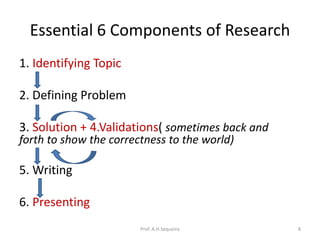
Essential 6 Components of Research
1. Identifying Topic
2. Defining Problem
3. Solution + 4.Validations( sometimes back and
forth to show the correctness to the world)
5. Writing
6. Presenting
Prof. A.H.Sequeira 8
Important 6 Guidelines for Topic
Selection
Prof. A.H.Sequeira 9
Selecting a Topic for Research-
Important 6 Guidelines
1. Realize your expertise and limitations
Expertise what you are good at
Limitation what you are not good at
• What you are interested not interested
• Are you willing to learn new areas
Prof. A.H.Sequeira 10
2. Focus on your breadth of knowledge
2. Focus on your breadth of knowledge first, not
the depth ; because depth is your goal.
• You may not have deep knowledge on your
topic
• Once you select the topic make your breadth
of knowledge strong
• Fundamentals should be clear.
Prof. A.H.Sequeira 11
3. Be specific about your topic but
flexible about the scope
E.g. I want to work on large scale systems..
I want to work on transmission losses..
I want to work on pollution …
• Don’t be copycats in selecting topics or areas
• Don’t put yourself in a box
Prof. A.H.Sequeira 12
4.Do not set rigid barriers regarding
the topic
• Keep flexibility in barriers
• Keep scope for expansion
• Accommodate new ideas
Prof. A.H.Sequeira 13
5. The topic may not be discipline
specific
• Problems are many times not discipline specific
but interdisciplinary
E.g. Imagine building a bridge across a river or
Tsunami - these are not only specific to Civil
engineering discipline alone.
Eg. Imagine Tsunami anticipation -not just one
discipline but many disciplines may be involved.
• These involve interdisciplinary thinking and
interaction.
Prof. A.H.Sequeira 14
6. Be prepared to revisit the topic
selection if needed.
• Keep the scope to change topic
• New topic may emerge while you do literature
search
Prof. A.H.Sequeira 15
Expanding knowledge
• It is desirable to expand your breadth of
knowledge on the selected topic
• Read the fundamentals on the topic to build
up the foundation for your research
• Feel open about broadening the scope of the
topic as you build up on it.
• Be prepared to revisit the topic selection if
needed
• It will pay off in long run.
Prof. A.H.Sequeira 16
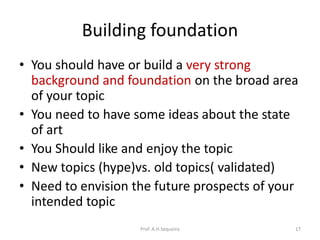
Building foundation
• You should have or build a very strong
background and foundation on the broad area
of your topic
• You need to have some ideas about the state
of art
• You Should like and enjoy the topic
• New topics (hype)vs. old topics( validated)
• Need to envision the future prospects of your
intended topic
Prof. A.H.Sequeira 17
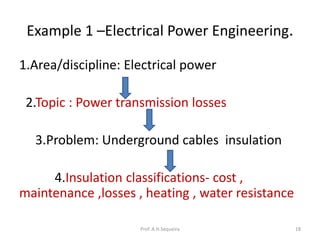
Example 1 –Electrical Power Engineering.
1.Area/discipline: Electrical power
2.Topic : Power transmission losses
3.Problem: Underground cables insulation
4.Insulation classifications- cost ,
maintenance ,losses , heating , water resistance
Prof. A.H.Sequeira 18
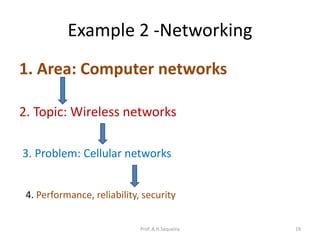
Example 2 -Networking
1. Area: Computer networks
2. Topic: Wireless networks
3. Problem: Cellular networks
4. Performance, reliability, security
Prof. A.H.Sequeira 19
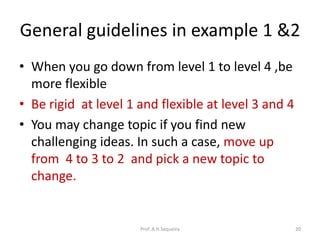
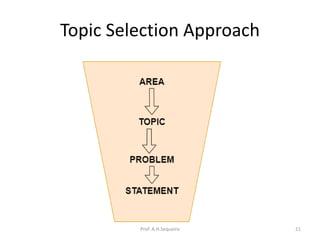
General guidelines in example 1 &2
• When you go down from level 1 to level 4 ,be
more flexible
• Be rigid at level 1 and flexible at level 3 and 4
• You may change topic if you find new
challenging ideas. In such a case, move up
from 4 to 3 to 2 and pick a new topic to
change.
Prof. A.H.Sequeira 20
Topic Selection Approach
Prof. A.H.Sequeira 21
Criteria for considering Potential
Topics
Prof. A.H.Sequeira 22
Some general Criteria for considering
Potential Topics
1. It needs to hold your interest for a long time.
It takes longer than you anticipate to write an
acceptable thesis.
2. It must be manageable in size. Most students
begin with a topic that is too large. Remember
you can’t do it all. Your goal is to add a small but
significant piece to the knowledge base.
Prof. A.H.Sequeira 23
Some general Criteria for considering
Potential Topics
3. It must have the potential to make an original
and significant contribution to knowledge. Can
you find a hole, a gap, a missing piece in the
knowledge base that you can fill and that would
be useful to theory or practice?
Prof. A.H.Sequeira 24
Some general Criteria for considering
Potential Topics
4. It must be doable within your time frame and
budget. Given your current situation, is it a
feasible topic to undertake?
5. It has to have obtainable data. You must be
able to collect data for the study from an
appropriate sample size in a reasonable period
of time.
Prof. A.H.Sequeira 25
Some general Criteria for considering
Potential Topics
6. It has not already been sufficiently
researched. There is no value to conducting one
more study about a topic that has been
researched over and over again.
7. It should be acceptable to your advisor and
committee members.
Prof. A.H.Sequeira 26
Summary: Topic selection
• Focus on your breadth of knowledge first, not the
depth ; because depth is your goal .
• Be specific about your topic but flexible about the
scope
• Don’t put yourself in a box
• Do not set rigid barriers regarding the topic
• The topic may not be discipline specific
• Be prepared to revisit the topic selection if needed
• Once you select the topic make your breadth of
knowledge strong – fundamentals be clear.
Prof. A.H.Sequeira 27
Final Advice
• Spend more time on formulating the problem
rather than jumping into any problem.
• Select broad topic and not too specific.
• Choose the topic jointly with
supervisor/guide.
Prof. A.H.Sequeira 28
References
• Donald Cooper, Pamela Schindler, Business Research
Methods: 12th Edition, McGraw-Hill Higher Education,
2013
• Earl Babbie, The Basic of Social Research, 7th Edition,
Wadsworth- Thomson Learning, 2018
• John W. Creswell and J. David Creswell, Research Design:
Qualitative, Quantitative, and Mixed Approaches, 5th
Edition, Sage Publication, 2018.
• Trochim, Donnelly, Arora Kanika, “Research
Methods: The Essential Knowledge Base”, Cengage
Learning, 2015
• https://www.youtube.com/watch?v=nv7MOoHMM2k
• https://www.youtube.com/watch?v=9IJscfF_irU
Prof. A.H.Sequeira 29

Topic selection slide share

  • 1.
    Selection of Topicfor Research Dr. Aloysius H. Sequeira Professor School of Management, NITK, Surathkal email: aloysiushs@gmail.com
  • 2.
    Defining research • Researchis an art of investigation of new and innovative aspects of any branch of knowledge. • It comprises of defining and redefining problems, formulating hypothesis, suggest solutions or solution approaches , collecting and analyzing data , deriving, experimenting , and eventually validating the hypothesis or deducing new conclusions. Prof. A.H.Sequeira 2
  • 3.
    Defining Research • Researchis also defined as search for knowledge through objective and systematic method of finding solution to a problem or developing foundational theories. • Research is intended to fill research gaps or solve problems. • Research can be also revalidating existing knowledge. Prof. A.H.Sequeira 3
  • 4.
    What is Research •Culture-research is a culture to be practiced through continued quest for innovation • Attitude-needs hard work, dedication, perseverance and an appropriate attitude • Knowledge gaps- research should attempt to fill existing knowledge gaps, create new knowledge and validate existing knowledge. Prof. A.H.Sequeira 4
  • 5.
    Motivation for Research •Intellectual satisfaction of doing something innovative and creative • Meaningful and long-lasting contributions towards advancement of mankind and society • Enjoy the challenges of solving unsolved problems • Attain higher level of understanding of fundamental concepts as well as practical significances • Degrees , financial benefits and respect comes along the way Prof. A.H.Sequeira 5
  • 6.
    Summing up…. Research •“Research” cannot be only taught , it also requires practice. • It does not follow “On-off model”, work once and then relax . • Continuous nourishment is essential • There is no “one-size-fits-all” model, different disciplines need different methodologies. • Research dictates its own pace and direction – should not be imposed Prof. A.H.Sequeira 6
  • 7.
    Essential 6 Componentsof Research. Prof. A.H.Sequeira 7
  • 8.
    Essential 6 Componentsof Research 1. Identifying Topic 2. Defining Problem 3. Solution + 4.Validations( sometimes back and forth to show the correctness to the world) 5. Writing 6. Presenting Prof. A.H.Sequeira 8
  • 9.
    Important 6 Guidelinesfor Topic Selection Prof. A.H.Sequeira 9
  • 10.
    Selecting a Topicfor Research- Important 6 Guidelines 1. Realize your expertise and limitations Expertise what you are good at Limitation what you are not good at • What you are interested not interested • Are you willing to learn new areas Prof. A.H.Sequeira 10
  • 11.
    2. Focus onyour breadth of knowledge 2. Focus on your breadth of knowledge first, not the depth ; because depth is your goal. • You may not have deep knowledge on your topic • Once you select the topic make your breadth of knowledge strong • Fundamentals should be clear. Prof. A.H.Sequeira 11
  • 12.
    3. Be specificabout your topic but flexible about the scope E.g. I want to work on large scale systems.. I want to work on transmission losses.. I want to work on pollution … • Don’t be copycats in selecting topics or areas • Don’t put yourself in a box Prof. A.H.Sequeira 12
  • 13.
    4.Do not setrigid barriers regarding the topic • Keep flexibility in barriers • Keep scope for expansion • Accommodate new ideas Prof. A.H.Sequeira 13
  • 14.
    5. The topicmay not be discipline specific • Problems are many times not discipline specific but interdisciplinary E.g. Imagine building a bridge across a river or Tsunami - these are not only specific to Civil engineering discipline alone. Eg. Imagine Tsunami anticipation -not just one discipline but many disciplines may be involved. • These involve interdisciplinary thinking and interaction. Prof. A.H.Sequeira 14
  • 15.
    6. Be preparedto revisit the topic selection if needed. • Keep the scope to change topic • New topic may emerge while you do literature search Prof. A.H.Sequeira 15
  • 16.
    Expanding knowledge • Itis desirable to expand your breadth of knowledge on the selected topic • Read the fundamentals on the topic to build up the foundation for your research • Feel open about broadening the scope of the topic as you build up on it. • Be prepared to revisit the topic selection if needed • It will pay off in long run. Prof. A.H.Sequeira 16
  • 17.
    Building foundation • Youshould have or build a very strong background and foundation on the broad area of your topic • You need to have some ideas about the state of art • You Should like and enjoy the topic • New topics (hype)vs. old topics( validated) • Need to envision the future prospects of your intended topic Prof. A.H.Sequeira 17
  • 18.
    Example 1 –ElectricalPower Engineering. 1.Area/discipline: Electrical power 2.Topic : Power transmission losses 3.Problem: Underground cables insulation 4.Insulation classifications- cost , maintenance ,losses , heating , water resistance Prof. A.H.Sequeira 18
  • 19.
    Example 2 -Networking 1.Area: Computer networks 2. Topic: Wireless networks 3. Problem: Cellular networks 4. Performance, reliability, security Prof. A.H.Sequeira 19
  • 20.
    General guidelines inexample 1 &2 • When you go down from level 1 to level 4 ,be more flexible • Be rigid at level 1 and flexible at level 3 and 4 • You may change topic if you find new challenging ideas. In such a case, move up from 4 to 3 to 2 and pick a new topic to change. Prof. A.H.Sequeira 20
  • 21.
  • 22.
    Criteria for consideringPotential Topics Prof. A.H.Sequeira 22
  • 23.
    Some general Criteriafor considering Potential Topics 1. It needs to hold your interest for a long time. It takes longer than you anticipate to write an acceptable thesis. 2. It must be manageable in size. Most students begin with a topic that is too large. Remember you can’t do it all. Your goal is to add a small but significant piece to the knowledge base. Prof. A.H.Sequeira 23
  • 24.
    Some general Criteriafor considering Potential Topics 3. It must have the potential to make an original and significant contribution to knowledge. Can you find a hole, a gap, a missing piece in the knowledge base that you can fill and that would be useful to theory or practice? Prof. A.H.Sequeira 24
  • 25.
    Some general Criteriafor considering Potential Topics 4. It must be doable within your time frame and budget. Given your current situation, is it a feasible topic to undertake? 5. It has to have obtainable data. You must be able to collect data for the study from an appropriate sample size in a reasonable period of time. Prof. A.H.Sequeira 25
  • 26.
    Some general Criteriafor considering Potential Topics 6. It has not already been sufficiently researched. There is no value to conducting one more study about a topic that has been researched over and over again. 7. It should be acceptable to your advisor and committee members. Prof. A.H.Sequeira 26
  • 27.
    Summary: Topic selection •Focus on your breadth of knowledge first, not the depth ; because depth is your goal . • Be specific about your topic but flexible about the scope • Don’t put yourself in a box • Do not set rigid barriers regarding the topic • The topic may not be discipline specific • Be prepared to revisit the topic selection if needed • Once you select the topic make your breadth of knowledge strong – fundamentals be clear. Prof. A.H.Sequeira 27
  • 28.
    Final Advice • Spendmore time on formulating the problem rather than jumping into any problem. • Select broad topic and not too specific. • Choose the topic jointly with supervisor/guide. Prof. A.H.Sequeira 28
  • 29.
    References • Donald Cooper,Pamela Schindler, Business Research Methods: 12th Edition, McGraw-Hill Higher Education, 2013 • Earl Babbie, The Basic of Social Research, 7th Edition, Wadsworth- Thomson Learning, 2018 • John W. Creswell and J. David Creswell, Research Design: Qualitative, Quantitative, and Mixed Approaches, 5th Edition, Sage Publication, 2018. • Trochim, Donnelly, Arora Kanika, “Research Methods: The Essential Knowledge Base”, Cengage Learning, 2015 • https://www.youtube.com/watch?v=nv7MOoHMM2k • https://www.youtube.com/watch?v=9IJscfF_irU Prof. A.H.Sequeira 29