It is really important to do the right research
as well as to do the research right.
You need to do ‘wow’ research, researchthat
is compelling, not justinteresting.
 Choosing a research problem to work on is a tough
decision to make, and the relevant advice is rather
infrequent.
Choosing Research Topic
 Identifying the right research area, and the right research
topic.
 The right topic will be interesting to you, complex, and
compelling.
 The research you do as a student will set the stage for your
research as future research and career.
 Choosing the right topic as a student will help you insure
that your research will be viable in the future.
There is nothing new under the sun!
Getting ideas for your topic
 Course Material: Go back over lecture notes or textbook
chapters to find atopic.
 Brain Storming : Take the general topic and create a
concept map for it. From thereyou may find someaspect
of the topic you would like toexplore.
 News: Yahoo News, CNN.com, local broadcast news all
cover recent events and may piqueyour interest for further
exploration of thestory.
 Internet: There are many reliable educational and current
event resources available on the Web that are excellent
sources of ideas for selecting research topics. Keep inmind
that because of the open nature of the Web, many
resources vary inquality.
Getting ideas for your topic
 Advisor/ Committee members/colleagues
 Reading literature/publications
 Library/internet
 Conferences/seminars
 Look what has been funded, whogets funded and by
whom?
 Draw inspiration from anywhere youcan
 What is a greatidea?
Formulating and clarifying your research topic
The important steps
 Identifying the attributes of a good research topic
 Generating ideas that help you select a suitable
topic
 Turning ideas into clear research questions and
objectives
 Writing your research proposal
Attributes of a good research topic (1)
Capability: is it feasible?
 Are you fascinated by the topic?
 Do you have the necessary research skills?
 Can you complete the project in the time available?
 Will the research still be current when you finish?
 Do you have sufficient financial and other resources?
 Will you be able to gain access to data?
Attributes of a good research topic (2)
Appropriateness: is it worthwhile?
 Will the examining institute's standards be met?
 Does the the topic contain issues with clear links to
theory?
 Are the research questions and objectives clearly
stated?
 Will the proposed research provide fresh insights into
the topic?
 Are the findings likely to be symmetrical?
 Does the research topic match your career goals?
Attributes of a good research topic (3)
And - (if relevant)
Does the topic relate clearly to an idea
you were given -
possibly by your organisation ?
Choose an interesting topic
There is more motivation to do a research assignment if
there is genuine interest in the topic. If the research
assignment is unrestricted, relate the topic to some
personal experience or issue of personal relevance. Ifyou
have no personal interest in the assigned topic, pick an
aspect of the topic you are curious to know more about.
Apprehension of Topic Selection
 Settling a research topic is often a low pointeven
for the most successfulstudents
 Why? Because it is veryimportant!
 It’s the next two (or three) yearsof your life
 Itwill define thearea foryour job search
 You may beworking in thesamearea (ora
derivative) for yearsafter
Things to Consider
 Doyou havea “preassigned” research advisorordo
you have to findone?
 What kind of job are you interestedin?
 Teaching, gov’t lab, industry
 Whatare your strengths? weaknesses?
 What drives you? boresyou?
 Technology, puzzles, applications, interdisciplinary
More Things to Consider
 Doesyouradvisor knowanything about the
topic? What isyour advisor’s style?
 Areyou morecomfortable working as partof a
team oralone?
 Doyou (i.e., youradvisor) have funding foryou
to work in thearea?
1) Flash of Brilliance Model
 Youwake uponedaywith a new insight/idea
 Newapproach tosolvean importantopen
problem
 Warnings:
 This rarely happens
 Even if it does, you may not beable to find an
advisor whoagrees
2) The Apprentice Model
 Youradvisorhas a listof topics
 Suggestsone (or more!) thatyou can work on
 Can saveyou a lotof time/anxiety
 Warnings:
 Don’t work on something you find boring,
fruitless, badly-motivated,…
 Several students may be working onthe
same/related problem
3) The Phoenix Model
 Youwork on some projectsand thinkvery hard
aboutwhatyou’vedone looking for insights
 Re-implement in a commonframework
 Identify an algorithm/proof probleminside
 The topicemerges fromyourwork
 Especially common insystems
 Warnings:
 You may be working without “a topic” for along
time
4) The Stapler Model
 Youwork on a numberof small topics that turn
into aseries of conference papers
 E.g., you figureout how toapplya technique (e.g.,
ILP) toa numberof key problems in an area
 You figureout somehow how to tie itall together,
create a chapter from each paper, and put a big
staple through it
 Warnings:
 May be hard/impossible to find thetie
5) The Synthesis Model
 You read some papers from other subfields in
computerscience/engineering ora related field
(e.g., biology)
 And look for places toapply insight from another
(sub)field to yourown
 E.g., databases tocompilers
 Warnings:
 You can spend a career readingpapers!
 You may not find any usefulconnections
6) The Expanded Term Project
Model
 You takea projectcourse thatgivesyou a new
perspective
 E.g., theory for systems and viceversa
 The project/papercombinesyourresearch project
with the courseproject
 One (and ½) project does doubleduty
 Warnings:
 This can distract fromyour research if you can’t
find a relatedproject/paper
Don’t be Afraid to Take Risks
 Switching areas/advisors can berisky
 May moveyou outsideyouradvisor’s areaof
expertise
 You don’t know the relatedwork
 You are starting fromscratch
 But itcan bevery refreshing!
 Recognize when your project isn’tworking
 Remember, its hard to publish negativeresults
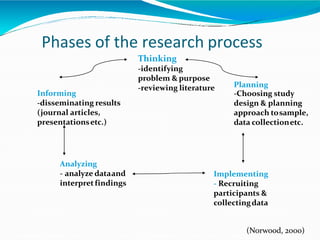
Phases of the research process
-reviewing literature
Thinking
-identifying
problem & purpose
Planning
-Choosing study
design & planning
approach tosample,
data collectionetc.
Implementing
- Recruiting
participants &
collectingdata
(Norwood, 2000)
Analyzing
- analyze dataand
interpretfindings
Informing
-disseminating results
(journal articles,
presentationsetc.)
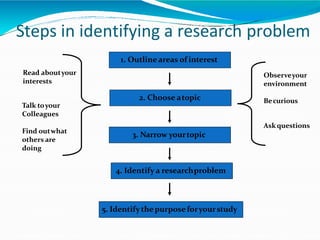
Steps in identifying a research problem
5. Identifythepurposeforyourstudy
4. Identify a researchproblem
3. Narrow yourtopic
1. Outline areas of interest
2. Choose atopic
Observeyour
environment
Becurious
Askquestions
Read aboutyour
interests
Talk toyour
Colleagues
Find outwhat
others are
doing
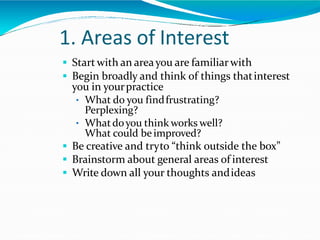
1. Areas of Interest
 Start with an areayou are familiarwith
 Begin broadly and think of things thatinterest
you in yourpractice
• What do you findfrustrating?
Perplexing?
• Whatdoyou think works well?
What could be improved?
 Be creative and tryto “think outside the box”
 Brainstorm about general areas of interest
 Write down all your thoughts andideas
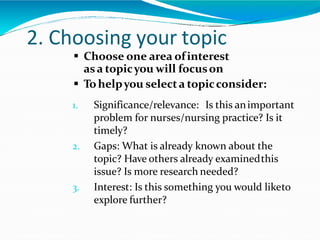
2. Choosing your topic
 Choose one area ofinterest
asa topicyou will focuson
 Tohelpyou selecta topicconsider:
1. Significance/relevance: Is this animportant
problem for nurses/nursing practice? Is it
timely?
2. Gaps: What is already known about the
topic? Have others already examinedthis
issue? Is more research needed?
3. Interest: Is this something you would liketo
explore further?
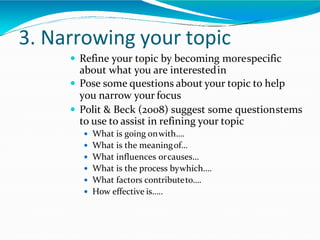
3. Narrowing your topic
 Refine your topic by becoming morespecific
about what you are interestedin
 Pose some questions about your topic to help
you narrow your focus
 Polit & Beck (2008) suggest some questionstems
to use to assist in refining your topic
 What is going onwith….
 What is the meaningof…
 What influences orcauses…
 What is the process bywhich….
 What factors contributeto….
 How effective is…..
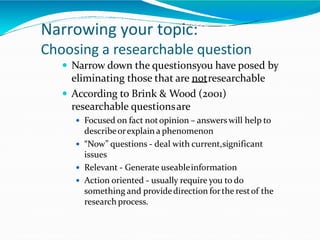
Narrowing your topic:
Choosing a researchable question
 Narrow down the questionsyou have posed by
eliminating those that are notresearchable
 According to Brink & Wood (2001)
researchable questionsare
 Focused on fact notopinion – answers will help to
describeorexplain a phenomenon
 “Now” questions - deal with current,significant
issues
 Relevant - Generate useableinformation
 Action oriented - usually require you to do
something and providedirection forthe restof the
research process.
5. Identifying the research problem
 To decide on your research problem consider
the potentially researchable questions about
your topic you identifiedearlier
 Select one that you would like to explore in
moredepth
 In choosing your focusconsider
 Yourinterests
 The literature
 Feasibility of studying theproblem
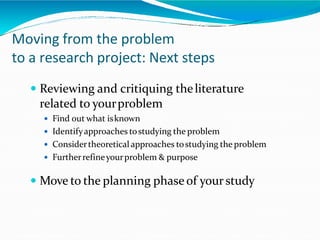
Moving from the problem
to a research project: Next steps
 Reviewing and critiquing theliterature
related to yourproblem
 Find out what isknown
 Identifyapproaches tostudying the problem
 Considertheoretical approaches tostudying the problem
 Furtherrefineyourproblem & purpose
 Move to the planning phase of yourstudy
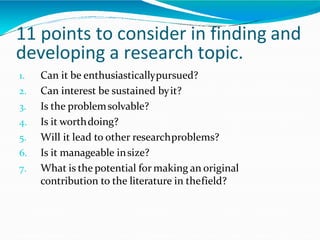
1. Can it be enthusiasticallypursued?
2. Can interest be sustained byit?
3. Is the problemsolvable?
4. Is it worthdoing?
5. Will it lead to other researchproblems?
6. Is it manageable insize?
7. What is the potential for making an original
contribution to the literature in thefield?
11 points to consider in finding and
developing a research topic.
38
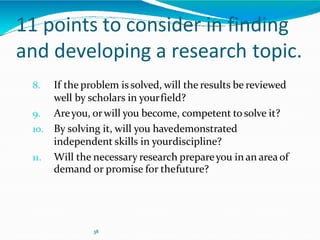
8. If the problem is solved, will the results be reviewed
well by scholars in yourfield?
9. Areyou, orwill you become, competent to solve it?
10. By solving it, will you havedemonstrated
independent skills in yourdiscipline?
11. Will the necessary research prepareyou in an area of
demand or promise for thefuture?
11 points to consider in finding
and developing a research topic.

Research.pptx

  • 2.
    It is reallyimportant to do the right research as well as to do the research right. You need to do ‘wow’ research, researchthat is compelling, not justinteresting.
  • 3.
     Choosing aresearch problem to work on is a tough decision to make, and the relevant advice is rather infrequent.
  • 4.
    Choosing Research Topic Identifying the right research area, and the right research topic.  The right topic will be interesting to you, complex, and compelling.  The research you do as a student will set the stage for your research as future research and career.  Choosing the right topic as a student will help you insure that your research will be viable in the future.
  • 5.
    There is nothingnew under the sun! Getting ideas for your topic
  • 6.
    Getting ideas foryour topic  Course Material: Go back over lecture notes or textbook chapters to find atopic.  Brain Storming : Take the general topic and create a concept map for it. From thereyou may find someaspect of the topic you would like toexplore.  News: Yahoo News, CNN.com, local broadcast news all cover recent events and may piqueyour interest for further exploration of thestory.  Internet: There are many reliable educational and current event resources available on the Web that are excellent sources of ideas for selecting research topics. Keep inmind that because of the open nature of the Web, many resources vary inquality.
  • 7.
    Getting ideas foryour topic  Advisor/ Committee members/colleagues  Reading literature/publications  Library/internet  Conferences/seminars  Look what has been funded, whogets funded and by whom?  Draw inspiration from anywhere youcan  What is a greatidea?
  • 8.
    Formulating and clarifyingyour research topic The important steps  Identifying the attributes of a good research topic  Generating ideas that help you select a suitable topic  Turning ideas into clear research questions and objectives  Writing your research proposal
  • 9.
    Attributes of agood research topic (1) Capability: is it feasible?  Are you fascinated by the topic?  Do you have the necessary research skills?  Can you complete the project in the time available?  Will the research still be current when you finish?  Do you have sufficient financial and other resources?  Will you be able to gain access to data?
  • 10.
    Attributes of agood research topic (2) Appropriateness: is it worthwhile?  Will the examining institute's standards be met?  Does the the topic contain issues with clear links to theory?  Are the research questions and objectives clearly stated?  Will the proposed research provide fresh insights into the topic?  Are the findings likely to be symmetrical?  Does the research topic match your career goals?
  • 11.
    Attributes of agood research topic (3) And - (if relevant) Does the topic relate clearly to an idea you were given - possibly by your organisation ?
  • 12.
    Choose an interestingtopic There is more motivation to do a research assignment if there is genuine interest in the topic. If the research assignment is unrestricted, relate the topic to some personal experience or issue of personal relevance. Ifyou have no personal interest in the assigned topic, pick an aspect of the topic you are curious to know more about.
  • 13.
    Apprehension of TopicSelection  Settling a research topic is often a low pointeven for the most successfulstudents  Why? Because it is veryimportant!  It’s the next two (or three) yearsof your life  Itwill define thearea foryour job search  You may beworking in thesamearea (ora derivative) for yearsafter
  • 14.
    Things to Consider Doyou havea “preassigned” research advisorordo you have to findone?  What kind of job are you interestedin?  Teaching, gov’t lab, industry  Whatare your strengths? weaknesses?  What drives you? boresyou?  Technology, puzzles, applications, interdisciplinary
  • 15.
    More Things toConsider  Doesyouradvisor knowanything about the topic? What isyour advisor’s style?  Areyou morecomfortable working as partof a team oralone?  Doyou (i.e., youradvisor) have funding foryou to work in thearea?
  • 17.
    1) Flash ofBrilliance Model  Youwake uponedaywith a new insight/idea  Newapproach tosolvean importantopen problem  Warnings:  This rarely happens  Even if it does, you may not beable to find an advisor whoagrees
  • 18.
    2) The ApprenticeModel  Youradvisorhas a listof topics  Suggestsone (or more!) thatyou can work on  Can saveyou a lotof time/anxiety  Warnings:  Don’t work on something you find boring, fruitless, badly-motivated,…  Several students may be working onthe same/related problem
  • 19.
    3) The PhoenixModel  Youwork on some projectsand thinkvery hard aboutwhatyou’vedone looking for insights  Re-implement in a commonframework  Identify an algorithm/proof probleminside  The topicemerges fromyourwork  Especially common insystems  Warnings:  You may be working without “a topic” for along time
  • 20.
    4) The StaplerModel  Youwork on a numberof small topics that turn into aseries of conference papers  E.g., you figureout how toapplya technique (e.g., ILP) toa numberof key problems in an area  You figureout somehow how to tie itall together, create a chapter from each paper, and put a big staple through it  Warnings:  May be hard/impossible to find thetie
  • 21.
    5) The SynthesisModel  You read some papers from other subfields in computerscience/engineering ora related field (e.g., biology)  And look for places toapply insight from another (sub)field to yourown  E.g., databases tocompilers  Warnings:  You can spend a career readingpapers!  You may not find any usefulconnections
  • 22.
    6) The ExpandedTerm Project Model  You takea projectcourse thatgivesyou a new perspective  E.g., theory for systems and viceversa  The project/papercombinesyourresearch project with the courseproject  One (and ½) project does doubleduty  Warnings:  This can distract fromyour research if you can’t find a relatedproject/paper
  • 23.
    Don’t be Afraidto Take Risks  Switching areas/advisors can berisky  May moveyou outsideyouradvisor’s areaof expertise  You don’t know the relatedwork  You are starting fromscratch  But itcan bevery refreshing!  Recognize when your project isn’tworking  Remember, its hard to publish negativeresults
  • 24.
    Phases of theresearch process -reviewing literature Thinking -identifying problem & purpose Planning -Choosing study design & planning approach tosample, data collectionetc. Implementing - Recruiting participants & collectingdata (Norwood, 2000) Analyzing - analyze dataand interpretfindings Informing -disseminating results (journal articles, presentationsetc.)
  • 25.
    Steps in identifyinga research problem 5. Identifythepurposeforyourstudy 4. Identify a researchproblem 3. Narrow yourtopic 1. Outline areas of interest 2. Choose atopic Observeyour environment Becurious Askquestions Read aboutyour interests Talk toyour Colleagues Find outwhat others are doing
  • 26.
    1. Areas ofInterest  Start with an areayou are familiarwith  Begin broadly and think of things thatinterest you in yourpractice • What do you findfrustrating? Perplexing? • Whatdoyou think works well? What could be improved?  Be creative and tryto “think outside the box”  Brainstorm about general areas of interest  Write down all your thoughts andideas
  • 27.
    2. Choosing yourtopic  Choose one area ofinterest asa topicyou will focuson  Tohelpyou selecta topicconsider: 1. Significance/relevance: Is this animportant problem for nurses/nursing practice? Is it timely? 2. Gaps: What is already known about the topic? Have others already examinedthis issue? Is more research needed? 3. Interest: Is this something you would liketo explore further?
  • 28.
    3. Narrowing yourtopic  Refine your topic by becoming morespecific about what you are interestedin  Pose some questions about your topic to help you narrow your focus  Polit & Beck (2008) suggest some questionstems to use to assist in refining your topic  What is going onwith….  What is the meaningof…  What influences orcauses…  What is the process bywhich….  What factors contributeto….  How effective is…..
  • 29.
    Narrowing your topic: Choosinga researchable question  Narrow down the questionsyou have posed by eliminating those that are notresearchable  According to Brink & Wood (2001) researchable questionsare  Focused on fact notopinion – answers will help to describeorexplain a phenomenon  “Now” questions - deal with current,significant issues  Relevant - Generate useableinformation  Action oriented - usually require you to do something and providedirection forthe restof the research process.
  • 30.
    5. Identifying theresearch problem  To decide on your research problem consider the potentially researchable questions about your topic you identifiedearlier  Select one that you would like to explore in moredepth  In choosing your focusconsider  Yourinterests  The literature  Feasibility of studying theproblem
  • 31.
    Moving from theproblem to a research project: Next steps  Reviewing and critiquing theliterature related to yourproblem  Find out what isknown  Identifyapproaches tostudying the problem  Considertheoretical approaches tostudying the problem  Furtherrefineyourproblem & purpose  Move to the planning phase of yourstudy
  • 32.
    1. Can itbe enthusiasticallypursued? 2. Can interest be sustained byit? 3. Is the problemsolvable? 4. Is it worthdoing? 5. Will it lead to other researchproblems? 6. Is it manageable insize? 7. What is the potential for making an original contribution to the literature in thefield? 11 points to consider in finding and developing a research topic.
  • 33.
    38 8. If theproblem is solved, will the results be reviewed well by scholars in yourfield? 9. Areyou, orwill you become, competent to solve it? 10. By solving it, will you havedemonstrated independent skills in yourdiscipline? 11. Will the necessary research prepareyou in an area of demand or promise for thefuture? 11 points to consider in finding and developing a research topic.