Compiled by
Sanchit Pathak
Bhavya Kenia
Mohanish Gaikwad
Krishna Chukewad
Devesh Kadam
Aditya Kakad
Abhiraj Phadnis
Akshay Rajput
Dhiraj Khadka
S.Y.BTech, Electrical Department ,V.J.T.I., Matunga, Mumbai-19.
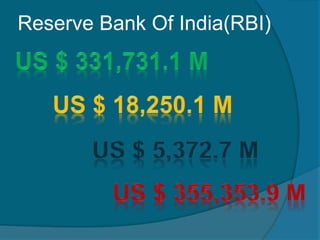
Reserve Bank Of India(RBI)
 Established - in Calcutta -1st April, 1935
 It was set up on the recommendations of
the HILTON YOUNG COMMISSION.
 It was started as a Share-Holders Bank -
paid up capital of Rs. 5 crs - initially
privately owned.
Reserve Bank Of India(RBI)
 1937 - moved to Mumbai.
 First bank to be Nationalised on 1st
Jan,1949.
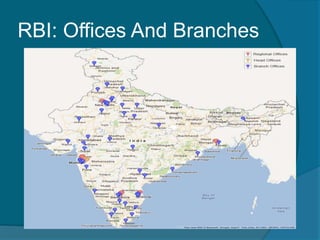
 19 regional offices in India.
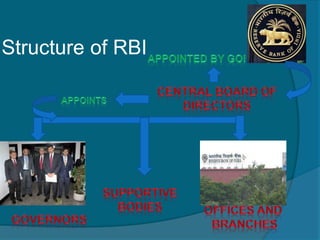
Structure of RBI
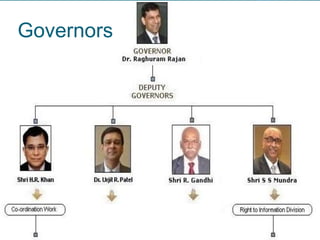
Governors
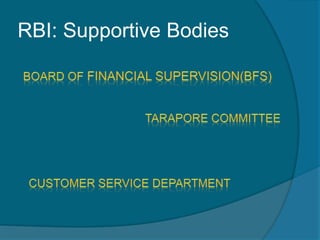
RBI: Supportive Bodies
RBI: Offices And Branches
Reserve Bank Of India(RBI)
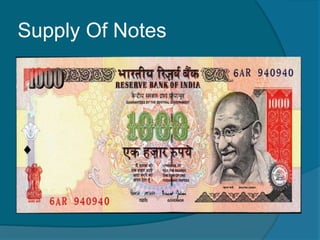
Supply Of Notes
Banker To Govt
Custodian Of Cash Reserves
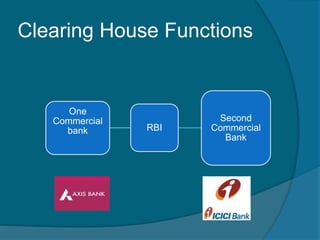
Clearing House Functions
RBI
Second
Commercial
Bank
One
Commercial
bank
Credit Control
 Controls Creation Of Credit
 Uses Qualitative and Quantitative tools.
 Thereby controlling inflation.
Lender of Last Resort
 When commercial banks face financial
crisis or shortfall of cash(Low CR)
 They approach other banks and if their
demands are not met,
 they approach to RBI as their
“LAST RESORT”
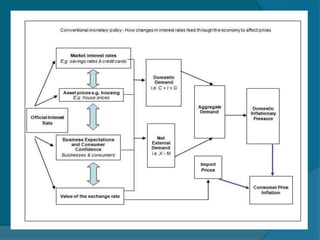
Monetary policy rests on the relationship between the rates of
interest in an economy ,that is the price at which money can be
borrowed ,and the total supply of money.
(1)The supply of money.
(2)Availability of money ,and
(3)Cost of money or rate of interest to attain a set of goals.
MONETARY POLICY:
TYPES OF MONETARY POLICY
 Tight Monetary Policy:
“Tight monetary policy, tends to curb inflation by
contracting/reducing the money supply.
 Expansionary /Easy monetary policy :
“Easy monetary policy ,also called expansion
monetary policy ,tends to encourage growth by
expanding the money supply.”
TOOLS OF MONETARY POLICY
Quantitative Tools
 Open Market Operations
 Bank Rate
 Cash Reserve Requirement
 Liquidity Ratio
 Special Deposit
Qualitative Tools
 Credit rationing
 Credit ceiling
 Moral Persuasion
 Direct Action
 Advertisement
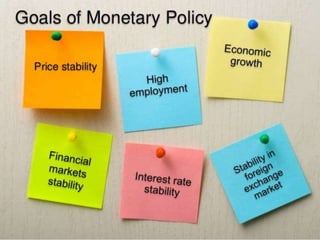
Price Stability
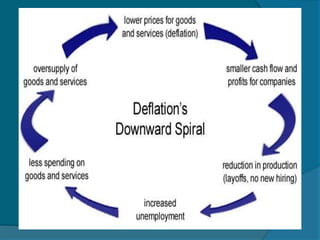
 Price stability refers to avoiding long term
inflation/deflation in order to bring the prices to a
reasonable level.
 In case of inflation ,the central bank(RBI) may
tighten the monetary policy so as to decrease the
supply of money and thus bring down the prices.
 In case of deflation the RBI adopts a liberal
monetary policy ,thus increasing the money supply
causing a further increase in demand and
normalizing the prices.
High Employment
o The role of central bank is to implement a
monetary policy which creates a positive
sentiment in the market thus promoting
demands and a corresponding growth in
manufacturing and services sector ,thus
creating employment opportunities.
Economic Growth
 The Monetary Policy aims at improving the economic growth
of the nation.
 The main measures involved in achieving economic growth
include reducing the fiscal deficit, allowing a greater share in
GDP to the manufacturing sector, allowing greater capital
inflow in the economy increasing the forex reserves.
 However developing economies may not see a steady growth
in economy due to the Monetary Policy alone. The reasons for
this include challenges offered on the supply side, lower
participation of the citizens in the banking system ,financial
conditions persisting in the world markets.
Quantitative Tools Of Monetary Policy
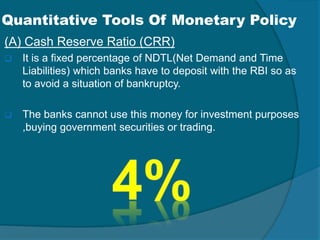
(A) Cash Reserve Ratio (CRR)
 It is a fixed percentage of NDTL(Net Demand and Time
Liabilities) which banks have to deposit with the RBI so as
to avoid a situation of bankruptcy.
 The banks cannot use this money for investment purposes
,buying government securities or trading.
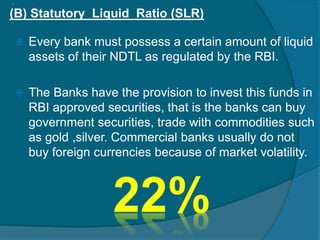
(B) Statutory Liquid Ratio (SLR)
.
 Every bank must possess a certain amount of liquid
assets of their NDTL as regulated by the RBI.
 The Banks have the provision to invest this funds in
RBI approved securities, that is the banks can buy
government securities, trade with commodities such
as gold ,silver. Commercial banks usually do not
buy foreign currencies because of market volatility.
.
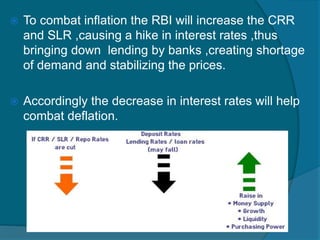
 To combat inflation the RBI will increase the CRR
and SLR ,causing a hike in interest rates ,thus
bringing down lending by banks ,creating shortage
of demand and stabilizing the prices.
 Accordingly the decrease in interest rates will help
combat deflation.
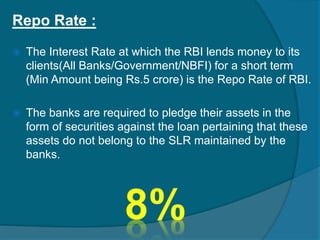
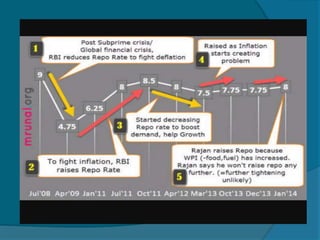
Repo Rate :
 The Interest Rate at which the RBI lends money to its
clients(All Banks/Government/NBFI) for a short term
(Min Amount being Rs.5 crore) is the Repo Rate of RBI.
 The banks are required to pledge their assets in the
form of securities against the loan pertaining that these
assets do not belong to the SLR maintained by the
banks.
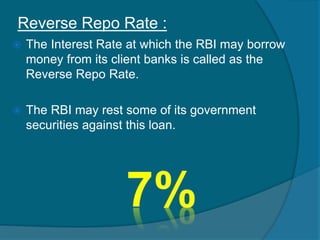
Reverse Repo Rate :
 The Interest Rate at which the RBI may borrow
money from its client banks is called as the
Reverse Repo Rate.
 The RBI may rest some of its government
securities against this loan.
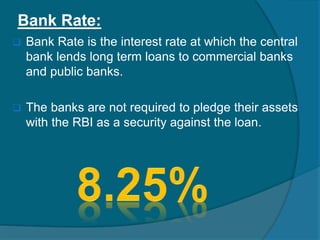
Bank Rate:
 Bank Rate is the interest rate at which the central
bank lends long term loans to commercial banks
and public banks.
 The banks are not required to pledge their assets
with the RBI as a security against the loan.
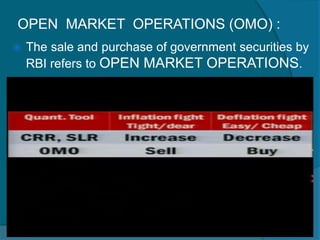
OPEN MARKET OPERATIONS (OMO) :
 The sale and purchase of government securities by
RBI refers to OPEN MARKET OPERATIONS.
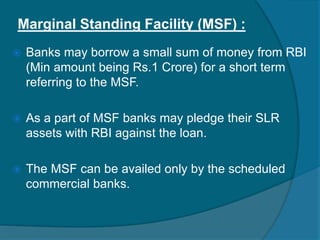
Marginal Standing Facility (MSF) :
 Banks may borrow a small sum of money from RBI
(Min amount being Rs.1 Crore) for a short term
referring to the MSF.
 As a part of MSF banks may pledge their SLR
assets with RBI against the loan.
 The MSF can be availed only by the scheduled
commercial banks.
Bibliography
 https://www.rbi.org.in/
 https://en.wikipedia.org/wiki/Reserve_Bank_of_India
 https://en.wikipedia.org/wiki/Monetary_policy_of_India
 https://www.youtube.com/user/TheMrunalPatel
Rbi and monetary policy final

Rbi and monetary policy final

  • 1.
    Compiled by Sanchit Pathak BhavyaKenia Mohanish Gaikwad Krishna Chukewad Devesh Kadam Aditya Kakad Abhiraj Phadnis Akshay Rajput Dhiraj Khadka S.Y.BTech, Electrical Department ,V.J.T.I., Matunga, Mumbai-19.
  • 2.
    Reserve Bank OfIndia(RBI)  Established - in Calcutta -1st April, 1935  It was set up on the recommendations of the HILTON YOUNG COMMISSION.  It was started as a Share-Holders Bank - paid up capital of Rs. 5 crs - initially privately owned.
  • 3.
    Reserve Bank OfIndia(RBI)  1937 - moved to Mumbai.  First bank to be Nationalised on 1st Jan,1949.  19 regional offices in India.
  • 4.
  • 5.
  • 6.
  • 7.
  • 8.
    Reserve Bank OfIndia(RBI)
  • 10.
  • 11.
  • 12.
  • 13.
  • 14.
    Credit Control  ControlsCreation Of Credit  Uses Qualitative and Quantitative tools.  Thereby controlling inflation.
  • 15.
    Lender of LastResort  When commercial banks face financial crisis or shortfall of cash(Low CR)  They approach other banks and if their demands are not met,  they approach to RBI as their “LAST RESORT”
  • 16.
    Monetary policy restson the relationship between the rates of interest in an economy ,that is the price at which money can be borrowed ,and the total supply of money. (1)The supply of money. (2)Availability of money ,and (3)Cost of money or rate of interest to attain a set of goals. MONETARY POLICY:
  • 17.
    TYPES OF MONETARYPOLICY  Tight Monetary Policy: “Tight monetary policy, tends to curb inflation by contracting/reducing the money supply.  Expansionary /Easy monetary policy : “Easy monetary policy ,also called expansion monetary policy ,tends to encourage growth by expanding the money supply.”
  • 18.
    TOOLS OF MONETARYPOLICY Quantitative Tools  Open Market Operations  Bank Rate  Cash Reserve Requirement  Liquidity Ratio  Special Deposit Qualitative Tools  Credit rationing  Credit ceiling  Moral Persuasion  Direct Action  Advertisement
  • 20.
    Price Stability  Pricestability refers to avoiding long term inflation/deflation in order to bring the prices to a reasonable level.  In case of inflation ,the central bank(RBI) may tighten the monetary policy so as to decrease the supply of money and thus bring down the prices.  In case of deflation the RBI adopts a liberal monetary policy ,thus increasing the money supply causing a further increase in demand and normalizing the prices.
  • 22.
    High Employment o Therole of central bank is to implement a monetary policy which creates a positive sentiment in the market thus promoting demands and a corresponding growth in manufacturing and services sector ,thus creating employment opportunities.
  • 23.
    Economic Growth  TheMonetary Policy aims at improving the economic growth of the nation.  The main measures involved in achieving economic growth include reducing the fiscal deficit, allowing a greater share in GDP to the manufacturing sector, allowing greater capital inflow in the economy increasing the forex reserves.  However developing economies may not see a steady growth in economy due to the Monetary Policy alone. The reasons for this include challenges offered on the supply side, lower participation of the citizens in the banking system ,financial conditions persisting in the world markets.
  • 24.
    Quantitative Tools OfMonetary Policy (A) Cash Reserve Ratio (CRR)  It is a fixed percentage of NDTL(Net Demand and Time Liabilities) which banks have to deposit with the RBI so as to avoid a situation of bankruptcy.  The banks cannot use this money for investment purposes ,buying government securities or trading.
  • 26.
    (B) Statutory LiquidRatio (SLR) .  Every bank must possess a certain amount of liquid assets of their NDTL as regulated by the RBI.  The Banks have the provision to invest this funds in RBI approved securities, that is the banks can buy government securities, trade with commodities such as gold ,silver. Commercial banks usually do not buy foreign currencies because of market volatility.
  • 29.
    .  To combatinflation the RBI will increase the CRR and SLR ,causing a hike in interest rates ,thus bringing down lending by banks ,creating shortage of demand and stabilizing the prices.  Accordingly the decrease in interest rates will help combat deflation.
  • 31.
    Repo Rate : The Interest Rate at which the RBI lends money to its clients(All Banks/Government/NBFI) for a short term (Min Amount being Rs.5 crore) is the Repo Rate of RBI.  The banks are required to pledge their assets in the form of securities against the loan pertaining that these assets do not belong to the SLR maintained by the banks.
  • 33.
    Reverse Repo Rate:  The Interest Rate at which the RBI may borrow money from its client banks is called as the Reverse Repo Rate.  The RBI may rest some of its government securities against this loan.
  • 34.
    Bank Rate:  BankRate is the interest rate at which the central bank lends long term loans to commercial banks and public banks.  The banks are not required to pledge their assets with the RBI as a security against the loan.
  • 35.
    OPEN MARKET OPERATIONS(OMO) :  The sale and purchase of government securities by RBI refers to OPEN MARKET OPERATIONS.
  • 36.
    Marginal Standing Facility(MSF) :  Banks may borrow a small sum of money from RBI (Min amount being Rs.1 Crore) for a short term referring to the MSF.  As a part of MSF banks may pledge their SLR assets with RBI against the loan.  The MSF can be availed only by the scheduled commercial banks.
  • 37.
    Bibliography  https://www.rbi.org.in/  https://en.wikipedia.org/wiki/Reserve_Bank_of_India https://en.wikipedia.org/wiki/Monetary_policy_of_India  https://www.youtube.com/user/TheMrunalPatel

Editor's Notes

  • #3 Established in accordance with the provisions of the Reserve Bank of India Act, 1934.
  • #8 The Reserve Bank of India has four zonal offices. It has 19 regional offices at most state capitals and at a few major cities in India. Few of them are located in Ahmedabad, Bangalore, Bhopal, Bhubaneswar, Chandigarh, Chennai, Guwahati, Hyderabad, Jaipur, Jammu, Kanpur, Kochi, Kolkata, Lucknow, Mumbai, Nagpur, Patna, and Thiruvananthapuram. It also has 09 sub-offices located in Dehradun, Gangtok, Panaji, Raipur, Ranchi, Shillong, Shimla , Srinagar and Agartala. The bank has also two training colleges for its officers, viz. Reserve Bank Staff College at Chennai and College of Agricultural Banking at Pune. There are three autonomous institutions National Institute of Bank Management(NIBM), Indira Gandhi Institute for Development Research (IGIDR), Institute for Development and Research in Banking Technology (IDRBT). There are also four Zonal Training Centres at Mumbai, Chennai, Kolkata and New Delhi.
  • #17  Monetary Policy uses a variety of tools to control one or both of these ,to influence outcomes like economic growth ,inflation ,exchange rates with other currencies and unemployment . Where currency is under a monopoly issuance ,or where there is a regulated system of issuing currency through banks ,which are tied to a central bank, the monetary authority has the ability to alter the money supply and thus influence the interest rate:
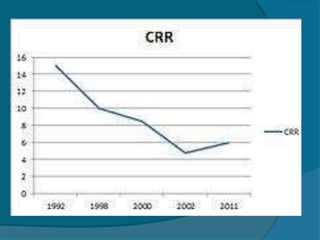
  • #25 The present CRR is 4%. The instances in change in CRR can be seen from the graph.
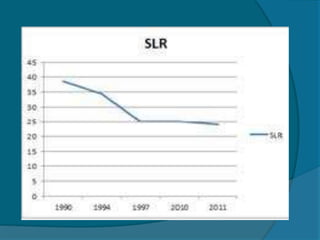
  • #27 The present rate of SLR is 22%.
  • #32 The present repo rate is 8%.
  • #34 The Reverse Repo Rate is 1% less than the Repo Rate.The current Reverse Repo Rate is 7%.
  • #35 The present bank rate is 8.25%.