Decision involving alternate choices
Presented By :
CHITRANSHU SHUKLA
20-01-2017 Assignment for MANIAC-II 1
Decision Making
Decision making is the process of evaluating two or more alternative’s leading to
a final choice.
 Identify and define problem.
 Identify alternatives as possible solutions to problem.
 Eliminate alternatives that are clearly not feasible.
 Collect relevant data associated with each feasible alternative.
 Identify costs and benefits as relevant or irrelevant and eliminate
20-01-2017 Assignment for MANIAC-II 2
Relevant revenue
Relevant revenue is amount of increase or decrease in revenue expected from a
particular course of action as compared with the alternative, It has mainly two
features.
 They are expected future events.
 They differ between alternatives.
They are like cash inflows, if amount of accrual profit and cash flows differs the
managers should give importance to cash flows.
20-01-2017 Assignment for MANIAC-II 3
Relevant Costs
Relevant costs are also known as differential costs, decision making costs. It is the
difference in total costs between the alternative choices. When a decision results
in increased cost , differential cost maybe referred to as an incremental cost,
whereas if the cost decreases it maybe referred to as decremental cost. They are
expected future events.
 They differ between alternatives.
 Relevant costs are expected future costs.
20-01-2017 Assignment for MANIAC-II 4
Case 1:->
Make or Buy Decision
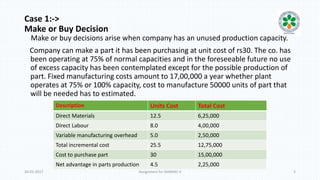
Make or buy decisions arise when company has an unused production capacity.
Company can make a part it has been purchasing at unit cost of rs30. The co. has
been operating at 75% of normal capacities and in the foreseeable future no use
of excess capacity has been contemplated except for the possible production of
part. Fixed manufacturing costs amount to 17,00,000 a year whether plant
operates at 75% or 100% capacity, cost to manufacture 50000 units of part that
will be needed has to estimated.
Description Units Cost Total Cost
Direct Materials 12.5 6,25,000
Direct Labour 8.0 4,00,000
Variable manufacturing overhead 5.0 2,50,000
Total incremental cost 25.5 12,75,000
Cost to purchase part 30 15,00,000
Net advantage in parts production 4.5 2,25,000
20-01-2017 Assignment for MANIAC-II 5
Case 2:->
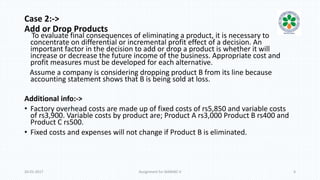
Add or Drop Products
To evaluate final consequences of eliminating a product, it is necessary to
concentrate on differential or incremental profit effect of a decision. An
important factor in the decision to add or drop a product is whether it will
increase or decrease the future income of the business. Appropriate cost and
profit measures must be developed for each alternative.
Assume a company is considering dropping product B from its line because
accounting statement shows that B is being sold at loss.
Additional info:->
• Factory overhead costs are made up of fixed costs of rs5,850 and variable costs
of rs3,900. Variable costs by product are; Product A rs3,000 Product B rs400 and
Product C rs500.
• Fixed costs and expenses will not change if Product B is eliminated.
20-01-2017 Assignment for MANIAC-II 6
20-01-2017 Assignment for MANIAC-II 7
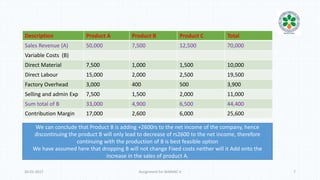
Description Product A Product B Product C Total
Sales Revenue (A) 50,000 7,500 12,500 70,000
Variable Costs (B)
Direct Material 7,500 1,000 1,500 10,000
Direct Labour 15,000 2,000 2,500 19,500
Factory Overhead 3,000 400 500 3,900
Selling and admin Exp 7,500 1,500 2,000 11,000
Sum total of B 33,000 4,900 6,500 44,400
Contribution Margin 17,000 2,600 6,000 25,600
We can conclude that Product B is adding +2600rs to the net income of the company, hence
discontinuing the product B will only lead to decrease of rs2600 to the net income, therefore
continuing with the production of B is best feasible option
We have assumed here that dropping B will not change Fixed costs neither will it Add onto the
increase in the sales of product A.
Case 3:->
Sell or Process further
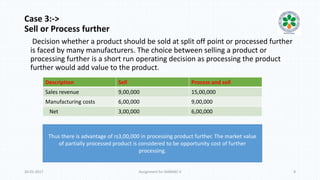
Decision whether a product should be sold at split off point or processed further
is faced by many manufacturers. The choice between selling a product or
processing further is a short run operating decision as processing the product
further would add value to the product.
20-01-2017 Assignment for MANIAC-II 8
Description Sell Process and sell
Sales revenue 9,00,000 15,00,000
Manufacturing costs 6,00,000 9,00,000
Net 3,00,000 6,00,000
Thus there is advantage of rs3,00,000 in processing product further. The market value
of partially processed product is considered to be opportunity cost of further
processing.
Case 4:->
Operate or Shutdown
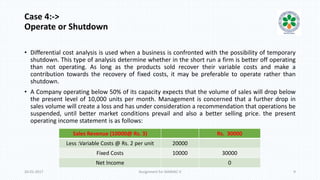
• Differential cost analysis is used when a business is confronted with the possibility of temporary
shutdown. This type of analysis determine whether in the short run a firm is better off operating
than not operating. As long as the products sold recover their variable costs and make a
contribution towards the recovery of fixed costs, it may be preferable to operate rather than
shutdown.
• A Company operating below 50% of its capacity expects that the volume of sales will drop below
the present level of 10,000 units per month. Management is concerned that a further drop in
sales volume will create a loss and has under consideration a recommendation that operations be
suspended, until better market conditions prevail and also a better selling price. the present
operating income statement is as follows:
20-01-2017 Assignment for MANIAC-II 9
Sales Revenue (10000@ Rs. 3) Rs. 30000
Less :Variable Costs @ Rs. 2 per unit 20000
Fixed Costs 10000 30000
Net Income 0
20-01-2017 Assignment for MANIAC-II 10
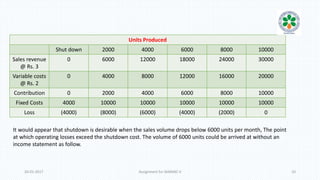
Units Produced
Shut down 2000 4000 6000 8000 10000
Sales revenue
@ Rs. 3
0 6000 12000 18000 24000 30000
Variable costs
@ Rs. 2
0 4000 8000 12000 16000 20000
Contribution 0 2000 4000 6000 8000 10000
Fixed Costs 4000 10000 10000 10000 10000 10000
Loss (4000) (8000) (6000) (4000) (2000) 0
It would appear that shutdown is desirable when the sales volume drops below 6000 units per month, The point
at which operating losses exceed the shutdown cost. The volume of 6000 units could be arrived at without an
income statement as follow.
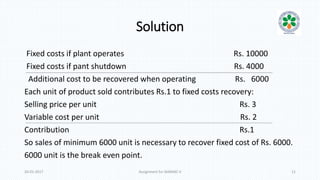
Solution
Fixed costs if plant operates Rs. 10000
Fixed costs if pant shutdown Rs. 4000
Additional cost to be recovered when operating Rs. 6000
Each unit of product sold contributes Rs.1 to fixed costs recovery:
Selling price per unit Rs. 3
Variable cost per unit Rs. 2
Contribution Rs.1
So sales of minimum 6000 unit is necessary to recover fixed cost of Rs. 6000.
6000 unit is the break even point.
20-01-2017 Assignment for MANIAC-II 11
Case 5:->
Special Orders
 Special order or one time order arises when a company has excess or idle
production capacity and management considers the possibility of selling
additional products at less than normal selling prices, provided that such order
will not affect the regular sales of the same product.
 The basic problem is to determine an acceptable price for special order units ,
so cost analysis is done to determine the short run profit effects of special order
transaction without disturbing the normal operations and when unused
production capacity exists.
 It is not advisable to attach fixed costs to products, the price may be too high
and business firm can lost order so only contribution margin and variable cost
take into account.
20-01-2017 Assignment for MANIAC-II 12
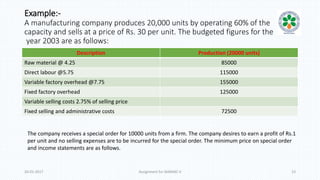
Example:-
A manufacturing company produces 20,000 units by operating 60% of the
capacity and sells at a price of Rs. 30 per unit. The budgeted figures for the
year 2003 are as follows:
Description Production (20000 units)
Raw material @ 4.25 85000
Direct labour @5.75 115000
Variable factory overhead @7.75 155000
Fixed factory overhead 125000
Variable selling costs 2.75% of selling price
Fixed selling and administrative costs 72500
20-01-2017 Assignment for MANIAC-II 13
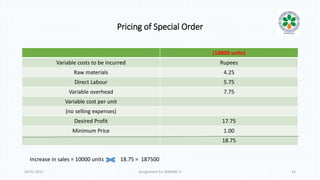
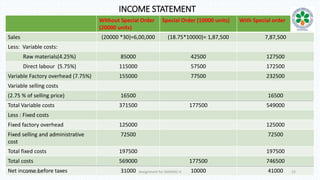
The company receives a special order for 10000 units from a firm. The company desires to earn a profit of Rs.1
per unit and no selling expenses are to be incurred for the special order. The minimum price on special order
and income statements are as follows.
Pricing of Special Order
20-01-2017 Assignment for MANIAC-II 14
(10000 units)
Variable costs to be incurred Rupees
Raw materials 4.25
Direct Labour 5.75
Variable overhead 7.75
Variable cost per unit
(no selling expenses)
Desired Profit 17.75
Minimum Price 1.00
18.75
Increase in sales = 10000 units 18.75 = 187500
INCOME STATEMENT
Without Special Order
(20000 units)
Special Order (10000 units) With Special order
Sales (20000 *30)=6,00,000 (18.75*10000)= 1,87,500 7,87,500
Less: Variable costs:
Raw materials(4.25%) 85000 42500 127500
Direct labour (5.75%) 115000 57500 172500
Variable Factory overhead (7.75%) 155000 77500 232500
Variable selling costs
(2.75 % of selling price) 16500 16500
Total Variable costs 371500 177500 549000
Less : Fixed costs
Fixed factory overhead 125000 125000
Fixed selling and administrative
cost
72500 72500
Total fixed costs 197500 197500
Total costs 569000 177500 746500
Net income before taxes 31000 10000 4100020-01-2017 Assignment for MANIAC-II 15
.
20-01-2017 Assignment for MANIAC-II 16

Decision involving Alternate choices

  • 1.
    Decision involving alternatechoices Presented By : CHITRANSHU SHUKLA 20-01-2017 Assignment for MANIAC-II 1
  • 2.
    Decision Making Decision makingis the process of evaluating two or more alternative’s leading to a final choice.  Identify and define problem.  Identify alternatives as possible solutions to problem.  Eliminate alternatives that are clearly not feasible.  Collect relevant data associated with each feasible alternative.  Identify costs and benefits as relevant or irrelevant and eliminate 20-01-2017 Assignment for MANIAC-II 2
  • 3.
    Relevant revenue Relevant revenueis amount of increase or decrease in revenue expected from a particular course of action as compared with the alternative, It has mainly two features.  They are expected future events.  They differ between alternatives. They are like cash inflows, if amount of accrual profit and cash flows differs the managers should give importance to cash flows. 20-01-2017 Assignment for MANIAC-II 3
  • 4.
    Relevant Costs Relevant costsare also known as differential costs, decision making costs. It is the difference in total costs between the alternative choices. When a decision results in increased cost , differential cost maybe referred to as an incremental cost, whereas if the cost decreases it maybe referred to as decremental cost. They are expected future events.  They differ between alternatives.  Relevant costs are expected future costs. 20-01-2017 Assignment for MANIAC-II 4
  • 5.
    Case 1:-> Make orBuy Decision Make or buy decisions arise when company has an unused production capacity. Company can make a part it has been purchasing at unit cost of rs30. The co. has been operating at 75% of normal capacities and in the foreseeable future no use of excess capacity has been contemplated except for the possible production of part. Fixed manufacturing costs amount to 17,00,000 a year whether plant operates at 75% or 100% capacity, cost to manufacture 50000 units of part that will be needed has to estimated. Description Units Cost Total Cost Direct Materials 12.5 6,25,000 Direct Labour 8.0 4,00,000 Variable manufacturing overhead 5.0 2,50,000 Total incremental cost 25.5 12,75,000 Cost to purchase part 30 15,00,000 Net advantage in parts production 4.5 2,25,000 20-01-2017 Assignment for MANIAC-II 5
  • 6.
    Case 2:-> Add orDrop Products To evaluate final consequences of eliminating a product, it is necessary to concentrate on differential or incremental profit effect of a decision. An important factor in the decision to add or drop a product is whether it will increase or decrease the future income of the business. Appropriate cost and profit measures must be developed for each alternative. Assume a company is considering dropping product B from its line because accounting statement shows that B is being sold at loss. Additional info:-> • Factory overhead costs are made up of fixed costs of rs5,850 and variable costs of rs3,900. Variable costs by product are; Product A rs3,000 Product B rs400 and Product C rs500. • Fixed costs and expenses will not change if Product B is eliminated. 20-01-2017 Assignment for MANIAC-II 6
  • 7.
    20-01-2017 Assignment forMANIAC-II 7 Description Product A Product B Product C Total Sales Revenue (A) 50,000 7,500 12,500 70,000 Variable Costs (B) Direct Material 7,500 1,000 1,500 10,000 Direct Labour 15,000 2,000 2,500 19,500 Factory Overhead 3,000 400 500 3,900 Selling and admin Exp 7,500 1,500 2,000 11,000 Sum total of B 33,000 4,900 6,500 44,400 Contribution Margin 17,000 2,600 6,000 25,600 We can conclude that Product B is adding +2600rs to the net income of the company, hence discontinuing the product B will only lead to decrease of rs2600 to the net income, therefore continuing with the production of B is best feasible option We have assumed here that dropping B will not change Fixed costs neither will it Add onto the increase in the sales of product A.
  • 8.
    Case 3:-> Sell orProcess further Decision whether a product should be sold at split off point or processed further is faced by many manufacturers. The choice between selling a product or processing further is a short run operating decision as processing the product further would add value to the product. 20-01-2017 Assignment for MANIAC-II 8 Description Sell Process and sell Sales revenue 9,00,000 15,00,000 Manufacturing costs 6,00,000 9,00,000 Net 3,00,000 6,00,000 Thus there is advantage of rs3,00,000 in processing product further. The market value of partially processed product is considered to be opportunity cost of further processing.
  • 9.
    Case 4:-> Operate orShutdown • Differential cost analysis is used when a business is confronted with the possibility of temporary shutdown. This type of analysis determine whether in the short run a firm is better off operating than not operating. As long as the products sold recover their variable costs and make a contribution towards the recovery of fixed costs, it may be preferable to operate rather than shutdown. • A Company operating below 50% of its capacity expects that the volume of sales will drop below the present level of 10,000 units per month. Management is concerned that a further drop in sales volume will create a loss and has under consideration a recommendation that operations be suspended, until better market conditions prevail and also a better selling price. the present operating income statement is as follows: 20-01-2017 Assignment for MANIAC-II 9 Sales Revenue (10000@ Rs. 3) Rs. 30000 Less :Variable Costs @ Rs. 2 per unit 20000 Fixed Costs 10000 30000 Net Income 0
  • 10.
    20-01-2017 Assignment forMANIAC-II 10 Units Produced Shut down 2000 4000 6000 8000 10000 Sales revenue @ Rs. 3 0 6000 12000 18000 24000 30000 Variable costs @ Rs. 2 0 4000 8000 12000 16000 20000 Contribution 0 2000 4000 6000 8000 10000 Fixed Costs 4000 10000 10000 10000 10000 10000 Loss (4000) (8000) (6000) (4000) (2000) 0 It would appear that shutdown is desirable when the sales volume drops below 6000 units per month, The point at which operating losses exceed the shutdown cost. The volume of 6000 units could be arrived at without an income statement as follow.
  • 11.
    Solution Fixed costs ifplant operates Rs. 10000 Fixed costs if pant shutdown Rs. 4000 Additional cost to be recovered when operating Rs. 6000 Each unit of product sold contributes Rs.1 to fixed costs recovery: Selling price per unit Rs. 3 Variable cost per unit Rs. 2 Contribution Rs.1 So sales of minimum 6000 unit is necessary to recover fixed cost of Rs. 6000. 6000 unit is the break even point. 20-01-2017 Assignment for MANIAC-II 11
  • 12.
    Case 5:-> Special Orders Special order or one time order arises when a company has excess or idle production capacity and management considers the possibility of selling additional products at less than normal selling prices, provided that such order will not affect the regular sales of the same product.  The basic problem is to determine an acceptable price for special order units , so cost analysis is done to determine the short run profit effects of special order transaction without disturbing the normal operations and when unused production capacity exists.  It is not advisable to attach fixed costs to products, the price may be too high and business firm can lost order so only contribution margin and variable cost take into account. 20-01-2017 Assignment for MANIAC-II 12
  • 13.
    Example:- A manufacturing companyproduces 20,000 units by operating 60% of the capacity and sells at a price of Rs. 30 per unit. The budgeted figures for the year 2003 are as follows: Description Production (20000 units) Raw material @ 4.25 85000 Direct labour @5.75 115000 Variable factory overhead @7.75 155000 Fixed factory overhead 125000 Variable selling costs 2.75% of selling price Fixed selling and administrative costs 72500 20-01-2017 Assignment for MANIAC-II 13 The company receives a special order for 10000 units from a firm. The company desires to earn a profit of Rs.1 per unit and no selling expenses are to be incurred for the special order. The minimum price on special order and income statements are as follows.
  • 14.
    Pricing of SpecialOrder 20-01-2017 Assignment for MANIAC-II 14 (10000 units) Variable costs to be incurred Rupees Raw materials 4.25 Direct Labour 5.75 Variable overhead 7.75 Variable cost per unit (no selling expenses) Desired Profit 17.75 Minimum Price 1.00 18.75 Increase in sales = 10000 units 18.75 = 187500
  • 15.
    INCOME STATEMENT Without SpecialOrder (20000 units) Special Order (10000 units) With Special order Sales (20000 *30)=6,00,000 (18.75*10000)= 1,87,500 7,87,500 Less: Variable costs: Raw materials(4.25%) 85000 42500 127500 Direct labour (5.75%) 115000 57500 172500 Variable Factory overhead (7.75%) 155000 77500 232500 Variable selling costs (2.75 % of selling price) 16500 16500 Total Variable costs 371500 177500 549000 Less : Fixed costs Fixed factory overhead 125000 125000 Fixed selling and administrative cost 72500 72500 Total fixed costs 197500 197500 Total costs 569000 177500 746500 Net income before taxes 31000 10000 4100020-01-2017 Assignment for MANIAC-II 15
  • 16.