NATURE OF FIXEDASSETS
Fixed assets are long-term or relatively permanent
assets such as equipment, machinery, buildings, and
land.
Other descriptive titles for plant assets or property,
plant, and equipment.
Fixed assets have the following characteristics:
They exist physically and, thus, are tangible assets.
They are owned and used by the company in its normal
operations.
They are not offered by sale as part of normal operations.
3.
CLASSIFYING COSTS
Acost that has been incurred may be classified as a fixed
asset, an investment, or an expense.
Items that are classified and recorded as fixed assets
include land, buildings, or equipment. Such assets normally
last more than a year and are used in the normal
operations.
Investments are long-lived assets that are not used in the
normal operations and are held for future resale. Such
assets are reported on the balance sheet in a section
entitled Investments.
A cost that is not long lived is recorded as an expense.
4.
COST OF FIXEDASSETS
Only costs necessary for preparing the fixed asset for
use are included as a cost of the asset.
Unnecessary costs that do not increase the asset’s
usefulness are recorded as an expense. These include
the following:
Vandalism
Mistakes in installation
Uninsured theft
Damage during unpacking and installing
Fines for not obtaining proper permits from governmental
agencies
5.
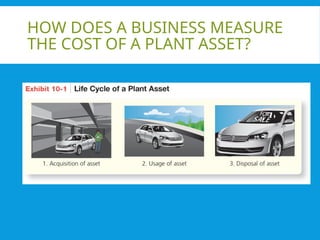
HOW DOES ABUSINESS MEASURE
THE COST OF A PLANT ASSET?
6.
ACCOUNTING FOR
DEPRECIATION OFFIXED
ASSETS
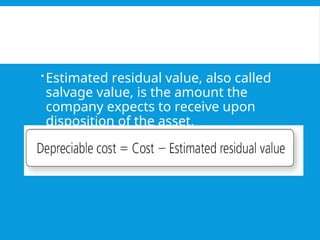
Over time, fixed assets, with the exception of land, wears out
and lose their ability to provide services.
Thus, the costs of fixed assets such as equipment and
buildings should be recorded as an expense over their useful
lives.
This periodic recording of the cost of fixed assets as an
expense is called depreciation.
Because land has an unlimited life, it is not depreciated.
Depreciation matches the expense against the revenue
generated from using an asset.
7.
The adjustingentry to record depreciation debits
Depreciation Expense and credits a contra asset account
entitled Accumulated Depreciation.
The use of a contra asset account allows the original cost to
remain unchanged in the fixed asset account.
Depreciation can be caused by physical or functional
factors.
Physical depreciation factors such as wear and tear.
Functional depreciation factors such as obsolescence.
STRAIGHT LINE METHOD
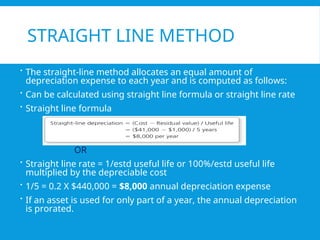
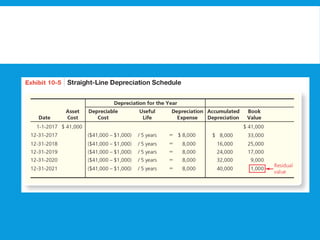
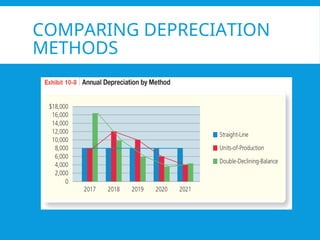
The straight-line method allocates an equal amount of
depreciation expense to each year and is computed as follows:
Can be calculated using straight line formula or straight line rate
Straight line formula
OR
Straight line rate = 1/estd useful life or 100%/estd useful life
multiplied by the depreciable cost
1/5 = 0.2 X $440,000 = $8,000 annual depreciation expense
If an asset is used for only part of a year, the annual depreciation
is prorated.
12.
ADJUSTING ENTRY FOR
DEPRECIATION
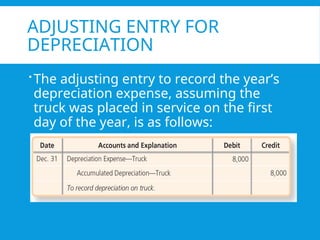
Theadjusting entry to record the year’s
depreciation expense, assuming the
truck was placed in service on the first
day of the year, is as follows:
13.
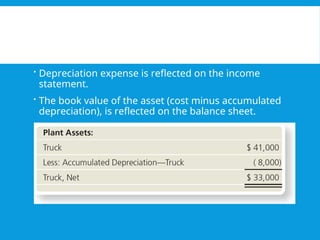
Depreciation expenseis reflected on the income
statement.
The book value of the asset (cost minus accumulated
depreciation), is reflected on the balance sheet.
15.
UNITS OF OUTPUT
(PRODUCTION)METHOD
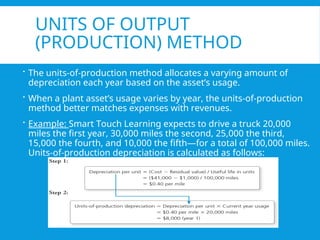
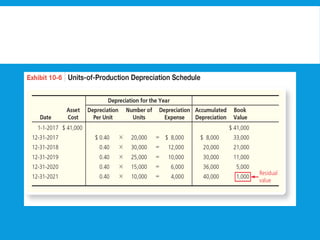
The units-of-production method allocates a varying amount of
depreciation each year based on the asset’s usage.
When a plant asset’s usage varies by year, the units-of-production
method better matches expenses with revenues.
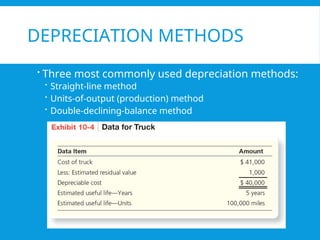
Example: Smart Touch Learning expects to drive a truck 20,000
miles the first year, 30,000 miles the second, 25,000 the third,
15,000 the fourth, and 10,000 the fifth—for a total of 100,000 miles.
Units-of-production depreciation is calculated as follows:
17.
DOUBLE-DECLINING BALANCE
METHOD
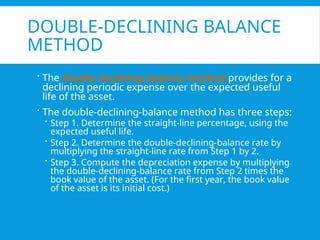
Thedouble-declining-balance method provides for a
declining periodic expense over the expected useful
life of the asset.
The double-declining-balance method has three steps:
Step 1. Determine the straight-line percentage, using the
expected useful life.
Step 2. Determine the double-declining-balance rate by
multiplying the straight-line rate from Step 1 by 2.
Step 3. Compute the depreciation expense by multiplying
the double-declining-balance rate from Step 2 times the
book value of the asset. (For the first year, the book value
of the asset is its initial cost.)
18.
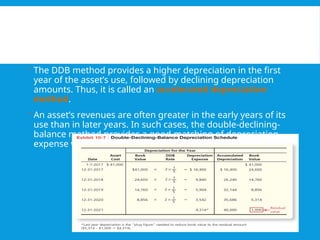
The DDBmethod provides a higher depreciation in the first
year of the asset’s use, followed by declining depreciation
amounts. Thus, it is called an accelerated depreciation
method.
An asset’s revenues are often greater in the early years of its
use than in later years. In such cases, the double-declining-
balance method provides a good matching of depreciation
expense with the asset’s revenues.
REVISING DEPRECIATION
Estimatesof residual values and useful lives of fixed
assets may change due to abnormal wear and tear or
obsolescence.
When new estimates are determined, they are used to
determine the depreciation expense in future periods.
The depreciation expense recorded in earlier years is
not affected.
21.
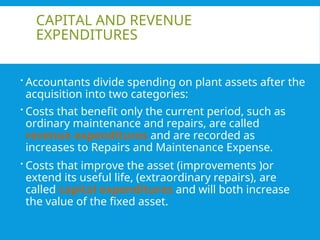
CAPITAL AND REVENUE
EXPENDITURES
Accountants divide spending on plant assets after the
acquisition into two categories:
Costs that benefit only the current period, such as
ordinary maintenance and repairs, are called
revenue expenditures and are recorded as
increases to Repairs and Maintenance Expense.
Costs that improve the asset (improvements )or
extend its useful life, (extraordinary repairs), are
called capital expenditures and will both increase
the value of the fixed asset.
22.
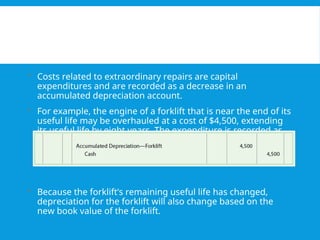
Costs relatedto extraordinary repairs are capital
expenditures and are recorded as a decrease in an
accumulated depreciation account.
For example, the engine of a forklift that is near the end of its
useful life may be overhauled at a cost of $4,500, extending
its useful life by eight years. The expenditure is recorded as
follows:
Because the forklift’s remaining useful life has changed,
depreciation for the forklift will also change based on the
new book value of the forklift.
23.
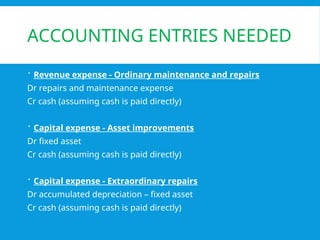
ACCOUNTING ENTRIES NEEDED
Revenue expense - Ordinary maintenance and repairs
Dr repairs and maintenance expense
Cr cash (assuming cash is paid directly)
Capital expense - Asset improvements
Dr fixed asset
Cr cash (assuming cash is paid directly)
Capital expense - Extraordinary repairs
Dr accumulated depreciation – fixed asset
Cr cash (assuming cash is paid directly)
HOW ARE DISPOSALSOF
PLANT ASSETS RECORDED?
Eventually, an asset wears out or becomes obsolete.
The business then has several options:
Discard the plant asset.
Sell the plant asset.
Exchange the plant asset for another asset.
Regardless of the type of disposal, there are four steps:
1.Bring the depreciation up to date.
2.Remove the old, disposed-of asset and associated
accumulated depreciation from the books.
3.Record the value of any cash received (or paid).
4.Determine the amount of any gain or loss.
See Handout for examples; see pgs 504 to 506
26.
HOW ARE NATURAL
RESOURCESACCOUNTED FOR?
The fixed assets of some companies include timber,
metal ores, minerals, or other natural resources.
As these resources are harvested or mined and then
sold, a portion of their cost is debited to an expense
account.
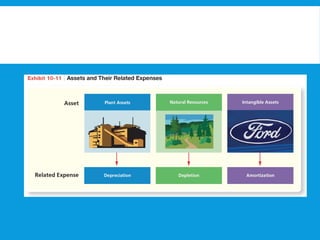
This process of transferring the cost of natural
resources to an expense account is called depletion.
Depletion is computed by the units-of-output method.
27.
ACCTG FOR NATURAL
RESOURCES
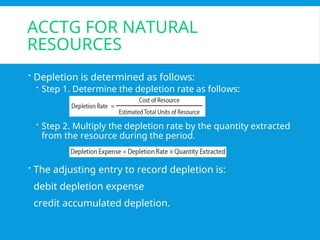
Depletion is determined as follows:
Step 1. Determine the depletion rate as follows:
Step 2. Multiply the depletion rate by the quantity extracted
from the resource during the period.
The adjusting entry to record depletion is:
debit depletion expense
credit accumulated depletion.
28.
HOW ARE INTANGIBLEASSETS
ACCOUNTED FOR?
Patents, copyrights, trademarks, and goodwill are
long-lived assets that are used in the operations of a
business and are not held for sale. These assets are
called intangible assets because they do not exist
physically.
The accounting for intangible assets is similar to that
for fixed assets. The major issues are:
Determining the initial cost.
Determining the amortization, which is the amount of cost
to transfer to expense.
Amortization results from the passage of time or a
decline in the usefulness of the intangible asset.
29.
INTANGIBLE ASSETS
Patent: isan intangible asset that is a federal grant conveying
an exclusive
20-year right to produce and sell an invention.
The invention may be a process, product, or formula.
The acquisition cost of a patent is debited to the Patent
account.
Patents are amortized at the end of the acctg period.
Copyright is the exclusive right to reproduce and sell a book, a
musical composition, a film, another work of art, or intellectual
property.
Trademark (also called a trade name) is an asset that
represents distinctive identifications of products or services,
such as the Nike “swoosh” or the McDonald’s “golden arches.”
30.
Goodwill refersto an intangible asset of a business that
is created from such favorable factors as location,
product quality, reputation, and managerial skill.
Generally accepted accounting principles (GAAP) allow
goodwill to be recorded only if it is objectively
determined by a transaction. (An example is the
purchase of a business at a price in excess of the fair
value of its net assets (assets – liabilities).) The excess is
recorded as goodwill and reported as an intangible
asset.
31.
ACCTG ENTRIES NEEEDED
Accounting for Patent – a patent gets amortized as it is
used up
Dr. amortization exp, cr. patent
Accounting for Goodwill – goodwill gets impaired if the
fair market value is less than it’s book value
Dr. loss from impaired goodwill, Cr. goodwill
Accounting for copyright – copyright gets amortized
Accounting for trademark – trademark gets impaired
Go over example exercise Pg 467