Financial Accounting
TOPIC 14
Adjustment: Fixed
Assets
CIK NURUL NAJIHAH KHAIRUDIN
Depreciation of tangible non-
current assets
Depreciation is the part of the original
cost of a non-current asset that is
consumed during its period of use by
the business.
Depreciation is charged to the profit
and loss account each year.
The amount charged is based on an
estimate of how much economic
usefulness has been used up in the
accounting period.
Causes of depreciation
Physical deterioration such as wear
and tear through use or erosion and
decay.
Economic factors such as
obsolescence or inadequacy.
Time, where assets have a legal life
fixed under a contract.
Depletion, where the assets are of a
wasting character.
Land and buildings
Land is not depreciated because it has
an unlimited useful life.
Buildings are depreciated over their
useful life because they can fall into
disrepair or become obsolete.
Depreciation methods –
straight line
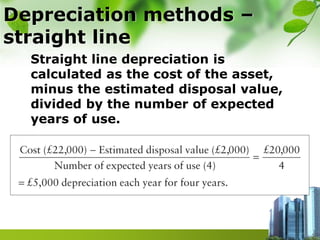
Straight line depreciation is
calculated as the cost of the asset,
minus the estimated disposal value,
divided by the number of expected
years of use.
Depreciation methods – reducing
balance
Reducing balance depreciation is
calculated using a fixed percentage,
on the net value of the asset.
Choice of method
The method chosen should be the one
that allocates the cost to each period
in accordance with the overall
economic benefit from the use of the
asset.
Therefore, if more benefit is derived
from the asset in early years, then the
reducing balance method is more
appropriate.
However, if benefits are spread
equally over the years, the straight
line method is suitable.
Other methods of depreciation
The revaluation method, where items
are valued each year and the
difference charged as depreciation.
The depletion unit method, where a
charge is made dependent upon how
much of the asset has been used up.
The machine hour method, where a
charge is made dependent on how
many hours the machine has worked
for.
Other methods of depreciation
(Continued)
The sum of the years’ digits method,
where a proportion is charged on the
basis of the life of the asset.
The units of output method which
charges according to the proportion
of units produced, compared to the
total units expected to be achieved.
Thank You!

ADJUSTMENTS FIXED ASSETS.pptx

  • 1.
    Financial Accounting TOPIC 14 Adjustment:Fixed Assets CIK NURUL NAJIHAH KHAIRUDIN
  • 2.
    Depreciation of tangiblenon- current assets Depreciation is the part of the original cost of a non-current asset that is consumed during its period of use by the business. Depreciation is charged to the profit and loss account each year. The amount charged is based on an estimate of how much economic usefulness has been used up in the accounting period.
  • 3.
    Causes of depreciation Physicaldeterioration such as wear and tear through use or erosion and decay. Economic factors such as obsolescence or inadequacy. Time, where assets have a legal life fixed under a contract. Depletion, where the assets are of a wasting character.
  • 4.
    Land and buildings Landis not depreciated because it has an unlimited useful life. Buildings are depreciated over their useful life because they can fall into disrepair or become obsolete.
  • 5.
    Depreciation methods – straightline Straight line depreciation is calculated as the cost of the asset, minus the estimated disposal value, divided by the number of expected years of use.
  • 6.
    Depreciation methods –reducing balance Reducing balance depreciation is calculated using a fixed percentage, on the net value of the asset.
  • 7.
    Choice of method Themethod chosen should be the one that allocates the cost to each period in accordance with the overall economic benefit from the use of the asset. Therefore, if more benefit is derived from the asset in early years, then the reducing balance method is more appropriate. However, if benefits are spread equally over the years, the straight line method is suitable.
  • 8.
    Other methods ofdepreciation The revaluation method, where items are valued each year and the difference charged as depreciation. The depletion unit method, where a charge is made dependent upon how much of the asset has been used up. The machine hour method, where a charge is made dependent on how many hours the machine has worked for.
  • 9.
    Other methods ofdepreciation (Continued) The sum of the years’ digits method, where a proportion is charged on the basis of the life of the asset. The units of output method which charges according to the proportion of units produced, compared to the total units expected to be achieved.
  • 10.