Measurement
Uncertainty
Measurement Uncertainty in
ISO17025
ISO 17025 5.4.6.1
A calibration laboratory or a testing laboratory performing
its own calibration, shall have and shall apply a
procedure to estimate the uncertainty of measurement
for all calibration and types of calibrations.
ISO 17025 5.4.6.2
Testing laboratories shall have and shall apply procedures
for estimating uncertainty of measurement. In certain
cases the nature of test methods may preclude rigorous ,
metrologically and statistical valid, calculation of
uncertainty………………..
Measurement Uncertainty in
ISO17025
ISO 17025 5.4.6.3
When estimating the uncertainty of measurement, all
uncertainty component which are of importance in the
given situation shall be taken into account using
appropriate method of analysis.
Measurement uncertainty is also mentioned elsewhere in
the ISO 17025 standard.
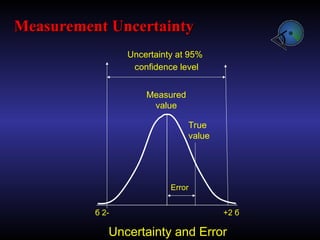
Measured
value
Error
Uncertainty at 95%
confidence level
Uncertainty and Error
True
value
+2 б
-
2
б
Measurement Uncertainty
Measurement Error
Measurement Error
• Error is the difference between the result of the
measurement and the true value of the quantity
measured.
• Error is a real physical quantity, its magnitude can not
be exactly known .
• Error is viewed is being of two kinds : random error and
systematic error .
Measurement Uncertainty
Uncertainty
Uncertainty
Uncertainty is the range of values, usually centered on the
measured value, that contains the true value with stated
probability.
Confidence interval
Confidence interval
When uncertainty is defined as above, the confidence
interval is the range of values that corresponds to the
stated uncertainty.
Confidence level
Confidence level
It is the probability associated with a confidence interval.
Measurement Uncertainty
• We would say “The true value can be expected to lie
within ± X units of the measured value with 95%
confidence . “
• Uncertainty is determined by an uncertainty analysis that
take into consideration the effect of systematic and
random errors in all the measurement processes.
Measurement
Measurement Uncertainty
Uncertainty
Sources of Measurement
Uncertainty
• Incomplete definition of measured quantity.
• Non-representative sampling.
• Environmental conditions effects.
• Instruments resolution.
• Personal bias in reading analogue instruments.
• Inexact values of measurement standards and reference
materials.
• Approximations and assumptions in measurement
methods and procedures.
• Variations in repeated measurements.
Calculating Measurement
Uncertainty
Before Starting
• Basic knowledge of mathematics and statistics is
required to determine measurement uncertainty.
• Ensure that the process of determining uncertainty is
under statistical control.
Calculating Measurement
Uncertainty
Steps for calculating measurement uncertainty
1. Identify the uncertainties in the measurement process.
2. Classify type of uncertainty (A or B).
3. Quantify (evaluate and calculate) individual uncertainty
by various methods.
4. Combine uncertainty by Root sum square (RSS
methods).
5. Assign appropriate K factor multiplier to combined
uncertainty to report expanded uncertainty
6. Document in an uncertainty budget.
7. Document in an uncertainty report.
Calculating Measurement
Uncertainty
1.Identify the uncertainties in the measurement
process.
Determine contribution of factors affecting measurement.
• Environment
• Measuring Instruments.
• Operators.
• Measuring methods and procedures.
• Calculation methods.
• Other constrains
Calculating Measurement
Uncertainty
2. Classify Type of uncertainty (A or B).
Uncertainty components are grouped into two major
categories depending on the source of data. The
categories are type A and type B uncertainties.
2.1 Type A uncertainty
Uncertainty of measurement evaluated by statistical
analysis of series of observations. In this case the
standard uncertainty is the experimental standard
deviation of the mean that follows from an averaging
procedure.
Calculating Measurement
Uncertainty
2.1 Type A uncertainty.
Type A evaluation of standard uncertainty can be applied
when several independent observations have been
made for one measurement . When there is sufficient
resolution in the measurement process there will be an
observable scatter or spread in the values obtained.
Calculating Measurement
Uncertainty
2.2 Type B uncertainty.
Type B evaluation of standard uncertainty is the evaluation
of the uncertainty by means other than the statistical
analysis of a series of observation.
it is based on experience and general knowledge. It is a
skill that can be learned with practice.
Calculating Measurement
Uncertainty
2.2 Type B uncertainty.
Values of this type of uncertainty are driven at least from:
• Previous measurement data.
• Experience or general knowledge of the behavior of the
instrument.
• Manufacturer's specifications.
• Data in calibration certificates.
• Data in hand books.
• Environmental conditions effect.
Calculating Measurement
Uncertainty
3. Evaluate and calculate individual uncertainty by
various methods.
• Compute a type A standard uncertainty for random sources
of error from series of measurements observations.
• Compute a standard uncertainty for each type B
component
Calculating Measurement
Uncertainty
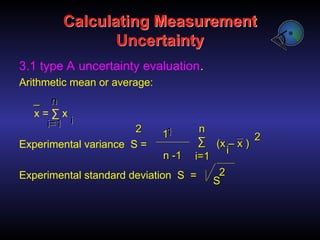
3.1 type A uncertainty evaluation.
Arithmetic mean or average:
x = ∑ x
Experimental variance S =
Experimental standard deviation S =
1
1
1
1
n -1
n -1
∑
∑ (x – x )
(x – x )
i
i
2
2
_
_
n
n
i=1
i=1
_
_
2
2
S
S
2
2
i
i
i=1
i=1
n
n
Calculating Measurement
Uncertainty
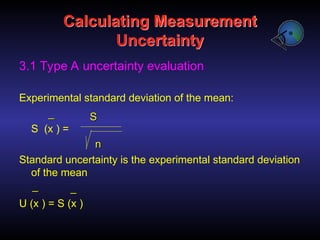
3.1 Type A uncertainty evaluation
Experimental standard deviation of the mean:
S (x ) =
Standard uncertainty is the experimental standard deviation
of the mean
U (x ) = S (x )
S
S
n
n
_
_
_
_ _
_
Calculating Measurement
Uncertainty
3.2 type B uncertainty evaluation.
• The standard uncertainty is calculated from known
characteristics of the distribution.
• There are 3 distributions that can be considered;
rectangular – triangle – normal.
• One can not combine normal and non normal
distributions when combining uncertainties.
• apply correction factors when combining normal and
non normal distributions.
Calculating Measurement
Uncertainty
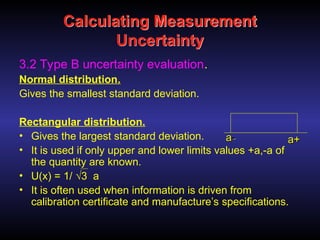
3.2 Type B uncertainty evaluation.
Normal distribution.
Gives the smallest standard deviation.
Rectangular distribution.
• Gives the largest standard deviation.
• It is used if only upper and lower limits values +a,-a of
the quantity are known.
• U(x) = 1/ √3 a
• It is often used when information is driven from
calibration certificate and manufacture’s specifications.
-
-
a
a +
+
a
a
Calculating Measurement
Uncertainty
3.2 Type B uncertainty evaluation
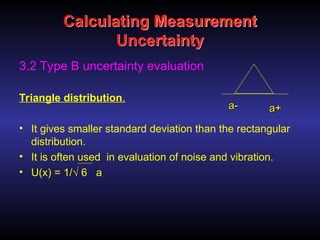
Triangle distribution.
• It gives smaller standard deviation than the rectangular
distribution.
• It is often used in evaluation of noise and vibration.
• U(x) = 1/√ 6 a
-
-
a
a +
+
a
a
Calculating Measurement
Uncertainty
3.2 Type B uncertainty evaluation
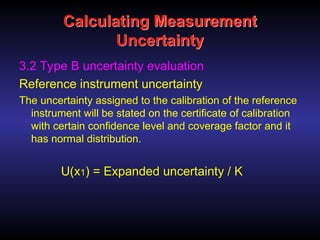
Reference instrument uncertainty
The uncertainty assigned to the calibration of the reference
instrument will be stated on the certificate of calibration
with certain confidence level and coverage factor and it
has normal distribution.
U(x1) = Expanded uncertainty / K
Calculating Measurement
Uncertainty
3.2 Type B uncertainty evaluation
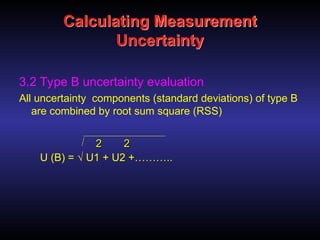
All uncertainty components (standard deviations) of type B
are combined by root sum square (RSS)
U (B) = √ U1 + U2 +………..
2
2 2
2
Calculating Measurement
Uncertainty
4. Combined uncertainty
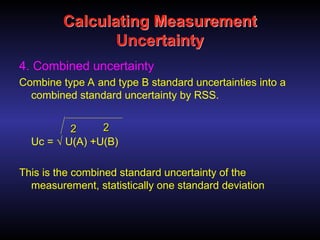
Combine type A and type B standard uncertainties into a
combined standard uncertainty by RSS.
Uc = √ U(A) +U(B)
This is the combined standard uncertainty of the
measurement, statistically one standard deviation
2
2 2
2
Calculating Measurement
Uncertainty
5. Expanded uncertainty
• The uncertainty is expressed in more than one standard
deviation basis
• Expanded uncertainty , roughly equivalent to a
confidence interval .
• Expanded uncertainty provide high level of confidence.
• Expanded uncertainty should be calculated by
multiplying the combined uncertainty by a coverage
factor K.
Um = K Uc
Calculating Measurement
Uncertainty
5. Expanded uncertainty
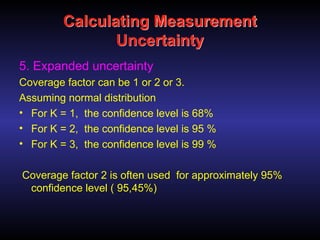
Coverage factor can be 1 or 2 or 3.
Assuming normal distribution
• For K = 1, the confidence level is 68%
• For K = 2, the confidence level is 95 %
• For K = 3, the confidence level is 99 %
Coverage factor 2 is often used for approximately 95%
confidence level ( 95,45%)
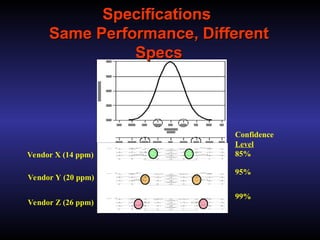
Vendor X (14 ppm)
Vendor Y (20 ppm)
Vendor Z (26 ppm)
Confidence
Level
85%
95%
99%
Specifications
Specifications
Same Performance, Different
Specs
Specs
Calculating Measurement
Uncertainty
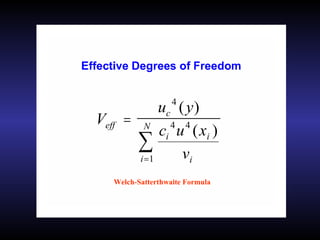
5. Expanded uncertainty
Coverage factors derived from effective degree of freedom
• Effective degree of freedom is the reliability of the
standard uncertainty as an estimate of the standard
deviation of measurement.
• For normal distribution Veff = n -1 Type A
• For other distributions in type B assume Veff = ∞
Calculating Measurement
Uncertainty
5. Expanded uncertainty
Coverage factors derived from effective degree of freedom
The coverage factor Kp is used when type A uncertainty is
large with respect to other components of combined
uncertainty and the number of observations n is small
(2 or less).
In this case the probability that the distribution is not
normal and the confidence level is less than 95% when
K = 2
Calculating Measurement
Uncertainty
5. Expanded uncertainty
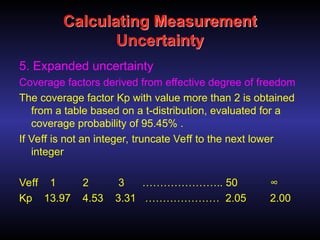
Coverage factors derived from effective degree of freedom
The coverage factor Kp with value more than 2 is obtained
from a table based on a t-distribution, evaluated for a
coverage probability of 95.45% .
If Veff is not an integer, truncate Veff to the next lower
integer
Veff 1 2 3 ………………….. 50 ∞
Kp 13.97 4.53 3.31 ………………… 2.05 2.00
Calculating Measurement
Uncertainty
6. Uncertainty Budget
All results are tabulated to include all uncertainties
components , uncertainties values , probability
distributions, the correction factors, the combined
uncertainty and the expanded uncertainty,
Calculating Measurement
Uncertainty
7. Uncertainty Reporting
The reported measured value and the uncertainty are
written in the calibration certificate as:
Y +/- U
With the following statement:
“The reported expanded uncertainty of measurement is
stated as the standard uncertainty of measurement
multiplied by the coverage factor K= 2 which for a normal
distribution corresponds to confidence level of 95 %”
Calculating Measurement
Uncertainty
7. Uncertainty Reporting
In case of using Kp the following statement is used:
“The reported expanded uncertainty of measurement is
stated as the standard uncertainty of measurement
multiplied by the coverage factor Kp = xx which for
t- distribution corresponds to effective degree of freedom
Veff = y y with confidence level of 95 %”
Thank you for listening

New uncertainty course part 2- july05.ppt

  • 1.
  • 2.
    Measurement Uncertainty in ISO17025 ISO17025 5.4.6.1 A calibration laboratory or a testing laboratory performing its own calibration, shall have and shall apply a procedure to estimate the uncertainty of measurement for all calibration and types of calibrations. ISO 17025 5.4.6.2 Testing laboratories shall have and shall apply procedures for estimating uncertainty of measurement. In certain cases the nature of test methods may preclude rigorous , metrologically and statistical valid, calculation of uncertainty………………..
  • 3.
    Measurement Uncertainty in ISO17025 ISO17025 5.4.6.3 When estimating the uncertainty of measurement, all uncertainty component which are of importance in the given situation shall be taken into account using appropriate method of analysis. Measurement uncertainty is also mentioned elsewhere in the ISO 17025 standard.
  • 4.
    Measured value Error Uncertainty at 95% confidencelevel Uncertainty and Error True value +2 б - 2 б Measurement Uncertainty Measurement Uncertainty
  • 5.
    Measurement Error Measurement Error •Error is the difference between the result of the measurement and the true value of the quantity measured. • Error is a real physical quantity, its magnitude can not be exactly known . • Error is viewed is being of two kinds : random error and systematic error . Measurement Uncertainty Measurement Uncertainty
  • 6.
    Uncertainty Uncertainty Uncertainty is therange of values, usually centered on the measured value, that contains the true value with stated probability. Confidence interval Confidence interval When uncertainty is defined as above, the confidence interval is the range of values that corresponds to the stated uncertainty. Confidence level Confidence level It is the probability associated with a confidence interval. Measurement Uncertainty Measurement Uncertainty
  • 7.
    • We wouldsay “The true value can be expected to lie within ± X units of the measured value with 95% confidence . “ • Uncertainty is determined by an uncertainty analysis that take into consideration the effect of systematic and random errors in all the measurement processes. Measurement Measurement Uncertainty Uncertainty
  • 8.
    Sources of Measurement Uncertainty •Incomplete definition of measured quantity. • Non-representative sampling. • Environmental conditions effects. • Instruments resolution. • Personal bias in reading analogue instruments. • Inexact values of measurement standards and reference materials. • Approximations and assumptions in measurement methods and procedures. • Variations in repeated measurements.
  • 9.
    Calculating Measurement Uncertainty Before Starting •Basic knowledge of mathematics and statistics is required to determine measurement uncertainty. • Ensure that the process of determining uncertainty is under statistical control.
  • 10.
    Calculating Measurement Uncertainty Steps forcalculating measurement uncertainty 1. Identify the uncertainties in the measurement process. 2. Classify type of uncertainty (A or B). 3. Quantify (evaluate and calculate) individual uncertainty by various methods. 4. Combine uncertainty by Root sum square (RSS methods). 5. Assign appropriate K factor multiplier to combined uncertainty to report expanded uncertainty 6. Document in an uncertainty budget. 7. Document in an uncertainty report.
  • 11.
    Calculating Measurement Uncertainty 1.Identify theuncertainties in the measurement process. Determine contribution of factors affecting measurement. • Environment • Measuring Instruments. • Operators. • Measuring methods and procedures. • Calculation methods. • Other constrains
  • 12.
    Calculating Measurement Uncertainty 2. ClassifyType of uncertainty (A or B). Uncertainty components are grouped into two major categories depending on the source of data. The categories are type A and type B uncertainties. 2.1 Type A uncertainty Uncertainty of measurement evaluated by statistical analysis of series of observations. In this case the standard uncertainty is the experimental standard deviation of the mean that follows from an averaging procedure.
  • 13.
    Calculating Measurement Uncertainty 2.1 TypeA uncertainty. Type A evaluation of standard uncertainty can be applied when several independent observations have been made for one measurement . When there is sufficient resolution in the measurement process there will be an observable scatter or spread in the values obtained.
  • 14.
    Calculating Measurement Uncertainty 2.2 TypeB uncertainty. Type B evaluation of standard uncertainty is the evaluation of the uncertainty by means other than the statistical analysis of a series of observation. it is based on experience and general knowledge. It is a skill that can be learned with practice.
  • 15.
    Calculating Measurement Uncertainty 2.2 TypeB uncertainty. Values of this type of uncertainty are driven at least from: • Previous measurement data. • Experience or general knowledge of the behavior of the instrument. • Manufacturer's specifications. • Data in calibration certificates. • Data in hand books. • Environmental conditions effect.
  • 16.
    Calculating Measurement Uncertainty 3. Evaluateand calculate individual uncertainty by various methods. • Compute a type A standard uncertainty for random sources of error from series of measurements observations. • Compute a standard uncertainty for each type B component
  • 17.
    Calculating Measurement Uncertainty 3.1 typeA uncertainty evaluation. Arithmetic mean or average: x = ∑ x Experimental variance S = Experimental standard deviation S = 1 1 1 1 n -1 n -1 ∑ ∑ (x – x ) (x – x ) i i 2 2 _ _ n n i=1 i=1 _ _ 2 2 S S 2 2 i i i=1 i=1 n n
  • 18.
    Calculating Measurement Uncertainty 3.1 TypeA uncertainty evaluation Experimental standard deviation of the mean: S (x ) = Standard uncertainty is the experimental standard deviation of the mean U (x ) = S (x ) S S n n _ _ _ _ _ _
  • 19.
    Calculating Measurement Uncertainty 3.2 typeB uncertainty evaluation. • The standard uncertainty is calculated from known characteristics of the distribution. • There are 3 distributions that can be considered; rectangular – triangle – normal. • One can not combine normal and non normal distributions when combining uncertainties. • apply correction factors when combining normal and non normal distributions.
  • 20.
    Calculating Measurement Uncertainty 3.2 TypeB uncertainty evaluation. Normal distribution. Gives the smallest standard deviation. Rectangular distribution. • Gives the largest standard deviation. • It is used if only upper and lower limits values +a,-a of the quantity are known. • U(x) = 1/ √3 a • It is often used when information is driven from calibration certificate and manufacture’s specifications. - - a a + + a a
  • 21.
    Calculating Measurement Uncertainty 3.2 TypeB uncertainty evaluation Triangle distribution. • It gives smaller standard deviation than the rectangular distribution. • It is often used in evaluation of noise and vibration. • U(x) = 1/√ 6 a - - a a + + a a
  • 22.
    Calculating Measurement Uncertainty 3.2 TypeB uncertainty evaluation Reference instrument uncertainty The uncertainty assigned to the calibration of the reference instrument will be stated on the certificate of calibration with certain confidence level and coverage factor and it has normal distribution. U(x1) = Expanded uncertainty / K
  • 23.
    Calculating Measurement Uncertainty 3.2 TypeB uncertainty evaluation All uncertainty components (standard deviations) of type B are combined by root sum square (RSS) U (B) = √ U1 + U2 +……….. 2 2 2 2
  • 24.
    Calculating Measurement Uncertainty 4. Combineduncertainty Combine type A and type B standard uncertainties into a combined standard uncertainty by RSS. Uc = √ U(A) +U(B) This is the combined standard uncertainty of the measurement, statistically one standard deviation 2 2 2 2
  • 25.
    Calculating Measurement Uncertainty 5. Expandeduncertainty • The uncertainty is expressed in more than one standard deviation basis • Expanded uncertainty , roughly equivalent to a confidence interval . • Expanded uncertainty provide high level of confidence. • Expanded uncertainty should be calculated by multiplying the combined uncertainty by a coverage factor K. Um = K Uc
  • 26.
    Calculating Measurement Uncertainty 5. Expandeduncertainty Coverage factor can be 1 or 2 or 3. Assuming normal distribution • For K = 1, the confidence level is 68% • For K = 2, the confidence level is 95 % • For K = 3, the confidence level is 99 % Coverage factor 2 is often used for approximately 95% confidence level ( 95,45%)
  • 27.
    Vendor X (14ppm) Vendor Y (20 ppm) Vendor Z (26 ppm) Confidence Level 85% 95% 99% Specifications Specifications Same Performance, Different Same Performance, Different Specs Specs
  • 28.
    Calculating Measurement Uncertainty 5. Expandeduncertainty Coverage factors derived from effective degree of freedom • Effective degree of freedom is the reliability of the standard uncertainty as an estimate of the standard deviation of measurement. • For normal distribution Veff = n -1 Type A • For other distributions in type B assume Veff = ∞
  • 30.
    Calculating Measurement Uncertainty 5. Expandeduncertainty Coverage factors derived from effective degree of freedom The coverage factor Kp is used when type A uncertainty is large with respect to other components of combined uncertainty and the number of observations n is small (2 or less). In this case the probability that the distribution is not normal and the confidence level is less than 95% when K = 2
  • 31.
    Calculating Measurement Uncertainty 5. Expandeduncertainty Coverage factors derived from effective degree of freedom The coverage factor Kp with value more than 2 is obtained from a table based on a t-distribution, evaluated for a coverage probability of 95.45% . If Veff is not an integer, truncate Veff to the next lower integer Veff 1 2 3 ………………….. 50 ∞ Kp 13.97 4.53 3.31 ………………… 2.05 2.00
  • 32.
    Calculating Measurement Uncertainty 6. UncertaintyBudget All results are tabulated to include all uncertainties components , uncertainties values , probability distributions, the correction factors, the combined uncertainty and the expanded uncertainty,
  • 33.
    Calculating Measurement Uncertainty 7. UncertaintyReporting The reported measured value and the uncertainty are written in the calibration certificate as: Y +/- U With the following statement: “The reported expanded uncertainty of measurement is stated as the standard uncertainty of measurement multiplied by the coverage factor K= 2 which for a normal distribution corresponds to confidence level of 95 %”
  • 34.
    Calculating Measurement Uncertainty 7. UncertaintyReporting In case of using Kp the following statement is used: “The reported expanded uncertainty of measurement is stated as the standard uncertainty of measurement multiplied by the coverage factor Kp = xx which for t- distribution corresponds to effective degree of freedom Veff = y y with confidence level of 95 %”
  • 35.
    Thank you forlistening