Rain forest
 A dense evergreen forest that are characterized by
high rainfall with annual rainfall in the case of tropical
rainforests between 250 to 450 cm.
 More than half of animal & plants species live.
 millions of species of plants, insects and
microorganisms still undiscovered in tropical rainforests.
 "world's largest pharmacy.
 28% of the world's oxygen
Types of rain forests
1. Tropical rain forest
Tropical rain forest
• Average annual rainfall is no less than 168 cm & can
exceed 1,000 cm.
• Tropical moist forests are located in the equatorial
zone between the Tropic of Cancer and Tropic of
Capricorn.
• Tropical rainforests exist in Southeast
Asia(from Myanmar (Burma) to
the Philippines, Malaysia, Indonesia, Papua New
Guinea, Sri Lanka, Sub-Saharan Africa from
Cameroon to the Congo (Congo Rainforest), South
America (e.g. the Amazon
Rainforest), CentralAmerica , Australia, and on many
of the Pacific Islands(such as Hawai).
2.Temperate rainforest
• Temperate rainforests are rainforests in
temperate regions.
• They are present in North America in the Pacific
Northwest area in Alaska and Britis
Columbia, Washington, Oregon and California and
in Europe such as the coastal areas
of Ireland and Scotland, southern Norway,
coastal Turkey in East Asia in southern China,
Highlands of Taiwan, much of Japan and Korea.
Rainforest depletion
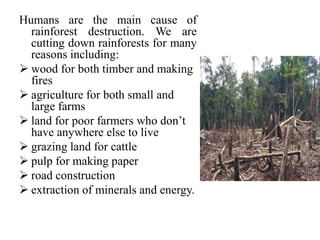
Humans are the main cause of
rainforest destruction. We are
cutting down rainforests for many
reasons including:
 wood for both timber and making
fires
 agriculture for both small and
large farms
 land for poor farmers who don’t
have anywhere else to live
 grazing land for cattle
 pulp for making paper
 road construction
 extraction of minerals and energy.
Rainforest depletion
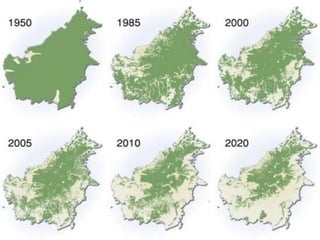
• Rainforests have been subjected to heavy logging and
agricultural clearance throughout the 20th century and the area
covered by rainforests around the world is shrinking.
• Almost 90% of West Africa's rainforest has been
destroyed. Since the arrival of humans Madagascar has lost
two thirds of its original rainforest.
THE DRIVING FORCES OF
DESTRUCTION
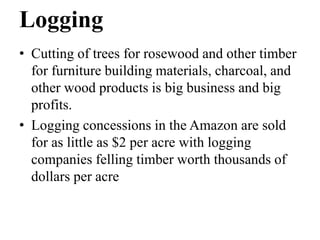
Logging
• Cutting of trees for rosewood and other timber
for furniture building materials, charcoal, and
other wood products is big business and big
profits.
• Logging concessions in the Amazon are sold
for as little as $2 per acre with logging
companies felling timber worth thousands of
dollars per acre
Fuel Wood and the Paper Industry
• wood also use in developing countries for fuel wood and
charcoal.
• Pulpwood also use in paper industry
• Only 1 to 2 percent of light reach the forest floor .
• Most times when timber is harvested trees and other plants
that have evolved over centuries to grow in the dark humid
environment below the canopy .
• Simply cannot live out in the open and as a result the plants
and animals of the original forest become extinct
Grazing Land
• As the demand in the Western world for meat
increases more and more rainforests are destroyed to
provide grazing land
• Most of Central and Latin America's tropical and
temperate rainforests have been lost to cattle
operations to meet the world demand and still the
cattle operations.
Farming
• Less than 10 percent of Amazonian soils are
suitable for sustained conventional agriculture.
• Because of the infertility of the soil and the
lack of knowledge of cultivation,
• farmers continue to move farther into the
rainforest in search of new land.
• They must be helped and educated to break
free of the need to continually clear rainforest
in search of fresh fertile land if the rainforest is
to be saved.

Rain forest depletion

  • 2.
    Rain forest  Adense evergreen forest that are characterized by high rainfall with annual rainfall in the case of tropical rainforests between 250 to 450 cm.  More than half of animal & plants species live.  millions of species of plants, insects and microorganisms still undiscovered in tropical rainforests.  "world's largest pharmacy.  28% of the world's oxygen
  • 3.
    Types of rainforests 1. Tropical rain forest
  • 4.
    Tropical rain forest •Average annual rainfall is no less than 168 cm & can exceed 1,000 cm. • Tropical moist forests are located in the equatorial zone between the Tropic of Cancer and Tropic of Capricorn. • Tropical rainforests exist in Southeast Asia(from Myanmar (Burma) to the Philippines, Malaysia, Indonesia, Papua New Guinea, Sri Lanka, Sub-Saharan Africa from Cameroon to the Congo (Congo Rainforest), South America (e.g. the Amazon Rainforest), CentralAmerica , Australia, and on many of the Pacific Islands(such as Hawai).
  • 6.
    2.Temperate rainforest • Temperaterainforests are rainforests in temperate regions. • They are present in North America in the Pacific Northwest area in Alaska and Britis Columbia, Washington, Oregon and California and in Europe such as the coastal areas of Ireland and Scotland, southern Norway, coastal Turkey in East Asia in southern China, Highlands of Taiwan, much of Japan and Korea.
  • 8.
  • 9.
    Humans are themain cause of rainforest destruction. We are cutting down rainforests for many reasons including:  wood for both timber and making fires  agriculture for both small and large farms  land for poor farmers who don’t have anywhere else to live  grazing land for cattle  pulp for making paper  road construction  extraction of minerals and energy.
  • 10.
    Rainforest depletion • Rainforestshave been subjected to heavy logging and agricultural clearance throughout the 20th century and the area covered by rainforests around the world is shrinking. • Almost 90% of West Africa's rainforest has been destroyed. Since the arrival of humans Madagascar has lost two thirds of its original rainforest.
  • 11.
    THE DRIVING FORCESOF DESTRUCTION
  • 12.
    Logging • Cutting oftrees for rosewood and other timber for furniture building materials, charcoal, and other wood products is big business and big profits. • Logging concessions in the Amazon are sold for as little as $2 per acre with logging companies felling timber worth thousands of dollars per acre
  • 14.
    Fuel Wood andthe Paper Industry • wood also use in developing countries for fuel wood and charcoal. • Pulpwood also use in paper industry • Only 1 to 2 percent of light reach the forest floor . • Most times when timber is harvested trees and other plants that have evolved over centuries to grow in the dark humid environment below the canopy . • Simply cannot live out in the open and as a result the plants and animals of the original forest become extinct
  • 15.
    Grazing Land • Asthe demand in the Western world for meat increases more and more rainforests are destroyed to provide grazing land • Most of Central and Latin America's tropical and temperate rainforests have been lost to cattle operations to meet the world demand and still the cattle operations.
  • 16.
    Farming • Less than10 percent of Amazonian soils are suitable for sustained conventional agriculture. • Because of the infertility of the soil and the lack of knowledge of cultivation, • farmers continue to move farther into the rainforest in search of new land. • They must be helped and educated to break free of the need to continually clear rainforest in search of fresh fertile land if the rainforest is to be saved.