WELCOME
WORLD ENVIRONMENT DAY!
Lecture
on
Role of Forest and Trees on
Environment
By
Manyapragathi & RGUKT Nuzvid, NSS Unit-6
Associated with UNEP
Speaker: Ravi Gedela M.Tech IITG, (PhD IITG)
Assistant professor &
Head of the Department (i/c)
NSS Programme Officer
Department of Bio-Sciences
RGUKT- Nuzvid
https://www.manyapragathi.com
JOIN #GENERATIONRESTORATION ON
WORLD ENVIRONMENT DAY!
JOIN #GENERATIONRESTORATION ON
WORLD ENVIRONMENT DAY!
• Restoration efforts and goals cannot be
addressed by just one entity, everyone has a
part.
• And you've taken a big step in contributing
towards healing the planet.
TOGETHER WE CAN BE
#GENERATIONRESTORATION
PEOPLE IN ENVIRONMENT
People in Environment International
1. Charles Darwin: Origin of Species.
2. Henry Thoreau: Wilderness should be preserved Indian
3. Salim Ali: Fall of Sparrow
4. Smt. Indira Gandhi: Wild life protection act was formulated
during her tenure.
5. M.S.Swaminathan: Worked on conservation of biological
diversity.
6. M.C.Metha: Initiated the Government to implement
Environmental education in schools and colleges, struggles for
protection of Taj Mahal and cleaning of Ganga water.
7. Sunder Lal Bahuguna: Chipko movement.
8. Medha Patker: Narmada Bhachavo Andolan.
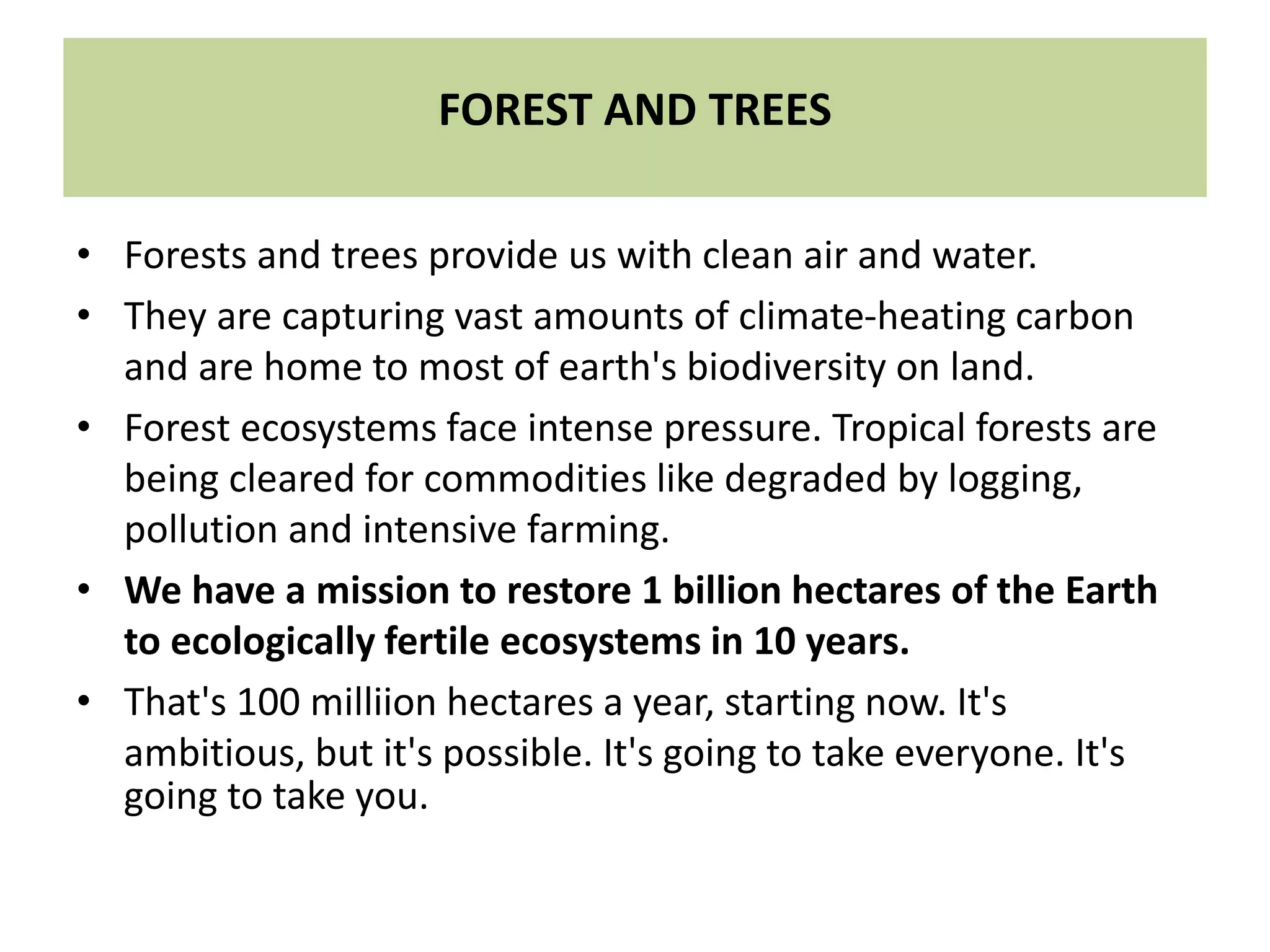
FOREST AND TREES
• Forests and trees provide us with clean air and water.
• They are capturing vast amounts of climate-heating carbon
and are home to most of earth's biodiversity on land.
• Forest ecosystems face intense pressure. Tropical forests are
being cleared for commodities like degraded by logging,
pollution and intensive farming.
• We have a mission to restore 1 billion hectares of the Earth
to ecologically fertile ecosystems in 10 years.
• That's 100 milliion hectares a year, starting now. It's
ambitious, but it's possible. It's going to take everyone. It's
going to take you.
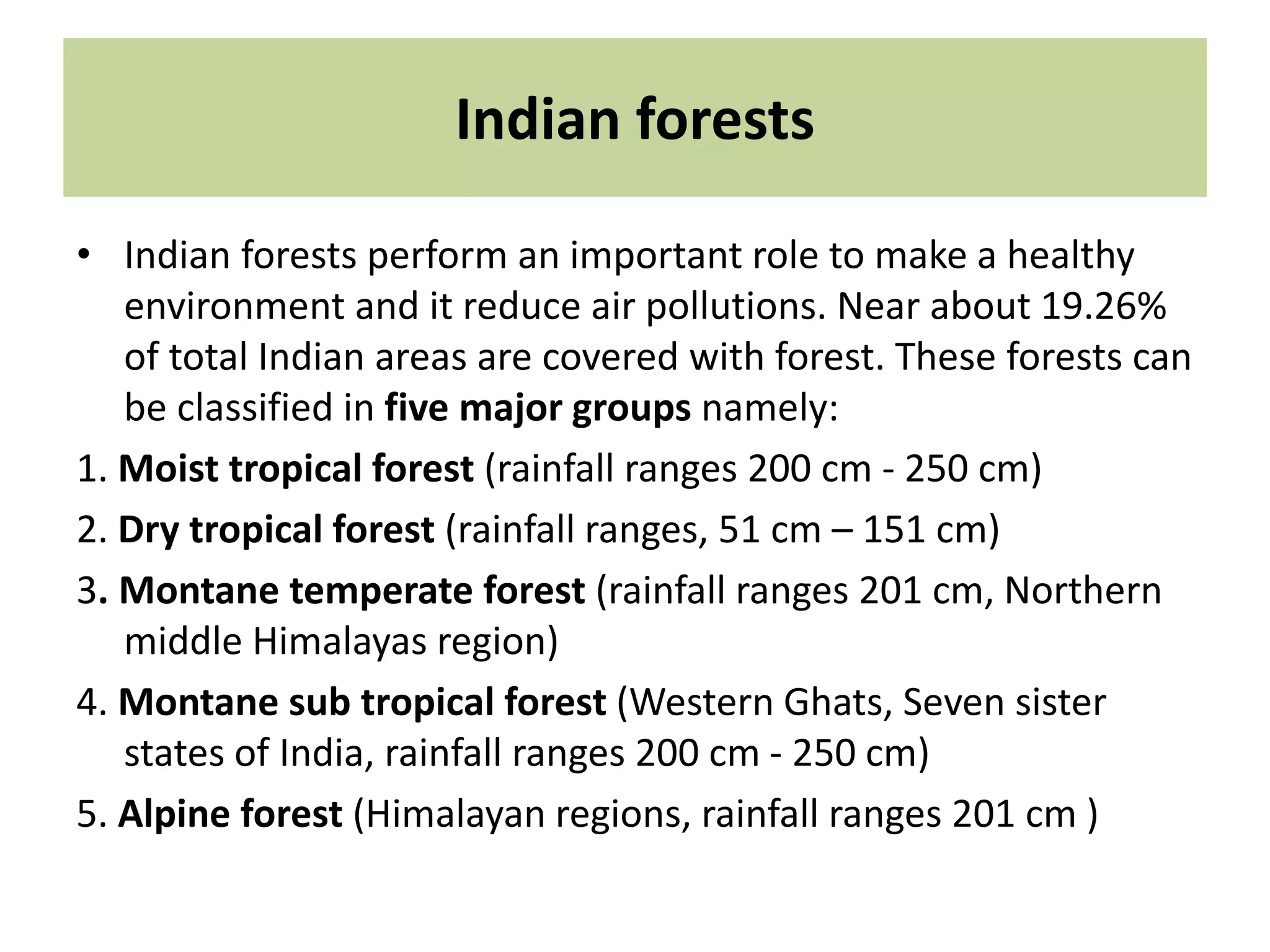
Indian forests
• Indian forests perform an important role to make a healthy
environment and it reduce air pollutions. Near about 19.26%
of total Indian areas are covered with forest. These forests can
be classified in five major groups namely:
1. Moist tropical forest (rainfall ranges 200 cm - 250 cm)
2. Dry tropical forest (rainfall ranges, 51 cm – 151 cm)
3. Montane temperate forest (rainfall ranges 201 cm, Northern
middle Himalayas region)
4. Montane sub tropical forest (Western Ghats, Seven sister
states of India, rainfall ranges 200 cm - 250 cm)
5. Alpine forest (Himalayan regions, rainfall ranges 201 cm )
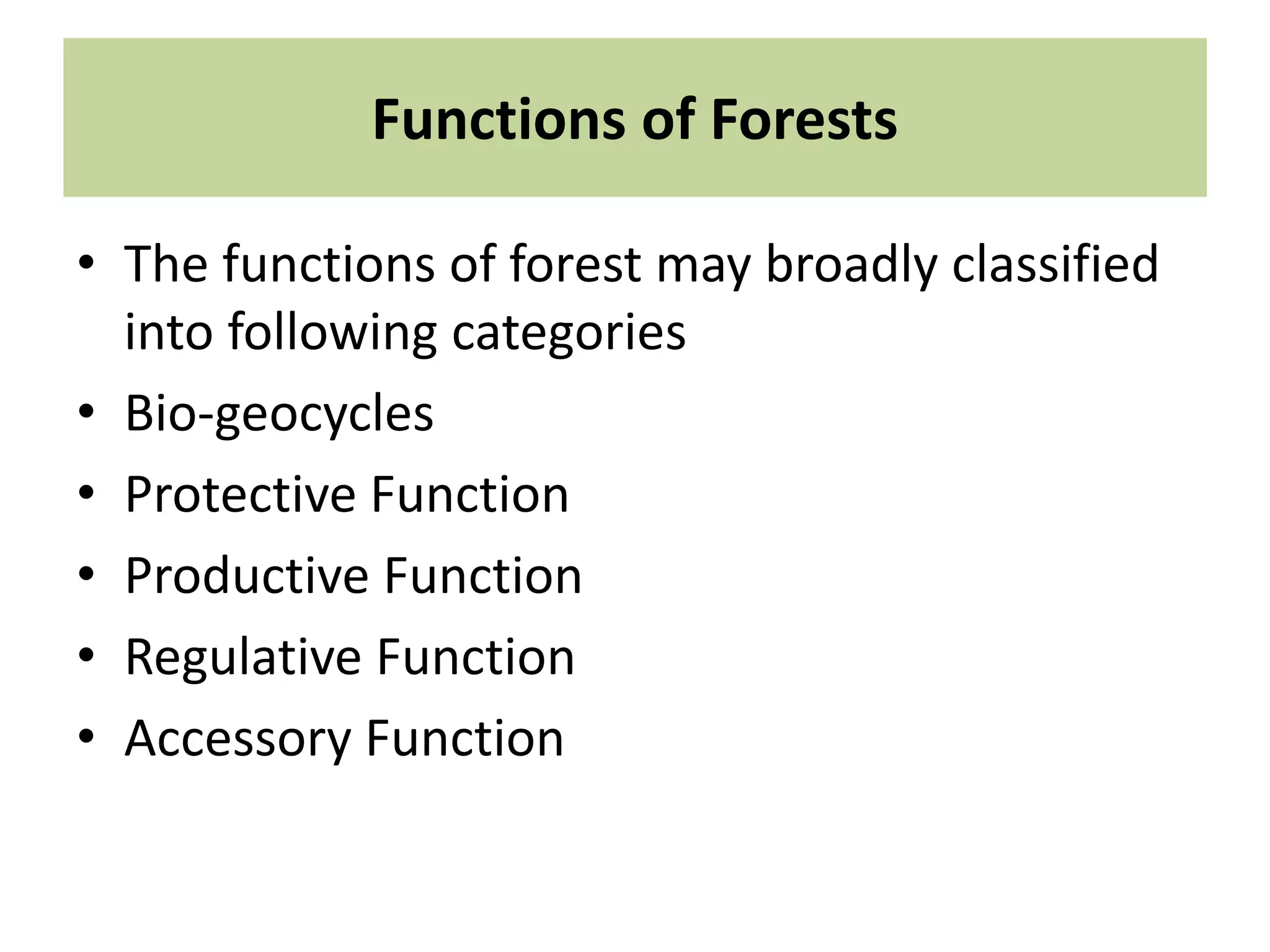
Functions of Forests
• The functions of forest may broadly classified
into following categories
• Bio-geocycles
• Protective Function
• Productive Function
• Regulative Function
• Accessory Function
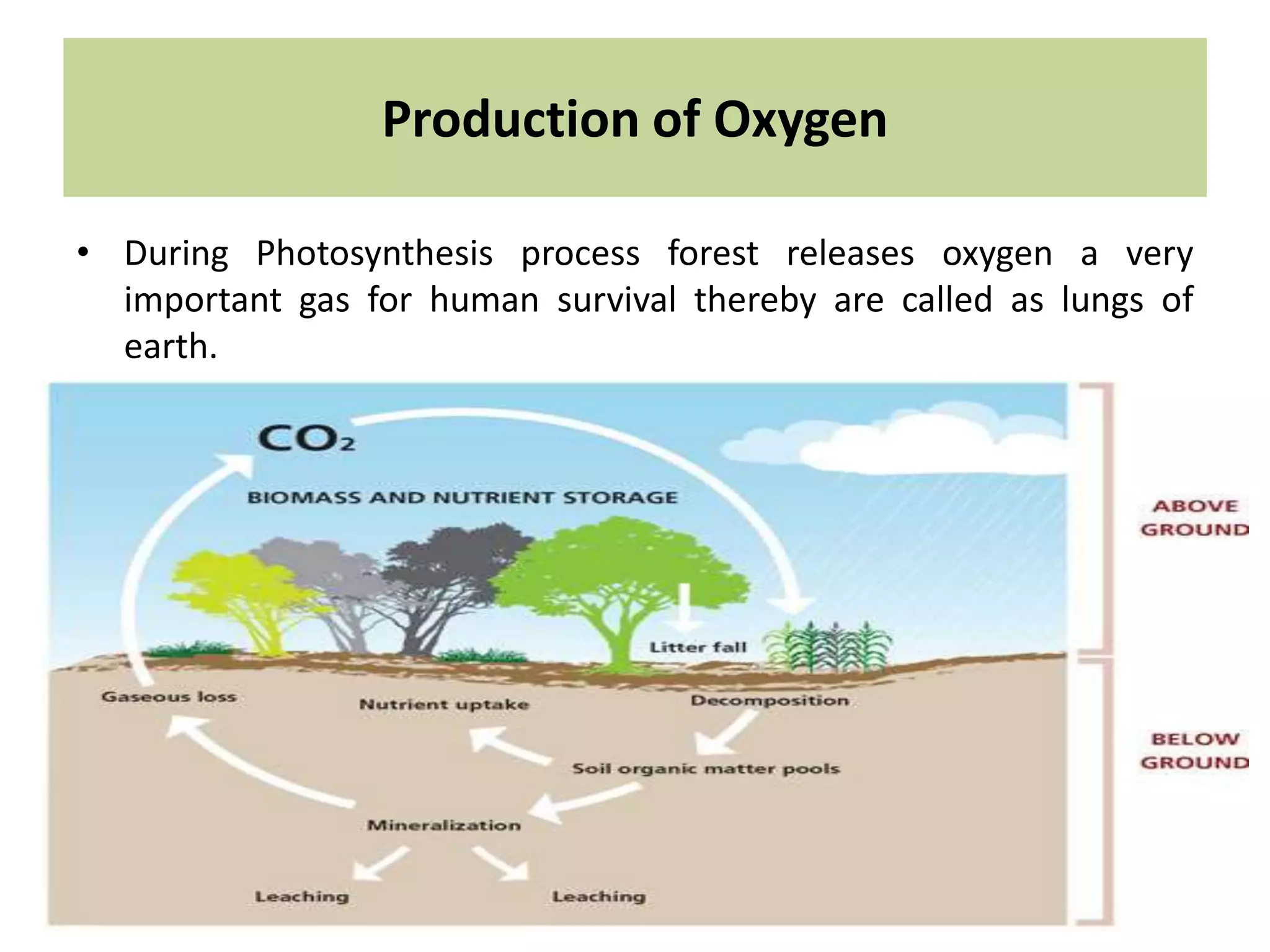
Production of Oxygen
• During Photosynthesis process forest releases oxygen a very
important gas for human survival thereby are called as lungs of
earth.
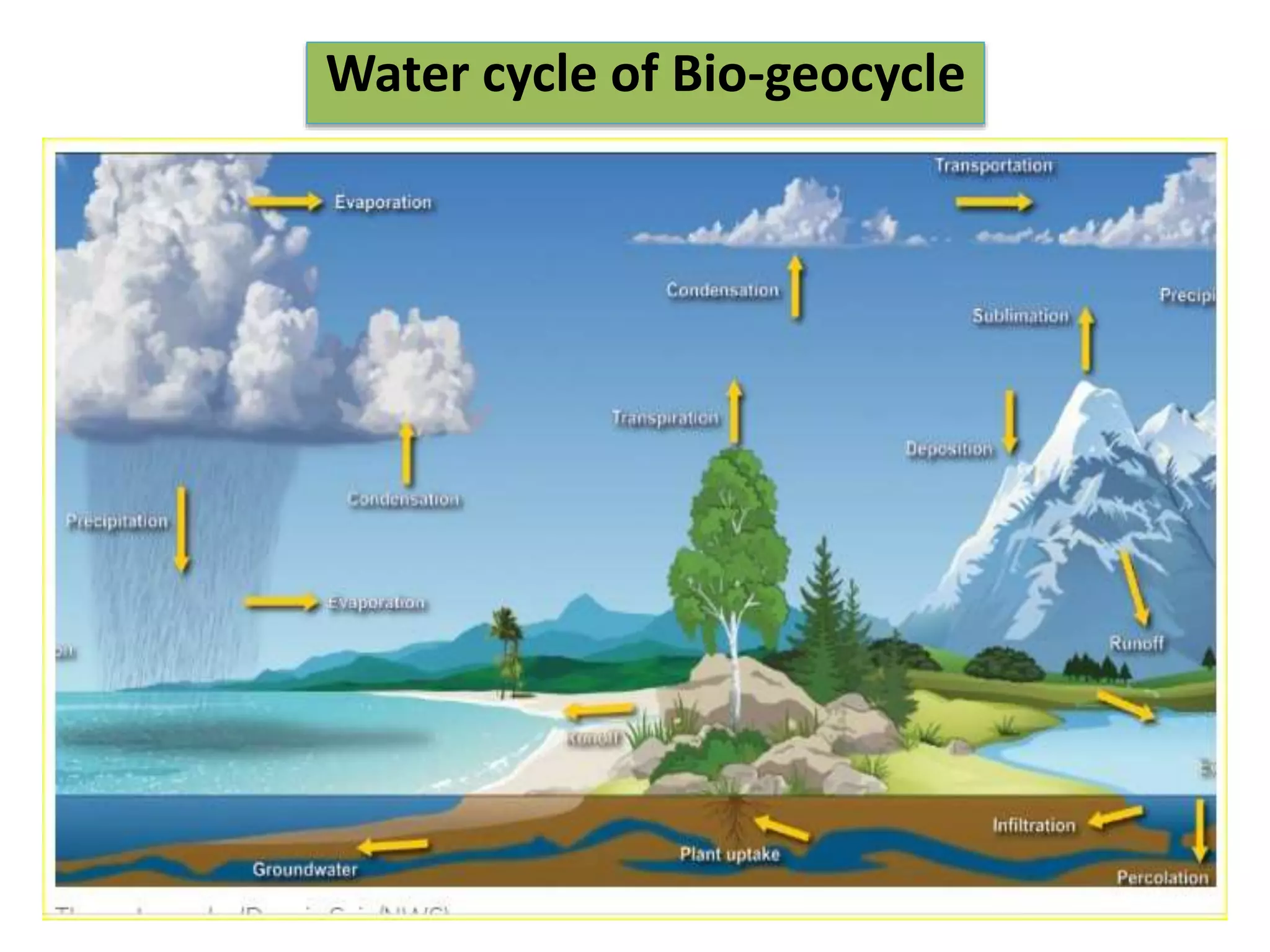
Water cycle of Bio-geocycle
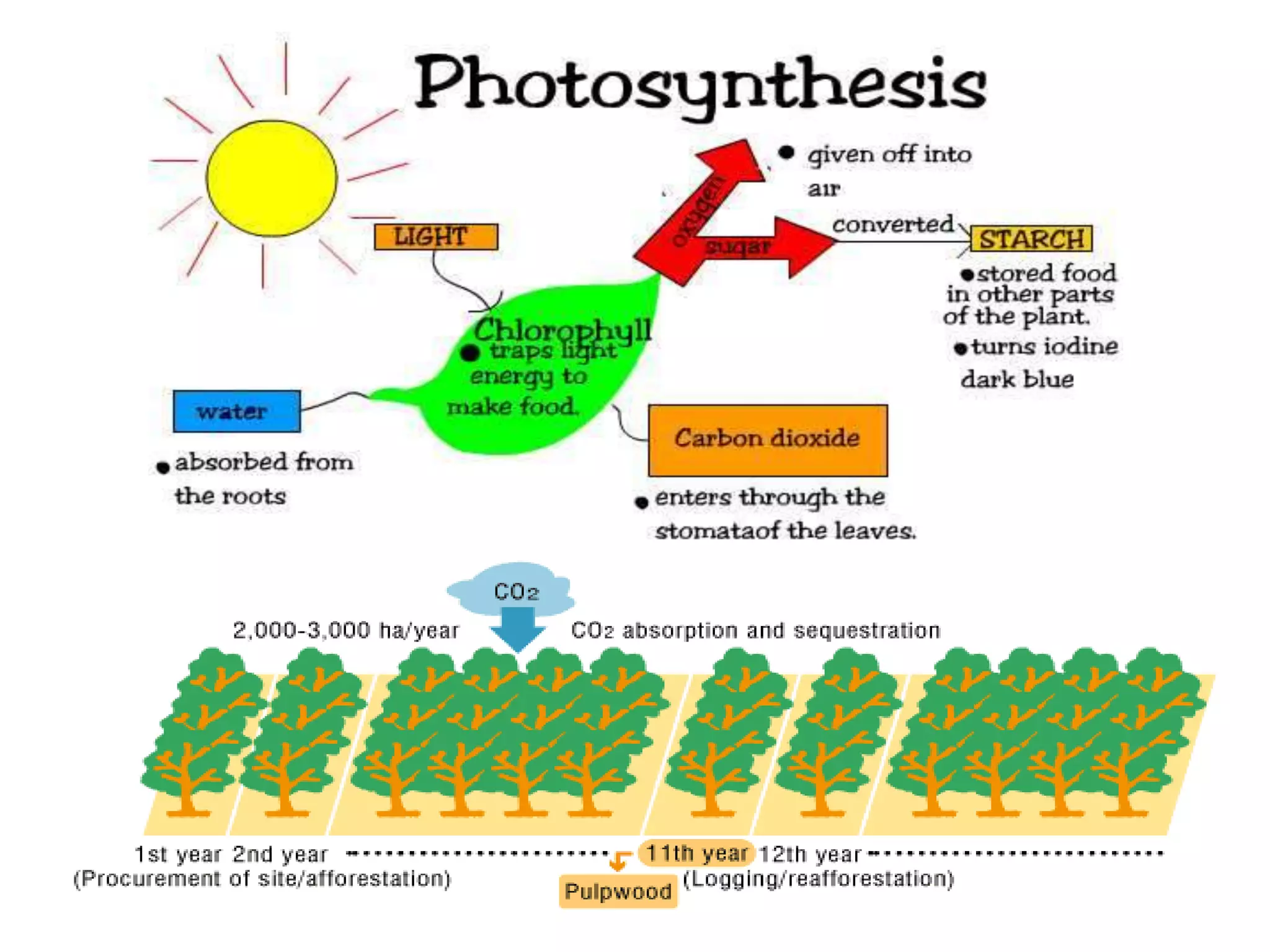
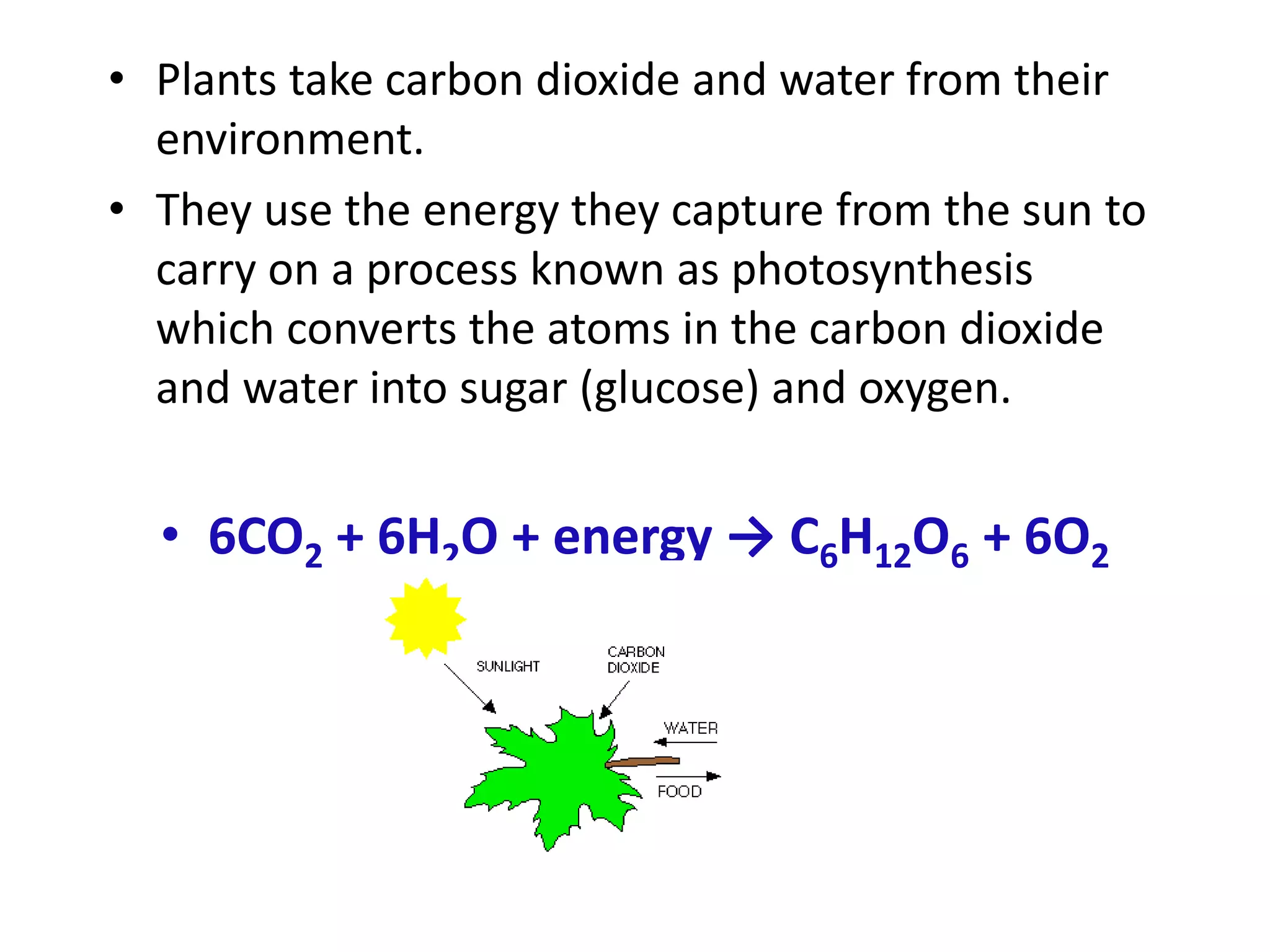
• Plants take carbon dioxide and water from their
environment.
• They use the energy they capture from the sun to
carry on a process known as photosynthesis
which converts the atoms in the carbon dioxide
and water into sugar (glucose) and oxygen.
• 6CO2 + 6H2O + energy → C6H12O6 + 6O2
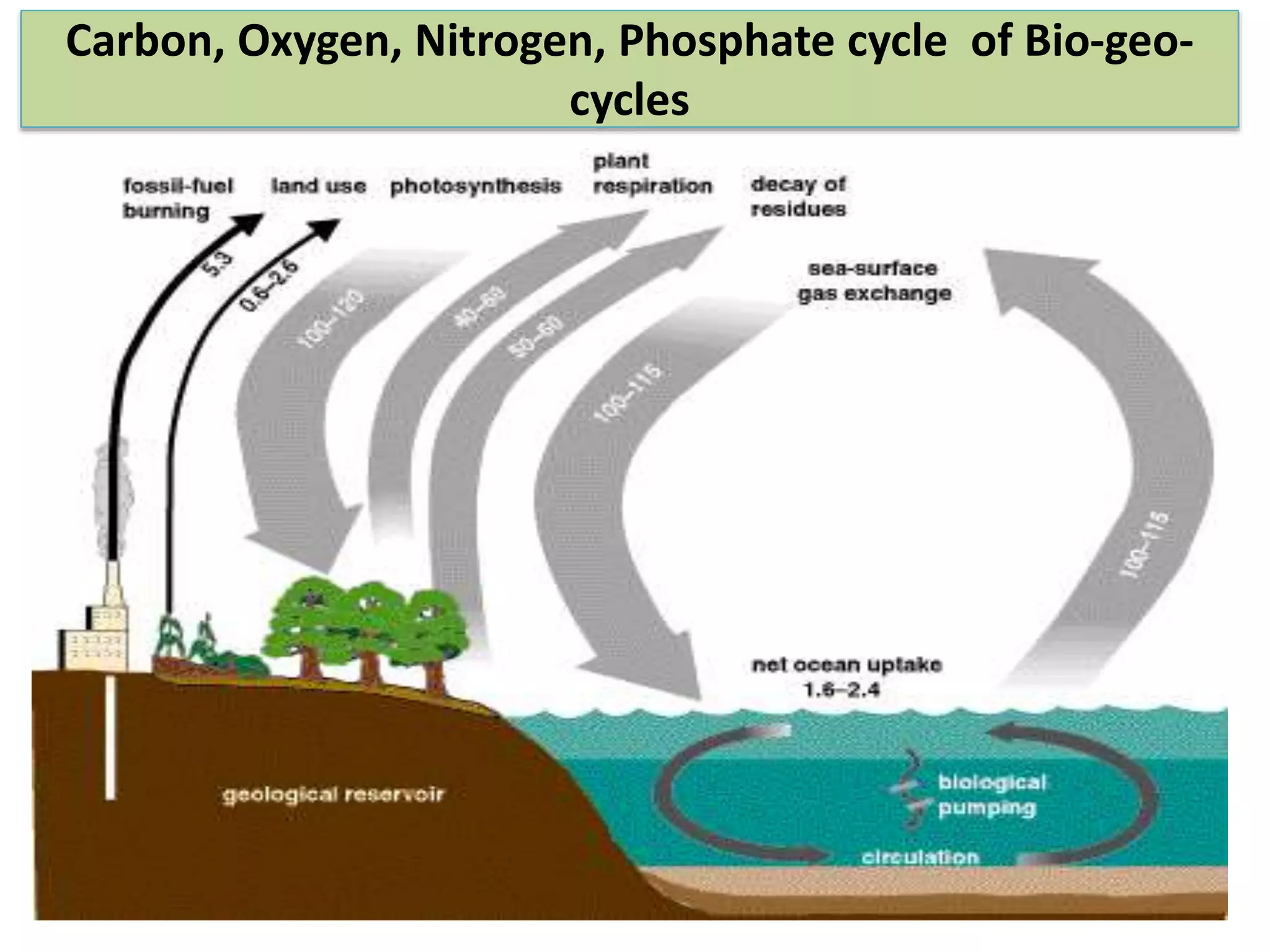
Carbon, Oxygen, Nitrogen, Phosphate cycle of Bio-geo-
cycles
Protective Functions
• Forest Provide protection against Soil erosion, Droughts,
floods, noise, radiations
Soil erosion Floods
Soil erosion Droughts
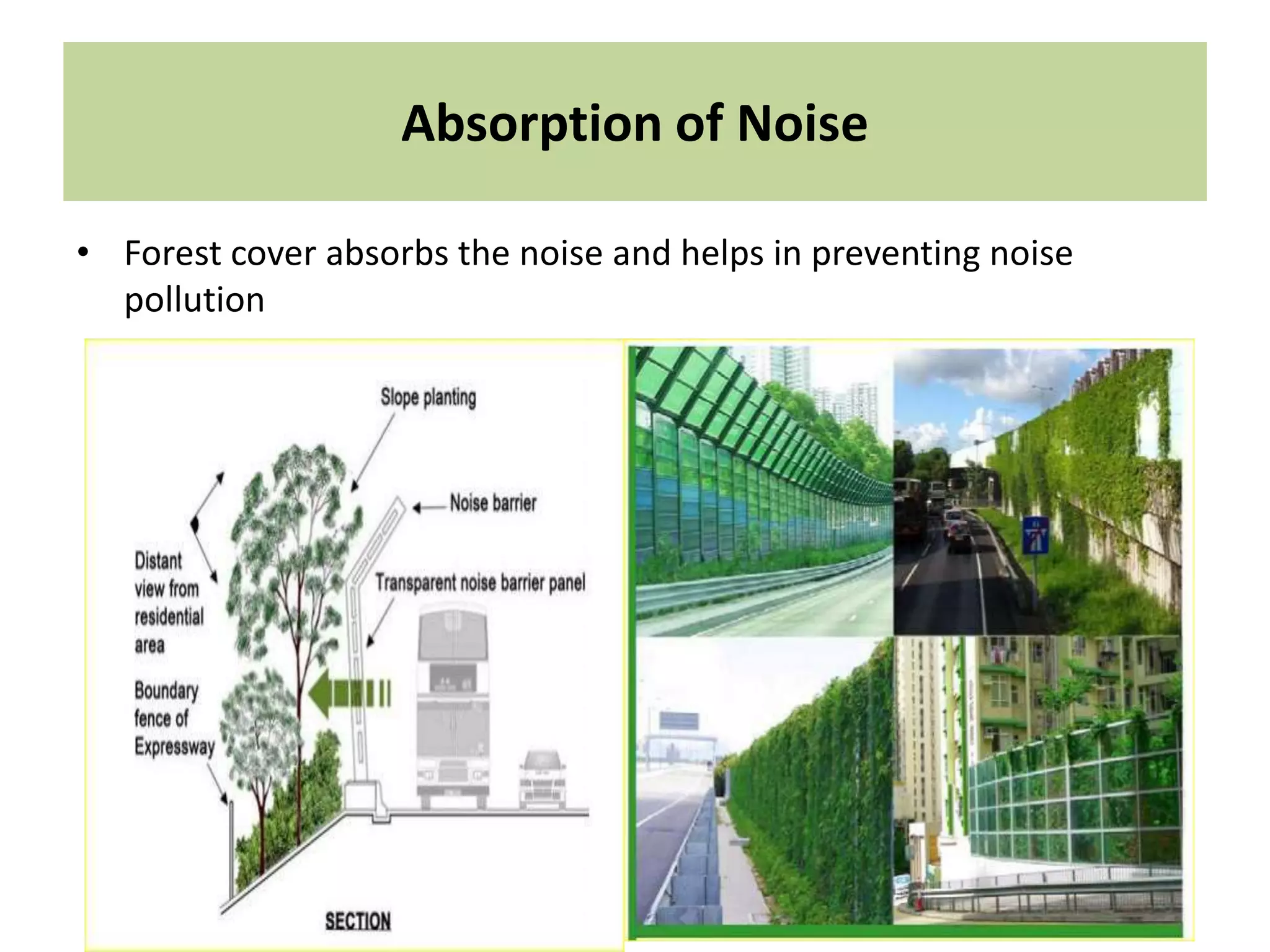
Absorption of Noise
• Forest cover absorbs the noise and helps in preventing noise
pollution
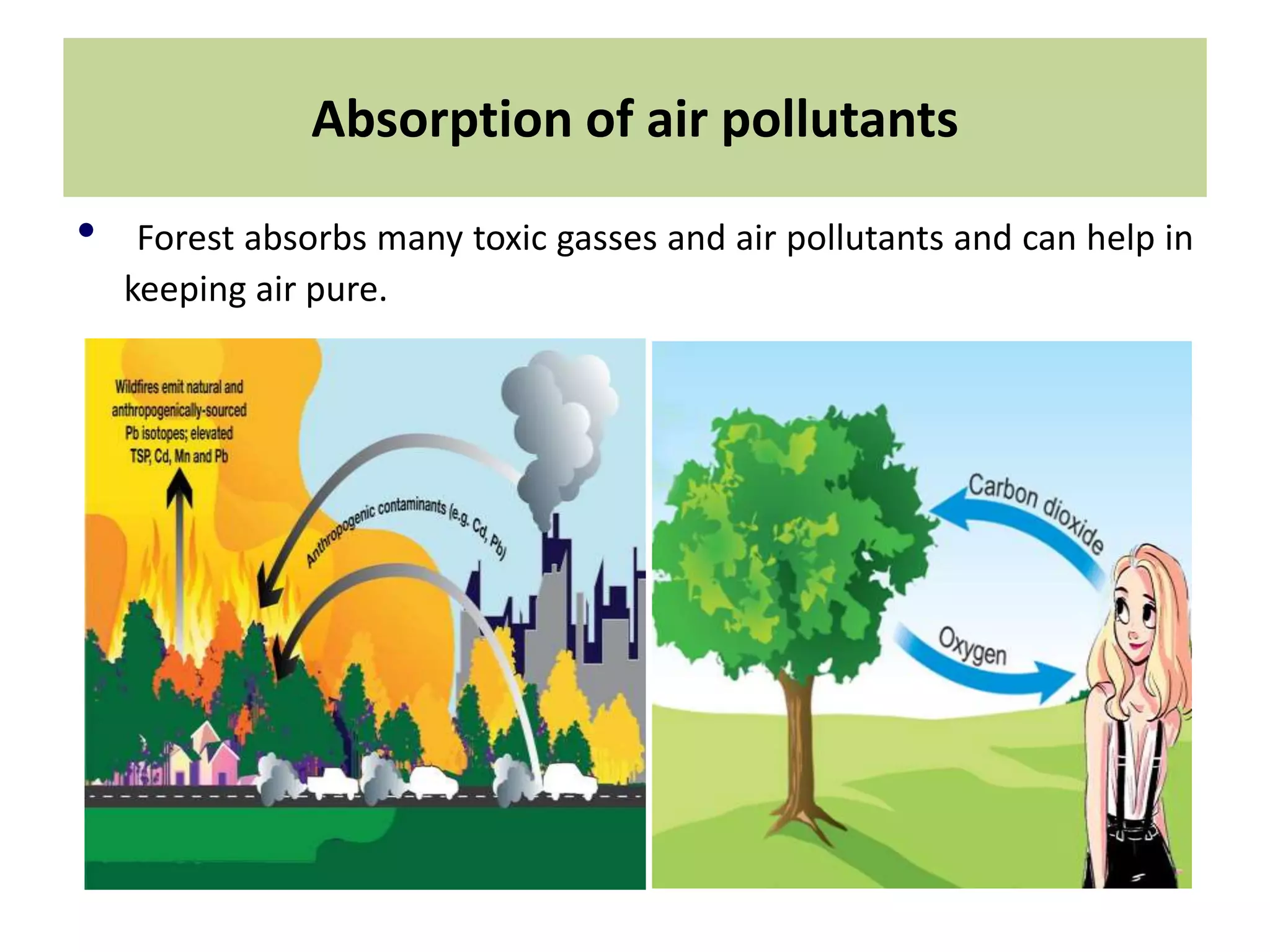
Absorption of air pollutants
• Forest absorbs many toxic gasses and air pollutants and can help in
keeping air pure.
Ecological Importance or uses of Forests
• Regulation of global climate and temperature
• Forest play a crucial role in regulation of global climate and
temperature as forest cover absorb the solar radiations that
would otherwise be reflected back into the atmosphere by
bare surface of the earth.
• Transpiration of plants increases the atmosphere humidity
which affects the rainfall, cools the atmosphere and thus
regulate the hydrological cycle
Reduction of Global Warming
• The main green house gas co2 is used by forests for
photosynthesis process the forest act as a sink for co2 there by
reducing the green house effect due to co2
• Timber Wood used for commercial purposes like
for making furniture and other items like boats,
bridges and other day to day uses.
• Fuel Wood: The wood is used as fuel for cooking
and other purposes by poor people.
• Raw material for wood based industries: forest
provide raw material for various wood based
industries like paper and pulp, sports goods,
furniture, match boxes etc.
Conti..
Productive Functions
• Forest Provide various products like, gum resins, medicines, honey,
pulp, bamboo, timber, and fruits
• Food: Fruits, roots, leaves of plants and trees along with the meat
of forest animals provide the food to the tribal people.
• Miscellaneous Products: Miscellaneous products like, resin, gums,
oils, medicines, honey are provided by forests
Accessory Function
• Forest provides aesthetics, habitat to various flora and fauna
besides that it also has an recreational value.
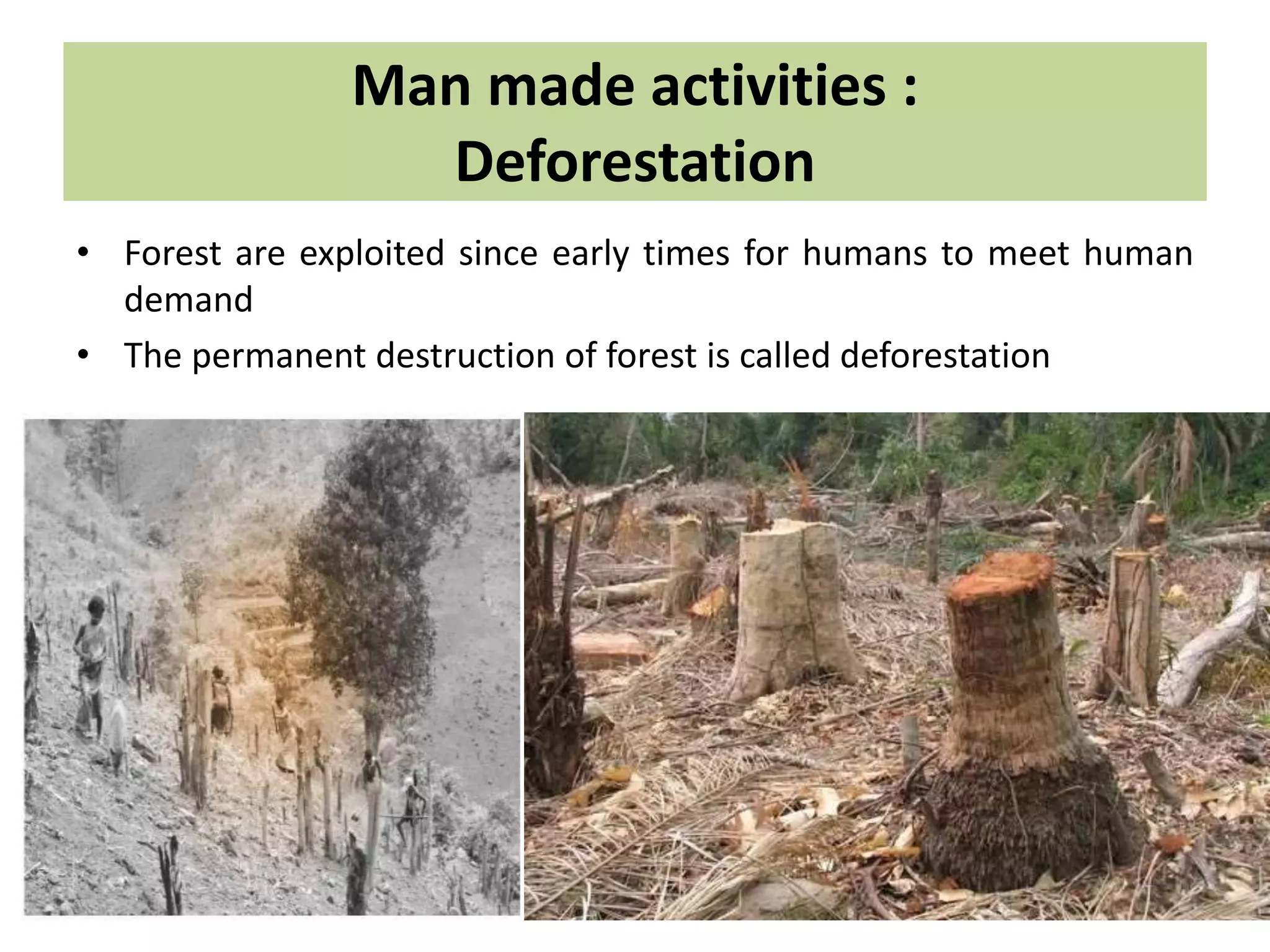
Man made activities :
Deforestation
• Forest are exploited since early times for humans to meet human
demand
• The permanent destruction of forest is called deforestation
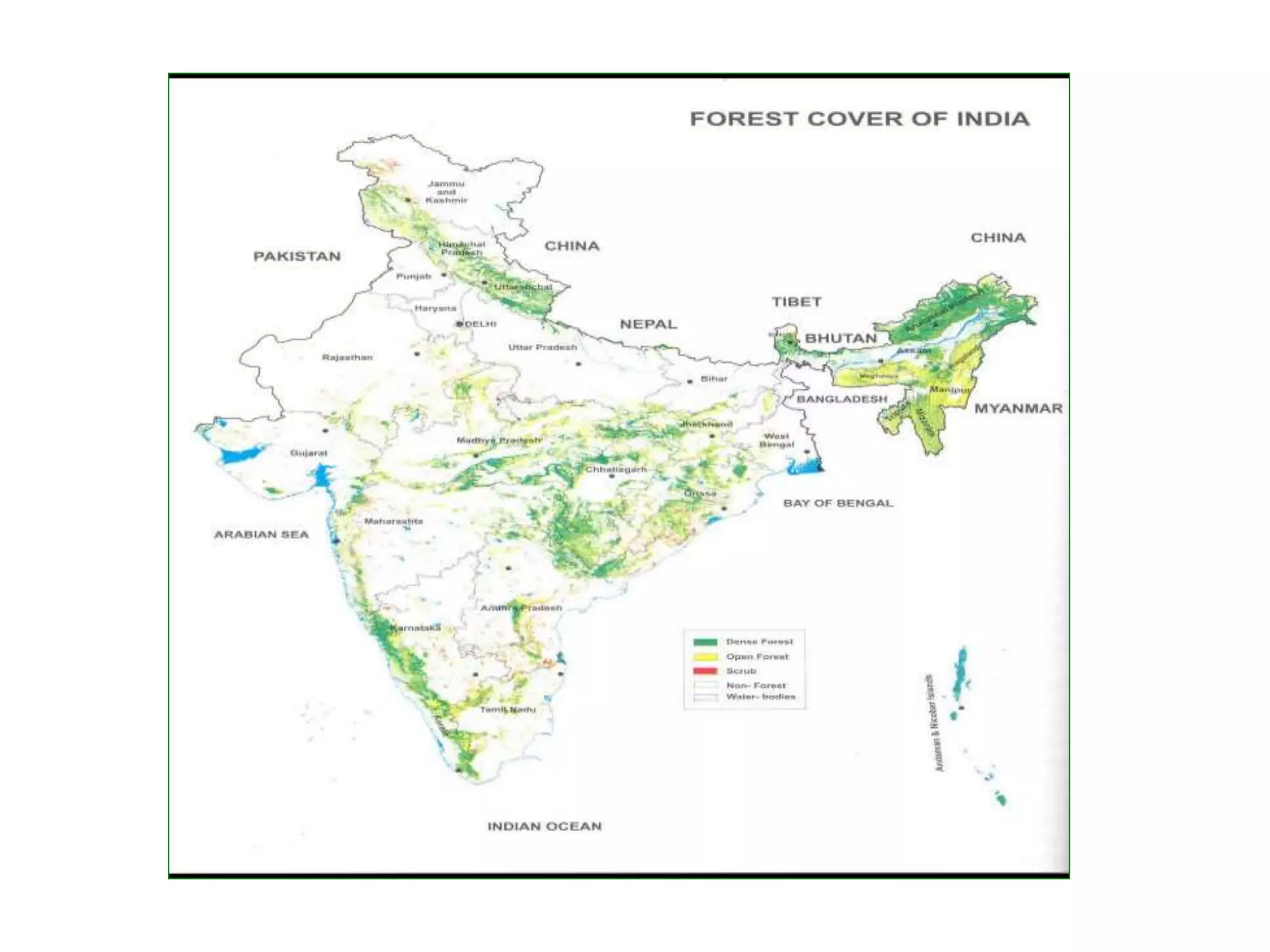
Forest Degradation in India
• At the beginning of 20th century about 30 % of land in India was
covered with forests but by the end of 20th century the forest cover
was reduced to 19.4%
• As a result of exploitation, the tropical forest cover in India, is now
only reduced to coastal western Ghats and northern India
• We have a huge population size and a very low precipitate forest
area 0.075 Ha per capita as compared to 0.64 ha/ capita of world
forest area.
• The National forest policy has recommended 33 % forest area for
plains and 67 % for hills
• The deforestation rate per unit population in India is lowest among
the major tropical countries
• For effective forest management of country we have to take the
confidence of tribal who have been living in forest.
Causes of Deforestation
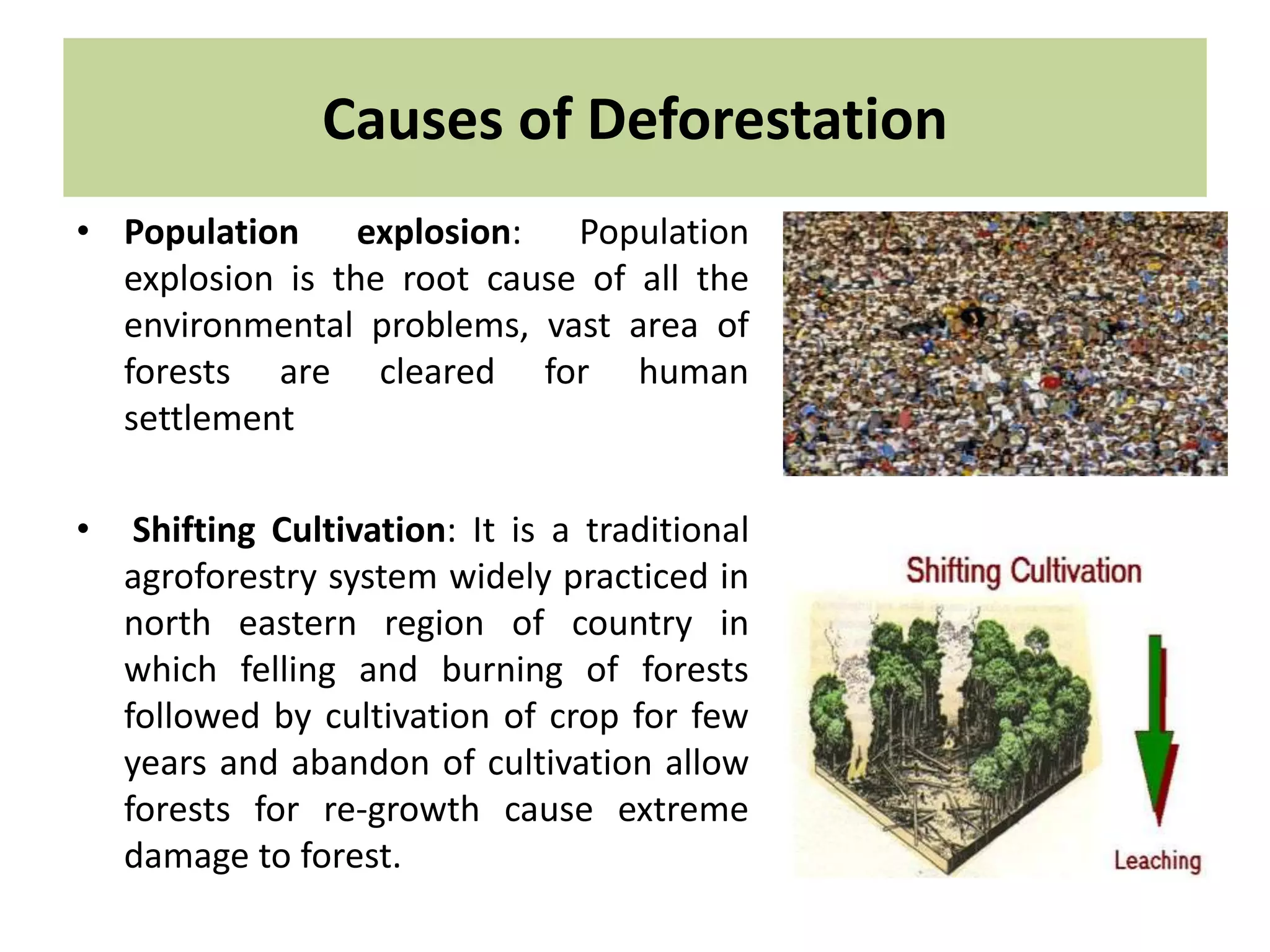
• Population explosion: Population
explosion is the root cause of all the
environmental problems, vast area of
forests are cleared for human
settlement
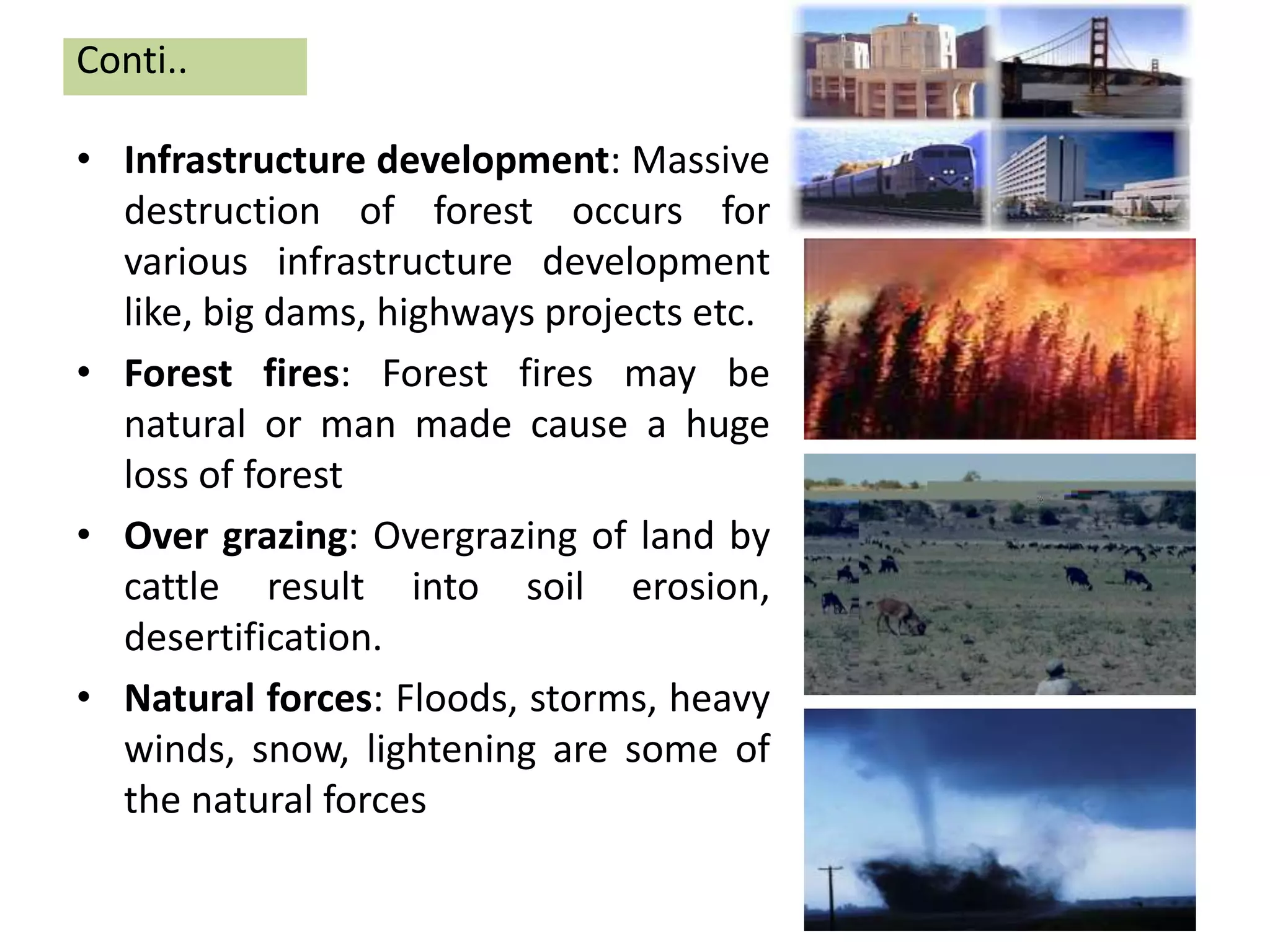
• Shifting Cultivation: It is a traditional
agroforestry system widely practiced in
north eastern region of country in
which felling and burning of forests
followed by cultivation of crop for few
years and abandon of cultivation allow
forests for re-growth cause extreme
damage to forest.
• Growing food demand: To meet the food
demand of rapidly growing population more
and more forests are cleared off for
agricultural purpose.
• Fire wood: Increasing demand of wood for
fuel increases pressure on forests.
• Raw material for wood based industry:
Increasing demand of wood for making
furniture, plywood, match box etc results into
tremendous pressure on forests.
Conti..
• Infrastructure development: Massive
destruction of forest occurs for
various infrastructure development
like, big dams, highways projects etc.
• Forest fires: Forest fires may be
natural or man made cause a huge
loss of forest
• Over grazing: Overgrazing of land by
cattle result into soil erosion,
desertification.
• Natural forces: Floods, storms, heavy
winds, snow, lightening are some of
the natural forces
Conti..
Consequences of Deforestation
• Deforestation adversely affects and
damages the environment
• The adverse effect of deforestation are
discussed below:
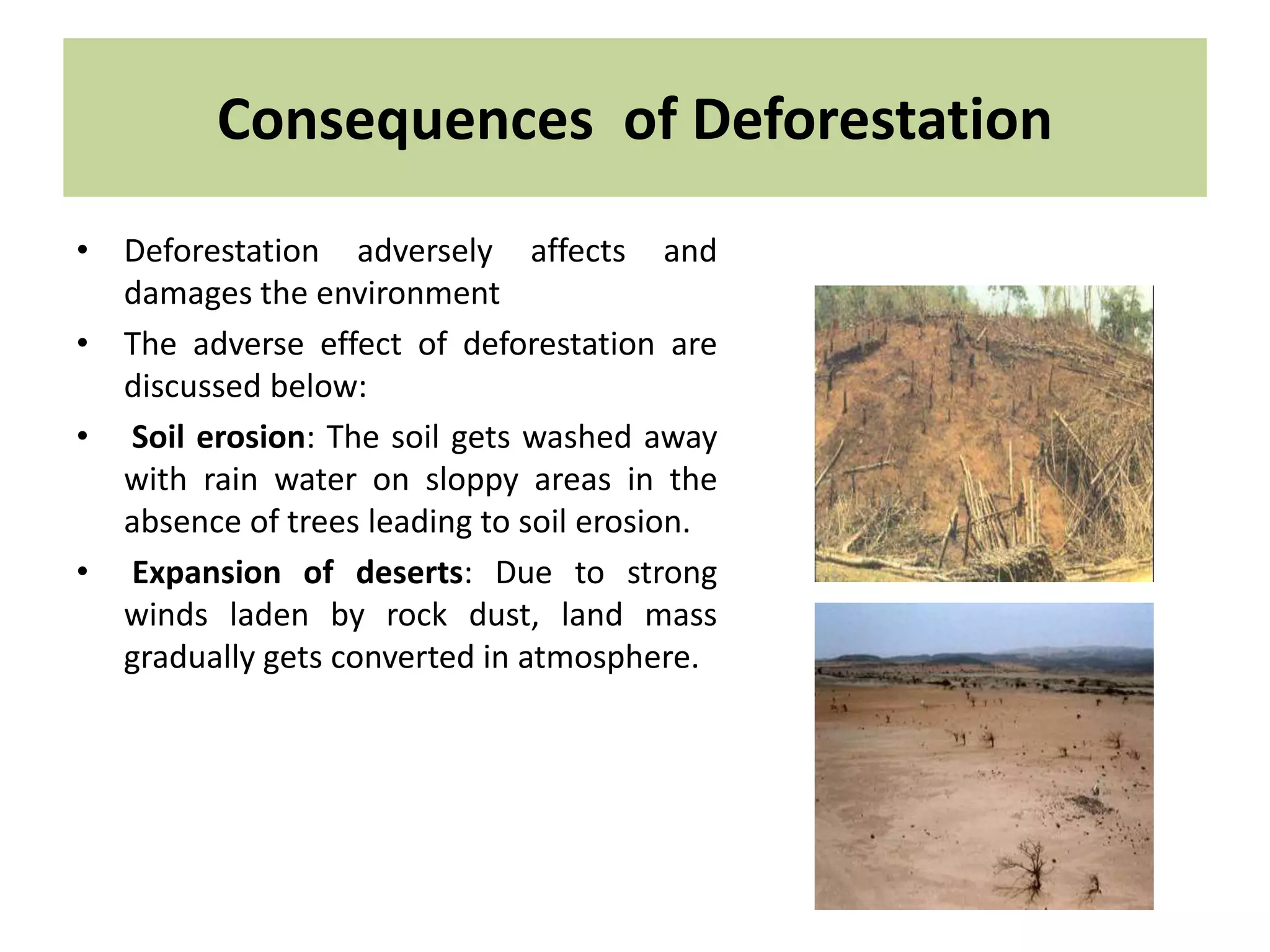
• Soil erosion: The soil gets washed away
with rain water on sloppy areas in the
absence of trees leading to soil erosion.
• Expansion of deserts: Due to strong
winds laden by rock dust, land mass
gradually gets converted in atmosphere.
• Decrease in rainfall : In the absence of
forest, rainfall declines considerably
because forest bring rains due to high
rate of transpiration. It maintains
humidity in atmosphere
• Loss of fertile land: Less rainfall results
into loss of fertile land owing to less
natural vegetation growth.
• Effect on climate: Deforestation induces
global climate change. Climate becomes
warmer due to lack of humidity in
deforested areas, also pattern of rainfall
changes
Conti..
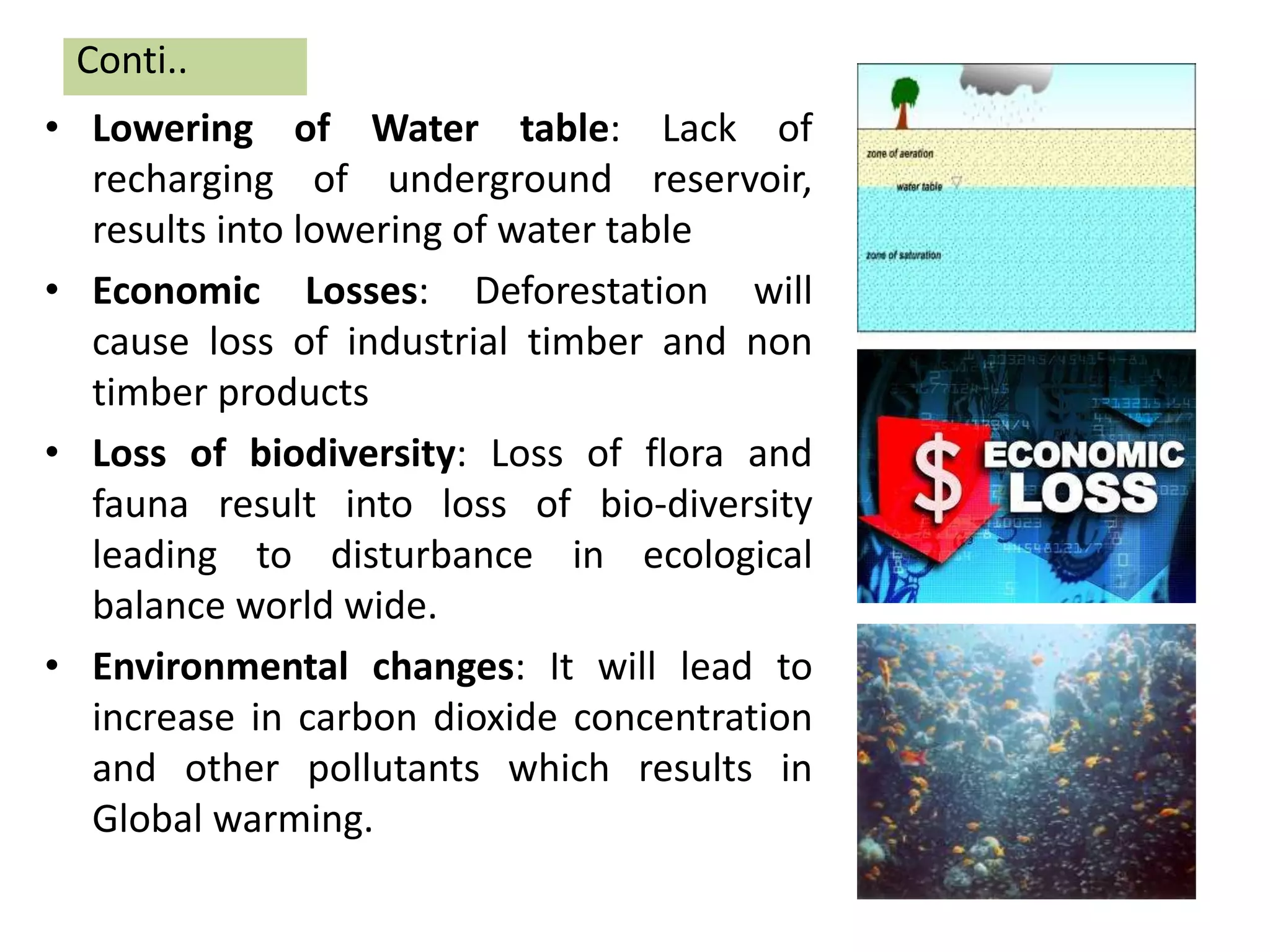
• Lowering of Water table: Lack of
recharging of underground reservoir,
results into lowering of water table
• Economic Losses: Deforestation will
cause loss of industrial timber and non
timber products
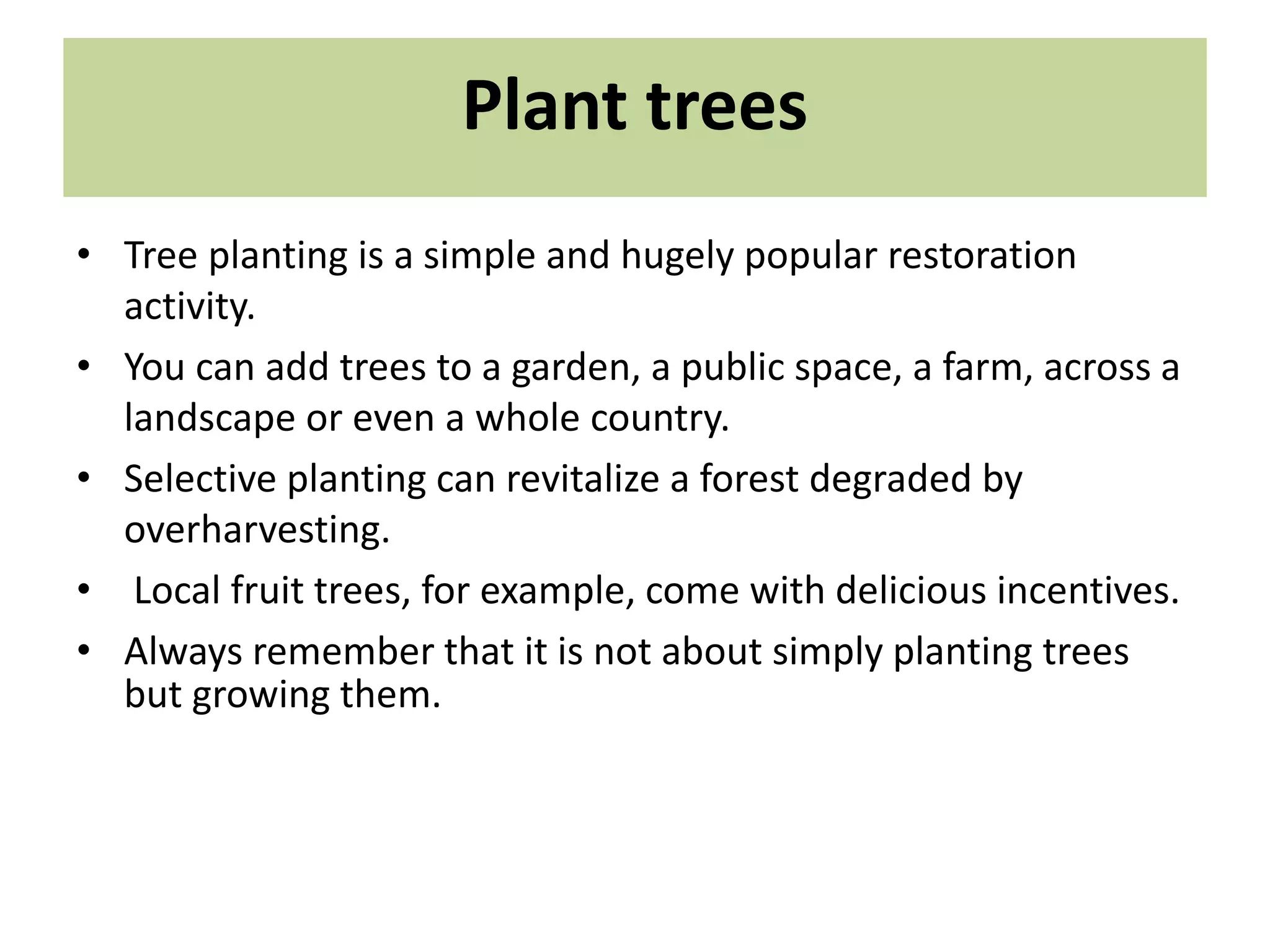
• Loss of biodiversity: Loss of flora and
fauna result into loss of bio-diversity
leading to disturbance in ecological
balance world wide.
• Environmental changes: It will lead to
increase in carbon dioxide concentration
and other pollutants which results in
Global warming.
Conti..
Your Role on Environment
Afforestation
• The conservation measure
against the deforestation is
afforestation.
• The development of forest by
planting trees on waste land is
called a forestation
The main objective of a
forestation
• To control the deforestation
• To prevent soil erosion
• To regulate rainfall and
maintain temperature
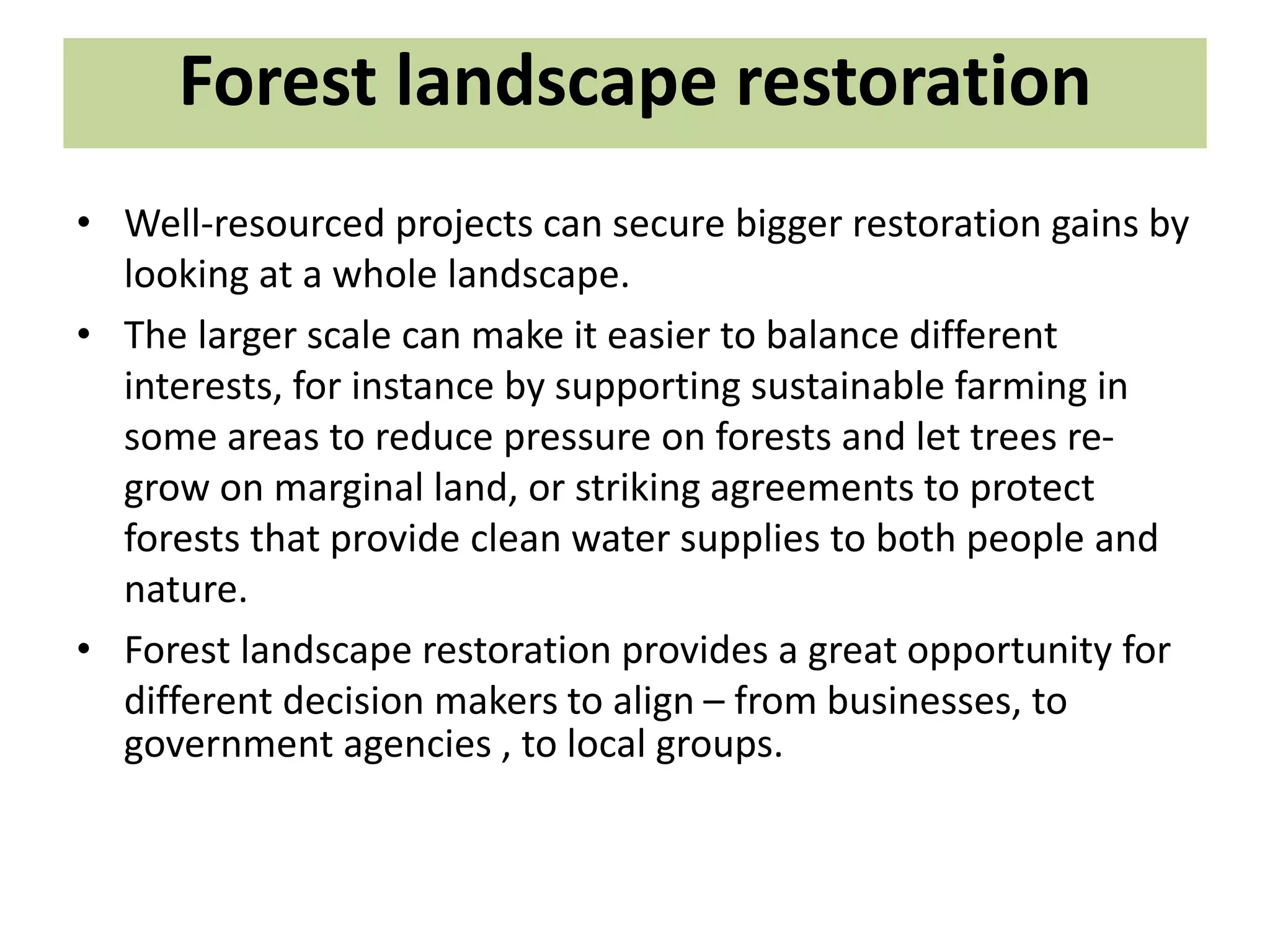
Plant trees
• Tree planting is a simple and hugely popular restoration
activity.
• You can add trees to a garden, a public space, a farm, across a
landscape or even a whole country.
• Selective planting can revitalize a forest degraded by
overharvesting.
• Local fruit trees, for example, come with delicious incentives.
• Always remember that it is not about simply planting trees
but growing them.
Assist natural regeneration
• This low-cost restoration strategy involves creating the
conditions for indigenous trees to germinate or resprout
naturally.
• This can mean excluding animals that would eat young shoots
and removing other vegetation, especially invasive species,
that compete with the young trees for light and water.
• It can also mean reaching community-level agreements to
protect forests and trees, and managing them sustainably so
that the new trees are not all cut again later.
• The concept of “rewilding” is becoming more and more
popular in Europe and other places, where there is enough
space and opportunity to introduce species that have once
been lost.
Forest landscape restoration
• Well-resourced projects can secure bigger restoration gains by
looking at a whole landscape.
• The larger scale can make it easier to balance different
interests, for instance by supporting sustainable farming in
some areas to reduce pressure on forests and let trees re-
grow on marginal land, or striking agreements to protect
forests that provide clean water supplies to both people and
nature.
• Forest landscape restoration provides a great opportunity for
different decision makers to align – from businesses, to
government agencies , to local groups.
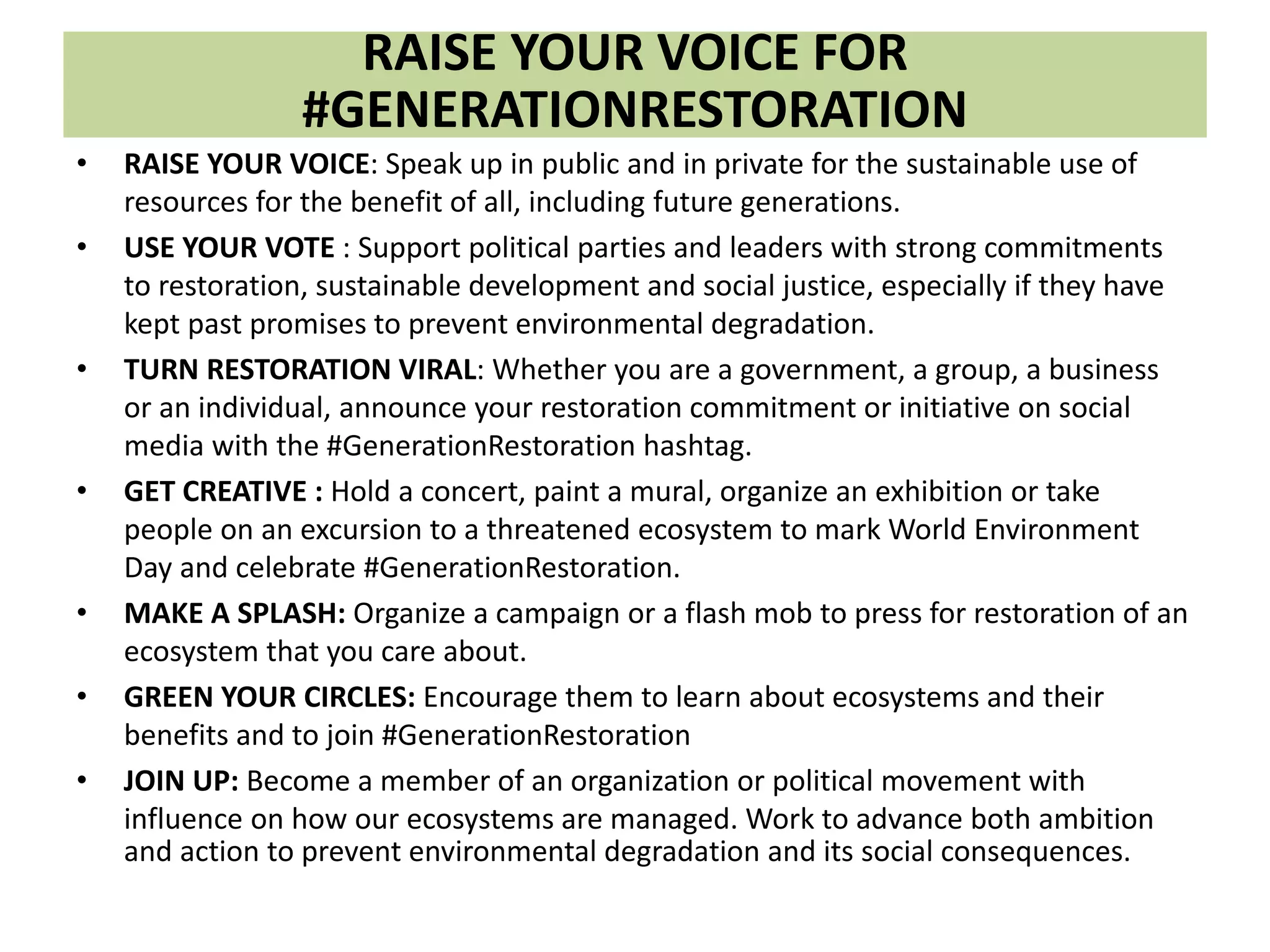
RAISE YOUR VOICE FOR
#GENERATIONRESTORATION
• RAISE YOUR VOICE: Speak up in public and in private for the sustainable use of
resources for the benefit of all, including future generations.
• USE YOUR VOTE : Support political parties and leaders with strong commitments
to restoration, sustainable development and social justice, especially if they have
kept past promises to prevent environmental degradation.
• TURN RESTORATION VIRAL: Whether you are a government, a group, a business
or an individual, announce your restoration commitment or initiative on social
media with the #GenerationRestoration hashtag.
• GET CREATIVE : Hold a concert, paint a mural, organize an exhibition or take
people on an excursion to a threatened ecosystem to mark World Environment
Day and celebrate #GenerationRestoration.
• MAKE A SPLASH: Organize a campaign or a flash mob to press for restoration of an
ecosystem that you care about.
• GREEN YOUR CIRCLES: Encourage them to learn about ecosystems and their
benefits and to join #GenerationRestoration
• JOIN UP: Become a member of an organization or political movement with
influence on how our ecosystems are managed. Work to advance both ambition
and action to prevent environmental degradation and its social consequences.
Role of Forest and trees on Environment

Role of Forest and trees on Environment

  • 1.
  • 2.
    Lecture on Role of Forestand Trees on Environment By Manyapragathi & RGUKT Nuzvid, NSS Unit-6 Associated with UNEP Speaker: Ravi Gedela M.Tech IITG, (PhD IITG) Assistant professor & Head of the Department (i/c) NSS Programme Officer Department of Bio-Sciences RGUKT- Nuzvid https://www.manyapragathi.com JOIN #GENERATIONRESTORATION ON WORLD ENVIRONMENT DAY!
  • 3.
    JOIN #GENERATIONRESTORATION ON WORLDENVIRONMENT DAY! • Restoration efforts and goals cannot be addressed by just one entity, everyone has a part. • And you've taken a big step in contributing towards healing the planet. TOGETHER WE CAN BE #GENERATIONRESTORATION
  • 4.
    PEOPLE IN ENVIRONMENT Peoplein Environment International 1. Charles Darwin: Origin of Species. 2. Henry Thoreau: Wilderness should be preserved Indian 3. Salim Ali: Fall of Sparrow 4. Smt. Indira Gandhi: Wild life protection act was formulated during her tenure. 5. M.S.Swaminathan: Worked on conservation of biological diversity. 6. M.C.Metha: Initiated the Government to implement Environmental education in schools and colleges, struggles for protection of Taj Mahal and cleaning of Ganga water. 7. Sunder Lal Bahuguna: Chipko movement. 8. Medha Patker: Narmada Bhachavo Andolan.
  • 5.
    FOREST AND TREES •Forests and trees provide us with clean air and water. • They are capturing vast amounts of climate-heating carbon and are home to most of earth's biodiversity on land. • Forest ecosystems face intense pressure. Tropical forests are being cleared for commodities like degraded by logging, pollution and intensive farming. • We have a mission to restore 1 billion hectares of the Earth to ecologically fertile ecosystems in 10 years. • That's 100 milliion hectares a year, starting now. It's ambitious, but it's possible. It's going to take everyone. It's going to take you.
  • 6.
    Indian forests • Indianforests perform an important role to make a healthy environment and it reduce air pollutions. Near about 19.26% of total Indian areas are covered with forest. These forests can be classified in five major groups namely: 1. Moist tropical forest (rainfall ranges 200 cm - 250 cm) 2. Dry tropical forest (rainfall ranges, 51 cm – 151 cm) 3. Montane temperate forest (rainfall ranges 201 cm, Northern middle Himalayas region) 4. Montane sub tropical forest (Western Ghats, Seven sister states of India, rainfall ranges 200 cm - 250 cm) 5. Alpine forest (Himalayan regions, rainfall ranges 201 cm )
  • 8.
    Functions of Forests •The functions of forest may broadly classified into following categories • Bio-geocycles • Protective Function • Productive Function • Regulative Function • Accessory Function
  • 9.
    Production of Oxygen •During Photosynthesis process forest releases oxygen a very important gas for human survival thereby are called as lungs of earth.
  • 10.
    Water cycle ofBio-geocycle
  • 12.
    • Plants takecarbon dioxide and water from their environment. • They use the energy they capture from the sun to carry on a process known as photosynthesis which converts the atoms in the carbon dioxide and water into sugar (glucose) and oxygen. • 6CO2 + 6H2O + energy → C6H12O6 + 6O2
  • 13.
    Carbon, Oxygen, Nitrogen,Phosphate cycle of Bio-geo- cycles
  • 14.
    Protective Functions • ForestProvide protection against Soil erosion, Droughts, floods, noise, radiations Soil erosion Floods Soil erosion Droughts
  • 15.
    Absorption of Noise •Forest cover absorbs the noise and helps in preventing noise pollution
  • 16.
    Absorption of airpollutants • Forest absorbs many toxic gasses and air pollutants and can help in keeping air pure.
  • 17.
    Ecological Importance oruses of Forests • Regulation of global climate and temperature • Forest play a crucial role in regulation of global climate and temperature as forest cover absorb the solar radiations that would otherwise be reflected back into the atmosphere by bare surface of the earth. • Transpiration of plants increases the atmosphere humidity which affects the rainfall, cools the atmosphere and thus regulate the hydrological cycle Reduction of Global Warming • The main green house gas co2 is used by forests for photosynthesis process the forest act as a sink for co2 there by reducing the green house effect due to co2
  • 18.
    • Timber Woodused for commercial purposes like for making furniture and other items like boats, bridges and other day to day uses. • Fuel Wood: The wood is used as fuel for cooking and other purposes by poor people. • Raw material for wood based industries: forest provide raw material for various wood based industries like paper and pulp, sports goods, furniture, match boxes etc. Conti..
  • 19.
    Productive Functions • ForestProvide various products like, gum resins, medicines, honey, pulp, bamboo, timber, and fruits
  • 20.
    • Food: Fruits,roots, leaves of plants and trees along with the meat of forest animals provide the food to the tribal people. • Miscellaneous Products: Miscellaneous products like, resin, gums, oils, medicines, honey are provided by forests
  • 21.
    Accessory Function • Forestprovides aesthetics, habitat to various flora and fauna besides that it also has an recreational value.
  • 22.
    Man made activities: Deforestation • Forest are exploited since early times for humans to meet human demand • The permanent destruction of forest is called deforestation
  • 23.
    Forest Degradation inIndia • At the beginning of 20th century about 30 % of land in India was covered with forests but by the end of 20th century the forest cover was reduced to 19.4% • As a result of exploitation, the tropical forest cover in India, is now only reduced to coastal western Ghats and northern India • We have a huge population size and a very low precipitate forest area 0.075 Ha per capita as compared to 0.64 ha/ capita of world forest area. • The National forest policy has recommended 33 % forest area for plains and 67 % for hills • The deforestation rate per unit population in India is lowest among the major tropical countries • For effective forest management of country we have to take the confidence of tribal who have been living in forest.
  • 24.
    Causes of Deforestation •Population explosion: Population explosion is the root cause of all the environmental problems, vast area of forests are cleared for human settlement • Shifting Cultivation: It is a traditional agroforestry system widely practiced in north eastern region of country in which felling and burning of forests followed by cultivation of crop for few years and abandon of cultivation allow forests for re-growth cause extreme damage to forest.
  • 25.
    • Growing fooddemand: To meet the food demand of rapidly growing population more and more forests are cleared off for agricultural purpose. • Fire wood: Increasing demand of wood for fuel increases pressure on forests. • Raw material for wood based industry: Increasing demand of wood for making furniture, plywood, match box etc results into tremendous pressure on forests. Conti..
  • 26.
    • Infrastructure development:Massive destruction of forest occurs for various infrastructure development like, big dams, highways projects etc. • Forest fires: Forest fires may be natural or man made cause a huge loss of forest • Over grazing: Overgrazing of land by cattle result into soil erosion, desertification. • Natural forces: Floods, storms, heavy winds, snow, lightening are some of the natural forces Conti..
  • 27.
    Consequences of Deforestation •Deforestation adversely affects and damages the environment • The adverse effect of deforestation are discussed below: • Soil erosion: The soil gets washed away with rain water on sloppy areas in the absence of trees leading to soil erosion. • Expansion of deserts: Due to strong winds laden by rock dust, land mass gradually gets converted in atmosphere.
  • 28.
    • Decrease inrainfall : In the absence of forest, rainfall declines considerably because forest bring rains due to high rate of transpiration. It maintains humidity in atmosphere • Loss of fertile land: Less rainfall results into loss of fertile land owing to less natural vegetation growth. • Effect on climate: Deforestation induces global climate change. Climate becomes warmer due to lack of humidity in deforested areas, also pattern of rainfall changes Conti..
  • 29.
    • Lowering ofWater table: Lack of recharging of underground reservoir, results into lowering of water table • Economic Losses: Deforestation will cause loss of industrial timber and non timber products • Loss of biodiversity: Loss of flora and fauna result into loss of bio-diversity leading to disturbance in ecological balance world wide. • Environmental changes: It will lead to increase in carbon dioxide concentration and other pollutants which results in Global warming. Conti..
  • 30.
    Your Role onEnvironment
  • 31.
    Afforestation • The conservationmeasure against the deforestation is afforestation. • The development of forest by planting trees on waste land is called a forestation The main objective of a forestation • To control the deforestation • To prevent soil erosion • To regulate rainfall and maintain temperature
  • 32.
    Plant trees • Treeplanting is a simple and hugely popular restoration activity. • You can add trees to a garden, a public space, a farm, across a landscape or even a whole country. • Selective planting can revitalize a forest degraded by overharvesting. • Local fruit trees, for example, come with delicious incentives. • Always remember that it is not about simply planting trees but growing them.
  • 33.
    Assist natural regeneration •This low-cost restoration strategy involves creating the conditions for indigenous trees to germinate or resprout naturally. • This can mean excluding animals that would eat young shoots and removing other vegetation, especially invasive species, that compete with the young trees for light and water. • It can also mean reaching community-level agreements to protect forests and trees, and managing them sustainably so that the new trees are not all cut again later. • The concept of “rewilding” is becoming more and more popular in Europe and other places, where there is enough space and opportunity to introduce species that have once been lost.
  • 34.
    Forest landscape restoration •Well-resourced projects can secure bigger restoration gains by looking at a whole landscape. • The larger scale can make it easier to balance different interests, for instance by supporting sustainable farming in some areas to reduce pressure on forests and let trees re- grow on marginal land, or striking agreements to protect forests that provide clean water supplies to both people and nature. • Forest landscape restoration provides a great opportunity for different decision makers to align – from businesses, to government agencies , to local groups.
  • 35.
    RAISE YOUR VOICEFOR #GENERATIONRESTORATION • RAISE YOUR VOICE: Speak up in public and in private for the sustainable use of resources for the benefit of all, including future generations. • USE YOUR VOTE : Support political parties and leaders with strong commitments to restoration, sustainable development and social justice, especially if they have kept past promises to prevent environmental degradation. • TURN RESTORATION VIRAL: Whether you are a government, a group, a business or an individual, announce your restoration commitment or initiative on social media with the #GenerationRestoration hashtag. • GET CREATIVE : Hold a concert, paint a mural, organize an exhibition or take people on an excursion to a threatened ecosystem to mark World Environment Day and celebrate #GenerationRestoration. • MAKE A SPLASH: Organize a campaign or a flash mob to press for restoration of an ecosystem that you care about. • GREEN YOUR CIRCLES: Encourage them to learn about ecosystems and their benefits and to join #GenerationRestoration • JOIN UP: Become a member of an organization or political movement with influence on how our ecosystems are managed. Work to advance both ambition and action to prevent environmental degradation and its social consequences.