No. Name Matric No
1. Shahid bin Dzayuddin 129993
2. Fatin Filzah Nur binti Abdul Kadir 131251
3. Nur Adnin binti Mat Ripa 129963
4. Ainnur Azwa bt Zaidi 129928
5. Zahirah binti Mohamad Tahir 130009
BBT 308
TROPICAL PLANT ECOLOGY
DEFINITION OF RAINFOREST BIOME
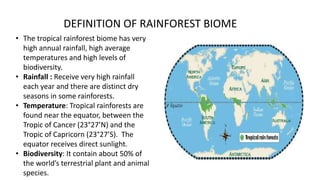
• The tropical rainforest biome has very
high annual rainfall, high average
temperatures and high levels of
biodiversity.
• Rainfall : Receive very high rainfall
each year and there are distinct dry
seasons in some rainforests.
• Temperature: Tropical rainforests are
found near the equator, between the
Tropic of Cancer (23°27’N) and the
Tropic of Capricorn (23°27’S). The
equator receives direct sunlight.
• Biodiversity: It contain about 50% of
the world’s terrestrial plant and animal
species.
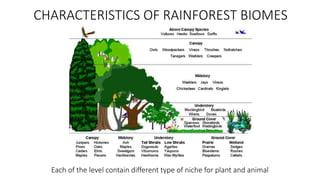
CHARACTERISTICS OF RAINFOREST BIOMES
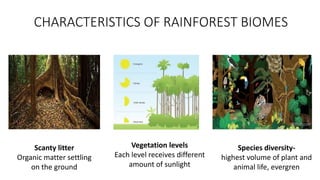
Species diversity-
highest volume of plant and
animal life, evergren
Vegetation levels
Each level receives different
amount of sunlight
Scanty litter
Organic matter settling
on the ground
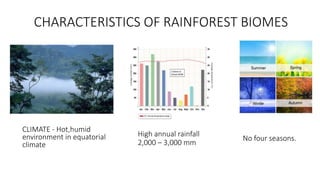
CLIMATE - Hot,humid
environment in equatorial
climate
High annual rainfall
2,000 – 3,000 mm
No four seasons.
CHARACTERISTICS OF RAINFOREST BIOMES
Each of the level contain different type of niche for plant and animal
CHARACTERISTICS OF RAINFOREST BIOMES
IMPORTANCE
AND ROLES OF
TREES
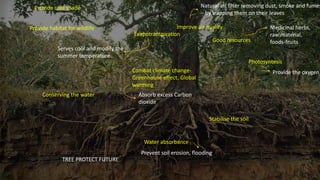
Improve air quality
Stabilise the soil
Provide cool shade
Medicinal herbs,
raw material,
foods-fruitsGood resources
Natural air filter removing dust, smoke and fumes
– by trapping them on their leaves
Photosyntesis
Absorb excess Carbon
dioxide
Provide the oxygenCombat climate change-
Greenhouse effect, Global
warming
Conserving the water
Provide habitat for wildlife
Water absorbance
Prevent soil erosion, flooding
TREE PROTECT FUTURE
Evapotranspiration
Serves cool and modify the
summer temperature
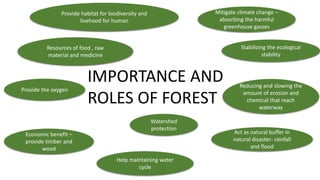
Resources of food , raw
material and medicine
Provide habitat for biodiversity and
livehood for human
Watershed
protection
Provide the oxygen
Help maintaining water
cycle
Mitigate climate change –
absorbing the harmful
greenhouse gasses
Act as natural buffer in
natural disaster- rainfall
and flood
Reducing and slowing the
amount of erosion and
chemical that reach
waterway
Stabilizing the ecological
stability
Economic benefit –
provide timber and
wood
IMPORTANCE AND
ROLES OF FOREST
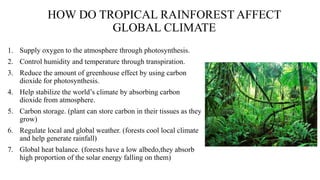
1. Supply oxygen to the atmosphere through photosynthesis.
2. Control humidity and temperature through transpiration.
3. Reduce the amount of greenhouse effect by using carbon
dioxide for photosynthesis.
4. Help stabilize the world’s climate by absorbing carbon
dioxide from atmosphere.
5. Carbon storage. (plant can store carbon in their tissues as they
grow)
6. Regulate local and global weather. (forests cool local climate
and help generate rainfall)
7. Global heat balance. (forests have a low albedo,they absorb
high proportion of the solar energy falling on them)
HOW DO TROPICAL RAINFOREST AFFECT
GLOBAL CLIMATE
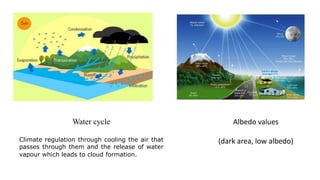
Water cycle
Climate regulation through cooling the air that
passes through them and the release of water
vapour which leads to cloud formation.
Albedo values
(dark area, low albedo)
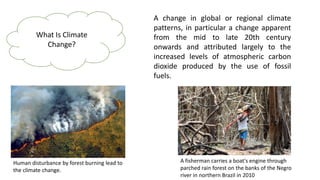
A change in global or regional climate
patterns, in particular a change apparent
from the mid to late 20th century
onwards and attributed largely to the
increased levels of atmospheric carbon
dioxide produced by the use of fossil
fuels.
What Is Climate
Change?
A fisherman carries a boat's engine through
parched rain forest on the banks of the Negro
river in northern Brazil in 2010
Human disturbance by forest burning lead to
the climate change.
WEATHER
 Weather is the short-term changes we
seeintemperature,clouds,precipitation,
humidityandwindinaregionoracity.
 Weather can vary greatly from one day
tothenext,orevenwithinthesameday.
CLIMATE
 The climate of a region or city is
its weather averaged over many
years.
 This is usually different for
different seasons.
 The climate of a city, region or
the entire planet changes very
slowly.
 These changes take place on the
scale of tens, hundreds and
thousands of years.
VERSUS
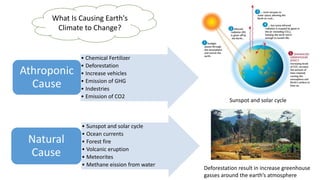
What Is Causing Earth's
Climate to Change?
• Chemical Fertilizer
• Deforestation
• Increase vehicles
• Emission of GHG
• Indestries
• Emission of CO2
Athroponic
Cause
• Sunspot and solar cycle
• Ocean currents
• Forest fire
• Volcanic eruption
• Meteorites
• Methane eission from water
Natural
Cause
Sunspot and solar cycle
Deforestation result in increase greenhouse
gasses around the earth’s atmosphere
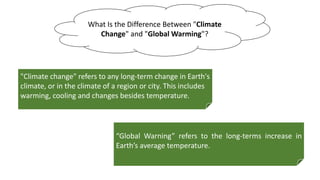
“Global Warning” refers to the long-terms increase in
Earth’s average temperature.
What Is the Difference Between "Climate
Change" and "Global Warming"?
"Climate change" refers to any long-term change in Earth's
climate, or in the climate of a region or city. This includes
warming, cooling and changes besides temperature.
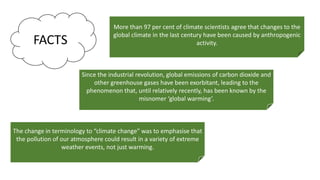
More than 97 per cent of climate scientists agree that changes to the
global climate in the last century have been caused by anthropogenic
activity.
Since the industrial revolution, global emissions of carbon dioxide and
other greenhouse gases have been exorbitant, leading to the
phenomenon that, until relatively recently, has been known by the
misnomer ‘global warming’.
The change in terminology to “climate change” was to emphasise that
the pollution of our atmosphere could result in a variety of extreme
weather events, not just warming.
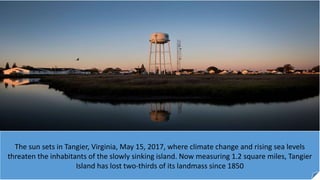
The sun sets in Tangier, Virginia, May 15, 2017, where climate change and rising sea levels
threaten the inhabitants of the slowly sinking island. Now measuring 1.2 square miles, Tangier
Island has lost two-thirds of its landmass since 1850
IMPACT OF CLIMATE CHANGE ON
TROPICAL RAINFOREST
• Global climate change initiated by global warming is expected to have wide-
ranging effects for tropical rainforests.
• Changes in weather patterns, rainfall distribution, and temperature will result
in the transformation of rainforest into drier forest in some areas.
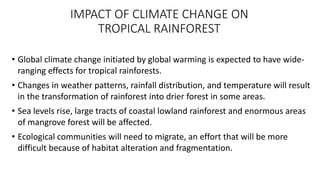
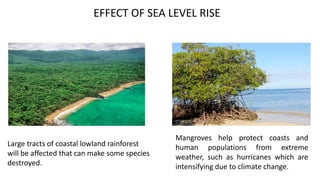
• Sea levels rise, large tracts of coastal lowland rainforest and enormous areas
of mangrove forest will be affected.
• Ecological communities will need to migrate, an effort that will be more
difficult because of habitat alteration and fragmentation.
EFFECT OF SEA LEVEL RISE
Mangroves help protect coasts and
human populations from extreme
weather, such as hurricanes which are
intensifying due to climate change.
Large tracts of coastal lowland rainforest
will be affected that can make some species
destroyed.
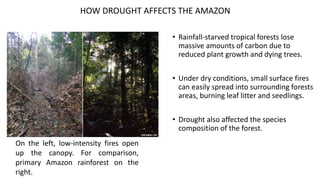
• Rainfall-starved tropical forests lose
massive amounts of carbon due to
reduced plant growth and dying trees.
• Under dry conditions, small surface fires
can easily spread into surrounding forests
areas, burning leaf litter and seedlings.
• Drought also affected the species
composition of the forest.
On the left, low-intensity fires open
up the canopy. For comparison,
primary Amazon rainforest on the
right.
HOW DROUGHT AFFECTS THE AMAZON
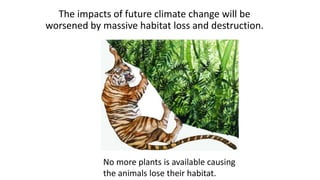
The impacts of future climate change will be
worsened by massive habitat loss and destruction.
No more plants is available causing
the animals lose their habitat.
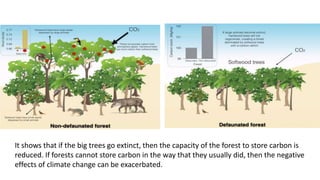
It shows that if the big trees go extinct, then the capacity of the forest to store carbon is
reduced. If forests cannot store carbon in the way that they usually did, then the negative
effects of climate change can be exacerbated.
You Know What Is Mean!?

Tropical Rainforest Biomes

  • 1.
    No. Name MatricNo 1. Shahid bin Dzayuddin 129993 2. Fatin Filzah Nur binti Abdul Kadir 131251 3. Nur Adnin binti Mat Ripa 129963 4. Ainnur Azwa bt Zaidi 129928 5. Zahirah binti Mohamad Tahir 130009 BBT 308 TROPICAL PLANT ECOLOGY
  • 2.
    DEFINITION OF RAINFORESTBIOME • The tropical rainforest biome has very high annual rainfall, high average temperatures and high levels of biodiversity. • Rainfall : Receive very high rainfall each year and there are distinct dry seasons in some rainforests. • Temperature: Tropical rainforests are found near the equator, between the Tropic of Cancer (23°27’N) and the Tropic of Capricorn (23°27’S). The equator receives direct sunlight. • Biodiversity: It contain about 50% of the world’s terrestrial plant and animal species.
  • 3.
    CHARACTERISTICS OF RAINFORESTBIOMES Species diversity- highest volume of plant and animal life, evergren Vegetation levels Each level receives different amount of sunlight Scanty litter Organic matter settling on the ground
  • 4.
    CLIMATE - Hot,humid environmentin equatorial climate High annual rainfall 2,000 – 3,000 mm No four seasons. CHARACTERISTICS OF RAINFOREST BIOMES
  • 5.
    Each of thelevel contain different type of niche for plant and animal CHARACTERISTICS OF RAINFOREST BIOMES
  • 6.
  • 7.
    Improve air quality Stabilisethe soil Provide cool shade Medicinal herbs, raw material, foods-fruitsGood resources Natural air filter removing dust, smoke and fumes – by trapping them on their leaves Photosyntesis Absorb excess Carbon dioxide Provide the oxygenCombat climate change- Greenhouse effect, Global warming Conserving the water Provide habitat for wildlife Water absorbance Prevent soil erosion, flooding TREE PROTECT FUTURE Evapotranspiration Serves cool and modify the summer temperature
  • 8.
    Resources of food, raw material and medicine Provide habitat for biodiversity and livehood for human Watershed protection Provide the oxygen Help maintaining water cycle Mitigate climate change – absorbing the harmful greenhouse gasses Act as natural buffer in natural disaster- rainfall and flood Reducing and slowing the amount of erosion and chemical that reach waterway Stabilizing the ecological stability Economic benefit – provide timber and wood IMPORTANCE AND ROLES OF FOREST
  • 9.
    1. Supply oxygento the atmosphere through photosynthesis. 2. Control humidity and temperature through transpiration. 3. Reduce the amount of greenhouse effect by using carbon dioxide for photosynthesis. 4. Help stabilize the world’s climate by absorbing carbon dioxide from atmosphere. 5. Carbon storage. (plant can store carbon in their tissues as they grow) 6. Regulate local and global weather. (forests cool local climate and help generate rainfall) 7. Global heat balance. (forests have a low albedo,they absorb high proportion of the solar energy falling on them) HOW DO TROPICAL RAINFOREST AFFECT GLOBAL CLIMATE
  • 10.
    Water cycle Climate regulationthrough cooling the air that passes through them and the release of water vapour which leads to cloud formation. Albedo values (dark area, low albedo)
  • 11.
    A change inglobal or regional climate patterns, in particular a change apparent from the mid to late 20th century onwards and attributed largely to the increased levels of atmospheric carbon dioxide produced by the use of fossil fuels. What Is Climate Change? A fisherman carries a boat's engine through parched rain forest on the banks of the Negro river in northern Brazil in 2010 Human disturbance by forest burning lead to the climate change.
  • 12.
    WEATHER  Weather isthe short-term changes we seeintemperature,clouds,precipitation, humidityandwindinaregionoracity.  Weather can vary greatly from one day tothenext,orevenwithinthesameday. CLIMATE  The climate of a region or city is its weather averaged over many years.  This is usually different for different seasons.  The climate of a city, region or the entire planet changes very slowly.  These changes take place on the scale of tens, hundreds and thousands of years. VERSUS
  • 13.
    What Is CausingEarth's Climate to Change? • Chemical Fertilizer • Deforestation • Increase vehicles • Emission of GHG • Indestries • Emission of CO2 Athroponic Cause • Sunspot and solar cycle • Ocean currents • Forest fire • Volcanic eruption • Meteorites • Methane eission from water Natural Cause Sunspot and solar cycle Deforestation result in increase greenhouse gasses around the earth’s atmosphere
  • 14.
    “Global Warning” refersto the long-terms increase in Earth’s average temperature. What Is the Difference Between "Climate Change" and "Global Warming"? "Climate change" refers to any long-term change in Earth's climate, or in the climate of a region or city. This includes warming, cooling and changes besides temperature.
  • 15.
    More than 97per cent of climate scientists agree that changes to the global climate in the last century have been caused by anthropogenic activity. Since the industrial revolution, global emissions of carbon dioxide and other greenhouse gases have been exorbitant, leading to the phenomenon that, until relatively recently, has been known by the misnomer ‘global warming’. The change in terminology to “climate change” was to emphasise that the pollution of our atmosphere could result in a variety of extreme weather events, not just warming.
  • 16.
    The sun setsin Tangier, Virginia, May 15, 2017, where climate change and rising sea levels threaten the inhabitants of the slowly sinking island. Now measuring 1.2 square miles, Tangier Island has lost two-thirds of its landmass since 1850
  • 17.
    IMPACT OF CLIMATECHANGE ON TROPICAL RAINFOREST • Global climate change initiated by global warming is expected to have wide- ranging effects for tropical rainforests. • Changes in weather patterns, rainfall distribution, and temperature will result in the transformation of rainforest into drier forest in some areas. • Sea levels rise, large tracts of coastal lowland rainforest and enormous areas of mangrove forest will be affected. • Ecological communities will need to migrate, an effort that will be more difficult because of habitat alteration and fragmentation.
  • 18.
    EFFECT OF SEALEVEL RISE Mangroves help protect coasts and human populations from extreme weather, such as hurricanes which are intensifying due to climate change. Large tracts of coastal lowland rainforest will be affected that can make some species destroyed.
  • 19.
    • Rainfall-starved tropicalforests lose massive amounts of carbon due to reduced plant growth and dying trees. • Under dry conditions, small surface fires can easily spread into surrounding forests areas, burning leaf litter and seedlings. • Drought also affected the species composition of the forest. On the left, low-intensity fires open up the canopy. For comparison, primary Amazon rainforest on the right. HOW DROUGHT AFFECTS THE AMAZON
  • 20.
    The impacts offuture climate change will be worsened by massive habitat loss and destruction. No more plants is available causing the animals lose their habitat.
  • 21.
    It shows thatif the big trees go extinct, then the capacity of the forest to store carbon is reduced. If forests cannot store carbon in the way that they usually did, then the negative effects of climate change can be exacerbated.
  • 22.
    You Know WhatIs Mean!?