JOURNALISTIC
TEXTS
THIRD QUARTER
TOPIC 1
EN8INF-III-1 Examine text structures for clarity of
meaning and purpose:
JOURNALISTIC TEXTS
• Opinion editorials
• Sports articles as news, features, and
editorials
• Science and technology articles as news,
features, and editorials
OBJECTIVES
a. To identify the features of different types of journalistic texts (news,
features, and editorials).
b. To analyze and examine different text structures used in journalistic
writing (news articles, opinion editorials, sports articles, and
science/technology articles).
c. To understand how text structures contribute to clarity of meaning and
purpose.
Journalistic
Journalistic text refers to writing that
is intended to inform, educate, and
sometimes entertain the public about
current events, issues, or trends.
Journalistic
This form of writing is typically
found in newspapers, magazines,
online media outlets, broadcast
media, and other news platforms.
Journalistic
The goal is to communicate factual
information clearly and objectively, often
following a set of established principles
like accuracy, fairness, balance, and
transparency.
TYPES OF JOURNALISTIC
TEXT, STRUCTURES AND
THEIR MEANINGS
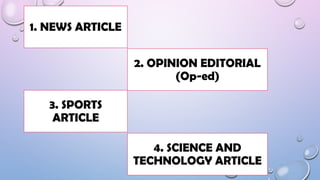
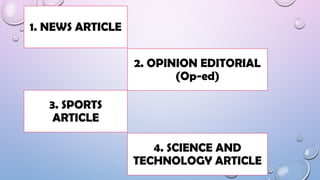
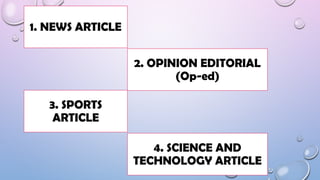
1. NEWS ARTICLE
2. OPINION EDITORIAL
(Op-ed)
4. SCIENCE AND
TECHNOLOGY ARTICLE
3. SPORTS
ARTICLE
A news article is written to inform readers
about recent events or developments. It
presents facts and answers the basic
questions of who, what, when, where, why,
and how.
1. NEWS ARTICLE
STRUCTURE: HEADLINE → LEAD →
BODY → CONCLUSION
1. NEWS ARTICLE
Headline: A short, attention-grabbing
sentence summarizing the main point of
the article.
Lead (Introduction): The first
paragraph, which gives the most
important details (often the 5 Ws).
1. NEWS ARTICLE
Body: The main content, providing
additional details, quotes, and
background information.
Conclusion: Sometimes a closing
statement or a summary, but not always
necessary in news articles.
1. NEWS ARTICLE
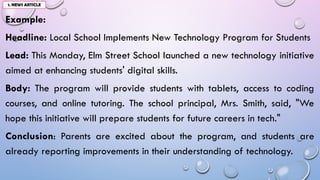
Example:
Headline: Local School Implements New Technology Program for Students
Lead: This Monday, Elm Street School launched a new technology initiative
aimed at enhancing students' digital skills.
Body: The program will provide students with tablets, access to coding
courses, and online tutoring. The school principal, Mrs. Smith, said, "We

hope this initiative will prepare students for future careers in tech."
Conclusion: Parents are excited about the program, and students are
already reporting improvements in their understanding of technology.
1. NEWS ARTICLE
1. NEWS ARTICLE
2. OPINION EDITORIAL
(Op-ed)
4. SCIENCE AND
TECHNOLOGY ARTICLE
3. SPORTS
ARTICLE
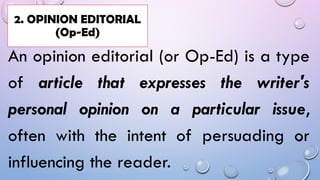
An opinion editorial (or Op-Ed) is a type
of article that expresses the writer's
personal opinion on a particular issue,
often with the intent of persuading or
influencing the reader.
2. OPINION EDITORIAL
(Op-Ed)
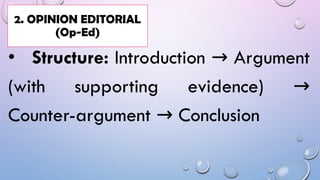
• Structure: Introduction Argument
→
(with supporting evidence) →
Counter-argument Conclusion
→
2. OPINION EDITORIAL
(Op-Ed)
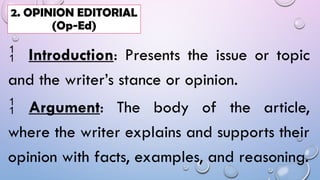
 Introduction: Presents the issue or topic
and the writer’s stance or opinion.
 Argument: The body of the article,
where the writer explains and supports their
opinion with facts, examples, and reasoning.

2. OPINION EDITORIAL
(Op-Ed)
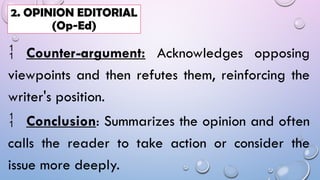
 Counter-argument: Acknowledges opposing
viewpoints and then refutes them, reinforcing the
writer's position.
 Conclusion: Summarizes the opinion and often
calls the reader to take action or consider the
issue more deeply.
2. OPINION EDITORIAL
(Op-Ed)
Headline: Why Schools Should Implement Year-Round Learning
Introduction: As the world changes and students are expected to learn more in
less time, it's time for us to reconsider the traditional school calendar.
Argument: Year-round learning would reduce summer learning loss, help students
retain information, and prepare them better for future challenges.
Counter-argument: Some believe that students need a long summer break to
rest and recharge. However, research has shown that a shorter break would actually
improve overall learning.
Conclusion: In conclusion, switching to a year-round school schedule would not
only boost academic success but also provide a more balanced lifestyle for students.
2. OPINION EDITORIAL (Op-Ed)
1. NEWS ARTICLE
2. OPINION EDITORIAL
(Op-ed)
4. SCIENCE AND
TECHNOLOGY ARTICLE
3. SPORTS
ARTICLE
Sports articles can be categorized into news
reports, features, or commentaries, each with
a specific focus on a sporting event, athlete,
or team. These articles might aim to inform,
entertain, or provide analysis.
3. SPORTS
ARTICLE
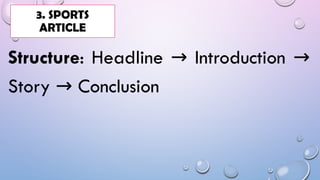
Structure: Headline Introduction
→ →
Story Conclusion
→
3. SPORTS
ARTICLE
 Headline: A catchy title that highlights
the main event, athlete, or achievement.
 Introduction: The opening lines, which
may set the scene of the event or
introduce the athlete/issue.
3. SPORTS
ARTICLE
 Story (Body): Details about the game, the
performance, the players, or the background of
the event. It might include stats, quotes from
players or coaches, and analysis of key moments.
 Conclusion: Often summarizes the outcome or
reflects on the significance of the event.
3. SPORTS
ARTICLE
Headline: Maria Sanchez: Rising Star of the Women's Basketball League
Introduction: At just 16, Maria Sanchez has already made waves in the
Women’s Basketball League, becoming the youngest player ever to score
30 points in a game.
Story: Growing up in a small town, Maria never imagined she would be
playing professionally so soon. "Basketball has always been my passion,"
she says. "I just love the game." Her coach, Jim Davis, praises her as a
hardworking and dedicated athlete.
Conclusion: Maria hopes to continue breaking records and inspire other
young girls to follow their dreams, both on and off the court.
3. SPORTS ARTICLE
1. NEWS ARTICLE
2. OPINION EDITORIAL
(Op-ed)
4. SCIENCE AND
TECHNOLOGY ARTICLE
3. SPORTS
ARTICLE
These articles discuss scientific
discoveries, technological
advancements, or issues related
to science and tech.
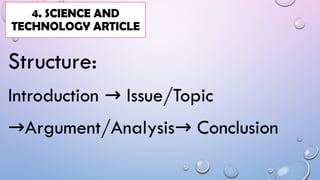
4. SCIENCE AND
TECHNOLOGY ARTICLE
Structure:
Introduction Issue/Topic
→
→Argument/Analysis Conclusion
→
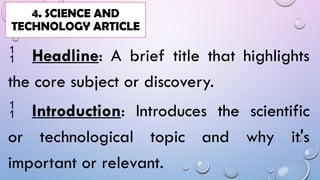
4. SCIENCE AND
TECHNOLOGY ARTICLE
 Headline: A brief title that highlights
the core subject or discovery.
 Introduction: Introduces the scientific
or technological topic and why it's
important or relevant.
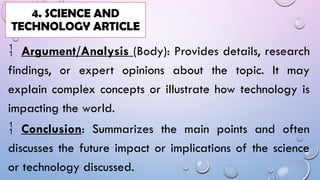
4. SCIENCE AND
TECHNOLOGY ARTICLE
 Argument/Analysis (Body): Provides details, research
findings, or expert opinions about the topic. It may
explain complex concepts or illustrate how technology is
impacting the world.
 Conclusion: Summarizes the main points and often
discusses the future impact or implications of the science
or technology discussed.
4. SCIENCE AND
TECHNOLOGY ARTICLE
Example:
Headline: The Rise of Artificial Intelligence: A Threat or an Opportunity?
Introduction: Artificial Intelligence (AI) is transforming industries worldwide, but
some people worry about its potential risks to jobs and privacy.
Argument/Analysis: On one hand, AI can automate tedious tasks and make life
easier. On the other hand, it raises concerns about job displacement and ethical
challenges. Experts argue that we need clear regulations to harness its benefits
safely.
Conclusion: As AI continues to evolve, it’s essential for society to address these
concerns proactively. With the right approach, AI can be a powerful tool for
progress.
4. SCIENCE AND TECHNOLOGY ARTICLE
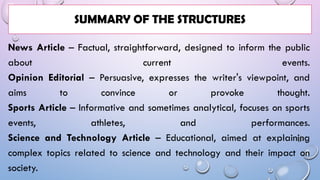
SUMMARY
News Article – Factual, straightforward, designed to inform the public
about current events.
Opinion Editorial – Persuasive, expresses the writer's viewpoint, and
aims to convince or provoke thought.
Sports Article – Informative and sometimes analytical, focuses on sports
events, athletes, and performances.
Science and Technology Article – Educational, aimed at explaining
complex topics related to science and technology and their impact on
society.
SUMMARY OF THE STRUCTURES
ACTIVITY
TOPIC 1 INTRODUCTION TO JOURNALISTIC TEXT.pptx

TOPIC 1 INTRODUCTION TO JOURNALISTIC TEXT.pptx

  • 2.
  • 3.
    EN8INF-III-1 Examine textstructures for clarity of meaning and purpose: JOURNALISTIC TEXTS • Opinion editorials • Sports articles as news, features, and editorials • Science and technology articles as news, features, and editorials
  • 4.
    OBJECTIVES a. To identifythe features of different types of journalistic texts (news, features, and editorials). b. To analyze and examine different text structures used in journalistic writing (news articles, opinion editorials, sports articles, and science/technology articles). c. To understand how text structures contribute to clarity of meaning and purpose.
  • 5.
    Journalistic Journalistic text refersto writing that is intended to inform, educate, and sometimes entertain the public about current events, issues, or trends.
  • 6.
    Journalistic This form ofwriting is typically found in newspapers, magazines, online media outlets, broadcast media, and other news platforms.
  • 7.
    Journalistic The goal isto communicate factual information clearly and objectively, often following a set of established principles like accuracy, fairness, balance, and transparency.
  • 8.
    TYPES OF JOURNALISTIC TEXT,STRUCTURES AND THEIR MEANINGS
  • 9.
    1. NEWS ARTICLE 2.OPINION EDITORIAL (Op-ed) 4. SCIENCE AND TECHNOLOGY ARTICLE 3. SPORTS ARTICLE
  • 10.
    A news articleis written to inform readers about recent events or developments. It presents facts and answers the basic questions of who, what, when, where, why, and how. 1. NEWS ARTICLE
  • 11.
    STRUCTURE: HEADLINE →LEAD → BODY → CONCLUSION 1. NEWS ARTICLE
  • 12.
    Headline: A short,attention-grabbing sentence summarizing the main point of the article. Lead (Introduction): The first paragraph, which gives the most important details (often the 5 Ws). 1. NEWS ARTICLE
  • 13.
    Body: The maincontent, providing additional details, quotes, and background information. Conclusion: Sometimes a closing statement or a summary, but not always necessary in news articles. 1. NEWS ARTICLE
  • 14.
    Example: Headline: Local SchoolImplements New Technology Program for Students Lead: This Monday, Elm Street School launched a new technology initiative aimed at enhancing students' digital skills. Body: The program will provide students with tablets, access to coding courses, and online tutoring. The school principal, Mrs. Smith, said, "We hope this initiative will prepare students for future careers in tech." Conclusion: Parents are excited about the program, and students are already reporting improvements in their understanding of technology. 1. NEWS ARTICLE
  • 15.
    1. NEWS ARTICLE 2.OPINION EDITORIAL (Op-ed) 4. SCIENCE AND TECHNOLOGY ARTICLE 3. SPORTS ARTICLE
  • 16.
    An opinion editorial(or Op-Ed) is a type of article that expresses the writer's personal opinion on a particular issue, often with the intent of persuading or influencing the reader. 2. OPINION EDITORIAL (Op-Ed)
  • 17.
    • Structure: IntroductionArgument → (with supporting evidence) → Counter-argument Conclusion → 2. OPINION EDITORIAL (Op-Ed)
  • 18.
     Introduction: Presentsthe issue or topic and the writer’s stance or opinion.  Argument: The body of the article, where the writer explains and supports their opinion with facts, examples, and reasoning. 2. OPINION EDITORIAL (Op-Ed)
  • 19.
     Counter-argument: Acknowledgesopposing viewpoints and then refutes them, reinforcing the writer's position.  Conclusion: Summarizes the opinion and often calls the reader to take action or consider the issue more deeply. 2. OPINION EDITORIAL (Op-Ed)
  • 20.
    Headline: Why SchoolsShould Implement Year-Round Learning Introduction: As the world changes and students are expected to learn more in less time, it's time for us to reconsider the traditional school calendar. Argument: Year-round learning would reduce summer learning loss, help students retain information, and prepare them better for future challenges. Counter-argument: Some believe that students need a long summer break to rest and recharge. However, research has shown that a shorter break would actually improve overall learning. Conclusion: In conclusion, switching to a year-round school schedule would not only boost academic success but also provide a more balanced lifestyle for students. 2. OPINION EDITORIAL (Op-Ed)
  • 21.
    1. NEWS ARTICLE 2.OPINION EDITORIAL (Op-ed) 4. SCIENCE AND TECHNOLOGY ARTICLE 3. SPORTS ARTICLE
  • 22.
    Sports articles canbe categorized into news reports, features, or commentaries, each with a specific focus on a sporting event, athlete, or team. These articles might aim to inform, entertain, or provide analysis. 3. SPORTS ARTICLE
  • 23.
    Structure: Headline Introduction →→ Story Conclusion → 3. SPORTS ARTICLE
  • 24.
     Headline: Acatchy title that highlights the main event, athlete, or achievement.  Introduction: The opening lines, which may set the scene of the event or introduce the athlete/issue. 3. SPORTS ARTICLE
  • 25.
     Story (Body):Details about the game, the performance, the players, or the background of the event. It might include stats, quotes from players or coaches, and analysis of key moments.  Conclusion: Often summarizes the outcome or reflects on the significance of the event. 3. SPORTS ARTICLE
  • 26.
    Headline: Maria Sanchez:Rising Star of the Women's Basketball League Introduction: At just 16, Maria Sanchez has already made waves in the Women’s Basketball League, becoming the youngest player ever to score 30 points in a game. Story: Growing up in a small town, Maria never imagined she would be playing professionally so soon. "Basketball has always been my passion," she says. "I just love the game." Her coach, Jim Davis, praises her as a hardworking and dedicated athlete. Conclusion: Maria hopes to continue breaking records and inspire other young girls to follow their dreams, both on and off the court. 3. SPORTS ARTICLE
  • 27.
    1. NEWS ARTICLE 2.OPINION EDITORIAL (Op-ed) 4. SCIENCE AND TECHNOLOGY ARTICLE 3. SPORTS ARTICLE
  • 28.
    These articles discussscientific discoveries, technological advancements, or issues related to science and tech. 4. SCIENCE AND TECHNOLOGY ARTICLE
  • 29.
  • 30.
     Headline: Abrief title that highlights the core subject or discovery.  Introduction: Introduces the scientific or technological topic and why it's important or relevant. 4. SCIENCE AND TECHNOLOGY ARTICLE
  • 31.
     Argument/Analysis (Body):Provides details, research findings, or expert opinions about the topic. It may explain complex concepts or illustrate how technology is impacting the world.  Conclusion: Summarizes the main points and often discusses the future impact or implications of the science or technology discussed. 4. SCIENCE AND TECHNOLOGY ARTICLE
  • 32.
    Example: Headline: The Riseof Artificial Intelligence: A Threat or an Opportunity? Introduction: Artificial Intelligence (AI) is transforming industries worldwide, but some people worry about its potential risks to jobs and privacy. Argument/Analysis: On one hand, AI can automate tedious tasks and make life easier. On the other hand, it raises concerns about job displacement and ethical challenges. Experts argue that we need clear regulations to harness its benefits safely. Conclusion: As AI continues to evolve, it’s essential for society to address these concerns proactively. With the right approach, AI can be a powerful tool for progress. 4. SCIENCE AND TECHNOLOGY ARTICLE
  • 33.
  • 34.
    News Article –Factual, straightforward, designed to inform the public about current events. Opinion Editorial – Persuasive, expresses the writer's viewpoint, and aims to convince or provoke thought. Sports Article – Informative and sometimes analytical, focuses on sports events, athletes, and performances. Science and Technology Article – Educational, aimed at explaining complex topics related to science and technology and their impact on society. SUMMARY OF THE STRUCTURES
  • 35.

Editor's Notes

  • #4 Have you ever read a news article, an opinion piece, or a sports article? What are the differences between these?How do these different types of articles help you understand the topic better?
  • #14 News articles follow a clear structure to help readers understand key facts quickly. The headline grabs attention, the lead gives the main idea, and the body provides more details, while the conclusion wraps up the story.
  • #20 Opinion editorials are structured to make a persuasive argument. The writer presents their opinion, supports it with reasons or evidence, addresses opposing views, and wraps up with a strong conclusion.
  • #26 Sports features often tell the personal story behind the game. The writer may focus on a player's background, struggles, and achievements, making the article engaging for fans and readers interested in sports.
  • #28 They may explain concepts, explore the impact of new developments, or discuss their implications for society.
  • #32 Science and technology editorials often weigh the pros and cons of emerging issues. These articles require a logical structure to present both sides of an argument and provide insight into the future implications.
  • #35 Activity: Group Work (15 minutes) Instructions: Divide students into small groups. Assign each group one of the types of articles (news, opinion editorial, sports feature, or science/technology editorial). Have them read a short article of their assigned type and analyze its structure. Ask them to: Identify the headline, lead, body, and conclusion (for news). Identify the introduction, argument, counter-argument, and conclusion (for opinion editorials). Find the introduction, story, and conclusion (for sports features). Look for the introduction, argument/analysis, and conclusion (for science/technology editorials). Each group should present their findings to the class, explaining how the structure helps make the article clear and effective.