Publishing
Literary Texts
Quarter 1, Week 8
Publishing
Literary Texts
DAY 1
Objectives
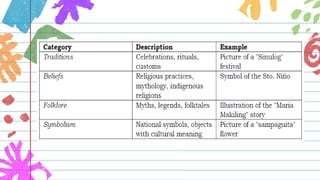
Analyze how cultural elements (e.g., traditions,
beliefs, folklore, symbolism) influence and shape
the lives and stories of the people within a chosen
culture.
Integrate cultural elements into literary work.
Communicate cultural nuances through a poem
(ensure their original poem accurately and
respectfully portrays the chosen culture).
01
02
03
04 Publish original work.
DAY 1 1.Short Review
Folklore and
Symbolism
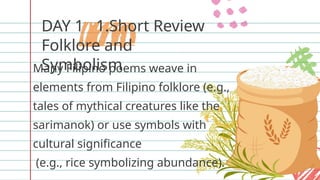
Many Filipino poems weave in
elements from Filipino folklore (e.g.,
tales of mythical creatures like the
sarimanok) or use symbols with
cultural significance
(e.g., rice symbolizing abundance).
Traditions and Beliefs
Poems might explore the
importance of "pagmamano"
(respectful hand-kissing
gesture) or the value of
family in Filipino society.
Choose a Filipino poem you
encountered earlier (or a new
one).
1. Can you identify any
cultural elements present?
2. How do these elements
1. Lesson Purpose
“Today, we are
embarking on a
creative journey to do
just that!
1. Lesson Purpose
Let’s explore the
power of cultural
elements in enriching
poetry.
1. Lesson Purpose
Let’s delve into the traditions,
beliefs, and symbols that
shape a culture's identity and
discover how these elements
can be woven into your
1. Think back to poems you've
read or heard. Have you ever
encountered a poem that felt so
vivid and powerful, it transported
you to a different place or culture?
What made that poem so
Questions:
2. Can you identify any elements that
helped create that feeling of immersion?
Did the poem mention specific traditions,
beliefs, or symbols of a particular culture?
Did the language paint a clear picture in
your mind?
3. Imagine yourself as a storyteller.
How can you use poetry to share
the beauty and essence of a
particular culture? What elements
would you need to consider
creating a respectful and accurate
portrayal?
Write/create poems that sound
great, paint pictures with words,
and show respect for different
cultures by telling their stories
accurately.
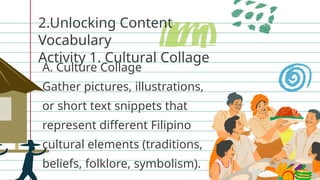
2.Unlocking Content
Vocabulary
Activity 1. Cultural Collage
A. Culture Collage
Gather pictures, illustrations,
or short text snippets that
represent different Filipino
cultural elements (traditions,
beliefs, folklore, symbolism).
1.Write down the vocabulary words you learned
throughout your exploration of Filipino culture.
2.Choose a specific cultural element from your
collage or chart and explain the connection
between them.
3.Use complete sentences to explain
how the vocabulary word relates to
the cultural element it represents.
Example:
Vocabulary Word: Pista (Festival)
Cultural Element: Picture of the Sinulog
Festival (Option 1) or "Traditions" category in
the chart (Option 2)
Explanation: The picture (or category) shows
the vibrant Sinulog festival, which is a
tradition held in Cebu to honor the Santo
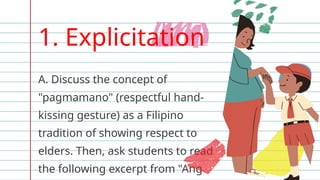
1. Explicitation
A. Discuss the concept of
"pagmamano" (respectful hand-
kissing gesture) as a Filipino
tradition of showing respect to
elders. Then, ask students to read

the following excerpt from "Ang
“Nay,” tawag ko, luhod ako at
sasaludo sana sa kanya ngunit
pinigil niya ako. “Huwag kang
lumuhod, anak,” malumanay
niyang sabi. “Hindi na kailangan pa
ng mga ganitong ritus (ri-tum –
tradition) ngayon.” (N.B. "Ritus" is
the Tagalog word used in the
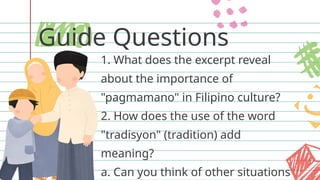
Guide Questions
1. What does the excerpt reveal
about the importance of
"pagmamano" in Filipino culture?
2. How does the use of the word
"tradisyon" (tradition) add
meaning?
a. Can you think of other situations
B. Briefly discuss the significance of
myths and legends in Filipino culture,
often explaining natural phenomena or
historical events.
1. How does this myth or legend
explain a natural phenomenon or
historical event?
Writing a Haiku
Creatively integrate Filipino
cultural elements into your own
writing.
The following activity is called,
Haiku with a Filipino Twist.
Writing a Haiku
Haiku, a traditional
Japanese poem with three
lines (5-7-5 syllables).
Writing a Haiku
A haiku is an unrhymed Japanese
poetic form consisting of 17
syllables arranged in three lines
with five, seven, and five syllables,
respectively. It expresses much and
suggests more in the fewest
Writing a Haiku
While Haiku itself is not a
traditional form of Philippine
poetry, some contemporary
Filipino poets do experiment
with this Japanese poetic form
and infuse it with Filipino
Here's an example:
Morning dew glistens
Sunlight dances on the leaves
Whispers of the breeze
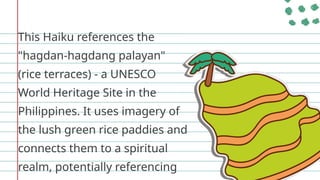
Here's an example:
Rice terraces rise,
Emerald steps to heaven's gate,
Ancestors watch.
This Haiku references the
"hagdan-hagdang palayan"
(rice terraces) - a UNESCO
World Heritage Site in the
Philippines. It uses imagery of
the lush green rice paddies and
connects them to a spiritual
realm, potentially referencing
Publishing
Literary Texts
DAY 2
2. Worked Example
Activity 2. Write a Haiku poem (in English or
Tagalog) that incorporates a Filipino
cultural element (e.g., a traditional food, a
festival, a piece of clothing). Explain your
Haiku by identifying the cultural elements
integrated in it.
2. Worked Example
Example:
Lugaw sa Umaga (Breakfast Porridge)
Steaming white comfort,
Mangga on the side, a sweet start,
Spoon warms the soul too.
My Haiku
A. Write your Haiku.
B. What is your Haiku
about (Cultural
Elements)
Publishing
Literary Texts
DAY 3-4
3. Lesson Activity
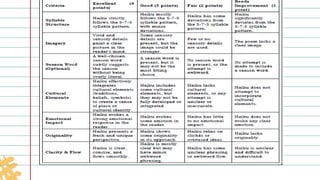
Be guided with the rubrics/criteria for assessing a
Haiku.
Total Points: | 28 | 24 | 16
| 8 |Grading Scale:
•28-24 points: Excellent
•20-23 points: Good
•12-19 points: Fair
•8-11 points: Needs
Improvement
After discussing the rubric, ask the students to
assess their classmates’ Haiku.
Activity 3. Peer Review and Appreciation.
Exchange poems with your classmates. Read the
assigned poem, and rate it using the rubric for
assessing a Haiku previously discussed.
Activity 4. Classroom Poetry Café: Culture Corner
Showcase.
Step 1. Have students decorate the area with artwork
or cultural objects related to their poems.
Step 2. (Presentation)
Each student prepares a
short presentation for the
class, reading their poem
aloud and explaining the
cultural element it
incorporates (if applicable).
Step 3. Encourage classmates to ask
questions and share their
interpretations of the poems.
Step 4. (Gallery Walk) After
presentations, students can visit the
"Culture Corner" at their own pace,
rereading poems and appreciating the
cultural context.
Activity 5. Exploring Publication
Opportunities.
Have students explore various publication
options for their poetry, weigh the pros and
cons of each platform, and receive support
in the publishing process.
Materials:
a. Whiteboard or Projector
b. Markers or Pens
c. Chart Paper (optional)
d. Examples of school literary magazines (if
Step 1. Brainstorming Publication Possibilities
a. Imagine you've written a fantastic poem
you'd love to share with the world. How could
you get it published?
b. Brainstorm different publication options
(e.g., school literary magazine, online
platforms, local newspapers).
c. List the options on the board or chart
paper.
Step 2. Investigating Options
Choose two main publication avenues to
explore in detail: School Literary Magazine
and Social Media Platforms.
a. For the School Literary Magazine:
1. Discuss the pros: Provides a
platform within the school
community, potential for recognition
from peers and teachers.
2. Discuss the cons: Submission
guidelines and deadlines that need
to be met.
b. For Social Media Platforms:
1. Discuss the pros: Wide reach, potential for
engagement with a broader audience.
2. Discuss the cons: Requires careful navigation of
privacy settings and safety considerations.
Step 3. Student Choice & Support
a. Allow students to choose their
preferred publication option based
on their goals and comfort level.
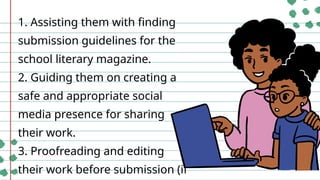
b. Offer support to students
throughout the process. This might
include:
1. Assisting them with finding
submission guidelines for the
school literary magazine.
2. Guiding them on creating a
safe and appropriate social
media presence for sharing
their work.
3. Proofreading and editing
their work before submission (if
1.Learners’ Takeaways
a. I have learned that
publishing my Haiku involves
more than just writing the
poem. I need to consider
_____________________
(consideration like format,
b. I realized that sharing my work
with others through publication
can be _____________________
(positive emotions like exciting,
rewarding) but also a bit
_____________________ (positive or
negative emotions like nerve-
wracking, challenging).
2. Reflection on Learning
a. Did incorporating a Filipino cultural
element in your Haiku change how you
approached the poem?
b. What aspect of publishing your Haiku
did you find most unexpected? Was it
easier or harder than you anticipated?
c. Think about the feedback you
received during peer review. Did it
highlight any areas in your Haiku that
you could strengthen?
How did it help you refine your poem?
d. What challenges do you anticipate
facing when sharing your work there?
What opportunities for feedback or
e. As you think about sharing
your creative work in the future,
what new things would you like
to explore? Are there different
publishing avenues you'd like to
learn more about?
Publishing
Literary Texts
Formative Assessment
Instructions: Read each question
carefully and choose the best answer.
1.How many syllables does the
first line of a Haiku poem
typically have?
a) 3 b) 5 c) 7 d)
2. What is a characteristic of
effective imagery in Haiku?
a) Abstract ideas and complex
emotions b) Sensory details that
paint a clear picture
c) Long, descriptive sentences
d) Rhyming words at the end of
3. Haiku poems often originate
from what country?
a) China
b) Japan
c) Korea
d) India
4. Which of the following is NOT a
common element integrated into
Haiku poems?
a) A season word
b) A moral lesson
c) Vivid imagery
5. How can incorporating a Filipino
cultural element into your Haiku enrich
the poem? a) It adds unnecessary
complexity.
b) It creates a sense of place and
cultural identity.
c) It makes the poem too long.
6. Here's a Haiku: "Sweet mangoes
ripen, Golden scent fills the warm air,
Summer's bounty blooms." What
season word is used in this Haiku?
a) Sweet b) Golden c) Warm d)
Mangoes
7. What is an example of a Filipino
cultural element you could integrate
into your Haiku?
a) A historical landmark
b) A famous pop star
c) A traditional food (like Adobo)
d) A brand-name clothing item
8. You are giving peer feedback on a
classmate's Haiku. What is the MOST
important aspect to consider?
a) Whether you like the poem personally
b) How well the poem follows the 5-7-5
syllable structure
c) How clearly the poem conveys its
message
9. When publishing your Haiku online, what
is an important safety consideration?
a) Sharing your full name and address
b) Using a creative pen name
c) Following platform-specific privacy
settings
d) Posting the Haiku without permission
from your teacher
10. After revising your Haiku based on
feedback, what is the final step before
sharing it with a wider audience?
a) Proofread for any spelling or grammar
errors.
b) Ask your classmates for another round of
feedback.
c) Submit it to a publication
Let’s
check!
Instructions: Read each question
carefully and choose the best answer.
1.How many syllables does the
first line of a Haiku poem
typically have?
a) 3 b) 5 c) 7 d)
2. What is a characteristic of
effective imagery in Haiku?
a) Abstract ideas and complex
emotions b) Sensory details that
paint a clear picture
c) Long, descriptive sentences
d) Rhyming words at the end of
3. Haiku poems often originate
from what country?
a) China
b) Japan
c) Korea
d) India
4. Which of the following is NOT a
common element integrated into
Haiku poems?
a) A season word
b) A moral lesson
c) Vivid imagery
5. How can incorporating a Filipino
cultural element into your Haiku enrich
the poem? a) It adds unnecessary
complexity.
b) It creates a sense of place and
cultural identity.
c) It makes the poem too long.
6. Here's a Haiku: "Sweet mangoes
ripen, Golden scent fills the warm air,
Summer's bounty blooms." What
season word is used in this Haiku?
a) Sweet b) Golden c) Warm d)
Mangoes
7. What is an example of a Filipino
cultural element you could integrate
into your Haiku?
a) A historical landmark
b) A famous pop star
c) A traditional food (like Adobo)
d) A brand-name clothing item
8. You are giving peer feedback on a
classmate's Haiku. What is the MOST
important aspect to consider?
a) Whether you like the poem personally
b) How well the poem follows the 5-7-5
syllable structure
c) How clearly the poem conveys its
message
9. When publishing your Haiku online, what
is an important safety consideration?
a) Sharing your full name and address
b) Using a creative pen name
c) Following platform-specific privacy
settings
d) Posting the Haiku without permission
from your teacher
10. After revising your Haiku based on
feedback, what is the final step before
sharing it with a wider audience?
a) Proofread for any spelling or grammar
errors.
b) Ask your classmates for another round of
feedback.
c) Submit it to a publication
Thank you for
attentive
listening