TOP TREE
BY PARID VAROSHI
• Top trees are a dynamic self-adjusting data structure that can be
used by any tree algorithm. Actually, an arbitrary number of different
tree algorithms can use a single structure. The usage still requires a
detail knowledge of the structure which is quite complex. Moreover
about them.The TFL is a special programming language which
combines declarative and procedural approaches that results in
simpler and faster algorithm designing. The query language TQL
provides an easy top trees administration. The implementation of top
trees, the programming language TFL and the query language TQL
together form a complex solution for using top trees.
ANOTHER DEFINITION
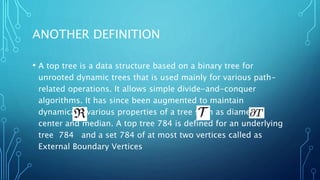
• A top tree is a data structure based on a binary tree for
unrooted dynamic trees that is used mainly for various path-
related operations. It allows simple divide-and-conquer
algorithms. It has since been augmented to maintain
dynamically various properties of a tree such as diameter,
center and median. A top tree 784 is defined for an underlying
tree 784 and a set 784 of at most two vertices called as
External Boundary Vertices
i
• :A top tree R over (T, ∂T) is a binary tree such that:
• 1. The nodes of R are the clusters of (T, ∂T).
• 2. The leaves of R are the edges of T.
• 3. Two clusters are called neighbors if they intersect in a single
vertex. Their union is a parent cluster.
HOTKEYS:
• Boundary Vertex
A vertex in a connected subtree is a Boundary Vertex if it is connected
to a vertex outside the subtree by an edge.
• External Boundary Vertices
Up to a pair of vertices in the top tree can be called as External
Boundary Vertices, they can be thought of as Boundary Vertices of the
cluster which represents the entire top tree.
• Cluster
A cluster is a connected subtree with at most two Boundary Vertices.
The set of Boundary Vertices of a given cluster is denoted as
With each cluster the user may associate some meta information n
hand give methods to maintain it under the various internal
operations.
• Path Cluster
If contains at least one edge then is called a Path
Cluster.
• Cluster Path
The path between the Boundary Vertices of is called the
cluster path of
and it is denoted by
• Path Edge Cluster
Edge Clusters with two Boundary Nodes.
• Edge Cluster
A Cluster containing a single edge is called an Edge Cluster.
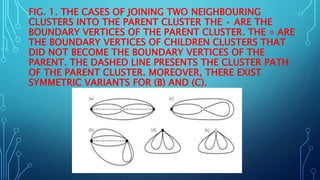
FIG. 1. THE CASES OF JOINING TWO NEIGHBOURING
CLUSTERS INTO THE PARENT CLUSTER THE • ARE THE
BOUNDARY VERTICES OF THE PARENT CLUSTER. THE ◦ ARE
THE BOUNDARY VERTICES OF CHILDREN CLUSTERS THAT
DID NOT BECOME THE BOUNDARY VERTICES OF THE
PARENT. THE DASHED LINE PRESENTS THE CLUSTER PATH
OF THE PARENT CLUSTER. MOREOVER, THERE EXIST
SYMMETRIC VARIANTS FOR (B) AND (C).
REFERENCES:
• http://ceur-ws.org/Vol-471/paper7.pdf
• https://en.wikipedia.org/wiki/Top_tree
• PARID VAROSHI
• EPOKA UNIVERSITY
TIRANA,ALBANIA
• DATA STRUCTURES

Top tree

  • 1.
  • 2.
    • Top treesare a dynamic self-adjusting data structure that can be used by any tree algorithm. Actually, an arbitrary number of different tree algorithms can use a single structure. The usage still requires a detail knowledge of the structure which is quite complex. Moreover about them.The TFL is a special programming language which combines declarative and procedural approaches that results in simpler and faster algorithm designing. The query language TQL provides an easy top trees administration. The implementation of top trees, the programming language TFL and the query language TQL together form a complex solution for using top trees.
  • 3.
    ANOTHER DEFINITION • Atop tree is a data structure based on a binary tree for unrooted dynamic trees that is used mainly for various path- related operations. It allows simple divide-and-conquer algorithms. It has since been augmented to maintain dynamically various properties of a tree such as diameter, center and median. A top tree 784 is defined for an underlying tree 784 and a set 784 of at most two vertices called as External Boundary Vertices i
  • 4.
    • :A toptree R over (T, ∂T) is a binary tree such that: • 1. The nodes of R are the clusters of (T, ∂T). • 2. The leaves of R are the edges of T. • 3. Two clusters are called neighbors if they intersect in a single vertex. Their union is a parent cluster.
  • 5.
    HOTKEYS: • Boundary Vertex Avertex in a connected subtree is a Boundary Vertex if it is connected to a vertex outside the subtree by an edge. • External Boundary Vertices Up to a pair of vertices in the top tree can be called as External Boundary Vertices, they can be thought of as Boundary Vertices of the cluster which represents the entire top tree. • Cluster A cluster is a connected subtree with at most two Boundary Vertices. The set of Boundary Vertices of a given cluster is denoted as With each cluster the user may associate some meta information n hand give methods to maintain it under the various internal operations.
  • 6.
    • Path Cluster Ifcontains at least one edge then is called a Path Cluster. • Cluster Path The path between the Boundary Vertices of is called the cluster path of and it is denoted by • Path Edge Cluster Edge Clusters with two Boundary Nodes. • Edge Cluster A Cluster containing a single edge is called an Edge Cluster.
  • 7.
    FIG. 1. THECASES OF JOINING TWO NEIGHBOURING CLUSTERS INTO THE PARENT CLUSTER THE • ARE THE BOUNDARY VERTICES OF THE PARENT CLUSTER. THE ◦ ARE THE BOUNDARY VERTICES OF CHILDREN CLUSTERS THAT DID NOT BECOME THE BOUNDARY VERTICES OF THE PARENT. THE DASHED LINE PRESENTS THE CLUSTER PATH OF THE PARENT CLUSTER. MOREOVER, THERE EXIST SYMMETRIC VARIANTS FOR (B) AND (C).
  • 8.
    REFERENCES: • http://ceur-ws.org/Vol-471/paper7.pdf • https://en.wikipedia.org/wiki/Top_tree •PARID VAROSHI • EPOKA UNIVERSITY TIRANA,ALBANIA • DATA STRUCTURES