Data Structures and Algorithms
Trees - II
Outline
• Binary Tree Revision
• Traversing a Binary Tree
– Depth-first
• Pre-order
• In-order
• Post-order
– Breadth-first
Tree Traversal
• A traversal iterates through a collection, one item at a time, in
order to access or visit each item.
• With a linear structure such as a linked list, the traversal is
rather easy since we can start with the first node and iterate
through the nodes, one at a time, by following the links
between the nodes.
• But how do we visit every node in a binary tree?
Linked Implementation
Pre-order Traversal
Since every node is the
root of its own subtree,
we can repeat the same
process on each node,
resulting in a
recursive solution.
(Also called NLR traversal)
In-order Traversal
(Also called LNR traversal)
Post-Order Traversal
(Also called LRN traversal)
Depth-First and Breadth-First Traversal
• The preorder, inorder, and postorder traversals are
all examples of a depth-first traversal.
– That is, the nodes are traversed deeper in the tree
before returning to higher-level nodes.
• Another type of traversal that can be performed on
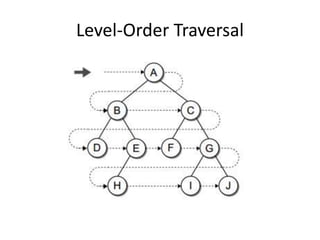
a binary tree is the level order traversal which is
known as breadth-first traversal.
– That is, the nodes are visited by level, from left to right.
Level-Order Traversal
Expression Trees
• Arithmetic expressions such as (9+3)*(8 4) can be
represented using an expression tree.
• An expression tree is a binary tree in which the
operators are stored in the interior nodes and the
operands (the variables or constant values) are
stored in the leaves.
• Once constructed, an expression tree can be used
to evaluate the expression or for converting an
infix expression to either pre-fix or post-fix
notation.
Expression Tree (Cont.)
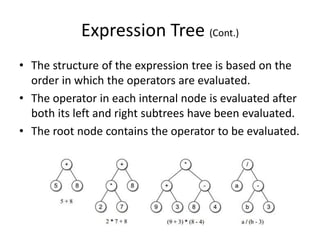
• The structure of the expression tree is based on the
order in which the operators are evaluated.
• The operator in each internal node is evaluated after
both its left and right subtrees have been evaluated.
• The root node contains the operator to be evaluated.
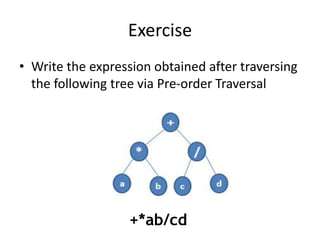
+*ab/cd
Exercise
• Write the expression obtained after traversing
the following tree via Pre-order Traversal
a+b+c+d
Exercise
• Write the expression obtained after traversing
the following tree via in-order Traversal
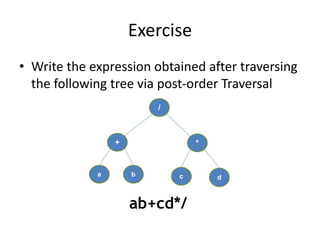
ab+cd*/
Exercise
• Write the expression obtained after traversing
the following tree via post-order Traversal
/
+
d
c
b
a
*
*
+
9
/
6
5
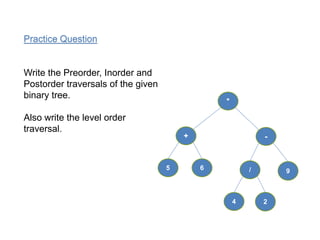
Practice Question
Write the Preorder, Inorder and
Postorder traversals of the given
binary tree.
Also write the level order
traversal.
-
2
4
References
• Data Structures and Algorithms Using Python, Rance D.
Necaise, John Wiley & Sons, Inc. 2010
• John R. Hubbard, Data Structures with Java (Schaum's Outline
Series), McGraw-Hill Education; 2nd edition (June 16, 2009)

Lecture 22_Trees - II.pptx

  • 1.
    Data Structures andAlgorithms Trees - II
  • 2.
    Outline • Binary TreeRevision • Traversing a Binary Tree – Depth-first • Pre-order • In-order • Post-order – Breadth-first
  • 3.
    Tree Traversal • Atraversal iterates through a collection, one item at a time, in order to access or visit each item. • With a linear structure such as a linked list, the traversal is rather easy since we can start with the first node and iterate through the nodes, one at a time, by following the links between the nodes. • But how do we visit every node in a binary tree?
  • 4.
  • 5.
    Pre-order Traversal Since everynode is the root of its own subtree, we can repeat the same process on each node, resulting in a recursive solution. (Also called NLR traversal)
  • 6.
  • 7.
  • 8.
    Depth-First and Breadth-FirstTraversal • The preorder, inorder, and postorder traversals are all examples of a depth-first traversal. – That is, the nodes are traversed deeper in the tree before returning to higher-level nodes. • Another type of traversal that can be performed on a binary tree is the level order traversal which is known as breadth-first traversal. – That is, the nodes are visited by level, from left to right.
  • 9.
  • 10.
    Expression Trees • Arithmeticexpressions such as (9+3)*(8 4) can be represented using an expression tree. • An expression tree is a binary tree in which the operators are stored in the interior nodes and the operands (the variables or constant values) are stored in the leaves. • Once constructed, an expression tree can be used to evaluate the expression or for converting an infix expression to either pre-fix or post-fix notation.
  • 11.
    Expression Tree (Cont.) •The structure of the expression tree is based on the order in which the operators are evaluated. • The operator in each internal node is evaluated after both its left and right subtrees have been evaluated. • The root node contains the operator to be evaluated.
  • 12.
    +*ab/cd Exercise • Write theexpression obtained after traversing the following tree via Pre-order Traversal
  • 13.
    a+b+c+d Exercise • Write theexpression obtained after traversing the following tree via in-order Traversal
  • 14.
    ab+cd*/ Exercise • Write theexpression obtained after traversing the following tree via post-order Traversal / + d c b a *
  • 15.
    * + 9 / 6 5 Practice Question Write thePreorder, Inorder and Postorder traversals of the given binary tree. Also write the level order traversal. - 2 4
  • 16.
    References • Data Structuresand Algorithms Using Python, Rance D. Necaise, John Wiley & Sons, Inc. 2010 • John R. Hubbard, Data Structures with Java (Schaum's Outline Series), McGraw-Hill Education; 2nd edition (June 16, 2009)