Successful MEMS Implementation
in a Downturn: A Top 10 List
Dr. James Wylde
04 Mar 2004
Table of Contents
 Bookham Technology
 Optical Attenuators
 Integrated MEMS Technology
 Top ten commercialization tips
 Conclusion
 COMS2004
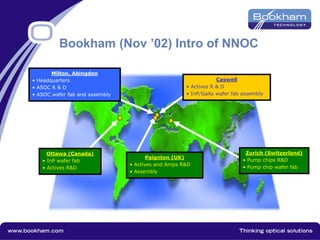
Caswell
• Actives R & D
• InP/GaAs wafer fab assembly
Milton, Abingdon
• Headquarters
• ASOC R & D
• ASOC wafer fab and assembly
Bookham (Nov ’02) Intro of NNOC
Paignton (UK)
• Actives and Amps R&D
• Assembly
Zurich (Switzerland)
• Pump chips R&D
• Pump chip wafer fab
Ottawa (Canada)
• InP wafer fab
• Actives R&D
Ottawa (Carling)
InP Wafer Fab
R&D
Milton (Oxford)
ASOC
Paignton
Tx/Rx
EDFA
Zurich+
Poughkee
psie
980 Pump
laser
Caswell
GaAs & InP Wafer Fabs
MMIC; DBR Tunable Laser
Bookham Locations
Introduction
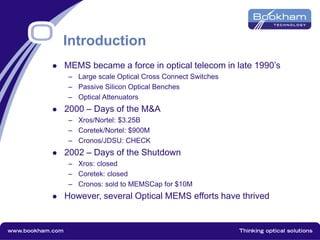
 MEMS became a force in optical telecom in late 1990’s
– Large scale Optical Cross Connect Switches
– Passive Silicon Optical Benches
– Optical Attenuators
 2000 – Days of the M&A
– Xros/Nortel: $3.25B
– Coretek/Nortel: $900M
– Cronos/JDSU: CHECK
 2002 – Days of the Shutdown
– Xros: closed
– Coretek: closed
– Cronos: sold to MEMSCap for $10M
 However, several Optical MEMS efforts have thrived
Optical Attenuators
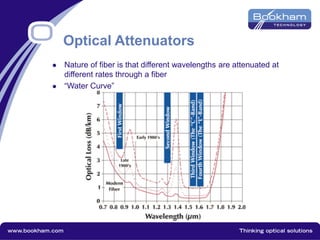
 Nature of fiber is that different wavelengths are attenuated at
different rates through a fiber
 “Water Curve”
Optical Attenuators
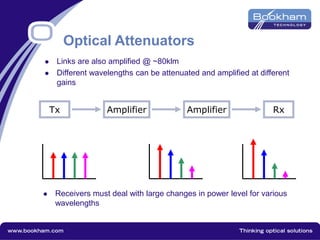
 Links are also amplified @ ~80klm
 Different wavelengths can be attenuated and amplified at different
gains
Tx Amplifier Amplifier Rx
 Receivers must deal with large changes in power level for various
wavelengths
Optical Attenuators
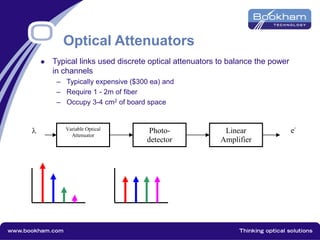
 Typical links used discrete optical attenuators to balance the power
in channels
– Typically expensive ($300 ea) and
– Require 1 - 2m of fiber
– Occupy 3-4 cm2 of board space
Variable Optical
Attenuator
Linear
Amplifier
 e-
Photo-
detector
Market Background
• Competing Technologies (LCD, EO)
• MEMS “bad rap”
• Industry in survival mode
BUT:
• Customers feeling the same squeeze
• Technology barriers to existing solutions
= Opportunity for MEMS
Integrated MEMS Rx
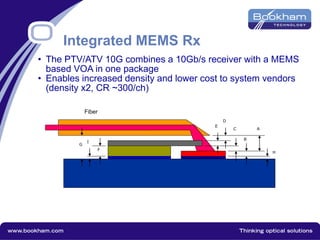
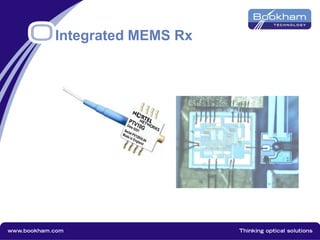
• The PTV/ATV 10G combines a 10Gb/s receiver with a MEMS
based VOA in one package
• Enables increased density and lower cost to system vendors
(density x2, CR ~300/ch)
Integrated MEMS Rx
Fiber
A
B
C
D
E
F
G
H
I
Integrated MEMS Rx
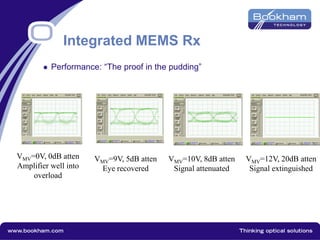
 Performance: “The proof in the pudding”
VMV=0V, 0dB atten
Amplifier well into
overload
VMV=12V, 20dB atten
Signal extinguished
VMV=9V, 5dB atten
Eye recovered
VMV=10V, 8dB atten
Signal attenuated
Integrated MEMS Rx
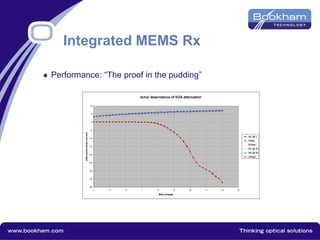
 Performance: “The proof in the pudding”
temp' dependance of VOA attenuation
-40
-35
-30
-25
-20
-15
-10
-5
0
5
10
4 5 6 7 8 9 10 11 12 13
Bias voltage
attenuation/biascurrent
Iatt @ 0
0degC
85degC
Iatt @ 25
Iatt @ 85
25degC
Integrated MEMS Rx
#10
 Terminology
– Everyone has to speak the same language
– 3000 word glossary (MANCEF estimate)
– MST, Micromachine, Microtechnology, Nanotechnology,
MEMS, NEMS, Microsystems!?!?!?!?!?!?!
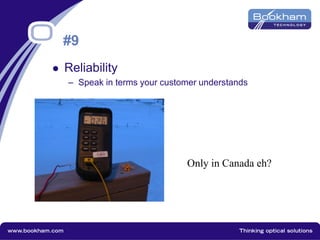
#9
 Reliability
– Speak in terms your customer understands
Only in Canada eh?
#8
 Standards
– Again, talk in terms customers understand
– Telcordia 1221 + 468
– 3 MEMS standards, 100+ semiconductor standards
#7
 Specifications
– Again, talk in terms customers understand
Be careful of spec creep!
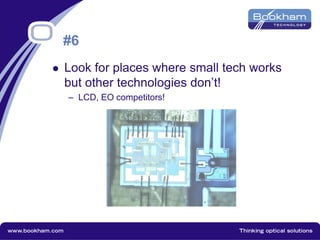
#6
 Look for places where small tech works
but other technologies don’t!
– LCD, EO competitors!
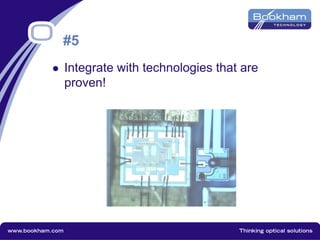
#5
 Integrate with technologies that are
proven!
#4
 Need to provide a REAL benefit: cost?
Performance? Size?
#3
 Set realistic expectations with customers.
#2
 Remember: MEMS Inside doesn’t sell!
#1
 Have Fun! Smile!
Conclusion
 Integrated devices offer significant space and cost savings
 Integration offers design challenges with additional DOF
 MEMS Solution viable for unique applications
– Other solutions don’t fit!
 Combination of design tools and shortloop experiments
enabled faster TTM
 Successful implementation of MEMS by:
– Adapting technology to the required solution
– Identify the market need and design the MEMS to fit the need
 A significant challenge to the widespread acceptance of
“small tech” is the lack of a sound reliability model

Top Ten Ways to Commercialize Microtechnology

  • 1.
    Successful MEMS Implementation ina Downturn: A Top 10 List Dr. James Wylde 04 Mar 2004
  • 2.
    Table of Contents Bookham Technology  Optical Attenuators  Integrated MEMS Technology  Top ten commercialization tips  Conclusion  COMS2004
  • 3.
    Caswell • Actives R& D • InP/GaAs wafer fab assembly Milton, Abingdon • Headquarters • ASOC R & D • ASOC wafer fab and assembly Bookham (Nov ’02) Intro of NNOC Paignton (UK) • Actives and Amps R&D • Assembly Zurich (Switzerland) • Pump chips R&D • Pump chip wafer fab Ottawa (Canada) • InP wafer fab • Actives R&D
  • 4.
    Ottawa (Carling) InP WaferFab R&D Milton (Oxford) ASOC Paignton Tx/Rx EDFA Zurich+ Poughkee psie 980 Pump laser Caswell GaAs & InP Wafer Fabs MMIC; DBR Tunable Laser Bookham Locations
  • 5.
    Introduction  MEMS becamea force in optical telecom in late 1990’s – Large scale Optical Cross Connect Switches – Passive Silicon Optical Benches – Optical Attenuators  2000 – Days of the M&A – Xros/Nortel: $3.25B – Coretek/Nortel: $900M – Cronos/JDSU: CHECK  2002 – Days of the Shutdown – Xros: closed – Coretek: closed – Cronos: sold to MEMSCap for $10M  However, several Optical MEMS efforts have thrived
  • 6.
    Optical Attenuators  Natureof fiber is that different wavelengths are attenuated at different rates through a fiber  “Water Curve”
  • 7.
    Optical Attenuators  Linksare also amplified @ ~80klm  Different wavelengths can be attenuated and amplified at different gains Tx Amplifier Amplifier Rx  Receivers must deal with large changes in power level for various wavelengths
  • 8.
    Optical Attenuators  Typicallinks used discrete optical attenuators to balance the power in channels – Typically expensive ($300 ea) and – Require 1 - 2m of fiber – Occupy 3-4 cm2 of board space Variable Optical Attenuator Linear Amplifier  e- Photo- detector
  • 9.
    Market Background • CompetingTechnologies (LCD, EO) • MEMS “bad rap” • Industry in survival mode BUT: • Customers feeling the same squeeze • Technology barriers to existing solutions = Opportunity for MEMS Integrated MEMS Rx
  • 10.
    • The PTV/ATV10G combines a 10Gb/s receiver with a MEMS based VOA in one package • Enables increased density and lower cost to system vendors (density x2, CR ~300/ch) Integrated MEMS Rx Fiber A B C D E F G H I
  • 11.
  • 12.
     Performance: “Theproof in the pudding” VMV=0V, 0dB atten Amplifier well into overload VMV=12V, 20dB atten Signal extinguished VMV=9V, 5dB atten Eye recovered VMV=10V, 8dB atten Signal attenuated Integrated MEMS Rx
  • 13.
     Performance: “Theproof in the pudding” temp' dependance of VOA attenuation -40 -35 -30 -25 -20 -15 -10 -5 0 5 10 4 5 6 7 8 9 10 11 12 13 Bias voltage attenuation/biascurrent Iatt @ 0 0degC 85degC Iatt @ 25 Iatt @ 85 25degC Integrated MEMS Rx
  • 14.
    #10  Terminology – Everyonehas to speak the same language – 3000 word glossary (MANCEF estimate) – MST, Micromachine, Microtechnology, Nanotechnology, MEMS, NEMS, Microsystems!?!?!?!?!?!?!
  • 15.
    #9  Reliability – Speakin terms your customer understands Only in Canada eh?
  • 16.
    #8  Standards – Again,talk in terms customers understand – Telcordia 1221 + 468 – 3 MEMS standards, 100+ semiconductor standards
  • 17.
    #7  Specifications – Again,talk in terms customers understand Be careful of spec creep!
  • 18.
    #6  Look forplaces where small tech works but other technologies don’t! – LCD, EO competitors!
  • 19.
    #5  Integrate withtechnologies that are proven!
  • 20.
    #4  Need toprovide a REAL benefit: cost? Performance? Size?
  • 21.
    #3  Set realisticexpectations with customers.
  • 22.
    #2  Remember: MEMSInside doesn’t sell!
  • 23.
  • 24.
    Conclusion  Integrated devicesoffer significant space and cost savings  Integration offers design challenges with additional DOF  MEMS Solution viable for unique applications – Other solutions don’t fit!  Combination of design tools and shortloop experiments enabled faster TTM  Successful implementation of MEMS by: – Adapting technology to the required solution – Identify the market need and design the MEMS to fit the need  A significant challenge to the widespread acceptance of “small tech” is the lack of a sound reliability model