
Introduction to
     Entrepreneurship


Unlocking the Secrets of Wealth Creation
             April 27, 2012
A. General Concepts
The ENTREPRENEUR
Our common understanding

 The boss
 The business owner

 The risk taker

 One who starts a small

  business
 The resourceful guy?
No single definition
French word origin

   Entependre – an
     undertaker
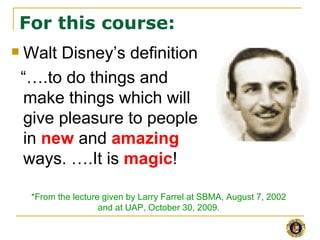
For this course:
   Walt Disney’s definition
    “….to do things and
    make things which will
    give pleasure to people
    in new and amazing
    ways. ….It is magic!

     *From the lecture given by Larry Farrel at SBMA, August 7, 2002
                      and at UAP, October 30, 2009.
Walt Disney and
entrepreneurship

Simply amazing!
   Magical
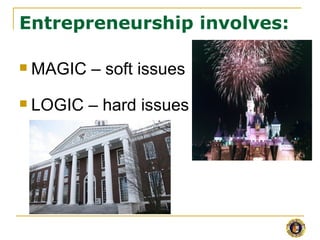
Entrepreneurship involves:

   MAGIC – soft issues
   LOGIC – hard issues
According to George Gilder –
from “The Spirit of the Enterprise”*
   “It is making the world forever new.
    It is taking aggressive actions.”
According to Joseph Schumpeter -*
   “It is destroying the old order and creating
    new ones.”


         *From “Business as a Calling” by Michael Novak
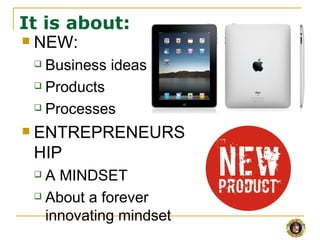
It is about:
 NEW:

     Business ideas
     Products

     Processes

   ENTREPRENEURS
    HIP
     A MINDSET
     About a forever

      innovating mindset
Timmons

   “It is creating something from
    practically nothing”

   “ It is doing something vs. just
    talking”
It is about:

 Action
 Strategy

 Courage

 Wise use of resources

 Start with what he has
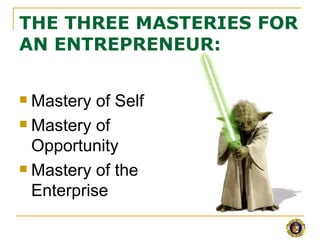
THE THREE MASTERIES FOR
AN ENTREPRENEUR:

 Mastery of Self
 Mastery of

  Opportunity
 Mastery of the

  Enterprise
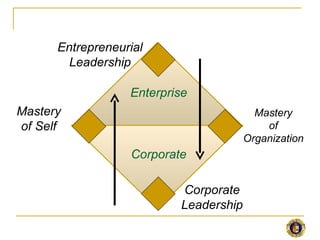
Entrepreneurial
        Leadership

                  Enterprise
Mastery                                  Mastery
of Self                                    of
                                       Organization
                  Corporate

                          Corporate
                          Leadership
Aspects of
Self-Mastery
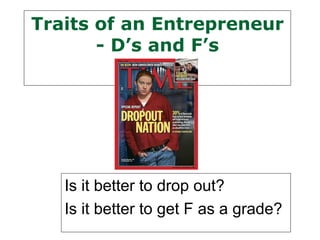
Traits of an Entrepreneur
       - D’s and F’s


   Is it better to drop out?
   Is it better to get F as a grade?
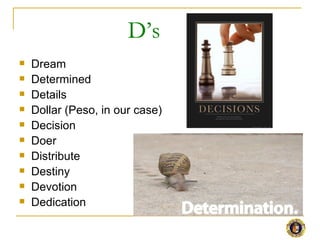
D’s
   Dream
   Determined
   Details
   Dollar (Peso, in our case)
   Decision
   Doer
   Distribute
   Destiny
   Devotion
   Dedication
F’s
   Founder
   Faith
   Focused
   Frugal
   Fast
   Fun
   Flexible
   Flat
   Forever Improving
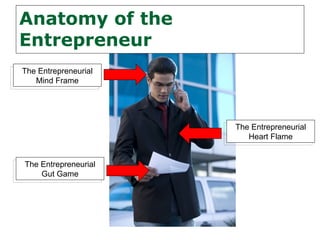
Anatomy of the
Entrepreneur
The Entrepreneurial
   Mind Frame


                      The Entrepreneurial
                         Heart Flame


The Entrepreneurial
    Gut Game
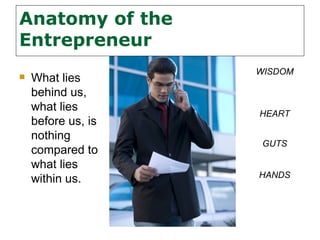
Anatomy of the
Entrepreneur
                    WISDOM
   What lies
    behind us,
    what lies
                    HEART
    before us, is
    nothing
                     GUTS
    compared to
    what lies
                    HANDS
    within us.
Self Analysis:

    Gifted minds
    Steely Guts

        Ability to intuit
        Courage

    Patriotic Hearts
    Hands that truly care

           Do I possess all of the above?
The Entrepreneur’s
Brain

  Let us do a brain
  surgery…
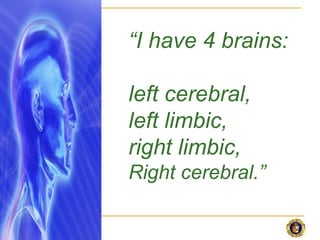
“I have 4 brains:

left cerebral,
left limbic,
right limbic,
Right cerebral.”
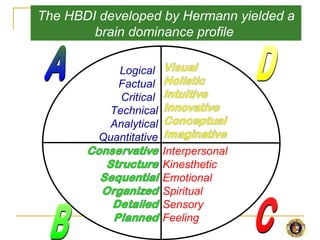
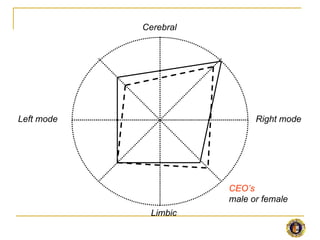
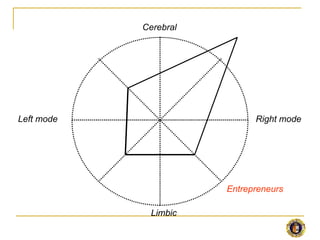
The HBDI developed by Hermann yielded a
        brain dominance profile

            Logical
            Factual
             Critical
           Technical
           Analytical
         Quantitative
                        Interpersonal
                        Kinesthetic
                        Emotional
                        Spiritual
                        Sensory
                        Feeling
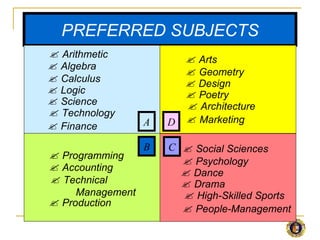
PREFERRED SUBJECTS
 Arithmetic             Arts
 Algebra
                         Geometry
 Calculus               Design
 Logic                  Poetry
 Science                Architecture
 Technology
 Finance         A   D  Marketing

                  B   C  Social Sciences
 Programming
                         Psychology
 Accounting             Dance
 Technical              Drama
     Management          High-Skilled Sports
 Production
                         People-Management
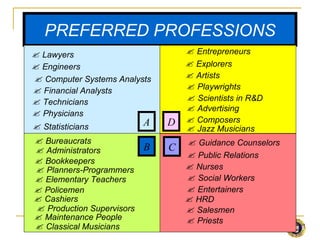
PREFERRED PROFESSIONS
 Lawyers                          Entrepreneurs
 Engineers                        Explorers
 Computer Systems Analysts        Artists
 Financial Analysts               Playwrights
 Technicians                      Scientists in R&D
                                   Advertising
 Physicians
                         A    D    Composers
 Statisticians                    Jazz Musicians
 Bureaucrats                      Guidance Counselors
 Administrators         B    C
                                   Public Relations
 Bookkeepers
 Planners-Programmers             Nurses
 Elementary Teachers              Social Workers
 Policemen                        Entertainers
 Cashiers                         HRD
 Production Supervisors           Salesmen
 Maintenance People               Priests
 Classical Musicians
Cerebral


Left mode                    Right mode


                       CEO’s
                       male or female
             Limbic
Cerebral


Left mode                    Right mode


                       Entrepreneurs

             Limbic
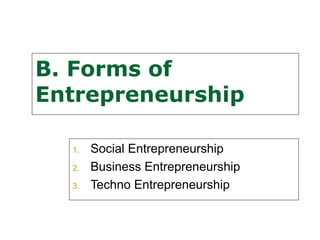
B. Forms of
Entrepreneurship

  1.   Social Entrepreneurship
  2.   Business Entrepreneurship
  3.   Techno Entrepreneurship
1. Social
Entrepreneurship
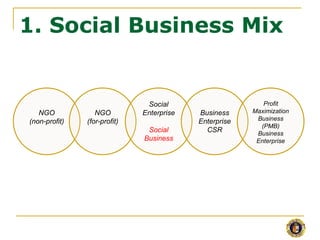
1. Social Business Mix


                               Social                      Profit
   NGO            NGO         Enterprise   Business     Maximization
(non-profit)   (for-profit)                Enterprise    Business
                                                          (PMB)
                               Social        CSR         Business
                              Business                   Enterprise
Social Entrepreneurship

   “Any creative and innovative
    solution applied to solve social
    problems” (Mohammad Yunus,
    2007)
     It involves social mission
     Profit and/or entrepreneurial

      processes
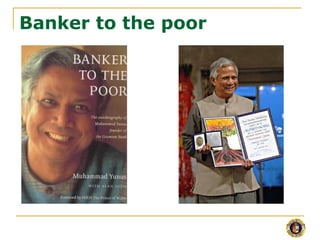
Banker to the poor
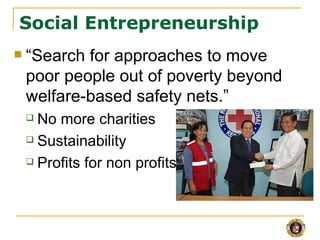
Social Entrepreneurship
   “Search for approaches to move
    poor people out of poverty beyond
    welfare-based safety nets.”
     No more charities
     Sustainability

     Profits for non profits
Social Entrepreneurship
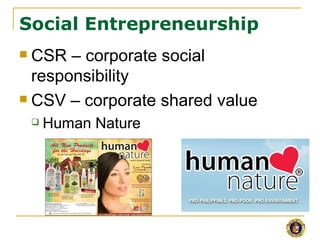
 CSR – corporate social
  responsibility
 CSV – corporate shared value

       Human Nature
Social Business
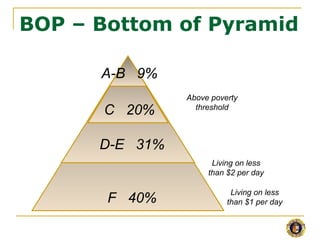
   The triple bottom line
     PEOPLE
     PROFIT

     PLANET

   BOP – Bottom of the Pyramid
BOP – Bottom of Pyramid

      A-B 9%
                Above poverty
      C 20%       threshold


      D-E 31%
                      Living on less
                     than $2 per day

                           Living on less
       F 40%              than $1 per day
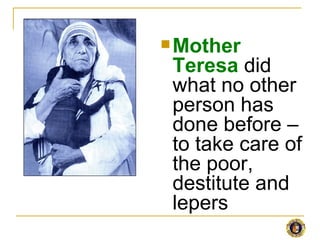
 Mother
 Teresa did
 what no other
 person has
 done before –
 to take care of
 the poor,
 destitute and
 lepers
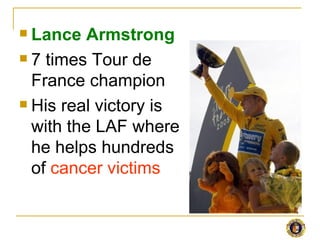
 Lance Armstrong
 7 times Tour de

  France champion
 His real victory is

  with the LAF where
  he helps hundreds
  of cancer victims
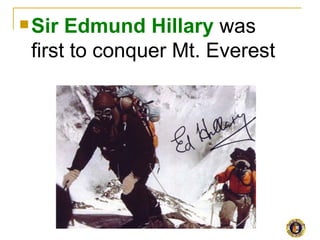
 Sir Edmund Hillary was
 first to conquer Mt. Everest
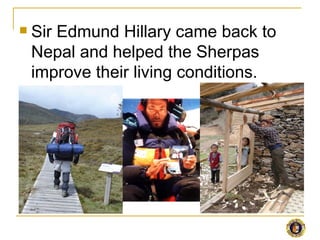
   Sir Edmund Hillary came back to
    Nepal and helped the Sherpas
    improve their living conditions.
Mohammad Yunus
   Taught Developmental Economics at
    the University of Chitagoong in
    Bangladesh.
   Economics, right at the outskirt of the
    University, poverty was everywhere.
   He found out that all that was needed
    by the poor was a loan of 27 chakas.
    That’s how the Grameen Bank started.
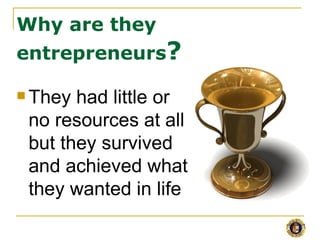
Why are they
entrepreneurs?

 They had little or
 no resources at all
 but they survived
 and achieved what
 they wanted in life
2. Business
Entrepreneurship

  Business for profit
Business Entrepreneurship

   It’s about the study of systems,
    structure, and staffing to make a
    large corporation stay competitive,
    innovative, and profitable on a
    sustainable basis.
2 types of business
entrepreneurship
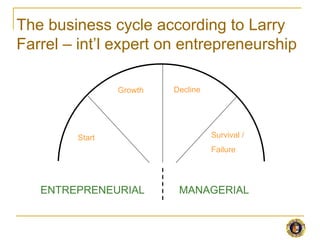
The business cycle according to Larry
Farrel – int’l expert on entrepreneurship

                Growth   Decline


        Start                      Survival /
                                   Failure


   ENTREPRENEURIAL        MANAGERIAL
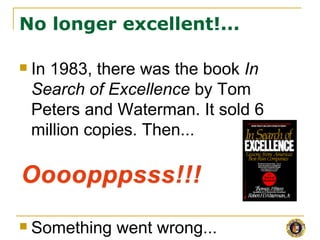
No longer excellent!...

   In 1983, there was the book In
    Search of Excellence by Tom
    Peters and Waterman. It sold 6
    million copies. Then...


   Something went wrong...
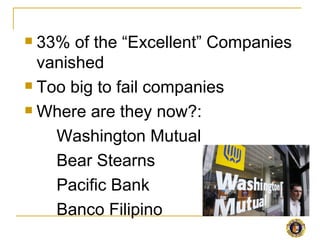
 33% of the “Excellent” Companies
  vanished
 Too big to fail companies

 Where are they now?:

    Washington Mutual
    Bear Stearns
    Pacific Bank
    Banco Filipino
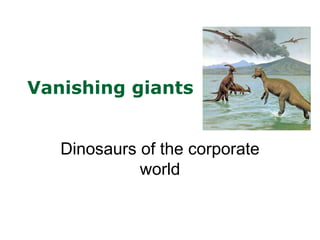
Vanishing giants


   Dinosaurs of the corporate
             world
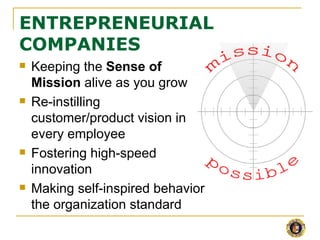
ENTREPRENEURIAL
COMPANIES
   Keeping the Sense of
    Mission alive as you grow
   Re-instilling
    customer/product vision in
    every employee
   Fostering high-speed
    innovation
   Making self-inspired behavior
    the organization standard
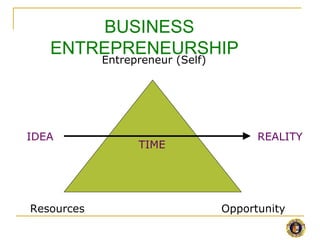
BUSINESS
   ENTREPRENEURSHIP
            Entrepreneur (Self)


IDEA                                    REALITY
                  TIME


Resources                         Opportunity
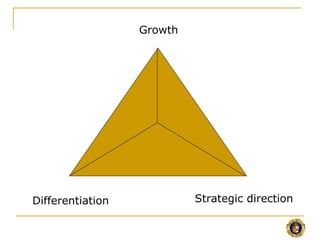
Growth


Differentiation            Strategic direction
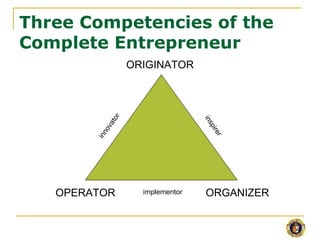
Three Competencies of the
Complete Entrepreneur
                 ORIGINATOR


            or


                                 ins
          at


                                  pi r
         ov
        inn


                                      er
   OPERATOR        implementor   ORGANIZER
Compelling Reasons
Why We Need
Entrepreneurs
   90% of the world’s jobs are created by
    entrepreneurs
   Source of new products and innovation
   In the third-world countries, the entrepreneurs
    keep the sagging economies alive
   It’s the entrepreneurs – not the central bank –
    that keep the economy moving
   Finally...
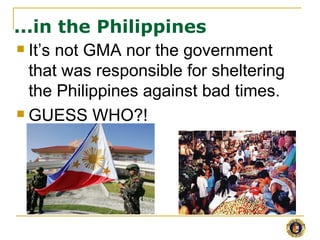
...in the Philippines
 It’s not GMA nor the government

  that was responsible for sheltering
  the Philippines against bad times.
 GUESS WHO?!
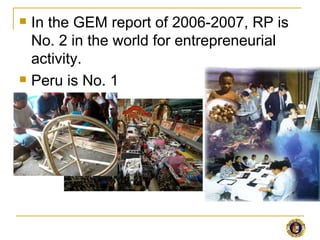
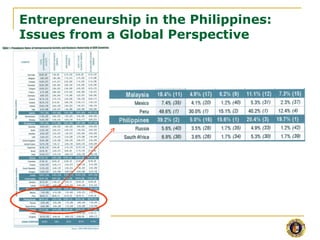
   In the GEM report of 2006-2007, RP is
    No. 2 in the world for entrepreneurial
    activity.
   Peru is No. 1
RP is a HOTBED OF
ENTREPRENEURSHIP!
 4 out of 10 adult Filipinos are into

  business
 Highest in Northern Luzon – 54%

 Lowest in Metro Manila – 30%

 In the early stages, it is highest in

  Mindanao, at 73%
Entrepreneurship in the Philippines:
Issues from a Global Perspective
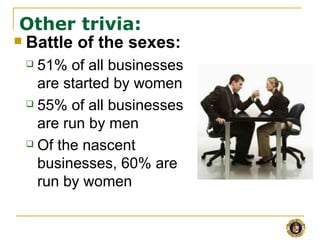
Other trivia:
 Battle of the sexes:

  51% of all businesses
   are started by women
  55% of all businesses

   are run by men
  Of the nascent

   businesses, 60% are
   run by women
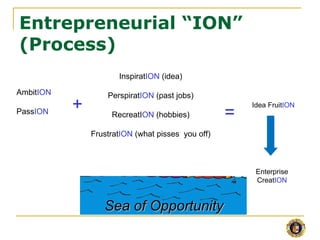
Entrepreneurial “ION”
(Process)
                      InspiratION (idea)

AmbitION           PerspiratION (past jobs)

PassION
           +        RecreatION (hobbies)           =
                                                       Idea FruitION


               FrustratION (what pisses you off)


                                                        Enterprise
                                                        CreatION


                  Sea of Opportunity
Is Entrepreneurship easy?

   We choose to go to the moon in this decade
    and do all the other things to get there, not
    because they are easy but because they are
    hard, because that goal will serve to
    measure the best of our energies and skills,
    because that challenge is one we are willing
    to accept and we are unwilling to postpone,
    and which we intend to win and others too.
                                      -- JFK, 1962
So you want to be a billionaire


                Put your name here:

        __________________________________
          THE NEXT MILLIONAIRE / WINNER

Introduction to entrep v2

  • 1.
    Introduction to Entrepreneurship Unlocking the Secrets of Wealth Creation April 27, 2012
  • 2.
  • 3.
  • 4.
    Our common understanding The boss  The business owner  The risk taker  One who starts a small business  The resourceful guy?
  • 5.
  • 6.
    French word origin Entependre – an undertaker
  • 7.
    For this course:  Walt Disney’s definition “….to do things and make things which will give pleasure to people in new and amazing ways. ….It is magic! *From the lecture given by Larry Farrel at SBMA, August 7, 2002 and at UAP, October 30, 2009.
  • 8.
  • 9.
    Entrepreneurship involves:  MAGIC – soft issues  LOGIC – hard issues
  • 10.
    According to GeorgeGilder – from “The Spirit of the Enterprise”*  “It is making the world forever new. It is taking aggressive actions.” According to Joseph Schumpeter -*  “It is destroying the old order and creating new ones.” *From “Business as a Calling” by Michael Novak
  • 11.
    It is about: NEW:  Business ideas  Products  Processes  ENTREPRENEURS HIP  A MINDSET  About a forever innovating mindset
  • 12.
    Timmons  “It is creating something from practically nothing”  “ It is doing something vs. just talking”
  • 13.
    It is about: Action  Strategy  Courage  Wise use of resources  Start with what he has
  • 14.
    THE THREE MASTERIESFOR AN ENTREPRENEUR:  Mastery of Self  Mastery of Opportunity  Mastery of the Enterprise
  • 15.
    Entrepreneurial Leadership Enterprise Mastery Mastery of Self of Organization Corporate Corporate Leadership
  • 16.
  • 17.
    Traits of anEntrepreneur - D’s and F’s Is it better to drop out? Is it better to get F as a grade?
  • 18.
    D’s  Dream  Determined  Details  Dollar (Peso, in our case)  Decision  Doer  Distribute  Destiny  Devotion  Dedication
  • 19.
    F’s  Founder  Faith  Focused  Frugal  Fast  Fun  Flexible  Flat  Forever Improving
  • 20.
    Anatomy of the Entrepreneur TheEntrepreneurial Mind Frame The Entrepreneurial Heart Flame The Entrepreneurial Gut Game
  • 21.
    Anatomy of the Entrepreneur WISDOM  What lies behind us, what lies HEART before us, is nothing GUTS compared to what lies HANDS within us.
  • 22.
    Self Analysis:  Gifted minds  Steely Guts  Ability to intuit  Courage  Patriotic Hearts  Hands that truly care Do I possess all of the above?
  • 23.
    The Entrepreneur’s Brain Let us do a brain surgery…
  • 24.
    “I have 4brains: left cerebral, left limbic, right limbic, Right cerebral.”
  • 25.
    The HBDI developedby Hermann yielded a brain dominance profile Logical Factual Critical Technical Analytical Quantitative Interpersonal Kinesthetic Emotional Spiritual Sensory Feeling
  • 26.
    PREFERRED SUBJECTS  Arithmetic  Arts  Algebra  Geometry  Calculus  Design  Logic  Poetry  Science  Architecture  Technology  Finance A D  Marketing B C  Social Sciences  Programming  Psychology  Accounting  Dance  Technical  Drama Management  High-Skilled Sports  Production  People-Management
  • 27.
    PREFERRED PROFESSIONS  Lawyers  Entrepreneurs  Engineers  Explorers  Computer Systems Analysts  Artists  Financial Analysts  Playwrights  Technicians  Scientists in R&D  Advertising  Physicians A D  Composers  Statisticians  Jazz Musicians  Bureaucrats  Guidance Counselors  Administrators B C  Public Relations  Bookkeepers  Planners-Programmers  Nurses  Elementary Teachers  Social Workers  Policemen  Entertainers  Cashiers  HRD  Production Supervisors  Salesmen  Maintenance People  Priests  Classical Musicians
  • 28.
    Cerebral Left mode Right mode CEO’s male or female Limbic
  • 29.
    Cerebral Left mode Right mode Entrepreneurs Limbic
  • 30.
    B. Forms of Entrepreneurship 1. Social Entrepreneurship 2. Business Entrepreneurship 3. Techno Entrepreneurship
  • 31.
  • 32.
    1. Social BusinessMix Social Profit NGO NGO Enterprise Business Maximization (non-profit) (for-profit) Enterprise Business (PMB) Social CSR Business Business Enterprise
  • 33.
    Social Entrepreneurship  “Any creative and innovative solution applied to solve social problems” (Mohammad Yunus, 2007)  It involves social mission  Profit and/or entrepreneurial processes
  • 34.
  • 35.
    Social Entrepreneurship  “Search for approaches to move poor people out of poverty beyond welfare-based safety nets.”  No more charities  Sustainability  Profits for non profits
  • 36.
    Social Entrepreneurship  CSR– corporate social responsibility  CSV – corporate shared value  Human Nature
  • 37.
    Social Business  The triple bottom line  PEOPLE  PROFIT  PLANET  BOP – Bottom of the Pyramid
  • 38.
    BOP – Bottomof Pyramid A-B 9% Above poverty C 20% threshold D-E 31% Living on less than $2 per day Living on less F 40% than $1 per day
  • 39.
     Mother Teresadid what no other person has done before – to take care of the poor, destitute and lepers
  • 40.
     Lance Armstrong 7 times Tour de France champion  His real victory is with the LAF where he helps hundreds of cancer victims
  • 41.
     Sir EdmundHillary was first to conquer Mt. Everest
  • 42.
    Sir Edmund Hillary came back to Nepal and helped the Sherpas improve their living conditions.
  • 43.
    Mohammad Yunus  Taught Developmental Economics at the University of Chitagoong in Bangladesh.  Economics, right at the outskirt of the University, poverty was everywhere.  He found out that all that was needed by the poor was a loan of 27 chakas. That’s how the Grameen Bank started.
  • 44.
    Why are they entrepreneurs? They had little or no resources at all but they survived and achieved what they wanted in life
  • 45.
    2. Business Entrepreneurship Business for profit
  • 46.
    Business Entrepreneurship  It’s about the study of systems, structure, and staffing to make a large corporation stay competitive, innovative, and profitable on a sustainable basis.
  • 47.
    2 types ofbusiness entrepreneurship
  • 48.
    The business cycleaccording to Larry Farrel – int’l expert on entrepreneurship Growth Decline Start Survival / Failure ENTREPRENEURIAL MANAGERIAL
  • 49.
    No longer excellent!...  In 1983, there was the book In Search of Excellence by Tom Peters and Waterman. It sold 6 million copies. Then...  Something went wrong...
  • 50.
     33% ofthe “Excellent” Companies vanished  Too big to fail companies  Where are they now?: Washington Mutual Bear Stearns Pacific Bank Banco Filipino
  • 51.
    Vanishing giants Dinosaurs of the corporate world
  • 52.
    ENTREPRENEURIAL COMPANIES  Keeping the Sense of Mission alive as you grow  Re-instilling customer/product vision in every employee  Fostering high-speed innovation  Making self-inspired behavior the organization standard
  • 53.
    BUSINESS ENTREPRENEURSHIP Entrepreneur (Self) IDEA REALITY TIME Resources Opportunity
  • 54.
    Growth Differentiation Strategic direction
  • 55.
    Three Competencies ofthe Complete Entrepreneur ORIGINATOR or ins at pi r ov inn er OPERATOR implementor ORGANIZER
  • 56.
    Compelling Reasons Why WeNeed Entrepreneurs  90% of the world’s jobs are created by entrepreneurs  Source of new products and innovation  In the third-world countries, the entrepreneurs keep the sagging economies alive  It’s the entrepreneurs – not the central bank – that keep the economy moving  Finally...
  • 57.
    ...in the Philippines It’s not GMA nor the government that was responsible for sheltering the Philippines against bad times.  GUESS WHO?!
  • 58.
    In the GEM report of 2006-2007, RP is No. 2 in the world for entrepreneurial activity.  Peru is No. 1
  • 59.
    RP is aHOTBED OF ENTREPRENEURSHIP!  4 out of 10 adult Filipinos are into business  Highest in Northern Luzon – 54%  Lowest in Metro Manila – 30%  In the early stages, it is highest in Mindanao, at 73%
  • 60.
    Entrepreneurship in thePhilippines: Issues from a Global Perspective
  • 61.
    Other trivia:  Battleof the sexes:  51% of all businesses are started by women  55% of all businesses are run by men  Of the nascent businesses, 60% are run by women
  • 62.
    Entrepreneurial “ION” (Process) InspiratION (idea) AmbitION PerspiratION (past jobs) PassION + RecreatION (hobbies) = Idea FruitION FrustratION (what pisses you off) Enterprise CreatION Sea of Opportunity
  • 63.
    Is Entrepreneurship easy?  We choose to go to the moon in this decade and do all the other things to get there, not because they are easy but because they are hard, because that goal will serve to measure the best of our energies and skills, because that challenge is one we are willing to accept and we are unwilling to postpone, and which we intend to win and others too. -- JFK, 1962
  • 64.
    So you wantto be a billionaire Put your name here: __________________________________ THE NEXT MILLIONAIRE / WINNER