Open-Source Frameworks for
Deep Learning: an Overview
Vincenzo Lomonaco
University of Bologna ML Course - 2018
PhD Student @ University of Bologna
Founder of ContinualAI.org
vincenzolomonaco.com
About Me
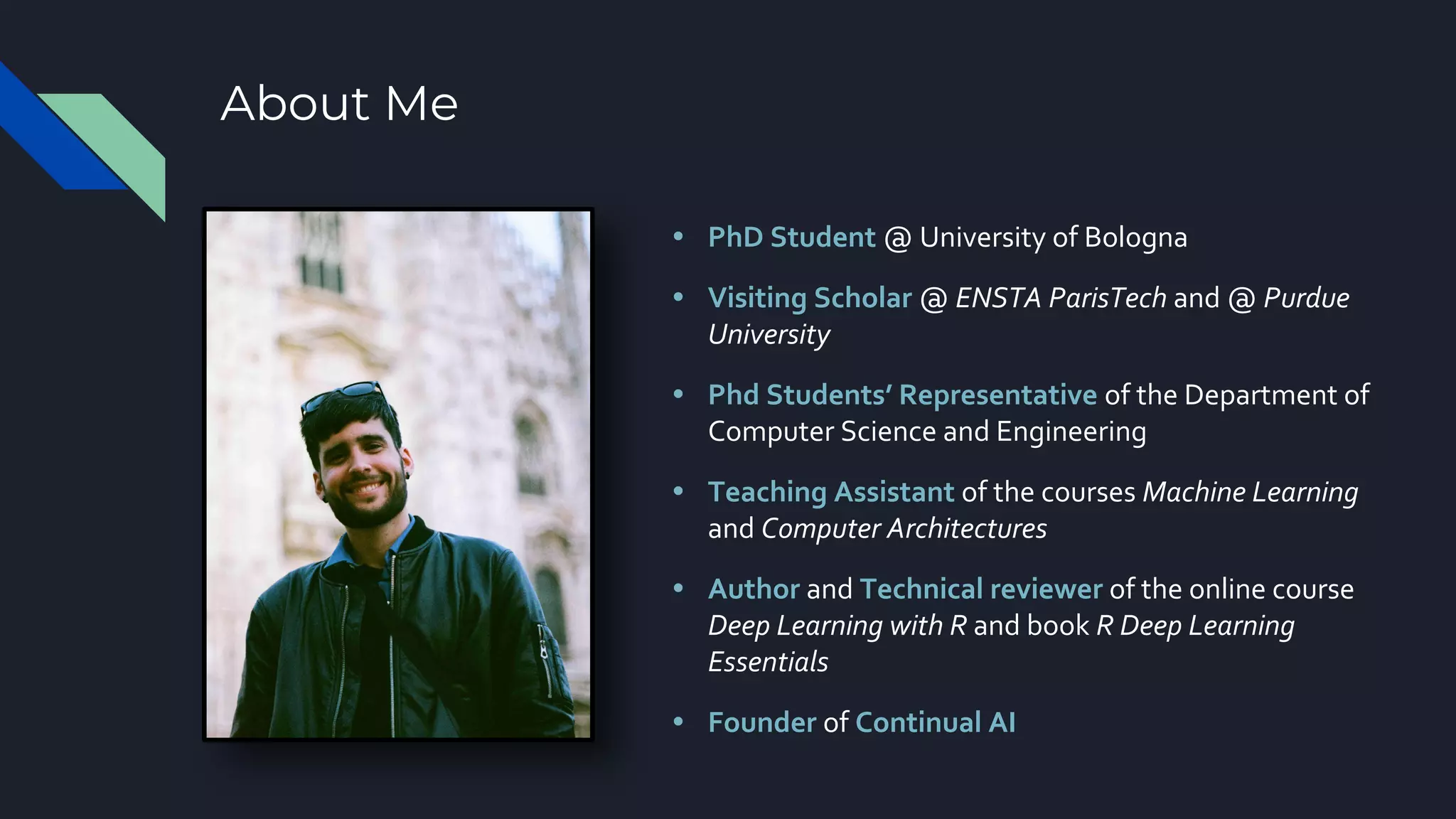
• PhD Student @ University of Bologna
• Visiting Scholar @ ENSTA ParisTech and @ Purdue
University
• Phd Students’ Representative of the Department of
Computer Science and Engineering
• Teaching Assistant of the courses Machine Learning
and Computer Architectures
• Author and Technical reviewer of the online course
Deep Learning with R and book R Deep Learning
Essentials
• Founder of Continual AI
Continual AI Community
http://continualai.org https://continualai.herokuapp.com
Outline
1. Introduction
a. From Machine Learning to Deep Learning
b. History of Deep Learning Frameworks
2. Open-Source Deep Learning Frameworks
a. Main Features and Distinctions
b. Caffe, Tensorflow and Pytorch
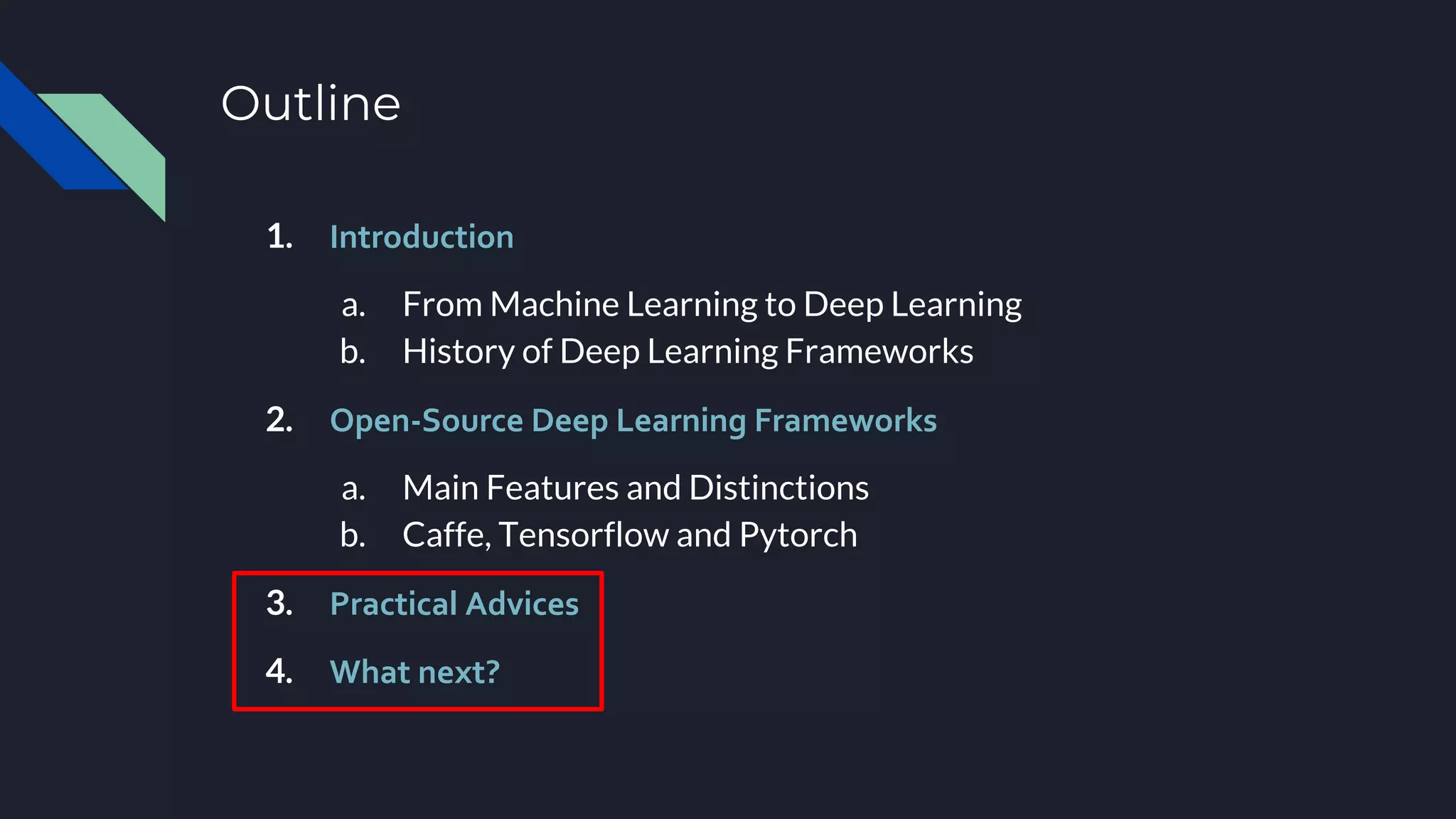
3. Practical Advices
4. What next?
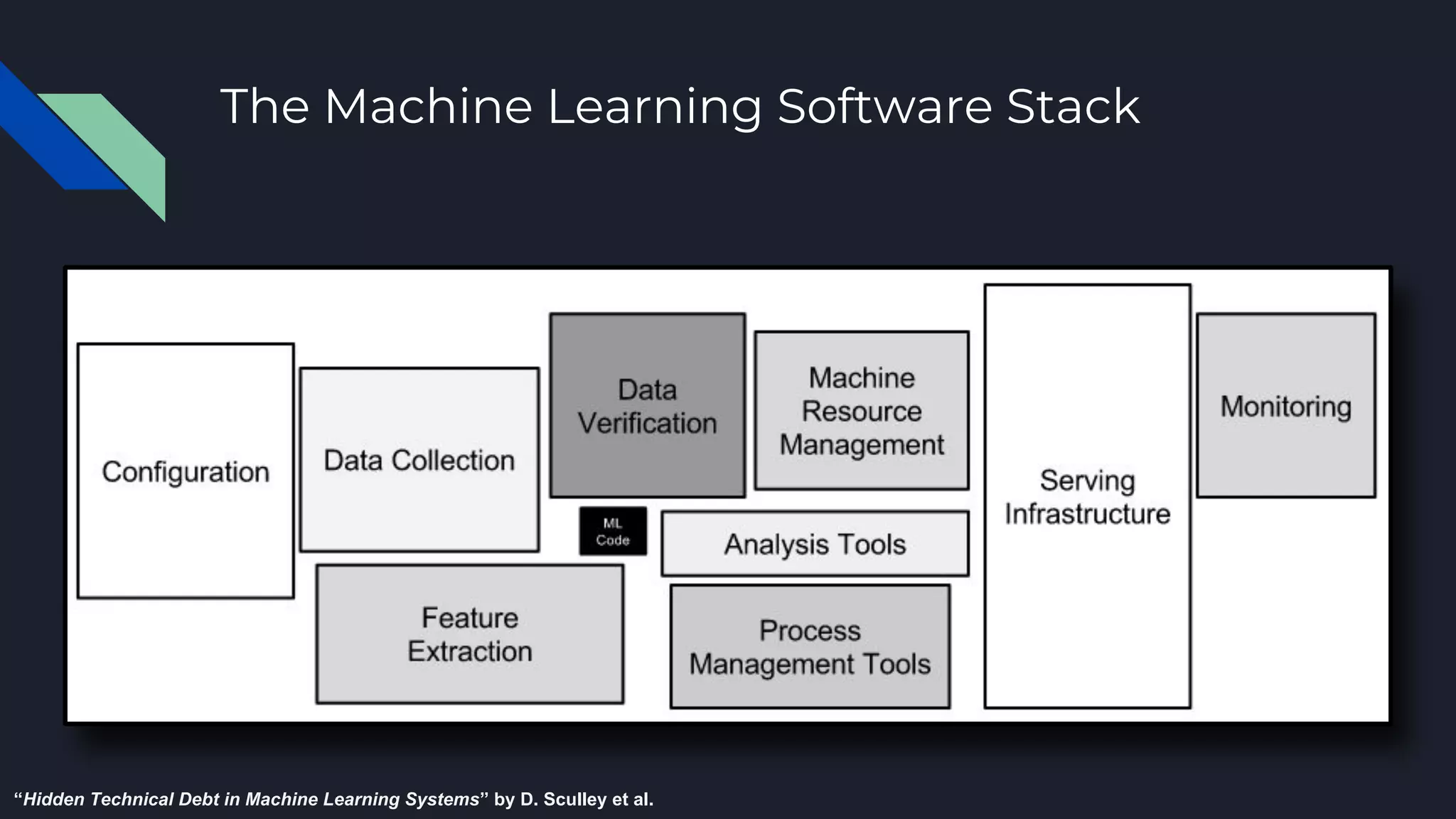
The Machine Learning Software Stack
“Hidden Technical Debt in Machine Learning Systems” by D. Sculley et al.
The Machine Learning Software Stack
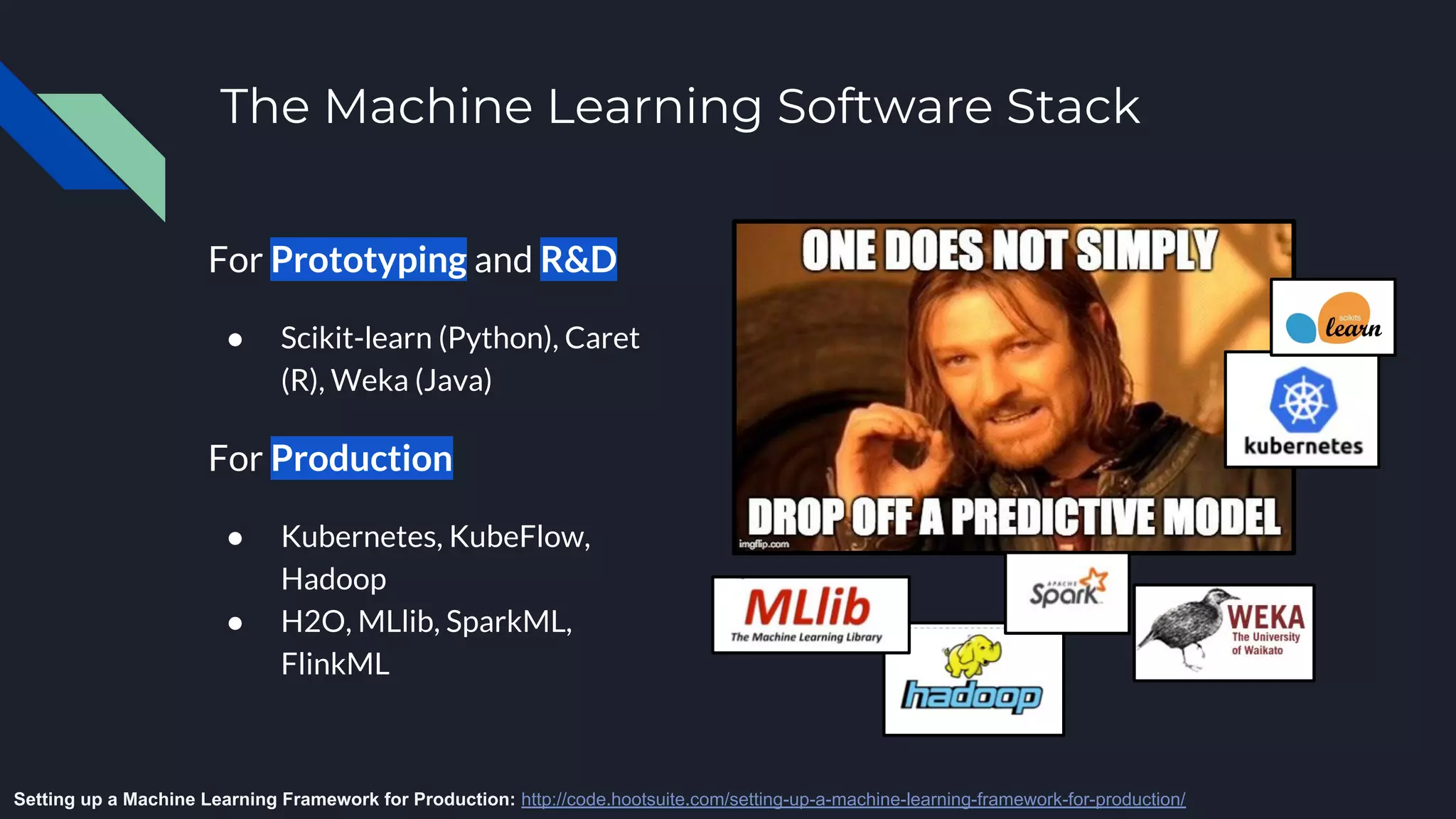
For Prototyping and R&D
● Scikit-learn (Python), Caret
(R), Weka (Java)
For Production
● Kubernetes, KubeFlow,
Hadoop
● H2O, MLlib, SparkML,
FlinkML
Setting up a Machine Learning Framework for Production: http://code.hootsuite.com/setting-up-a-machine-learning-framework-for-production/
From Machine Learning to Deep Learning
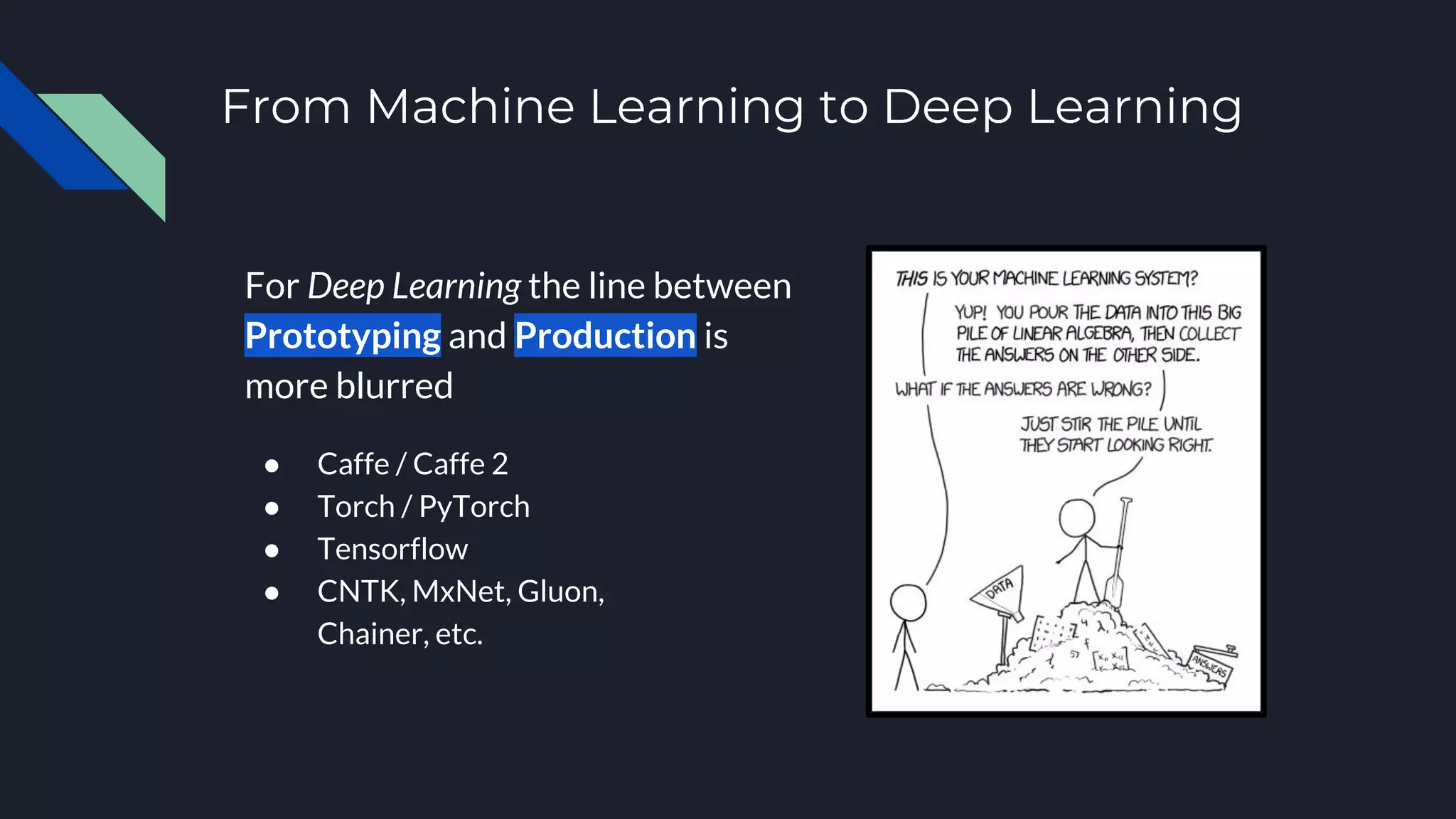
For Deep Learning the line between
Prototyping and Production is
more blurred
● Caffe / Caffe 2
● Torch / PyTorch
● Tensorflow
● CNTK, MxNet, Gluon,
Chainer, etc.
From Machine Learning to Deep Learning
Why
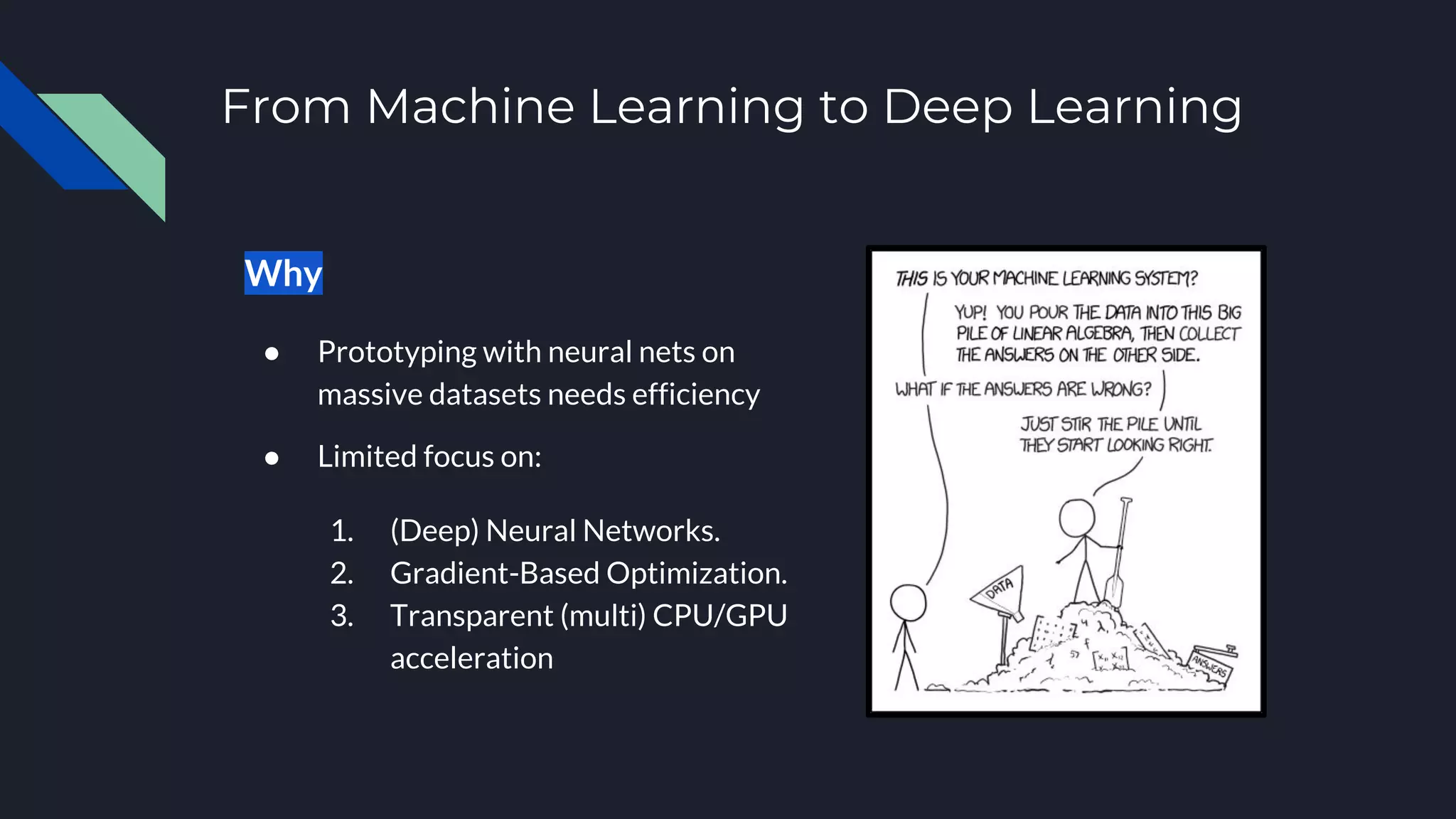
● Prototyping with neural nets on
massive datasets needs efficiency
● Limited focus on:
1. (Deep) Neural Networks.
2. Gradient-Based Optimization.
3. Transparent (multi) CPU/GPU
acceleration
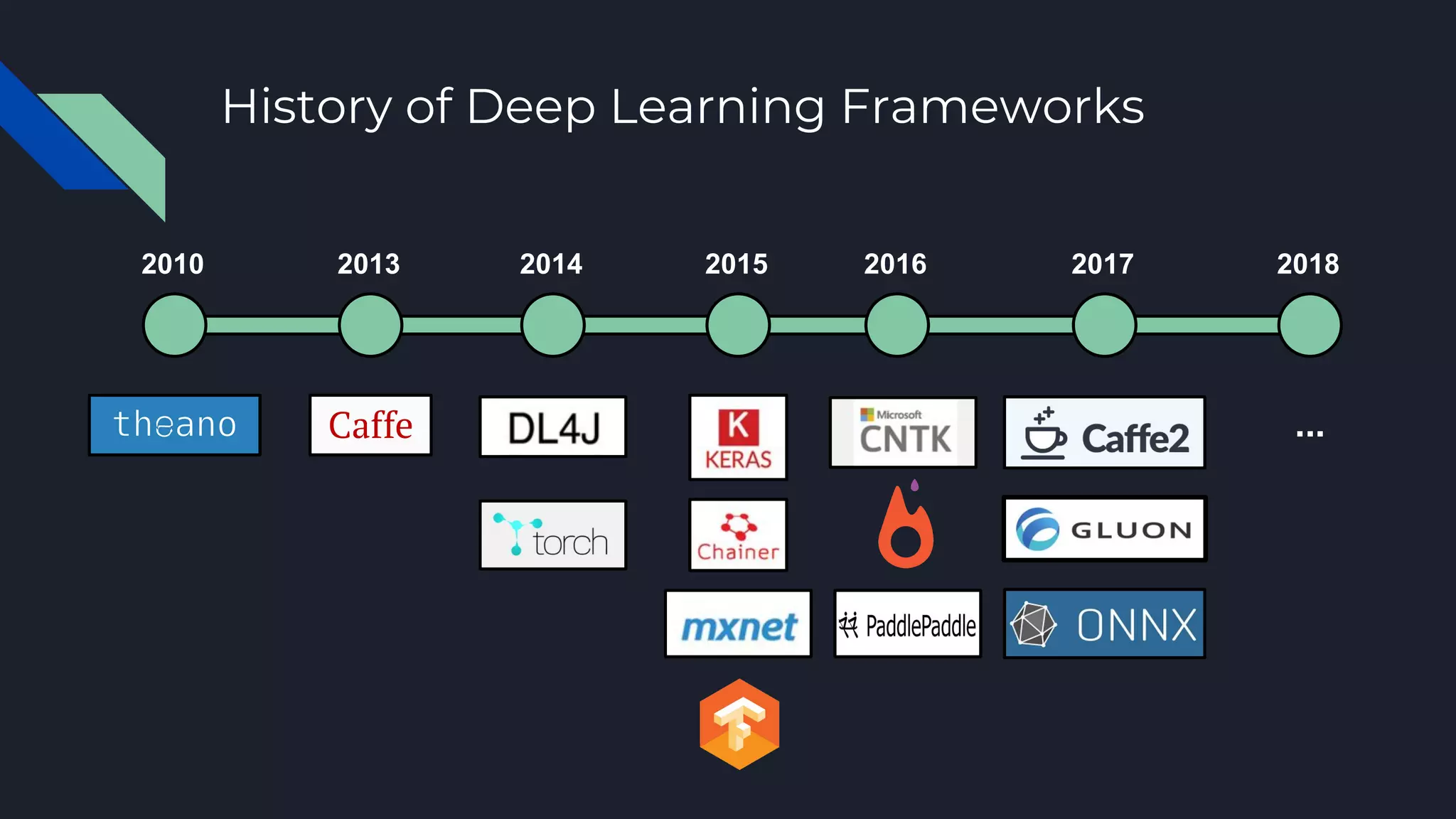
History of Deep Learning Frameworks
2010 2013 2014 2015 2016 20182017
...
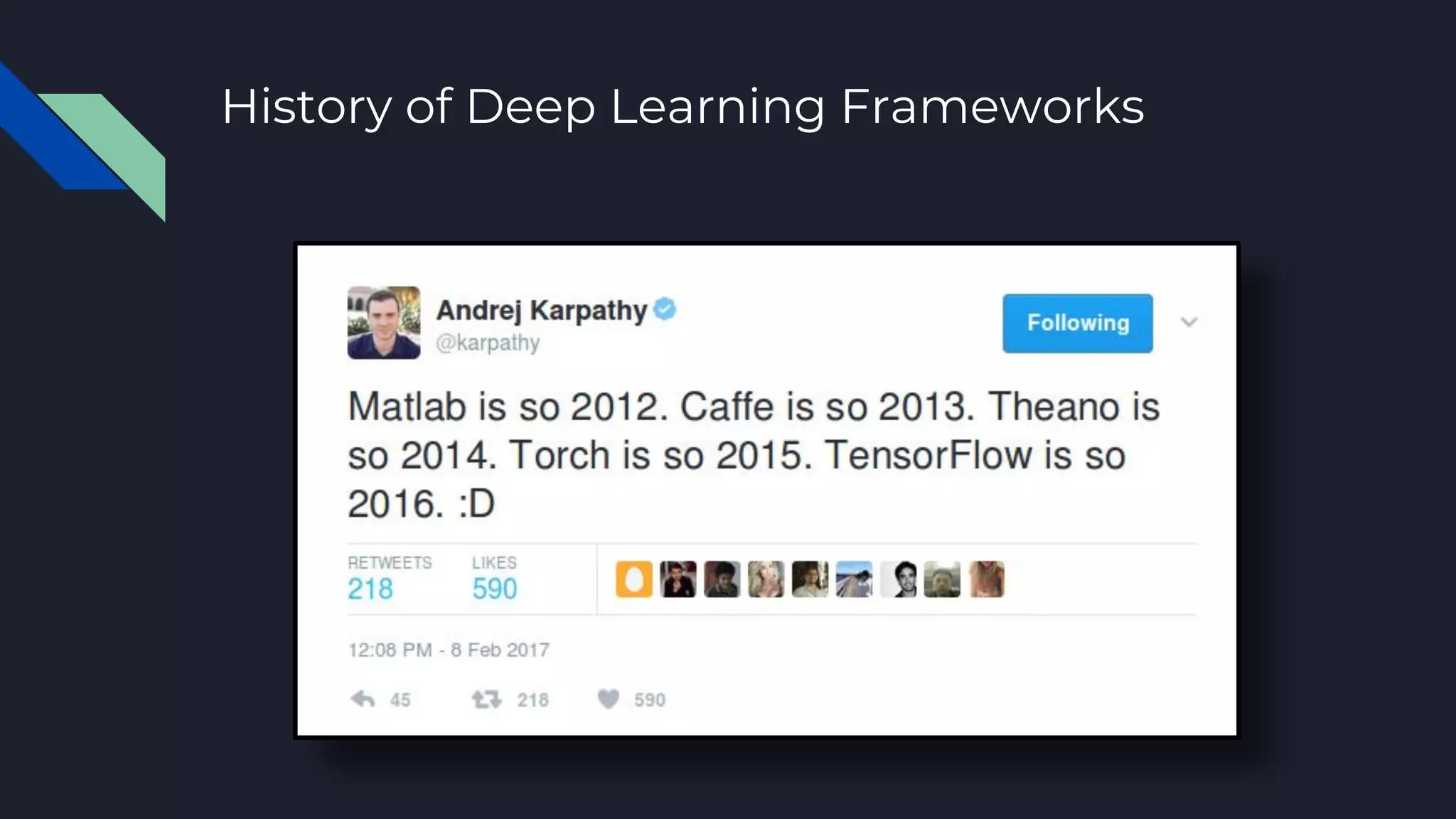
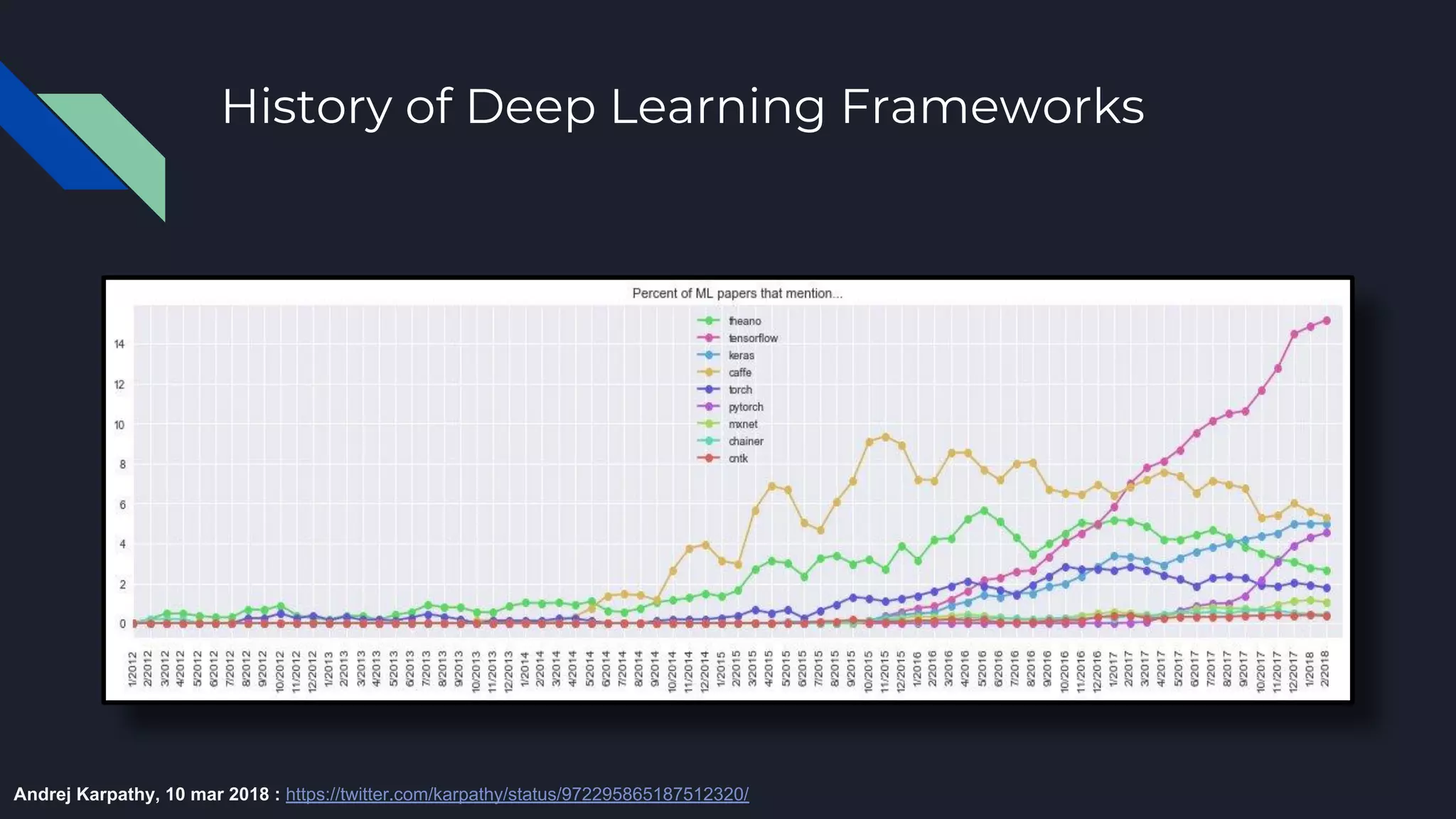
History of Deep Learning Frameworks
Andrej Karpathy, 10 mar 2018 : https://twitter.com/karpathy/status/972295865187512320/
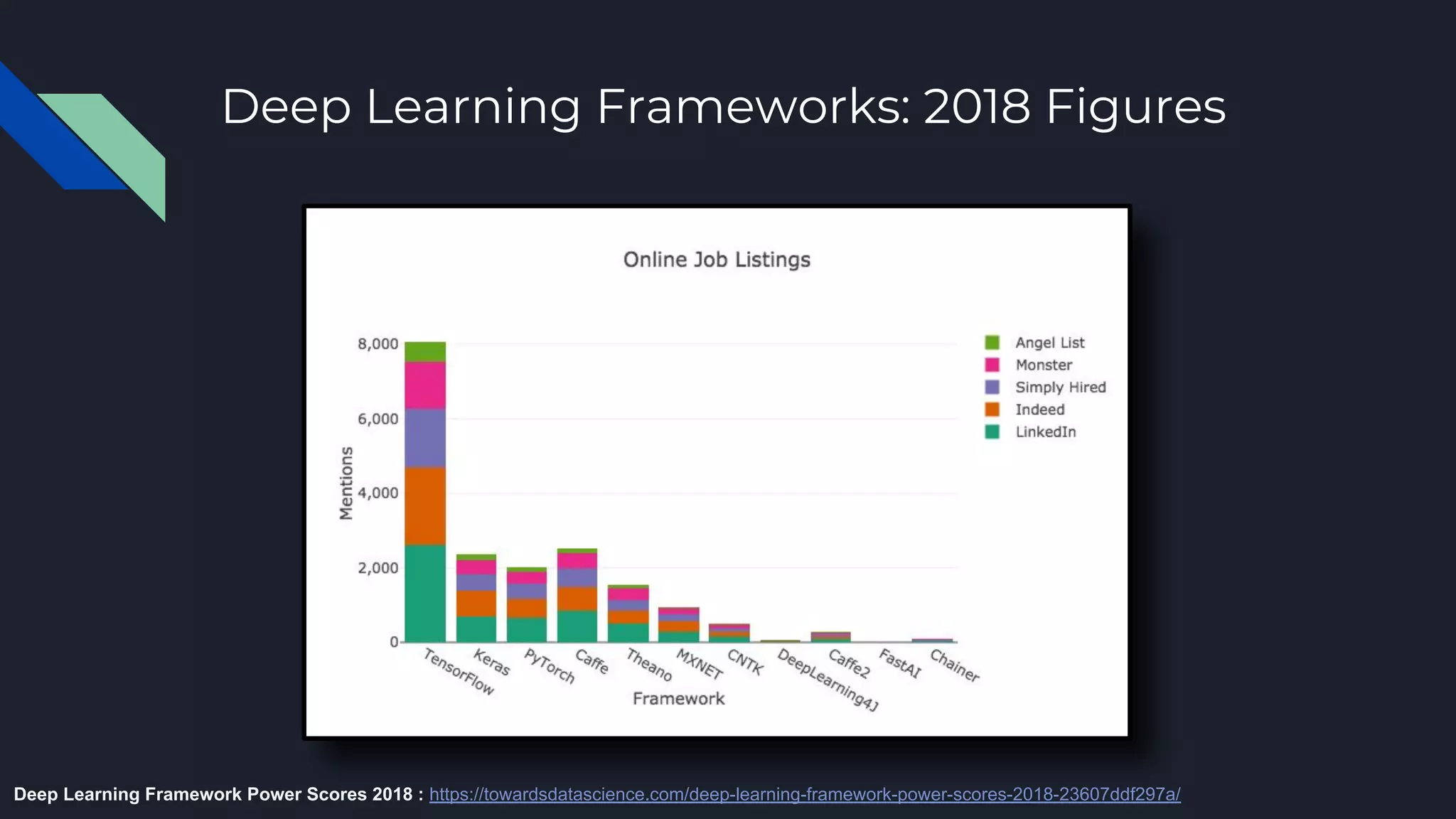
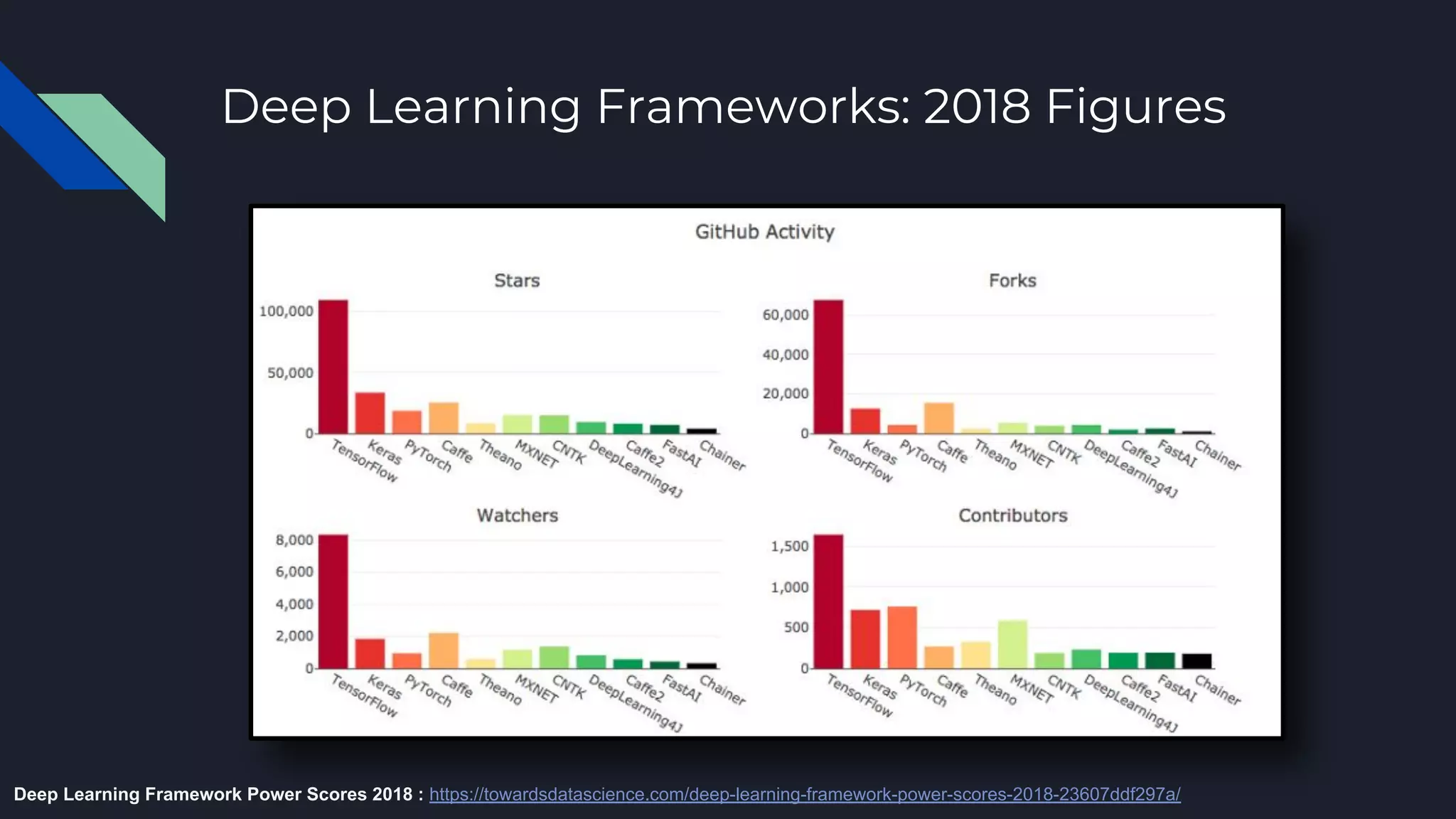
Deep Learning Frameworks: 2018 Figures
Deep Learning Framework Power Scores 2018 : https://towardsdatascience.com/deep-learning-framework-power-scores-2018-23607ddf297a/
Deep Learning Frameworks: 2018 Figures
Deep Learning Framework Power Scores 2018 : https://towardsdatascience.com/deep-learning-framework-power-scores-2018-23607ddf297a/
Outline
1. Introduction
a. From Machine Learning to Deep Learning
b. History of Deep Learning Frameworks
2. Open-Source Deep Learning Frameworks
a. Main Features and Distinctions
b. Caffe, Tensorflow and Pytorch
3. Practical Advices
4. What next?
Main Features and Distinctions
1. Static vs Dynamic Graph
2. Differentiation Support
3. Hardware / Platform Support
4. Model / Utils Support and Performance
5. Multi-CPU/GPU support
6. API level
7. License and Community Support
Comparison of deep learning software: https://en.wikipedia.org/wiki/Comparison_of_deep_learning_software
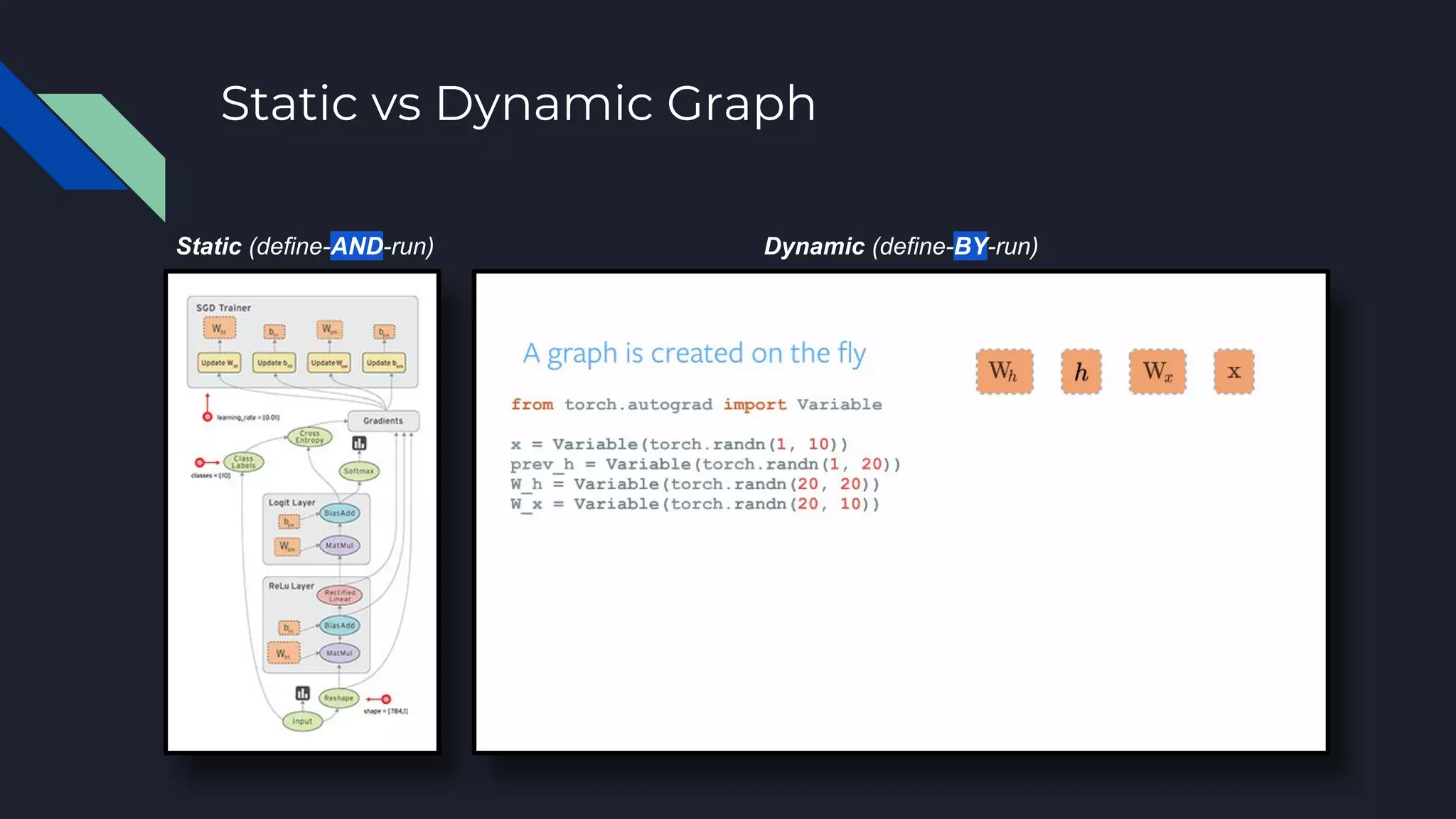
Static vs Dynamic Graph
Static (define-AND-run) Dynamic (define-BY-run)
Differentiation Support
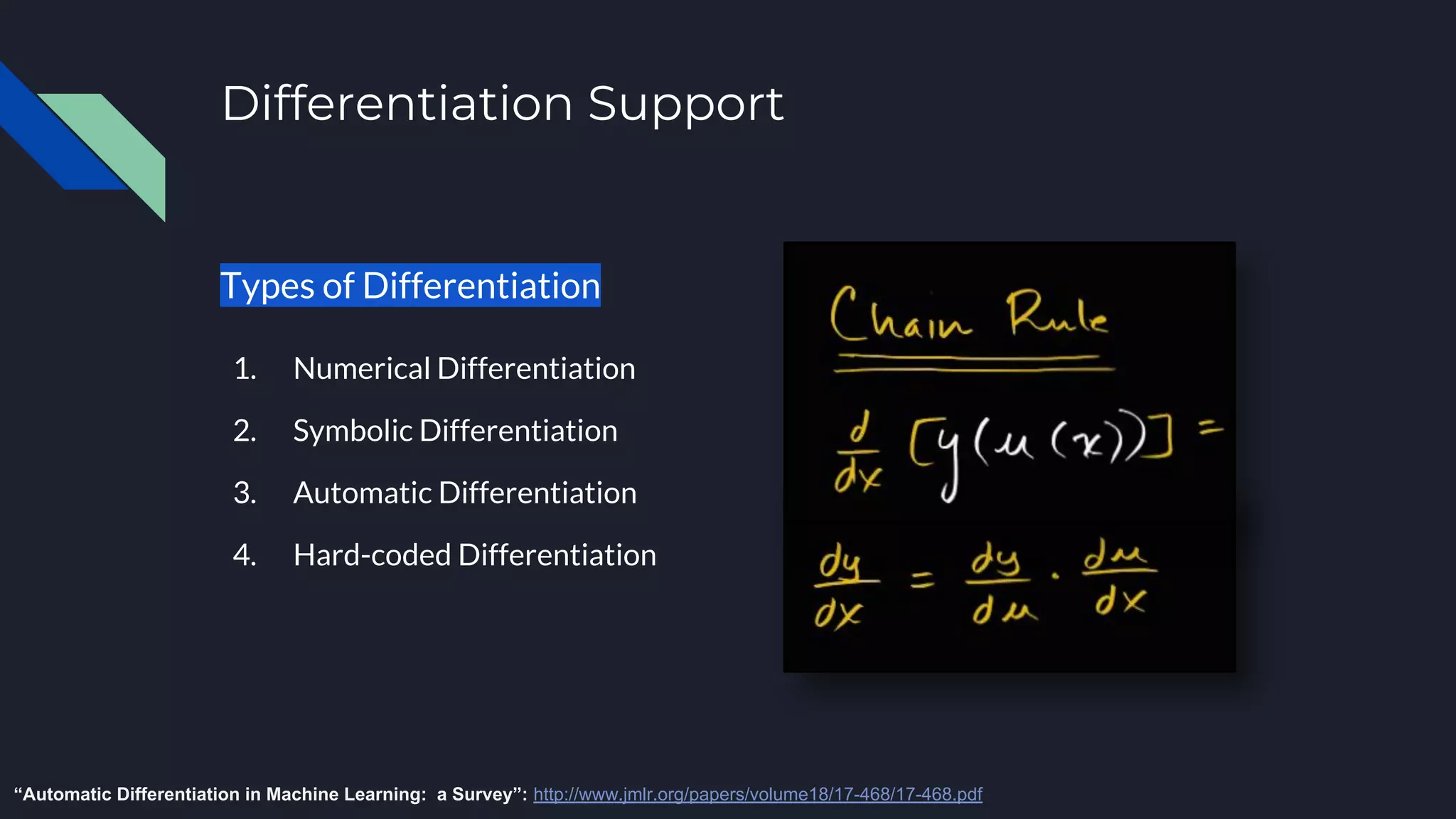
Types of Differentiation
1. Numerical Differentiation
2. Symbolic Differentiation
3. Automatic Differentiation
4. Hard-coded Differentiation
“Automatic Differentiation in Machine Learning: a Survey”: http://www.jmlr.org/papers/volume18/17-468/17-468.pdf
Hardware / Platform Support
Platform Support
● Windows, Unix (MAC OS, Linux)
● Android OS, iOS, Embedded
Systems
Hardware Acceleration
● Cuda / OpenCL Support
● OpenMP, MPI Support
● AI Chips
Model / Utils Support and Performance
Types of models supported
● FC-NNs, CNNs, RNNs, etc.
● General purpose algebraic
functions
Utils support
● Pre-trained models Zoo
● Data format and loading
● Monitoring / Visualization tools
Performance
● Very different from task to
task and model to model, etc.
Multi-CPU / GPU support
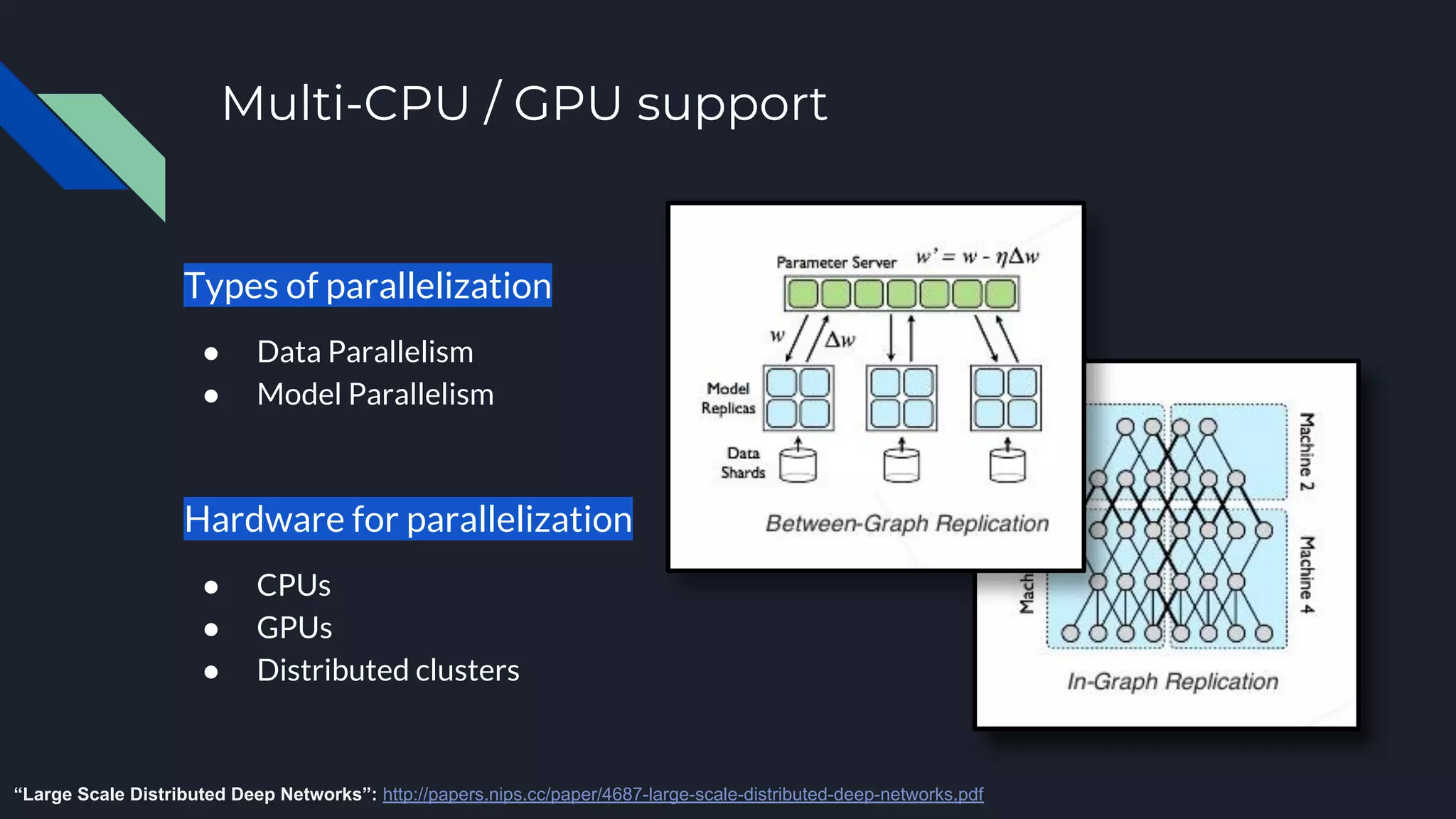
Types of parallelization
● Data Parallelism
● Model Parallelism
Hardware for parallelization
● CPUs
● GPUs
● Distributed clusters
“Large Scale Distributed Deep Networks”: http://papers.nips.cc/paper/4687-large-scale-distributed-deep-networks.pdf
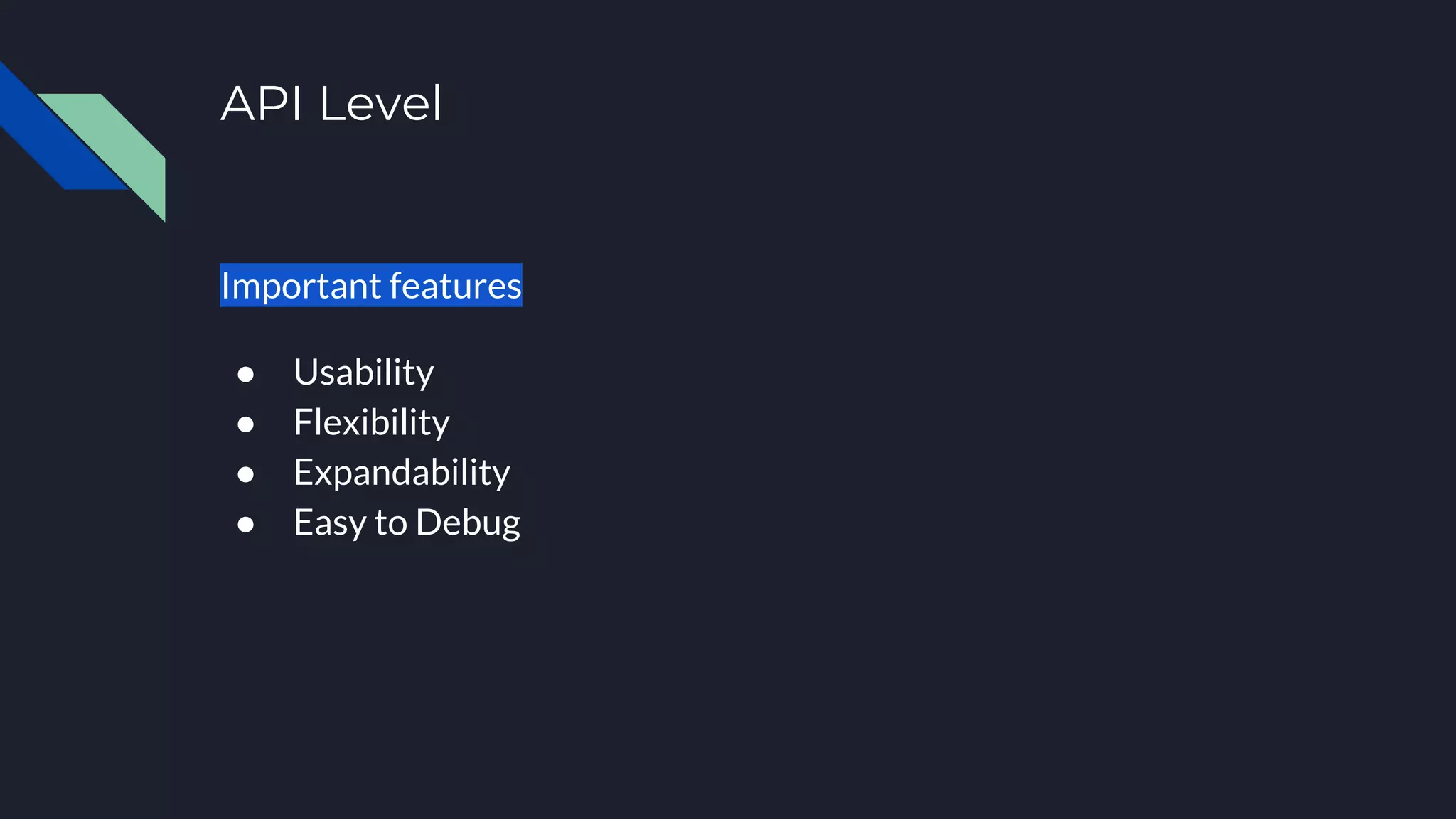
API Level
Important features
● Usability
● Flexibility
● Expandability
● Easy to Debug
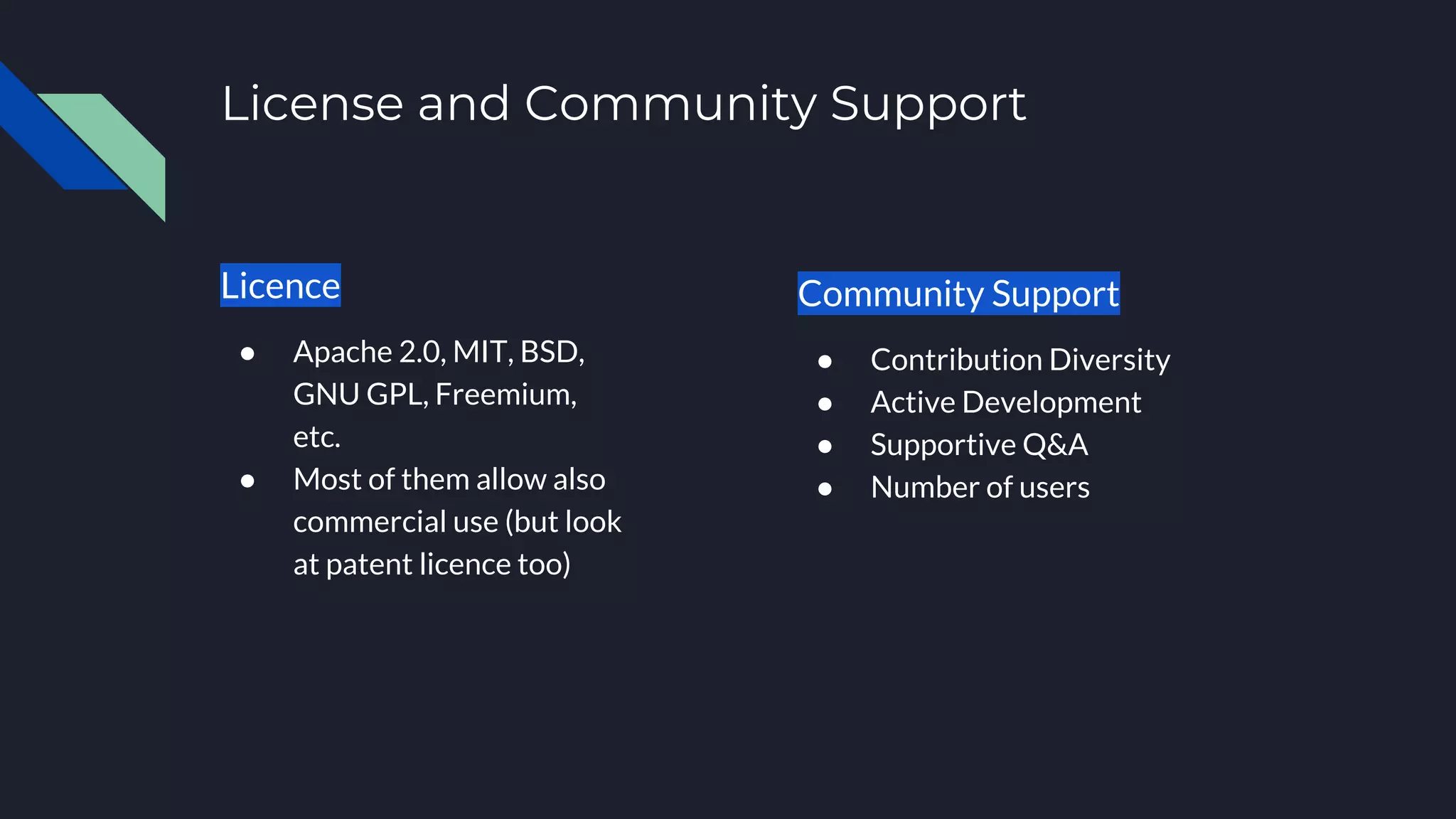
License and Community Support
Licence
● Apache 2.0, MIT, BSD,
GNU GPL, Freemium,
etc.
● Most of them allow also
commercial use (but look
at patent licence too)
Community Support
● Contribution Diversity
● Active Development
● Supportive Q&A
● Number of users
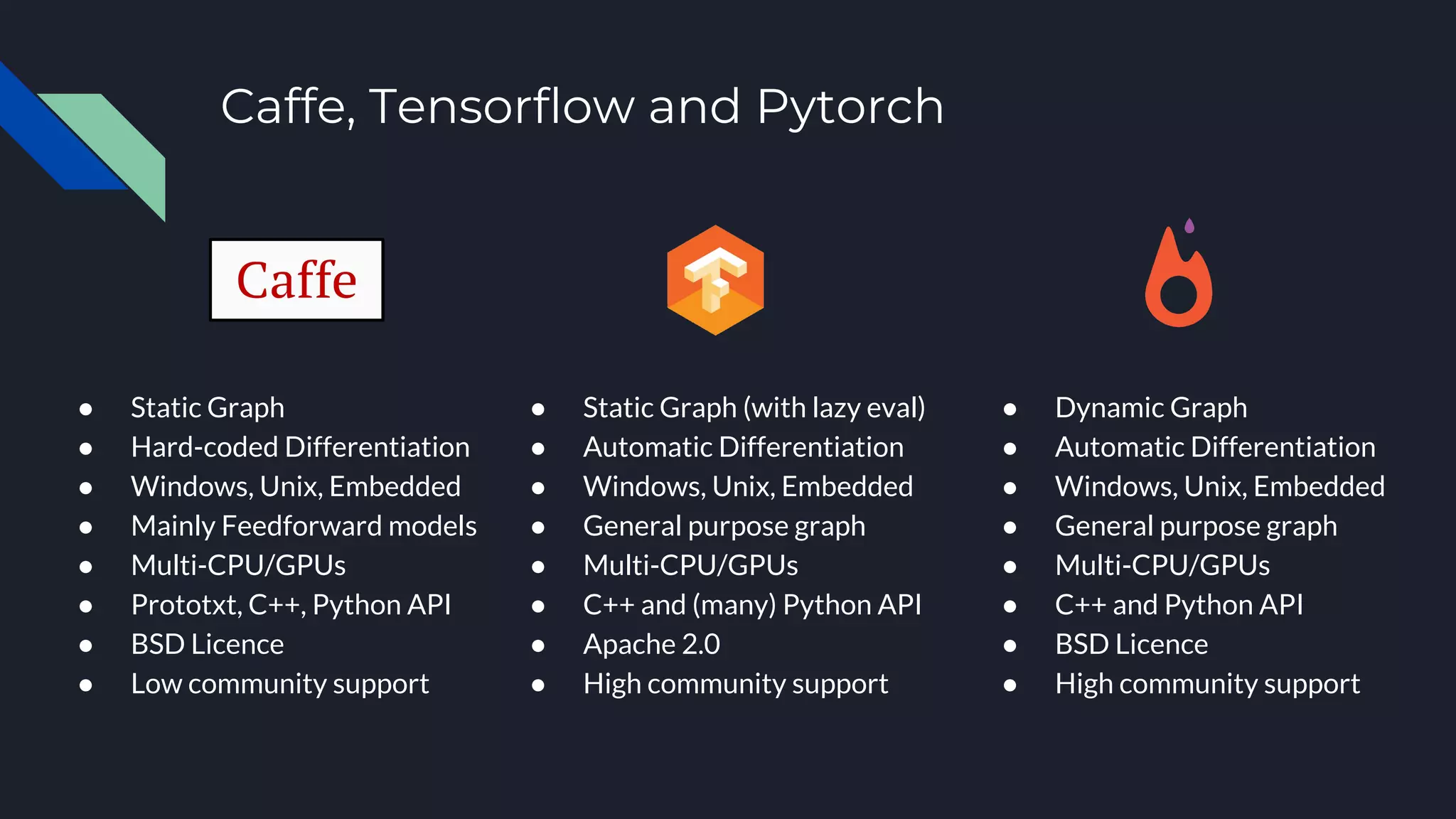
Caffe, Tensorflow and Pytorch
● Static Graph
● Hard-coded Differentiation
● Windows, Unix, Embedded
● Mainly Feedforward models
● Multi-CPU/GPUs
● Prototxt, C++, Python API
● BSD Licence
● Low community support
● Static Graph (with lazy eval)
● Automatic Differentiation
● Windows, Unix, Embedded
● General purpose graph
● Multi-CPU/GPUs
● C++ and (many) Python API
● Apache 2.0
● High community support
● Dynamic Graph
● Automatic Differentiation
● Windows, Unix, Embedded
● General purpose graph
● Multi-CPU/GPUs
● C++ and Python API
● BSD Licence
● High community support
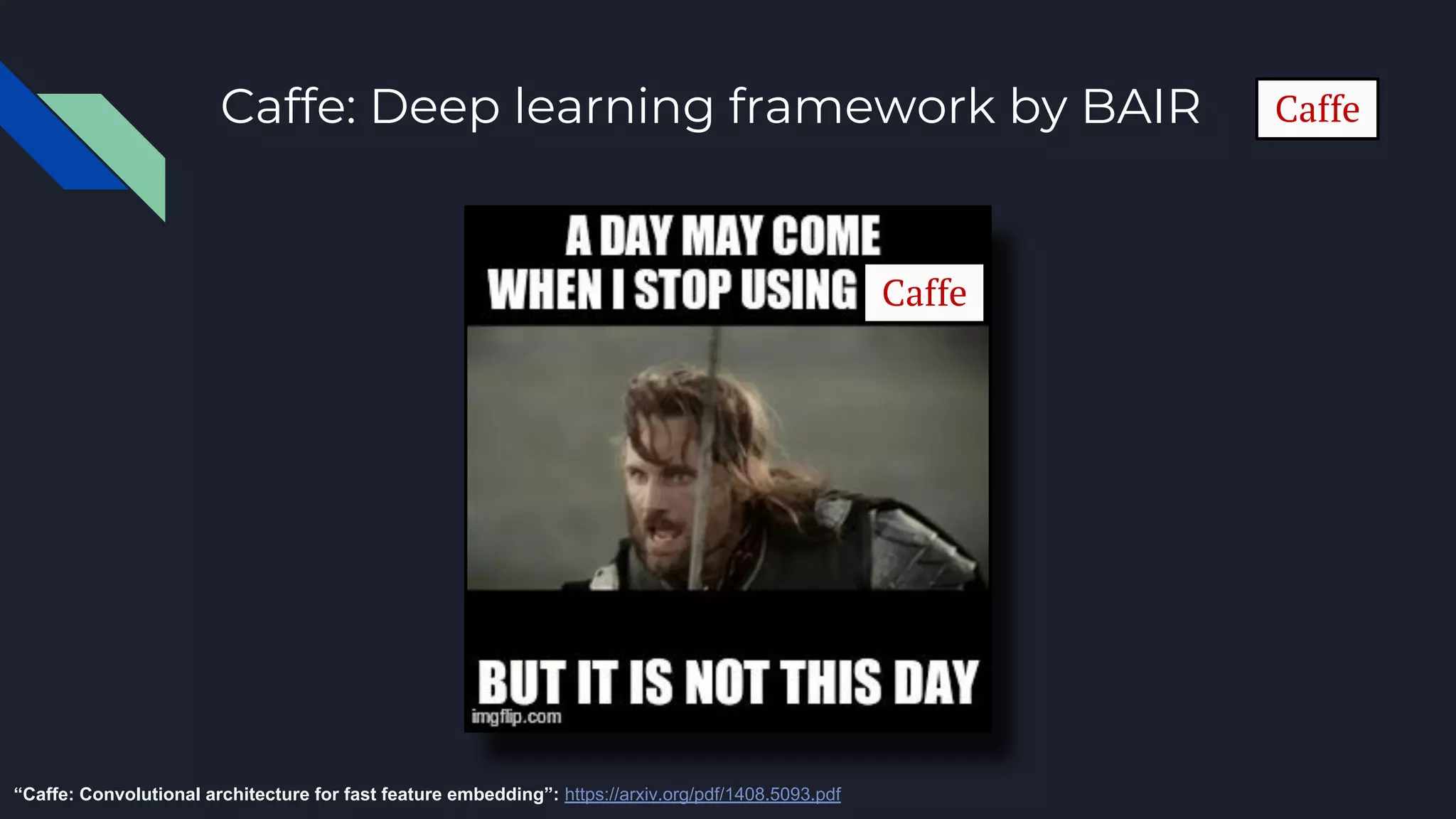
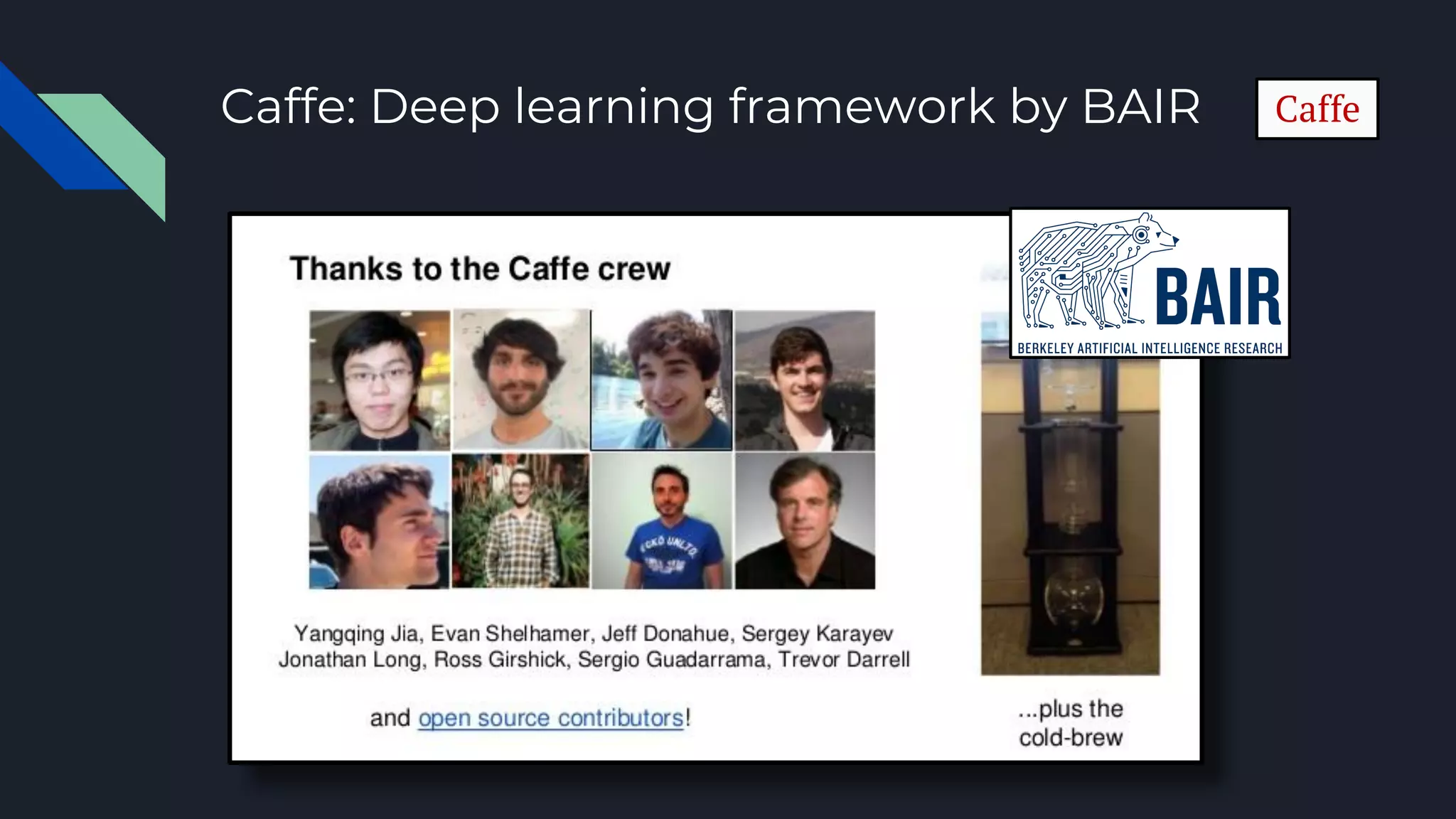
Caffe: Deep learning framework by BAIR
“Caffe: Convolutional architecture for fast feature embedding”: https://arxiv.org/pdf/1408.5093.pdf
Caffe: Deep learning framework by BAIR
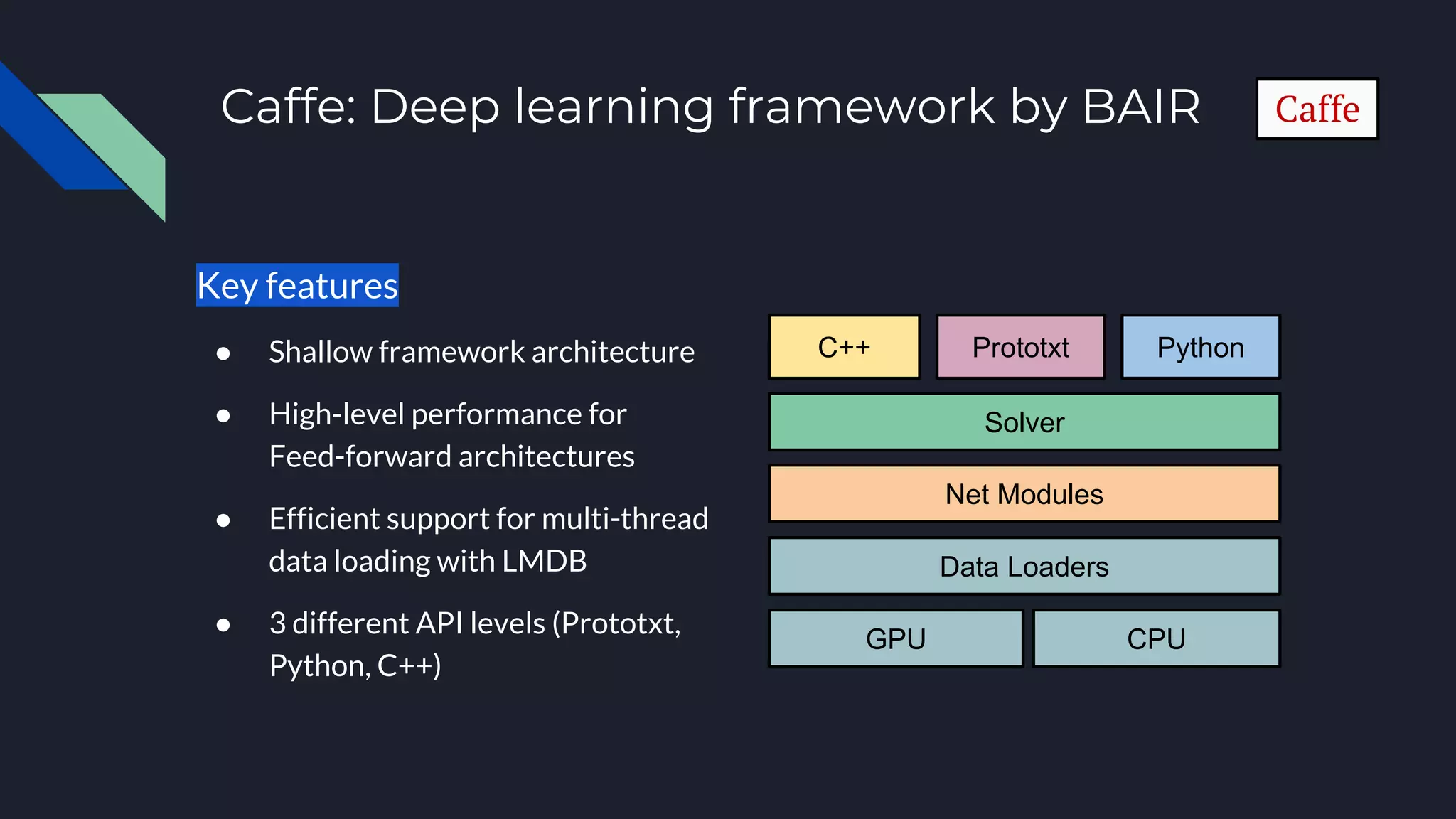
Key features
● Shallow framework architecture
● High-level performance for
Feed-forward architectures
● Efficient support for multi-thread
data loading with LMDB
● 3 different API levels (Prototxt,
Python, C++)
Data Loaders
Net Modules
Solver
C++ Prototxt Python
GPU CPU
Caffe: Deep learning framework by BAIR
[Hands-on (15 minutes)] Training a
ConvNet with Caffe
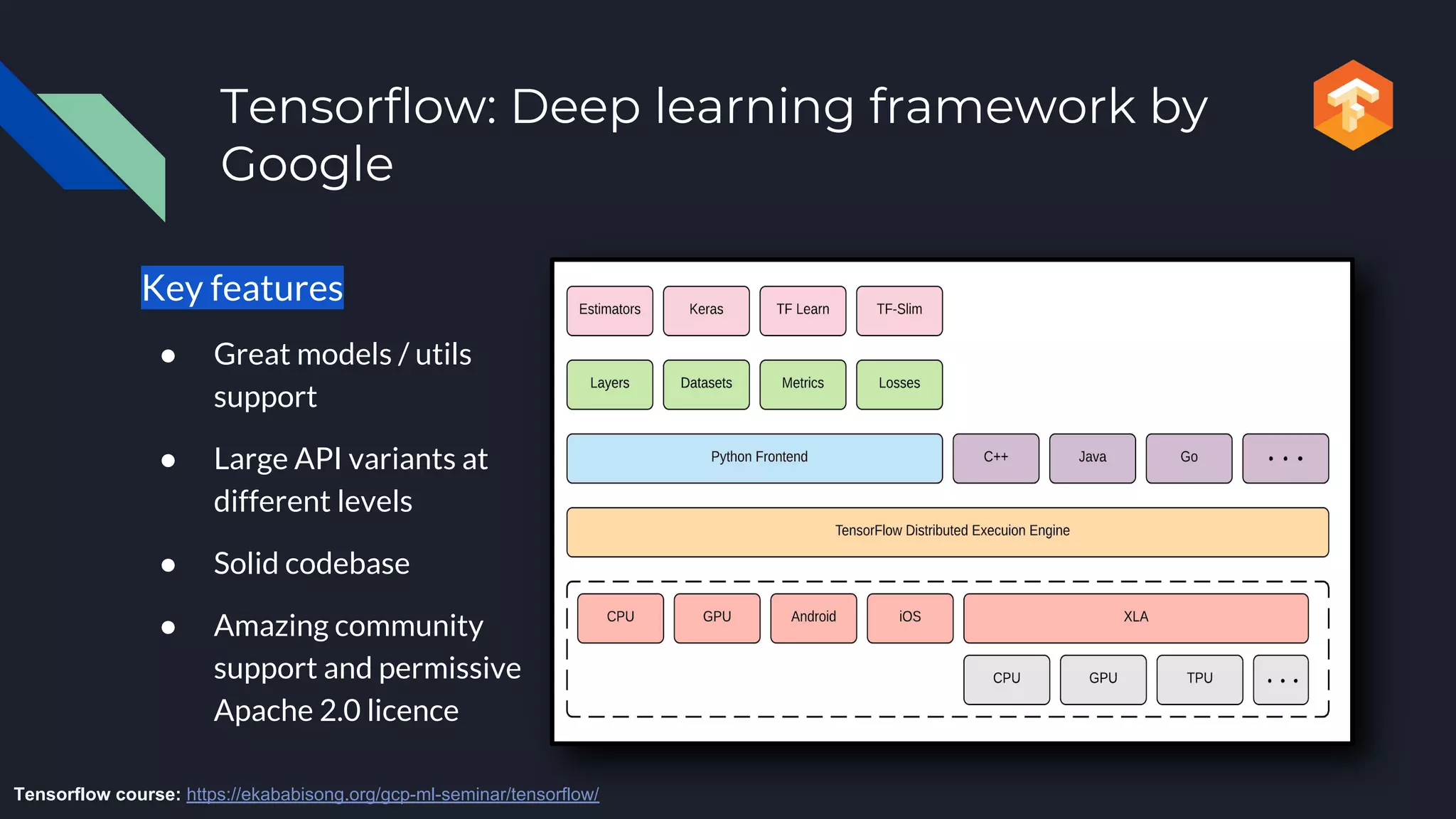
Tensorflow: Deep learning framework by
Google
“Tensorflow: a system for large-scale machine learning.”: https://www.usenix.org/system/files/conference/osdi16/osdi16-abadi.pdf
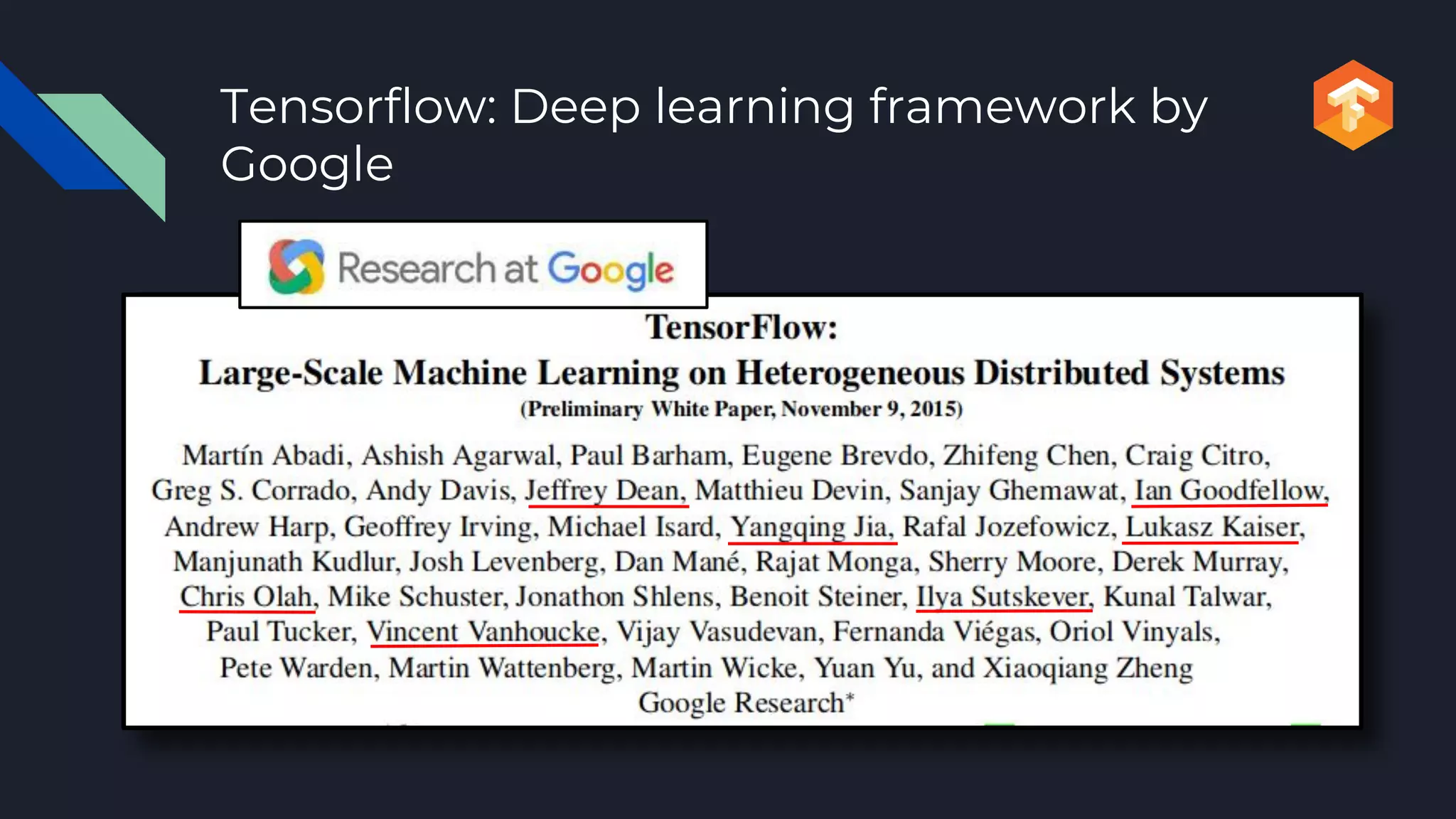
Tensorflow: Deep learning framework by
Google
Tensorflow: Deep learning framework by
Google
Key features
● Great models / utils
support
● Large API variants at
different levels
● Solid codebase
● Amazing community
support and permissive
Apache 2.0 licence
Tensorflow course: https://ekababisong.org/gcp-ml-seminar/tensorflow/
[Hands-on (15 minutes)] Training a
ConvNet with Tensorflow
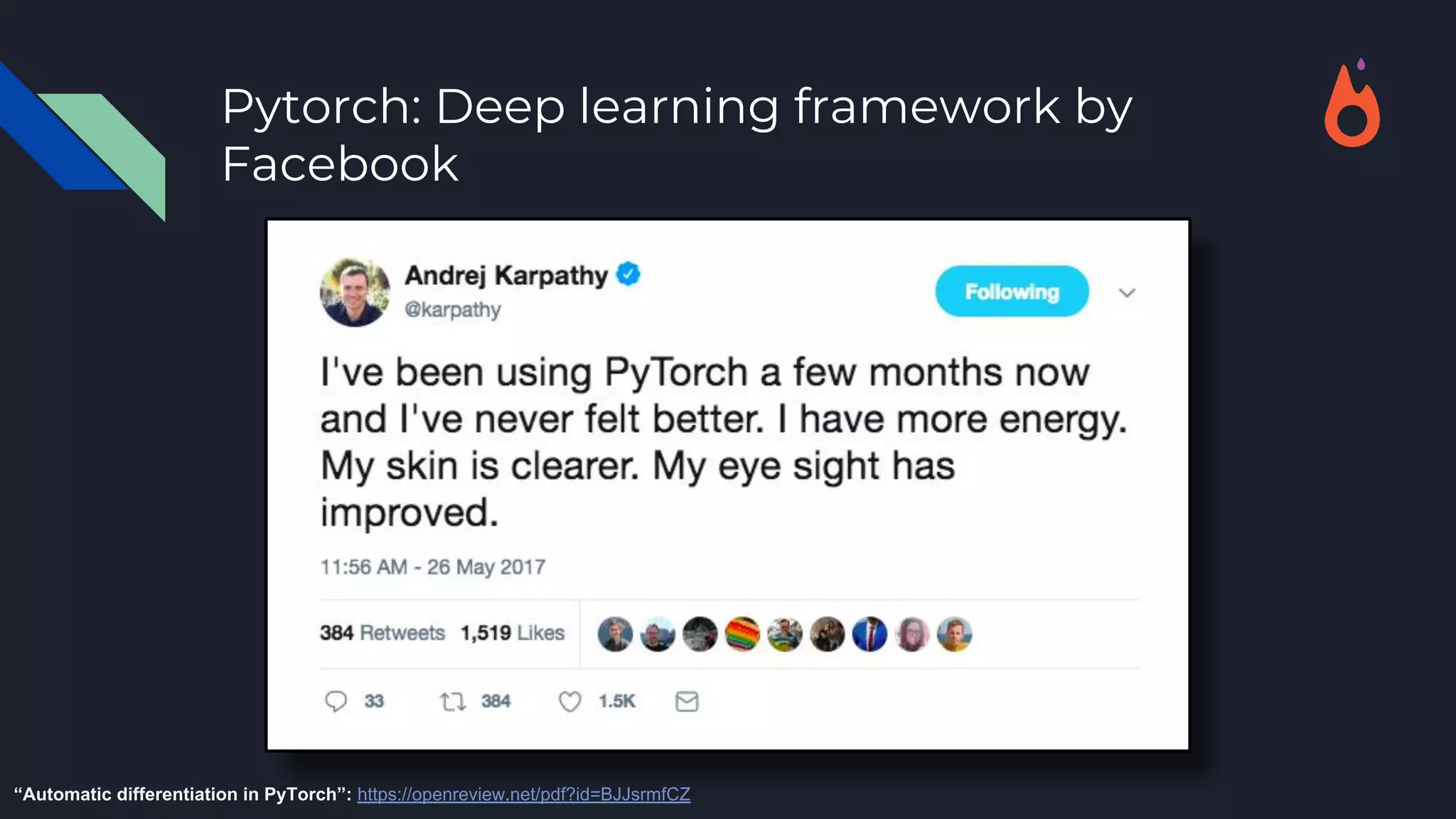
Pytorch: Deep learning framework by
Facebook
“Automatic differentiation in PyTorch”: https://openreview.net/pdf?id=BJJsrmfCZ
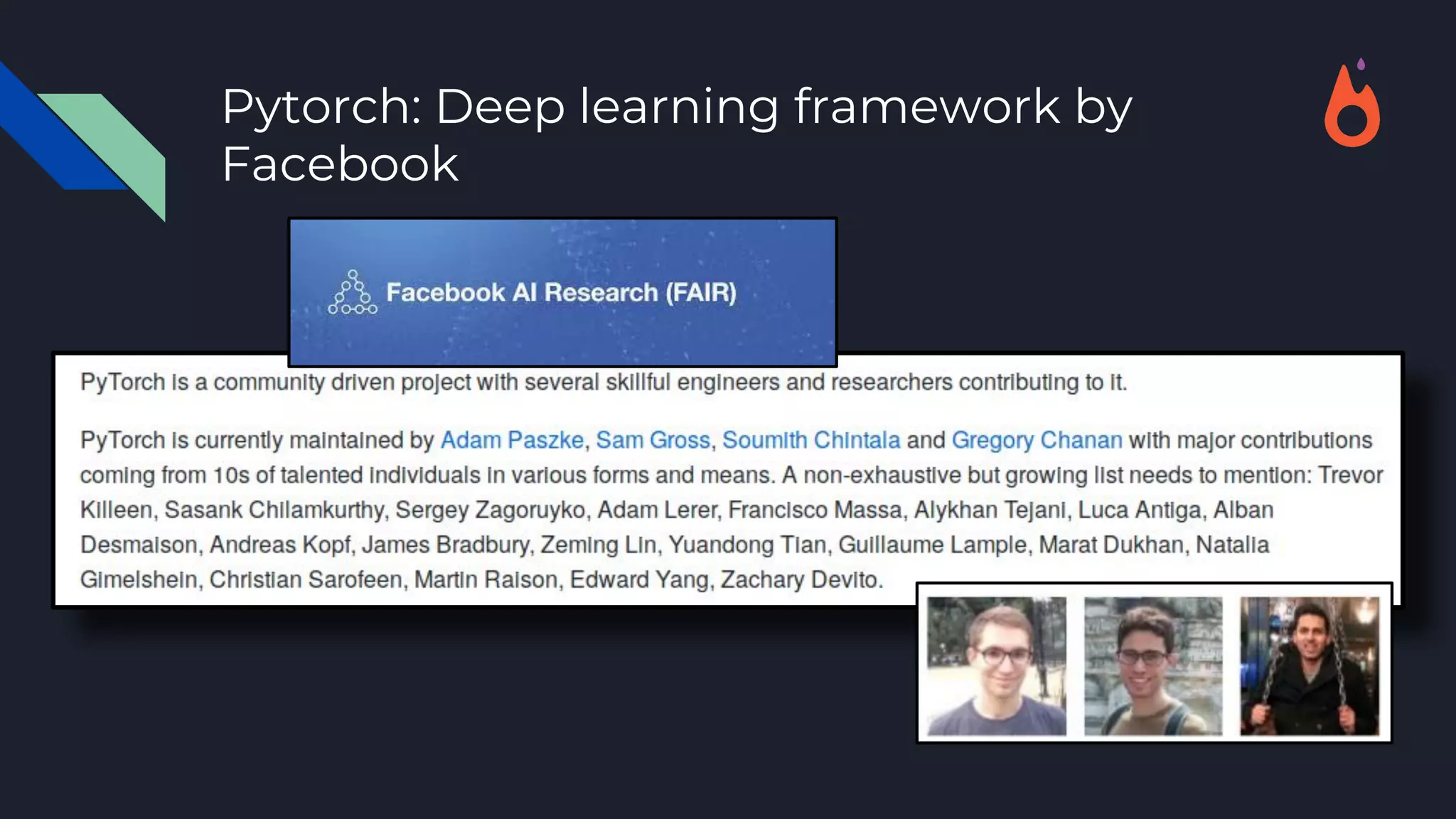
Pytorch: Deep learning framework by
Facebook
Pytorch: Deep learning framework by
Facebook
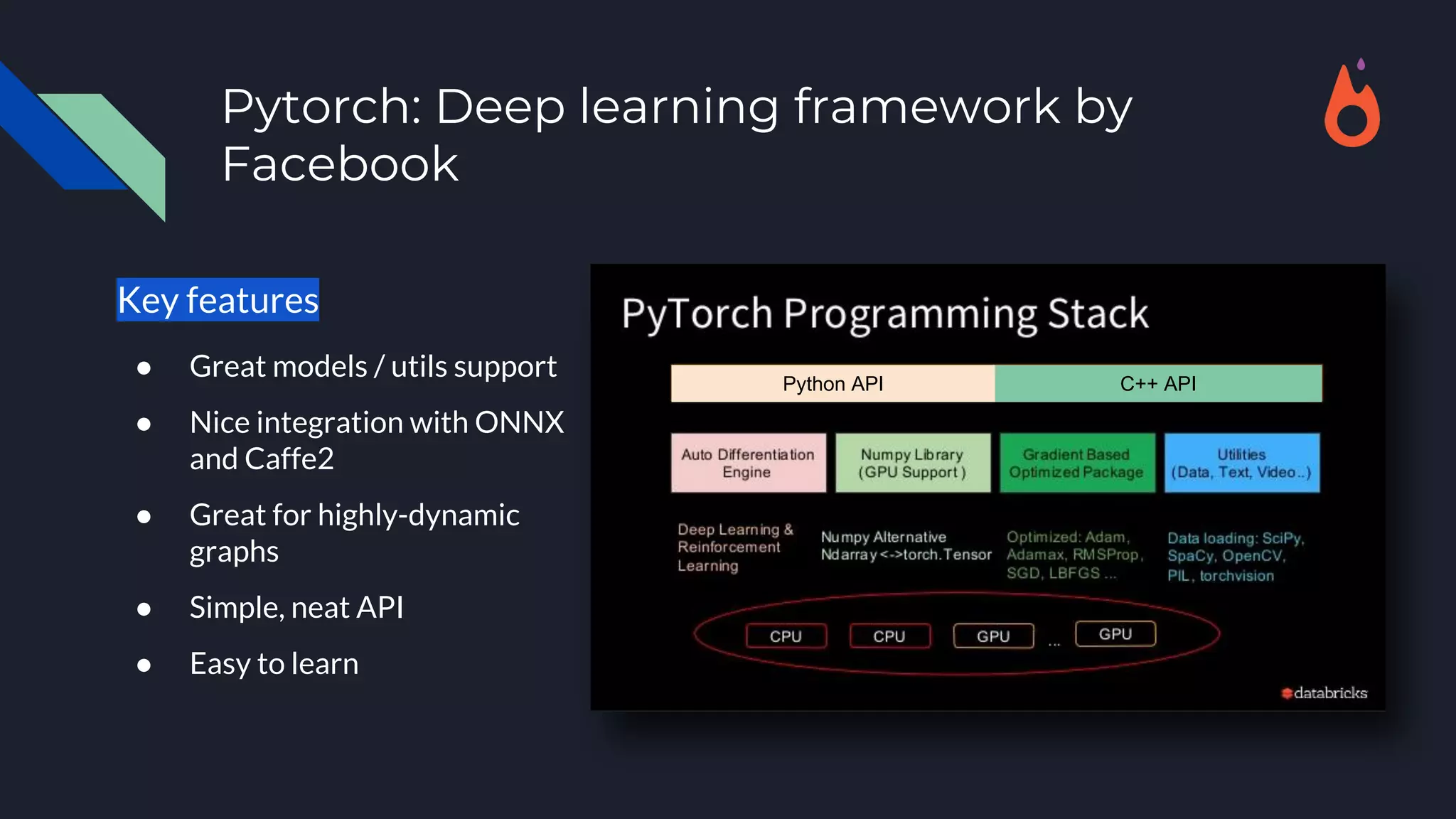
Key features
● Great models / utils support
● Nice integration with ONNX
and Caffe2
● Great for highly-dynamic
graphs
● Simple, neat API
● Easy to learn
Python API C++ API
[Hands-on (15 minutes)] Training a
ConvNet with Pytorch
Outline
1. Introduction
a. From Machine Learning to Deep Learning
b. History of Deep Learning Frameworks
2. Open-Source Deep Learning Frameworks
a. Main Features and Distinctions
b. Caffe, Tensorflow and Pytorch
3. Practical Advices
4. What next?
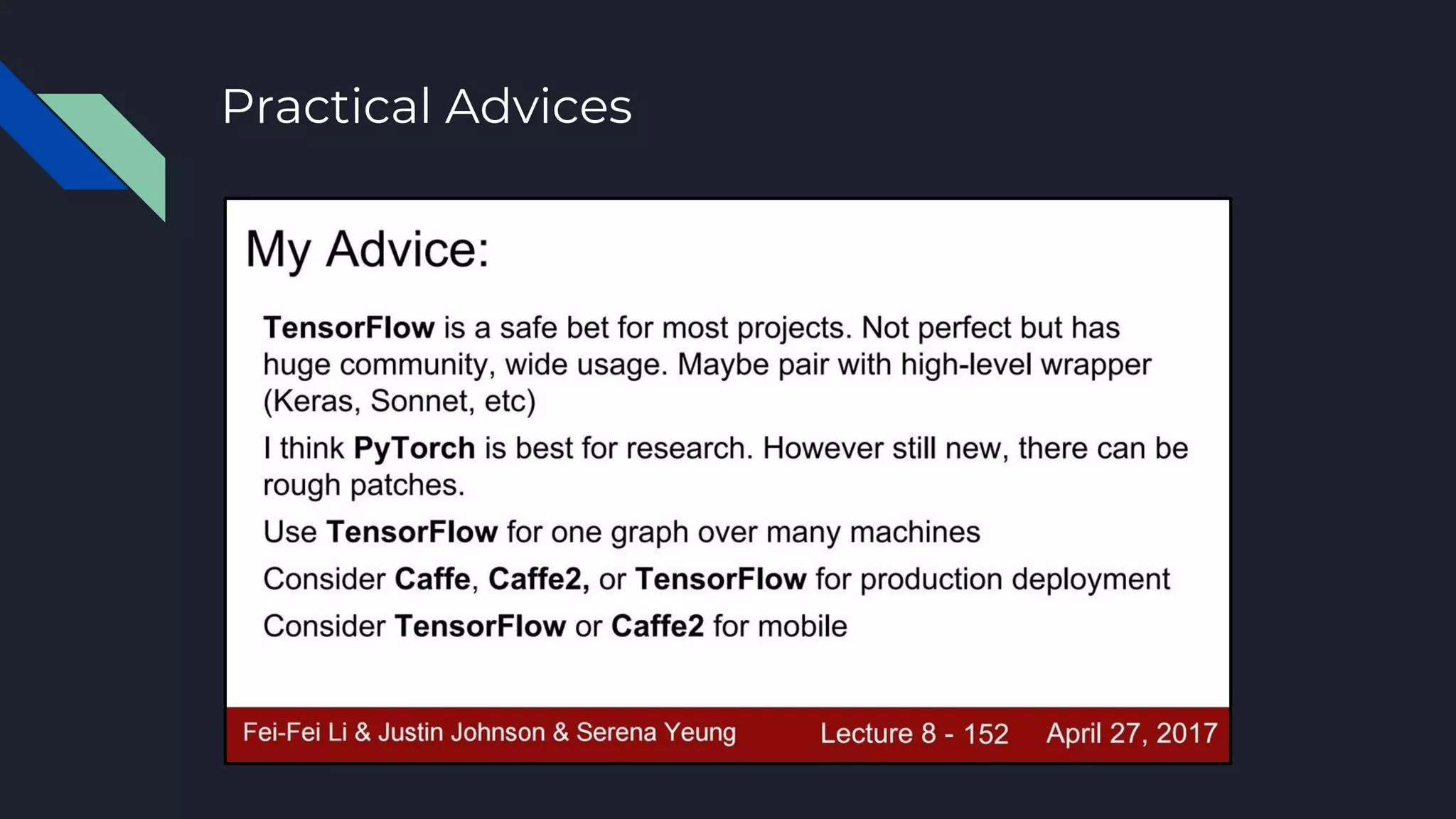
Practical Advices
Practical Advices
● Your don’t need to choose one framework for life
● Be flexible, understand the core and common
ideas
● On-the-run conversion may be painful!
● Choose the best depending on the task at hand
and the already existing resources
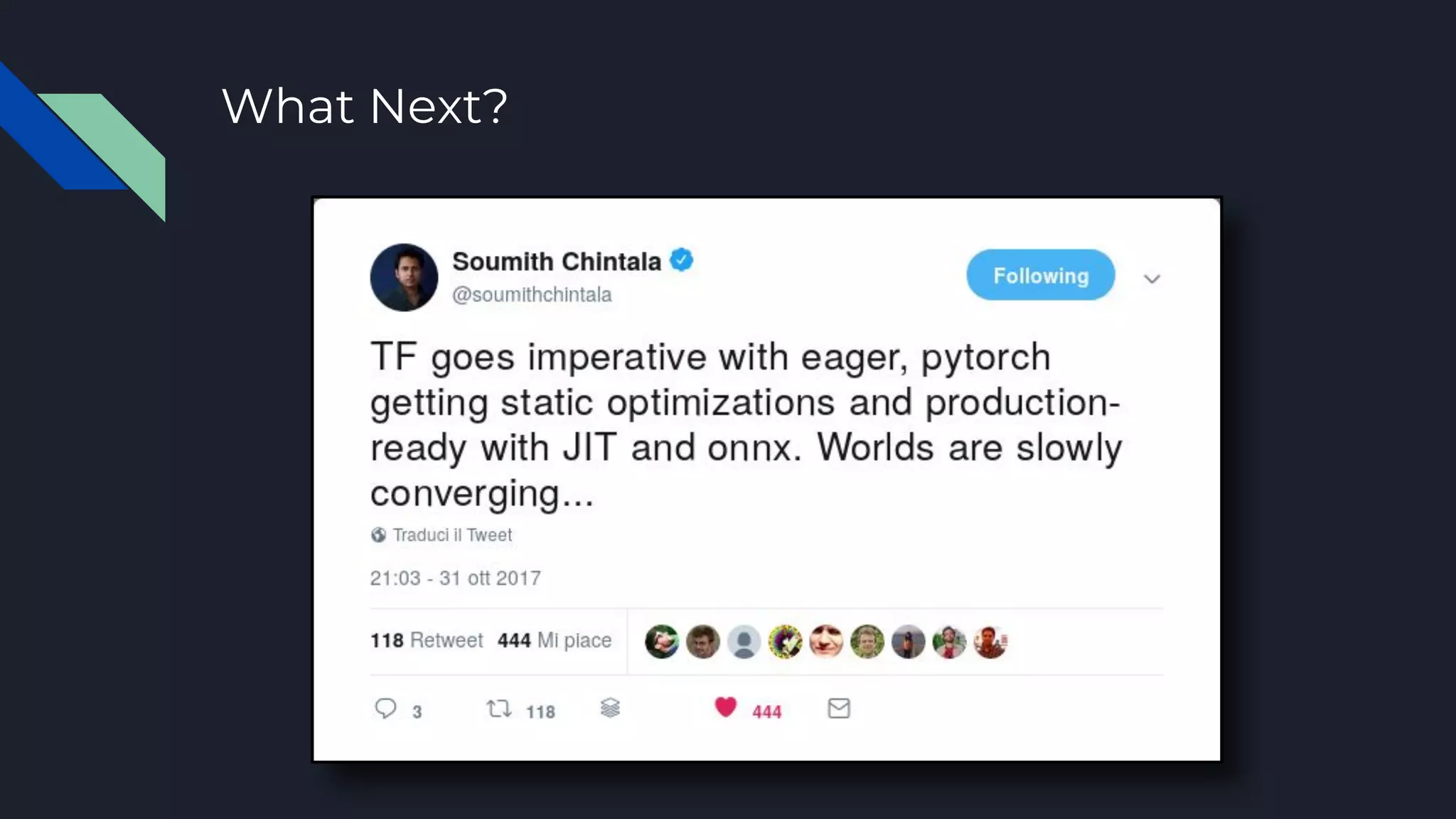
What Next?
Questions?
Vincenzo Lomonaco
University of Bologna ML Course - 2018
PhD Student @ University of Bologna
Founder of ContinualAI.org
vincenzolomonaco.com

Open-Source Frameworks for Deep Learning: an Overview

  • 1.
    Open-Source Frameworks for DeepLearning: an Overview Vincenzo Lomonaco University of Bologna ML Course - 2018 PhD Student @ University of Bologna Founder of ContinualAI.org vincenzolomonaco.com
  • 2.
    About Me • PhDStudent @ University of Bologna • Visiting Scholar @ ENSTA ParisTech and @ Purdue University • Phd Students’ Representative of the Department of Computer Science and Engineering • Teaching Assistant of the courses Machine Learning and Computer Architectures • Author and Technical reviewer of the online course Deep Learning with R and book R Deep Learning Essentials • Founder of Continual AI
  • 3.
    Continual AI Community http://continualai.orghttps://continualai.herokuapp.com
  • 4.
    Outline 1. Introduction a. FromMachine Learning to Deep Learning b. History of Deep Learning Frameworks 2. Open-Source Deep Learning Frameworks a. Main Features and Distinctions b. Caffe, Tensorflow and Pytorch 3. Practical Advices 4. What next?
  • 5.
    The Machine LearningSoftware Stack “Hidden Technical Debt in Machine Learning Systems” by D. Sculley et al.
  • 6.
    The Machine LearningSoftware Stack For Prototyping and R&D ● Scikit-learn (Python), Caret (R), Weka (Java) For Production ● Kubernetes, KubeFlow, Hadoop ● H2O, MLlib, SparkML, FlinkML Setting up a Machine Learning Framework for Production: http://code.hootsuite.com/setting-up-a-machine-learning-framework-for-production/
  • 7.
    From Machine Learningto Deep Learning For Deep Learning the line between Prototyping and Production is more blurred ● Caffe / Caffe 2 ● Torch / PyTorch ● Tensorflow ● CNTK, MxNet, Gluon, Chainer, etc.
  • 8.
    From Machine Learningto Deep Learning Why ● Prototyping with neural nets on massive datasets needs efficiency ● Limited focus on: 1. (Deep) Neural Networks. 2. Gradient-Based Optimization. 3. Transparent (multi) CPU/GPU acceleration
  • 9.
    History of DeepLearning Frameworks 2010 2013 2014 2015 2016 20182017 ...
  • 10.
    History of DeepLearning Frameworks
  • 11.
    History of DeepLearning Frameworks Andrej Karpathy, 10 mar 2018 : https://twitter.com/karpathy/status/972295865187512320/
  • 12.
    Deep Learning Frameworks:2018 Figures Deep Learning Framework Power Scores 2018 : https://towardsdatascience.com/deep-learning-framework-power-scores-2018-23607ddf297a/
  • 13.
    Deep Learning Frameworks:2018 Figures Deep Learning Framework Power Scores 2018 : https://towardsdatascience.com/deep-learning-framework-power-scores-2018-23607ddf297a/
  • 14.
    Outline 1. Introduction a. FromMachine Learning to Deep Learning b. History of Deep Learning Frameworks 2. Open-Source Deep Learning Frameworks a. Main Features and Distinctions b. Caffe, Tensorflow and Pytorch 3. Practical Advices 4. What next?
  • 15.
    Main Features andDistinctions 1. Static vs Dynamic Graph 2. Differentiation Support 3. Hardware / Platform Support 4. Model / Utils Support and Performance 5. Multi-CPU/GPU support 6. API level 7. License and Community Support Comparison of deep learning software: https://en.wikipedia.org/wiki/Comparison_of_deep_learning_software
  • 16.
    Static vs DynamicGraph Static (define-AND-run) Dynamic (define-BY-run)
  • 17.
    Differentiation Support Types ofDifferentiation 1. Numerical Differentiation 2. Symbolic Differentiation 3. Automatic Differentiation 4. Hard-coded Differentiation “Automatic Differentiation in Machine Learning: a Survey”: http://www.jmlr.org/papers/volume18/17-468/17-468.pdf
  • 18.
    Hardware / PlatformSupport Platform Support ● Windows, Unix (MAC OS, Linux) ● Android OS, iOS, Embedded Systems Hardware Acceleration ● Cuda / OpenCL Support ● OpenMP, MPI Support ● AI Chips
  • 19.
    Model / UtilsSupport and Performance Types of models supported ● FC-NNs, CNNs, RNNs, etc. ● General purpose algebraic functions Utils support ● Pre-trained models Zoo ● Data format and loading ● Monitoring / Visualization tools Performance ● Very different from task to task and model to model, etc.
  • 20.
    Multi-CPU / GPUsupport Types of parallelization ● Data Parallelism ● Model Parallelism Hardware for parallelization ● CPUs ● GPUs ● Distributed clusters “Large Scale Distributed Deep Networks”: http://papers.nips.cc/paper/4687-large-scale-distributed-deep-networks.pdf
  • 21.
    API Level Important features ●Usability ● Flexibility ● Expandability ● Easy to Debug
  • 22.
    License and CommunitySupport Licence ● Apache 2.0, MIT, BSD, GNU GPL, Freemium, etc. ● Most of them allow also commercial use (but look at patent licence too) Community Support ● Contribution Diversity ● Active Development ● Supportive Q&A ● Number of users
  • 23.
    Caffe, Tensorflow andPytorch ● Static Graph ● Hard-coded Differentiation ● Windows, Unix, Embedded ● Mainly Feedforward models ● Multi-CPU/GPUs ● Prototxt, C++, Python API ● BSD Licence ● Low community support ● Static Graph (with lazy eval) ● Automatic Differentiation ● Windows, Unix, Embedded ● General purpose graph ● Multi-CPU/GPUs ● C++ and (many) Python API ● Apache 2.0 ● High community support ● Dynamic Graph ● Automatic Differentiation ● Windows, Unix, Embedded ● General purpose graph ● Multi-CPU/GPUs ● C++ and Python API ● BSD Licence ● High community support
  • 24.
    Caffe: Deep learningframework by BAIR “Caffe: Convolutional architecture for fast feature embedding”: https://arxiv.org/pdf/1408.5093.pdf
  • 25.
    Caffe: Deep learningframework by BAIR Key features ● Shallow framework architecture ● High-level performance for Feed-forward architectures ● Efficient support for multi-thread data loading with LMDB ● 3 different API levels (Prototxt, Python, C++) Data Loaders Net Modules Solver C++ Prototxt Python GPU CPU
  • 26.
    Caffe: Deep learningframework by BAIR
  • 27.
    [Hands-on (15 minutes)]Training a ConvNet with Caffe
  • 28.
    Tensorflow: Deep learningframework by Google “Tensorflow: a system for large-scale machine learning.”: https://www.usenix.org/system/files/conference/osdi16/osdi16-abadi.pdf
  • 29.
    Tensorflow: Deep learningframework by Google
  • 30.
    Tensorflow: Deep learningframework by Google Key features ● Great models / utils support ● Large API variants at different levels ● Solid codebase ● Amazing community support and permissive Apache 2.0 licence Tensorflow course: https://ekababisong.org/gcp-ml-seminar/tensorflow/
  • 31.
    [Hands-on (15 minutes)]Training a ConvNet with Tensorflow
  • 32.
    Pytorch: Deep learningframework by Facebook “Automatic differentiation in PyTorch”: https://openreview.net/pdf?id=BJJsrmfCZ
  • 33.
    Pytorch: Deep learningframework by Facebook
  • 34.
    Pytorch: Deep learningframework by Facebook Key features ● Great models / utils support ● Nice integration with ONNX and Caffe2 ● Great for highly-dynamic graphs ● Simple, neat API ● Easy to learn Python API C++ API
  • 35.
    [Hands-on (15 minutes)]Training a ConvNet with Pytorch
  • 36.
    Outline 1. Introduction a. FromMachine Learning to Deep Learning b. History of Deep Learning Frameworks 2. Open-Source Deep Learning Frameworks a. Main Features and Distinctions b. Caffe, Tensorflow and Pytorch 3. Practical Advices 4. What next?
  • 37.
  • 38.
    Practical Advices ● Yourdon’t need to choose one framework for life ● Be flexible, understand the core and common ideas ● On-the-run conversion may be painful! ● Choose the best depending on the task at hand and the already existing resources
  • 39.
  • 40.
    Questions? Vincenzo Lomonaco University ofBologna ML Course - 2018 PhD Student @ University of Bologna Founder of ContinualAI.org vincenzolomonaco.com