WHAT ARE AUTISM SPECTRUM DISORDERS?


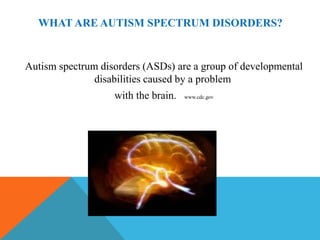
Autism spectrum disorders (ASDs) are a group of developmental
               disabilities caused by a problem
                   with the brain.   www.cdc.gov
WHAT CAUSES AUTISM?

Not long ago, the answer to this question would have been “we have no idea.”
Research is now delivering the answers. First and foremost, we now know that
there is no one cause of autism just as there is no one type of autism. Over the
last five years, scientists have identified a number of rare gene changes, or
mutations, associated with autism. A small number of these are sufficient to
cause autism by themselves. Most cases of autism, however, appear to be
caused by a combination of autism risk genes and environmental factors
influencing early brain development.
                                                             autismspeaks.org
IT IS A SPECTRUM DISORDER


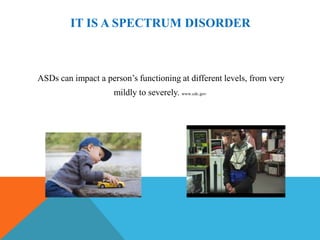
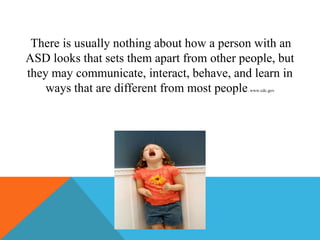
ASDs can impact a person’s functioning at different levels, from very
                     mildly to severely. www.cdc.gov
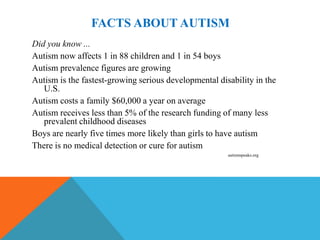
There is usually nothing about how a person with an
ASD looks that sets them apart from other people, but
they may communicate, interact, behave, and learn in
    ways that are different from most people
                                           . www.cdc.gov
FACTS ABOUT AUTISM
Did you know ...
Autism now affects 1 in 88 children and 1 in 54 boys
Autism prevalence figures are growing
Autism is the fastest-growing serious developmental disability in the
   U.S.
Autism costs a family $60,000 a year on average
Autism receives less than 5% of the research funding of many less
   prevalent childhood diseases
Boys are nearly five times more likely than girls to have autism
There is no medical detection or cure for autism
                                                       autismspeaks.org
COGNITIVE DIFFERENCES
The thinking and learning abilities of people with ASDs can vary – from gifted to severely challenged.


                       Focus on details-unable to see the whole picture or how
                                           things fit together


                      Difficulty integrating information, extracting information
                                  and distinguishing what is relevant


                        Have difficulty generalizing skills to different settings


                          Strong visual learners- eyes work better than ears


                                     Trouble understanding time


                           Slow processing time/don’t like to ask for help


                                                                           “Autism is an extremely variable disorder.”
                                                                                                     -Temple Grandin
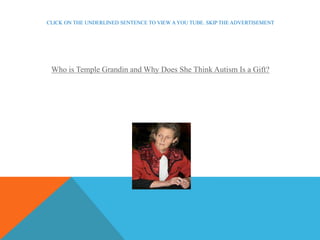
CLICK ON THE UNDERLINED SENTENCE TO VIEW A YOU TUBE. SKIP THE ADVERTISEMENT


 Who is Temple Grandin and Why Does She Think Autism Is a Gift?
CHALLENGES IN COMMUNICATION
*Challenges in repairing communication breakdowns
*Persistence in talking about area of interest
*Misunderstandings and misuse of body language and non-
  verbal communication
*Language difficulties may contribute to behavioral
  problems due to frustration
*Communication abilities may not be commensurate with
  peers                    Northwest Regional Education Service District
MORE CHALLENGES IN COMMUNICATION
*Often will not understand attempts at humor or sarcasm
*May inadvertently offend those around them
*Peers may be put off by a student who dominates conversations about his or
   her topic of interest
*Children may have challenges in engaging students with ASD in play that
   involves imagination and role play
*May not consistently greet or acknowledge others' attempts to get their
   attention
                                         Northwest Regional Education Service District


                             “You simply cannot tell other people they are
                              stupid-even if they really are stupid.”
                                                                           Temple Grandin
CHALLENGES WITH SOCIAL INTERACTIONS
*May select playmates who are younger than themselves
*Often will wander around playground at recess or sit alone during
   lunch and breaks
*May have little or no friends and/or may not be able to truly define
   what a friend is
*Personal appearance and hygiene may be neglected if unmotivated
   by social pressure to smell or look nice
*May violate others’ personal space
*May not understand that their strict adherence to rules and/or
   tattling, may alienate them from their peers
*May be easily taken advantage of by others
                                           Northwest Regional Education Service District
MORE CHALLENGES WITH SOCIAL INTERACTIONS

*Often will not understand attempts at humor or sarcasm
*May inadvertently offend those around them
*Peers may be put off by a student who dominates conversations about his
   or her topic of interest
*Children may have challenges in engaging students with ASD in play that
   involves imagination and role play
*May not consistently greet or acknowledge others' attempts to get their
   attention
                                                   Northwest Regional Education Service District


                         “You simply cannot tell other people they are stupid-even if they really
                                    are stupid.”                                      -Temple Grandin
CHALLENGES WITH RESTRICTIVE PATTERNS OF BEHAVIOR


*Engagement in stereotypic movements may appear
  disruptive or confusing to peers and may alienate student
*Due to general naiveté, may be “put up” to engaging in
  negative behavior by peers
*May be viewed as a “tattle tale” or “school policeman”
  due to desire for strict adherence to rules
                                    Northwest Regional Education Service District
MORE CHALLENGES WITH RESTRICTIVE PATTERNS
                 OF BEHAVIOR

*Special interests may not be age appropriate or those of their peers
*May isolate themselves by not wanting to discuss or interact about
   topics outside their areas of interest
*Often will show more interest in objects than peers
*May be viewed as a “little professor” by peers due to their above
   average abilities in some areas
                                             Northwest Regional Education Service District


                                            “The autistic mind sees all. I think in pictures
                                                                            -Temple Grandin
CHALLENGES WITH SENSORY DIFFERENCES
*May avoid social opportunities, such as dances or assemblies,
   due to being overwhelmed by the sensory stimulation
   associated with them
*May “tune out” communication bids from peers
*Dislike of grooming and personal care tasks may result in
   appearances and/or smells that are not appealing to others
*Interest in seeking sensory input may cause student with ASD
   to invade peers’ personal space
                                        Northwest Regional Education Service District
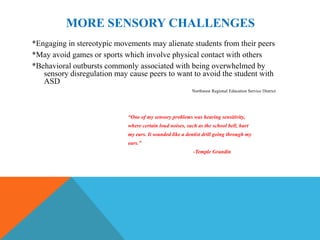
MORE SENSORY CHALLENGES
*Engaging in stereotypic movements may alienate students from their peers
*May avoid games or sports which involve physical contact with others
*Behavioral outbursts commonly associated with being overwhelmed by
   sensory disregulation may cause peers to want to avoid the student with
   ASD
                                                          Northwest Regional Education Service District


                             “One of my sensory problems was hearing sensitivity,
                             where certain loud noises, such as the school bell, hurt
                             my ears. It sounded like a dentist drill going through my
                             ears.”
                                                           -Temple Grandin
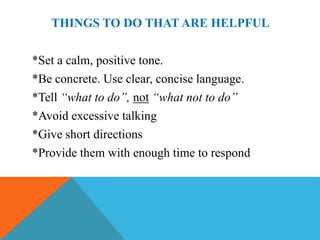
THINGS TO DO THAT ARE HELPFUL

*Set a calm, positive tone.
*Be concrete. Use clear, concise language.
*Tell “what to do”, not “what not to do”
*Avoid excessive talking
*Give short directions
*Provide them with enough time to respond
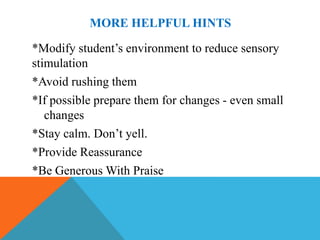
MORE HELPFUL HINTS

*Modify student’s environment to reduce sensory
stimulation
*Avoid rushing them
*If possible prepare them for changes - even small
   changes
*Stay calm. Don’t yell.
*Provide Reassurance
*Be Generous With Praise

Autism training module

  • 2.
    WHAT ARE AUTISMSPECTRUM DISORDERS? Autism spectrum disorders (ASDs) are a group of developmental disabilities caused by a problem with the brain. www.cdc.gov
  • 3.
    WHAT CAUSES AUTISM? Notlong ago, the answer to this question would have been “we have no idea.” Research is now delivering the answers. First and foremost, we now know that there is no one cause of autism just as there is no one type of autism. Over the last five years, scientists have identified a number of rare gene changes, or mutations, associated with autism. A small number of these are sufficient to cause autism by themselves. Most cases of autism, however, appear to be caused by a combination of autism risk genes and environmental factors influencing early brain development. autismspeaks.org
  • 4.
    IT IS ASPECTRUM DISORDER ASDs can impact a person’s functioning at different levels, from very mildly to severely. www.cdc.gov
  • 5.
    There is usuallynothing about how a person with an ASD looks that sets them apart from other people, but they may communicate, interact, behave, and learn in ways that are different from most people . www.cdc.gov
  • 6.
    FACTS ABOUT AUTISM Didyou know ... Autism now affects 1 in 88 children and 1 in 54 boys Autism prevalence figures are growing Autism is the fastest-growing serious developmental disability in the U.S. Autism costs a family $60,000 a year on average Autism receives less than 5% of the research funding of many less prevalent childhood diseases Boys are nearly five times more likely than girls to have autism There is no medical detection or cure for autism autismspeaks.org
  • 7.
    COGNITIVE DIFFERENCES The thinkingand learning abilities of people with ASDs can vary – from gifted to severely challenged. Focus on details-unable to see the whole picture or how things fit together Difficulty integrating information, extracting information and distinguishing what is relevant Have difficulty generalizing skills to different settings Strong visual learners- eyes work better than ears Trouble understanding time Slow processing time/don’t like to ask for help “Autism is an extremely variable disorder.” -Temple Grandin
  • 8.
    CLICK ON THEUNDERLINED SENTENCE TO VIEW A YOU TUBE. SKIP THE ADVERTISEMENT Who is Temple Grandin and Why Does She Think Autism Is a Gift?
  • 9.
    CHALLENGES IN COMMUNICATION *Challengesin repairing communication breakdowns *Persistence in talking about area of interest *Misunderstandings and misuse of body language and non- verbal communication *Language difficulties may contribute to behavioral problems due to frustration *Communication abilities may not be commensurate with peers Northwest Regional Education Service District
  • 10.
    MORE CHALLENGES INCOMMUNICATION *Often will not understand attempts at humor or sarcasm *May inadvertently offend those around them *Peers may be put off by a student who dominates conversations about his or her topic of interest *Children may have challenges in engaging students with ASD in play that involves imagination and role play *May not consistently greet or acknowledge others' attempts to get their attention Northwest Regional Education Service District “You simply cannot tell other people they are stupid-even if they really are stupid.” Temple Grandin
  • 11.
    CHALLENGES WITH SOCIALINTERACTIONS *May select playmates who are younger than themselves *Often will wander around playground at recess or sit alone during lunch and breaks *May have little or no friends and/or may not be able to truly define what a friend is *Personal appearance and hygiene may be neglected if unmotivated by social pressure to smell or look nice *May violate others’ personal space *May not understand that their strict adherence to rules and/or tattling, may alienate them from their peers *May be easily taken advantage of by others Northwest Regional Education Service District
  • 12.
    MORE CHALLENGES WITHSOCIAL INTERACTIONS *Often will not understand attempts at humor or sarcasm *May inadvertently offend those around them *Peers may be put off by a student who dominates conversations about his or her topic of interest *Children may have challenges in engaging students with ASD in play that involves imagination and role play *May not consistently greet or acknowledge others' attempts to get their attention Northwest Regional Education Service District “You simply cannot tell other people they are stupid-even if they really are stupid.” -Temple Grandin
  • 13.
    CHALLENGES WITH RESTRICTIVEPATTERNS OF BEHAVIOR *Engagement in stereotypic movements may appear disruptive or confusing to peers and may alienate student *Due to general naiveté, may be “put up” to engaging in negative behavior by peers *May be viewed as a “tattle tale” or “school policeman” due to desire for strict adherence to rules Northwest Regional Education Service District
  • 14.
    MORE CHALLENGES WITHRESTRICTIVE PATTERNS OF BEHAVIOR *Special interests may not be age appropriate or those of their peers *May isolate themselves by not wanting to discuss or interact about topics outside their areas of interest *Often will show more interest in objects than peers *May be viewed as a “little professor” by peers due to their above average abilities in some areas Northwest Regional Education Service District “The autistic mind sees all. I think in pictures -Temple Grandin
  • 15.
    CHALLENGES WITH SENSORYDIFFERENCES *May avoid social opportunities, such as dances or assemblies, due to being overwhelmed by the sensory stimulation associated with them *May “tune out” communication bids from peers *Dislike of grooming and personal care tasks may result in appearances and/or smells that are not appealing to others *Interest in seeking sensory input may cause student with ASD to invade peers’ personal space Northwest Regional Education Service District
  • 16.
    MORE SENSORY CHALLENGES *Engagingin stereotypic movements may alienate students from their peers *May avoid games or sports which involve physical contact with others *Behavioral outbursts commonly associated with being overwhelmed by sensory disregulation may cause peers to want to avoid the student with ASD Northwest Regional Education Service District “One of my sensory problems was hearing sensitivity, where certain loud noises, such as the school bell, hurt my ears. It sounded like a dentist drill going through my ears.” -Temple Grandin
  • 17.
    THINGS TO DOTHAT ARE HELPFUL *Set a calm, positive tone. *Be concrete. Use clear, concise language. *Tell “what to do”, not “what not to do” *Avoid excessive talking *Give short directions *Provide them with enough time to respond
  • 18.
    MORE HELPFUL HINTS *Modifystudent’s environment to reduce sensory stimulation *Avoid rushing them *If possible prepare them for changes - even small changes *Stay calm. Don’t yell. *Provide Reassurance *Be Generous With Praise