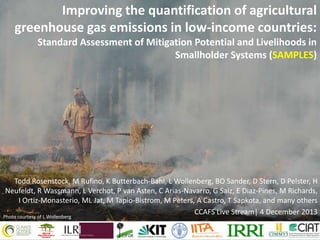
Improving the quantification of agricultural
greenhouse gas emissions in low-income countries:
Standard Assessment of Mitigation Potential and Livelihoods in
Smallholder Systems (SAMPLES)

Todd Rosenstock, M Rufino, K Butterbach-Bahl, L Wollenberg, BO Sander, D Stern, D Pelster, H
Neufeldt, R Wassmann, L Verchot, P van Asten, C Arias-Navarro, G Saiz, E Diaz-Pines, M Richards,
I Ortiz-Monasterio, ML Jat, M Tapio-Bistrom, M Peters, A Castro, T Sapkota, and many others
CCAFS Live Stream| 4 December 2013

Photo courtesy of L Wollenberg
Role of
Agriculture

Ocean
acidification

Nitrogen
cycle

Planetary
Boundaries

Climate
change
Phosphorous
cycle

Current
status

Biodiversity
loss

Global
freshwater use

Change in land use

Rockström et al. (2009);
Bennett et al. (in prep.)
Slide courtesy of B. Campbell
Sustainable natural
resource
management

Agricultural production

Courtesy: van Noordwijk unpublished
Suggestive mitigation potential of agricultural practices

Smith et al. 2008
But what do we really know about the impact of smallholders on
greenhouse gas emissions and removals in developing countries?

Virtually no data
+ = field
= lab-based

Studies of N2O emissions from managed soils in SSA

Hickman et al. in prep
Estimates based on data and models from other location
can provide erroneous estimates of sources and sinks
15

Local equation:
Our Equation

Brown, 1997

AGB (Mg)

12

Chave et al. 2005
Henry et al. 2009

As much as a 13%
underestimation of
biomass

9
6
3

0
0

30

60

90

120

dbh (cm)
Kuyah et al. 2012 Ag, Eco & Env.; Kuyah and Rosenstock in review
Predicting emissions for smallholder cropping
systems with available tools

800

Predicted CO2e kg/ha

Predicted by Cool Farm Tool
(CO2e kg ha-1 season-1)

1000

600

Maize Zimbabwe
400
Maize China
Maize Tanzania
200
Tea Kenya
Vegetables Kenya or Tanzania
0
0

200

400

600

800

1,000

Measured CO2e kg/ha

Measured (CO2e kg ha-1 season-1)

Richards et al. in prep
There is no data, so what…
• Calibrating to LED
• Emerging green economy
• Weakens position at global climate talk

Low-emissions
development

The green economy Global negotiations
White = livelihoods
Red = mitigation

The challenge

Cash crop
N2O
Feed
crop

Fuel
C sequestration
Pasture

Food/cash
CH4
C sequestration

Kaptumo, Kenya
Activities
Measurement
guidelines

Mapping propoor mitigation
opportunities

Capacity
development

Integrated
assessment of
farming systems
Not all greenhouse gas numbers are
equally credible
Rochette and Eriksen-Hamil 2008

60% of 360 studies of N2O emissions were inadequately reported to have
confidence in results
Development of new context specific methods
Research constraints

Spatial heterogeneity
Small-scale spatial heterogeneity

Analytical capacity

Arias-Navarro et al. 2013 SBB
Development of new context specific methods
Research constraints

Spatial heterogeneity
Small-scale spatial heterogeneity

Analytical capacity in the lab

Arias-Navarro et al. 2013 SBB
Good agreement between pooled sample
and average flux

Arias-Navarro et al. 2013 SBB
Methodological innovations
Smallholder centric
GHG impacts linked to productivity
Multi-scale
Cost differentiated

Region/
Continent

Landscape/
Watershed

Rosenstock et al. 2013 ERL

Farm
SocioBiophysical economic

A layered approach to identifying agricultural
hotspots

-Enabling policy env.
-Population density

-Wealth
-Management practices
-Farming systems
-Soils
-Climate
Capacity building: institutional and scientific

NARS

Short courses

Universities

MS and PhDs
Climate, Food, and Farming Network (CLIFF)

2012

2013
Recent clearing
Woody fallow

Agroforestry
species

Maize

Quantifying landscape emissions

Cassava
Deconstructing complex landscapes and farms
Complex landscape: f (m, n, o, p, q)
GIS
analysis, re
mote
sensing

Physical
environment

Food
security, pov
erty levels

Land
Livestock
Other assets
Sources of
incomes

Productivity,
GHG
emissions, cr
op
preferences

Characterise
fertility x
management

m Landscape units

n Farm types

p Farming
activities

o Common lands

q Land types
Landscape units and land users in Nyando, Kenya
Target locations for quantification
Quantification methods
Biomass
carbon

Livelihoods

Enteric fermention

Soil emissions

Soil carbon
Tradeoff analysis of multiple criteria
Identifying mitigation options

Alternate wetting and drying
CH4 reduction 43%. Sander et al. in press
Social constraints to water differs among farmers
1) Canal irrigation (upstream, low area, Bulacan 1)
 Should always have sufficient water
2) NIA-operated water pump (high-lying area, Bulacan 2)
 Pumps water 24/7 to higher area, electr. fee
3) Community owned water pump (Tarlac)
 Farmer buys diesel for usage of pump
4) Imposed AWD (canal end, Nueva Ecija)
 Water is supplied every other week

Sander and Wassmann ongoing
Cumulative methane emissions in 2013 in
Philippine farmer fields
8

Bulacan 1 -66%
5.3

6
4

1.8

2

7.8

6
4

1.8

2

10

AWD

Tarlac

-70%

8

3.7

4

1.1

2
0

CF

10

t CO2-eq/ha*season

CF

t CO2-eq/ha*season

8

0

0

6

Bulacan 2 -77%

10
t CO2-eq/ha*season

t CO2-eq/ha*season

10

AWD

NE -65%

8.6

8
6

3.0

4
2
0

CF

AWD

CF

AWD

Sander and Wassmann ongoing
Alternate wetting and drying yields equal to
those of continuous flooding in 2013

grain yield (t/ha)

10
*

9
8
7
6
5
4

3
2
1
0
CF AWD
Bulacan 1

CF AWD
Bulacan 2

CF AWD
Tarlac

CF AWD
Nueva Ecija

Sander and Wassmann ongoing
The efforts result in quantitative mitigation options
Measures being investigated
at various SAMPLES sites

Income & food
security

Mitigation of GHGs
CO2

CH4

N 2O

+/-

+

+

Improved diets

+

Water management

+

+

+

Manure management

+

+

+/-

Conservation agriculture
Improved cookstoves
Aforestation

+
From ‘+’s to
+
quantities and
+/+/ranges +/+

+
+/+/-

Nutrient management

+

+

+/-

Agroforestry

+

+

+/-
Activities
Measurement
guidelines

Consistent and
comparable data

Mapping propoor mitigation
opportunities

Capacity
development

Priorities for
research and
development

Human and
institutional
infrastructure

Outcomes

Integrated
assessment of
farming systems

Socially
acceptable,
place-based
solutions
Activities
Linking knowledge with action
Field-level
development
activities

Increased use of
LED solutions

National process

NAMAs

Evidence-based
climate change
planning

Design of land
based programs
Select examples of the SAMPLES 2014 research network
Nutrient management of
maize (CIMMYT)

Farm-level intensification
and avoided deforestation
(ICRAF)

Nutrient and residue
management/ rice and
wheat (CIMMYT)

Water
management/
rice (IRRI)
Silvopastoral systems
(CIAT)

Wetlands and perennial crop
management (IITA, ILRI)

Agroforestry, nutrient
management, landscapes
(ILRI, ICRAF, CIFOR)

10 countries
15 sites
Thank you
Standard Assessment of Mitigation Potential and Livelihoods in Smallholder Systems

Funding provided by:
CCAFS, Environment Canada, Gov’t of Finland, USAID, Bayer
CropScience, ICAR, BMBF, DAAD, CLIFF

t.rosenstock@cgiar.org

Improving the quantification of agriculture emissions in low-income countries by DR. Todd Rosenstock

  • 1.
    Improving the quantificationof agricultural greenhouse gas emissions in low-income countries: Standard Assessment of Mitigation Potential and Livelihoods in Smallholder Systems (SAMPLES) Todd Rosenstock, M Rufino, K Butterbach-Bahl, L Wollenberg, BO Sander, D Stern, D Pelster, H Neufeldt, R Wassmann, L Verchot, P van Asten, C Arias-Navarro, G Saiz, E Diaz-Pines, M Richards, I Ortiz-Monasterio, ML Jat, M Tapio-Bistrom, M Peters, A Castro, T Sapkota, and many others CCAFS Live Stream| 4 December 2013 Photo courtesy of L Wollenberg
  • 2.
  • 3.
  • 4.
    Suggestive mitigation potentialof agricultural practices Smith et al. 2008
  • 5.
    But what dowe really know about the impact of smallholders on greenhouse gas emissions and removals in developing countries? Virtually no data + = field = lab-based Studies of N2O emissions from managed soils in SSA Hickman et al. in prep
  • 6.
    Estimates based ondata and models from other location can provide erroneous estimates of sources and sinks 15 Local equation: Our Equation Brown, 1997 AGB (Mg) 12 Chave et al. 2005 Henry et al. 2009 As much as a 13% underestimation of biomass 9 6 3 0 0 30 60 90 120 dbh (cm) Kuyah et al. 2012 Ag, Eco & Env.; Kuyah and Rosenstock in review
  • 7.
    Predicting emissions forsmallholder cropping systems with available tools 800 Predicted CO2e kg/ha Predicted by Cool Farm Tool (CO2e kg ha-1 season-1) 1000 600 Maize Zimbabwe 400 Maize China Maize Tanzania 200 Tea Kenya Vegetables Kenya or Tanzania 0 0 200 400 600 800 1,000 Measured CO2e kg/ha Measured (CO2e kg ha-1 season-1) Richards et al. in prep
  • 8.
    There is nodata, so what… • Calibrating to LED • Emerging green economy • Weakens position at global climate talk Low-emissions development The green economy Global negotiations
  • 9.
    White = livelihoods Red= mitigation The challenge Cash crop N2O Feed crop Fuel C sequestration Pasture Food/cash CH4 C sequestration Kaptumo, Kenya
  • 10.
  • 11.
    Not all greenhousegas numbers are equally credible Rochette and Eriksen-Hamil 2008 60% of 360 studies of N2O emissions were inadequately reported to have confidence in results
  • 13.
    Development of newcontext specific methods Research constraints Spatial heterogeneity Small-scale spatial heterogeneity Analytical capacity Arias-Navarro et al. 2013 SBB
  • 14.
    Development of newcontext specific methods Research constraints Spatial heterogeneity Small-scale spatial heterogeneity Analytical capacity in the lab Arias-Navarro et al. 2013 SBB
  • 15.
    Good agreement betweenpooled sample and average flux Arias-Navarro et al. 2013 SBB
  • 16.
    Methodological innovations Smallholder centric GHGimpacts linked to productivity Multi-scale Cost differentiated Region/ Continent Landscape/ Watershed Rosenstock et al. 2013 ERL Farm
  • 17.
    SocioBiophysical economic A layeredapproach to identifying agricultural hotspots -Enabling policy env. -Population density -Wealth -Management practices -Farming systems -Soils -Climate
  • 18.
    Capacity building: institutionaland scientific NARS Short courses Universities MS and PhDs
  • 19.
    Climate, Food, andFarming Network (CLIFF) 2012 2013
  • 20.
  • 21.
    Deconstructing complex landscapesand farms Complex landscape: f (m, n, o, p, q) GIS analysis, re mote sensing Physical environment Food security, pov erty levels Land Livestock Other assets Sources of incomes Productivity, GHG emissions, cr op preferences Characterise fertility x management m Landscape units n Farm types p Farming activities o Common lands q Land types
  • 22.
    Landscape units andland users in Nyando, Kenya Target locations for quantification
  • 23.
  • 24.
    Tradeoff analysis ofmultiple criteria
  • 25.
    Identifying mitigation options Alternatewetting and drying CH4 reduction 43%. Sander et al. in press
  • 26.
    Social constraints towater differs among farmers 1) Canal irrigation (upstream, low area, Bulacan 1)  Should always have sufficient water 2) NIA-operated water pump (high-lying area, Bulacan 2)  Pumps water 24/7 to higher area, electr. fee 3) Community owned water pump (Tarlac)  Farmer buys diesel for usage of pump 4) Imposed AWD (canal end, Nueva Ecija)  Water is supplied every other week Sander and Wassmann ongoing
  • 27.
    Cumulative methane emissionsin 2013 in Philippine farmer fields 8 Bulacan 1 -66% 5.3 6 4 1.8 2 7.8 6 4 1.8 2 10 AWD Tarlac -70% 8 3.7 4 1.1 2 0 CF 10 t CO2-eq/ha*season CF t CO2-eq/ha*season 8 0 0 6 Bulacan 2 -77% 10 t CO2-eq/ha*season t CO2-eq/ha*season 10 AWD NE -65% 8.6 8 6 3.0 4 2 0 CF AWD CF AWD Sander and Wassmann ongoing
  • 28.
    Alternate wetting anddrying yields equal to those of continuous flooding in 2013 grain yield (t/ha) 10 * 9 8 7 6 5 4 3 2 1 0 CF AWD Bulacan 1 CF AWD Bulacan 2 CF AWD Tarlac CF AWD Nueva Ecija Sander and Wassmann ongoing
  • 29.
    The efforts resultin quantitative mitigation options Measures being investigated at various SAMPLES sites Income & food security Mitigation of GHGs CO2 CH4 N 2O +/- + + Improved diets + Water management + + + Manure management + + +/- Conservation agriculture Improved cookstoves Aforestation + From ‘+’s to + quantities and +/+/ranges +/+ + +/+/- Nutrient management + + +/- Agroforestry + + +/-
  • 30.
    Activities Measurement guidelines Consistent and comparable data Mappingpropoor mitigation opportunities Capacity development Priorities for research and development Human and institutional infrastructure Outcomes Integrated assessment of farming systems Socially acceptable, place-based solutions
  • 31.
    Activities Linking knowledge withaction Field-level development activities Increased use of LED solutions National process NAMAs Evidence-based climate change planning Design of land based programs
  • 32.
    Select examples ofthe SAMPLES 2014 research network Nutrient management of maize (CIMMYT) Farm-level intensification and avoided deforestation (ICRAF) Nutrient and residue management/ rice and wheat (CIMMYT) Water management/ rice (IRRI) Silvopastoral systems (CIAT) Wetlands and perennial crop management (IITA, ILRI) Agroforestry, nutrient management, landscapes (ILRI, ICRAF, CIFOR) 10 countries 15 sites
  • 33.
    Thank you Standard Assessmentof Mitigation Potential and Livelihoods in Smallholder Systems Funding provided by: CCAFS, Environment Canada, Gov’t of Finland, USAID, Bayer CropScience, ICAR, BMBF, DAAD, CLIFF t.rosenstock@cgiar.org

Editor's Notes

  • #3 From a famous 2009 paper by many experts led by Johan RockstromMany systems of earth have non-linear responses to changes, with important thresholds that, if crossed, could lead to disastrous changes such as a shift in the monsoon cycleThe proposed boundaries relate to values of control variables that represent a safe value for these thresholdsAgriculture makes a substantial contribution toward crossing those boundaries
  • #6 ~60% of global N2O budget15 studies, primary cause is fertilizer
  • #7 The need for empirically validated equations. One could easily classify forests in Kenya according to Brown/Chave’s guidelines (rainfall, evapotranspiration) but then miss outAgricultural landscapes resemble a hybrid of dry and wet forest typeHenry et al. 2009 underestimated AGB
  • #8 The need for empirically validated equations. One could easily classify forests in Kenya according to Brown/Chave’s guidelines (rainfall, evapotranspiration) but then miss outAgricultural landscapes resemble a hybrid of dry and wet forest typeHenry et al. 2009 underestimated AGB
  • #9 http://developmenthumanrights.wordpress.com/2012/05/11/green-economy-another-buzzwords-or-green-greed-or-what/
  • #10 -The challenge is development of a measurement program that can capture this type of heterogeneity, where there are multiple sources and siink and livelihood options-It is at the scales relevant to decision making-and it has the appropriate amount of uncertaintyMitigation of Climate Change in Agriculture (MICCA) ProgramFew data are available to know the impacts of smallholders on climateAcquiring better and more data is complicated by logistical and technical challenges
  • #11 -This diagram shows the various components of the SAMPLES program (Standard Assessment of Mitigation Potential and Livelihoods in Smallholder Systems). -I believe Mariana Rufino will specifically about the research compoenent later in the session-Highlights of this slide: - Integrated program from priority setting, methods development, capacity building and research - Currently being applied at two pilot sites, we are exploring different systems (Specifically selected because of mitigation potential but also to be as different as Multi-scale sampling procedure for GHG and livelihood indicatorsRigorous, consistent & low-cost measurement methodsTraining materials for field and lab techniciansPlace-based low-emission development solutionsDatabase of results possible). It is not only the systems that differ between the two sites, but also funcational components such as partners (e.g. NARS vs University). We are tryHuman and institutional capacity to carry out complex environmental research ing out different models to see what might work. (Inside the bubbles are key component for each site) - International consortium developing a protocol for (relatively) low-cost quantification greenhouse gas balance and mitigation options for farms and landscapes. The latter scale part being important because it corresponds with the scales at which decisions are being made, the household and communities - Funding form an international consortium including: Environment ministry of canada, CCAFS, UN FAO through the Mitigation of Climate Change in Agriculture Program (MICCA)
  • #12 -Methods, in the field, in the laboratory have a significnat impact on the results-And there is a large variation in the type of methods used-This study reviewed 360 chamber measurement of N2O and found nearly 60% made insufficiently rigorous measurement
  • #13 Comparative analysis of methods across scale, cost and accuracy
  • #22 This is how we’ve approached the landscape.We have stratified landscape into units using all sort of info.These landscapes have farmers (land users) and also common lands. This is the level at which we relate to poverty and food security, but not necessarily the level at which we measure emissions or productivity. So, for emissions measurement, we went to a finer level, at which we characterized field types (linked to management and emission potentials). The same can be done with common lands- types of woodlands or rangelands.
  • #25 That information can then becombined with expert opinion about the climate impacts to help guide the samplingDifferent sources and sinks demand different measurement strategies over space and time.Relative strength of emission sources and sinksRelative potential to change practices and have substantial impacts on emissions (is there a technical potential to change)It will also provide you information where potential interventions might be
  • #30 The purpose of this slide it:-list the -practices EADD is already advocating-show that productivity and climate mitigation are possible-what we need to know is the magnitude of the + and the direction of the +/- for a range of practices+ = has positive effect= has negative effect+/- = has uncertain effect, may depend on managementCO2 = carbon dioxideCH4 = methane (21x as potent CO2 over 100 years)N2O = nitrous oxide (310x as potent as CO2 over 100 years)
  • #31 -This diagram shows the various components of the SAMPLES program (Standard Assessment of Mitigation Potential and Livelihoods in Smallholder Systems). -I believe Mariana Rufino will specifically about the research compoenent later in the session-Highlights of this slide: - Integrated program from priority setting, methods development, capacity building and research - Currently being applied at two pilot sites, we are exploring different systems (Specifically selected because of mitigation potential but also to be as different as Multi-scale sampling procedure for GHG and livelihood indicatorsRigorous, consistent & low-cost measurement methodsTraining materials for field and lab techniciansPlace-based low-emission development solutionsDatabase of results possible). It is not only the systems that differ between the two sites, but also funcational components such as partners (e.g. NARS vs University). We are tryHuman and institutional capacity to carry out complex environmental research ing out different models to see what might work. (Inside the bubbles are key component for each site) - International consortium developing a protocol for (relatively) low-cost quantification greenhouse gas balance and mitigation options for farms and landscapes. The latter scale part being important because it corresponds with the scales at which decisions are being made, the household and communities - Funding form an international consortium including: Environment ministry of canada, CCAFS, UN FAO through the Mitigation of Climate Change in Agriculture Program (MICCA)
  • #32 -This diagram shows the various components of the SAMPLES program (Standard Assessment of Mitigation Potential and Livelihoods in Smallholder Systems). -I believe Mariana Rufino will specifically about the research compoenent later in the session-Highlights of this slide: - Integrated program from priority setting, methods development, capacity building and research - Currently being applied at two pilot sites, we are exploring different systems (Specifically selected because of mitigation potential but also to be as different as Multi-scale sampling procedure for GHG and livelihood indicatorsRigorous, consistent & low-cost measurement methodsTraining materials for field and lab techniciansPlace-based low-emission development solutionsDatabase of results possible). It is not only the systems that differ between the two sites, but also funcational components such as partners (e.g. NARS vs University). We are tryHuman and institutional capacity to carry out complex environmental research ing out different models to see what might work. (Inside the bubbles are key component for each site) - International consortium developing a protocol for (relatively) low-cost quantification greenhouse gas balance and mitigation options for farms and landscapes. The latter scale part being important because it corresponds with the scales at which decisions are being made, the household and communities - Funding form an international consortium including: Environment ministry of canada, CCAFS, UN FAO through the Mitigation of Climate Change in Agriculture Program (MICCA)