©TNS
TNS Value Manager
A new method to predict
consumer choice for
optimal price strategies
©TNS
Overall, Russian consumers are…
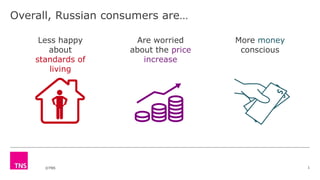
More money
conscious
Less happy
about
standards of
living
Are worried
about the price
increase
1
©TNS
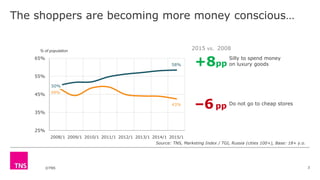
The shoppers are becoming more money conscious…
3
50%
58%
49%
43%
25%
35%
45%
55%
65%
2008/1 2009/1 2010/1 2011/1 2012/1 2013/1 2014/1 2015/1
% of population
+8pp
Silly to spend money
on luxury goods
–6pp Do not go to cheap stores
2015 vs. 2008
Source: TNS, Marketing Index / TGI, Russia (cities 100+), Base: 18+ y.o.
©TNS
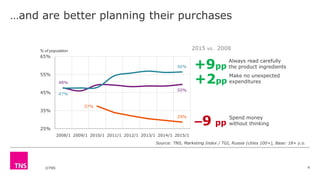
…and are better planning their purchases
4
48%
50%
37%
29%
47%
56%
25%
35%
45%
55%
65%
2008/1 2009/1 2010/1 2011/1 2012/1 2013/1 2014/1 2015/1
% of population
+2pp
Make no unexpected
expenditures
–9 pp
Spend money
without thinking
2015 vs. 2008
+9pp
Always read carefully
the product ingredients
Source: TNS, Marketing Index / TGI, Russia (cities 100+), Base: 18+ y.o.
©TNS
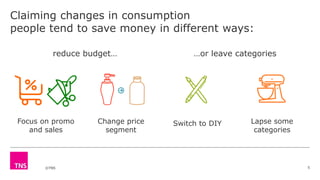
Claiming changes in consumption
people tend to save money in different ways:
5
reduce budget… …or leave categories
Focus on promo
and sales
Change price
segment
Lapse some
categories
Switch to DIY
©TNS
Building a pricing system around better data
6
"When we started to take pricing
seriously, we realized that we
needed not only to collect
better data but to be more
systematic about using it.“
(Petr Partsch – sales chief for Linde Gases,
Czech Republic)
©TNS
Better data with Technology Enabled Research
7
We’re listening,
but are we learning?
We’re collecting data,
but are we listening?
/ ˈlɪsn / [verb]
to hear what someone has
said and understand that
it is serious and important
/ lɜːn / [verb]
to improve your behaviour as
a result of gaining greater
experience or knowledge of
something
©TNS
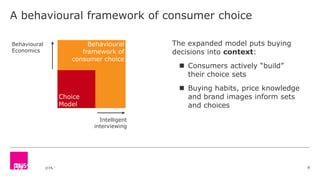
A behavioural framework of consumer choice
8By 2017, 87%of connected devices will be smartphones or tablets
Behavioural
framework of
consumer choice
Choice
Model
Intelligent
interviewing
Behavioural
Economics
The expanded model puts buying
decisions into context:
 Consumers actively “build”
their choice sets
 Buying habits, price knowledge
and brand images inform sets
and choices
©TNS
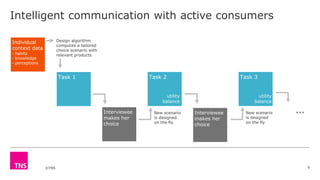
Intelligent communication with active consumers
9
...
Task 1
Interviewee
makes her
choice
New scenario
is designed
on the fly
Task 2 Task 3
utility
balance
utility
balance
Individual
context data
- habits
- knowledge
- perceptions
Interviewee
makes her
choice
Design algorithm
computes a tailored
choice scenario with
relevant products
New scenario
is designed
on the fly
©TNS
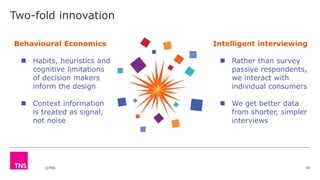
Two-fold innovation
10
Behavioural Economics
 Habits, heuristics and
cognitive limitations
of decision makers
inform the design
 Context information
is treated as signal,
not noise
Intelligent interviewing
 Rather than survey
passive respondents,
we interact with
individual consumers
 We get better data
from shorter, simpler
interviews
Market simulations
©TNS
A case study
12
Market simulations are the key output of our pricing tool:
How strongly will buyers react to new pricing scenarios?
In our case study we look at the German beer market in
the first 26 weeks of 2015.
©TNS
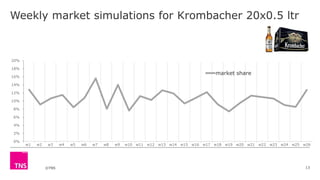
Weekly market simulations for Krombacher 20x0.5 ltr
13
w1 w2 w3 w4 w5 w6 w7 w8 w9 w10 w11 w12 w13 w14 w15 w16 w17 w18 w19 w20 w21 w22 w23 w24 w25 w26
0%
2%
4%
6%
8%
10%
12%
14%
16%
18%
20%
market share
©TNS
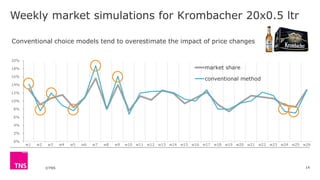
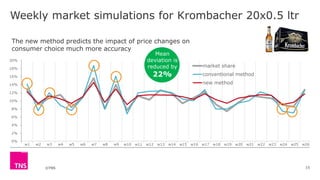
Weekly market simulations for Krombacher 20x0.5 ltr
14
w1 w2 w3 w4 w5 w6 w7 w8 w9 w10 w11 w12 w13 w14 w15 w16 w17 w18 w19 w20 w21 w22 w23 w24 w25 w26
0%
2%
4%
6%
8%
10%
12%
14%
16%
18%
20%
market share
conventional method
Conventional choice models tend to overestimate the impact of price changes
©TNS
w1 w2 w3 w4 w5 w6 w7 w8 w9 w10 w11 w12 w13 w14 w15 w16 w17 w18 w19 w20 w21 w22 w23 w24 w25 w26
0%
2%
4%
6%
8%
10%
12%
14%
16%
18%
20%
market share
conventional method
new method
Weekly market simulations for Krombacher 20x0.5 ltr
15
Mean
deviation is
reduced by
22%
The new method predicts the impact of price changes on
consumer choice much more accuracy
©TNS
Listen to each respondent and learn
16
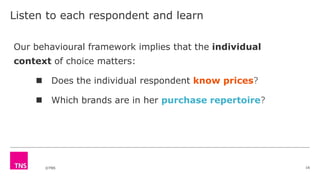
Our behavioural framework implies that the individual
context of choice matters:
 Does the individual respondent know prices?
 Which brands are in her purchase repertoire?
©TNS
The role of price knowledge
17
We expect that buyers with little or no awareness of
prices in the category are less price-sensitive.
Do we find that in our market simulations?
©TNS
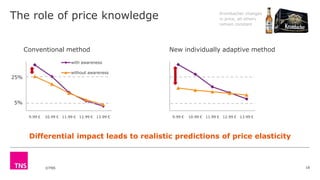
The role of price knowledge
18
9.99 € 10.99 € 11.99 € 12.99 € 13.99 €
with awareness
without awareness
Conventional method
9.99 € 10.99 € 11.99 € 12.99 € 13.99 €
New individually adaptive method
25%
Differential impact leads to realistic predictions of price elasticity
Krombacher changes
in price, all others
remain constant
5%
©TNS
The role of brand repertoires
19
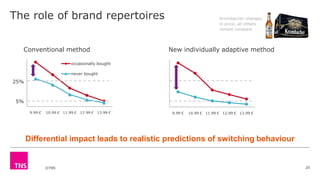
We expect that consumers do not change their habits easily.
They will be price-sensitive if a particular brand is in their
purchase repertoire. If they never bought a brand in the
past, they will ignore price changes of that brand.
Do we find that in our market simulations?
©TNS
The role of brand repertoires
20
9.99 € 10.99 € 11.99 € 12.99 € 13.99 €
occasionally bought
never bought
9.99 € 10.99 € 11.99 € 12.99 € 13.99 €
25%
Krombacher changes
in price, all others
remain constant
Differential impact leads to realistic predictions of switching behaviour
Conventional method New individually adaptive method
5%
©TNS
Better data in a mobile world
21
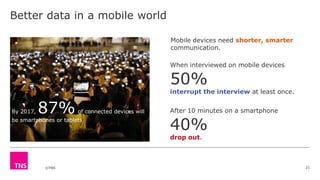
By 2017, 87% of connected devices will
be smartphones or tablets
When interviewed on mobile devices
50%
interrupt the interview at least once.
After 10 minutes on a smartphone
40%
drop out.
Mobile devices need shorter, smarter
communication.
©TNS
Fewer data in a mobile world
22
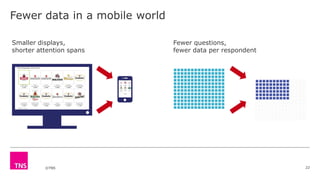
Smaller displays,
shorter attention spans
Fewer questions,
fewer data per respondent
©TNS
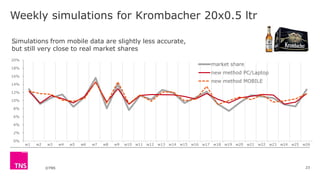
Weekly simulations for Krombacher 20x0.5 ltr
23
w1 w2 w3 w4 w5 w6 w7 w8 w9 w10 w11 w12 w13 w14 w15 w16 w17 w18 w19 w20 w21 w22 w23 w24 w25 w26
0%
2%
4%
6%
8%
10%
12%
14%
16%
18%
20%
market share
new method PC/Laptop
new method MOBILE
…Simulations from mobile data are slightly less accurate,
but still very close to real market shares
©TNS
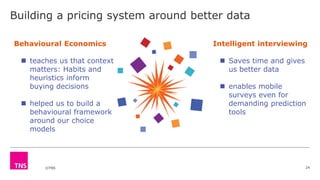
Building a pricing system around better data
24
Behavioural Economics
 teaches us that context
matters: Habits and
heuristics inform
buying decisions
 helped us to build a
behavioural framework
around our choice
models
Intelligent interviewing
 Saves time and gives
us better data
 enables mobile
surveys even for
demanding prediction
tools

Использование методики TNS Value Manager для построения оптимальных ценовых стратегий

  • 1.
    ©TNS TNS Value Manager Anew method to predict consumer choice for optimal price strategies
  • 2.
    ©TNS Overall, Russian consumersare… More money conscious Less happy about standards of living Are worried about the price increase 1
  • 3.
    ©TNS The shoppers arebecoming more money conscious… 3 50% 58% 49% 43% 25% 35% 45% 55% 65% 2008/1 2009/1 2010/1 2011/1 2012/1 2013/1 2014/1 2015/1 % of population +8pp Silly to spend money on luxury goods –6pp Do not go to cheap stores 2015 vs. 2008 Source: TNS, Marketing Index / TGI, Russia (cities 100+), Base: 18+ y.o.
  • 4.
    ©TNS …and are betterplanning their purchases 4 48% 50% 37% 29% 47% 56% 25% 35% 45% 55% 65% 2008/1 2009/1 2010/1 2011/1 2012/1 2013/1 2014/1 2015/1 % of population +2pp Make no unexpected expenditures –9 pp Spend money without thinking 2015 vs. 2008 +9pp Always read carefully the product ingredients Source: TNS, Marketing Index / TGI, Russia (cities 100+), Base: 18+ y.o.
  • 5.
    ©TNS Claiming changes inconsumption people tend to save money in different ways: 5 reduce budget… …or leave categories Focus on promo and sales Change price segment Lapse some categories Switch to DIY
  • 6.
    ©TNS Building a pricingsystem around better data 6 "When we started to take pricing seriously, we realized that we needed not only to collect better data but to be more systematic about using it.“ (Petr Partsch – sales chief for Linde Gases, Czech Republic)
  • 7.
    ©TNS Better data withTechnology Enabled Research 7 We’re listening, but are we learning? We’re collecting data, but are we listening? / ˈlɪsn / [verb] to hear what someone has said and understand that it is serious and important / lɜːn / [verb] to improve your behaviour as a result of gaining greater experience or knowledge of something
  • 8.
    ©TNS A behavioural frameworkof consumer choice 8By 2017, 87%of connected devices will be smartphones or tablets Behavioural framework of consumer choice Choice Model Intelligent interviewing Behavioural Economics The expanded model puts buying decisions into context:  Consumers actively “build” their choice sets  Buying habits, price knowledge and brand images inform sets and choices
  • 9.
    ©TNS Intelligent communication withactive consumers 9 ... Task 1 Interviewee makes her choice New scenario is designed on the fly Task 2 Task 3 utility balance utility balance Individual context data - habits - knowledge - perceptions Interviewee makes her choice Design algorithm computes a tailored choice scenario with relevant products New scenario is designed on the fly
  • 10.
    ©TNS Two-fold innovation 10 Behavioural Economics Habits, heuristics and cognitive limitations of decision makers inform the design  Context information is treated as signal, not noise Intelligent interviewing  Rather than survey passive respondents, we interact with individual consumers  We get better data from shorter, simpler interviews
  • 11.
  • 12.
    ©TNS A case study 12 Marketsimulations are the key output of our pricing tool: How strongly will buyers react to new pricing scenarios? In our case study we look at the German beer market in the first 26 weeks of 2015.
  • 13.
    ©TNS Weekly market simulationsfor Krombacher 20x0.5 ltr 13 w1 w2 w3 w4 w5 w6 w7 w8 w9 w10 w11 w12 w13 w14 w15 w16 w17 w18 w19 w20 w21 w22 w23 w24 w25 w26 0% 2% 4% 6% 8% 10% 12% 14% 16% 18% 20% market share
  • 14.
    ©TNS Weekly market simulationsfor Krombacher 20x0.5 ltr 14 w1 w2 w3 w4 w5 w6 w7 w8 w9 w10 w11 w12 w13 w14 w15 w16 w17 w18 w19 w20 w21 w22 w23 w24 w25 w26 0% 2% 4% 6% 8% 10% 12% 14% 16% 18% 20% market share conventional method Conventional choice models tend to overestimate the impact of price changes
  • 15.
    ©TNS w1 w2 w3w4 w5 w6 w7 w8 w9 w10 w11 w12 w13 w14 w15 w16 w17 w18 w19 w20 w21 w22 w23 w24 w25 w26 0% 2% 4% 6% 8% 10% 12% 14% 16% 18% 20% market share conventional method new method Weekly market simulations for Krombacher 20x0.5 ltr 15 Mean deviation is reduced by 22% The new method predicts the impact of price changes on consumer choice much more accuracy
  • 16.
    ©TNS Listen to eachrespondent and learn 16 Our behavioural framework implies that the individual context of choice matters:  Does the individual respondent know prices?  Which brands are in her purchase repertoire?
  • 17.
    ©TNS The role ofprice knowledge 17 We expect that buyers with little or no awareness of prices in the category are less price-sensitive. Do we find that in our market simulations?
  • 18.
    ©TNS The role ofprice knowledge 18 9.99 € 10.99 € 11.99 € 12.99 € 13.99 € with awareness without awareness Conventional method 9.99 € 10.99 € 11.99 € 12.99 € 13.99 € New individually adaptive method 25% Differential impact leads to realistic predictions of price elasticity Krombacher changes in price, all others remain constant 5%
  • 19.
    ©TNS The role ofbrand repertoires 19 We expect that consumers do not change their habits easily. They will be price-sensitive if a particular brand is in their purchase repertoire. If they never bought a brand in the past, they will ignore price changes of that brand. Do we find that in our market simulations?
  • 20.
    ©TNS The role ofbrand repertoires 20 9.99 € 10.99 € 11.99 € 12.99 € 13.99 € occasionally bought never bought 9.99 € 10.99 € 11.99 € 12.99 € 13.99 € 25% Krombacher changes in price, all others remain constant Differential impact leads to realistic predictions of switching behaviour Conventional method New individually adaptive method 5%
  • 21.
    ©TNS Better data ina mobile world 21 By 2017, 87% of connected devices will be smartphones or tablets When interviewed on mobile devices 50% interrupt the interview at least once. After 10 minutes on a smartphone 40% drop out. Mobile devices need shorter, smarter communication.
  • 22.
    ©TNS Fewer data ina mobile world 22 Smaller displays, shorter attention spans Fewer questions, fewer data per respondent
  • 23.
    ©TNS Weekly simulations forKrombacher 20x0.5 ltr 23 w1 w2 w3 w4 w5 w6 w7 w8 w9 w10 w11 w12 w13 w14 w15 w16 w17 w18 w19 w20 w21 w22 w23 w24 w25 w26 0% 2% 4% 6% 8% 10% 12% 14% 16% 18% 20% market share new method PC/Laptop new method MOBILE …Simulations from mobile data are slightly less accurate, but still very close to real market shares
  • 24.
    ©TNS Building a pricingsystem around better data 24 Behavioural Economics  teaches us that context matters: Habits and heuristics inform buying decisions  helped us to build a behavioural framework around our choice models Intelligent interviewing  Saves time and gives us better data  enables mobile surveys even for demanding prediction tools