1 | Rocket Fuel | Marketing Tech Trends 2016
Marketing Tech Trends:
10 Things Happening in 2016
As 2016 ramps up, marketers can count on one thing: Change. After
a tumultuous 2015, this year promises its own challenges, shifts, and
emerging technologies. Ever interested in staying ahead, Rocket Fuel
polled industry decision makers to learn what they’re anticipating in 2016,
and how they’re planning to adapt. Based on their data and our analysis,
here are 10 predictions for 2016.
Methodology
Rocket Fuel surveyed 204 marketers and agency professionals in December 2015.
Respondents had to have a title of Director (or equivalent) or higher and were asked a
series of questions about their plans for adopting new technology, where they see the
industry going in 2016, and the key topics they want to explore in the coming year.
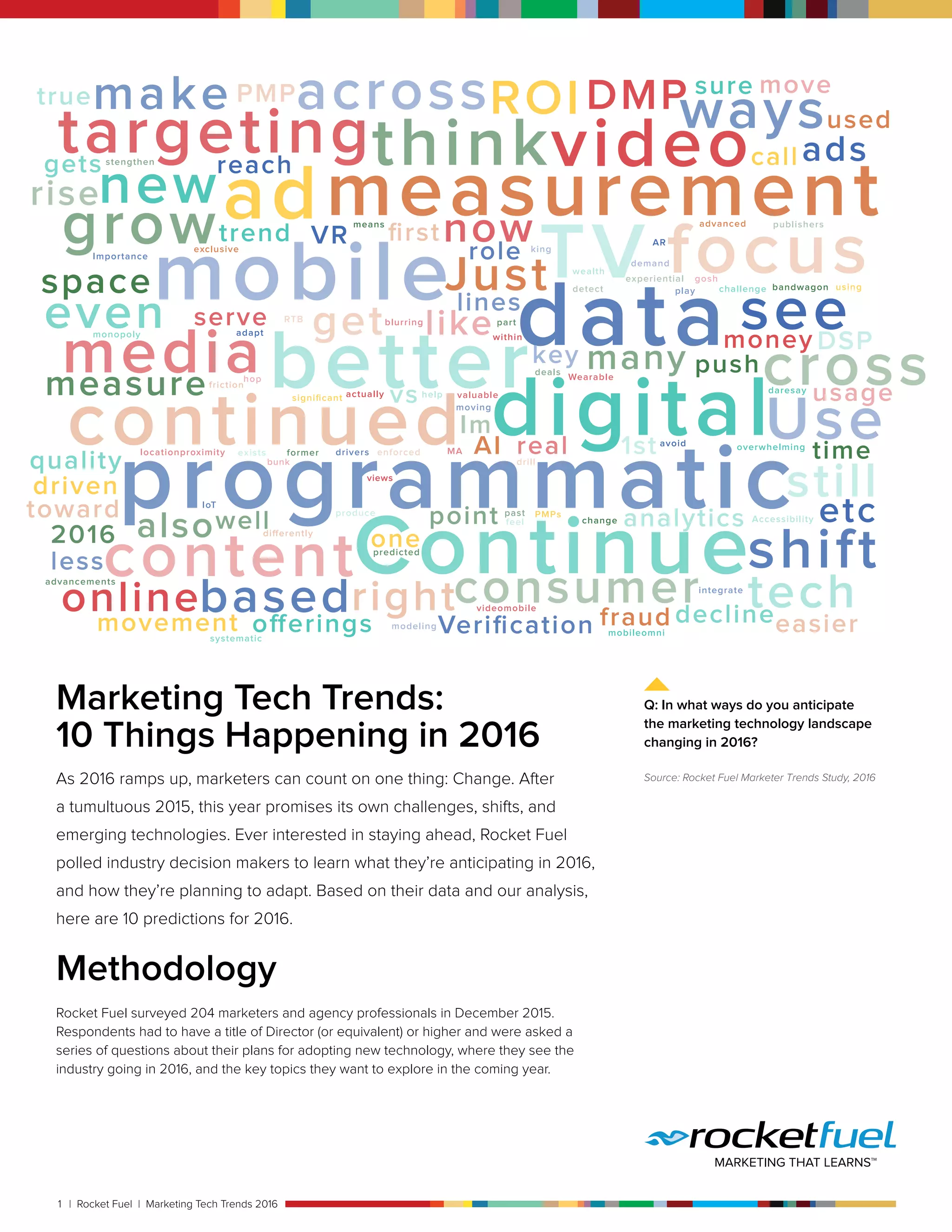
Q: In what ways do you anticipate
the marketing technology landscape
changing in 2016?
Source: Rocket Fuel Marketer Trends Study, 2016
2 | Rocket Fuel | Marketing Tech Trends 2016
1. Competition for
Analysts and Data
Scientists Will Become
[even more] Fierce
The explosion of marketing technology has been a double-edged
sword for marketers. They have access to a trove of new data
across previously unreported channels. But they’re struggling
to analyze it all to produce meaningful insights. When it came to
adopting new technology, respondents frequently listed a lack of
analysts to manage the technology as a key barrier to adoption,
particularly for multi-channel attribution, cross-device delivery/
tracking, and Data Management Platforms (DMPs).
One reason driving the demand for analysts: the ever-expanding
set of platforms being added to marketing technology stacks.
Each new platform adds a new dashboard, new implementation
headaches, and new integration issues, requiring more
experienced analysts to manage the tech and the process
of aggregating data and reporting from across the stack. As
demand for these analysts increases faster than the supply,
competition for good analysts will continue to heat up.
Barriers to adoption
Lack of analysts /
personnel to man-
age the technology
Programmatic TV 15%
Multi-Channel Attribution 20%
Cross-Device Tracking & Delivery 20%
DMP 19%
DSP 13%
Ad Viewability Measurement 16%
2. Marketers Will Seek
to Consolidate Their
Tech Platforms
As marketers compete over analysts, many will find that either
there aren’t enough to go around or they are they are pushing
up against budgetary constraints. While a majority of marketers
and advertisers generally prefer to buy best-in-class solutions,
even if it means working with multiple vendors (51%)1
, the
shortage of analysts to manage each new vendor solution will
put pressure on those marketers to consolidate their partners.
These marketers will seek technology partners that offer a
wider variety of solutions, such as data management, media
delivery, and cross-channel optimization, as a way to reduce
the resource demands of their tech stack. Similarly, although
most marketers prefer self-service tools1, the data analyst
shortage means marketers will find themselves evaluating
more full-service solutions for their tech needs.
1 Industry Index DMP Insight Report, May 2015
3 | Rocket Fuel | Marketing Tech Trends 2016
3. Budgets will continue to shift away from
traditional media
0%
10%
20%
30%
40%
50%
60%
70%
80%
90%
Channels
89%
Digital
Display
22%
82%
Mobile
10%
80%
Digital
Video
11%
74%
Social
11%
56%
Native
Advertising
5%
50%
TV
27%
48%
Print
8%
42%
Email
6%
37%
Radio
4%
36%
Out-of-home
4%
KEY:
% of Respondents who used the
following channels in 2015
Average % of budget allocated in 2015
Traditional Channels
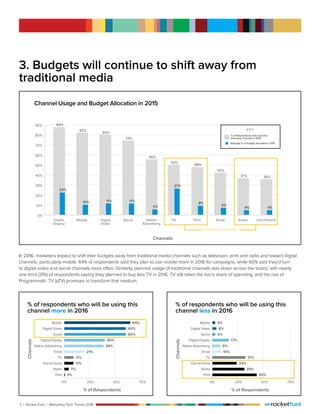
Channel Usage and Budget Allocation in 2015
In 2016, marketers expect to shift their budgets away from traditional media channels such as television, print and radio and toward digital
channels, particularly mobile: 64% of respondents said they plan to use mobile more in 2016 for campaigns, while 60% said they’d turn
to digital video and social channels more often. Similarly, planned usage of traditional channels was down across the board, with nearly
one third (31%) of respondents saying they planned to buy less TV in 2016. TV still takes the lion’s share of spending, and the rise of
Programmatic TV (pTV) promises to transform that medium.
% of respondents who will be using this
channel more in 2016
% of respondents who will be using this
channel less in 2016
3%
7%
11%
11%
21%
39%
40%
60%
60%
64%
Print
% of Respondents
Channels
0% 25% 50% 75%
Radio
Out-of-home
TV
Email
Native Advertising
Digital Display
Social
Digital Video
Mobile
43%
29%
24%
31%
10%
9%
17%
5%
6%
5%
Print
% of Respondents
Channels
0% 25% 50% 75%
Radio
Out-of-home
TV
Email
Native Advertising
Digital Display
Social
Digital Video
Mobile
4 | Rocket Fuel | Marketing Tech Trends 2016
43%Other
% of Respondents
Technology
0% 25% 50%
10%DSP
20%Ad Viewability Measurements
24%DMP
44%Programmatic TV
44%Multi-Channel Attribution
46%Cross-Device Tracking & Delivery
4. Brand Marketers will make a more significant
move to programmatic
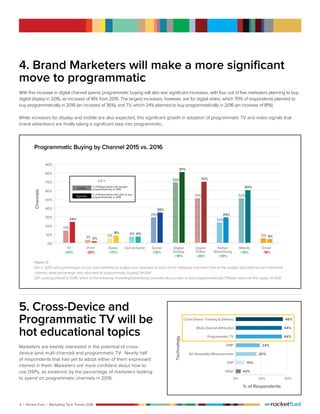
With this increase in digital channel spend, programmatic buying will also see significant increases, with four out of five marketers planning to buy
digital display in 2016, an increase of 18% from 2015. The largest increases, however, are for digital video, which 70% of respondents planned to
buy programmatically in 2016 (an increase of 36%), and TV, which 24% planned to buy programmatically in 2016 (an increase of 81%).
While increases for display and mobile are also expected, this significant growth in adoption of programmatic TV and video signals that
brand advertisers are finally taking a significant step into programmatic.
5. Cross-Device and
Programmatic TV will be
hot educational topics
Marketers are keenly interested in the potential of cross-
device (and multi-channel) and programmatic TV. Nearly half
of respondents that had yet to adopt either of them expressed
interest in them. Marketers are more confident about how to
use DSPs, as evidence by the percentage of marketers looking
to spend on programmatic channels in 2016.
Figure 12
TV
+81%
Print
-29%
Radio
+70%
Out-of-home Social
+18%
Digital
Display
+18%
Digital
Video
+36%
Native
Advertising
+29%
Mobile
+16%
Email
-18%
24%
Channels
0%
10%
20%
30%
40%
50%
60%
70%
80%
90%
13%
3% 2%
5%
8% 6% 6%
29%
35%
69%
81%
51%
70%
23%
29%
52%
60%
5% 4%
KEY:
Left Bar
% of Respondents who bought
programmatically in 2015
% of Respondents who plan to buy
programmatically in 2016Right Bar:
Programmatic Buying by Channel 2015 vs. 2016
Figure 12
Q4: In 2015 what percentage of your total advertising budget was allocated to each of the following channels? And of the budget allocated to each (relevant)
channel, what percentage was allocated to programmatic buying? N=204
Q11: Looking ahead to 2016, which of the following marketing/advertising channels do you plan to buy programmatically? Please select all that apply. N=204
5 | Rocket Fuel | Marketing Tech Trends 2016
Technology
DMP DSP Programmatic
TV
Multi-
Channel
Attribution
Ad
Viewability
Measurement
Cross-Device
Tracking &
Delivery
%ofRespondents
0%
10%
20%
30%
40%
50%
60%
70%
80%
90%
100%
91%
80% 80% 81%
78%
74%
6. Data will continue to be a
major point of interest, even
for savvier marketers
Across all marketers--even those who had already adopted key technologies -
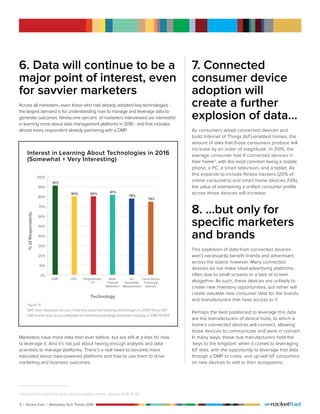
the largest demand is for understanding how to manage and leverage data to
generate outcomes. Ninety-one percent of marketers interviewed are interested
in learning more about data management platforms in 2016 - and that includes
almost every respondent already partnering with a DMP.
Figure 15
Q14: How interested are you in learning about the following technologies in 2016? Nmax=187
Q18: In what ways do you anticipate the marketing technology landscape changing in 2016? N=204
Interest in Learning About Technologies in 2016
(Somewhat + Very Interesting)
Marketers have more data than ever before, but are still at a loss for how
to leverage it. And it’s not just about having enough analysts and data
scientists to manage platforms. There’s a real need to become more
educated about data-powered platforms and how to use them to drive
marketing and business outcomes.
7. Connected
consumer device
adoption will
create a further
explosion of data...
As consumers adopt connected devices and
build Internet of Things (IoT)-enabled homes, the
amount of data that those consumers produce will
increase by an order of magnitude. In 2015, the
average consumer had 4 connected devices in
their home2
, with the most common being a mobile
phone, a PC, a smart television, and a tablet. As
this expands to include fitness trackers (20% of
online consumers) and smart home devices (13%),
the value of maintaining a unified consumer profile
across those devices will increase.
8. ...but only for
specific marketers
and brands
This explosion of data from connected devices
won’t necessarily benefit brands and advertisers
across the board, however. Many connected
devices do not make ideal advertising platforms,
often due to small screens or a lack of screen
altogether. As such, these devices are unlikely to
create new inventory opportunities, but rather will
create valuable new consumer data for the brands
and manufacturers that have access to it.
Perhaps the best positioned to leverage this data
are the manufacturers of device hubs, to which a
home’s connected devices will connect, allowing
those devices to communicate and work in concert.
In many ways, these hub manufacturers hold the
‘keys to the kingdom’ when it comes to leveraging
IoT data, with the opportunity to leverage that data
through a DMP to cross- and up-sell IoT consumers
on new devices to add to their ecosystems.
2 Rocket Fuel internal study on device adoption trends, January 2016, N=50
6 | Rocket Fuel | Marketing Tech Trends 2016
9. Ad blocking will
remain a serious
concern
While the impact of ad blocking on real-time bidding
systems may be mitigated when blocked ads aren’t
made available for bidding in ad exchanges, ad blocking
will continue to be a serious concern for advertisers in
2016. Publishers will be the hardest hit, standing to lose
the most revenue to blocked ads. Worse, ad blocking is
most prevalent among the affluent members of the oft-
coveted 18-34 demographic3
.
In some ways, ad blocking creates an arms race
between advertisers and the creators of ad blocker
software, each trying to find new ways to circumvent
the other’s technology. Some see it as another tax on
marketers who wish to advertise online, due to the
ability to circumvent some ad blocking software by
paying a fee. In the long term, ad blocking may change
how content is published online. In the meantime,
advertisers may seek to combat the proliferation of ad
blockers by spending more in digital channels where
ad blocker technology is less prevalent, like mobile
and programmatic live TV.
3 The State of Ad Blocking, ComScore and Sourcepoint, September 2015
10. Mobile will continue to
be a disruptive force
2015 will forever be known at Rocket Fuel as the year that biddable mobile
inventory surpassed Desktop/Laptop inventory. There is no turning back:
consumers spend more than an hour per week now browsing the internet on
their mobile devices, in a personal environment that - for now, at least - is much
less susceptible to ad blocking, particularly with in-app inventory.
2015 was the year in which Programmatic TV truly arrived. Rocket Fuel’s
partnership with DISH and Resolute Digital for Glenfiddich reached an
audience of 9 million. We expect Programmatic TV to be a major point of
interest for marketers in 2016, and it promises to transform the medium as
more inventory is made available and biddable by demand-side real-time
bidding platforms. As that happens, the need for real targeting and analytics
in Programmatic TV buys will increase, allowing advertisers to further unify
cross-device profiles with the largest screen in the household.
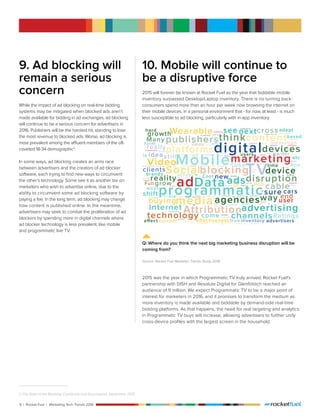
Q: Where do you think the next big marketing business disruption will be
coming from?
Source: Rocket Fuel Marketer Trends Study, 2016

Marketing_Tech_Trends_2016_V4

  • 1.
    1 | RocketFuel | Marketing Tech Trends 2016 Marketing Tech Trends: 10 Things Happening in 2016 As 2016 ramps up, marketers can count on one thing: Change. After a tumultuous 2015, this year promises its own challenges, shifts, and emerging technologies. Ever interested in staying ahead, Rocket Fuel polled industry decision makers to learn what they’re anticipating in 2016, and how they’re planning to adapt. Based on their data and our analysis, here are 10 predictions for 2016. Methodology Rocket Fuel surveyed 204 marketers and agency professionals in December 2015. Respondents had to have a title of Director (or equivalent) or higher and were asked a series of questions about their plans for adopting new technology, where they see the industry going in 2016, and the key topics they want to explore in the coming year. Q: In what ways do you anticipate the marketing technology landscape changing in 2016? Source: Rocket Fuel Marketer Trends Study, 2016
  • 2.
    2 | RocketFuel | Marketing Tech Trends 2016 1. Competition for Analysts and Data Scientists Will Become [even more] Fierce The explosion of marketing technology has been a double-edged sword for marketers. They have access to a trove of new data across previously unreported channels. But they’re struggling to analyze it all to produce meaningful insights. When it came to adopting new technology, respondents frequently listed a lack of analysts to manage the technology as a key barrier to adoption, particularly for multi-channel attribution, cross-device delivery/ tracking, and Data Management Platforms (DMPs). One reason driving the demand for analysts: the ever-expanding set of platforms being added to marketing technology stacks. Each new platform adds a new dashboard, new implementation headaches, and new integration issues, requiring more experienced analysts to manage the tech and the process of aggregating data and reporting from across the stack. As demand for these analysts increases faster than the supply, competition for good analysts will continue to heat up. Barriers to adoption Lack of analysts / personnel to man- age the technology Programmatic TV 15% Multi-Channel Attribution 20% Cross-Device Tracking & Delivery 20% DMP 19% DSP 13% Ad Viewability Measurement 16% 2. Marketers Will Seek to Consolidate Their Tech Platforms As marketers compete over analysts, many will find that either there aren’t enough to go around or they are they are pushing up against budgetary constraints. While a majority of marketers and advertisers generally prefer to buy best-in-class solutions, even if it means working with multiple vendors (51%)1 , the shortage of analysts to manage each new vendor solution will put pressure on those marketers to consolidate their partners. These marketers will seek technology partners that offer a wider variety of solutions, such as data management, media delivery, and cross-channel optimization, as a way to reduce the resource demands of their tech stack. Similarly, although most marketers prefer self-service tools1, the data analyst shortage means marketers will find themselves evaluating more full-service solutions for their tech needs. 1 Industry Index DMP Insight Report, May 2015
  • 3.
    3 | RocketFuel | Marketing Tech Trends 2016 3. Budgets will continue to shift away from traditional media 0% 10% 20% 30% 40% 50% 60% 70% 80% 90% Channels 89% Digital Display 22% 82% Mobile 10% 80% Digital Video 11% 74% Social 11% 56% Native Advertising 5% 50% TV 27% 48% Print 8% 42% Email 6% 37% Radio 4% 36% Out-of-home 4% KEY: % of Respondents who used the following channels in 2015 Average % of budget allocated in 2015 Traditional Channels Channel Usage and Budget Allocation in 2015 In 2016, marketers expect to shift their budgets away from traditional media channels such as television, print and radio and toward digital channels, particularly mobile: 64% of respondents said they plan to use mobile more in 2016 for campaigns, while 60% said they’d turn to digital video and social channels more often. Similarly, planned usage of traditional channels was down across the board, with nearly one third (31%) of respondents saying they planned to buy less TV in 2016. TV still takes the lion’s share of spending, and the rise of Programmatic TV (pTV) promises to transform that medium. % of respondents who will be using this channel more in 2016 % of respondents who will be using this channel less in 2016 3% 7% 11% 11% 21% 39% 40% 60% 60% 64% Print % of Respondents Channels 0% 25% 50% 75% Radio Out-of-home TV Email Native Advertising Digital Display Social Digital Video Mobile 43% 29% 24% 31% 10% 9% 17% 5% 6% 5% Print % of Respondents Channels 0% 25% 50% 75% Radio Out-of-home TV Email Native Advertising Digital Display Social Digital Video Mobile
  • 4.
    4 | RocketFuel | Marketing Tech Trends 2016 43%Other % of Respondents Technology 0% 25% 50% 10%DSP 20%Ad Viewability Measurements 24%DMP 44%Programmatic TV 44%Multi-Channel Attribution 46%Cross-Device Tracking & Delivery 4. Brand Marketers will make a more significant move to programmatic With this increase in digital channel spend, programmatic buying will also see significant increases, with four out of five marketers planning to buy digital display in 2016, an increase of 18% from 2015. The largest increases, however, are for digital video, which 70% of respondents planned to buy programmatically in 2016 (an increase of 36%), and TV, which 24% planned to buy programmatically in 2016 (an increase of 81%). While increases for display and mobile are also expected, this significant growth in adoption of programmatic TV and video signals that brand advertisers are finally taking a significant step into programmatic. 5. Cross-Device and Programmatic TV will be hot educational topics Marketers are keenly interested in the potential of cross- device (and multi-channel) and programmatic TV. Nearly half of respondents that had yet to adopt either of them expressed interest in them. Marketers are more confident about how to use DSPs, as evidence by the percentage of marketers looking to spend on programmatic channels in 2016. Figure 12 TV +81% Print -29% Radio +70% Out-of-home Social +18% Digital Display +18% Digital Video +36% Native Advertising +29% Mobile +16% Email -18% 24% Channels 0% 10% 20% 30% 40% 50% 60% 70% 80% 90% 13% 3% 2% 5% 8% 6% 6% 29% 35% 69% 81% 51% 70% 23% 29% 52% 60% 5% 4% KEY: Left Bar % of Respondents who bought programmatically in 2015 % of Respondents who plan to buy programmatically in 2016Right Bar: Programmatic Buying by Channel 2015 vs. 2016 Figure 12 Q4: In 2015 what percentage of your total advertising budget was allocated to each of the following channels? And of the budget allocated to each (relevant) channel, what percentage was allocated to programmatic buying? N=204 Q11: Looking ahead to 2016, which of the following marketing/advertising channels do you plan to buy programmatically? Please select all that apply. N=204
  • 5.
    5 | RocketFuel | Marketing Tech Trends 2016 Technology DMP DSP Programmatic TV Multi- Channel Attribution Ad Viewability Measurement Cross-Device Tracking & Delivery %ofRespondents 0% 10% 20% 30% 40% 50% 60% 70% 80% 90% 100% 91% 80% 80% 81% 78% 74% 6. Data will continue to be a major point of interest, even for savvier marketers Across all marketers--even those who had already adopted key technologies - the largest demand is for understanding how to manage and leverage data to generate outcomes. Ninety-one percent of marketers interviewed are interested in learning more about data management platforms in 2016 - and that includes almost every respondent already partnering with a DMP. Figure 15 Q14: How interested are you in learning about the following technologies in 2016? Nmax=187 Q18: In what ways do you anticipate the marketing technology landscape changing in 2016? N=204 Interest in Learning About Technologies in 2016 (Somewhat + Very Interesting) Marketers have more data than ever before, but are still at a loss for how to leverage it. And it’s not just about having enough analysts and data scientists to manage platforms. There’s a real need to become more educated about data-powered platforms and how to use them to drive marketing and business outcomes. 7. Connected consumer device adoption will create a further explosion of data... As consumers adopt connected devices and build Internet of Things (IoT)-enabled homes, the amount of data that those consumers produce will increase by an order of magnitude. In 2015, the average consumer had 4 connected devices in their home2 , with the most common being a mobile phone, a PC, a smart television, and a tablet. As this expands to include fitness trackers (20% of online consumers) and smart home devices (13%), the value of maintaining a unified consumer profile across those devices will increase. 8. ...but only for specific marketers and brands This explosion of data from connected devices won’t necessarily benefit brands and advertisers across the board, however. Many connected devices do not make ideal advertising platforms, often due to small screens or a lack of screen altogether. As such, these devices are unlikely to create new inventory opportunities, but rather will create valuable new consumer data for the brands and manufacturers that have access to it. Perhaps the best positioned to leverage this data are the manufacturers of device hubs, to which a home’s connected devices will connect, allowing those devices to communicate and work in concert. In many ways, these hub manufacturers hold the ‘keys to the kingdom’ when it comes to leveraging IoT data, with the opportunity to leverage that data through a DMP to cross- and up-sell IoT consumers on new devices to add to their ecosystems. 2 Rocket Fuel internal study on device adoption trends, January 2016, N=50
  • 6.
    6 | RocketFuel | Marketing Tech Trends 2016 9. Ad blocking will remain a serious concern While the impact of ad blocking on real-time bidding systems may be mitigated when blocked ads aren’t made available for bidding in ad exchanges, ad blocking will continue to be a serious concern for advertisers in 2016. Publishers will be the hardest hit, standing to lose the most revenue to blocked ads. Worse, ad blocking is most prevalent among the affluent members of the oft- coveted 18-34 demographic3 . In some ways, ad blocking creates an arms race between advertisers and the creators of ad blocker software, each trying to find new ways to circumvent the other’s technology. Some see it as another tax on marketers who wish to advertise online, due to the ability to circumvent some ad blocking software by paying a fee. In the long term, ad blocking may change how content is published online. In the meantime, advertisers may seek to combat the proliferation of ad blockers by spending more in digital channels where ad blocker technology is less prevalent, like mobile and programmatic live TV. 3 The State of Ad Blocking, ComScore and Sourcepoint, September 2015 10. Mobile will continue to be a disruptive force 2015 will forever be known at Rocket Fuel as the year that biddable mobile inventory surpassed Desktop/Laptop inventory. There is no turning back: consumers spend more than an hour per week now browsing the internet on their mobile devices, in a personal environment that - for now, at least - is much less susceptible to ad blocking, particularly with in-app inventory. 2015 was the year in which Programmatic TV truly arrived. Rocket Fuel’s partnership with DISH and Resolute Digital for Glenfiddich reached an audience of 9 million. We expect Programmatic TV to be a major point of interest for marketers in 2016, and it promises to transform the medium as more inventory is made available and biddable by demand-side real-time bidding platforms. As that happens, the need for real targeting and analytics in Programmatic TV buys will increase, allowing advertisers to further unify cross-device profiles with the largest screen in the household. Q: Where do you think the next big marketing business disruption will be coming from? Source: Rocket Fuel Marketer Trends Study, 2016