DEVELOPING PRICING
STRATEGIES AND
PROGRAMS
Montenegro, Riza Ann Lee G.
MD12-0010
Outline
1. Understanding Pricing
2. Setting the Price
3. Adapting the Price
4. Initiating and Responding to Price Changes
Introduction
 Price is the one element of marketing mix that
produces revenue (others produce costs)
 Pricing decisions are clearly complex and
difficult
 Must be consistent with the firm’s marketing
strategy and its target markets and brand
positionings
Outline
1. Understanding Pricing
2. Setting the Price
3. Adapting the Price
4. Initiating and Responding to Price Changes
Understanding Pricing
 Comes in many forms, performs many
functions
 Rent, tuition, fares, fees, rates, tolls, retainers,
wages, commissions
 Has many components
 Price has operated as a major determinant of
buyers choice
Concept 1: A Changing Pricing
Environment
 21st century
 Access to credit cards, debit cards
 allowed firms to offer more expensive products and
services
 Great Recession
 Shift from luxury to basics needs
 Less spending, smart buying
 Shift to more economic and practical purchases
 Technological environment
Concept 1: A Changing Pricing
Environment
 Technological environment (Internet)
 Buyers can get instant price comparisons from thousands
of vendors
 Name their price and have it met
 Get products free
 Give certain customers access to special prices
 Negotiate prices in online auctions and
 Intelligent shopping with the help of the internet
 Example (Kotler)
 mySimon.com, PriceSCAN.com – Compare prices of multiple
bookstores
 Example (local)
 Olx.com.ph (formerly sulit.com), Zalora, Lazada
 Example (medical)
 Forums about where to find the cheapest medical equipment
(e.g. bambang), or an affordable doctor, or cheap hospitals
Concept 2: Consumer Psychology
and Pricing
 Consumers actively process price information
 Prior purchasing experience, formal
communications, informal communications, point-
of-purchase or online resources, etc.
 Purchase decisions – consumer’s perception of
the price vs. what they consider the current
actual price to be
Concept 2: Consumer Psychology
and Pricing
 Example (Kotler)
 A Black T-Shirt, Gap ($14.90) vs. Armani ($275)
 Example (local)
 Nescafe small coffee bottle (Php 50.00) is considered
expensive but Starbucks coffee (Php 150.00) is
considered normal because customers are paying for
the “brand” the ambience, etc.
 Example (medical)
 Doctor X charges a higher PF to his patients in TMC
than his patients in other private less known hospitals
because he knows patients who go to TMC . Despite
offering the same services, and having the same set
of skills, his PF varies
Concept 2: Consumer Psychology
and Pricing
 Understanding how consumers arrive at their
perceptions of prices is an important marketing
priority
 Reference Prices
 Price-Quality Inferences
 Price Endings
Concept 3: Reference Prices
 “Fair Price”
 Typical Price
 Last Price Paid
 Upper-Bound Price
 Lower Bound Price
 Historical Competitor Prices
 Expected Future Price
 Usual Discounted Price
Concept 3: Reference Prices
 Examples
 Kotler: Dept stores will display women’s apparel
in separate departments differentiated by price;
dresses in more expensive department are
assumed to be of better quality
 Local: Suggested retail price “Ariel Php 7.50”
 Medical: An Welch Allyn diagnostic set in a
medical equipment store is worth 20k. A
consumer with a knowledge of competitor prices
(reference price) will prefer to buy it in Bambang
for 14.5k
Concept 4: Price-Quality
Inference
 Price as an indicator of quality
 Image pricing is effective with ego-sensitive
products
 Examples
 Kotler: Higher-priced cars are perceived to possess
high quality. Higher-quality cars are likewise perceived
to be higher priced than they actually are
 Local: Products bought from divisoria are perceived to
be of low quality and would not sell at a high price.
 Medical: Doctors who charge higher PF are assumed
to be very good doctors and would offer better
services. “They must be THAT good to charge that
Outline
1. Understanding Pricing
2. Setting the Price
3. Adapting the Price
4. Initiating and Responding to Price Changes
Setting the Price
 Step 1: Selecting the Pricing Objective
 Survival, max current profit, max market share,
product-quality leadership, other objectives
 Step 2: Determining Demand
 Step 3: Estimating Costs
 Step 4: Analyzing Competitors’ Costs, Prices,
and Offers
 Step 5: Selecting a Pricing Method
 Step 6: Selecting the Final Price
Step 1: Setting the Price
Objective
 Survival
 Maximum Current Profit
 Maximum Market Share
 Maximum Market Skimming
 Product Quality Leadership
 Other objectives (e.g. partial cost recovery)
Step 2: Determining Demand
Concept 5: Price Sensitivity
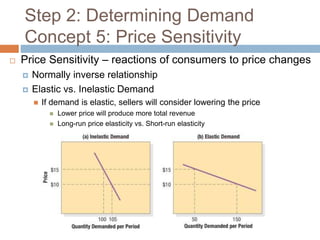
 Price Sensitivity – reactions of consumers to price changes
 Normally inverse relationship
 Elastic vs. Inelastic Demand
 If demand is elastic, sellers will consider lowering the price
 Lower price will produce more total revenue
 Long-run price elasticity vs. Short-run elasticity
Step 2: Determining Demand
Concept 5: Price Sensitivity
 Price sensitivity
 Customers are less price-sensitive:
 Distinct product
 No/few/unknown substitutes
 Cannot easily compare quality of substitutes
 Expenditure is small part of total income
 Expenditure is small compared to the total cost of the end
product
 Part of the cost is borne by another party
 Product is used in conjunction with assets previously
bought
 Product is assumed to have more qualilty, prestige, or
exclusiveness
 Buyers cannot store the product
Step 2: Determining Demand
Concept 5: Price Sensitivity
 Price Sensitivity – Examples
 Kotler: Internet increases price sensitivity. Car buyers
use the internet to gather information and borrow the
negotiating clout of an online buying service
 Local: Consumers are less sensitive to price
increases in SM supermarkets, than in stores such as
H&M, Zara, etc . Consumers are less sensitive to
price increases of basic needs (inelastic demand)
than luxury items (elastic demand)
 Medical: Consumers are less sensitive to rates of the
emergency room (need, no substitutes) than doctors’
professional fees (many alternatives)
Step 3: Estimating Costs
 Types of Costs and Levels of Production
 Demand: sets a ceiling price; Costs: set the floor
price
 Costs
 fixed costs + variable costs = total cost
 Average cost per unit
 To price intelligently, management needs to know
how its costs vary with different levels of
production
 To estimate the real profitability of selling to
different types of retailers or customers,
manufacturer needs to use activity-based cost
accounting instead of standard cost accounting
Step 3: Estimating Costs
 Accumulated Production
 Experience curve or Learning Curve
 Decline in average cost with accumulated production
experience
 Methods improve, workers learn shortcuts, materials flow

more smoothly, procurement costs fall
 Experience-curve pricing is risky
 Target Costing
Step 4, Concept 6: Analyzing
Competitors’ Costs, Prices and
Offers
 Introduction or change of any price can provoke a
response from customers, competitors, distributors,
suppliers, and even government
 Competitors are most likely to react when the
number of firms is few, the product is homogeneous,
and buyers are highly informed
 Examples
 Kotler: Green Works – affordable price, biodegradable
ingredients, packaged in recyclable materials, not tested
on animals
 Local: Sun Cellular – unlimited calls and texts – drove
Globe and Smart to lower prices to unlimited calls and
texts as well
 Medical – Laboratory clinics offering services at lower
prices will drive the other clinics in the area to match
Step 5: Selecting a Pricing
Method
 Costs set a floor
 Competitor’s prices, price of subs provide an
orienting point
 Customer’s perception of quality establishes
price ceiling
 Price-setting methods: Mark-up Pricing,
Target-return pricing, perceived-value pricing,
value pricing, going-rate pricing, and auction
type pricing
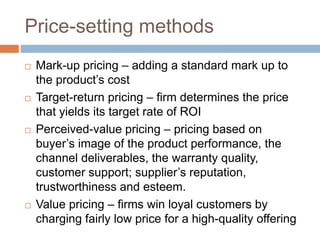
Price-setting methods
 Mark-up pricing – adding a standard mark up to
the product’s cost
 Target-return pricing – firm determines the price
that yields its target rate of ROI
 Perceived-value pricing – pricing based on
buyer’s image of the product performance, the
channel deliverables, the warranty quality,
customer support; supplier’s reputation,
trustworthiness and esteem.
 Value pricing – firms win loyal customers by
charging fairly low price for a high-quality offering
Price-setting methods
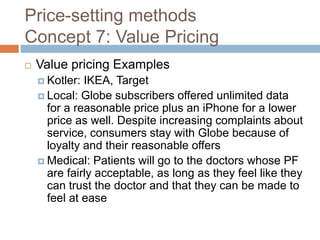
Concept 7: Value Pricing
 Value pricing Examples
 Kotler: IKEA, Target
 Local: Globe subscribers offered unlimited data
for a reasonable price plus an iPhone for a lower
price as well. Despite increasing complaints about
service, consumers stay with Globe because of
loyalty and their reasonable offers
 Medical: Patients will go to the doctors whose PF
are fairly acceptable, as long as they feel like they
can trust the doctor and that they can be made to
feel at ease
Price-setting methods
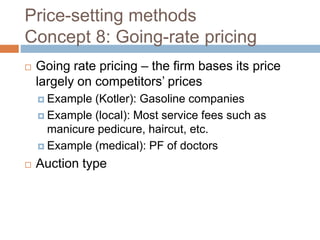
Concept 8: Going-rate pricing
 Going rate pricing – the firm bases its price
largely on competitors’ prices
 Example (Kotler): Gasoline companies
 Example (local): Most service fees such as
manicure pedicure, haircut, etc.
 Example (medical): PF of doctors
 Auction type
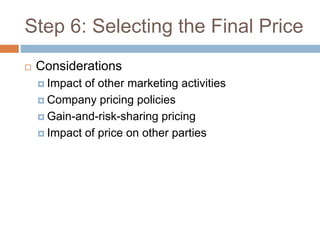
Step 6: Selecting the Final Price
 Considerations
 Impact of other marketing activities
 Company pricing policies
 Gain-and-risk-sharing pricing
 Impact of price on other parties
Step 6: Selecting the Final Price
 Impact of other marketing activities
 Average quality, high relative advertising budgets
– could charge premium prices
 High relative quality, high relative advertising –
highest prices
 Low quality and low advertising – lowest prices
Outline
1. Understanding Pricing
2. Setting the Price
3. Adapting the Price
4. Initiating and Responding to Price Changes
Adapting the Price
 Geographical pricing
 Price discounts and allowances
 Promotional pricing
 Differentiated pricing
Adapting the Price
Concept 9: Geographic Pricing
 Geographic Pricing – company decides how to price its
products to different customers in different locations and
countries
 Barter – exchange of goods
 Compensation deal – payment partly in cash, the rest in goods
 Example (kotler) – British aircraft manufacturer, 70% cash, the rest in
coffee
 Example (local) – Globe iPhone forever: Give your old iPhone +
some cashout = new iphone
 Example (medical) – med reps sending you to conferences out of
the country+ pocket money in exchange for you prescribing their
drug (UNETHICAL BUT IT HAPPENS!)
 Buyback agreement – an equipment, plant or technology in
exchange for the products it will produce
 Offset – full payment in cash, but that cash should be spent in
that country within a stated time period
Adapting the Price
 Price Discounts and Allowances
 Early payment
 Volume purchases
 Off-season buying
 Promotional Pricing
 Loss-leader pricing
 Special event pricing
 Special customer pricing
 Cash rebates
 Low-interest financing
 Longer payment terms
 Warranties and service contracts
 Psychological discounting
Adapting the Price
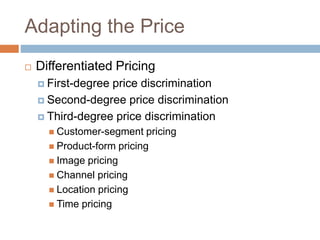
 Differentiated Pricing
 First-degree price discrimination
 Second-degree price discrimination
 Third-degree price discrimination
 Customer-segment pricing
 Product-form pricing
 Image pricing
 Channel pricing
 Location pricing
 Time pricing
Adapting the Price
Concept 10: Location Pricing
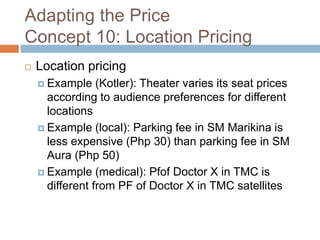
 Location pricing
 Example (Kotler): Theater varies its seat prices
according to audience preferences for different
locations
 Example (local): Parking fee in SM Marikina is
less expensive (Php 30) than parking fee in SM
Aura (Php 50)
 Example (medical): Pfof Doctor X in TMC is
different from PF of Doctor X in TMC satellites
Outline
1. Understanding Pricing
2. Setting the Price
3. Adapting the Price
4. Initiating and Responding to Price Changes
Initiating and Responding to Price
Changes
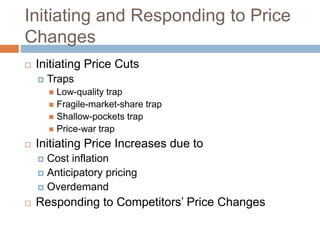
 Initiating Price Cuts
 Traps
 Low-quality trap
 Fragile-market-share trap
 Shallow-pockets trap
 Price-war trap
 Initiating Price Increases due to
 Cost inflation
 Anticipatory pricing
 Overdemand
 Responding to Competitors’ Price Changes
Outline
1. Understanding Pricing
2. Setting the Price
3. Adapting the Price
4. Initiating and Responding to Price Changes
DEVELOPING PRICING
STRATEGIES AND
PROGRAMS
Montenegro, Riza Ann Lee G.
MD12-0010

Montenegro, markman chapter 14

  • 1.
  • 2.
    Outline 1. Understanding Pricing 2.Setting the Price 3. Adapting the Price 4. Initiating and Responding to Price Changes
  • 3.
    Introduction  Price isthe one element of marketing mix that produces revenue (others produce costs)  Pricing decisions are clearly complex and difficult  Must be consistent with the firm’s marketing strategy and its target markets and brand positionings
  • 4.
    Outline 1. Understanding Pricing 2.Setting the Price 3. Adapting the Price 4. Initiating and Responding to Price Changes
  • 5.
    Understanding Pricing  Comesin many forms, performs many functions  Rent, tuition, fares, fees, rates, tolls, retainers, wages, commissions  Has many components  Price has operated as a major determinant of buyers choice
  • 6.
    Concept 1: AChanging Pricing Environment  21st century  Access to credit cards, debit cards  allowed firms to offer more expensive products and services  Great Recession  Shift from luxury to basics needs  Less spending, smart buying  Shift to more economic and practical purchases  Technological environment
  • 7.
    Concept 1: AChanging Pricing Environment  Technological environment (Internet)  Buyers can get instant price comparisons from thousands of vendors  Name their price and have it met  Get products free  Give certain customers access to special prices  Negotiate prices in online auctions and  Intelligent shopping with the help of the internet  Example (Kotler)  mySimon.com, PriceSCAN.com – Compare prices of multiple bookstores  Example (local)  Olx.com.ph (formerly sulit.com), Zalora, Lazada  Example (medical)  Forums about where to find the cheapest medical equipment (e.g. bambang), or an affordable doctor, or cheap hospitals
  • 8.
    Concept 2: ConsumerPsychology and Pricing  Consumers actively process price information  Prior purchasing experience, formal communications, informal communications, point- of-purchase or online resources, etc.  Purchase decisions – consumer’s perception of the price vs. what they consider the current actual price to be
  • 9.
    Concept 2: ConsumerPsychology and Pricing  Example (Kotler)  A Black T-Shirt, Gap ($14.90) vs. Armani ($275)  Example (local)  Nescafe small coffee bottle (Php 50.00) is considered expensive but Starbucks coffee (Php 150.00) is considered normal because customers are paying for the “brand” the ambience, etc.  Example (medical)  Doctor X charges a higher PF to his patients in TMC than his patients in other private less known hospitals because he knows patients who go to TMC . Despite offering the same services, and having the same set of skills, his PF varies
  • 10.
    Concept 2: ConsumerPsychology and Pricing  Understanding how consumers arrive at their perceptions of prices is an important marketing priority  Reference Prices  Price-Quality Inferences  Price Endings
  • 11.
    Concept 3: ReferencePrices  “Fair Price”  Typical Price  Last Price Paid  Upper-Bound Price  Lower Bound Price  Historical Competitor Prices  Expected Future Price  Usual Discounted Price
  • 12.
    Concept 3: ReferencePrices  Examples  Kotler: Dept stores will display women’s apparel in separate departments differentiated by price; dresses in more expensive department are assumed to be of better quality  Local: Suggested retail price “Ariel Php 7.50”  Medical: An Welch Allyn diagnostic set in a medical equipment store is worth 20k. A consumer with a knowledge of competitor prices (reference price) will prefer to buy it in Bambang for 14.5k
  • 13.
    Concept 4: Price-Quality Inference Price as an indicator of quality  Image pricing is effective with ego-sensitive products  Examples  Kotler: Higher-priced cars are perceived to possess high quality. Higher-quality cars are likewise perceived to be higher priced than they actually are  Local: Products bought from divisoria are perceived to be of low quality and would not sell at a high price.  Medical: Doctors who charge higher PF are assumed to be very good doctors and would offer better services. “They must be THAT good to charge that
  • 14.
    Outline 1. Understanding Pricing 2.Setting the Price 3. Adapting the Price 4. Initiating and Responding to Price Changes
  • 15.
    Setting the Price Step 1: Selecting the Pricing Objective  Survival, max current profit, max market share, product-quality leadership, other objectives  Step 2: Determining Demand  Step 3: Estimating Costs  Step 4: Analyzing Competitors’ Costs, Prices, and Offers  Step 5: Selecting a Pricing Method  Step 6: Selecting the Final Price
  • 16.
    Step 1: Settingthe Price Objective  Survival  Maximum Current Profit  Maximum Market Share  Maximum Market Skimming  Product Quality Leadership  Other objectives (e.g. partial cost recovery)
  • 17.
    Step 2: DeterminingDemand Concept 5: Price Sensitivity  Price Sensitivity – reactions of consumers to price changes  Normally inverse relationship  Elastic vs. Inelastic Demand  If demand is elastic, sellers will consider lowering the price  Lower price will produce more total revenue  Long-run price elasticity vs. Short-run elasticity
  • 18.
    Step 2: DeterminingDemand Concept 5: Price Sensitivity  Price sensitivity  Customers are less price-sensitive:  Distinct product  No/few/unknown substitutes  Cannot easily compare quality of substitutes  Expenditure is small part of total income  Expenditure is small compared to the total cost of the end product  Part of the cost is borne by another party  Product is used in conjunction with assets previously bought  Product is assumed to have more qualilty, prestige, or exclusiveness  Buyers cannot store the product
  • 19.
    Step 2: DeterminingDemand Concept 5: Price Sensitivity  Price Sensitivity – Examples  Kotler: Internet increases price sensitivity. Car buyers use the internet to gather information and borrow the negotiating clout of an online buying service  Local: Consumers are less sensitive to price increases in SM supermarkets, than in stores such as H&M, Zara, etc . Consumers are less sensitive to price increases of basic needs (inelastic demand) than luxury items (elastic demand)  Medical: Consumers are less sensitive to rates of the emergency room (need, no substitutes) than doctors’ professional fees (many alternatives)
  • 20.
    Step 3: EstimatingCosts  Types of Costs and Levels of Production  Demand: sets a ceiling price; Costs: set the floor price  Costs  fixed costs + variable costs = total cost  Average cost per unit  To price intelligently, management needs to know how its costs vary with different levels of production  To estimate the real profitability of selling to different types of retailers or customers, manufacturer needs to use activity-based cost accounting instead of standard cost accounting
  • 21.
    Step 3: EstimatingCosts  Accumulated Production  Experience curve or Learning Curve  Decline in average cost with accumulated production experience  Methods improve, workers learn shortcuts, materials flow more smoothly, procurement costs fall  Experience-curve pricing is risky  Target Costing
  • 22.
    Step 4, Concept6: Analyzing Competitors’ Costs, Prices and Offers  Introduction or change of any price can provoke a response from customers, competitors, distributors, suppliers, and even government  Competitors are most likely to react when the number of firms is few, the product is homogeneous, and buyers are highly informed  Examples  Kotler: Green Works – affordable price, biodegradable ingredients, packaged in recyclable materials, not tested on animals  Local: Sun Cellular – unlimited calls and texts – drove Globe and Smart to lower prices to unlimited calls and texts as well  Medical – Laboratory clinics offering services at lower prices will drive the other clinics in the area to match
  • 23.
    Step 5: Selectinga Pricing Method  Costs set a floor  Competitor’s prices, price of subs provide an orienting point  Customer’s perception of quality establishes price ceiling  Price-setting methods: Mark-up Pricing, Target-return pricing, perceived-value pricing, value pricing, going-rate pricing, and auction type pricing
  • 24.
    Price-setting methods  Mark-uppricing – adding a standard mark up to the product’s cost  Target-return pricing – firm determines the price that yields its target rate of ROI  Perceived-value pricing – pricing based on buyer’s image of the product performance, the channel deliverables, the warranty quality, customer support; supplier’s reputation, trustworthiness and esteem.  Value pricing – firms win loyal customers by charging fairly low price for a high-quality offering
  • 25.
    Price-setting methods Concept 7:Value Pricing  Value pricing Examples  Kotler: IKEA, Target  Local: Globe subscribers offered unlimited data for a reasonable price plus an iPhone for a lower price as well. Despite increasing complaints about service, consumers stay with Globe because of loyalty and their reasonable offers  Medical: Patients will go to the doctors whose PF are fairly acceptable, as long as they feel like they can trust the doctor and that they can be made to feel at ease
  • 26.
    Price-setting methods Concept 8:Going-rate pricing  Going rate pricing – the firm bases its price largely on competitors’ prices  Example (Kotler): Gasoline companies  Example (local): Most service fees such as manicure pedicure, haircut, etc.  Example (medical): PF of doctors  Auction type
  • 27.
    Step 6: Selectingthe Final Price  Considerations  Impact of other marketing activities  Company pricing policies  Gain-and-risk-sharing pricing  Impact of price on other parties
  • 28.
    Step 6: Selectingthe Final Price  Impact of other marketing activities  Average quality, high relative advertising budgets – could charge premium prices  High relative quality, high relative advertising – highest prices  Low quality and low advertising – lowest prices
  • 29.
    Outline 1. Understanding Pricing 2.Setting the Price 3. Adapting the Price 4. Initiating and Responding to Price Changes
  • 30.
    Adapting the Price Geographical pricing  Price discounts and allowances  Promotional pricing  Differentiated pricing
  • 31.
    Adapting the Price Concept9: Geographic Pricing  Geographic Pricing – company decides how to price its products to different customers in different locations and countries  Barter – exchange of goods  Compensation deal – payment partly in cash, the rest in goods  Example (kotler) – British aircraft manufacturer, 70% cash, the rest in coffee  Example (local) – Globe iPhone forever: Give your old iPhone + some cashout = new iphone  Example (medical) – med reps sending you to conferences out of the country+ pocket money in exchange for you prescribing their drug (UNETHICAL BUT IT HAPPENS!)  Buyback agreement – an equipment, plant or technology in exchange for the products it will produce  Offset – full payment in cash, but that cash should be spent in that country within a stated time period
  • 32.
    Adapting the Price Price Discounts and Allowances  Early payment  Volume purchases  Off-season buying  Promotional Pricing  Loss-leader pricing  Special event pricing  Special customer pricing  Cash rebates  Low-interest financing  Longer payment terms  Warranties and service contracts  Psychological discounting
  • 33.
    Adapting the Price Differentiated Pricing  First-degree price discrimination  Second-degree price discrimination  Third-degree price discrimination  Customer-segment pricing  Product-form pricing  Image pricing  Channel pricing  Location pricing  Time pricing
  • 34.
    Adapting the Price Concept10: Location Pricing  Location pricing  Example (Kotler): Theater varies its seat prices according to audience preferences for different locations  Example (local): Parking fee in SM Marikina is less expensive (Php 30) than parking fee in SM Aura (Php 50)  Example (medical): Pfof Doctor X in TMC is different from PF of Doctor X in TMC satellites
  • 35.
    Outline 1. Understanding Pricing 2.Setting the Price 3. Adapting the Price 4. Initiating and Responding to Price Changes
  • 36.
    Initiating and Respondingto Price Changes  Initiating Price Cuts  Traps  Low-quality trap  Fragile-market-share trap  Shallow-pockets trap  Price-war trap  Initiating Price Increases due to  Cost inflation  Anticipatory pricing  Overdemand  Responding to Competitors’ Price Changes
  • 37.
    Outline 1. Understanding Pricing 2.Setting the Price 3. Adapting the Price 4. Initiating and Responding to Price Changes
  • 38.