Mapping the Vegetation of
         Texas
Background
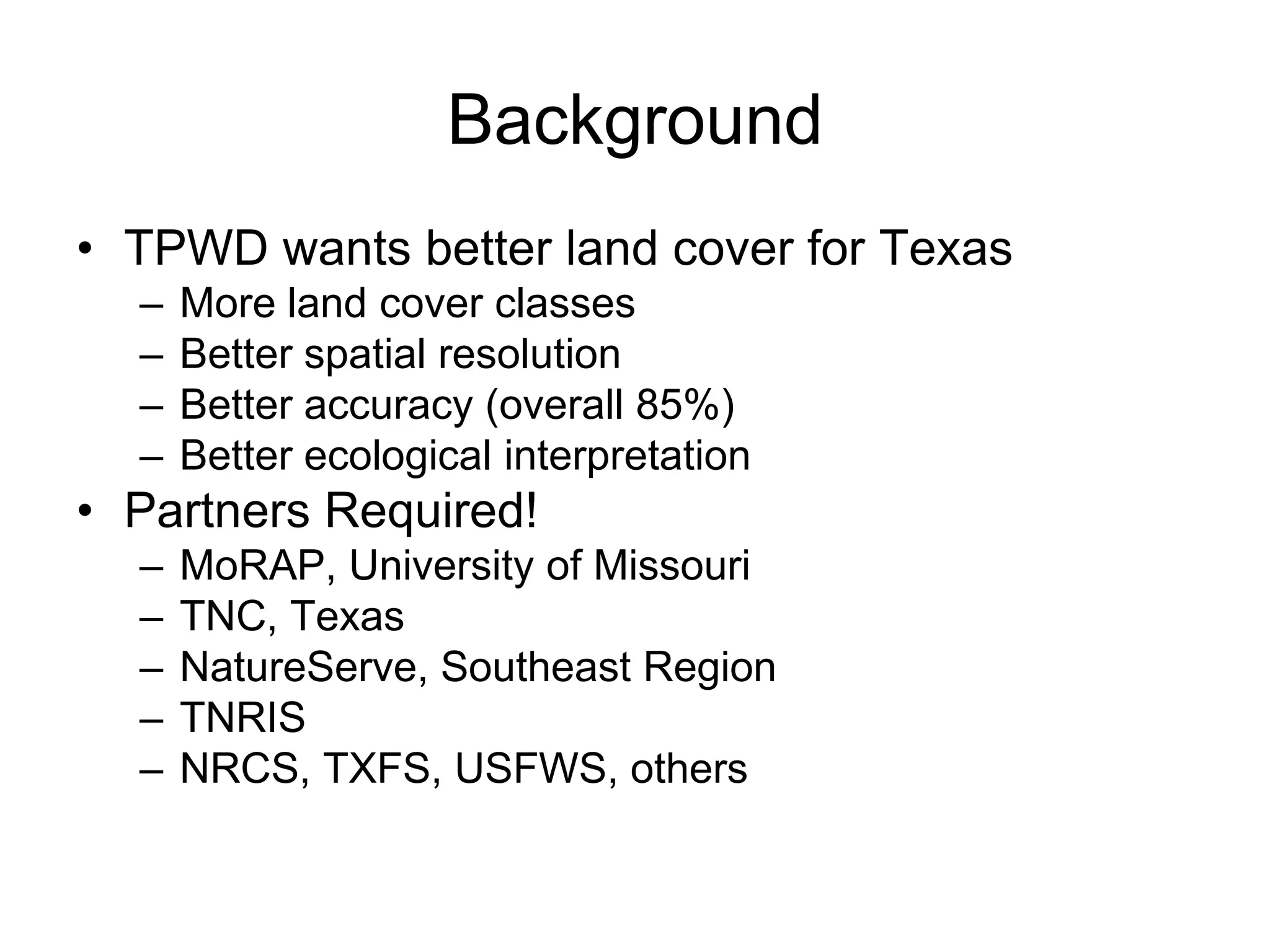
• TPWD wants better land cover for Texas
  –   More land cover classes
  –   Better spatial resolution
  –   Better accuracy (overall 85%)
  –   Better ecological interpretation
• Partners Required!
  –   MoRAP, University of Missouri
  –   TNC, Texas
  –   NatureServe, Southeast Region
  –   TNRIS
  –   NRCS, TXFS, USFWS, others
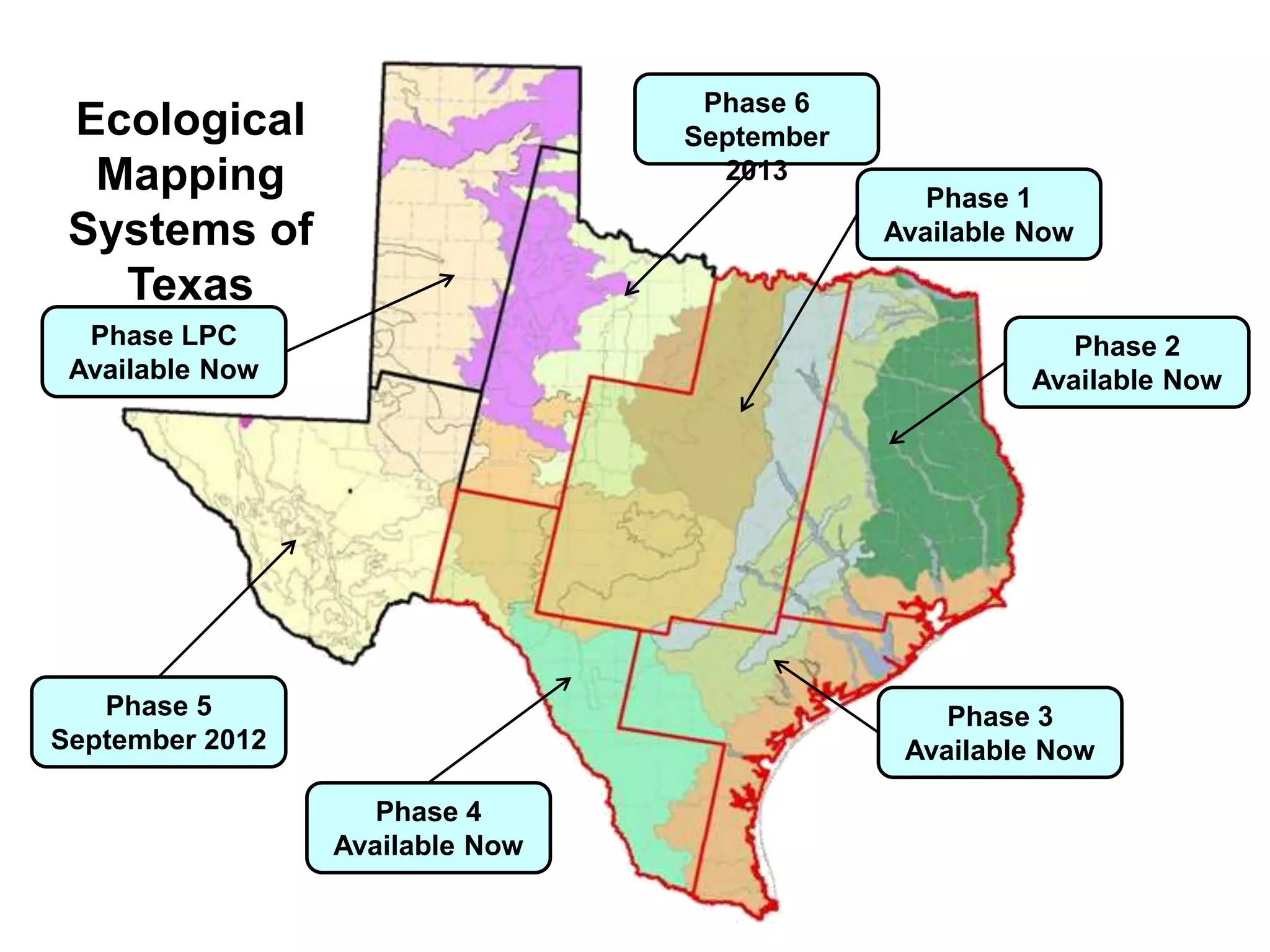
Phase 6
 Ecological                      September
  Mapping                          2013
                                                Phase 1
 Systems of                                  Available Now

   Texas
  Phase LPC                                               Phase 2
 Available Now                                         Available Now


   Phase 5                                       Phase 3
September 2012                                Available Now

                    Phase 4
                 Available Now
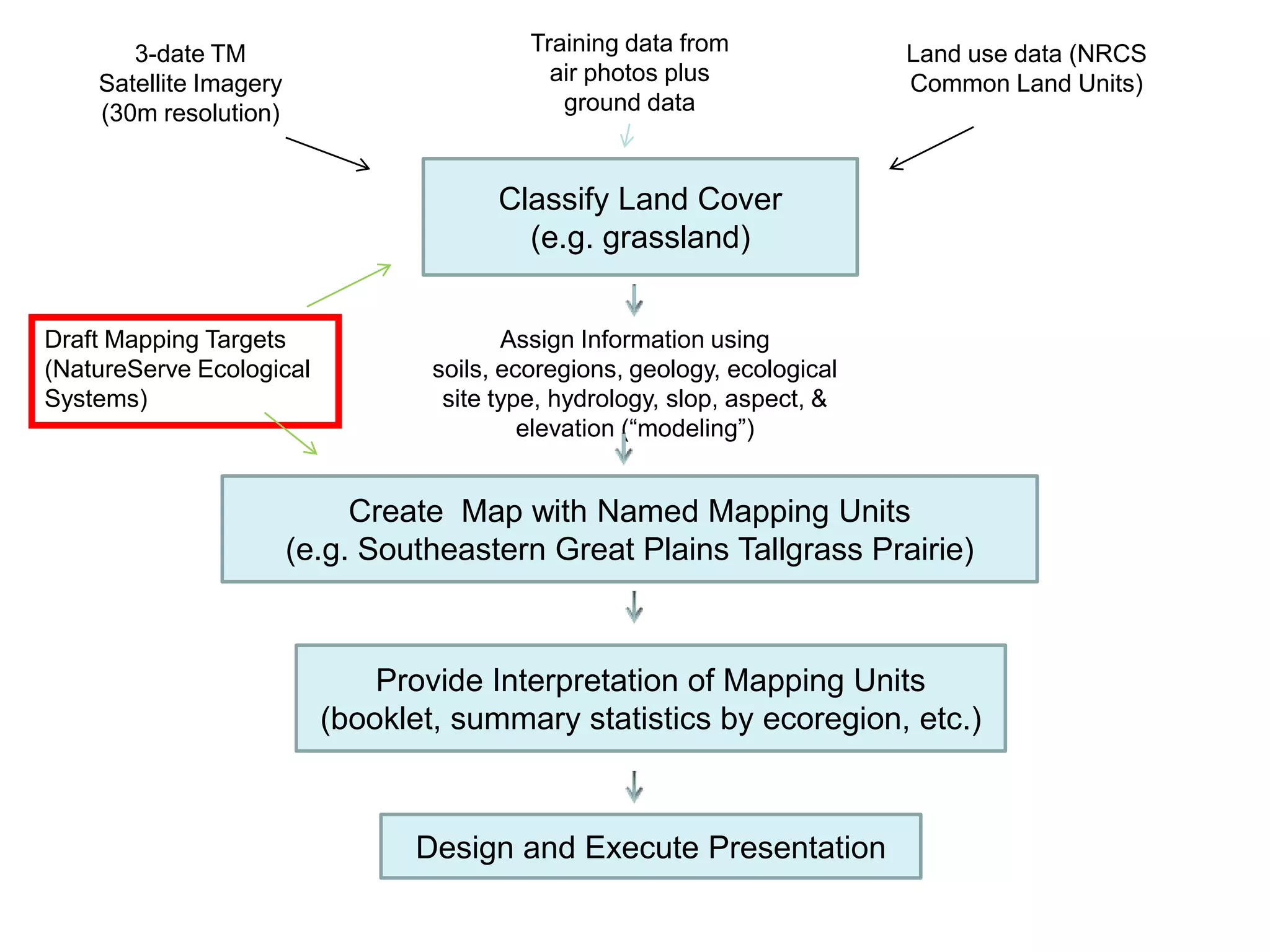
3-date TM                           Training data from              Land use data (NRCS
    Satellite Imagery                        air photos plus               Common Land Units)
    (30m resolution)                          ground data


                                        Classify Land Cover
                                          (e.g. grassland)


Draft Mapping Targets                    Assign Information using
(NatureServe Ecological           soils, ecoregions, geology, ecological
Systems)                           site type, hydrology, slop, aspect, &
                                           elevation (“modeling”)


                             Create Map with Named Mapping Units
                        (e.g. Southeastern Great Plains Tallgrass Prairie)


                              Provide Interpretation of Mapping Units
                          (booklet, summary statistics by ecoregion, etc.)


                                 Design and Execute Presentation
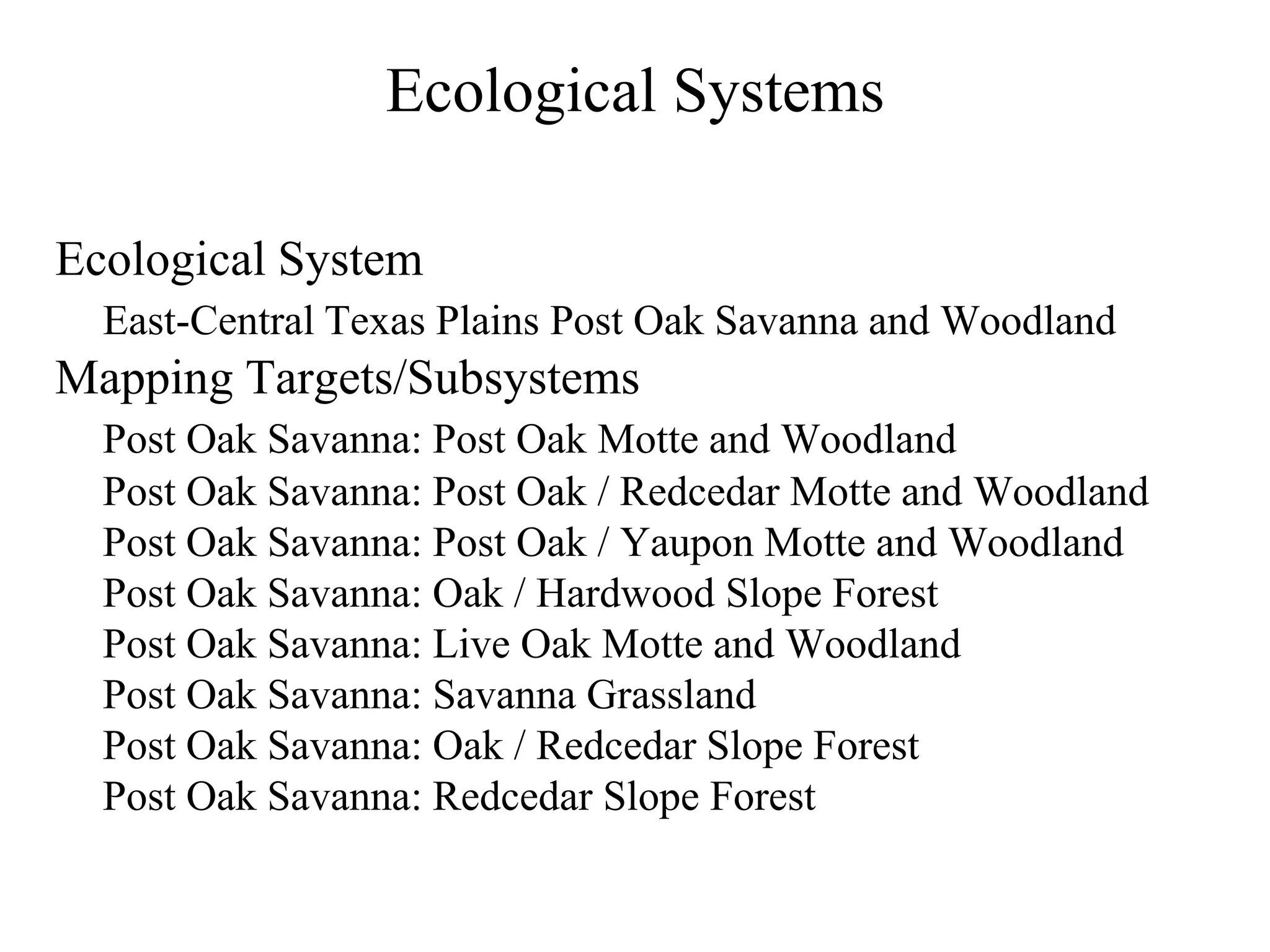
Ecological Systems

Ecological System
  East-Central Texas Plains Post Oak Savanna and Woodland
Mapping Targets/Subsystems
  Post Oak Savanna: Post Oak Motte and Woodland
  Post Oak Savanna: Post Oak / Redcedar Motte and Woodland
  Post Oak Savanna: Post Oak / Yaupon Motte and Woodland
  Post Oak Savanna: Oak / Hardwood Slope Forest
  Post Oak Savanna: Live Oak Motte and Woodland
  Post Oak Savanna: Savanna Grassland
  Post Oak Savanna: Oak / Redcedar Slope Forest
  Post Oak Savanna: Redcedar Slope Forest
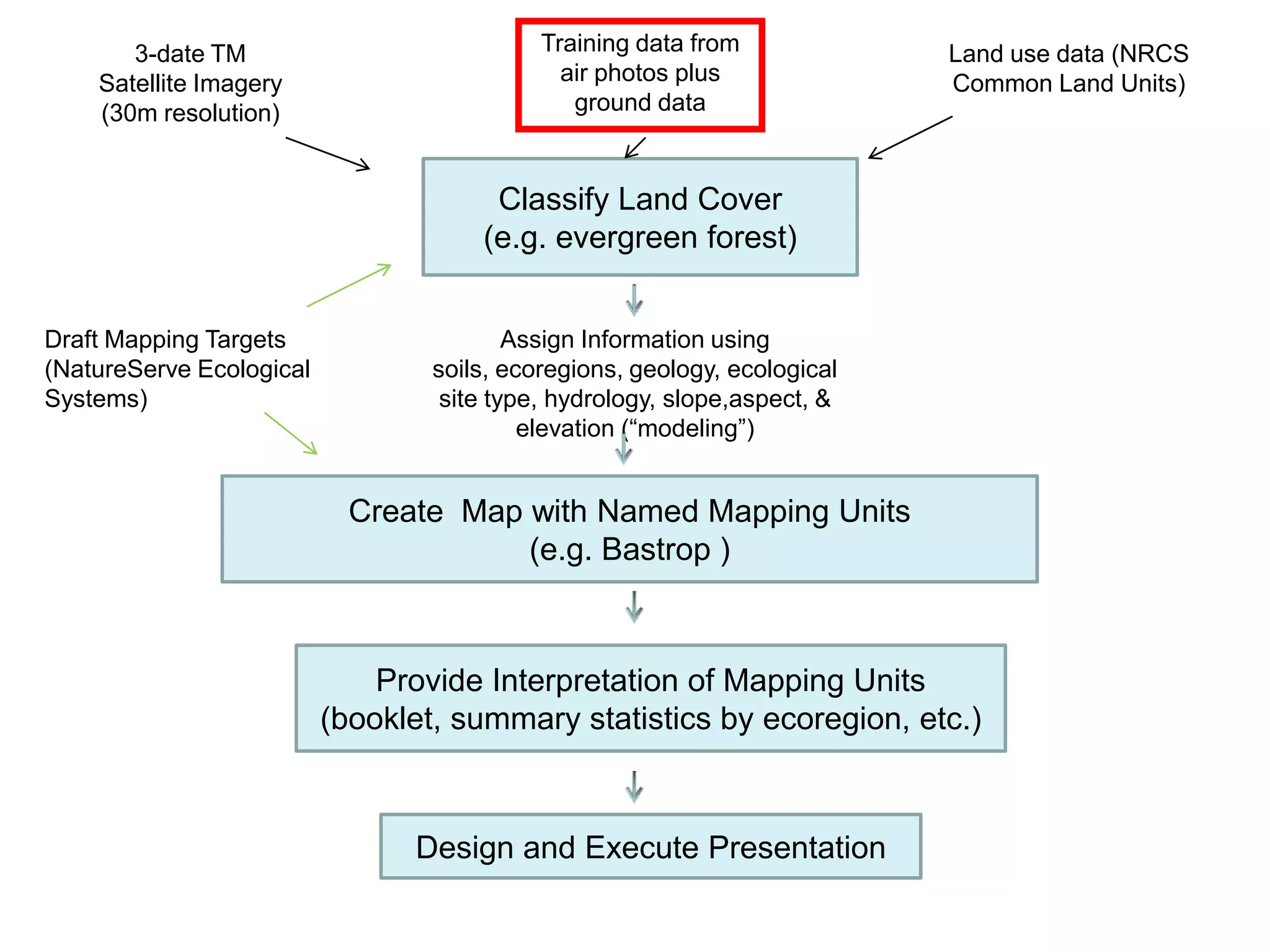
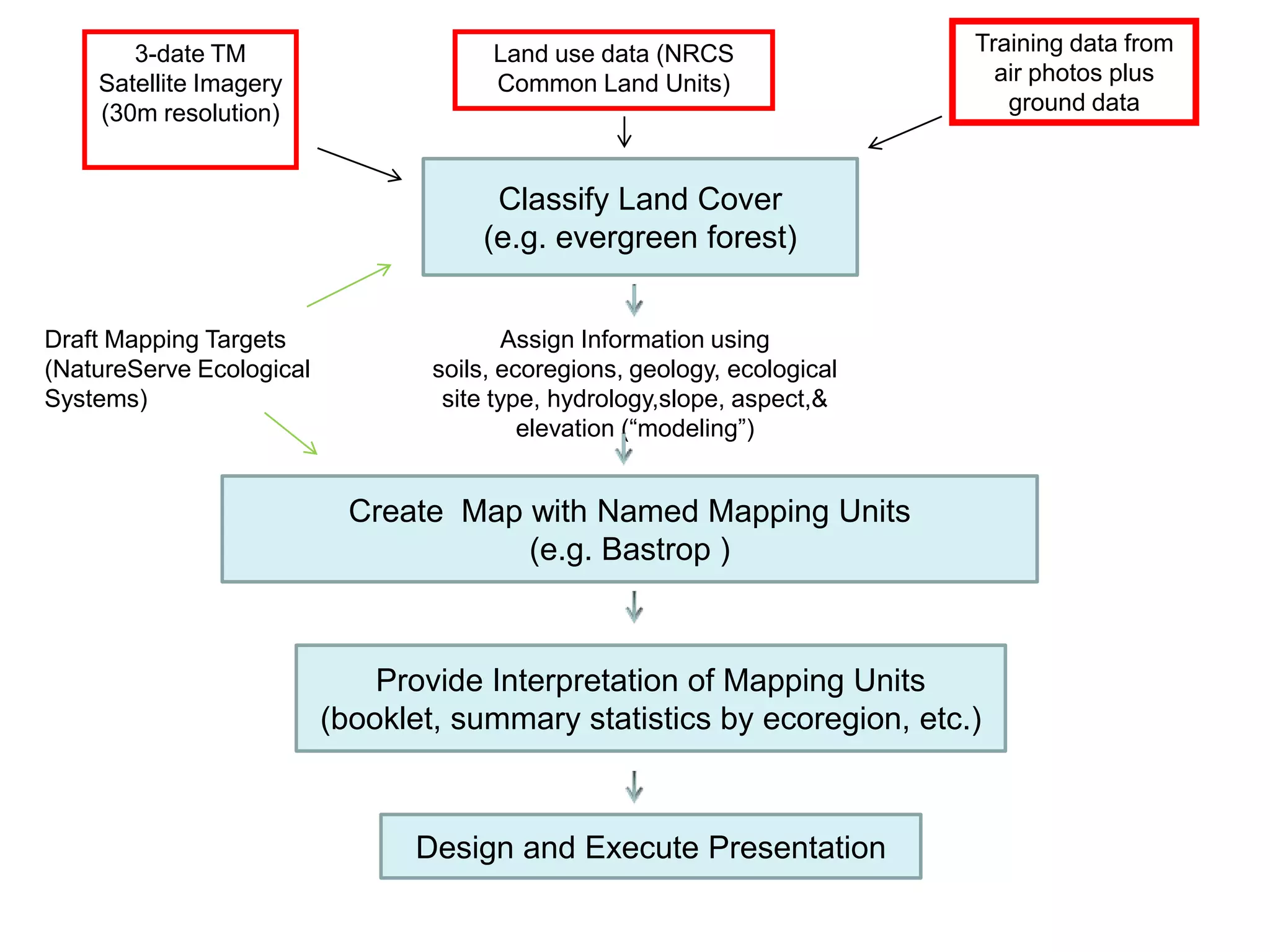
3-date TM                            Training data from             Land use data (NRCS
    Satellite Imagery                         air photos plus              Common Land Units)
    (30m resolution)                           ground data


                                       Classify Land Cover
                                      (e.g. evergreen forest)


Draft Mapping Targets                     Assign Information using
(NatureServe Ecological           soils, ecoregions, geology, ecological
Systems)                           site type, hydrology, slope,aspect, &
                                           elevation (“modeling”)


                            Create Map with Named Mapping Units
                                       (e.g. Bastrop )


                              Provide Interpretation of Mapping Units
                          (booklet, summary statistics by ecoregion, etc.)


                                Design and Execute Presentation
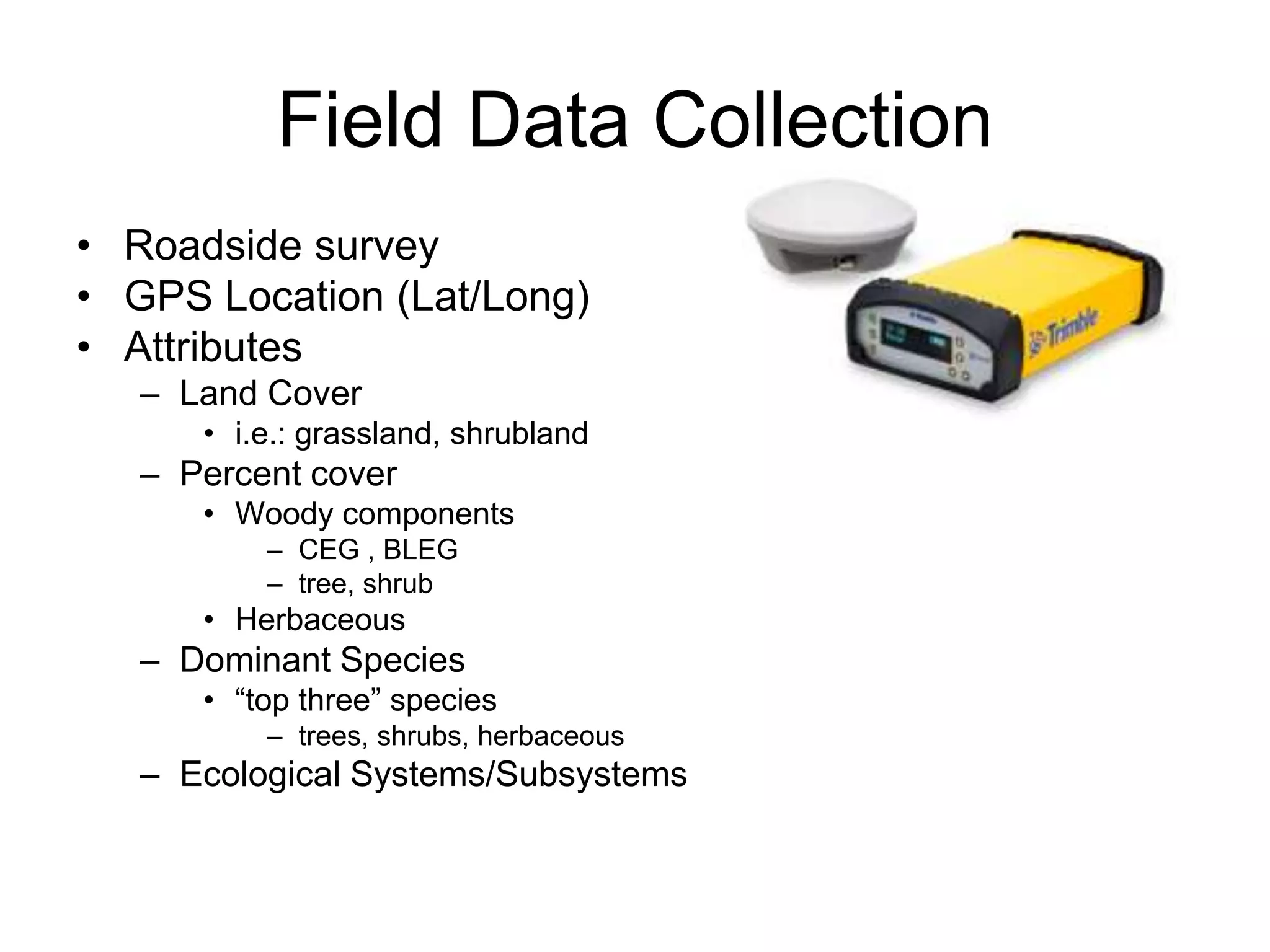
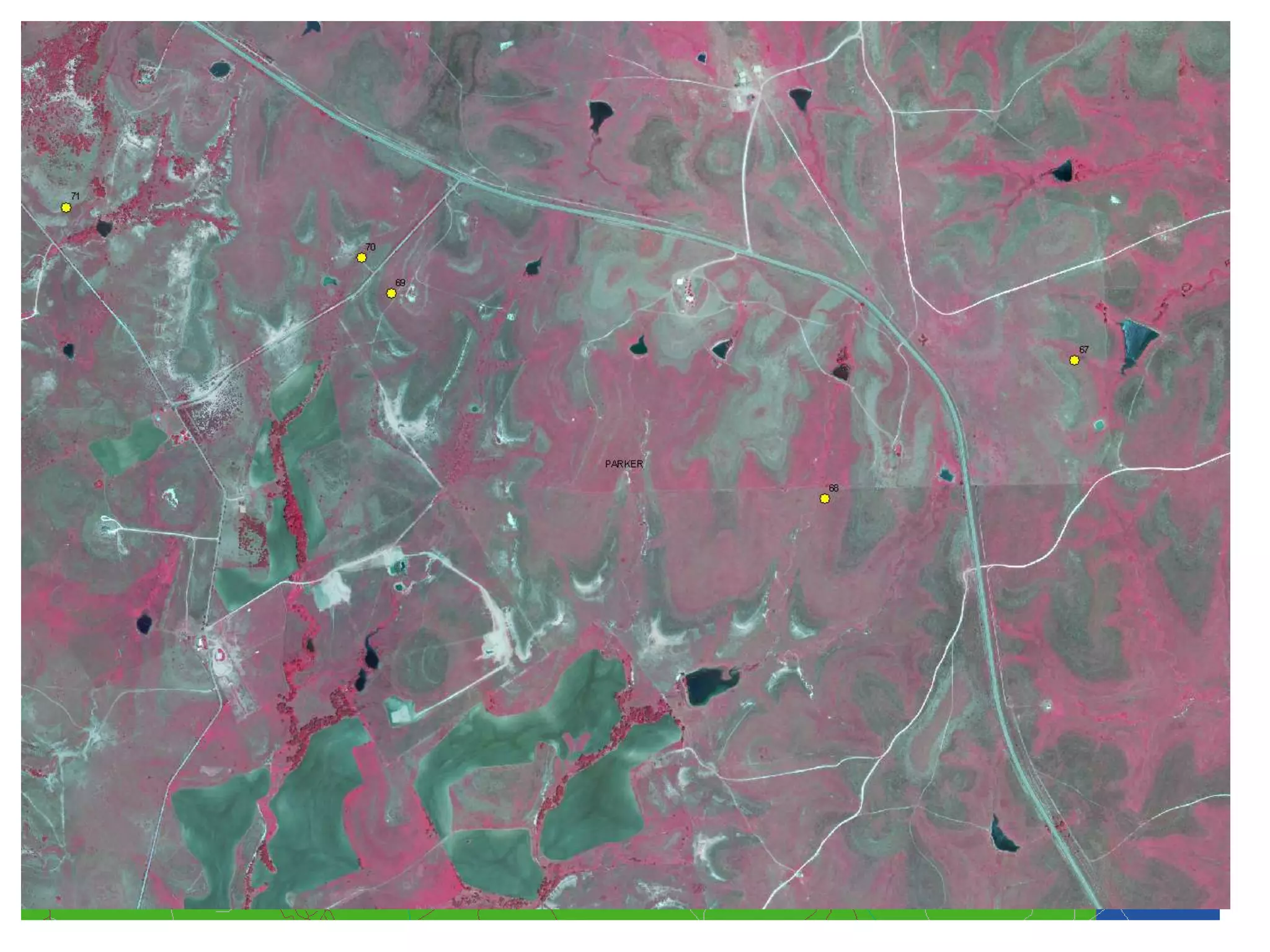
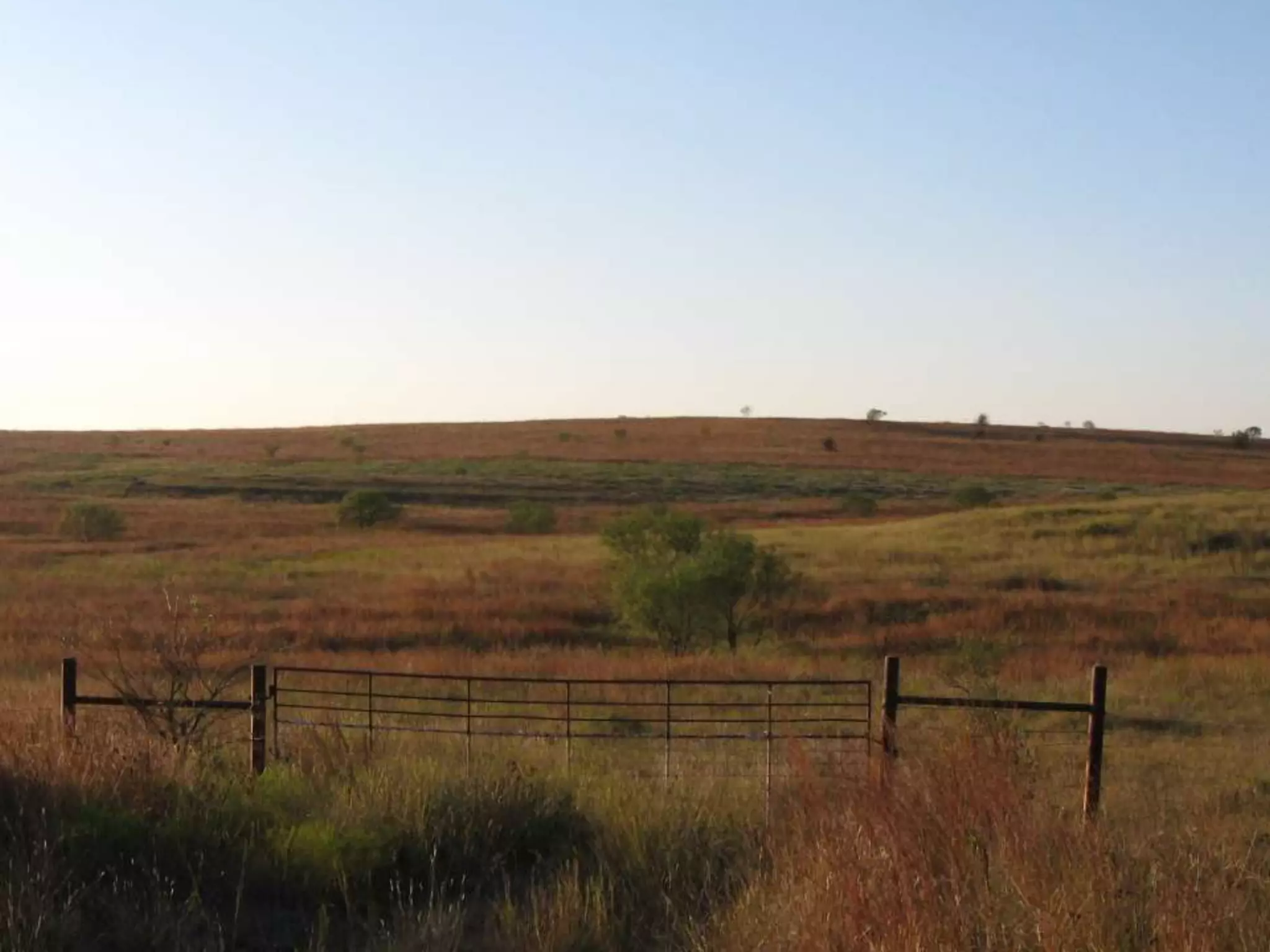
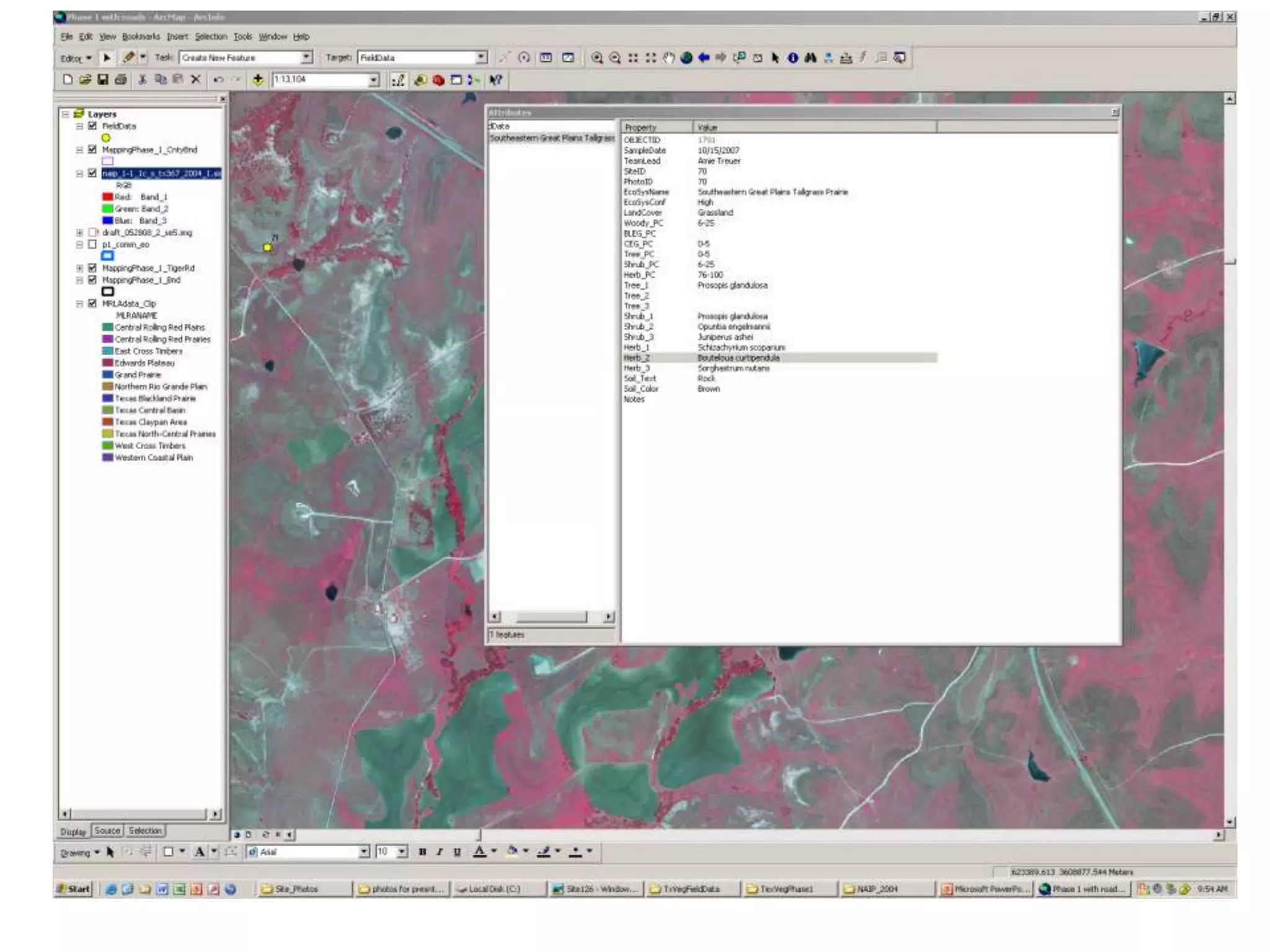
Field Data Collection
• Roadside survey
• GPS Location (Lat/Long)
• Attributes
   – Land Cover
      • i.e.: grassland, shrubland
   – Percent cover
      • Woody components
          – CEG , BLEG
          – tree, shrub
      • Herbaceous
   – Dominant Species
      • “top three” species
          – trees, shrubs, herbaceous
   – Ecological Systems/Subsystems
3-date TM                       Land use data (NRCS                 Training data from
    Satellite Imagery                  Common Land Units)                    air photos plus
    (30m resolution)                                                          ground data


                                       Classify Land Cover
                                      (e.g. evergreen forest)


Draft Mapping Targets                     Assign Information using
(NatureServe Ecological           soils, ecoregions, geology, ecological
Systems)                           site type, hydrology,slope, aspect,&
                                           elevation (“modeling”)


                            Create Map with Named Mapping Units
                                       (e.g. Bastrop )


                              Provide Interpretation of Mapping Units
                          (booklet, summary statistics by ecoregion, etc.)


                                Design and Execute Presentation
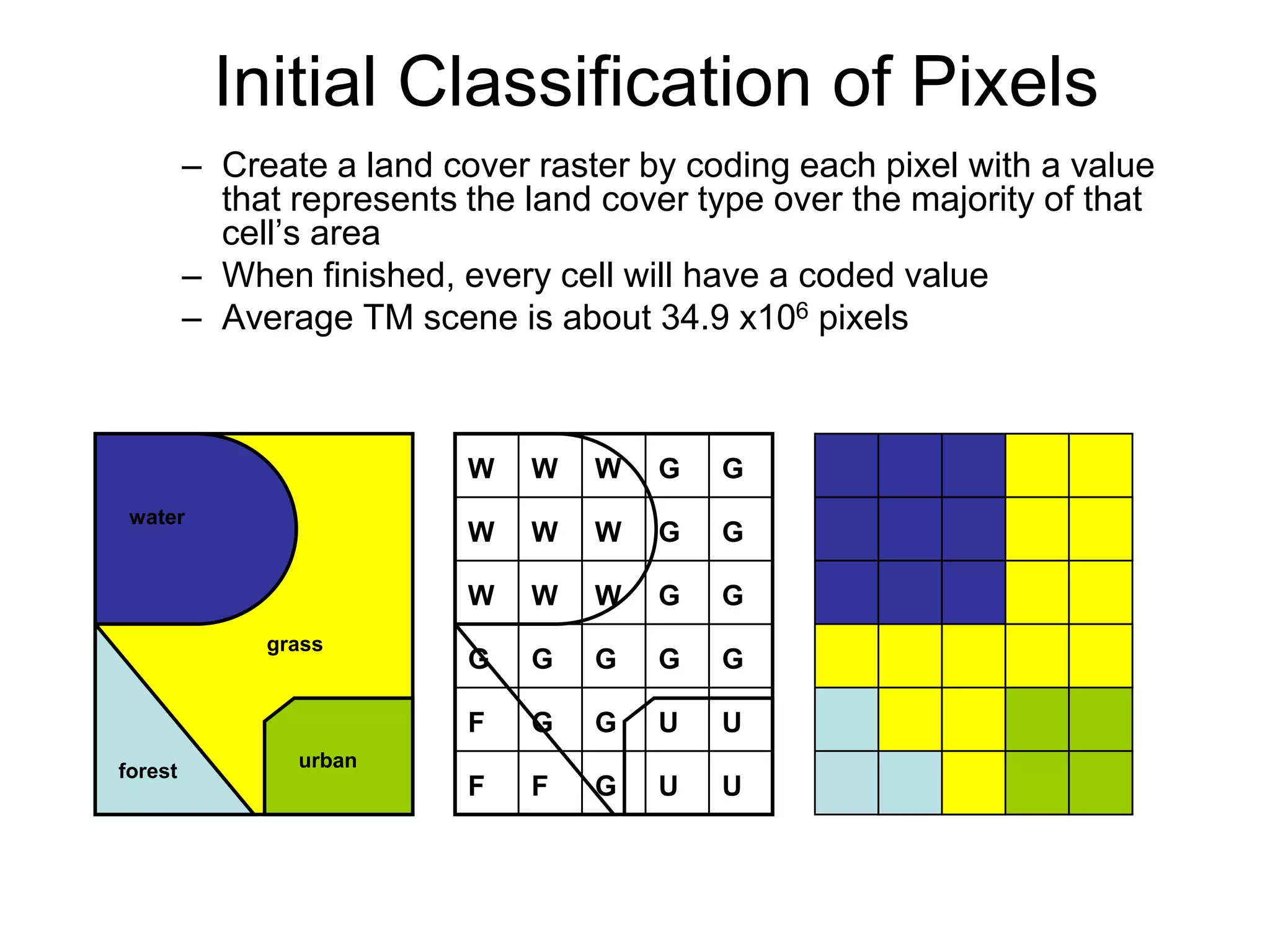
Initial Classification of Pixels
         – Create a land cover raster by coding each pixel with a value
           that represents the land cover type over the majority of that
           cell’s area
         – When finished, every cell will have a coded value
         – Average TM scene is about 34.9 x106 pixels


                           W   W   W   G   G
 water
                           W   W   W   G   G

                           W   W   W   G   G
              grass
                           G   G   G   G   G

                           F   G   G   U   U
forest          urban
                           F   F   G   U   U
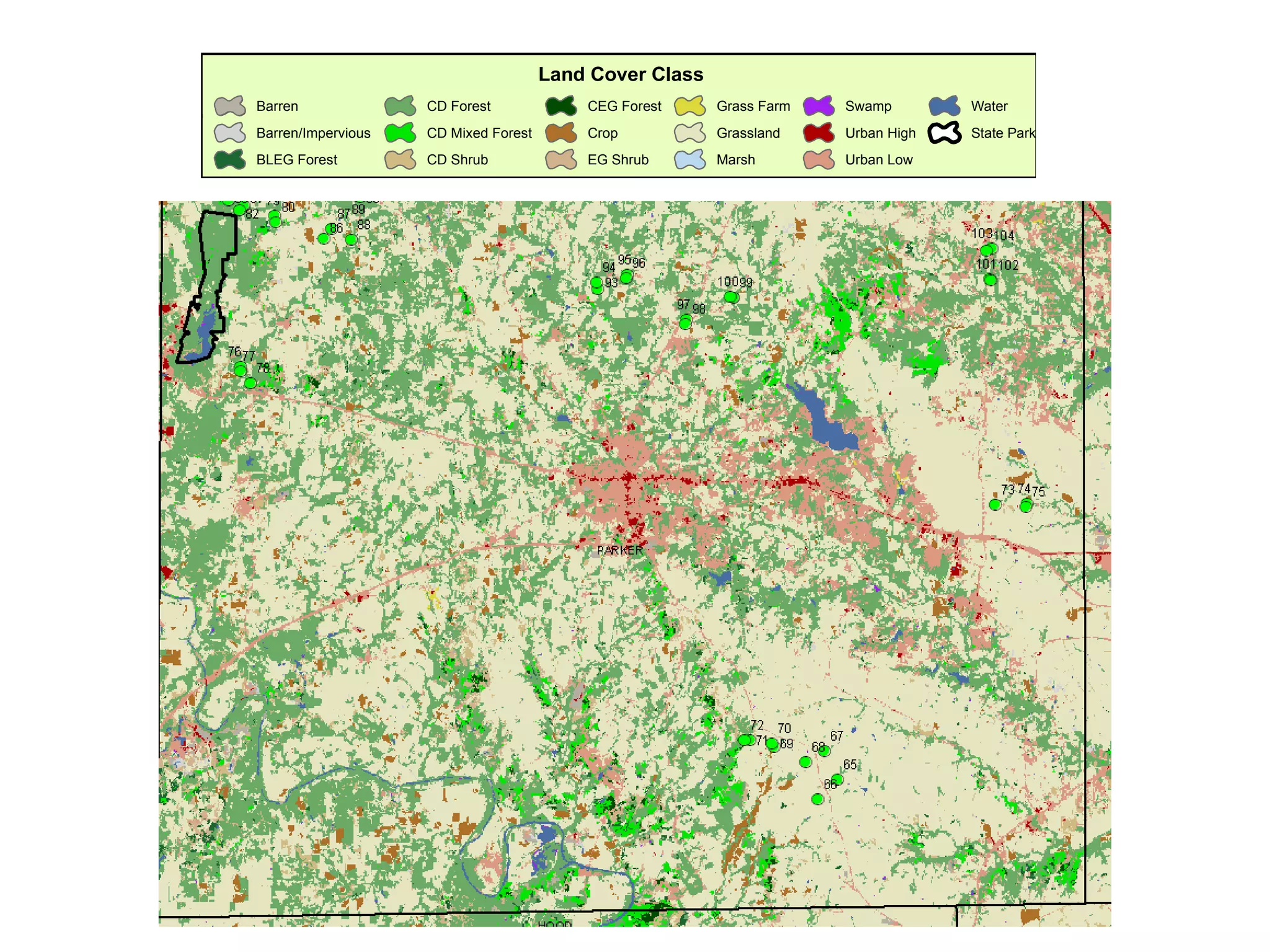
Land Cover Class
Barren              CD Forest             CEG Forest     Grass Farm   Swamp        Water
Barren/Impervious   CD Mixed Forest       Crop           Grassland    Urban High   State Park
BLEG Forest         CD Shrub              EG Shrub       Marsh        Urban Low
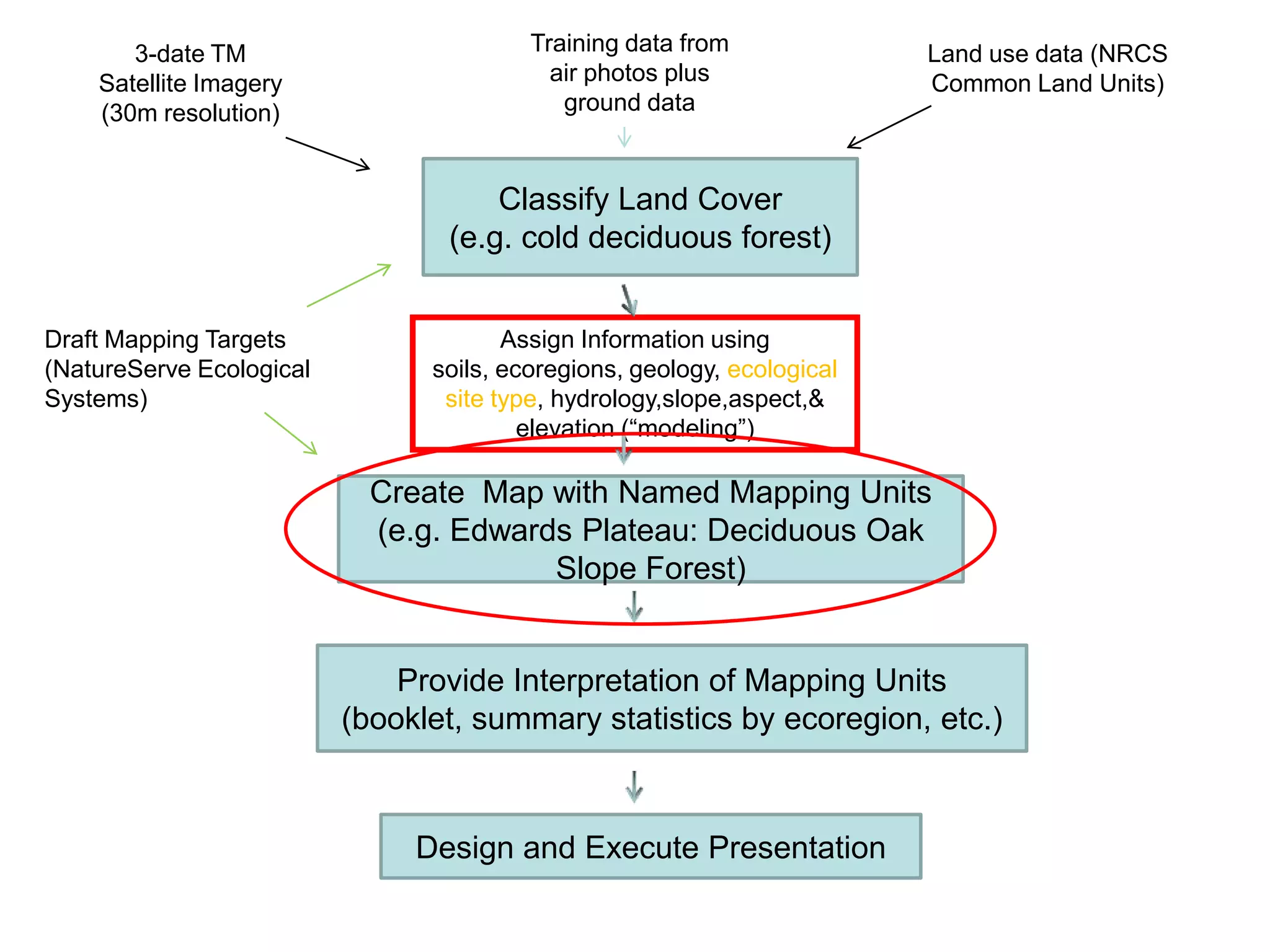
3-date TM                         Training data from              Land use data (NRCS
    Satellite Imagery                      air photos plus               Common Land Units)
    (30m resolution)                        ground data


                                     Classify Land Cover
                                 (e.g. cold deciduous forest)


Draft Mapping Targets                  Assign Information using
(NatureServe Ecological         soils, ecoregions, geology, ecological
Systems)                         site type, hydrology,slope,aspect,&
                                         elevation (“modeling”)

                            Create Map with Named Mapping Units
                            (e.g. Edwards Plateau: Deciduous Oak
                                        Slope Forest)


                              Provide Interpretation of Mapping Units
                          (booklet, summary statistics by ecoregion, etc.)


                               Design and Execute Presentation
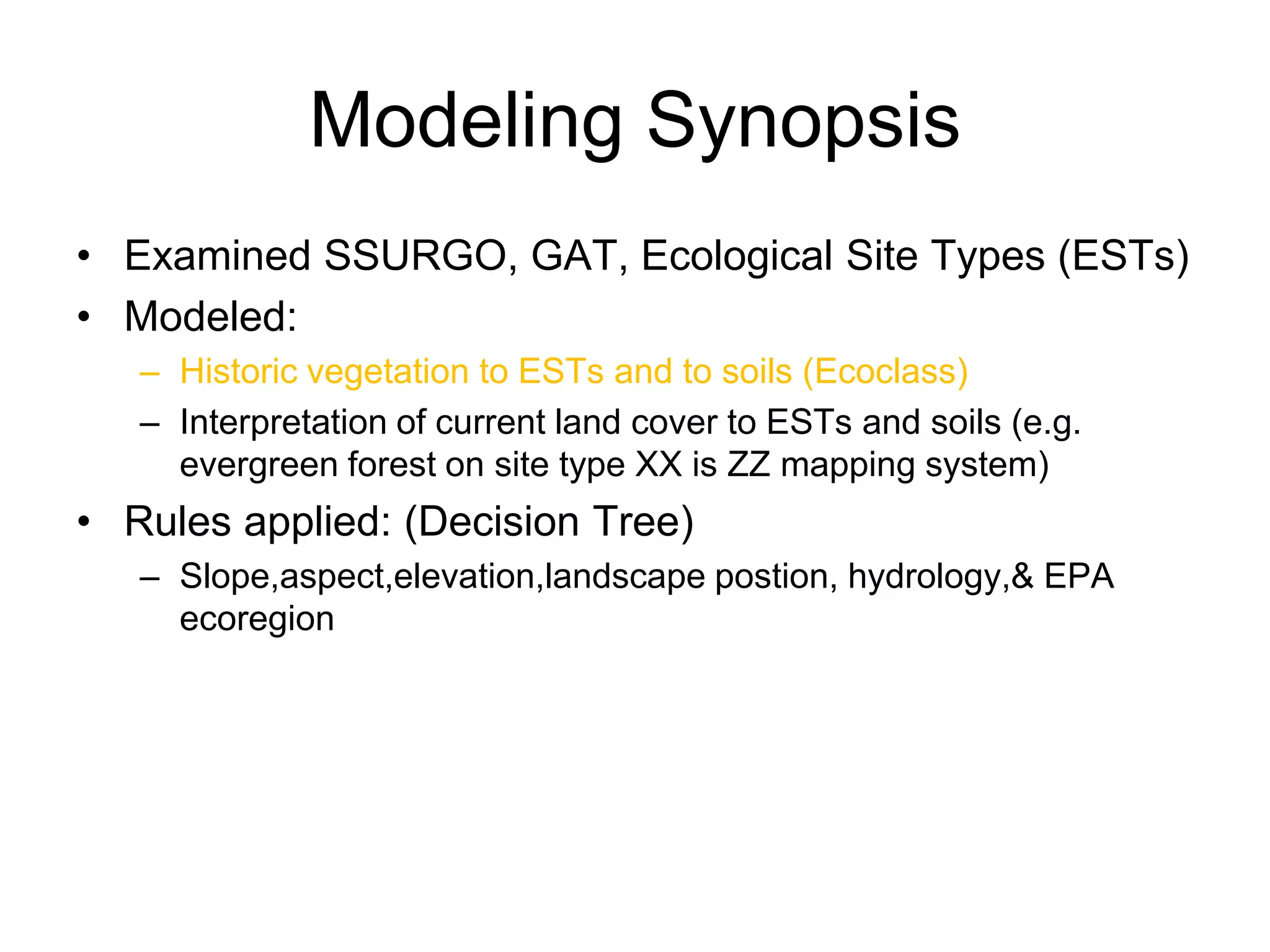
Modeling Synopsis
• Examined SSURGO, GAT, Ecological Site Types (ESTs)
• Modeled:
   – Historic vegetation to ESTs and to soils (Ecoclass)
   – Interpretation of current land cover to ESTs and soils (e.g.
     evergreen forest on site type XX is ZZ mapping system)
• Rules applied: (Decision Tree)
   – Slope,aspect,elevation,landscape postion, hydrology,& EPA
     ecoregion
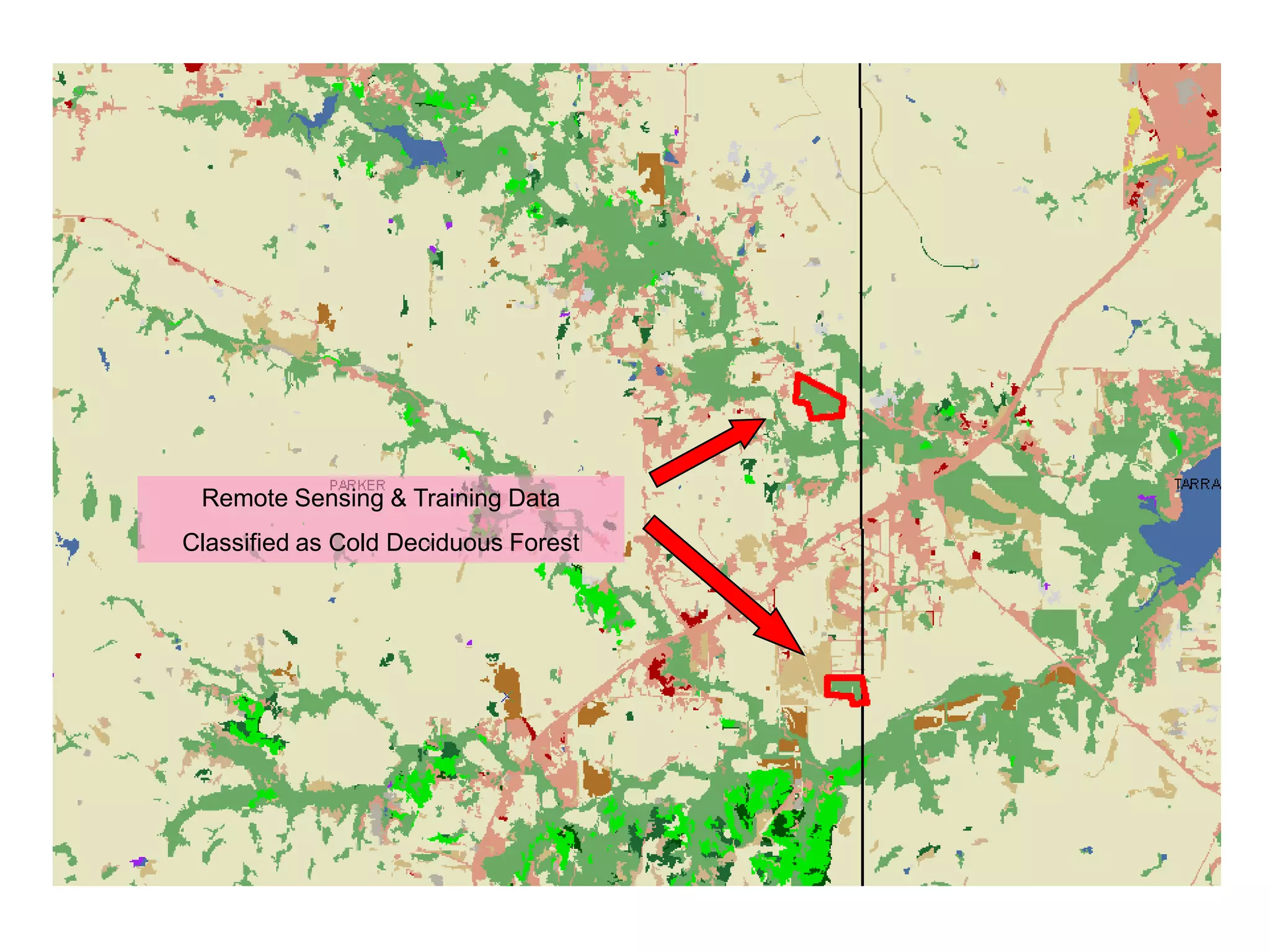
Remote Sensing & Training Data
Classified as Cold Deciduous Forest
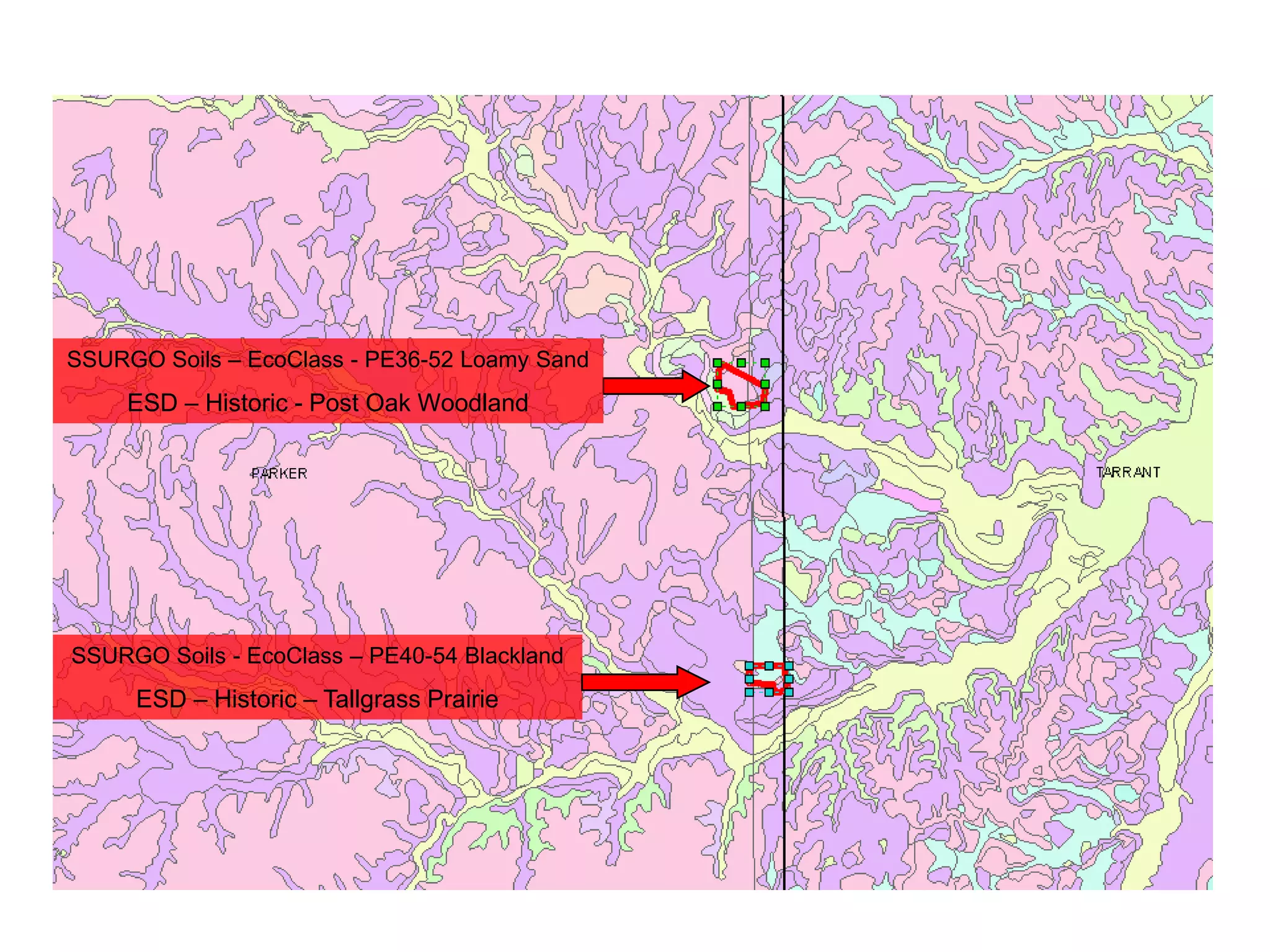
SSURGO Soils – EcoClass - PE36-52 Loamy Sand
     ESD – Historic - Post Oak Woodland


SSURGO Soils - EcoClass – PE40-54 Blackland
     ESD – Historic – Tallgrass Prairie
Mapping Subsystem
Crosstimbers: Post Oak Woodland & Forest


         Mapping Subsystem
Native Invasive Deciduous Woodland
1984
                     Vegetation Types of Texas
Bluestem Grassland                 Post Oak Woods, Forest, and Grassland Mosaics
Lake Granbury                      Silver Bluestem-Texas Wintergrass Grassland
Oak-Mesquite-Juniper Parks/Woods
Ecological Systems
Barren / Non-urban                                                 Edwards Plateau Limestone Evergreen Slope Shrubland                    Southeastern Great Plains Floodplain Herbaceous Vegetation
Barren / Urban                                                     Edwards Plateau Limestone Live Oak Motte and Forest                    Southeastern Great Plains Floodplain Juniper Forest and Woodland
Blackland Prairie Disturbance or Tame Grassland                    Edwards Plateau Limestone Savanna Grassland                            Southeastern Great Plains Floodplain Live Oak Forest and Woodland
Crosstimbers Deciduous Slope Forest                                Edwards Plateau Limestone Shin Oak Shrubland and Shrub Motte           Southeastern Great Plains Floodplain Mixed Deciduous Forest and Woodland
Crosstimbers Deciduous-Juniper Slope Forest                        Edwards Plateau Limestone Shin Oak Slope Shrubland                     Southeastern Great Plains Riparian Deciduous Forest and Woodland
Crosstimbers Live Oak Forest and Woodland                          Edwards Plateau Live Oak Dry-Mesic Slope Forest and Woodland           Southeastern Great Plains Riparian Deciduous Shrubland
Crosstimbers Post Oak Forest and Woodland                          Edwards Plateau Oak-Ashe Juniper Dry-Mesic Slope Forest and Woodland   Southeastern Great Plains Riparian Evergreen Shrubland
Crosstimbers Post Oak-Juniper Forest and Woodland                  Grass Farm                                                             Southeastern Great Plains Riparian Herbaceous Vegetation
Crosstimbers Sandyland Oak Woodland                                Marsh                                                                  Southeastern Great Plains Riparian Juniper Forest and Woodland
Crosstimbers Savanna Grassland                                     Native Invasive: Deciduous Woodland                                    Southeastern Great Plains Riparian Live Oak Forest and Woodland
East-Central Texas Plains Post Oak Motte and Woodland              Native Invasive: Juniper Shrubland                                     Southeastern Great Plains Riparian Mixed Deciduous Forest and Woodland
Edwards Plateau Ashe Juniper Dry-Mesic Slope Forest and Woodland   Native Invasive: Juniper Woodland                                      Southeastern Great Plains Tallgrass Prairie
Edwards Plateau Deciduous Dry-Mesic Slope Forest and Woodland      Native Invasive: Mesquite Shrubland                                    Southeastern Great Plains Wooded Cliff/Bluff
Edwards Plateau Floodplain Deciduous Forest and Woodland           Open Water                                                             Swamp
Edwards Plateau Limestone Ashe Juniper Motte and Forest            Rowcrops                                                               Urban High Intensity
Edwards Plateau Limestone Deciduous Motte and Woodland             Southeastern Great Plains Floodplain Deciduous Forest and Woodland     Urban Low Intensity
Edwards Plateau Limestone Deciduous-Evergreen Motte and Woodland   Southeastern Great Plains Floodplain Deciduous Shrubland
Edwards Plateau Limestone Evergreen Shrubland and Shrub Motte      Southeastern Great Plains Floodplain Evergreen Shrubland
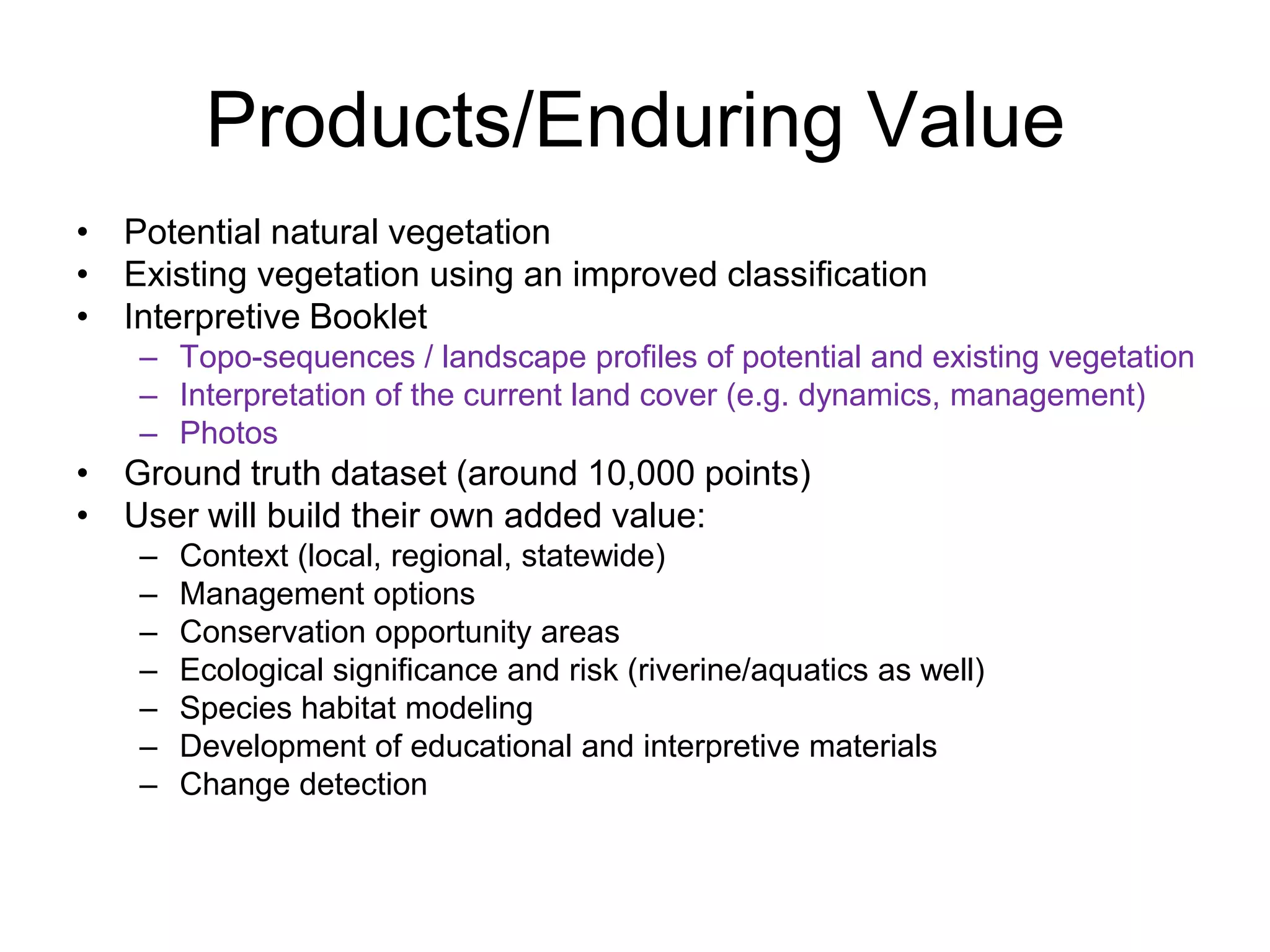
Products/Enduring Value
• Potential natural vegetation
• Existing vegetation using an improved classification
• Interpretive Booklet
    – Topo-sequences / landscape profiles of potential and existing vegetation
    – Interpretation of the current land cover (e.g. dynamics, management)
    – Photos
• Ground truth dataset (around 10,000 points)
• User will build their own added value:
    –   Context (local, regional, statewide)
    –   Management options
    –   Conservation opportunity areas
    –   Ecological significance and risk (riverine/aquatics as well)
    –   Species habitat modeling
    –   Development of educational and interpretive materials
    –   Change detection
Interpretive Booklet
Products/Enduring Value
• Potential natural vegetation
• Existing vegetation using an improved classification
• Interpretive Booklet
    – Topo-sequences / landscape profiles of potential and existing vegetation
    – Interpretation of the current land cover (e.g. dynamics, management)
    – Photos
• Ground truth dataset (around 10,000 points)
• User will build their own added value:
    –   Context (local, regional, statewide)
    –   Management options
    –   Conservation opportunity areas
    –   Ecological significance and risk (riverine/aquatics as well)
    –   Species habitat modeling
    –   Development of educational and interpretive materials
    –   Change detection
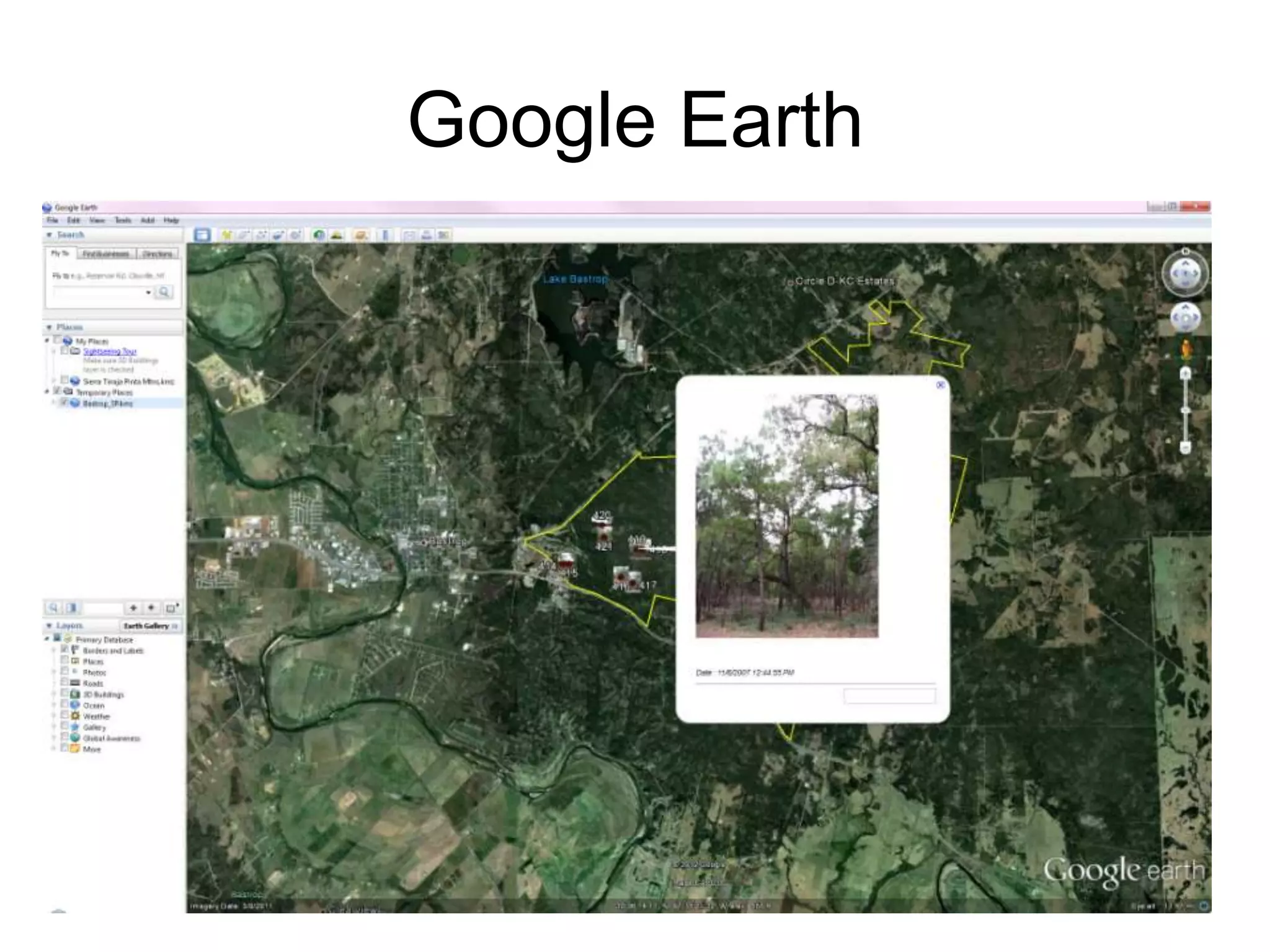
Google Earth
Google Earth
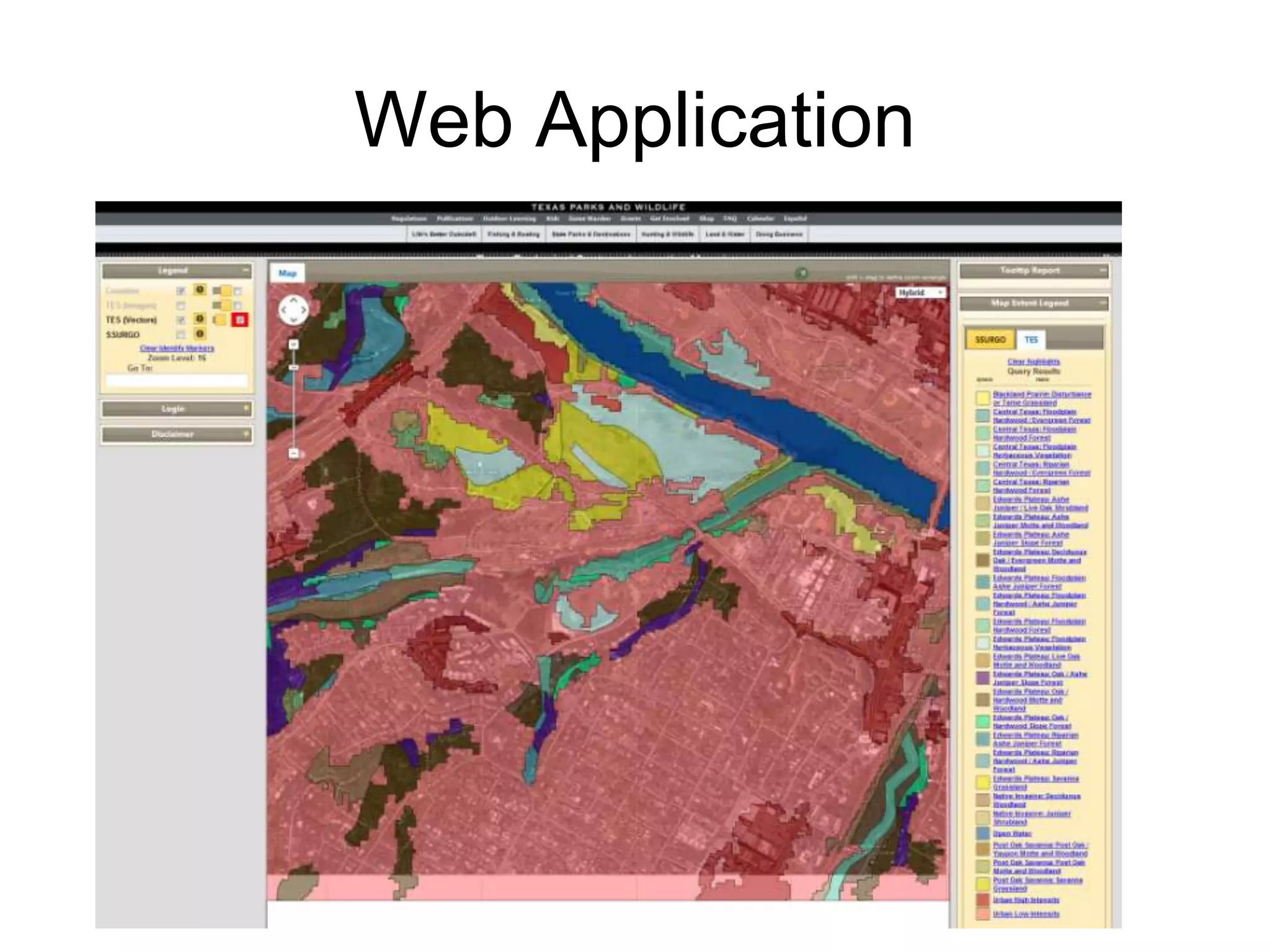
Web Application
Web Application
Products/Enduring Value
• Potential natural vegetation
• Existing vegetation using an improved classification
• Interpretive Booklet
    – Topo-sequences / landscape profiles of potential and existing vegetation
    – Interpretation of the current land cover (e.g. dynamics, management)
    – Photos
• Ground truth dataset (around 10,000 points)
• User will build their own added value:
    –   Context (local, regional, statewide)
    –   Management options
    –   Conservation opportunity areas
    –   Ecological significance and risk (riverine/aquatics as well)
    –   Species habitat modeling
    –   Development of educational and interpretive materials
    –   Change detection
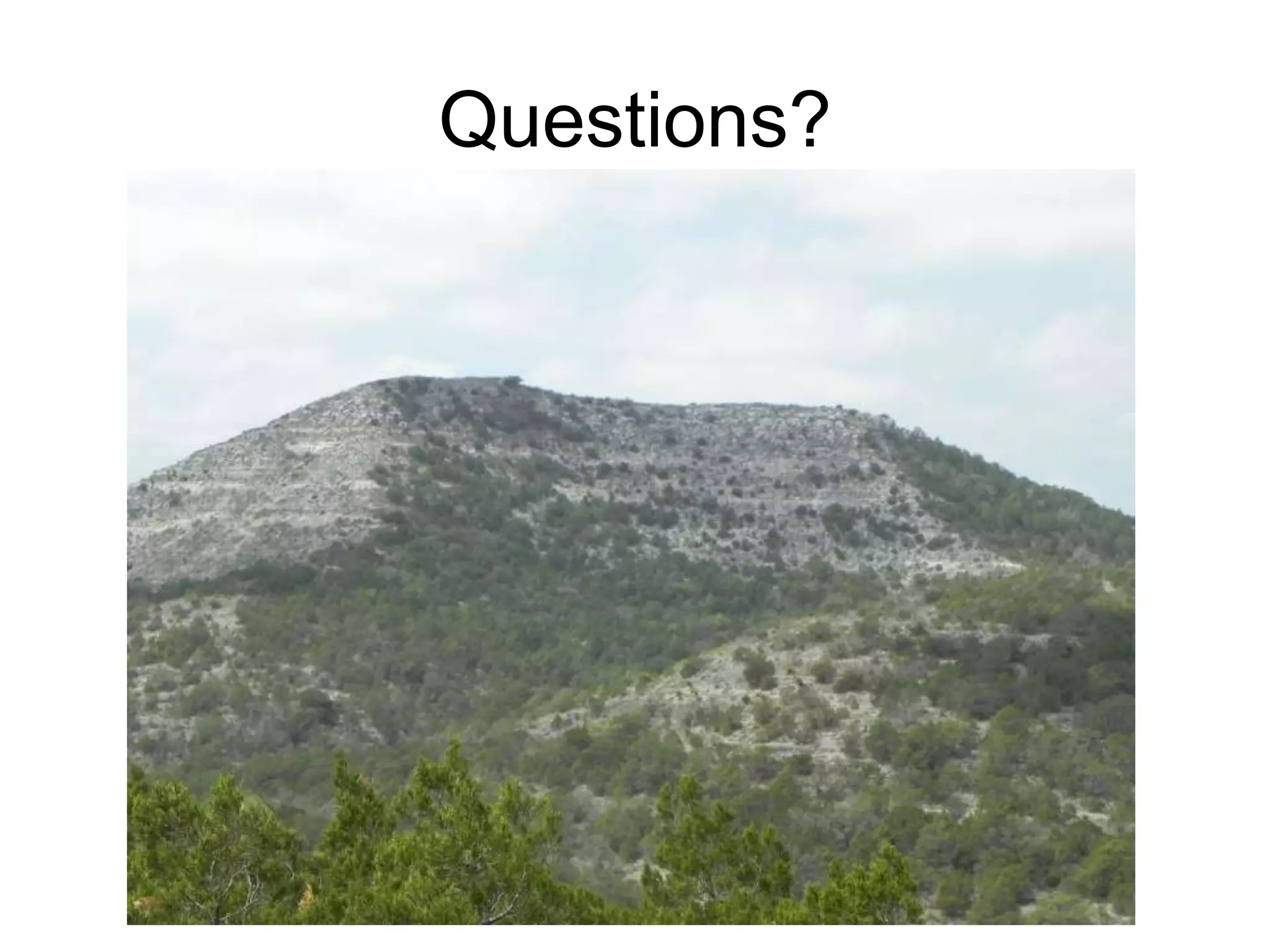
Questions?

Tnris 2012

  • 1.
  • 2.
    Background • TPWD wantsbetter land cover for Texas – More land cover classes – Better spatial resolution – Better accuracy (overall 85%) – Better ecological interpretation • Partners Required! – MoRAP, University of Missouri – TNC, Texas – NatureServe, Southeast Region – TNRIS – NRCS, TXFS, USFWS, others
  • 3.
    Phase 6 Ecological September Mapping 2013 Phase 1 Systems of Available Now Texas Phase LPC Phase 2 Available Now Available Now Phase 5 Phase 3 September 2012 Available Now Phase 4 Available Now
  • 4.
    3-date TM Training data from Land use data (NRCS Satellite Imagery air photos plus Common Land Units) (30m resolution) ground data Classify Land Cover (e.g. grassland) Draft Mapping Targets Assign Information using (NatureServe Ecological soils, ecoregions, geology, ecological Systems) site type, hydrology, slop, aspect, & elevation (“modeling”) Create Map with Named Mapping Units (e.g. Southeastern Great Plains Tallgrass Prairie) Provide Interpretation of Mapping Units (booklet, summary statistics by ecoregion, etc.) Design and Execute Presentation
  • 5.
    Ecological Systems Ecological System East-Central Texas Plains Post Oak Savanna and Woodland Mapping Targets/Subsystems Post Oak Savanna: Post Oak Motte and Woodland Post Oak Savanna: Post Oak / Redcedar Motte and Woodland Post Oak Savanna: Post Oak / Yaupon Motte and Woodland Post Oak Savanna: Oak / Hardwood Slope Forest Post Oak Savanna: Live Oak Motte and Woodland Post Oak Savanna: Savanna Grassland Post Oak Savanna: Oak / Redcedar Slope Forest Post Oak Savanna: Redcedar Slope Forest
  • 6.
    3-date TM Training data from Land use data (NRCS Satellite Imagery air photos plus Common Land Units) (30m resolution) ground data Classify Land Cover (e.g. evergreen forest) Draft Mapping Targets Assign Information using (NatureServe Ecological soils, ecoregions, geology, ecological Systems) site type, hydrology, slope,aspect, & elevation (“modeling”) Create Map with Named Mapping Units (e.g. Bastrop ) Provide Interpretation of Mapping Units (booklet, summary statistics by ecoregion, etc.) Design and Execute Presentation
  • 7.
    Field Data Collection •Roadside survey • GPS Location (Lat/Long) • Attributes – Land Cover • i.e.: grassland, shrubland – Percent cover • Woody components – CEG , BLEG – tree, shrub • Herbaceous – Dominant Species • “top three” species – trees, shrubs, herbaceous – Ecological Systems/Subsystems
  • 12.
    3-date TM Land use data (NRCS Training data from Satellite Imagery Common Land Units) air photos plus (30m resolution) ground data Classify Land Cover (e.g. evergreen forest) Draft Mapping Targets Assign Information using (NatureServe Ecological soils, ecoregions, geology, ecological Systems) site type, hydrology,slope, aspect,& elevation (“modeling”) Create Map with Named Mapping Units (e.g. Bastrop ) Provide Interpretation of Mapping Units (booklet, summary statistics by ecoregion, etc.) Design and Execute Presentation
  • 13.
    Initial Classification ofPixels – Create a land cover raster by coding each pixel with a value that represents the land cover type over the majority of that cell’s area – When finished, every cell will have a coded value – Average TM scene is about 34.9 x106 pixels W W W G G water W W W G G W W W G G grass G G G G G F G G U U forest urban F F G U U
  • 14.
    Land Cover Class Barren CD Forest CEG Forest Grass Farm Swamp Water Barren/Impervious CD Mixed Forest Crop Grassland Urban High State Park BLEG Forest CD Shrub EG Shrub Marsh Urban Low
  • 15.
    3-date TM Training data from Land use data (NRCS Satellite Imagery air photos plus Common Land Units) (30m resolution) ground data Classify Land Cover (e.g. cold deciduous forest) Draft Mapping Targets Assign Information using (NatureServe Ecological soils, ecoregions, geology, ecological Systems) site type, hydrology,slope,aspect,& elevation (“modeling”) Create Map with Named Mapping Units (e.g. Edwards Plateau: Deciduous Oak Slope Forest) Provide Interpretation of Mapping Units (booklet, summary statistics by ecoregion, etc.) Design and Execute Presentation
  • 16.
    Modeling Synopsis • ExaminedSSURGO, GAT, Ecological Site Types (ESTs) • Modeled: – Historic vegetation to ESTs and to soils (Ecoclass) – Interpretation of current land cover to ESTs and soils (e.g. evergreen forest on site type XX is ZZ mapping system) • Rules applied: (Decision Tree) – Slope,aspect,elevation,landscape postion, hydrology,& EPA ecoregion
  • 17.
    Remote Sensing &Training Data Classified as Cold Deciduous Forest
  • 18.
    SSURGO Soils –EcoClass - PE36-52 Loamy Sand ESD – Historic - Post Oak Woodland SSURGO Soils - EcoClass – PE40-54 Blackland ESD – Historic – Tallgrass Prairie
  • 19.
    Mapping Subsystem Crosstimbers: PostOak Woodland & Forest Mapping Subsystem Native Invasive Deciduous Woodland
  • 20.
    1984 Vegetation Types of Texas Bluestem Grassland Post Oak Woods, Forest, and Grassland Mosaics Lake Granbury Silver Bluestem-Texas Wintergrass Grassland Oak-Mesquite-Juniper Parks/Woods
  • 21.
    Ecological Systems Barren /Non-urban Edwards Plateau Limestone Evergreen Slope Shrubland Southeastern Great Plains Floodplain Herbaceous Vegetation Barren / Urban Edwards Plateau Limestone Live Oak Motte and Forest Southeastern Great Plains Floodplain Juniper Forest and Woodland Blackland Prairie Disturbance or Tame Grassland Edwards Plateau Limestone Savanna Grassland Southeastern Great Plains Floodplain Live Oak Forest and Woodland Crosstimbers Deciduous Slope Forest Edwards Plateau Limestone Shin Oak Shrubland and Shrub Motte Southeastern Great Plains Floodplain Mixed Deciduous Forest and Woodland Crosstimbers Deciduous-Juniper Slope Forest Edwards Plateau Limestone Shin Oak Slope Shrubland Southeastern Great Plains Riparian Deciduous Forest and Woodland Crosstimbers Live Oak Forest and Woodland Edwards Plateau Live Oak Dry-Mesic Slope Forest and Woodland Southeastern Great Plains Riparian Deciduous Shrubland Crosstimbers Post Oak Forest and Woodland Edwards Plateau Oak-Ashe Juniper Dry-Mesic Slope Forest and Woodland Southeastern Great Plains Riparian Evergreen Shrubland Crosstimbers Post Oak-Juniper Forest and Woodland Grass Farm Southeastern Great Plains Riparian Herbaceous Vegetation Crosstimbers Sandyland Oak Woodland Marsh Southeastern Great Plains Riparian Juniper Forest and Woodland Crosstimbers Savanna Grassland Native Invasive: Deciduous Woodland Southeastern Great Plains Riparian Live Oak Forest and Woodland East-Central Texas Plains Post Oak Motte and Woodland Native Invasive: Juniper Shrubland Southeastern Great Plains Riparian Mixed Deciduous Forest and Woodland Edwards Plateau Ashe Juniper Dry-Mesic Slope Forest and Woodland Native Invasive: Juniper Woodland Southeastern Great Plains Tallgrass Prairie Edwards Plateau Deciduous Dry-Mesic Slope Forest and Woodland Native Invasive: Mesquite Shrubland Southeastern Great Plains Wooded Cliff/Bluff Edwards Plateau Floodplain Deciduous Forest and Woodland Open Water Swamp Edwards Plateau Limestone Ashe Juniper Motte and Forest Rowcrops Urban High Intensity Edwards Plateau Limestone Deciduous Motte and Woodland Southeastern Great Plains Floodplain Deciduous Forest and Woodland Urban Low Intensity Edwards Plateau Limestone Deciduous-Evergreen Motte and Woodland Southeastern Great Plains Floodplain Deciduous Shrubland Edwards Plateau Limestone Evergreen Shrubland and Shrub Motte Southeastern Great Plains Floodplain Evergreen Shrubland
  • 22.
    Products/Enduring Value • Potentialnatural vegetation • Existing vegetation using an improved classification • Interpretive Booklet – Topo-sequences / landscape profiles of potential and existing vegetation – Interpretation of the current land cover (e.g. dynamics, management) – Photos • Ground truth dataset (around 10,000 points) • User will build their own added value: – Context (local, regional, statewide) – Management options – Conservation opportunity areas – Ecological significance and risk (riverine/aquatics as well) – Species habitat modeling – Development of educational and interpretive materials – Change detection
  • 23.
  • 24.
    Products/Enduring Value • Potentialnatural vegetation • Existing vegetation using an improved classification • Interpretive Booklet – Topo-sequences / landscape profiles of potential and existing vegetation – Interpretation of the current land cover (e.g. dynamics, management) – Photos • Ground truth dataset (around 10,000 points) • User will build their own added value: – Context (local, regional, statewide) – Management options – Conservation opportunity areas – Ecological significance and risk (riverine/aquatics as well) – Species habitat modeling – Development of educational and interpretive materials – Change detection
  • 25.
  • 26.
  • 27.
  • 28.
  • 29.
    Products/Enduring Value • Potentialnatural vegetation • Existing vegetation using an improved classification • Interpretive Booklet – Topo-sequences / landscape profiles of potential and existing vegetation – Interpretation of the current land cover (e.g. dynamics, management) – Photos • Ground truth dataset (around 10,000 points) • User will build their own added value: – Context (local, regional, statewide) – Management options – Conservation opportunity areas – Ecological significance and risk (riverine/aquatics as well) – Species habitat modeling – Development of educational and interpretive materials – Change detection
  • 30.