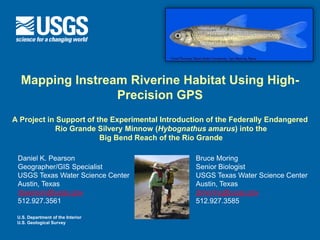
Mapping Instream Riverine Habitat Using High-
                 Precision GPS
A Project in Support of the Experimental Introduction of the Federally Endangered
            Rio Grande Silvery Minnow (Hybognathus amarus) into the
                         Big Bend Reach of the Rio Grande

 Daniel K. Pearson                                Bruce Moring
 Geographer/GIS Specialist                        Senior Biologist
 USGS Texas Water Science Center                  USGS Texas Water Science Center
 Austin, Texas                                    Austin, Texas
 dpearson@usgs.gov                                jbmoring@usgs.gov
 512.927.3561                                     512.927.3585

 U.S. Department of the Interior
 U.S. Geological Survey
Overview
 Background on Rio Grande silvery minnow
    introduction
   Rationale and approach to river mapping
   GPS Data Collection
      Methods, equipment and musings
   Results and Data products
Project Support
 Funding for study USGS SSP, USFWS, MRGESP
    Collaborative

Key Contacts –
   Aimee Roberson, Fish and Wildlife Biologist, Project
    Lead, USFWS, Alpine, TX
   Jason Remshardt and staff, support for fish assemblage
    survey, USFWS, Albuquerque, NM
   Rio Grande Silvery Minnow Technical Advisory Team
    (USFWS, Texas Parks and Wildlife Service, UT-Pan
    American University, Big Bend National Park, and USGS)
   Mickey Porter, Sarah Beck, USACE, Albuquerque, NM
Biology of Hybognathus amarus
   Historically found throughout the Rio Grande
    and Pecos Basins. Population numbers
    dropped after 1950s. Sustained population in
    Middle Rio Grande, New Mexico
   Pelagic spawners, produce large numbers of
    semi-buoyant eggs
   Prefer low-velocity habitat with sandy or silty
    substrates
   Preferred habitats including side channels,
    backwaters, and oxbows associated with a
    meandering channel. Algal grazers.
Historical Change to Rio Grande
   Drivers of change
     Altered flow, peak flows and
        sediment transport
       Aggrading and narrowing
        channel
       Invasives (Salt cedar, exotic
        river cane)
       Changes to flow contribution
        from Rio Conchos
       Images: Taken near Black
        Dike (Big Bend NP)
                           Dean and Schmidt, Role of feedback mechanisms in historic channel changes of the lower
                           Rio Grande in the Big Bend region., Geomorphology, 2010
RGSM Re-introduction to BBNP
   December 2008, silvery minnows were re-
    introduced in the Rio Grande as a non-
    essential experimental population under
    section 10(j) of the Endangered Species Act
   1.43 million minnows released to date with 4
    releases (2008-11), one additional release
    (2012)
   Release sites – 1. Contrabando, 2. Santa
    Elena (Terlingua Creek), 3. Rio Grande
    Village, 4. Stillwell Crossing (Adam’s Ranch)
Release Sites/Study Area
Project Objectives
 River mapping and fish assemblage collocated with
    release sites to understand variability among release
    sites
   Determine the area, frequency, and physical
    characteristics of in-channel river habitats at the
    mesohabitat scale over a range of river flows.
   Determine how fish assemblage varies (composition
    and distribution) among mesohabitat types and
    between reaches over a range of river flows with
    focus on Rio Grande silvery minnow population
Rationale for Mesohabitat Approach
 USFWS wanted a habitat component and fish assemblage
  survey in the early stages of the introduction and in the context
  of river flow!


                                Eco-hydraulic
                                Mesohabitat
                      River                     Distribution
                     Channel                          of
                    Geomorph.                     Aquatic
                                                   Biota


 “.…interest has grown in testing the hypothesis that significant
  variation in assemblage among streams is explicable in terms of
  hydrological patterns, which can vary substantially over short
  geographic distances (Poff and Allen, 1995).”
Mesohabitat
 Our Mesohabitat Scheme: A priori classification of “eco-
  hydraulic” habitats biased towards including more backwater
  and slack-water habitats important for Rio Grande silvery
  minnows and similar species.

                         Point bar
                                         Eddy Pool
                   Inundated point bar
          Riffle
                   `                             Run


 Mesohabitats used in this study include: backwater, forewater,
  embayment, rapid, riffle, run/glide, pool (eddy, main channel and
  isolated), submerged channel and point bars.
Selected River Flows
 Used IHA to determine target flows (Nature
    Conservancy)
   Winter to spring low-flow target = 200 – 400
    cfs
   Late spring to mid summer within-bank high
    pulse = 500 – 1500 cfs
   Overbank flooding
    flow = using peak of
    fall 2008 event
    (ca. 50,000 cfs)
GPS Data Collection
   Map and characterize instream habitat
    (mesohabitat-scale approach)
   Create a detailed reach map at each targeted
    flows using high-performance GPS receiver
    in conjunction with high-resolution remotely
    sensed imagery
   Create spatially enabled database to capture
    geographic (map), physical habitat, fish
    assemble and
Equipment
   Trimble® DSM™ 232 modular GPS receiver
     Omnistar Subcription (XP) - offers GPS correction
        services that improves the accuracy of a GPS
        receiver, allows sub-foot realtime positioning
       Fed directly in GIS (no post-processing)
   Panasonic Toughbook CF-19
   Hi Capacity External Laptop Battery
Mapping Methods
 Capture water’s edge on both banks was
    mapped first creating a boundary for each site
   Next, each mesohabitat was mapped by
    delineating its perimeter with the GPS receiver
    mounted in a boat or in a backpack by wading
   Each mesohabitat (e.g., rapid, riffle, run, pool,
    glide, embayment, backwater) edited and
    stored on a field laptop as geo-referenced
    polygons using ArcGIS
GPS used to capture water’s edge


                        Rio Grande @ Terlingua Creek
Complete delineations and attribute


                                   Run
                SCB


                            Pool


                      Run


                                         Rio Grande @ Terlingua Creek
Results – Data Collection/Mapping

   FY 2010 Sampling
     low-flow target (200-400cfs)
     high-pulse flow target (500-1500cfs)
   Low-flow sampling divided by flash flood
    event ~10,000cfs
   High-pulse flow mapping possible due to
    sustained release from Rio Conchos dams
    (MX)
More Results – Extreme low-flow
   FY 2011 Sampling
       West Texas and throughout under “Extreme
        Drought”
   Capture “bottom out” flows – May 2011
     Historically low flows – 1st Qtr 2011
     No measureable rainfall since September 2010
   Full habitat assessment, mapping study
    reaches and fish assemblage data
Low flows - May 2011
RAPID
       RIFFLE

         RUN

        POOL

   FOREWATER
   BACKWATER

   EMBAYMENT
SUBMERGED BAR
Lessons learned…
   Requires use of multiple flotation devices –
    Canoe/Kayak, Zodiac, Human
   Effort to limit impact of our presence on
    habitat
   Low flow mapping much easier than high-
    pulse (wadeable)
   Putting equipment in harm’s way
     GPS – Marine unit
     Panasonic laptop – Water “resistant”
More…
   Laptop battery good for about 4 hours
     External gives us +6 hours
   Considered use of PDA but opted for
    Toughbook for larger screen size
   Other GPS units would get us better accuracy
    but drawbacks
     Cost/Time
     Post-processing/Direct feed into ArcGIS
   Current imagery source
   Maps exported to GeoPDF (iPad)
Physical Characterization - Habitat

                       •Depth, velocity, substrate, at
                       3 to 5 points in each
                       mesohabitat.

                       •Fish cover along 1-meter
                       wide bank-to-bank transect at
                       each point.

                       •Margin or near-shore habitat
                       at mid-point transect
                       evaluated for percent
                       periphyton cover and
                       dominant substrate using .25
                       m2 quadrat
Fish Assemblage – (Wadeable)
   One seine haul per mesohabitat randomly
    selected from nine possible locations.
     Two or more seine hauls in some very large runs.
   Per seine haul
     Length, depth and velocity (center point),
      dominant substrate, and counts per species
      recorded.


                                      Left bank                 Right bank


                                                  Mesohabitat
Guild Association – Velocity

H. amarus


                       N. braytoni
Project Data Model
   Geographic Data (GPS)                       Tabular Data
     Polygons                                    Site information
          Low-pulse                              Physical Measures
          High-pulse                             Margin
          Extreme low-pulse
                                                  Fish
       Points
          Sampling                               Fish cover
       Lines                                     Fish habitat
          ADCP                                   Water quality
          Electrofishing

                               Relationship Class
How do we use this technology?
For RGSM Project:
 Project management of data resources
 Answer complex spatial queries
     Using GIS or via MS Access
     Data can be exported to other formats as needed
      for analysis
   Web application development
     Online access
     Mapping components
Next Steps
   Complete data analysis and writing of USGS
    Scientific Investigation Report and a journal
    article this summer
   Online publication of project database

   In first year of similar study in Middle Rio
    Grande (Albuq – Elephant Butte Reservoir) in
    New Mexico
Questions?

http://tx.usgs.gov/projects/bigbend/mapping
SMhabitat.html


   Daniel Pearson – dpearson@usgs.gov
   Bruce Moring – jbmoring@usgs.gov

Txgio presentation rgsm_gps_pearson_062012

  • 1.
    Mapping Instream RiverineHabitat Using High- Precision GPS A Project in Support of the Experimental Introduction of the Federally Endangered Rio Grande Silvery Minnow (Hybognathus amarus) into the Big Bend Reach of the Rio Grande Daniel K. Pearson Bruce Moring Geographer/GIS Specialist Senior Biologist USGS Texas Water Science Center USGS Texas Water Science Center Austin, Texas Austin, Texas dpearson@usgs.gov jbmoring@usgs.gov 512.927.3561 512.927.3585 U.S. Department of the Interior U.S. Geological Survey
  • 2.
    Overview  Background onRio Grande silvery minnow introduction  Rationale and approach to river mapping  GPS Data Collection  Methods, equipment and musings  Results and Data products
  • 3.
    Project Support  Fundingfor study USGS SSP, USFWS, MRGESP Collaborative Key Contacts –  Aimee Roberson, Fish and Wildlife Biologist, Project Lead, USFWS, Alpine, TX  Jason Remshardt and staff, support for fish assemblage survey, USFWS, Albuquerque, NM  Rio Grande Silvery Minnow Technical Advisory Team (USFWS, Texas Parks and Wildlife Service, UT-Pan American University, Big Bend National Park, and USGS)  Mickey Porter, Sarah Beck, USACE, Albuquerque, NM
  • 4.
    Biology of Hybognathusamarus  Historically found throughout the Rio Grande and Pecos Basins. Population numbers dropped after 1950s. Sustained population in Middle Rio Grande, New Mexico  Pelagic spawners, produce large numbers of semi-buoyant eggs  Prefer low-velocity habitat with sandy or silty substrates  Preferred habitats including side channels, backwaters, and oxbows associated with a meandering channel. Algal grazers.
  • 5.
    Historical Change toRio Grande  Drivers of change  Altered flow, peak flows and sediment transport  Aggrading and narrowing channel  Invasives (Salt cedar, exotic river cane)  Changes to flow contribution from Rio Conchos  Images: Taken near Black Dike (Big Bend NP) Dean and Schmidt, Role of feedback mechanisms in historic channel changes of the lower Rio Grande in the Big Bend region., Geomorphology, 2010
  • 6.
    RGSM Re-introduction toBBNP  December 2008, silvery minnows were re- introduced in the Rio Grande as a non- essential experimental population under section 10(j) of the Endangered Species Act  1.43 million minnows released to date with 4 releases (2008-11), one additional release (2012)  Release sites – 1. Contrabando, 2. Santa Elena (Terlingua Creek), 3. Rio Grande Village, 4. Stillwell Crossing (Adam’s Ranch)
  • 7.
  • 8.
    Project Objectives  Rivermapping and fish assemblage collocated with release sites to understand variability among release sites  Determine the area, frequency, and physical characteristics of in-channel river habitats at the mesohabitat scale over a range of river flows.  Determine how fish assemblage varies (composition and distribution) among mesohabitat types and between reaches over a range of river flows with focus on Rio Grande silvery minnow population
  • 9.
    Rationale for MesohabitatApproach  USFWS wanted a habitat component and fish assemblage survey in the early stages of the introduction and in the context of river flow! Eco-hydraulic Mesohabitat River Distribution Channel of Geomorph. Aquatic Biota  “.…interest has grown in testing the hypothesis that significant variation in assemblage among streams is explicable in terms of hydrological patterns, which can vary substantially over short geographic distances (Poff and Allen, 1995).”
  • 10.
    Mesohabitat  Our MesohabitatScheme: A priori classification of “eco- hydraulic” habitats biased towards including more backwater and slack-water habitats important for Rio Grande silvery minnows and similar species. Point bar Eddy Pool Inundated point bar Riffle ` Run  Mesohabitats used in this study include: backwater, forewater, embayment, rapid, riffle, run/glide, pool (eddy, main channel and isolated), submerged channel and point bars.
  • 11.
    Selected River Flows Used IHA to determine target flows (Nature Conservancy)  Winter to spring low-flow target = 200 – 400 cfs  Late spring to mid summer within-bank high pulse = 500 – 1500 cfs  Overbank flooding flow = using peak of fall 2008 event (ca. 50,000 cfs)
  • 12.
    GPS Data Collection  Map and characterize instream habitat (mesohabitat-scale approach)  Create a detailed reach map at each targeted flows using high-performance GPS receiver in conjunction with high-resolution remotely sensed imagery  Create spatially enabled database to capture geographic (map), physical habitat, fish assemble and
  • 13.
    Equipment  Trimble® DSM™ 232 modular GPS receiver  Omnistar Subcription (XP) - offers GPS correction services that improves the accuracy of a GPS receiver, allows sub-foot realtime positioning  Fed directly in GIS (no post-processing)  Panasonic Toughbook CF-19  Hi Capacity External Laptop Battery
  • 14.
    Mapping Methods  Capturewater’s edge on both banks was mapped first creating a boundary for each site  Next, each mesohabitat was mapped by delineating its perimeter with the GPS receiver mounted in a boat or in a backpack by wading  Each mesohabitat (e.g., rapid, riffle, run, pool, glide, embayment, backwater) edited and stored on a field laptop as geo-referenced polygons using ArcGIS
  • 15.
    GPS used tocapture water’s edge Rio Grande @ Terlingua Creek
  • 16.
    Complete delineations andattribute Run SCB Pool Run Rio Grande @ Terlingua Creek
  • 17.
    Results – DataCollection/Mapping  FY 2010 Sampling  low-flow target (200-400cfs)  high-pulse flow target (500-1500cfs)  Low-flow sampling divided by flash flood event ~10,000cfs  High-pulse flow mapping possible due to sustained release from Rio Conchos dams (MX)
  • 21.
    More Results –Extreme low-flow  FY 2011 Sampling  West Texas and throughout under “Extreme Drought”  Capture “bottom out” flows – May 2011  Historically low flows – 1st Qtr 2011  No measureable rainfall since September 2010  Full habitat assessment, mapping study reaches and fish assemblage data
  • 22.
    Low flows -May 2011
  • 24.
    RAPID RIFFLE RUN POOL FOREWATER BACKWATER EMBAYMENT SUBMERGED BAR
  • 25.
    Lessons learned…  Requires use of multiple flotation devices – Canoe/Kayak, Zodiac, Human  Effort to limit impact of our presence on habitat  Low flow mapping much easier than high- pulse (wadeable)  Putting equipment in harm’s way  GPS – Marine unit  Panasonic laptop – Water “resistant”
  • 26.
    More…  Laptop battery good for about 4 hours  External gives us +6 hours  Considered use of PDA but opted for Toughbook for larger screen size  Other GPS units would get us better accuracy but drawbacks  Cost/Time  Post-processing/Direct feed into ArcGIS  Current imagery source  Maps exported to GeoPDF (iPad)
  • 27.
    Physical Characterization -Habitat •Depth, velocity, substrate, at 3 to 5 points in each mesohabitat. •Fish cover along 1-meter wide bank-to-bank transect at each point. •Margin or near-shore habitat at mid-point transect evaluated for percent periphyton cover and dominant substrate using .25 m2 quadrat
  • 28.
    Fish Assemblage –(Wadeable)  One seine haul per mesohabitat randomly selected from nine possible locations.  Two or more seine hauls in some very large runs.  Per seine haul  Length, depth and velocity (center point), dominant substrate, and counts per species recorded. Left bank Right bank Mesohabitat
  • 29.
    Guild Association –Velocity H. amarus N. braytoni
  • 31.
    Project Data Model  Geographic Data (GPS)  Tabular Data  Polygons  Site information  Low-pulse  Physical Measures  High-pulse  Margin  Extreme low-pulse  Fish  Points  Sampling  Fish cover  Lines  Fish habitat  ADCP  Water quality  Electrofishing Relationship Class
  • 32.
    How do weuse this technology? For RGSM Project:  Project management of data resources  Answer complex spatial queries  Using GIS or via MS Access  Data can be exported to other formats as needed for analysis  Web application development  Online access  Mapping components
  • 33.
    Next Steps  Complete data analysis and writing of USGS Scientific Investigation Report and a journal article this summer  Online publication of project database  In first year of similar study in Middle Rio Grande (Albuq – Elephant Butte Reservoir) in New Mexico
  • 34.
    Questions? http://tx.usgs.gov/projects/bigbend/mapping SMhabitat.html  Daniel Pearson – dpearson@usgs.gov  Bruce Moring – jbmoring@usgs.gov