#RAG123 marking
Who: Kev Lister
What: Assistant Head
Where: Stratford upon Avon School
Twitter: @ListerKev
Blog: http://bit.ly/ListerKev
Originally shared November 2013
Updated presentation for TM Oxford 18th December 2014
 Others may well have been doing something similar for years.
 The only part of this I know I invented from scratch is the
#RAG123 hashtag.
 Details of the ideas that inspired RAG123 are given in my blog.
Disclaimer
#RAG123
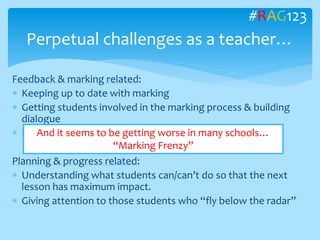
Feedback & marking related:
 Keeping up to date with marking
 Getting students involved in the marking process & building
dialogue
 Providing feedback that is timely and relevant.
Planning & progress related:
 Understanding what students can/can’t do so that the next
lesson has maximum impact.
 Giving attention to those students who “fly below the radar”
Perpetual challenges as a teacher…
#RAG123
And it seems to be getting worse in many schools…
“Marking Frenzy”
• A way to mark books after EVERY lesson (ideally)
• Simply rate based on a quick judgement:
• Red, Amber, Green for effort
• 1, 2, 3 for understanding
• Coded as G1, A3, R2, etc
• Full class takes between 5 and 15 mins
• Ideally students self/peer assess and you simply review/comment
• Then use the results to inform planning & intervention for
the next lesson(s)
So what is #RAG123?
#RAG123
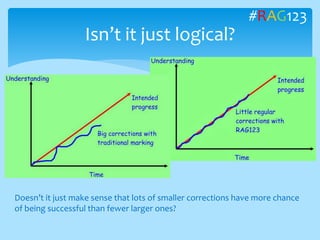
Isn’t it just logical?
Doesn’t it just make sense that lots of smaller corrections have more chance
of being successful than fewer larger ones?
#RAG123
 “Marking every book after every lesson must take ages”
 Actually easier to find 5-15 minutes to RAG123 regularly.
 non-contact time becomes more productive!
 “Just lazy marking” or “Not detailed enough for proper feedback”
 Lack of written detail is overcome because the content of the NEXT
LESSON(s) can be shaped to include intervention as needed.
 “We are required to do dialogue marking so this doesn’t fit”
 Students see the books being marked regularly so they respond more
fully.
 They know their comments will be seen.
Typical objections (before trying it)
#RAG123
 “Students won’t know what it means”
 Once you tell them they pick it up very quickly
 “Won’t work for my subject” or “We mark differently to maths”
 It’s not a maths only thing – it can and is used effectively across
whole schools and primary/secondary
 “Ofsted wouldn’t like it”
 Actually feedback from schools inspected shows generally positive
comments.
 One school leader has cited RAG123 as instrumental in helping his
school out of special measures
Typical objections (before trying it)
#RAG123
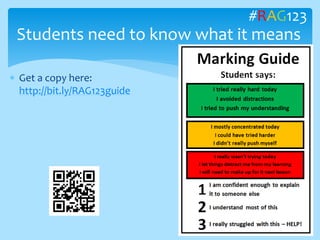
 Get a copy here:
http://bit.ly/RAG123guide
Students need to know what it means
#RAG123
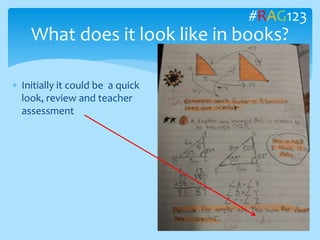
 Initially it could be a quick
look, review and teacher
assessment
What does it look like in books?
#RAG123
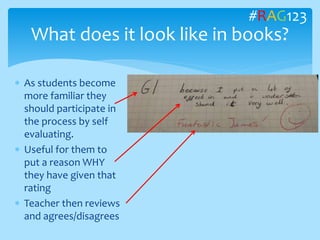
 As students become
more familiar they
should participate in
the process by self
evaluating.
 Useful for them to
put a reason WHY
they have given that
rating
 Teacher then reviews
and agrees/disagrees
What does it look like in books?
#RAG123
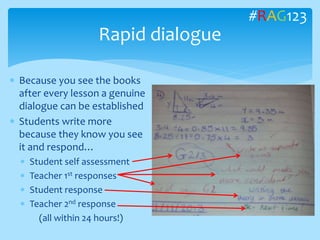
 Because you see the books
after every lesson a genuine
dialogue can be established
 Students write more
because they know you see
it and respond…
 Student self assessment
 Teacher 1st responses
 Student response
 Teacher 2nd response
(all within 24 hours!)
Rapid dialogue
#RAG123
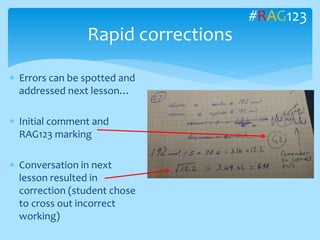
 Errors can be spotted and
addressed next lesson…
 Initial comment and
RAG123 marking
 Conversation in next
lesson resulted in
correction (student chose
to cross out incorrect
working)
Rapid corrections
#RAG123
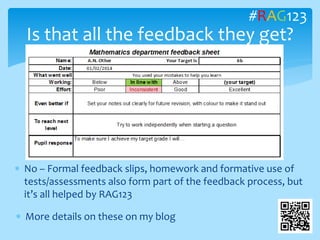
 No – Formal feedback slips, homework and formative use of
tests/assessments also form part of the feedback process, but
it’s all helped by RAG123
Is that all the feedback they get?
 More details on these on my blog
#RAG123
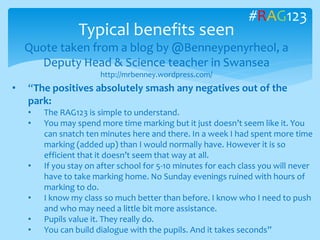
Typical benefits seen
Quote taken from a blog by @Benneypenyrheol, a
Deputy Head & Science teacher in Swansea
http://mrbenney.wordpress.com/
#RAG123
• “The positives absolutely smash any negatives out of the
park:
• The RAG123 is simple to understand.
• You may spend more time marking but it just doesn’t seem like it. You
can snatch ten minutes here and there. In a week I had spent more time
marking (added up) than I would normally have. However it is so
efficient that it doesn’t seem that way at all.
• If you stay on after school for 5-10 minutes for each class you will never
have to take marking home. No Sunday evenings ruined with hours of
marking to do.
• I know my class so much better than before. I know who I need to push
and who may need a little bit more assistance.
• Pupils value it. They really do.
• You can build dialogue with the pupils. And it takes seconds”
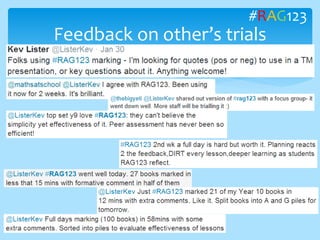
Feedback on other’s trials
#RAG123
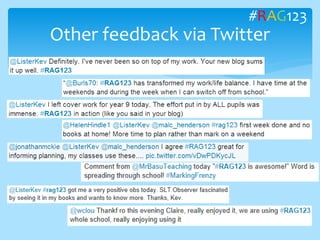
Other feedback via Twitter
#RAG123
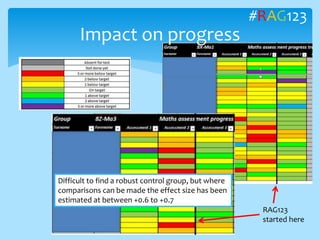
Impact on progress
RAG123
started here
#RAG123
Difficult to find a robust control group, but where
comparisons can be made the effect size has been
estimated at between +0.6 to +0.7
 None! Seriously!
 The only people who suggest negatives are
those that haven’t tried it!
 EVERYONE I know of who has tried it has said it
has a beneficial impact in the classroom!
 NOBODY who has tried it has reported an
increase in overall workload!
 I’ve not taken a single book home since Nov 2013!
Negatives
#RAG123
 “Can we use RAG for understanding and 123 for effort?”
 Of course! But the students focus on most on the colour. The
thing they can control most is effort, therefore I like to have
colour for effort.
 “How do I decide what qualifies as R/A/G effort?”
 Main consideration is the message you want the individual
student to receive.
 Don’t over–think it, quick judgement and move on…if it prompts
a challenge/question from the student… great – that’s dialogue!
 “What about pupils taking books home for homework?”
 Personally I set homework on separate sheets and keep the
books. Alternatively just miss RAG123 for that lesson.
 Worth considering what’s going to have more impact on their
progress – your feedback or them having their book at home?
Frequently asked questions
#RAG123
 “Does it have to be done on the same day as the lesson?”
 No, but ideally it’s before you plan the next lesson in detail so
there is opportunity to adjust based on RAG123
 “Does it have to be EVERY lesson?”
 No, but it’s better if it is.
 However even every other lesson or even once a week would still
have benefits.
Frequently asked questions
#RAG123
 Still sceptical?
 Take up my challenge…
 Choose a group
 Try #RAG123 for 3 lessons (yes – JUST 3!)
 If you don’t see any of the benefits then go back to your
normal approach to marking and feedback
 Please let me know if it doesn’t work for you - (you could
be the first!)
 Let me know how it goes… @ListerKev
Give it a try…
#RAG123

TMOxford Kev lister

  • 1.
    #RAG123 marking Who: KevLister What: Assistant Head Where: Stratford upon Avon School Twitter: @ListerKev Blog: http://bit.ly/ListerKev Originally shared November 2013 Updated presentation for TM Oxford 18th December 2014
  • 2.
     Others maywell have been doing something similar for years.  The only part of this I know I invented from scratch is the #RAG123 hashtag.  Details of the ideas that inspired RAG123 are given in my blog. Disclaimer #RAG123
  • 3.
    Feedback & markingrelated:  Keeping up to date with marking  Getting students involved in the marking process & building dialogue  Providing feedback that is timely and relevant. Planning & progress related:  Understanding what students can/can’t do so that the next lesson has maximum impact.  Giving attention to those students who “fly below the radar” Perpetual challenges as a teacher… #RAG123 And it seems to be getting worse in many schools… “Marking Frenzy”
  • 4.
    • A wayto mark books after EVERY lesson (ideally) • Simply rate based on a quick judgement: • Red, Amber, Green for effort • 1, 2, 3 for understanding • Coded as G1, A3, R2, etc • Full class takes between 5 and 15 mins • Ideally students self/peer assess and you simply review/comment • Then use the results to inform planning & intervention for the next lesson(s) So what is #RAG123? #RAG123
  • 5.
    Isn’t it justlogical? Doesn’t it just make sense that lots of smaller corrections have more chance of being successful than fewer larger ones? #RAG123
  • 6.
     “Marking everybook after every lesson must take ages”  Actually easier to find 5-15 minutes to RAG123 regularly.  non-contact time becomes more productive!  “Just lazy marking” or “Not detailed enough for proper feedback”  Lack of written detail is overcome because the content of the NEXT LESSON(s) can be shaped to include intervention as needed.  “We are required to do dialogue marking so this doesn’t fit”  Students see the books being marked regularly so they respond more fully.  They know their comments will be seen. Typical objections (before trying it) #RAG123
  • 7.
     “Students won’tknow what it means”  Once you tell them they pick it up very quickly  “Won’t work for my subject” or “We mark differently to maths”  It’s not a maths only thing – it can and is used effectively across whole schools and primary/secondary  “Ofsted wouldn’t like it”  Actually feedback from schools inspected shows generally positive comments.  One school leader has cited RAG123 as instrumental in helping his school out of special measures Typical objections (before trying it) #RAG123
  • 8.
     Get acopy here: http://bit.ly/RAG123guide Students need to know what it means #RAG123
  • 9.
     Initially itcould be a quick look, review and teacher assessment What does it look like in books? #RAG123
  • 10.
     As studentsbecome more familiar they should participate in the process by self evaluating.  Useful for them to put a reason WHY they have given that rating  Teacher then reviews and agrees/disagrees What does it look like in books? #RAG123
  • 11.
     Because yousee the books after every lesson a genuine dialogue can be established  Students write more because they know you see it and respond…  Student self assessment  Teacher 1st responses  Student response  Teacher 2nd response (all within 24 hours!) Rapid dialogue #RAG123
  • 12.
     Errors canbe spotted and addressed next lesson…  Initial comment and RAG123 marking  Conversation in next lesson resulted in correction (student chose to cross out incorrect working) Rapid corrections #RAG123
  • 13.
     No –Formal feedback slips, homework and formative use of tests/assessments also form part of the feedback process, but it’s all helped by RAG123 Is that all the feedback they get?  More details on these on my blog #RAG123
  • 14.
    Typical benefits seen Quotetaken from a blog by @Benneypenyrheol, a Deputy Head & Science teacher in Swansea http://mrbenney.wordpress.com/ #RAG123 • “The positives absolutely smash any negatives out of the park: • The RAG123 is simple to understand. • You may spend more time marking but it just doesn’t seem like it. You can snatch ten minutes here and there. In a week I had spent more time marking (added up) than I would normally have. However it is so efficient that it doesn’t seem that way at all. • If you stay on after school for 5-10 minutes for each class you will never have to take marking home. No Sunday evenings ruined with hours of marking to do. • I know my class so much better than before. I know who I need to push and who may need a little bit more assistance. • Pupils value it. They really do. • You can build dialogue with the pupils. And it takes seconds”
  • 15.
    Feedback on other’strials #RAG123
  • 16.
    Other feedback viaTwitter #RAG123
  • 17.
    Impact on progress RAG123 startedhere #RAG123 Difficult to find a robust control group, but where comparisons can be made the effect size has been estimated at between +0.6 to +0.7
  • 18.
     None! Seriously! The only people who suggest negatives are those that haven’t tried it!  EVERYONE I know of who has tried it has said it has a beneficial impact in the classroom!  NOBODY who has tried it has reported an increase in overall workload!  I’ve not taken a single book home since Nov 2013! Negatives #RAG123
  • 19.
     “Can weuse RAG for understanding and 123 for effort?”  Of course! But the students focus on most on the colour. The thing they can control most is effort, therefore I like to have colour for effort.  “How do I decide what qualifies as R/A/G effort?”  Main consideration is the message you want the individual student to receive.  Don’t over–think it, quick judgement and move on…if it prompts a challenge/question from the student… great – that’s dialogue!  “What about pupils taking books home for homework?”  Personally I set homework on separate sheets and keep the books. Alternatively just miss RAG123 for that lesson.  Worth considering what’s going to have more impact on their progress – your feedback or them having their book at home? Frequently asked questions #RAG123
  • 20.
     “Does ithave to be done on the same day as the lesson?”  No, but ideally it’s before you plan the next lesson in detail so there is opportunity to adjust based on RAG123  “Does it have to be EVERY lesson?”  No, but it’s better if it is.  However even every other lesson or even once a week would still have benefits. Frequently asked questions #RAG123
  • 21.
     Still sceptical? Take up my challenge…  Choose a group  Try #RAG123 for 3 lessons (yes – JUST 3!)  If you don’t see any of the benefits then go back to your normal approach to marking and feedback  Please let me know if it doesn’t work for you - (you could be the first!)  Let me know how it goes… @ListerKev Give it a try… #RAG123