EDUCATIONAL ACRONYM: WHAT IT STANDS FOR:
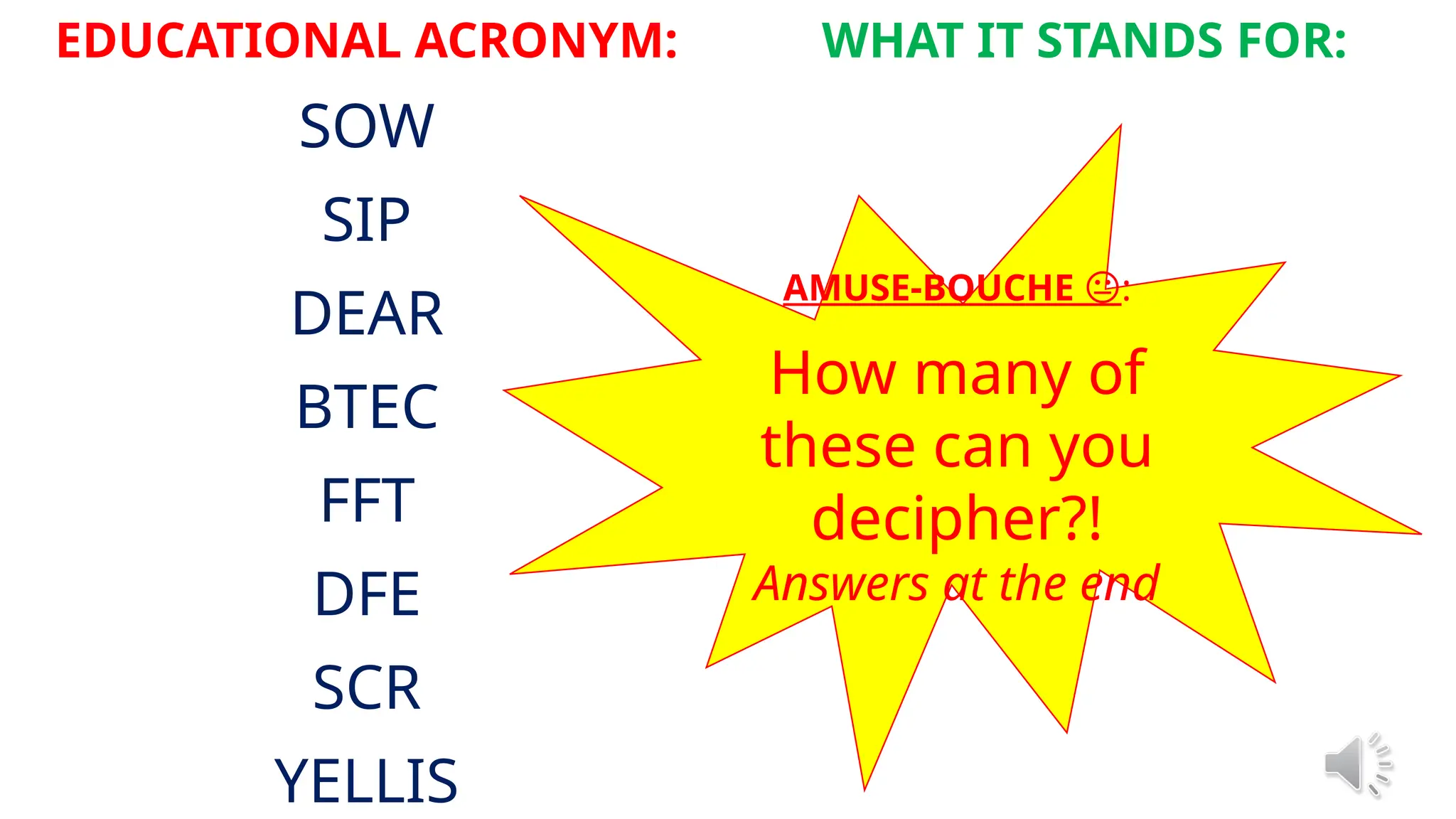
SOW
SIP
DEAR
BTEC
FFT
DFE
SCR
YELLIS
AMUSE-BOUCHE 😐:
How many of
these can you
decipher?!
Answers at the end
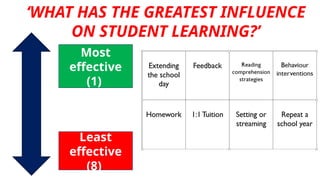
‘WHAT HAS THE GREATEST INFLUENCE
ON STUDENT LEARNING?’
Most
effective
(1)
Least
effective
(8)
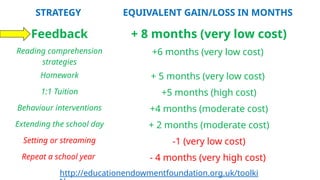
STRATEGY EQUIVALENT GAIN/LOSS IN MONTHS
Feedback + 8 months (very low cost)
Reading comprehension
strategies
+6 months (very low cost)
Homework + 5 months (very low cost)
1:1 Tuition +5 months (high cost)
Behaviour interventions +4 months (moderate cost)
Extending the school day + 2 months (moderate cost)
Setting or streaming -1 (very low cost)
Repeat a school year - 4 months (very high cost)
http://educationendowmentfoundation.org.uk/toolki
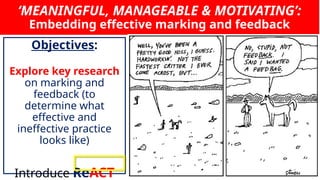
‘MEANINGFUL, MANAGEABLE & MOTIVATING’:
Embedding effective marking and feedback
Objectives:
Explore key research
on marking and
feedback (to
determine what
effective and
ineffective practice
looks like)
Introduce ReACT
Why do we mark student work? Who are we
marking for?
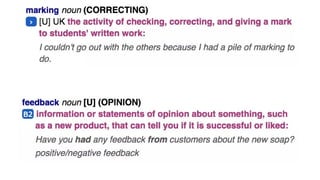
What is the difference between marking and
feedback?
What does effective look like?
What are the barriers to effective marking &
feedback?
TASK 2: GROUP DISCUSSIONS (5
MINS)
WHY DO WE MARK PUPIL WORK?
• To help pupils improve and make progress?
• To build positive relationships?
• To improve standards of work?
• To evaluate our teaching and inform our planning?
• To help pupils to value what they do (they know you’ll read
it…)?
• Because HoDs/school leaders/inspectors/parents expect it
and are holding us to account?
• Because it’s part of the job? Anything
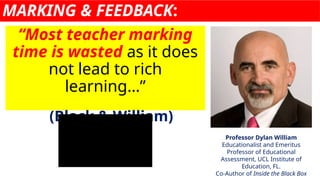
MARKING & FEEDBACK:
“Most teacher marking
time is wasted as it does
not lead to rich
learning…”
(Black & William)
Professor Dylan William
Educationalist and Emeritus
Professor of Educational
Assessment, UCL Institute of
Education, FL.
Co-Author of Inside the Black Box
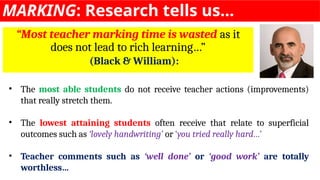
MARKING: Research tells us…
“Most teacher marking time is wasted as it
does not lead to rich learning…”
(Black & William):
• The most able students do not receive teacher actions (improvements)
that really stretch them.
• The lowest attaining students often receive that relate to superficial
outcomes such as ‘lovely handwriting’ or ‘you tried really hard…’
• Teacher comments such as ‘well done’ or ‘good work’ are totally
worthless…
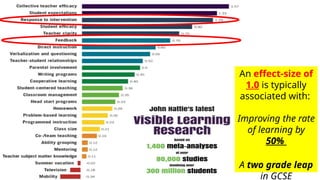
Professor John Hattie:
What has the
greatest
influence on
student
learning?
TES:
“possibly the world’s most influential
education academic”.
An effect-size of
1.0 is typically
associated with:
Improving the rate
of learning by
50%
A two grade leap
in GCSE
What does Hattie actually say?
FEEDBACK – one of the most powerful influences on
learning…
BUT this impact can be positive or negative…
Simply providing MORE FEEDBACK is not the answer!
It is necessary to consider:
the nature the timing how pupils’ receive/seek
OFSTED & THE ISI
ON
MARKING EXPECTATIONS:
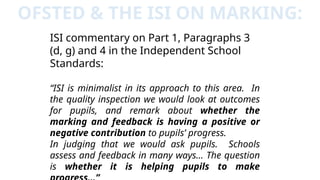
OFSTED & THE ISI ON MARKING:
ISI commentary on Part 1, Paragraphs 3
(d, g) and 4 in the Independent School
Standards:
“ISI is minimalist in its approach to this area. In
the quality inspection we would look at outcomes
for pupils, and remark about whether the
marking and feedback is having a positive or
negative contribution to pupils’ progress.
In judging that we would ask pupils. Schools
assess and feedback in many ways… The question
is whether it is helping pupils to make
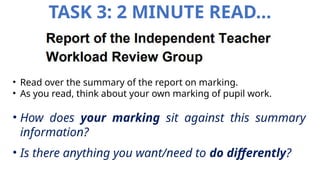
TASK 3: 2 MINUTE READ…
• Read over the summary of the report on marking.
• As you read, think about your own marking of pupil work.
• How does your marking sit against this summary
information?
• Is there anything you want/need to do differently?
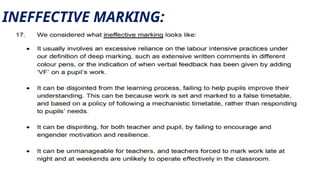
INEFFECTIVE MARKING:
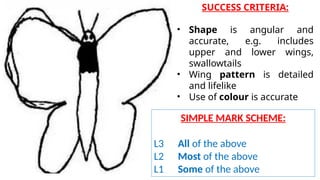
SUCCESS CRITERIA:
• Shape is angular and
accurate, e.g. includes
upper and lower wings,
swallowtails
• Wing pattern is detailed
and lifelike
• Use of colour is accurate
DRAWING A BUTTERFLY!
SIMPLE MARK SCHEME:
L3 All of the above
L2 Most of the above
L1 Some of the above
SUCCESS CRITERIA:
• Shape is angular and
accurate, e.g. includes
upper and lower wings,
swallowtails
• Wing pattern is detailed
and lifelike
• Use of colour is accurate
SIMPLE MARK SCHEME:
L3 All of the above
L2 Most of the above
L1 Some of the above
“RON BERGER: Austin’s Butterfly”
Ron Berger – Expeditionary Learning – advocate of better
assessment
Think: how might you apply this technique in your subject?
What might be the downsides or disadvantages?
MARKING & FEEDBACK
Guiding Principles:
1. Is it manageable, meaningful,
motivating?
2. Is it having a positive impact on
pupil learning, progress,
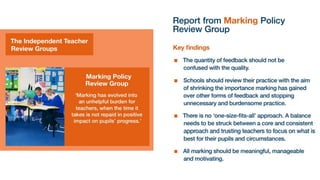
MEANINGFUL, MANAGEABLE, MOTIVATING
Meaningful: marking varies by age group, subject, and what works best for the pupil and
teacher in relation to any particular piece of work. Teachers are encouraged to adjust their
approach as necessary and trusted to incorporate the outcomes into subsequent planning
and teaching.
Manageable: marking practice is proportionate and considers the frequency and complexity
of written feedback, as well as the cost and time-effectiveness of marking in relation to the
overall workload of teachers. This is written into any assessment policy.
Motivating: Marking should help to motivate pupils to progress. This does not mean always

writing in-depth comments or being universally positive: sometimes short, challenging
comments or oral feedback are more effective. If the teacher is doing more work than their
pupils, this can become a disincentive for pupils to accept challenges and take responsibility
for improving their work.
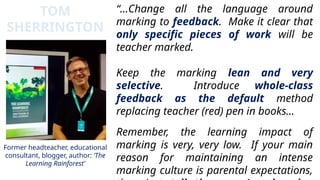
“…Change all the language around
marking to feedback. Make it clear that
only specific pieces of work will be
teacher marked.
Keep the marking lean and very
selective. Introduce whole-class
feedback as the default method
replacing teacher (red) pen in books…
Remember, the learning impact of
marking is very, very low. If your main
reason for maintaining an intense
marking culture is parental expectations,
TOM
SHERRINGTON
Former headteacher, educational
consultant, blogger, author: ‘The
Learning Rainforest’
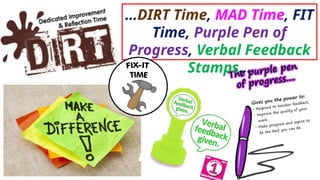
…DIRT Time, MAD Time, FIT
Time, Purple Pen of
Progress, Verbal Feedback
Stamps…
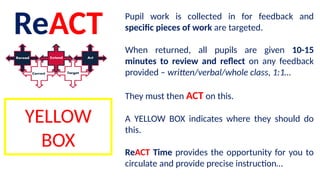
ReACT Time
YELLOW BOX
ReACT Pupil work is collected in for feedback and
specific pieces of work are targeted.
When returned, all pupils are given 10-15
minutes to review and reflect on any feedback
provided – written/verbal/whole class, 1:1…
They must then ACT on this.
A YELLOW BOX indicates where they should do
this.
ReACT Time provides the opportunity for you to
circulate and provide precise instruction…
YELLOW
BOX
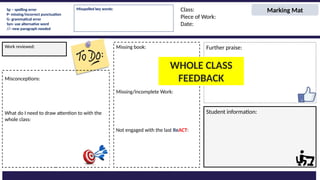
Class:
Piece of Work:
Date:
Misconceptions:
What do I need to draw attention to with the
whole class:
Student information:
Further praise:
Work reviewed: Missing book:
Missing/incomplete Work:
Not engaged with the last ReACT:
Sp – spelling error
P- missing/incorrect punctuation
G- grammatical error
Syn- use alternative word
//- new paragraph needed
Marking Mat
Misspelled key words:
WHOLE CLASS
FEEDBACK
•Not a prescriptive ‘one-size-fits-all’ approach –
find what works best for you and your subject – written
comments, short or challenge questions, oral feedback, whole
class feedback, 1:1 discussion, find-and-correct or dot marking
etc…
•But the pupils must have the opportunity to
review, redraft, reflect, respond etc. as
appropriate.
•The onus must be on the pupils to be working
harder than we are.
WHAT NOW?
Focus on YEAR 9:
1. Build in 10-15 minutes of ReACT Time into lessons
when specific/identified pieces of work have been marked.
2. Use yellow highlighter and YELLOW BOX to provide
guidance to pupils – approximate size of response required
– as to how they may improve their work. Ensure this is
followed up as work is returned. ReACT tasks can be given
as Prep.
POINTS 1 & 2 ARE NON-NEGOTIABLE… but do find
opportunities to discuss different ways to provide effective
feedback with department and other colleagues.
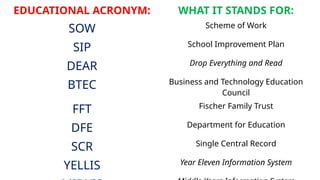
EDUCATIONAL ACRONYM: WHAT IT STANDS FOR:
SOW Scheme of Work
SIP School Improvement Plan
DEAR Drop Everything and Read
BTEC Business and Technology Education
Council
FFT Fischer Family Trust
DFE Department for Education
SCR Single Central Record
YELLIS Year Eleven Information System

Meaningful Marking - ReACT and Yellow Box

  • 1.
    EDUCATIONAL ACRONYM: WHATIT STANDS FOR: SOW SIP DEAR BTEC FFT DFE SCR YELLIS AMUSE-BOUCHE 😐: How many of these can you decipher?! Answers at the end
  • 2.
    ‘WHAT HAS THEGREATEST INFLUENCE ON STUDENT LEARNING?’ Most effective (1) Least effective (8)
  • 3.
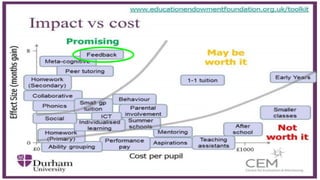
    STRATEGY EQUIVALENT GAIN/LOSSIN MONTHS Feedback + 8 months (very low cost) Reading comprehension strategies +6 months (very low cost) Homework + 5 months (very low cost) 1:1 Tuition +5 months (high cost) Behaviour interventions +4 months (moderate cost) Extending the school day + 2 months (moderate cost) Setting or streaming -1 (very low cost) Repeat a school year - 4 months (very high cost) http://educationendowmentfoundation.org.uk/toolki
  • 4.
    ‘MEANINGFUL, MANAGEABLE &MOTIVATING’: Embedding effective marking and feedback Objectives: Explore key research on marking and feedback (to determine what effective and ineffective practice looks like) Introduce ReACT
  • 6.
    Why do wemark student work? Who are we marking for? What is the difference between marking and feedback? What does effective look like? What are the barriers to effective marking & feedback? TASK 2: GROUP DISCUSSIONS (5 MINS)
  • 7.
    WHY DO WEMARK PUPIL WORK? • To help pupils improve and make progress? • To build positive relationships? • To improve standards of work? • To evaluate our teaching and inform our planning? • To help pupils to value what they do (they know you’ll read it…)? • Because HoDs/school leaders/inspectors/parents expect it and are holding us to account? • Because it’s part of the job? Anything
  • 9.
    MARKING & FEEDBACK: “Mostteacher marking time is wasted as it does not lead to rich learning…” (Black & William) Professor Dylan William Educationalist and Emeritus Professor of Educational Assessment, UCL Institute of Education, FL. Co-Author of Inside the Black Box
  • 10.
    MARKING: Research tellsus… “Most teacher marking time is wasted as it does not lead to rich learning…” (Black & William): • The most able students do not receive teacher actions (improvements) that really stretch them. • The lowest attaining students often receive that relate to superficial outcomes such as ‘lovely handwriting’ or ‘you tried really hard…’ • Teacher comments such as ‘well done’ or ‘good work’ are totally worthless…
  • 11.
    Professor John Hattie: Whathas the greatest influence on student learning? TES: “possibly the world’s most influential education academic”.
  • 12.
    An effect-size of 1.0is typically associated with: Improving the rate of learning by 50% A two grade leap in GCSE
  • 13.
    What does Hattieactually say? FEEDBACK – one of the most powerful influences on learning… BUT this impact can be positive or negative… Simply providing MORE FEEDBACK is not the answer! It is necessary to consider: the nature the timing how pupils’ receive/seek
  • 14.
    OFSTED & THEISI ON MARKING EXPECTATIONS:
  • 15.
    OFSTED & THEISI ON MARKING: ISI commentary on Part 1, Paragraphs 3 (d, g) and 4 in the Independent School Standards: “ISI is minimalist in its approach to this area. In the quality inspection we would look at outcomes for pupils, and remark about whether the marking and feedback is having a positive or negative contribution to pupils’ progress. In judging that we would ask pupils. Schools assess and feedback in many ways… The question is whether it is helping pupils to make
  • 16.
    TASK 3: 2MINUTE READ… • Read over the summary of the report on marking. • As you read, think about your own marking of pupil work. • How does your marking sit against this summary information? • Is there anything you want/need to do differently?
  • 17.
  • 19.
    SUCCESS CRITERIA: • Shapeis angular and accurate, e.g. includes upper and lower wings, swallowtails • Wing pattern is detailed and lifelike • Use of colour is accurate DRAWING A BUTTERFLY! SIMPLE MARK SCHEME: L3 All of the above L2 Most of the above L1 Some of the above
  • 21.
    SUCCESS CRITERIA: • Shapeis angular and accurate, e.g. includes upper and lower wings, swallowtails • Wing pattern is detailed and lifelike • Use of colour is accurate SIMPLE MARK SCHEME: L3 All of the above L2 Most of the above L1 Some of the above
  • 22.
    “RON BERGER: Austin’sButterfly” Ron Berger – Expeditionary Learning – advocate of better assessment Think: how might you apply this technique in your subject? What might be the downsides or disadvantages?
  • 25.
    MARKING & FEEDBACK GuidingPrinciples: 1. Is it manageable, meaningful, motivating? 2. Is it having a positive impact on pupil learning, progress,
  • 26.
    MEANINGFUL, MANAGEABLE, MOTIVATING Meaningful:marking varies by age group, subject, and what works best for the pupil and teacher in relation to any particular piece of work. Teachers are encouraged to adjust their approach as necessary and trusted to incorporate the outcomes into subsequent planning and teaching. Manageable: marking practice is proportionate and considers the frequency and complexity of written feedback, as well as the cost and time-effectiveness of marking in relation to the overall workload of teachers. This is written into any assessment policy. Motivating: Marking should help to motivate pupils to progress. This does not mean always writing in-depth comments or being universally positive: sometimes short, challenging comments or oral feedback are more effective. If the teacher is doing more work than their pupils, this can become a disincentive for pupils to accept challenges and take responsibility for improving their work.
  • 27.
    “…Change all thelanguage around marking to feedback. Make it clear that only specific pieces of work will be teacher marked. Keep the marking lean and very selective. Introduce whole-class feedback as the default method replacing teacher (red) pen in books… Remember, the learning impact of marking is very, very low. If your main reason for maintaining an intense marking culture is parental expectations, TOM SHERRINGTON Former headteacher, educational consultant, blogger, author: ‘The Learning Rainforest’
  • 28.
    …DIRT Time, MADTime, FIT Time, Purple Pen of Progress, Verbal Feedback Stamps…
  • 29.
  • 30.
    ReACT Pupil workis collected in for feedback and specific pieces of work are targeted. When returned, all pupils are given 10-15 minutes to review and reflect on any feedback provided – written/verbal/whole class, 1:1… They must then ACT on this. A YELLOW BOX indicates where they should do this. ReACT Time provides the opportunity for you to circulate and provide precise instruction… YELLOW BOX
  • 31.
    Class: Piece of Work: Date: Misconceptions: Whatdo I need to draw attention to with the whole class: Student information: Further praise: Work reviewed: Missing book: Missing/incomplete Work: Not engaged with the last ReACT: Sp – spelling error P- missing/incorrect punctuation G- grammatical error Syn- use alternative word //- new paragraph needed Marking Mat Misspelled key words: WHOLE CLASS FEEDBACK
  • 32.
    •Not a prescriptive‘one-size-fits-all’ approach – find what works best for you and your subject – written comments, short or challenge questions, oral feedback, whole class feedback, 1:1 discussion, find-and-correct or dot marking etc… •But the pupils must have the opportunity to review, redraft, reflect, respond etc. as appropriate. •The onus must be on the pupils to be working harder than we are.
  • 34.
    WHAT NOW? Focus onYEAR 9: 1. Build in 10-15 minutes of ReACT Time into lessons when specific/identified pieces of work have been marked. 2. Use yellow highlighter and YELLOW BOX to provide guidance to pupils – approximate size of response required – as to how they may improve their work. Ensure this is followed up as work is returned. ReACT tasks can be given as Prep. POINTS 1 & 2 ARE NON-NEGOTIABLE… but do find opportunities to discuss different ways to provide effective feedback with department and other colleagues.
  • 37.
    EDUCATIONAL ACRONYM: WHATIT STANDS FOR: SOW Scheme of Work SIP School Improvement Plan DEAR Drop Everything and Read BTEC Business and Technology Education Council FFT Fischer Family Trust DFE Department for Education SCR Single Central Record YELLIS Year Eleven Information System

Editor's Notes

  • #3 This report examines the impact on pupil gains vs cost.
  • #12 So avoid giving a grade or mark except where absolutely necessary. This is not easy to do on some courses. However it is rarely necessary, and almost never desirable, to grade every piece of work.
  • #15 This report examines the impact on pupil gains vs cost.
  • #16 • An effect size of 0.5 is equivalent to a one grade leap at GCSE • An effect size of 1.0 is equivalent to a two grade leap at GCSE Feedback Hattie has made clear that ‘feedback' includes telling students what they have done well (positive reinforcement), and what they need to do to improve (corrective work, targets etc), but it also includes clarifying goals. This means that giving students assessment criteria for example would be included in ‘feedback'. This may seem odd, but high quality feedback is always given against explicit criteria, and so these would be included in ‘feedback' experiments. As well as feedback on the task Hattie believes that students can get feedback on the processes they have used to complete the task, and on their ability to self-regulate their own learning. All these have the capacity to increase achievement. Feedback on the ‘self' such as ‘well done you are good at this' is not helpful. The feedback must be informative rather than evaluative.
  • #17 He has analysed 200,000 ‘effect-sizes’ from 180,000 studies representing 50+million students and covering almost every method of innovation.