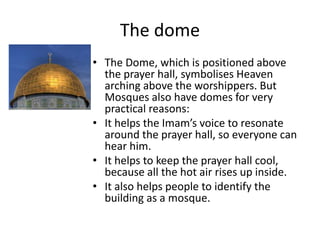
The dome
• The Dome, which is positioned above
the prayer hall, symbolises Heaven
arching above the worshippers. But
Mosques also have domes for very
practical reasons:
• It helps the Imam’s voice to resonate
around the prayer hall, so everyone can
hear him.
• It helps to keep the prayer hall cool,
because all the hot air rises up inside.
• It also helps people to identify the
building as a mosque.
The minaret
• The tall tower attached to the
mosque is called a minaret and it
has two main uses:
• It helps people to find the mosque,
since it is often the tallest structure
in the town.
• It is used for the call to prayer. A
man called a muezzin has the job
of climbing to the top and singing
the Adhan. This is the call to prayer,
and it reminds everyone that it is
time to come to the mosque. These
days, the muezzin often stays at
the bottom of the minaret and uses
a microphone attached to a
loudspeaker instead!
Prayer hall
• The main prayer hall is usually just a
large empty hall with the dome above
it. There are no chairs (apart from
maybe a few for the disabled or
elderly) because everyone sits on the
carpet. During prayer Muslims will
kneel and prostrate with their
foreheads to the floor as a sign of
submission to God, so chairs would
only get in the way.
• Men and women sit separately so that
their minds are on their prayers and
not on each other. In some mosques,
women will pray in a screened-off
section at the back of the prayer hall,
in others they have their own separate
room.
The mihrab
• When Muslims pray they must face the
direction of the Ka’ba, which is a cube-
shaped holy building in the centre of
Makkah in Saudi Arabia. Muslims believe
it was the first ever building that was
dedicated to the worship of Allah. This
direction is called the qibla.
• The mihrab is an archway or alcove set
into the wall at the front of the prayer
hall, and if you are facing the mihrab, you
know that you are facing the qibla. The
wall it is set into is sometimes called the
qibla wall.
• Some say the shape of the alcove
symbolises the ear of Allah being always
open to the prayers of Muslims.
Prayer mats
• The mat a Muslim uses for prayer also contains
important religious symbols. Although the designs
and colours vary, the rug will always have an arch
representing the mihrab in the mosque, to show a
Muslim they are facing Makkah.
• The prayer mat reminds Muslims of the need to
prayer 5 times a day, and to find a clean place to
prayer, so they can fully focus on Allah.
• In Mosques, the carpet is designed
to look like prayer mats.
Calligraphy
• When Islam began, most people
worshipped idols, which were statues
or pictures of their gods. Muslims
wanted to show that they were
different, and worshipped one unseen
God, so images of people or animals
were banned from mosques.
• Because no one can know what Allah is
like, it is disrespectful to draw him.
• Words from the Qur’an can instead be
seen in a Mosque, written in Arabic
calligraphy. It’s there so that Muslim
can meditate on the words of Allah.

Information on symbolism

  • 1.
    The dome • TheDome, which is positioned above the prayer hall, symbolises Heaven arching above the worshippers. But Mosques also have domes for very practical reasons: • It helps the Imam’s voice to resonate around the prayer hall, so everyone can hear him. • It helps to keep the prayer hall cool, because all the hot air rises up inside. • It also helps people to identify the building as a mosque.
  • 2.
    The minaret • Thetall tower attached to the mosque is called a minaret and it has two main uses: • It helps people to find the mosque, since it is often the tallest structure in the town. • It is used for the call to prayer. A man called a muezzin has the job of climbing to the top and singing the Adhan. This is the call to prayer, and it reminds everyone that it is time to come to the mosque. These days, the muezzin often stays at the bottom of the minaret and uses a microphone attached to a loudspeaker instead!
  • 3.
    Prayer hall • Themain prayer hall is usually just a large empty hall with the dome above it. There are no chairs (apart from maybe a few for the disabled or elderly) because everyone sits on the carpet. During prayer Muslims will kneel and prostrate with their foreheads to the floor as a sign of submission to God, so chairs would only get in the way. • Men and women sit separately so that their minds are on their prayers and not on each other. In some mosques, women will pray in a screened-off section at the back of the prayer hall, in others they have their own separate room.
  • 4.
    The mihrab • WhenMuslims pray they must face the direction of the Ka’ba, which is a cube- shaped holy building in the centre of Makkah in Saudi Arabia. Muslims believe it was the first ever building that was dedicated to the worship of Allah. This direction is called the qibla. • The mihrab is an archway or alcove set into the wall at the front of the prayer hall, and if you are facing the mihrab, you know that you are facing the qibla. The wall it is set into is sometimes called the qibla wall. • Some say the shape of the alcove symbolises the ear of Allah being always open to the prayers of Muslims.
  • 5.
    Prayer mats • Themat a Muslim uses for prayer also contains important religious symbols. Although the designs and colours vary, the rug will always have an arch representing the mihrab in the mosque, to show a Muslim they are facing Makkah. • The prayer mat reminds Muslims of the need to prayer 5 times a day, and to find a clean place to prayer, so they can fully focus on Allah. • In Mosques, the carpet is designed to look like prayer mats.
  • 6.
    Calligraphy • When Islambegan, most people worshipped idols, which were statues or pictures of their gods. Muslims wanted to show that they were different, and worshipped one unseen God, so images of people or animals were banned from mosques. • Because no one can know what Allah is like, it is disrespectful to draw him. • Words from the Qur’an can instead be seen in a Mosque, written in Arabic calligraphy. It’s there so that Muslim can meditate on the words of Allah.