Mastication, Degluttition
and Speech
Presented by: Dr Sakshi
I yr PG
Department of Prosthodontics
MASTICATION
Digestive System
• Functions
Ingestion
– Mastication
– Deglutition
– Digestion
– Absorption of nutrients
– Elimination of indigestible/undigested
food products
From Mouth to Stomach
• Mastication (chewing):
– Mixes food with saliva -
• Amylase = enzyme that can catalyze the
partial digestion of starch.
• Deglutition (swallowing):
– Involves 3 phases:
• Oral phase is voluntary.
• Pharyngeal and Esophageal phases are
involuntary.
– Cannot be stopped.
– Larynx is raised.
– Epiglottis covers the entrance to respiratory
tract
MASTICATION
Mastication of food is the initial stage in the
process of digestion.
Large pieces of food are reduced to smaller
for swallowing.
The food is broken apart and the surface
area increased for the efficient action of
digestive enzymes and to facilitate
solubilisation of food substances in saliva to
stimulate taste receptors.
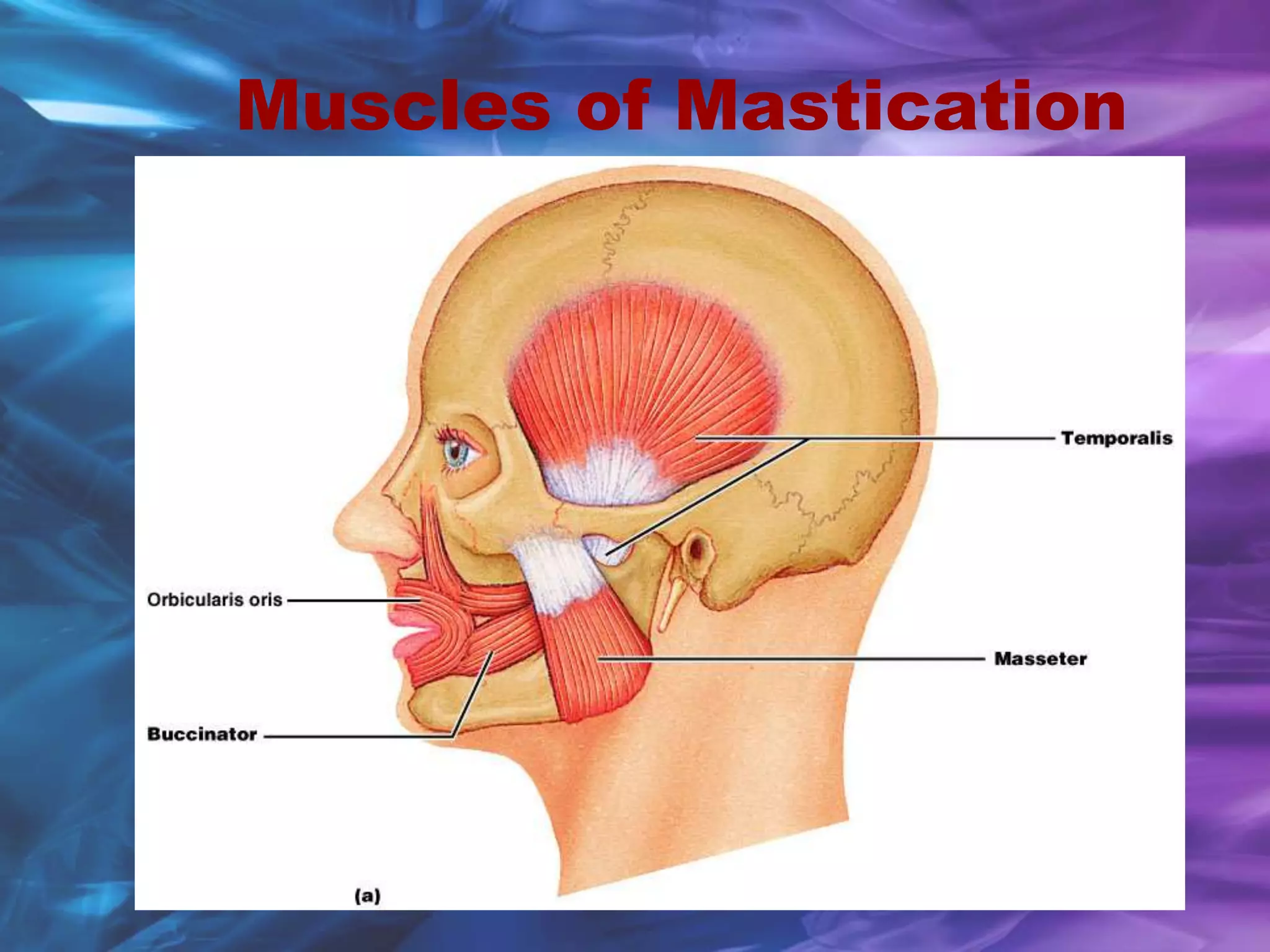
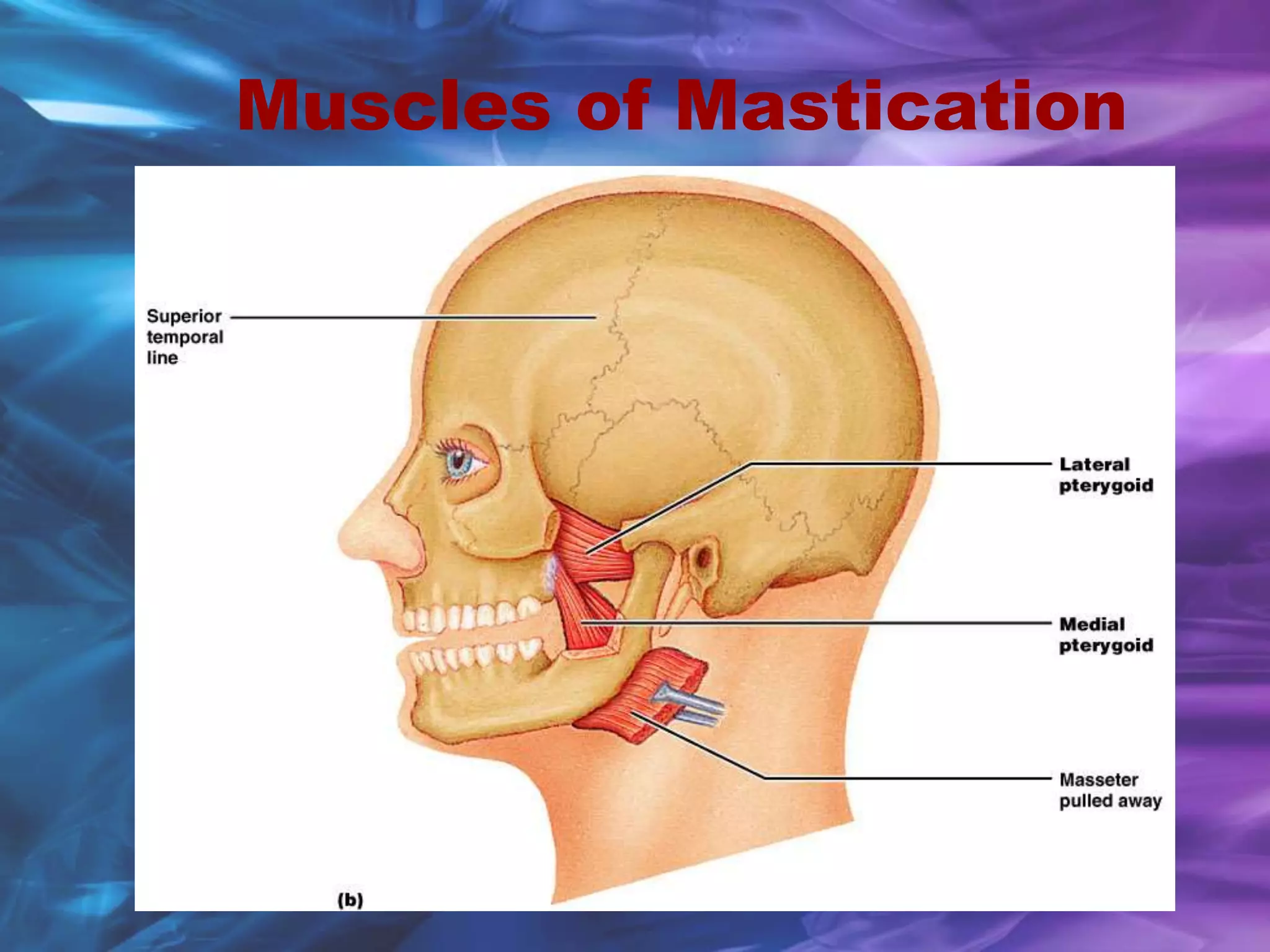
Muscles of Mastication
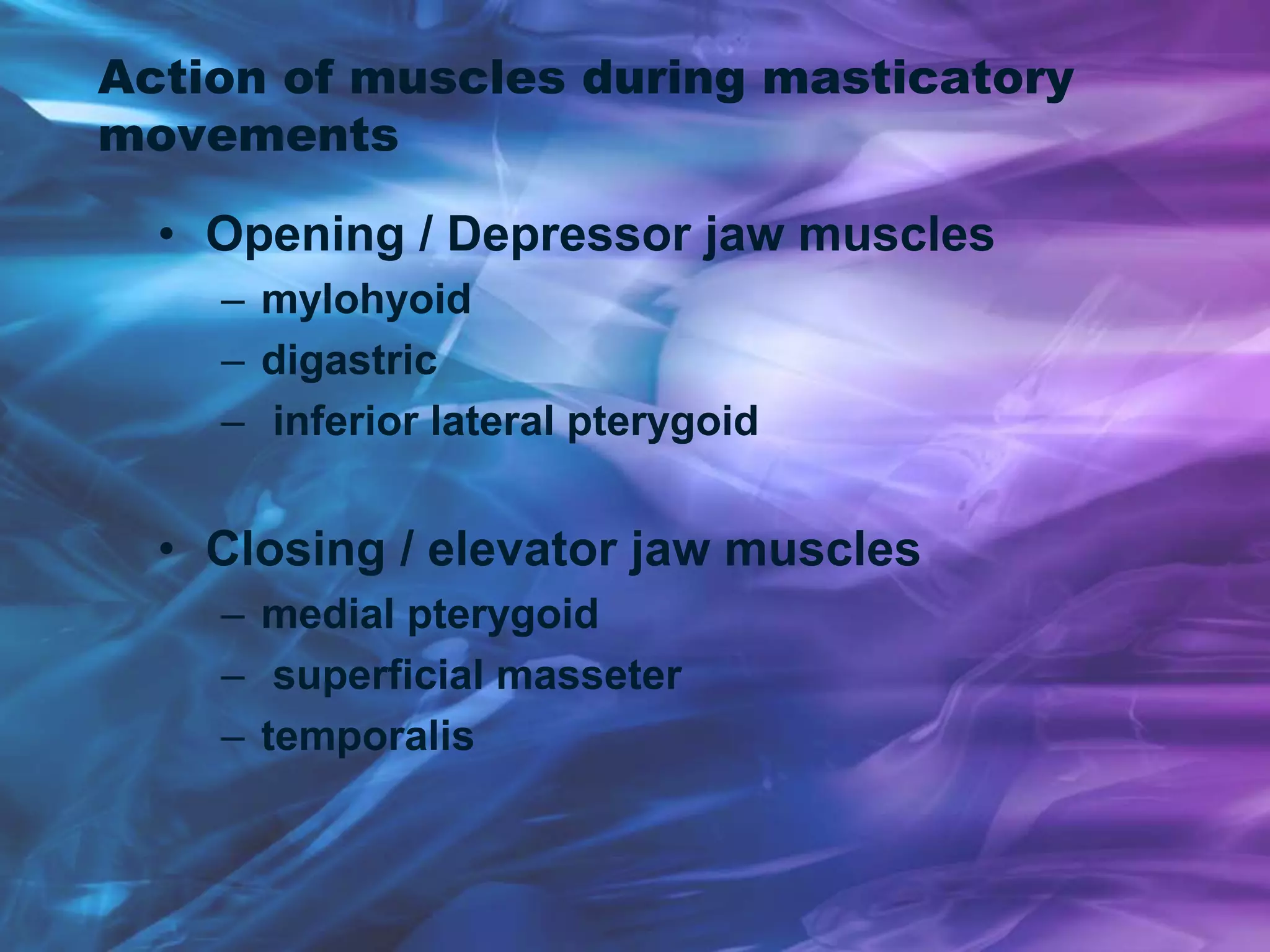
Action of muscles during masticatory
movements
• Opening / Depressor jaw muscles
– mylohyoid
– digastric
– inferior lateral pterygoid
• Closing / elevator jaw muscles
– medial pterygoid
– superficial masseter
– temporalis
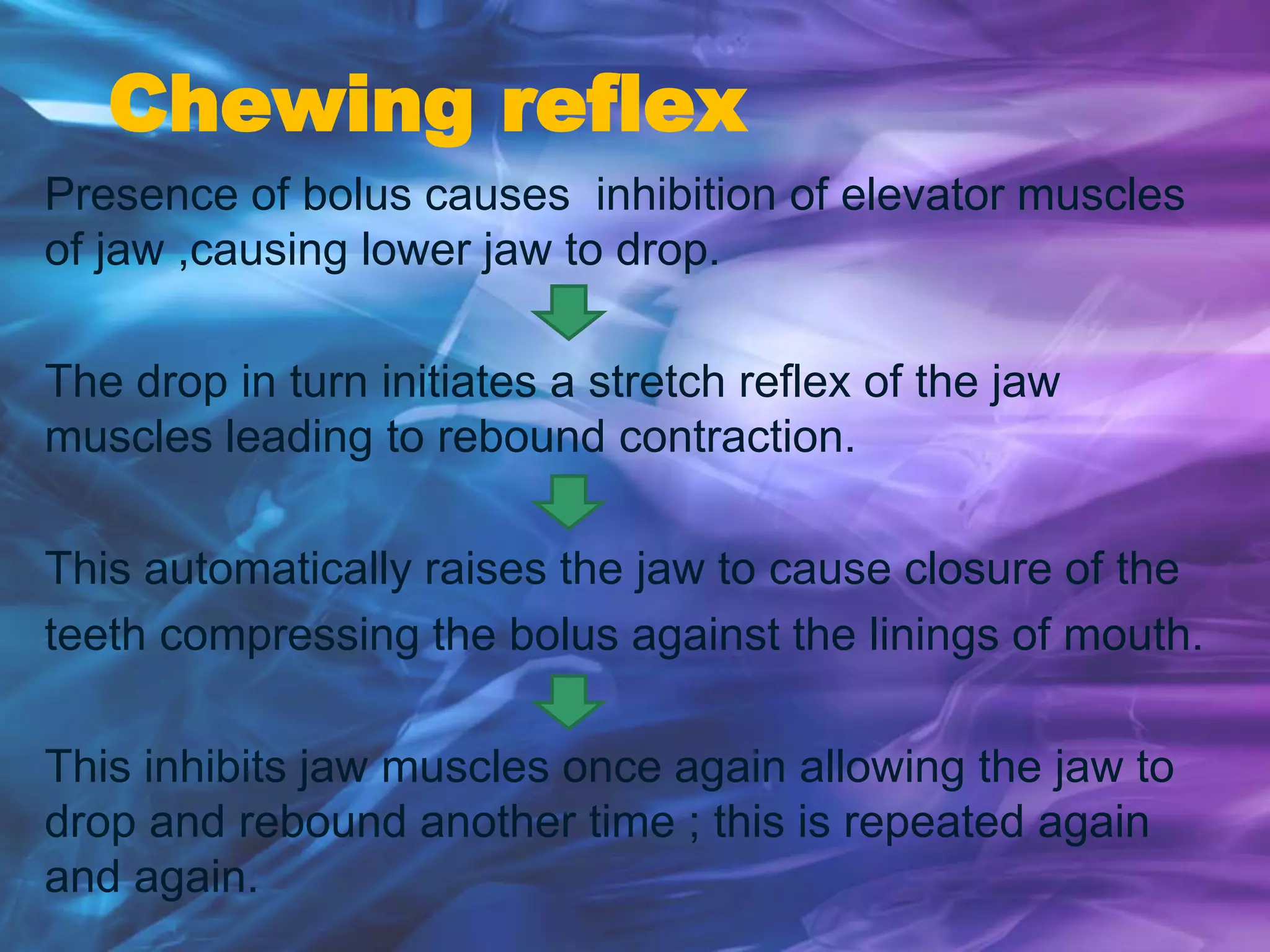
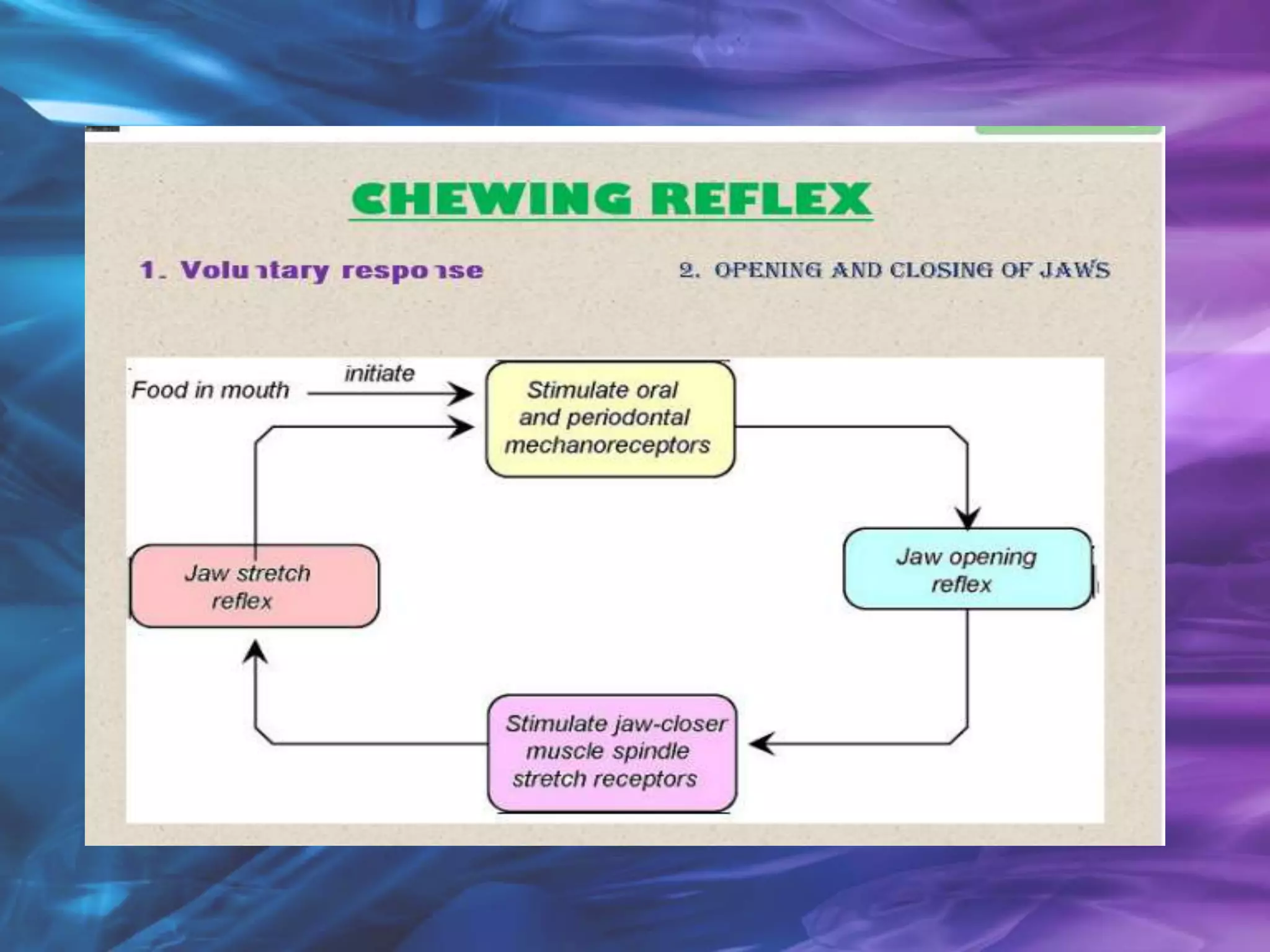
Chewing reflex
Presence of bolus causes inhibition of elevator muscles
of jaw ,causing lower jaw to drop.
The drop in turn initiates a stretch reflex of the jaw
muscles leading to rebound contraction.
This automatically raises the jaw to cause closure of the
teeth compressing the bolus against the linings of mouth.
This inhibits jaw muscles once again allowing the jaw to
drop and rebound another time ; this is repeated again
and again.
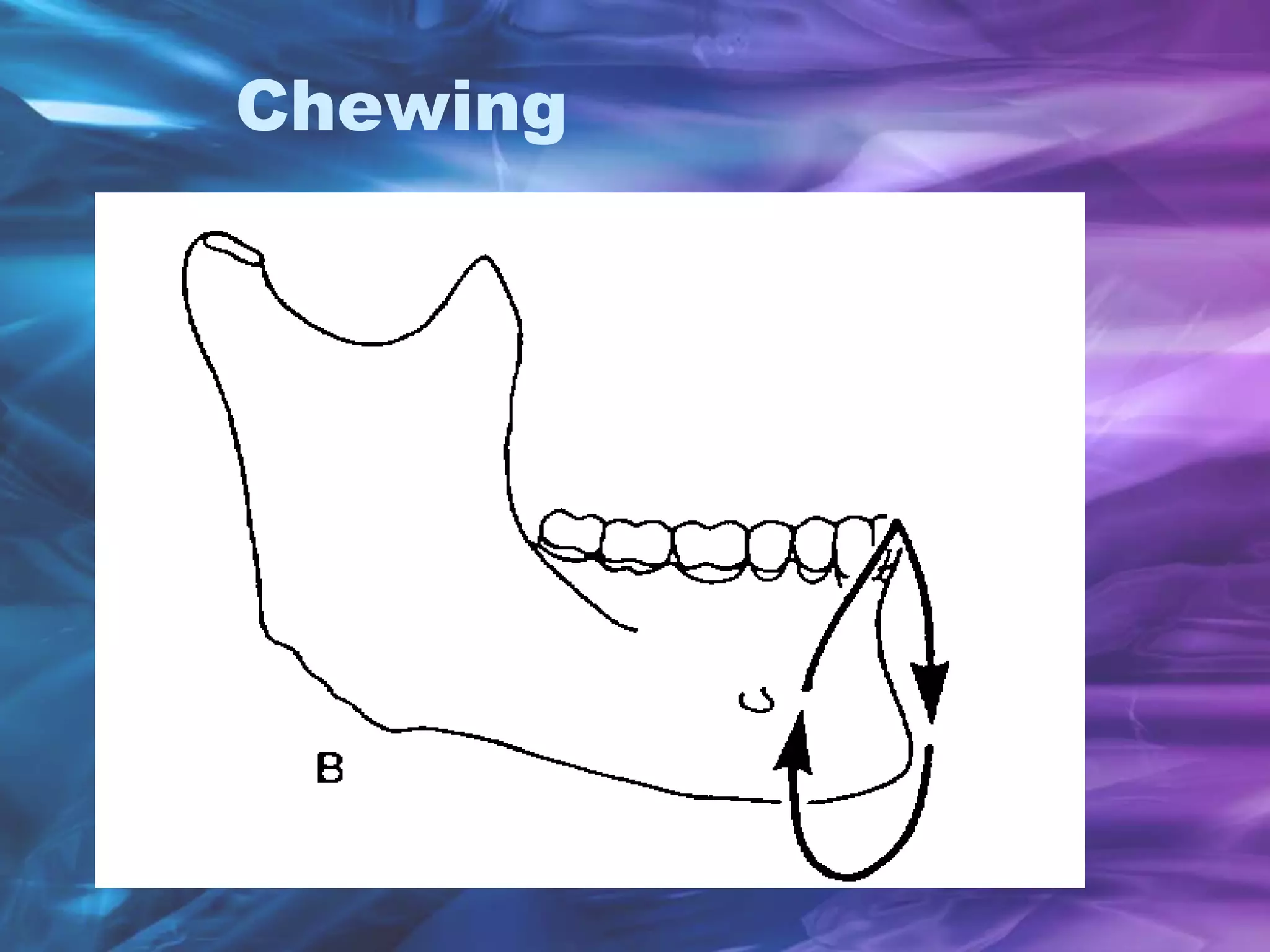
Chewing
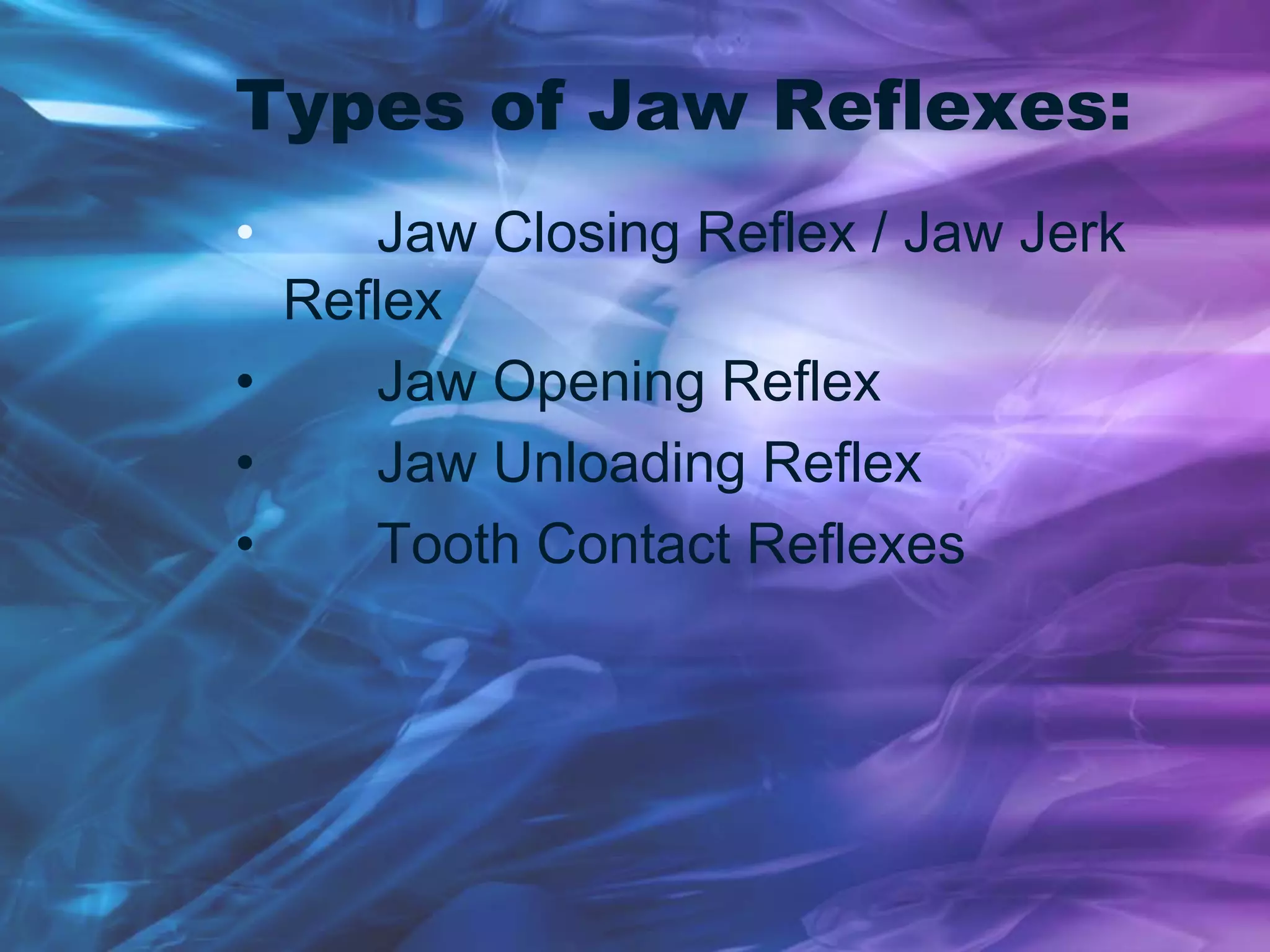
Types of Jaw Reflexes:
• Jaw Closing Reflex / Jaw Jerk
Reflex
• Jaw Opening Reflex
• Jaw Unloading Reflex
• Tooth Contact Reflexes
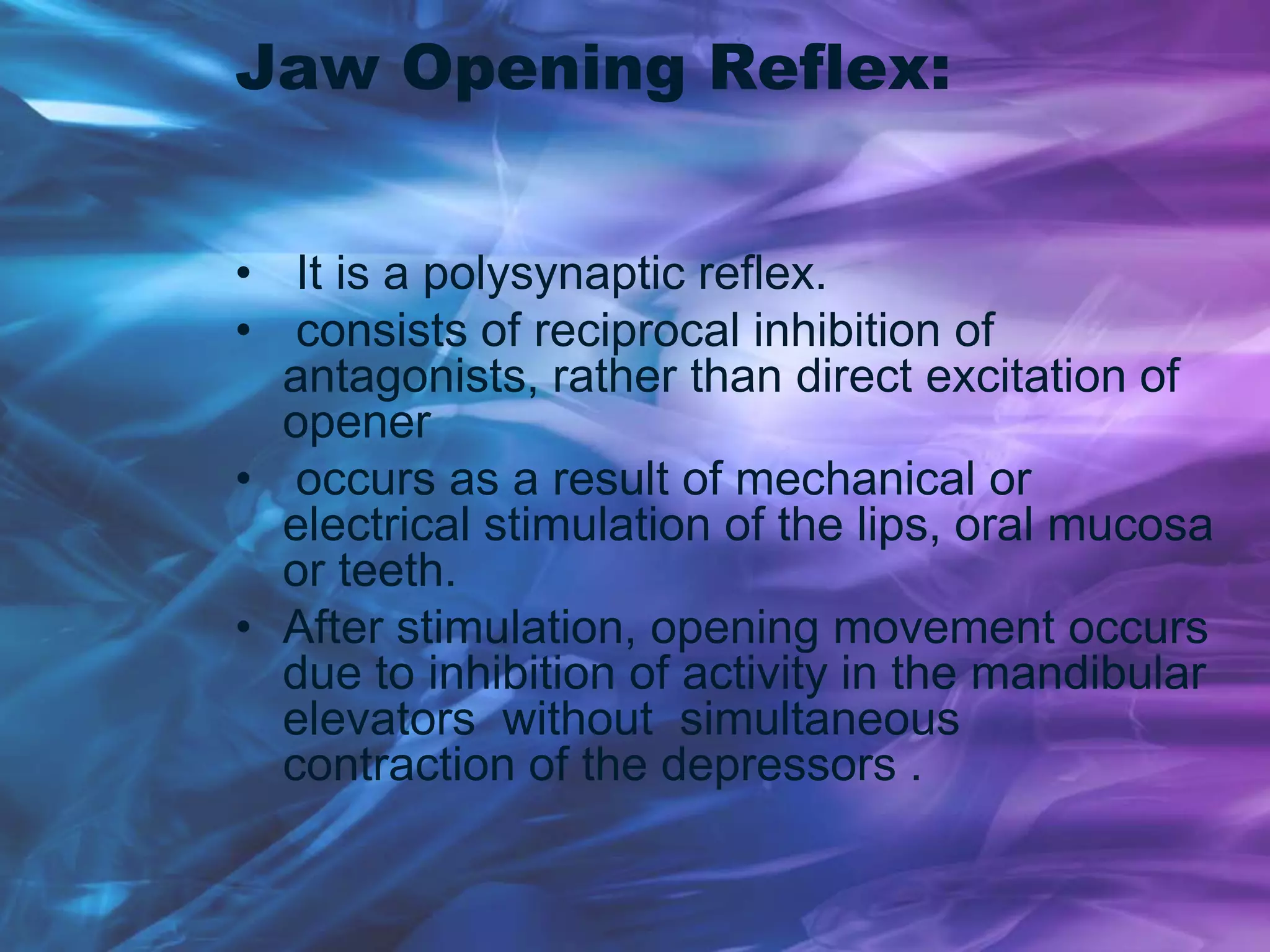
Jaw Opening Reflex:
• It is a polysynaptic reflex.
• consists of reciprocal inhibition of
antagonists, rather than direct excitation of
opener
• occurs as a result of mechanical or
electrical stimulation of the lips, oral mucosa
or teeth.
• After stimulation, opening movement occurs
due to inhibition of activity in the mandibular
elevators without simultaneous
contraction of the depressors .
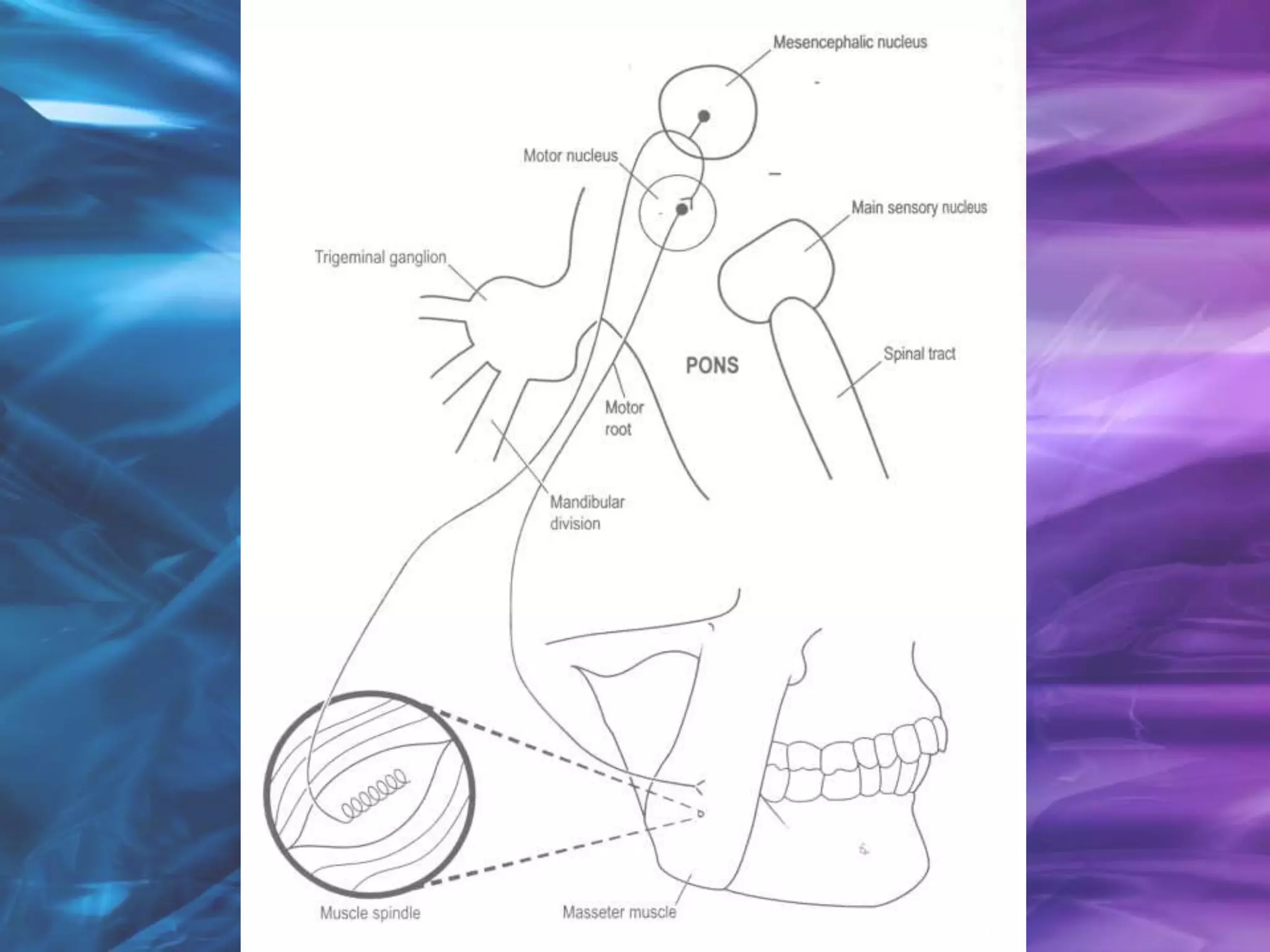
Jaw Closing Reflex / Jaw
Jerk Reflex:
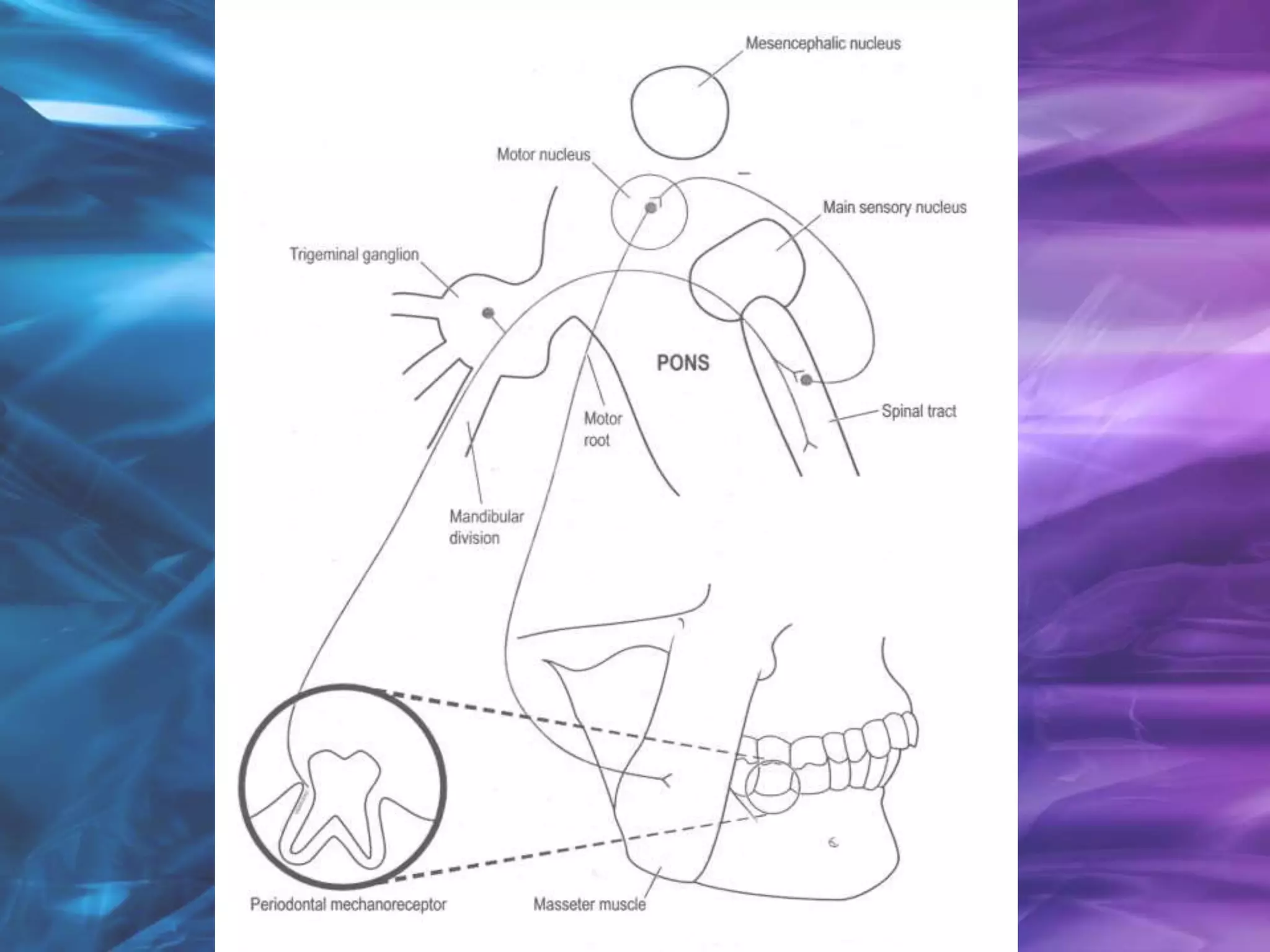
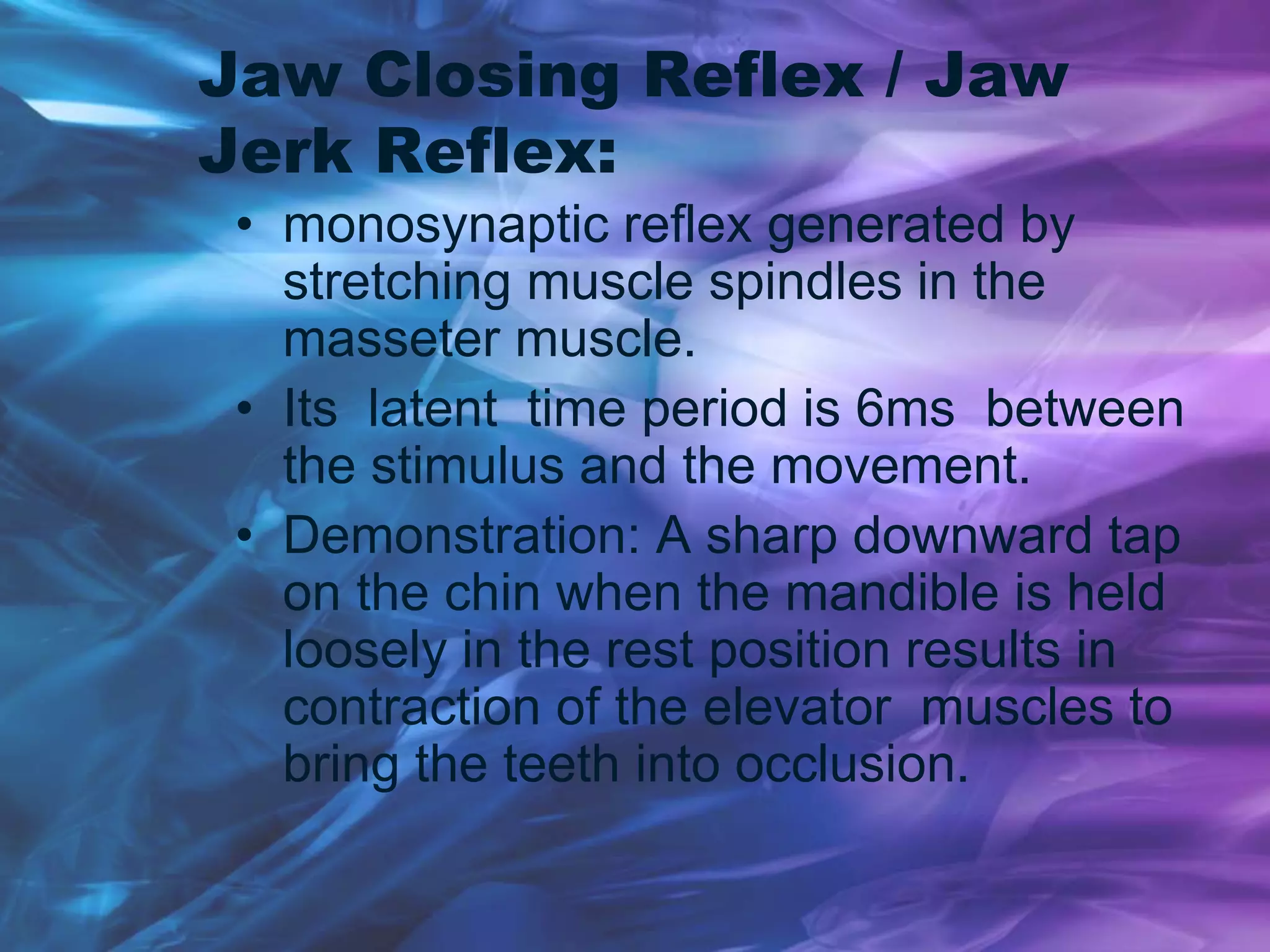
• monosynaptic reflex generated by
stretching muscle spindles in the
masseter muscle.
• Its latent time period is 6ms between
the stimulus and the movement.
• Demonstration: A sharp downward tap
on the chin when the mandible is held
loosely in the rest position results in
contraction of the elevator muscles to
bring the teeth into occlusion.
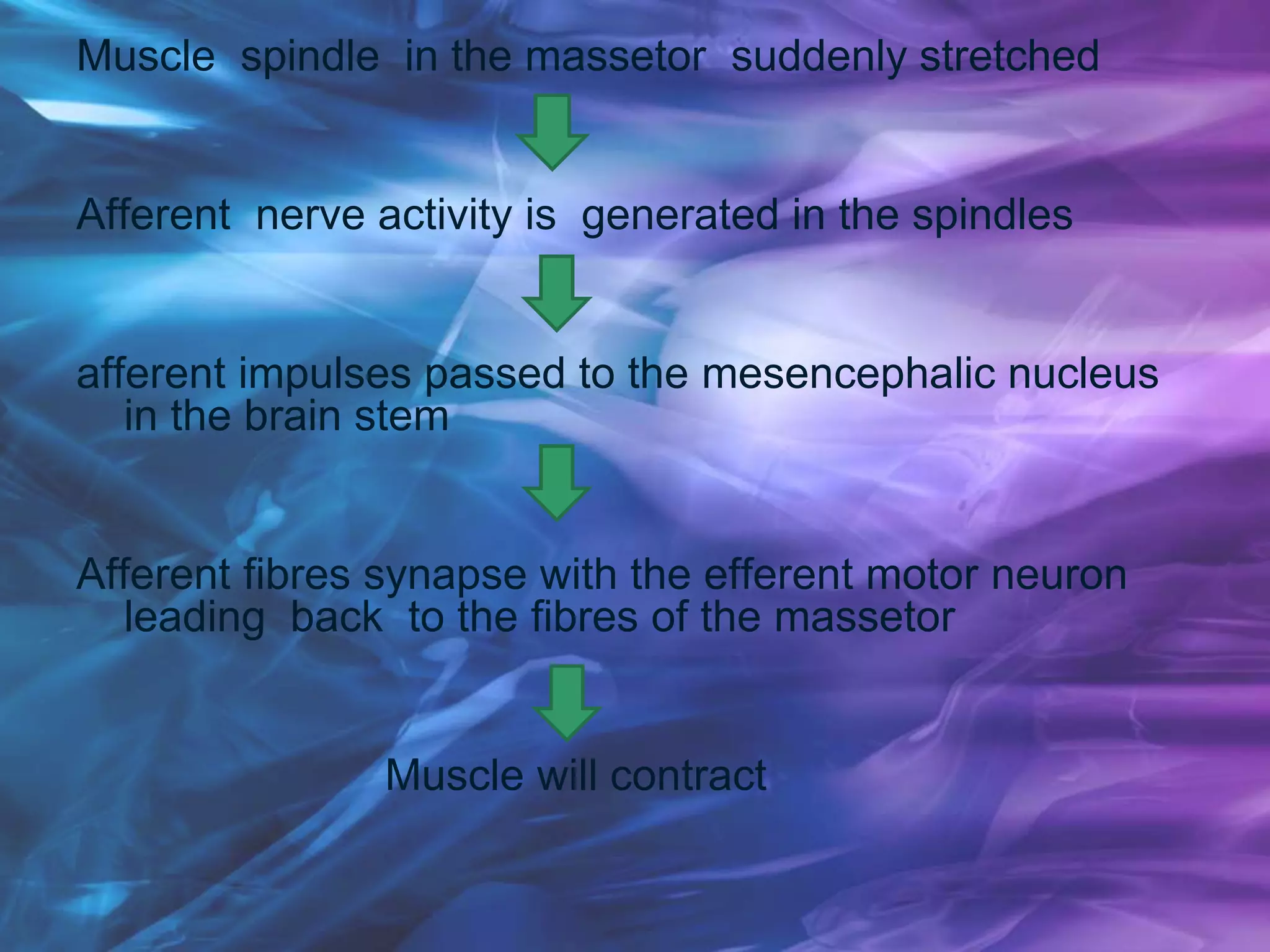
Muscle spindle in the massetor suddenly stretched
Afferent nerve activity is generated in the spindles
afferent impulses passed to the mesencephalic nucleus
in the brain stem
Afferent fibres synapse with the efferent motor neuron
leading back to the fibres of the massetor
Muscle will contract
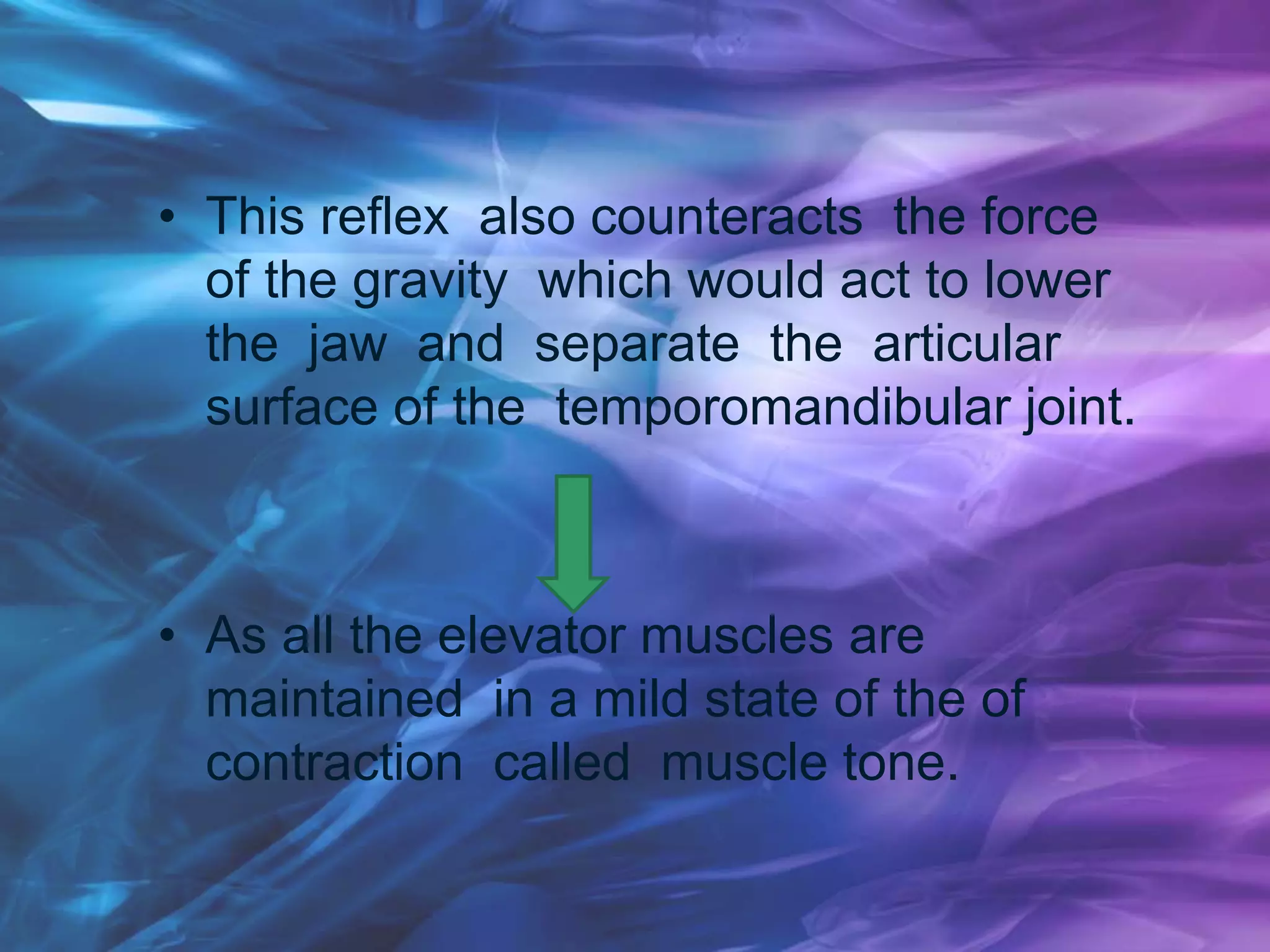
• This reflex also counteracts the force
of the gravity which would act to lower
the jaw and separate the articular
surface of the temporomandibular joint.
• As all the elevator muscles are
maintained in a mild state of the of
contraction called muscle tone.
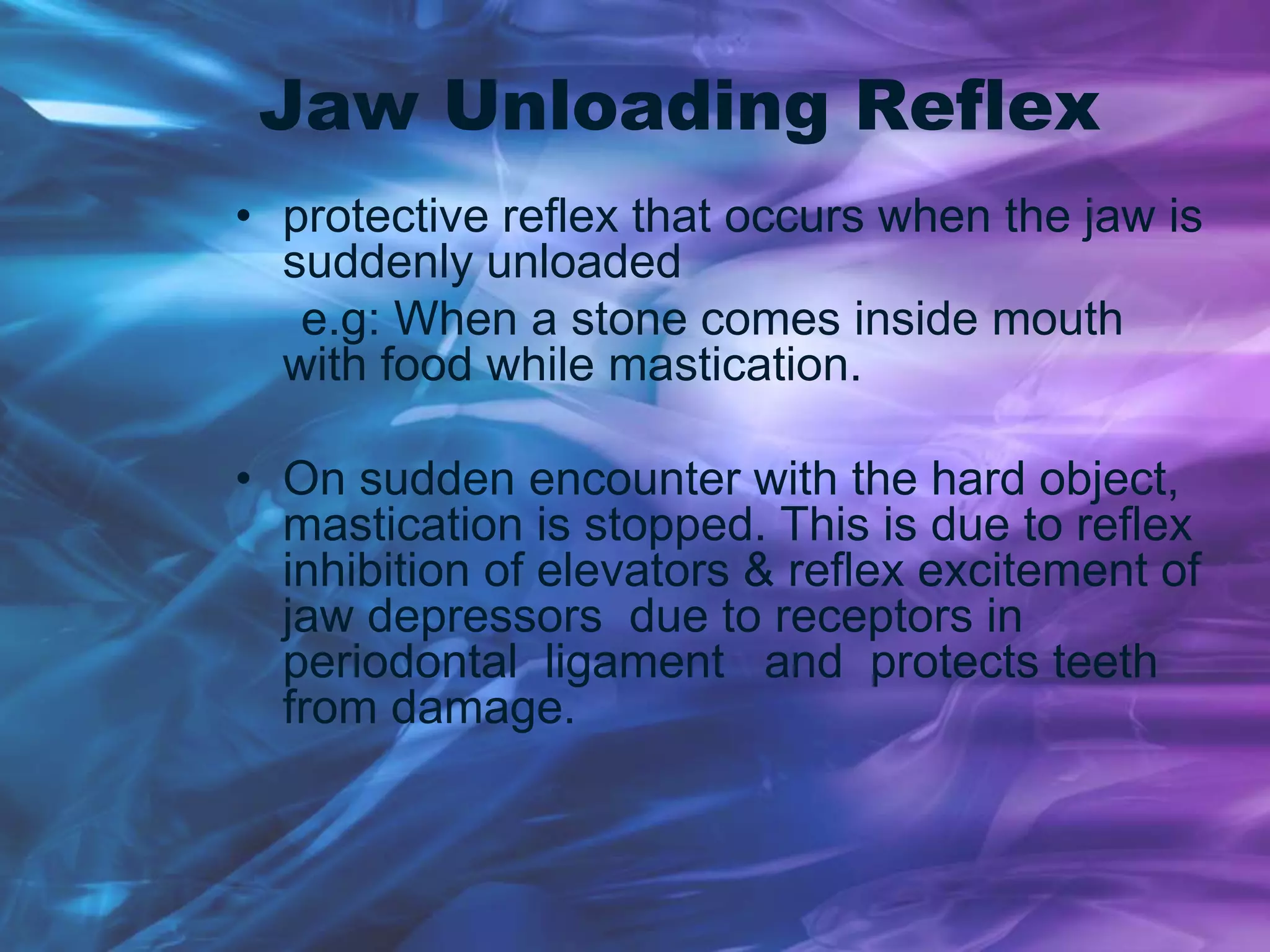
Jaw Unloading Reflex
• protective reflex that occurs when the jaw is
suddenly unloaded
e.g: When a stone comes inside mouth
with food while mastication.
• On sudden encounter with the hard object,
mastication is stopped. This is due to reflex
inhibition of elevators & reflex excitement of
jaw depressors due to receptors in
periodontal ligament and protects teeth
from damage.
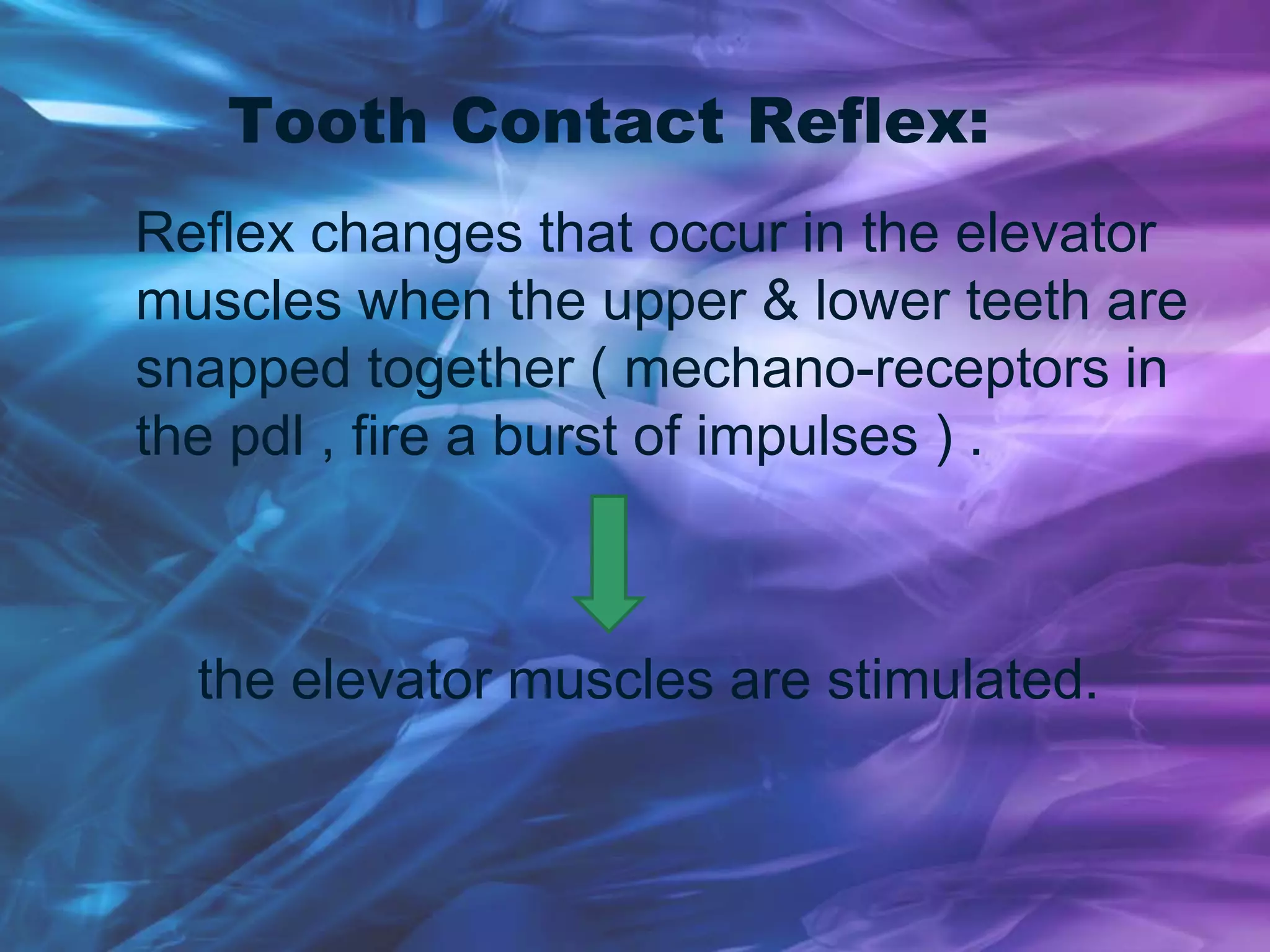
Tooth Contact Reflex:
Reflex changes that occur in the elevator
muscles when the upper & lower teeth are
snapped together ( mechano-receptors in
the pdl , fire a burst of impulses ) .
the elevator muscles are stimulated.
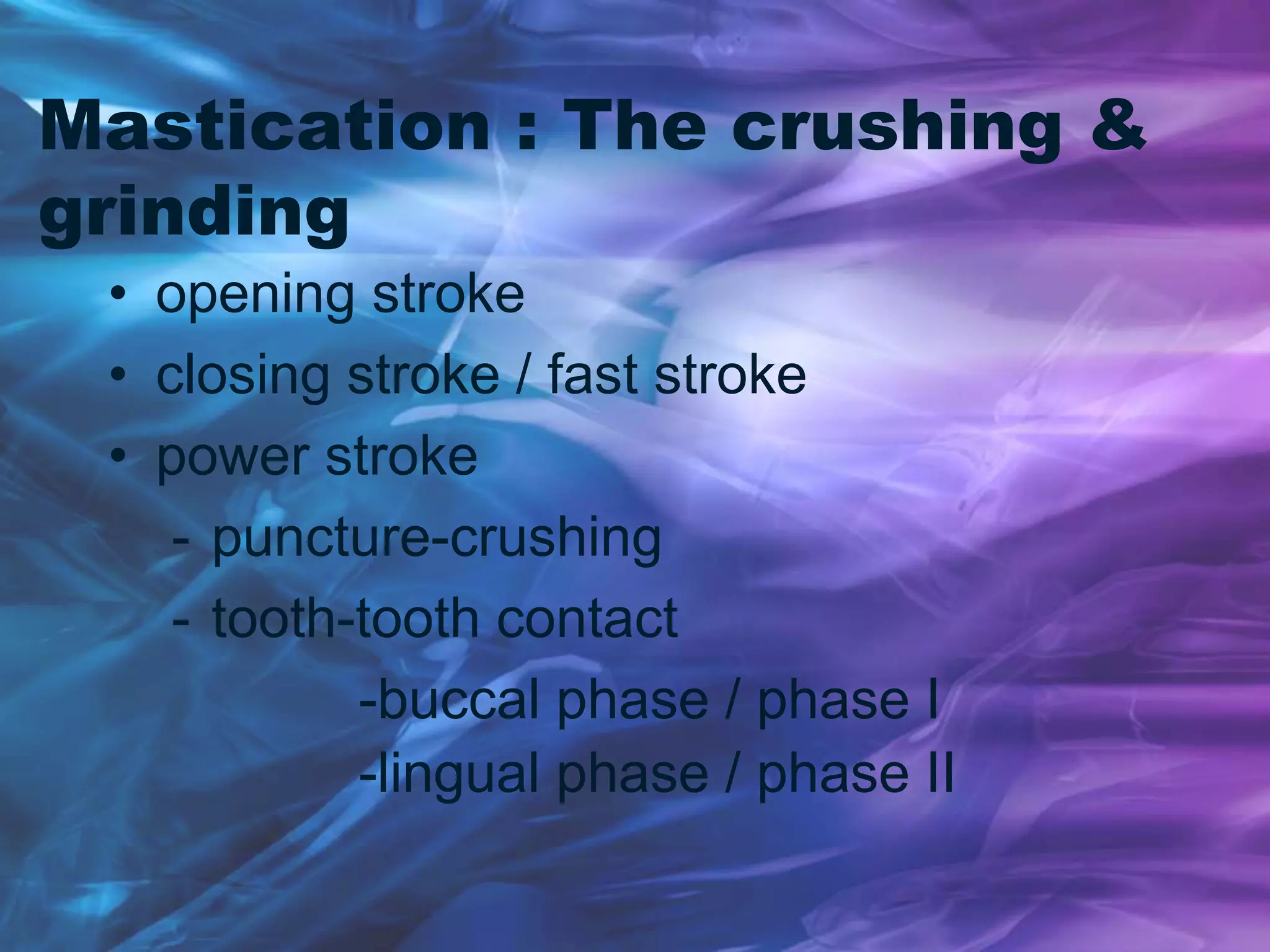
Mastication : The crushing &
grinding
• opening stroke
• closing stroke / fast stroke
• power stroke
- puncture-crushing
- tooth-tooth contact
-buccal phase / phase I
-lingual phase / phase II
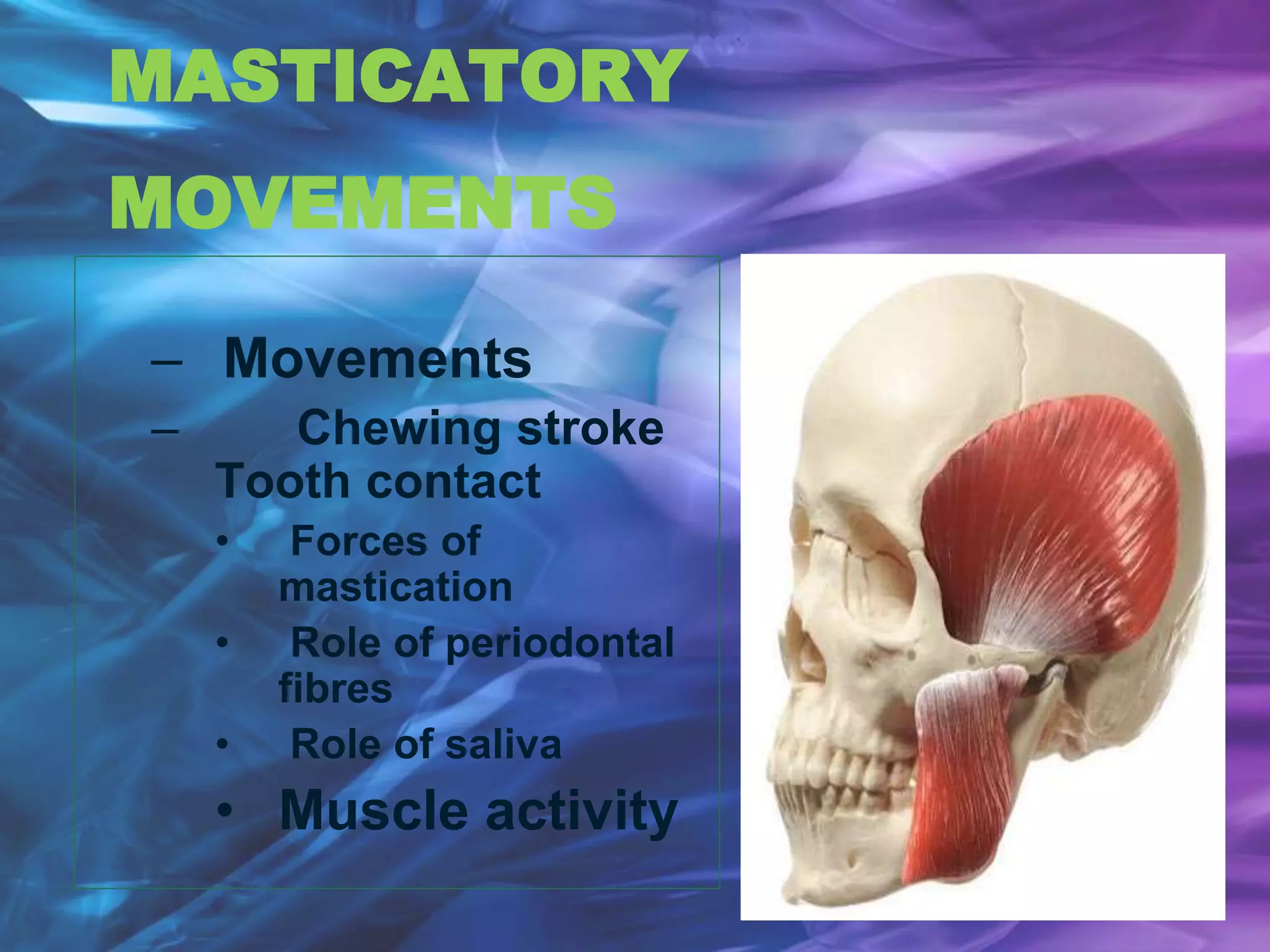
MASTICATORY
MOVEMENTS
– Movements
– Chewing stroke
Tooth contact
• Forces of
mastication
• Role of periodontal
fibres
• Role of saliva
• Muscle activity
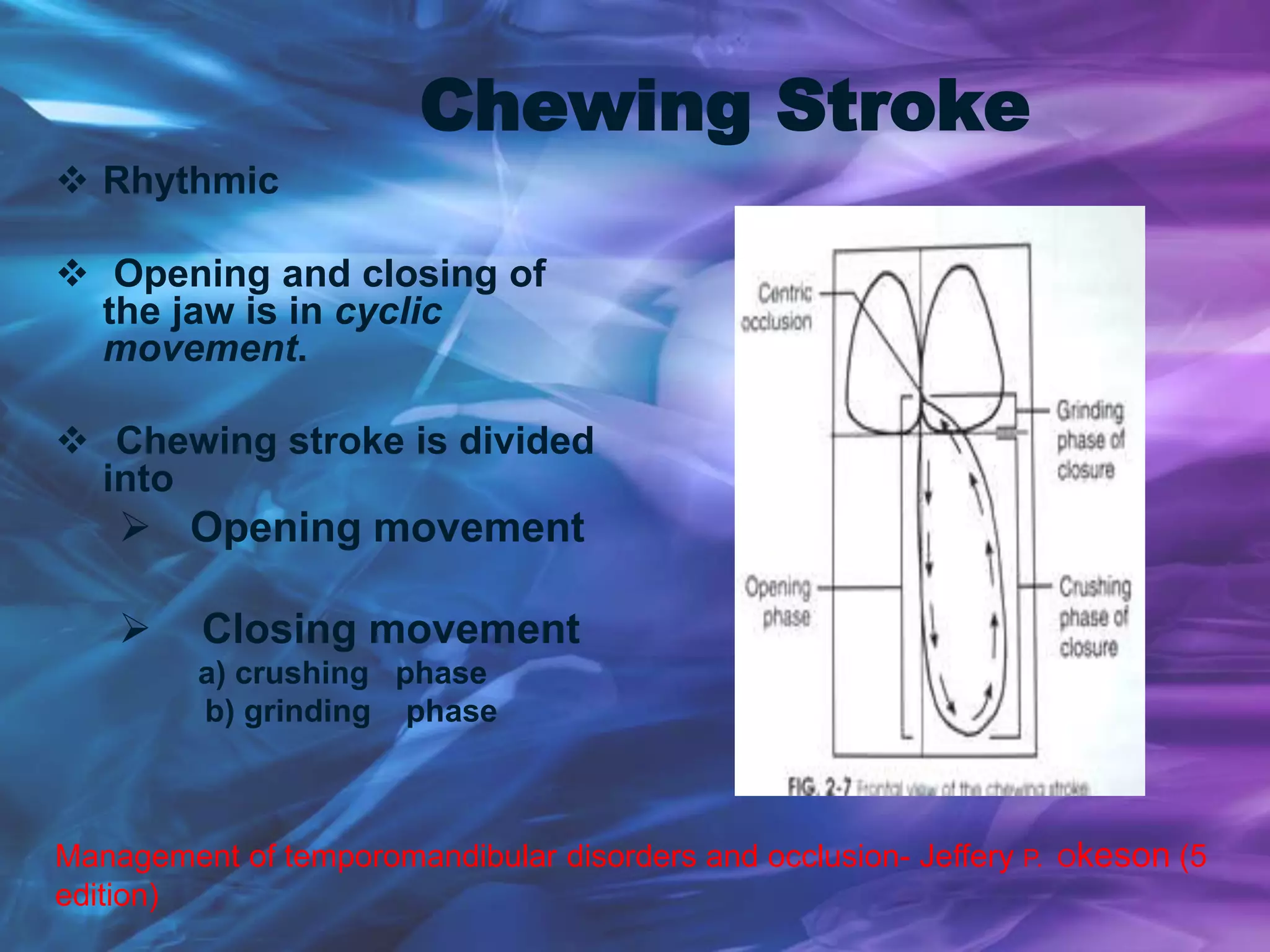
Chewing Stroke
 Rhythmic
 Opening and closing of
the jaw is in cyclic
movement.
 Chewing stroke is divided
into
 Opening movement
 Closing movement
a) crushing phase
b) grinding phase
Management of temporomandibular disorders and occlusion- Jeffery P. Okeson (5
edition)
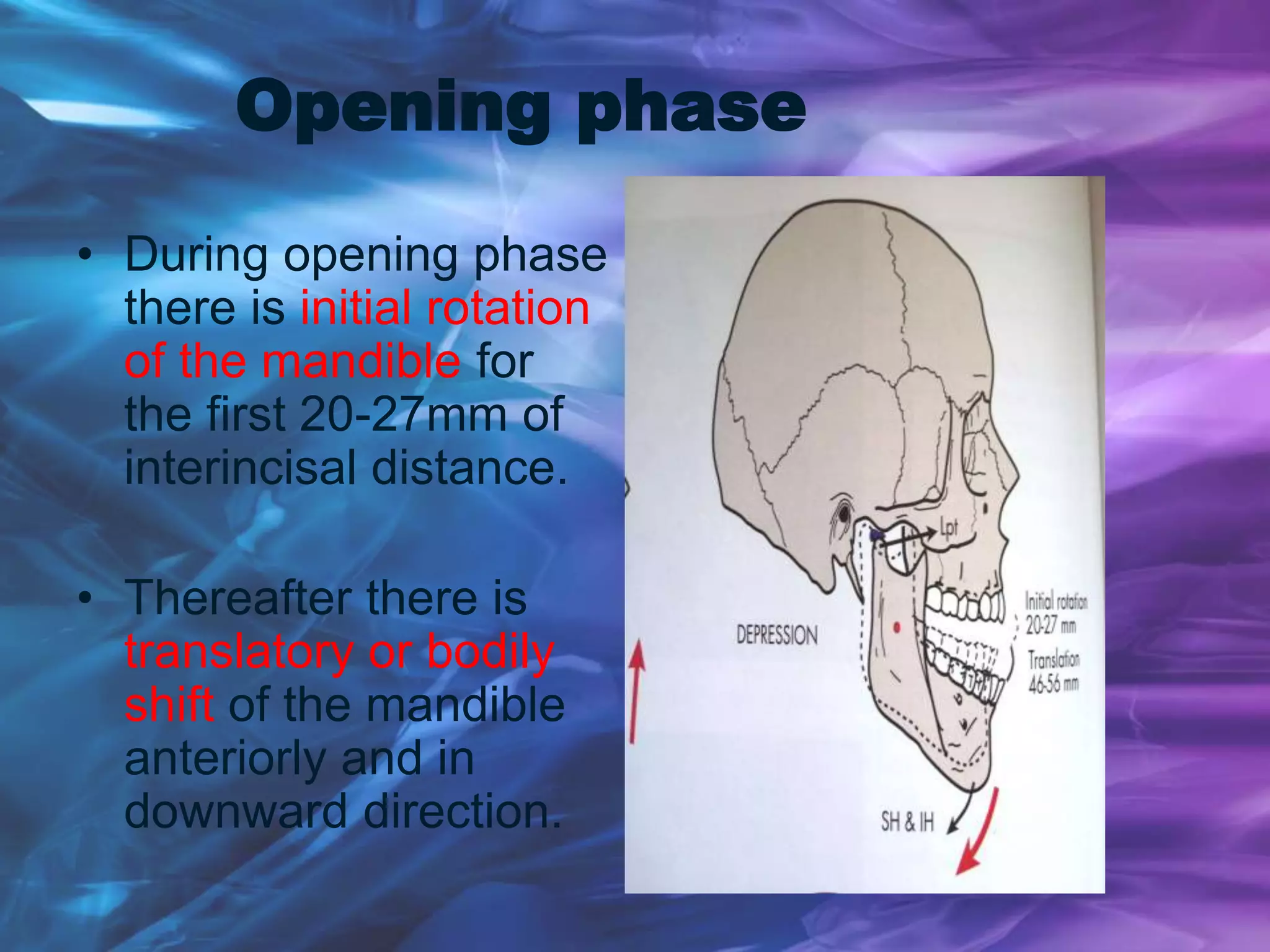
Opening phase
• During opening phase
there is initial rotation
of the mandible for
the first 20-27mm of
interincisal distance.
• Thereafter there is
translatory or bodily
shift of the mandible
anteriorly and in
downward direction.
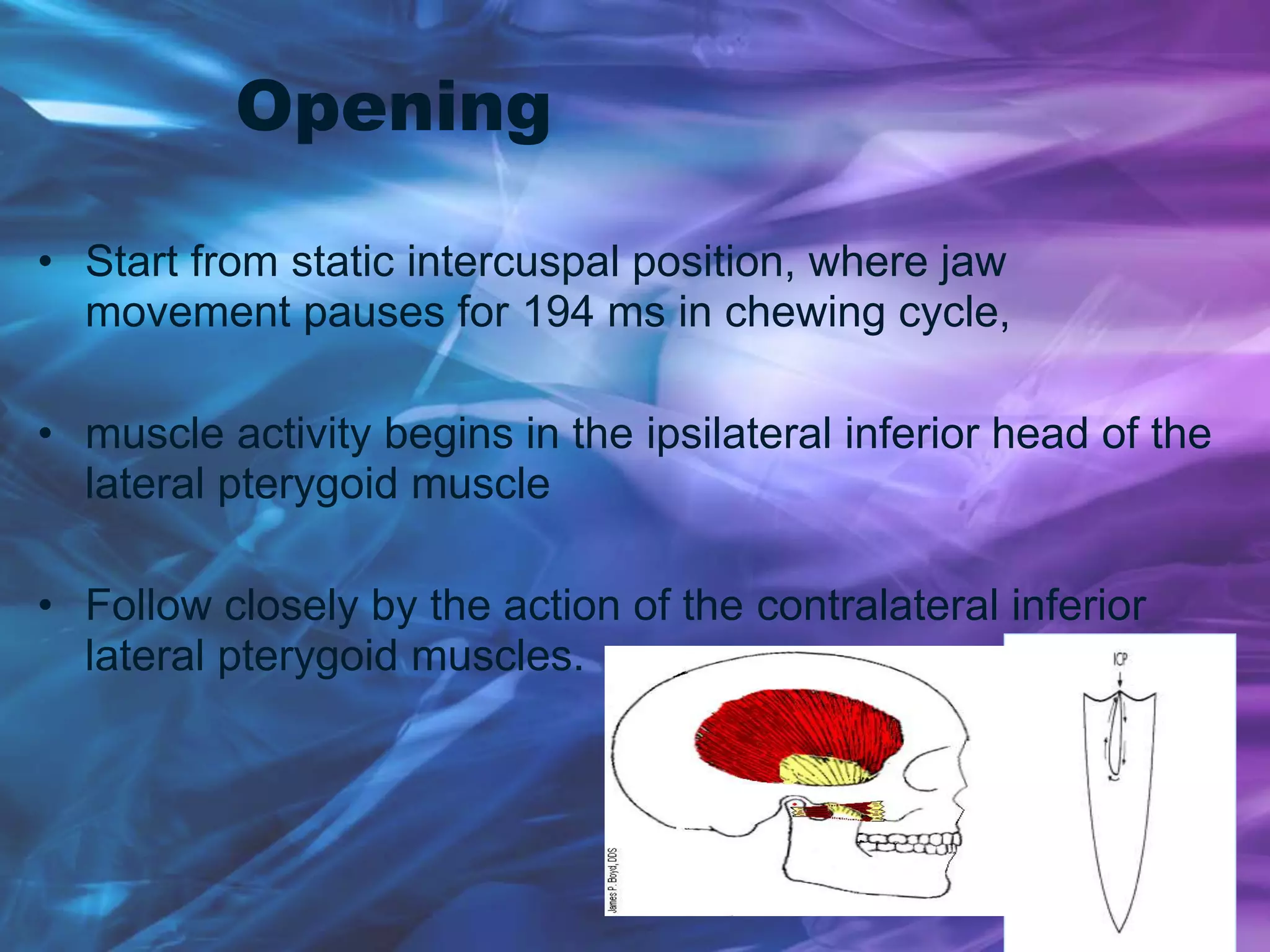
Opening
• Start from static intercuspal position, where jaw
movement pauses for 194 ms in chewing cycle,
• muscle activity begins in the ipsilateral inferior head of the
lateral pterygoid muscle
• Follow closely by the action of the contralateral inferior
lateral pterygoid muscles.
Opening
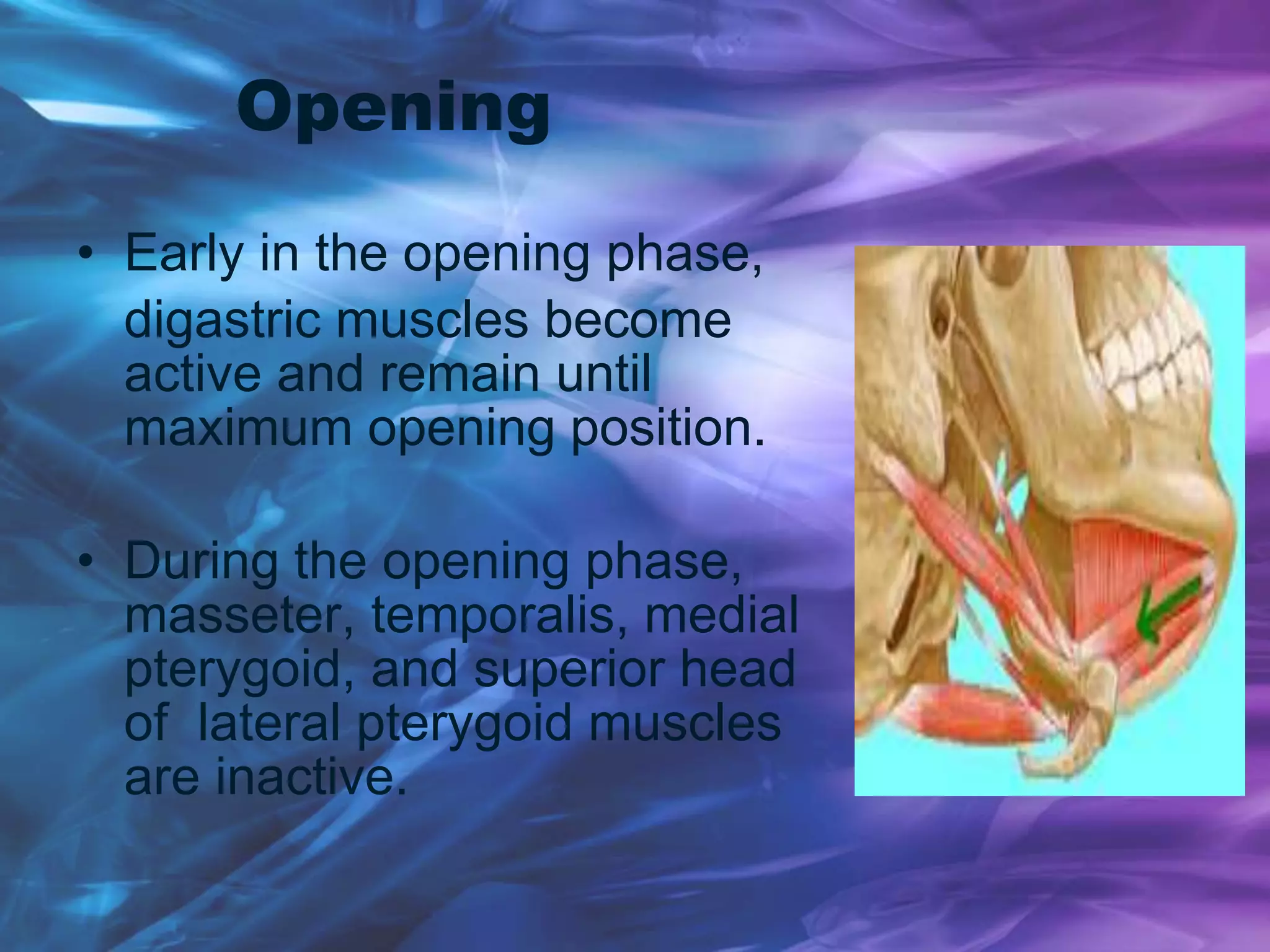
• Early in the opening phase,
digastric muscles become
active and remain until
maximum opening position.
• During the opening phase,
masseter, temporalis, medial
pterygoid, and superior head
of lateral pterygoid muscles
are inactive.
Closing Phase
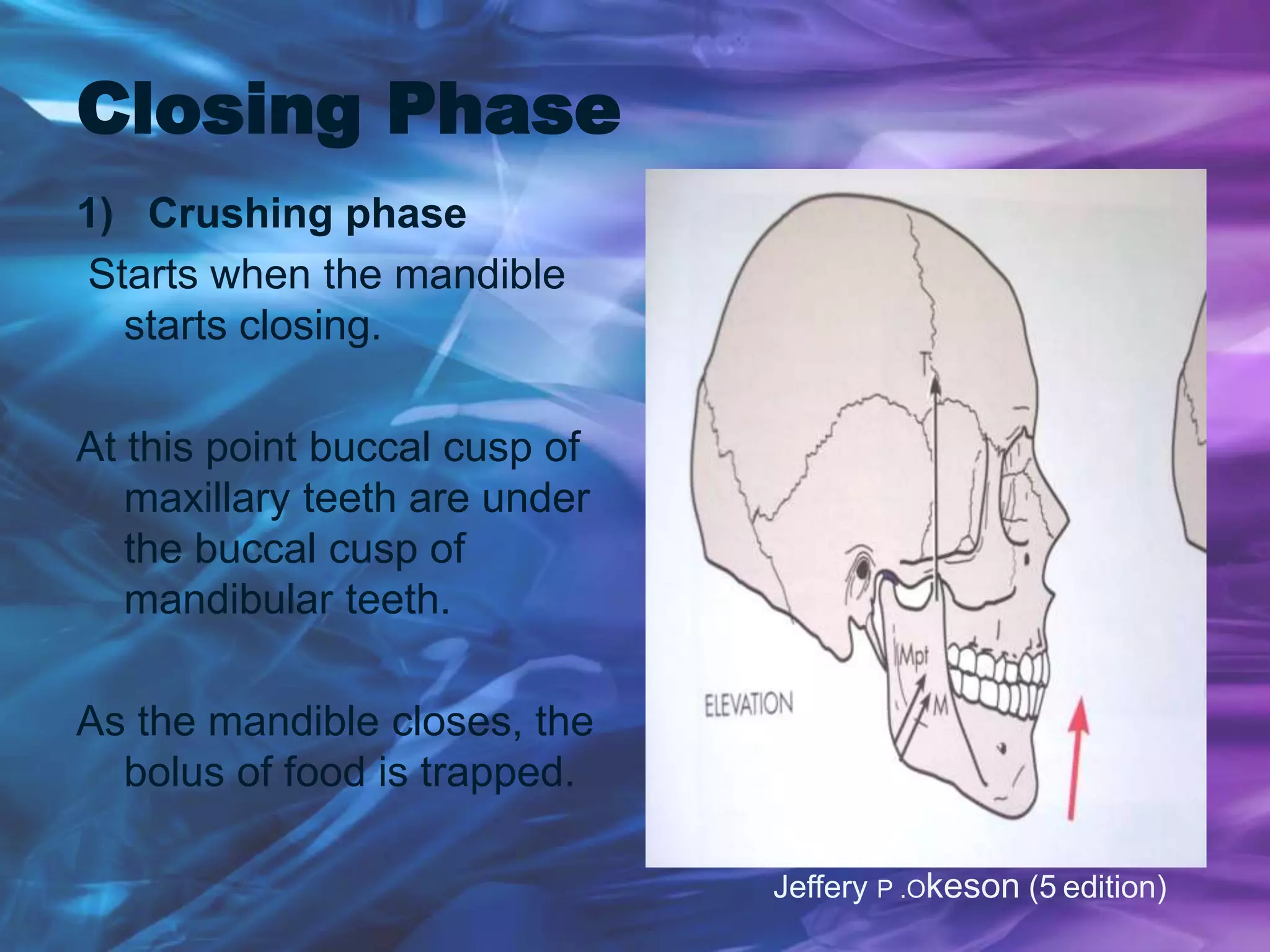
1) Crushing phase
Starts when the mandible
starts closing.
At this point buccal cusp of
maxillary teeth are under
the buccal cusp of
mandibular teeth.
As the mandible closes, the
bolus of food is trapped.
Jeffery P .Okeson (5 edition)
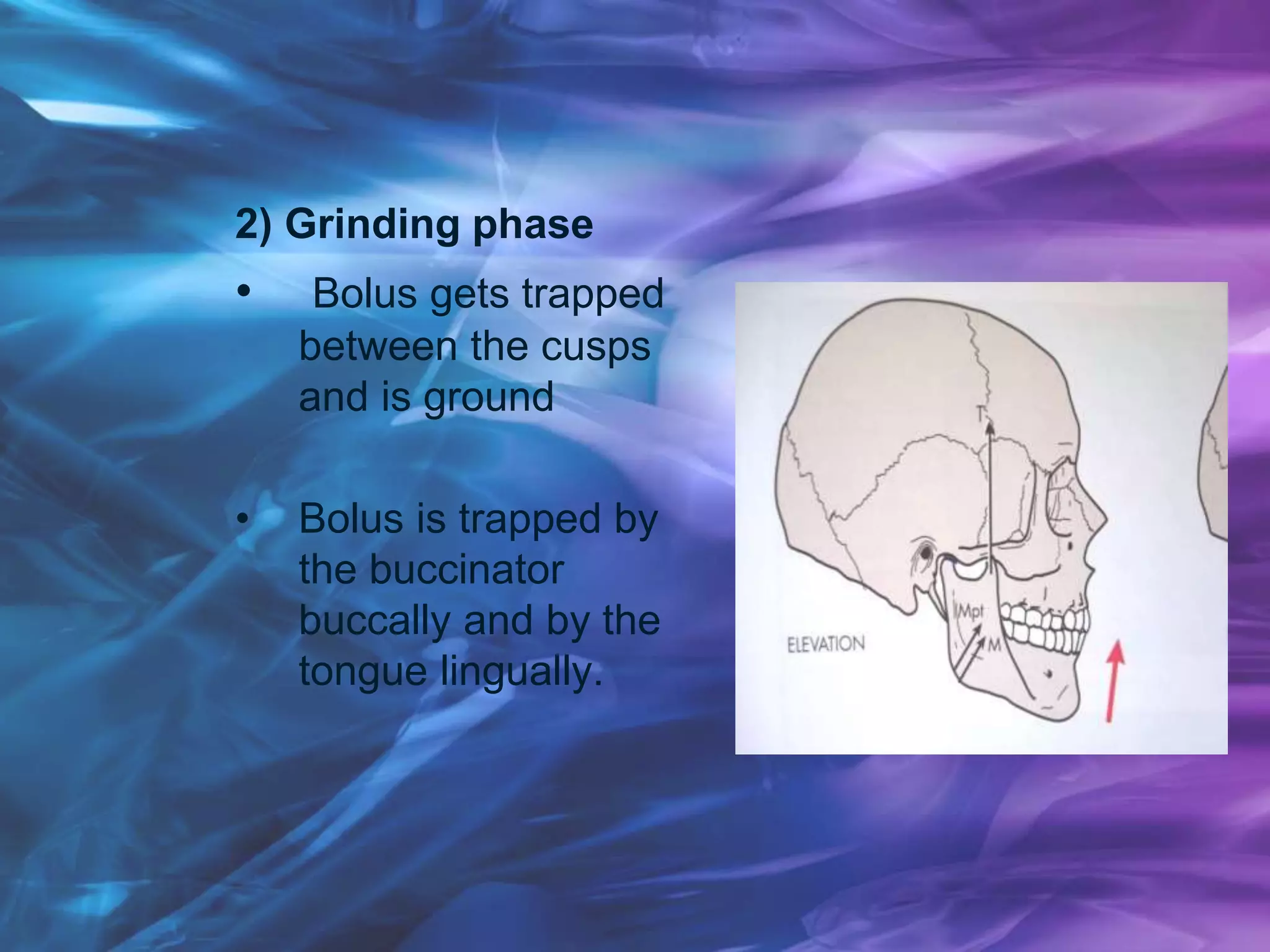
2) Grinding phase
• Bolus gets trapped
between the cusps
and is ground
• Bolus is trapped by
the buccinator
buccally and by the
tongue lingually.
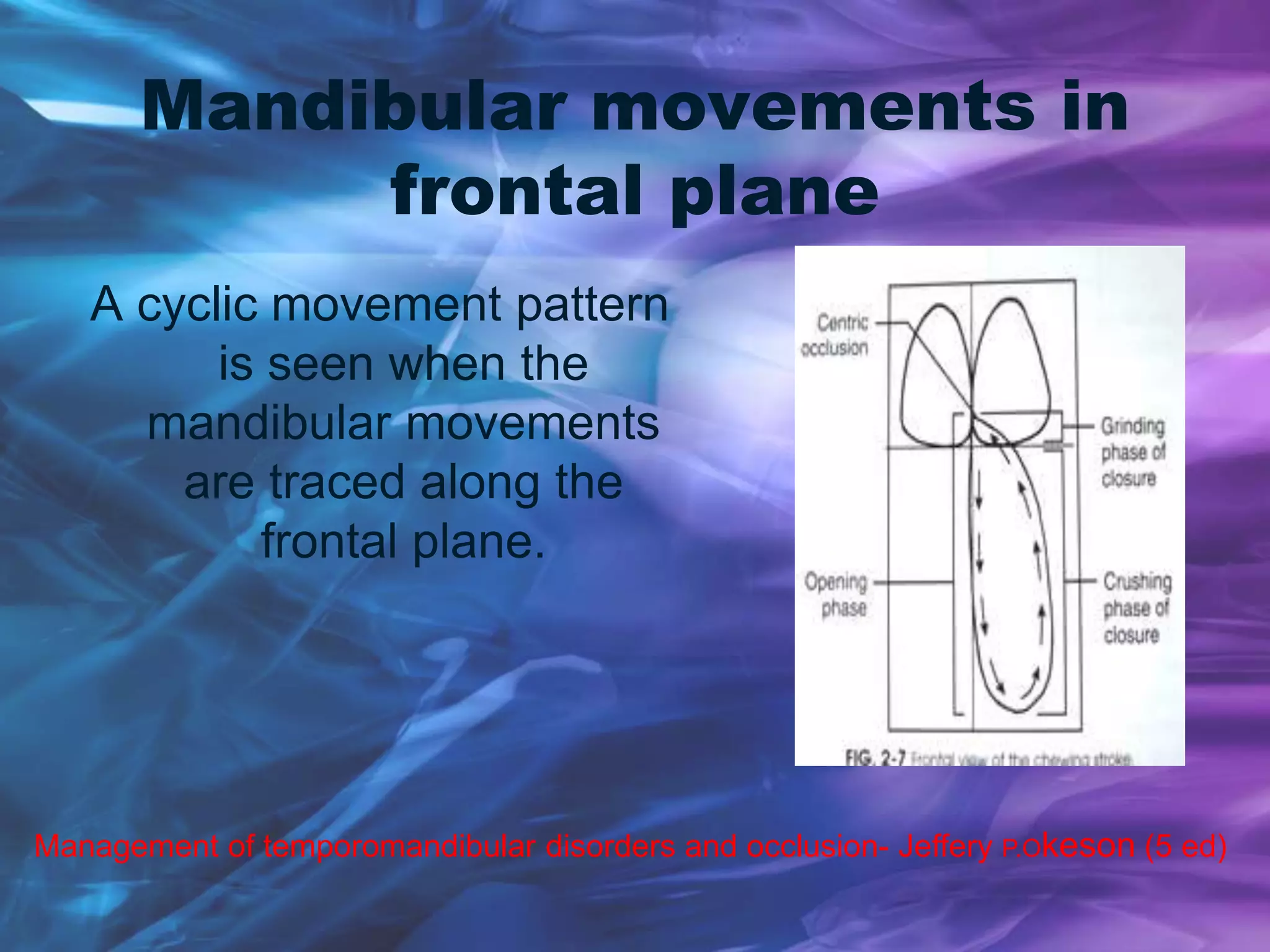
Mandibular movements in
frontal plane
A cyclic movement pattern
is seen when the
mandibular movements
are traced along the
frontal plane.
Management of temporomandibular disorders and occlusion- Jeffery P.Okeson (5 ed)
TOOTH CONTACT
• In final stages of mastication, just
before swallowing tooth contact
occurs during every stroke.
• Gliding contact
Centric contact
• Average length of time for tooth
contact during mastication is 194
msec.
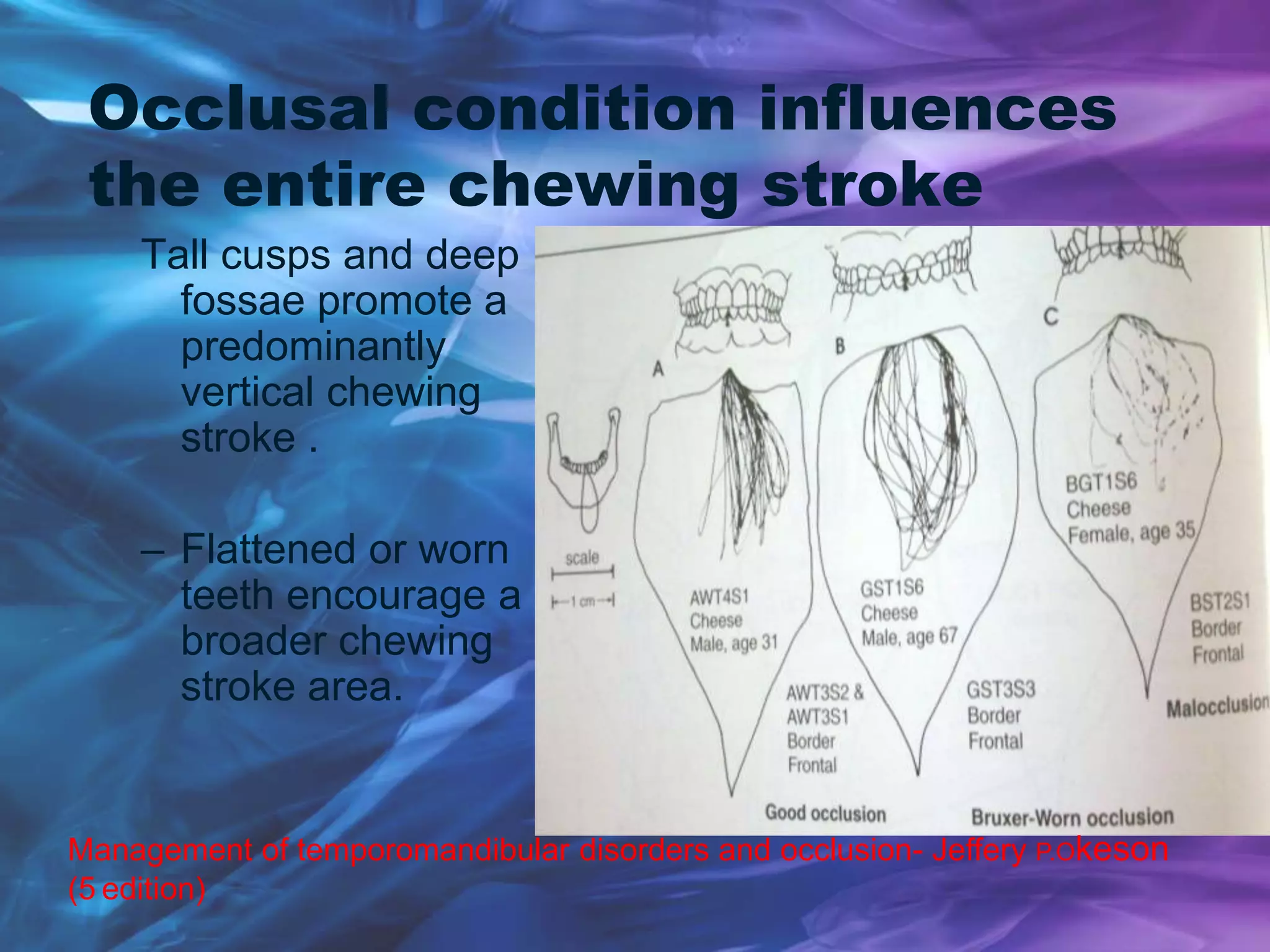
Occlusal condition influences
the entire chewing stroke
Tall cusps and deep
fossae promote a
predominantly
vertical chewing
stroke .
– Flattened or worn
teeth encourage a
broader chewing
stroke area.
Management of temporomandibular disorders and occlusion- Jeffery P.Okeson
(5 edition)
FORCES OF MASTICATION
• Varies from individual to individual.
• Maximum amount of force applied to the
molar is usually several times that can be
applied to the incisors.
for the molars is 91-198lb
for the incisors is 29-51lb
• The individuals can increase their
maximum biting force over time with
practice and exercise.
• The force generated during routine
mastication of food is about 70 to
150 N
• The maximum biting force is around
500 to 700 N
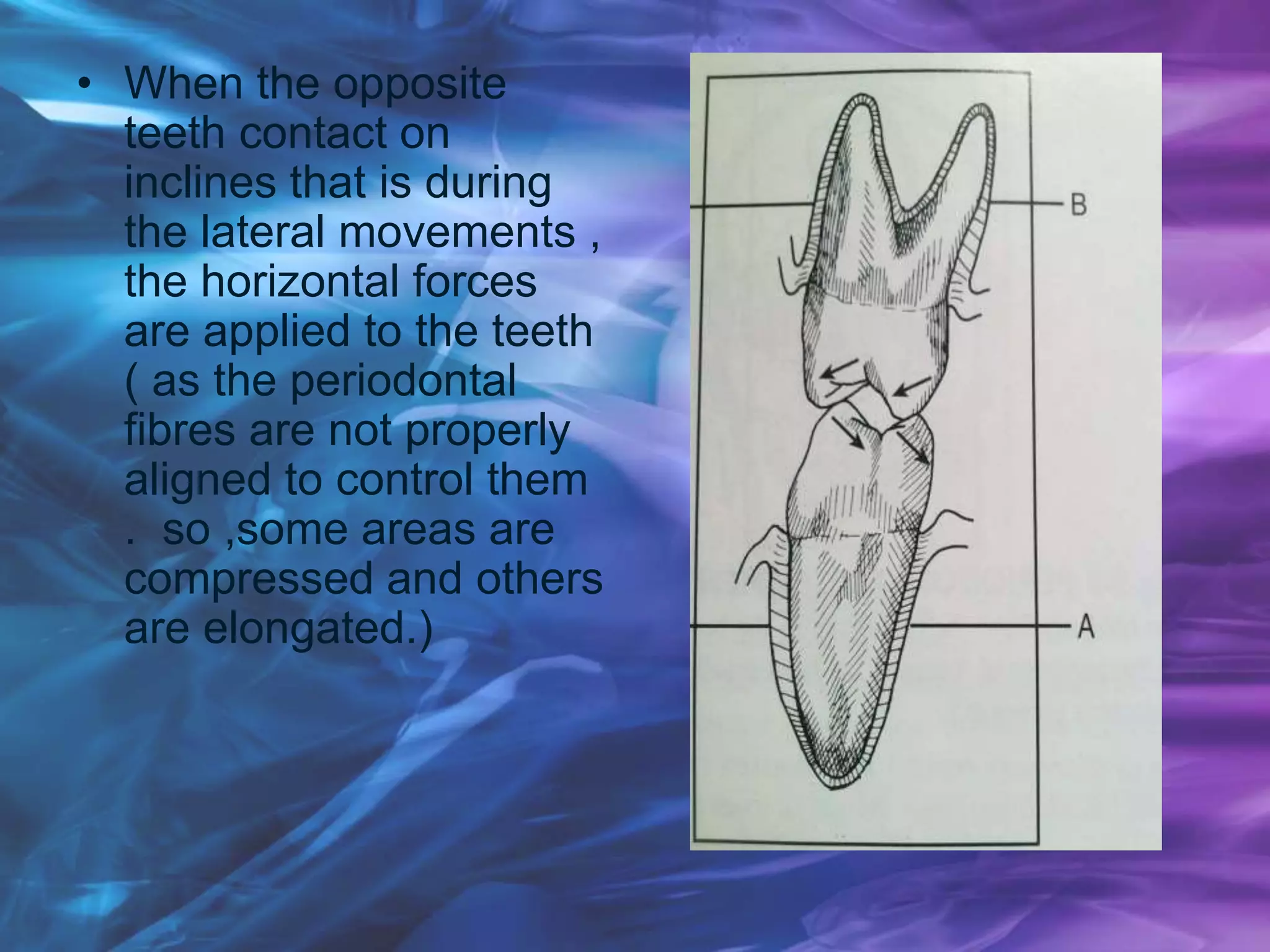
• When the opposite
teeth contact on
inclines that is during
the lateral movements ,
the horizontal forces
are applied to the teeth
( as the periodontal
fibres are not properly
aligned to control them
. so ,some areas are
compressed and others
are elongated.)
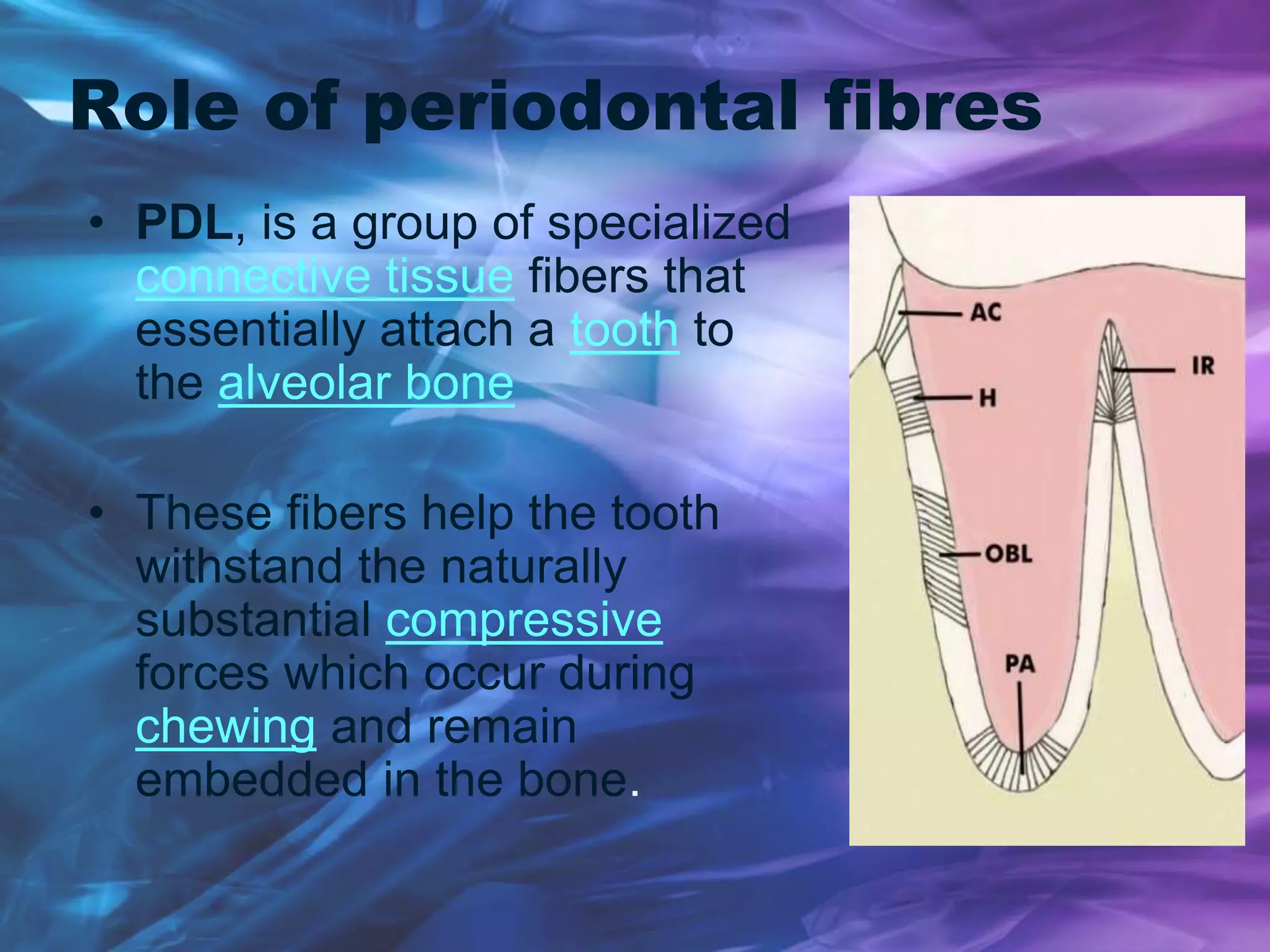
Role of periodontal fibres
• PDL, is a group of specialized
connective tissue fibers that
essentially attach a tooth to
the alveolar bone
• These fibers help the tooth
withstand the naturally
substantial compressive
forces which occur during
chewing and remain
embedded in the bone.
• The periodontal fibres have the
mechanoreceptors that respond to the forces
applied to the tooth and send impulses to the
brainstem.
• The alveolar crest fibers prevent extrusion of
tooth and resist lateral tooth movements.
ROLE OF SOFT TISSUE
• LIPS:
– Guide and control
intake.
– Seal off the oral cavity.
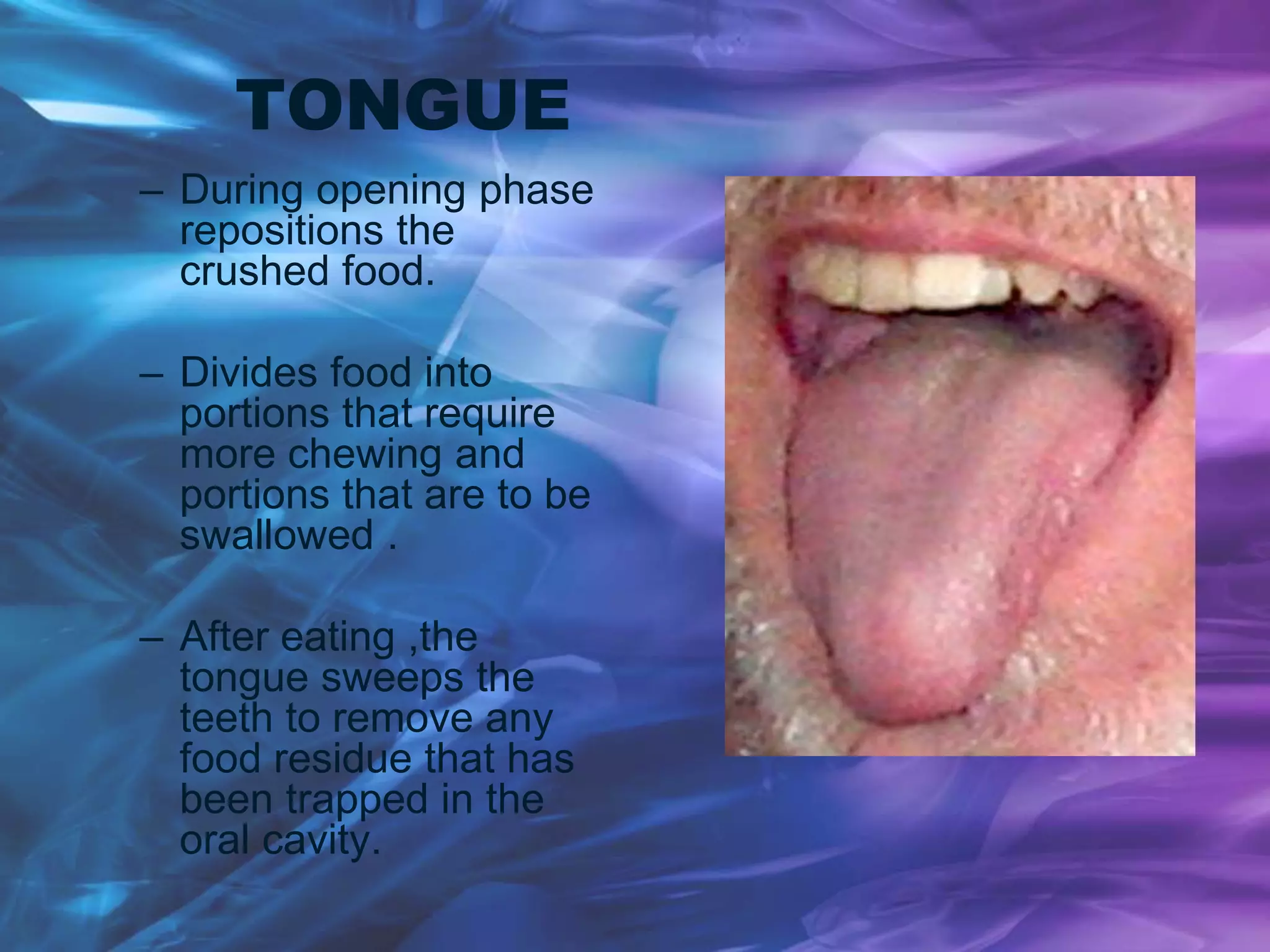
• TONGUE:
– Maneuvering the food
within the oral cavity.
– Initiates the breaking of
food.
– Pushes food to
occlusal surfaces of
teeth.
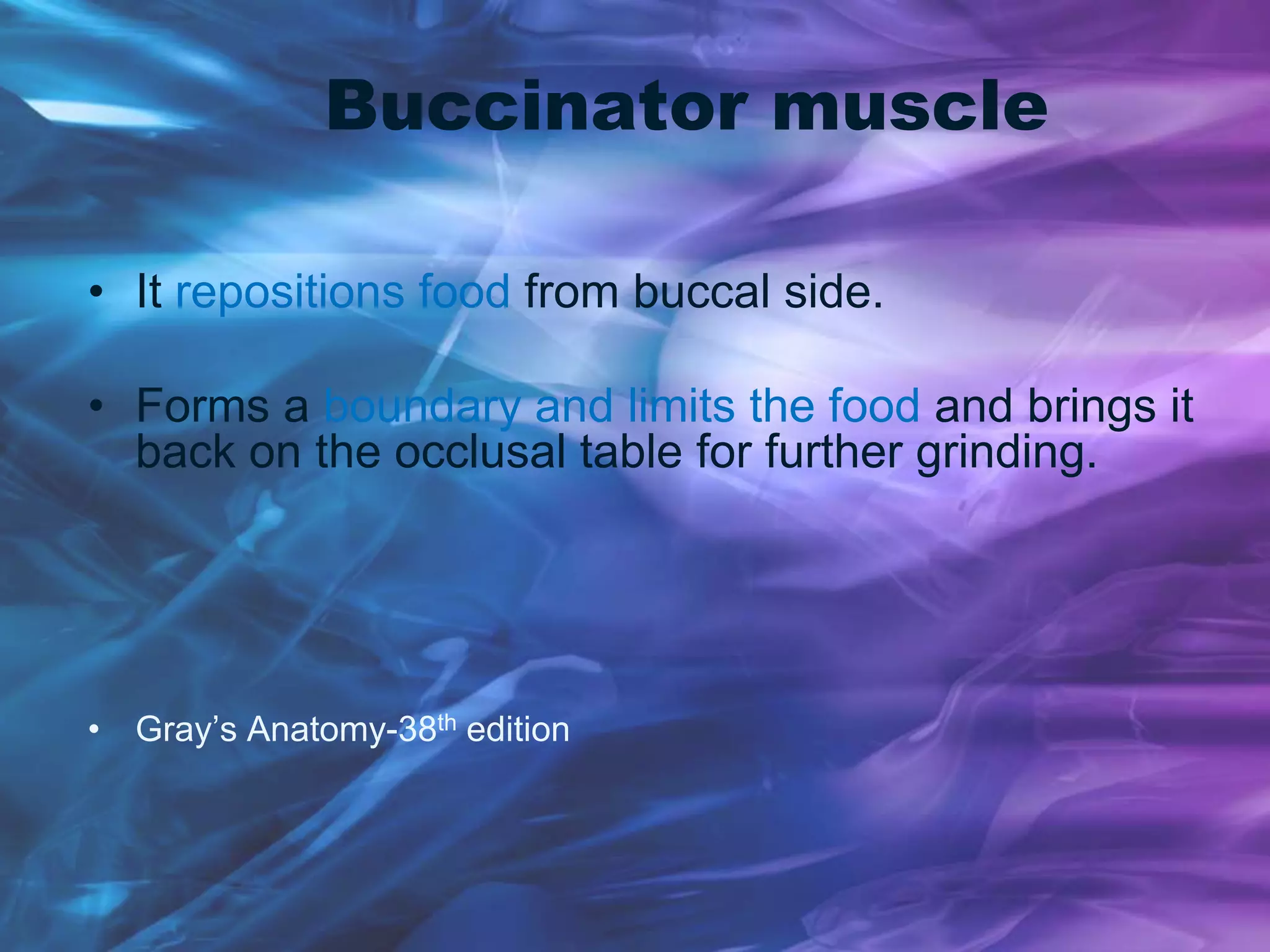
TONGUE
– During opening phase
repositions the
crushed food.
– Divides food into
portions that require
more chewing and
portions that are to be
swallowed .
– After eating ,the
tongue sweeps the
teeth to remove any
food residue that has
been trapped in the
oral cavity.
Buccinator muscle
• It repositions food from buccal side.
• Forms a boundary and limits the food and brings it
back on the occlusal table for further grinding.
• Gray’s Anatomy-38th edition
Muscle activity
 The general pattern of muscle activity
during chewing cycle.
 Closing muscles are inactive during jaw
opening.
 Activity of the jaw closing muscles
increases slowly as the teeth begin to
interdigitate or as soon as food is
encountered between the teeth.
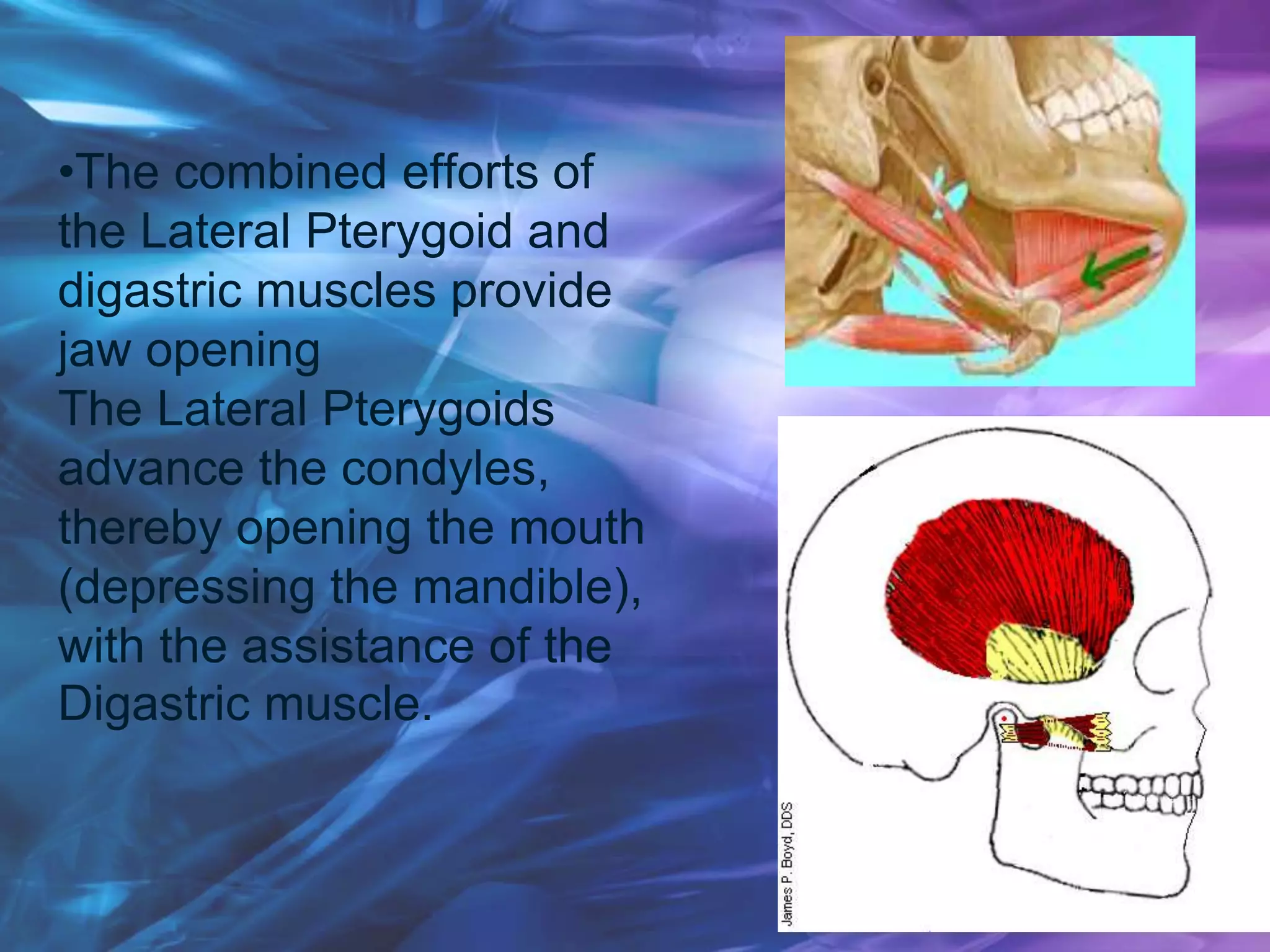
•The combined efforts of
the Lateral Pterygoid and
digastric muscles provide
jaw opening
The Lateral Pterygoids
advance the condyles,
thereby opening the mouth
(depressing the mandible),
with the assistance of the
Digastric muscle.
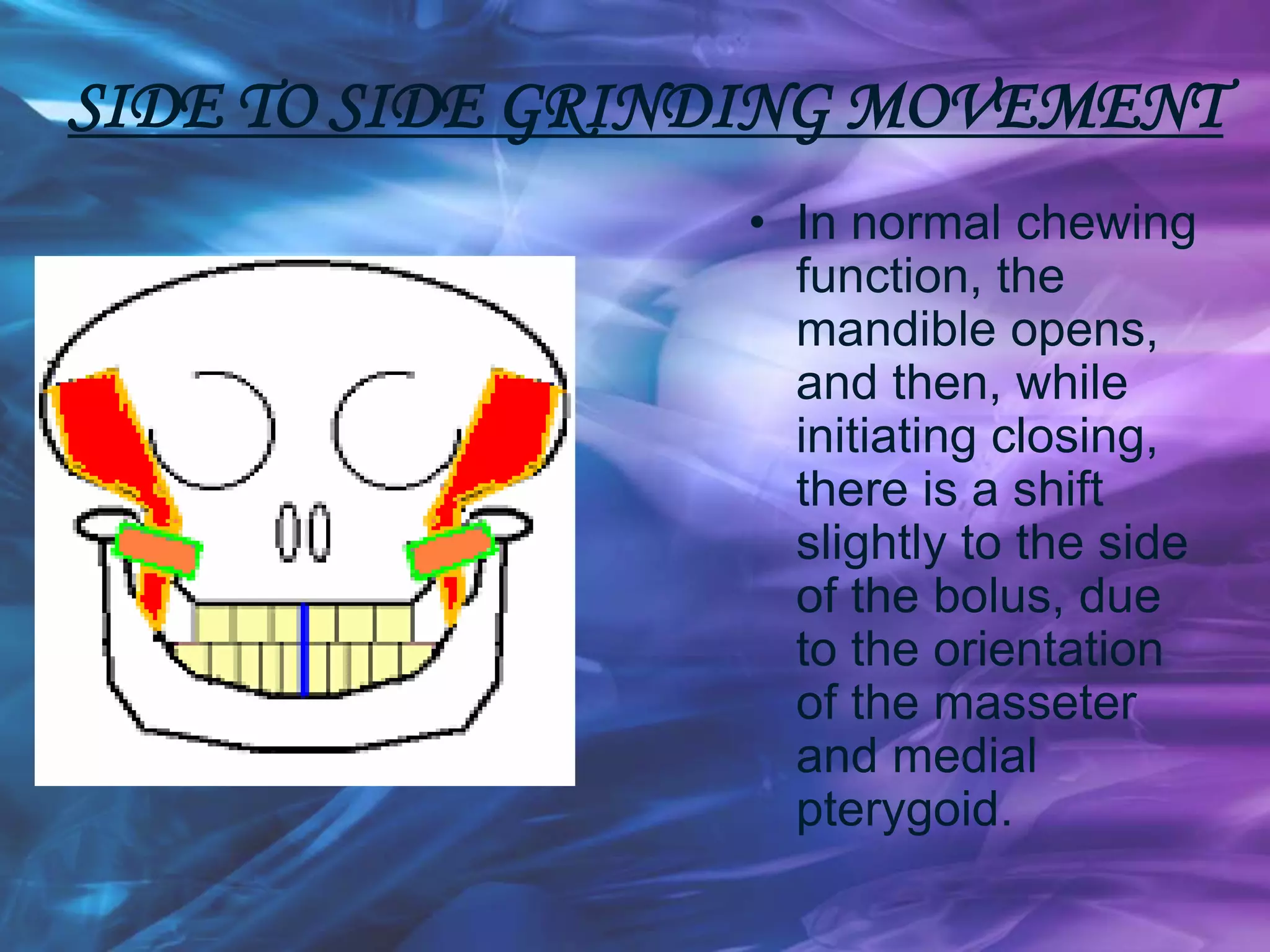
SIDE TO SIDE GRINDING MOVEMENT
• In normal chewing
function, the
mandible opens,
and then, while
initiating closing,
there is a shift
slightly to the side
of the bolus, due
to the orientation
of the masseter
and medial
pterygoid.
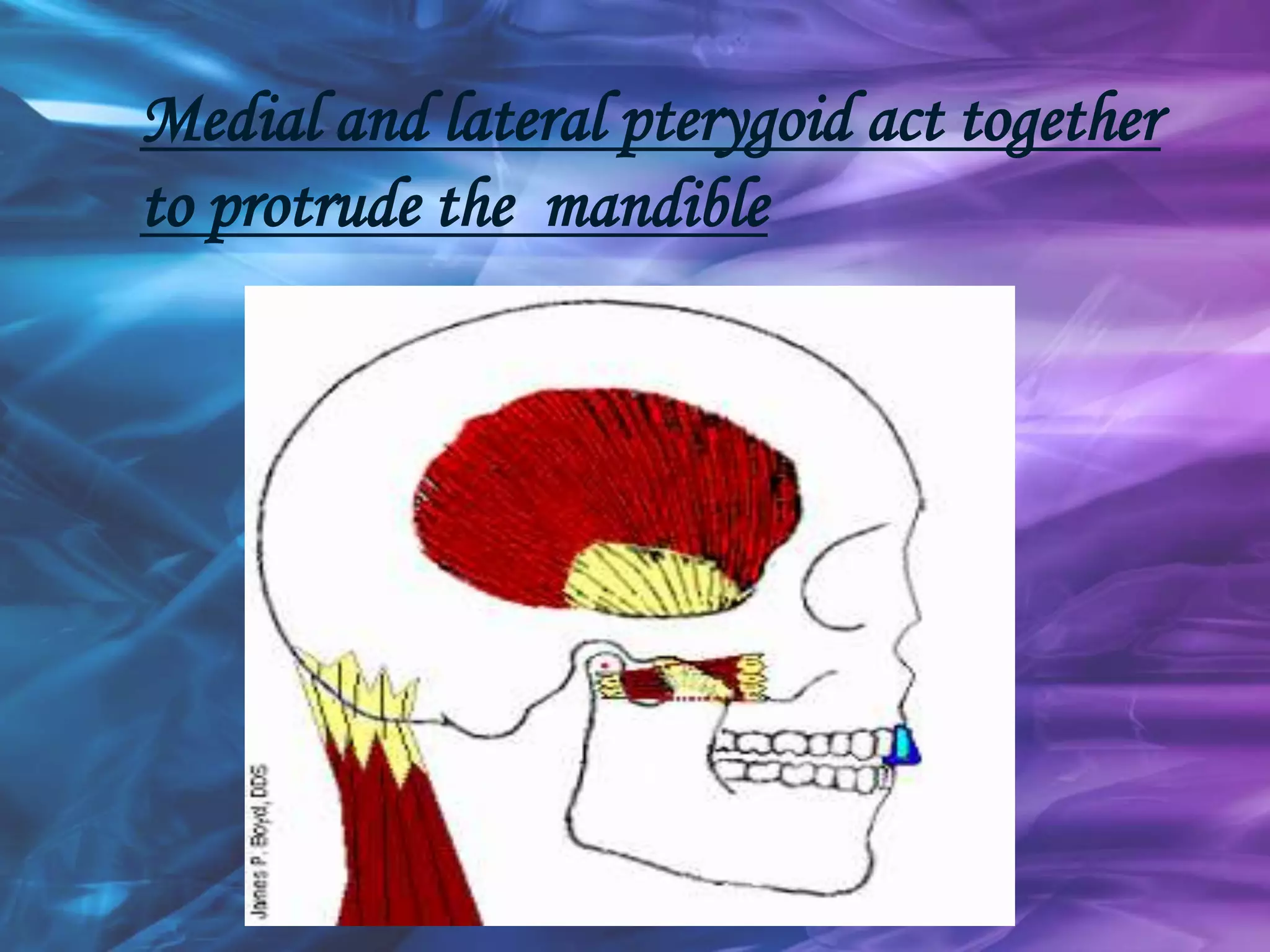
Medial and lateral pterygoid act together
to protrude the mandible
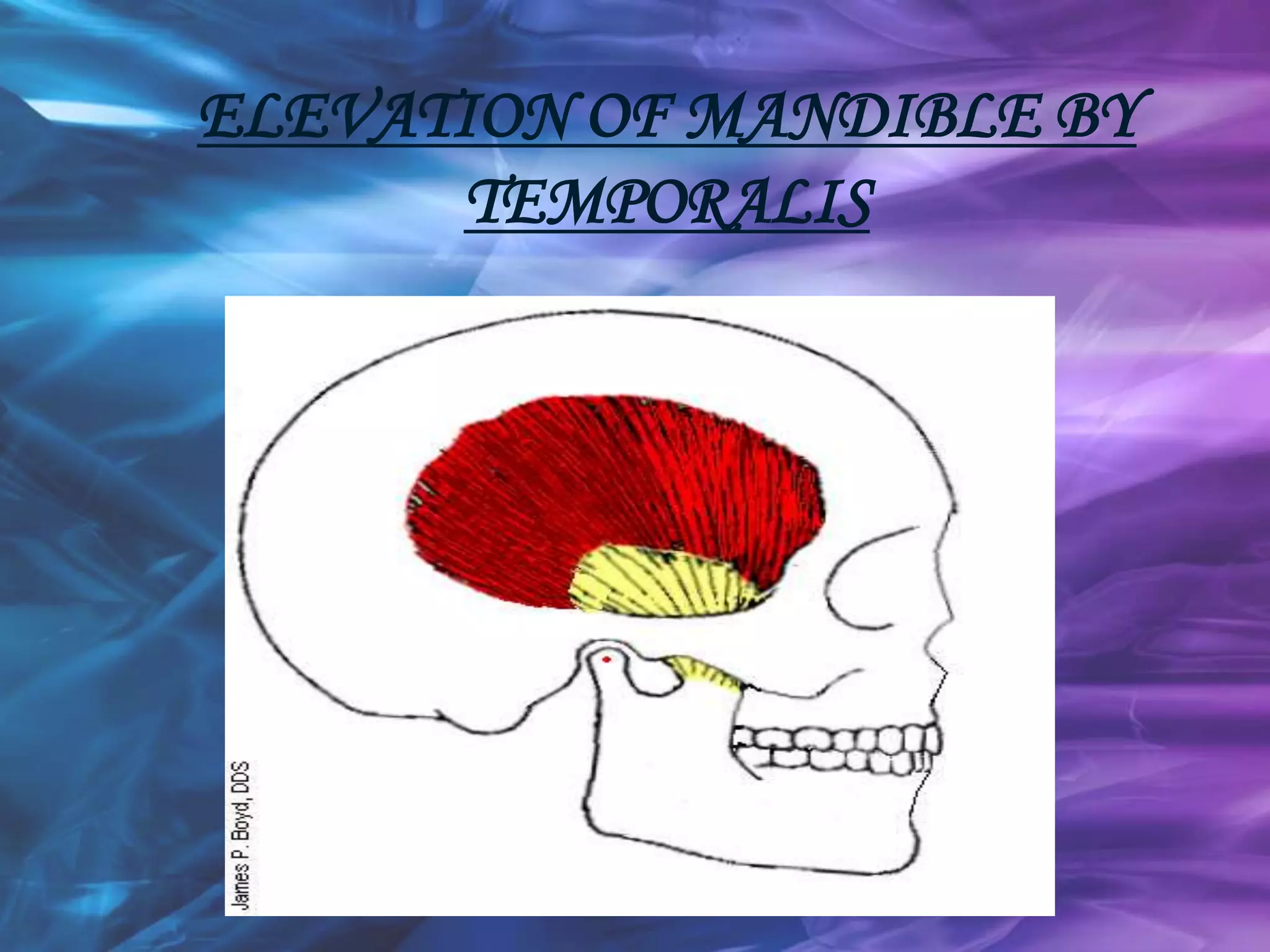
ELEVATION OF MANDIBLE BY
TEMPORALIS
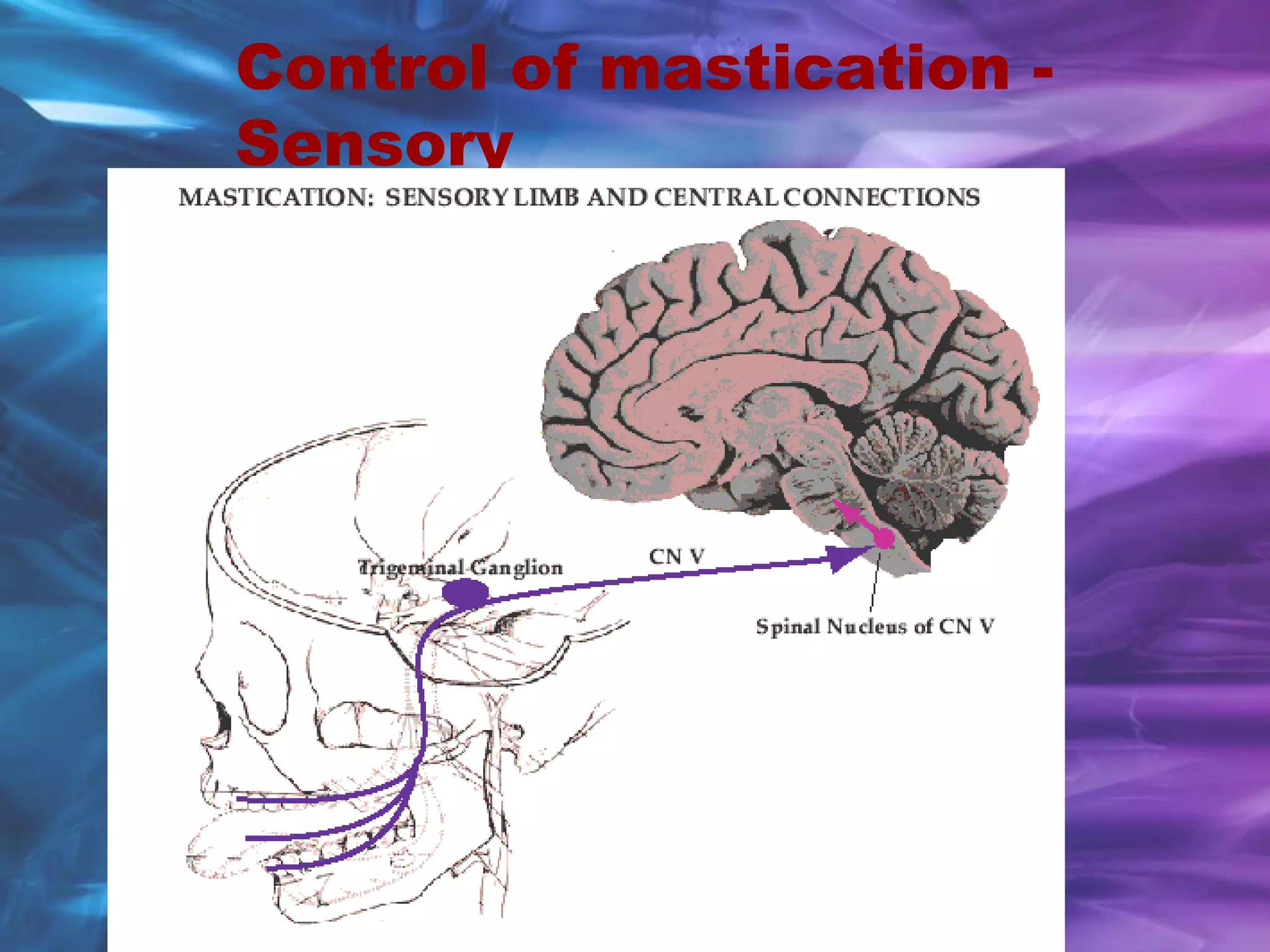
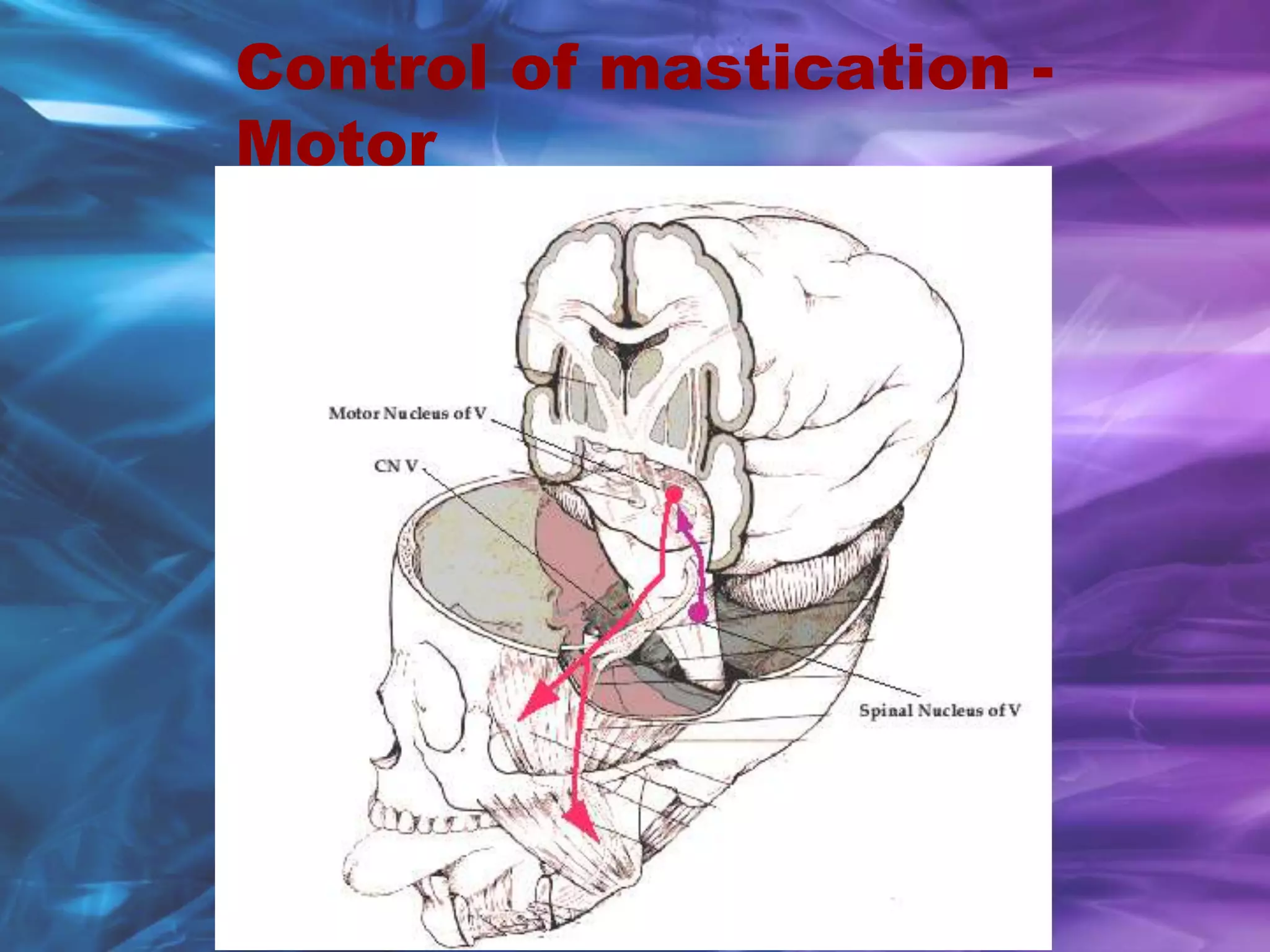
Neurological control during mastication
• Coordination between
– sensory feed back from peripheral organ
– CPG :Central Pattern Generator neuron
in brain stem
– higher center
– jaw reflexes
Motoneuronal Excitation
• During the jaw-opening phase of mastication,
– rhythmic inhibition occurs to inhibit the stretch
reflex.
• This postsynaptic hyperpolarization appears to be
responsible for the phasic inhibition of the stretch reflex
during jaw-opening
• Moto-neuron pool is inhibited during chewing.
• The muscle spindle feedback is mainly controlled by
cyclical changes in the membrane potential of jaw-
closing motoneurons.
Reflex modulation
• neuron circuits are modulated at the level
of primary afferent or interneurons.
• modulation of sensory transmission occur
through neurons in the trigeminal main
sensory nucleus in the sub-nucleus oralis,
and in the inter-trigeminal area which lies
between the sensory and motor nuclei.
Reflex modulation
• During the masticatory cycle the
excitability of the jaw-opening reflex
interneurons is inhibited
– which receive inputs from low-threshold
mechano-sensitive fields in the face or oral
cavity.
– most of the neuron with high threshold fields
are very excitable during fast and slow jaw
closing and relatively unexcitable during jaw
opening.
• Modulation of sensory transmission
through the subnucleus caudalis is not
phase modulated.
Control of mastication -
Sensory
Control of mastication -
Motor
MASTICATION WITH COMPLETE
DENTURE
• The biting force of subjects with complete denture is
only one fourth than that of subjects with natural teeth.
• Patient comfort and mastication may be impaired due
to the elicited excess flow of the saliva for a few days
after the placement of new complete denture.
COMPLETE DENTURE AND IMPLANT SUPPORTED DENTURES ZARB –BOLENBER -
12TH EDITION
• Patient should begin chewing relatively soft
food that requires less mastication and also
ready for swallowing with a simple push of
the tongue against the palate. This will make
the patient confident in stabilising the denture
• when biting with the denture ,patients should
be instructed to place the food between their
teeth towards the corner of the mouth then
the food should be pushed inward and
upwards as this will tend to seat the denture .
• So , learning with new denture requires at
least 6-8 weeks as the memory patterns are
established for the muscle of mastication.
DEGLUTITION
 Deglutition is the act of swallowing, through
which a food or liquid bolus is transported from
the mouth through the pharynx and esophagus
into the stomach.
 Normal deglutition is a smooth coordinated
process that involves a complex series of
voluntary and involuntary neuromuscular
contractions and typically is divided into four
distinct phases:
 Preparatory phase
Oral
Pharyngeal
Esophageal
Preparatory phase
• The average tooth contact during swallowing
lasts about 683msec.
• It is more than three times longer than the
duration of mastication.
• Definition--It consists of a reflex
sequence of muscle contraction that
propels ingested materials and pooled
saliva from the mouth to the stomach.
PREPARATORY PHASE
Bolus is prepared
↓
Positioned on the dorsum of the tongue
↓
The tongue tip pressed against the palatal aspect of the
maxillary incisors or against the anterior hard palate
↓
Bolus is located in depression of the tongue
↓
Tongue raised laterally against the buccal teeth and
palatal mucosa
↓
Posteriorly the pharyngeal part of the tongue arches up to
meet the soft palate
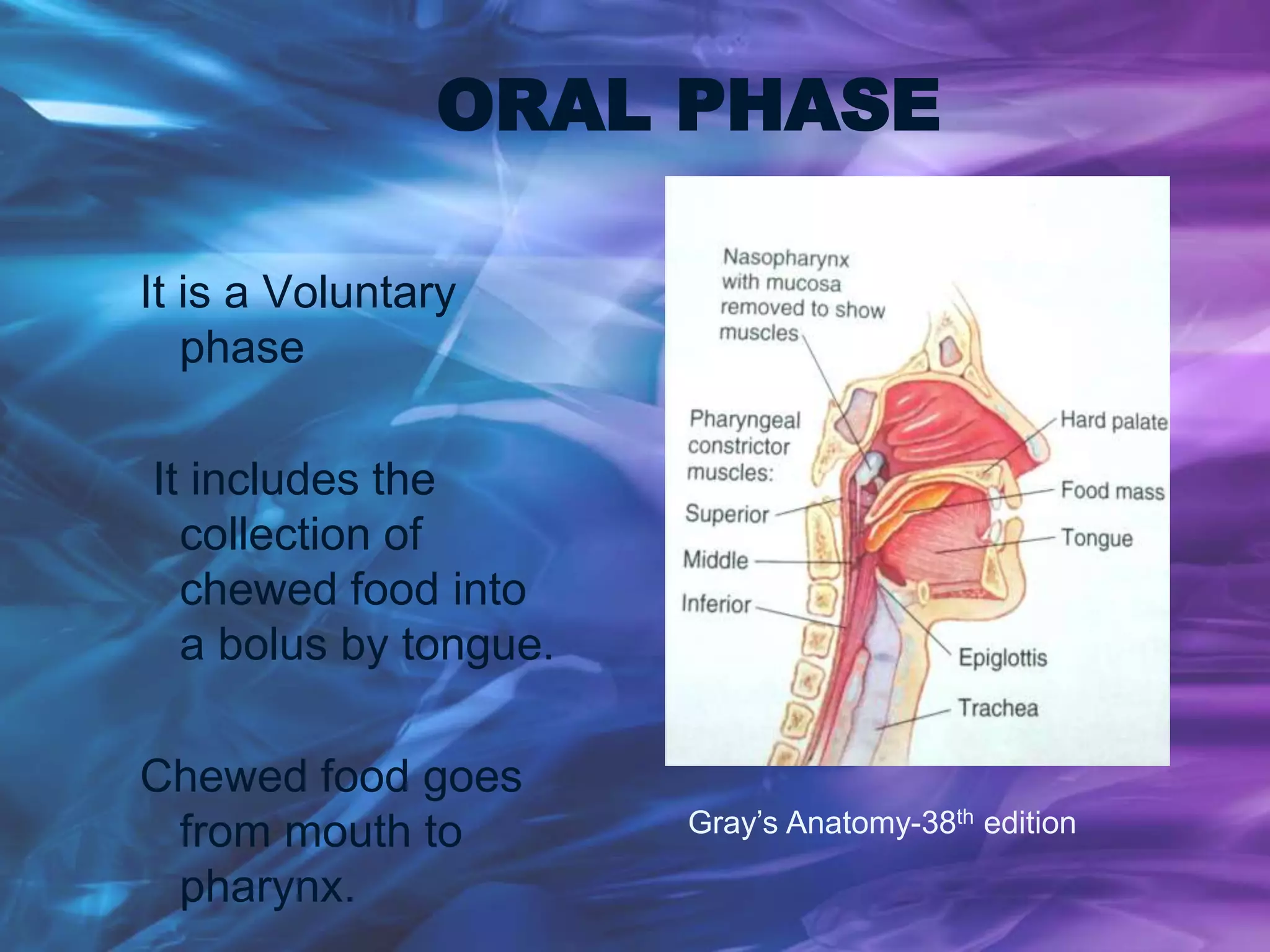
ORAL PHASE
It is a Voluntary
phase
It includes the
collection of
chewed food into
a bolus by tongue.
Chewed food goes
from mouth to
pharynx.
Gray’s Anatomy-38th edition
– collection of chewed food into a bolus by
tongue.
– bolus pressed against palate.
– lips sealed, teeth brought together.
– reflex contraction of tongue pushes food
backwards down into pharynx.
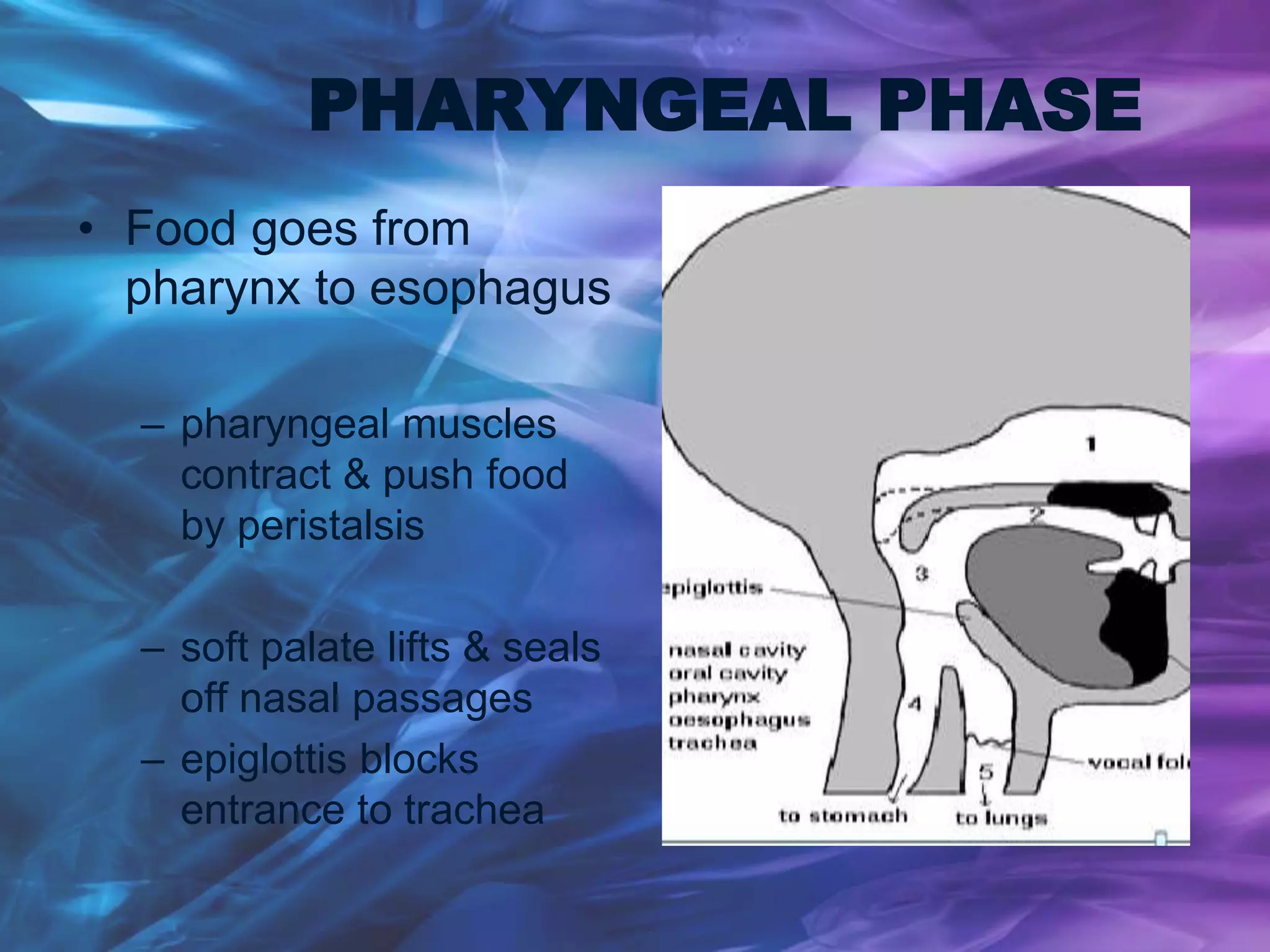
PHARYNGEAL PHASE
• Food goes from
pharynx to esophagus
– pharyngeal muscles
contract & push food
by peristalsis
– soft palate lifts & seals
off nasal passages
– epiglottis blocks
entrance to trachea
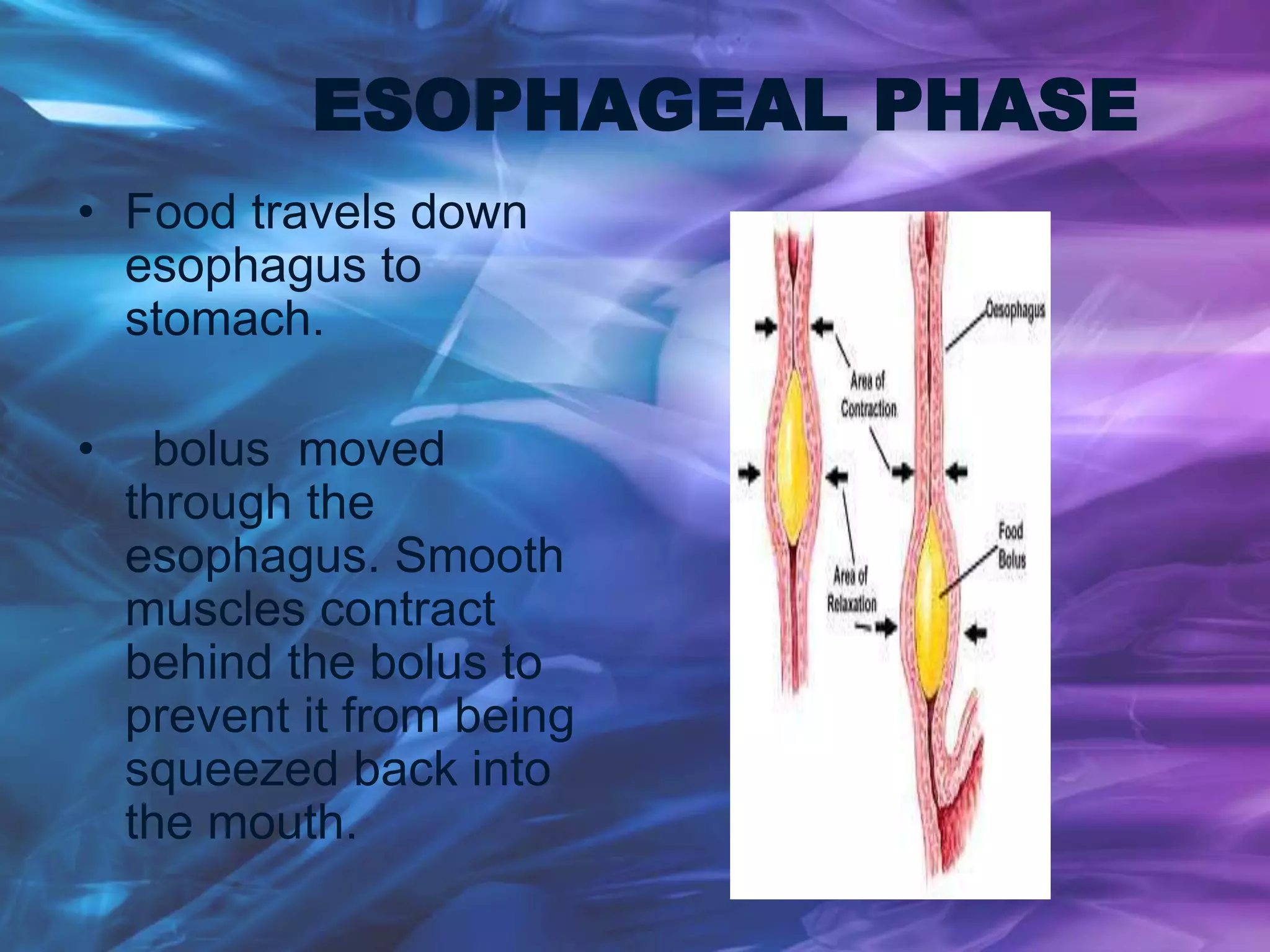
ESOPHAGEAL PHASE
• Food travels down
esophagus to
stomach.
• bolus moved
through the
esophagus. Smooth
muscles contract
behind the bolus to
prevent it from being
squeezed back into
the mouth.
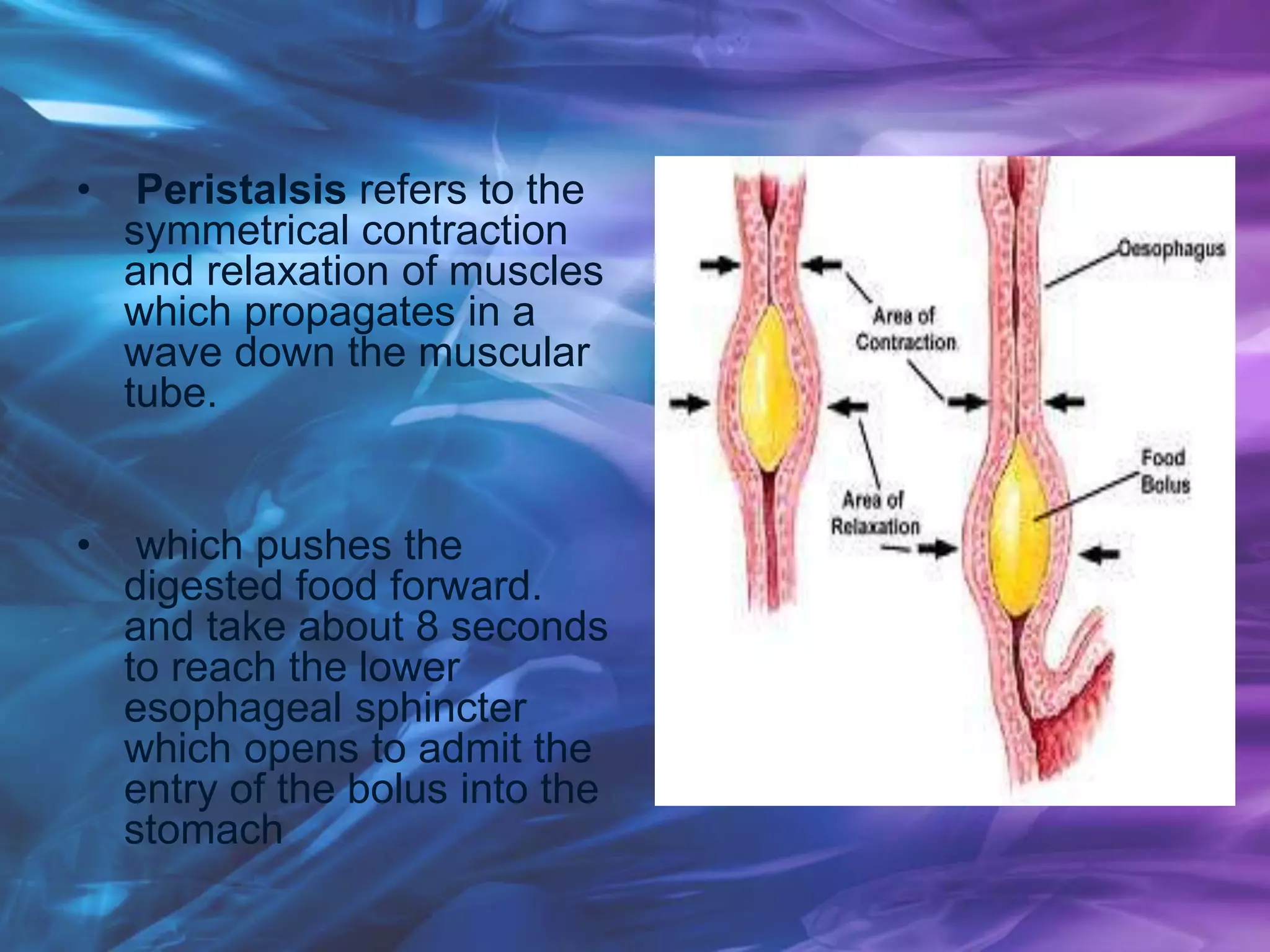
• Peristalsis refers to the
symmetrical contraction
and relaxation of muscles
which propagates in a
wave down the muscular
tube.
• which pushes the
digested food forward.
and take about 8 seconds
to reach the lower
esophageal sphincter
which opens to admit the
entry of the bolus into the
stomach
Food propulsion
When the food is propelled from the oral
cavity to the esophagus
Peristaltic wave starts in the whole
esophagus
This propels the bolus towards the stomach
Due to pressure difference, the valve of
lower esophageal sphincter opens and
food enters the stomach.
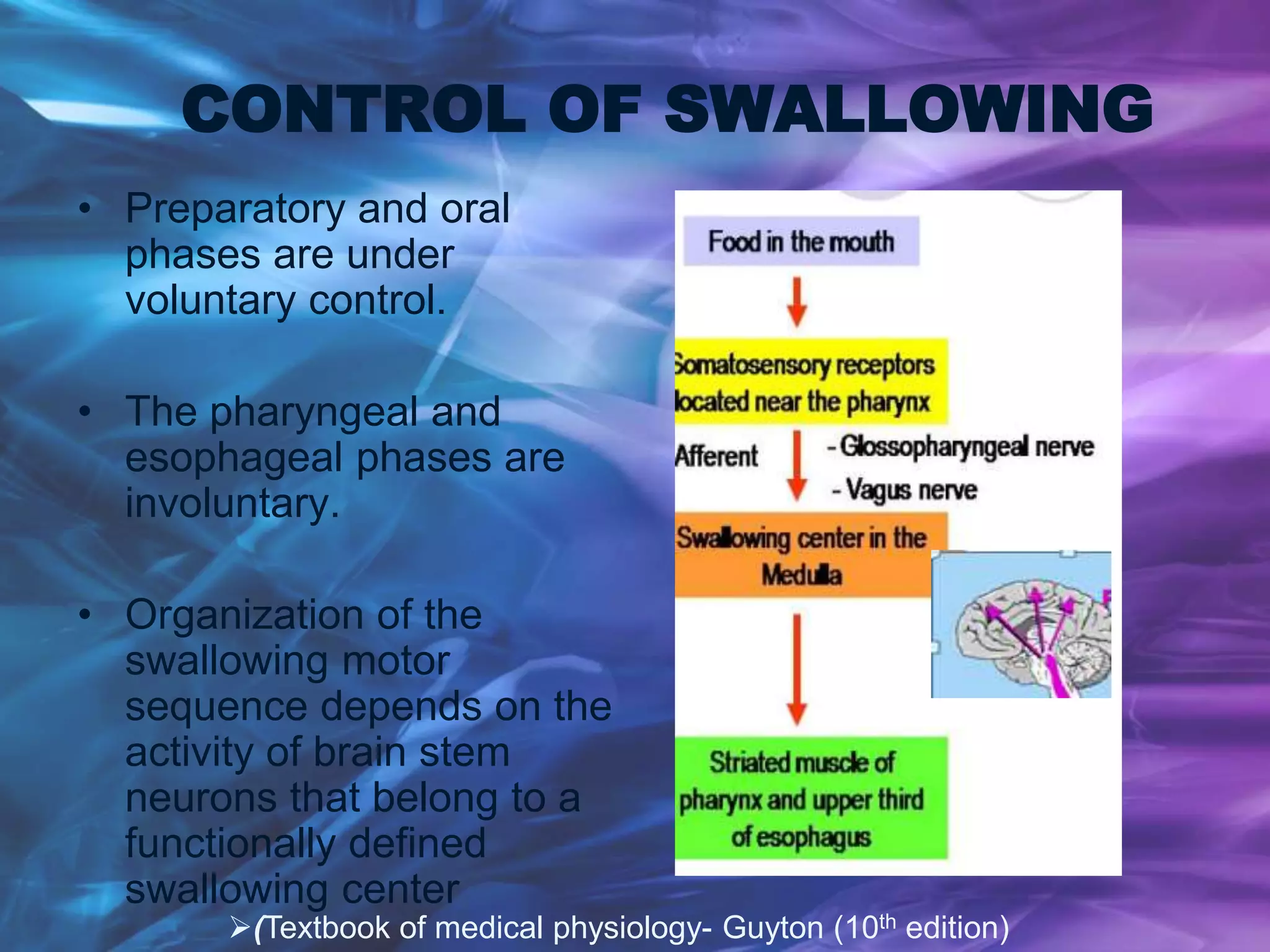
CONTROL OF SWALLOWING
• Preparatory and oral
phases are under
voluntary control.
• The pharyngeal and
esophageal phases are
involuntary.
• Organization of the
swallowing motor
sequence depends on the
activity of brain stem
neurons that belong to a
functionally defined
swallowing center
(Textbook of medical physiology- Guyton (10th edition)
Importance of swallowing
in prosthodontics
• As the process of swallowing completes, it
brings the mandible to its most retruded
position and therefore helpful in recording the
centric relation in edentulous patients.
• Immediately after swallowing, mandible tends
to come into maximal intercuspal position,
therefore it is important in recording “vertical
jaw relations”.
• COMPLETE DENTURE AND IMPLANT SUPPORTED DENTURES ZARB
–BOLENBER -12TH EDITION
SPEECH
INTRODUCTION
Definition-"Speech is the use of
systematized vocalization to express
verbal symbols or words." (GPT-7)
• Speech in matured man is learned habitual
neuromuscular pattern which makes use
of anatomical structures designed primarily
for respiration and deglutition.
• speech as the basic and fundamental means
of communication became the cornerstone for
the establishment and organization of society.
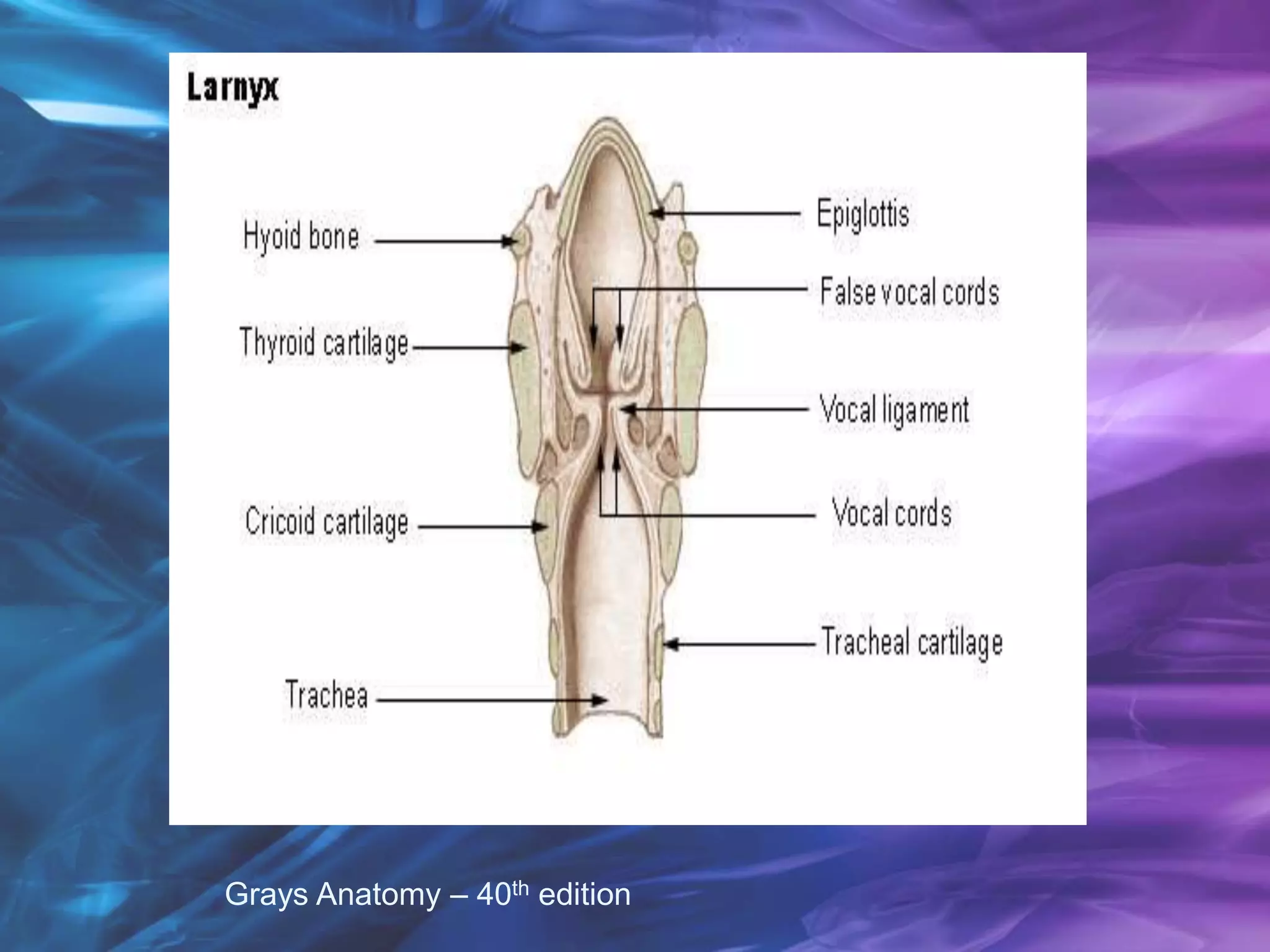
Larynx
• The larynx is a respiratory organ, set in the
respiratory tract between the pharynx and
trachea.
• Although phonation is important in man,
the main function of the larynx is to
provide a protective sphincter for the air
passages.
• The larynx lies below the hyoid bone in the
midline of the neck at the level of C 4-6
vertebrae.
Grays Anatomy – 40th edition
Speech production
• Controlling the airstream that is
initiated in the lungs and passes
through the larynx and vocal cords
produces all speech sounds
• Subtle adjustments in the airflow
contribute to variations of pitch and
intensity of the voice
MECHANISM OF VOICE
PRODUCTION
• The pre-requisites for sound are a source of
energy and a vibrator . The source of energy
for the voice is air in the lungs. The vibrator for
the voice are the vocal folds in the larynx.
• The larynx, pharynx, nasal cavity all act as
cavity resonators to reinforce the original
sound wave. This reinforcement is augmented
by the change of shape and size of these
cavities permitted by neuromuscular control.
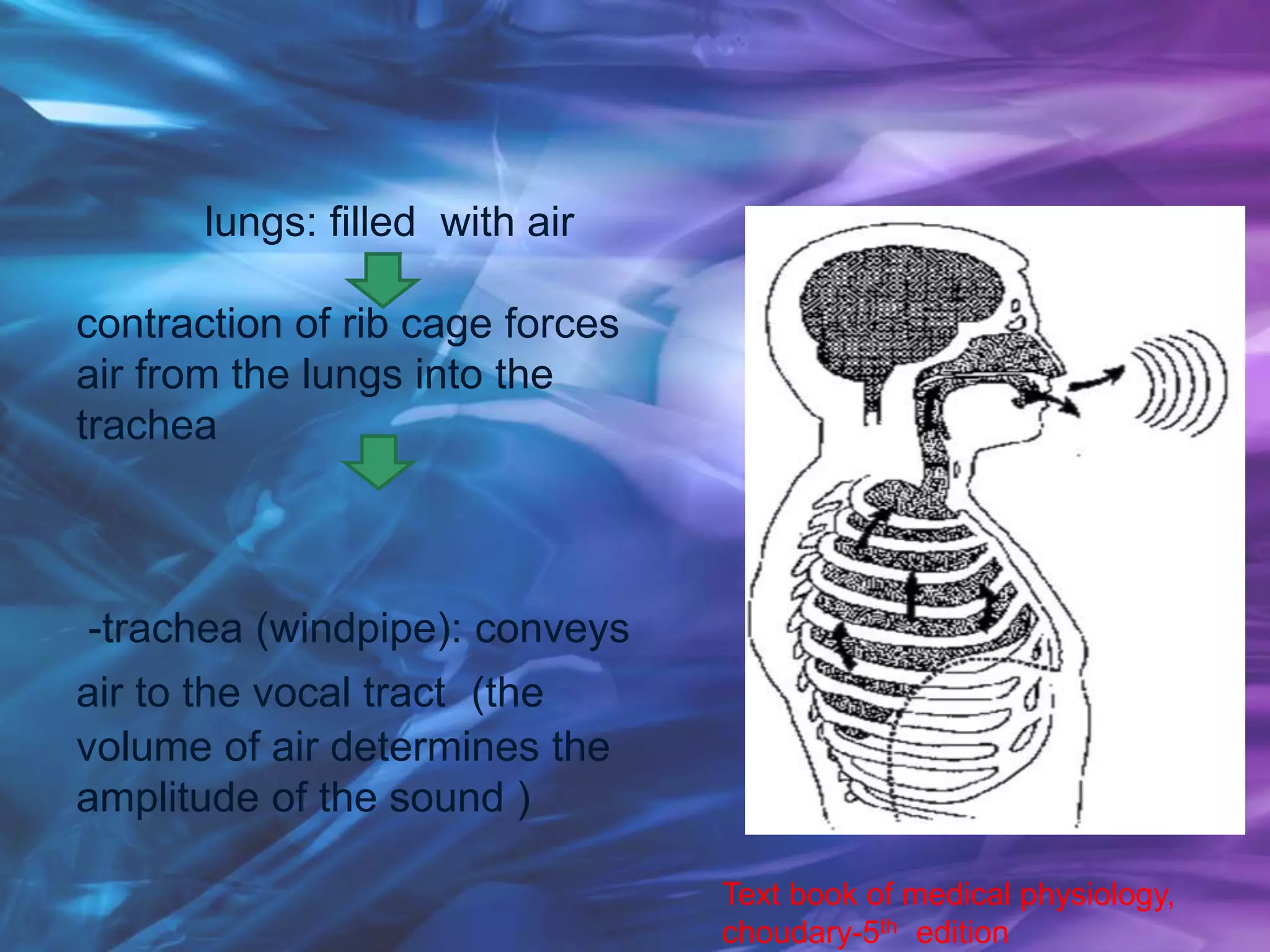
lungs: filled with air
contraction of rib cage forces
air from the lungs into the
trachea
-trachea (windpipe): conveys
air to the vocal tract (the
volume of air determines the
amplitude of the sound )
Text book of medical physiology,
choudary-5th edition
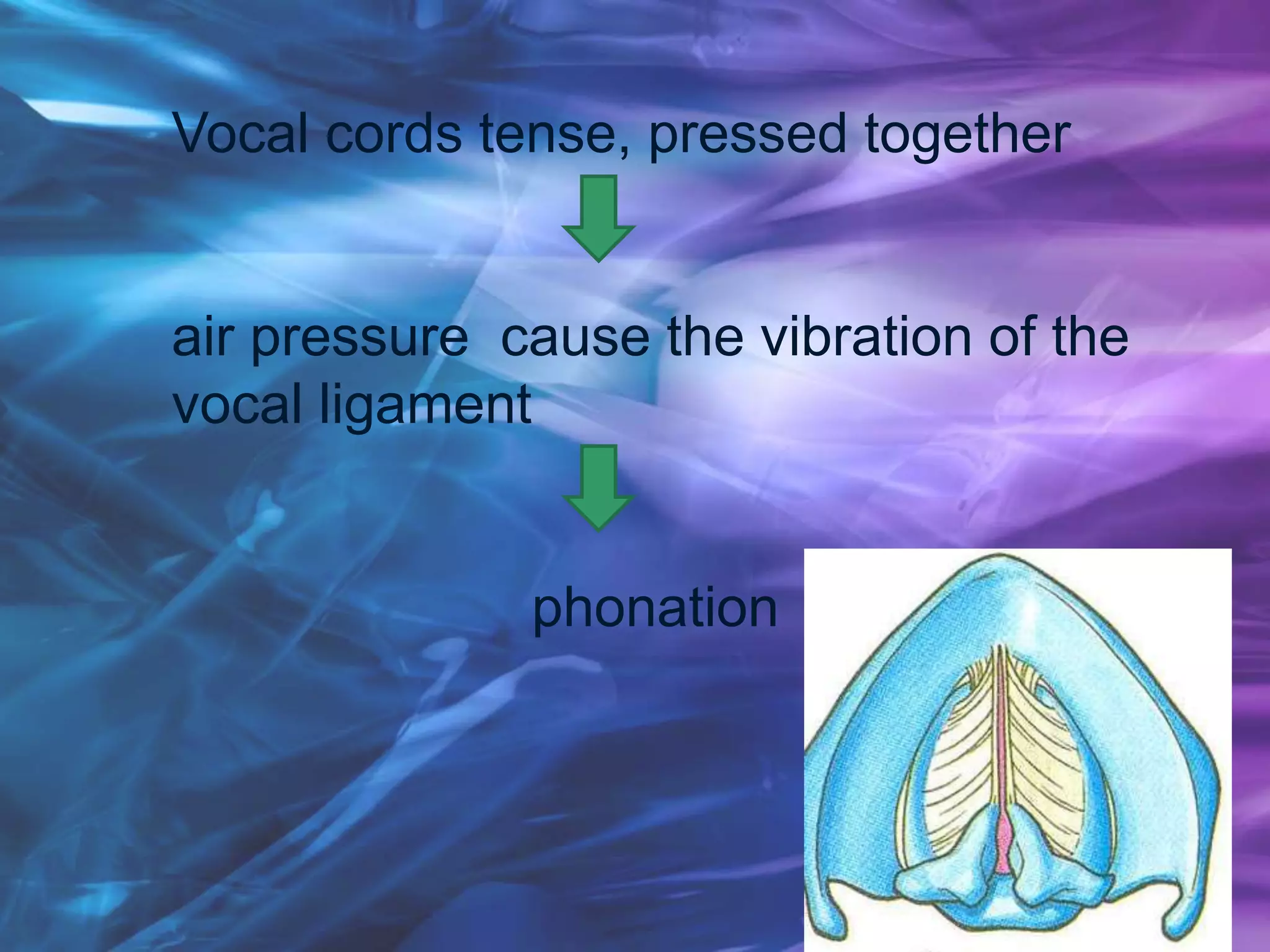
Vocal cords tense, pressed together
air pressure cause the vibration of the
vocal ligament
phonation
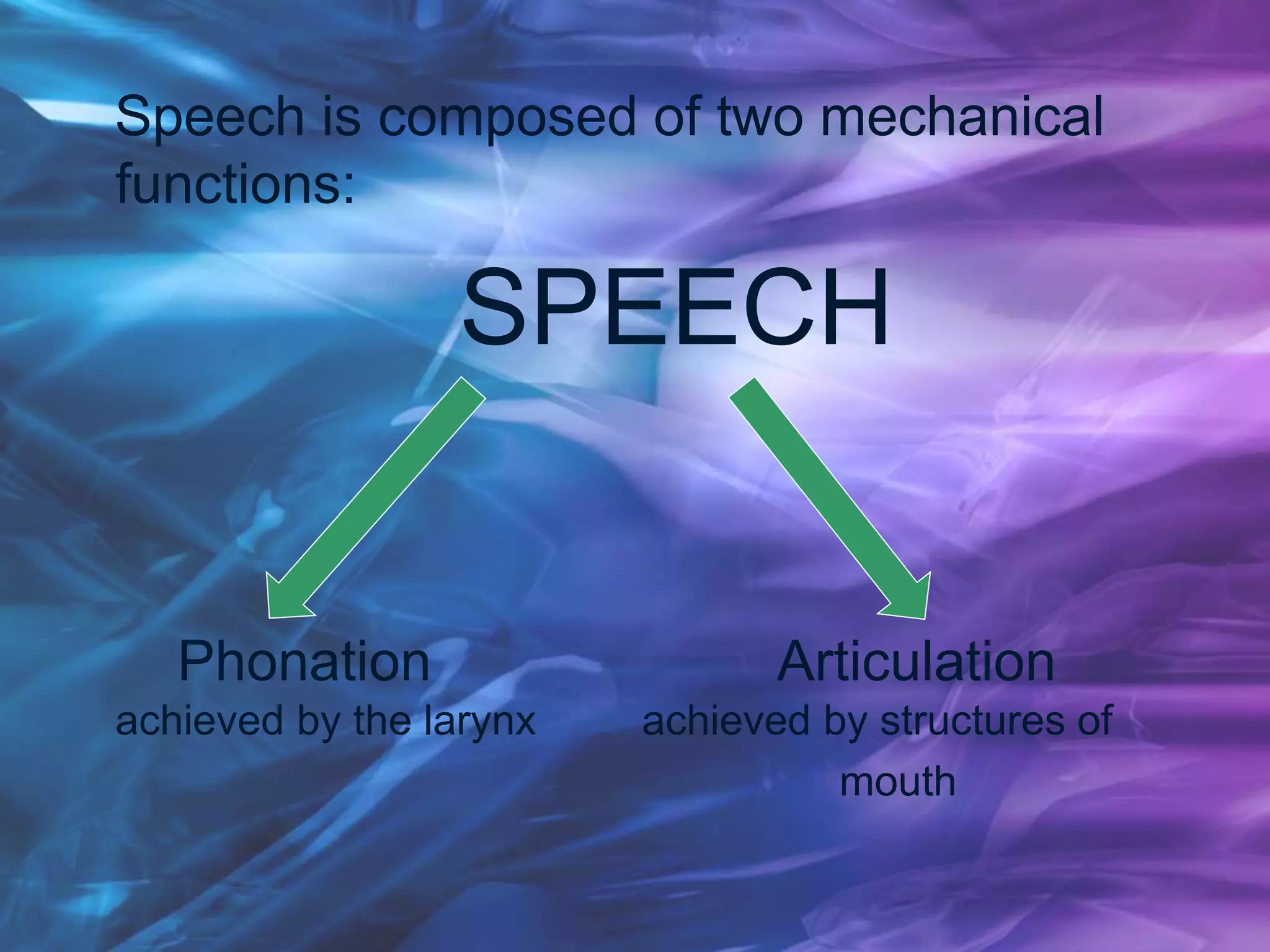
Speech is composed of two mechanical
functions:
SPEECH
Phonation Articulation
achieved by the larynx achieved by structures of
mouth
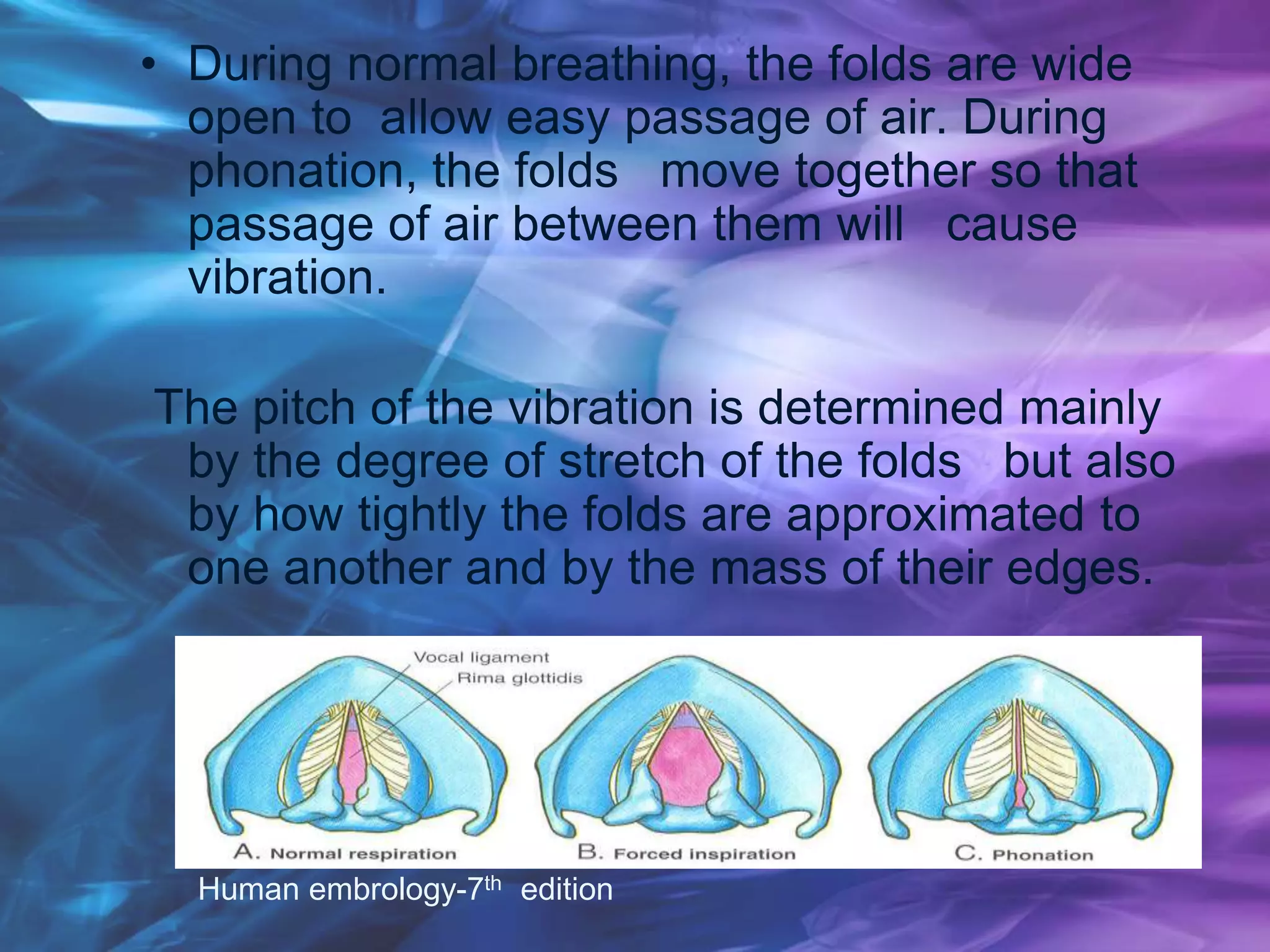
• During normal breathing, the folds are wide
open to allow easy passage of air. During
phonation, the folds move together so that
passage of air between them will cause
vibration.
The pitch of the vibration is determined mainly
by the degree of stretch of the folds but also
by how tightly the folds are approximated to
one another and by the mass of their edges.
Human embrology-7th edition
• The three major organs of articulation
are the lips, tongue, and soft palate .
• They alter the sound wave as it passes
through the mouth and shapes the flow
of air and voice into speech sounds, that
is, vowels and consonants.
• The resonators include the mouth, the
nose and associated nasal sinuses, the
pharynx.
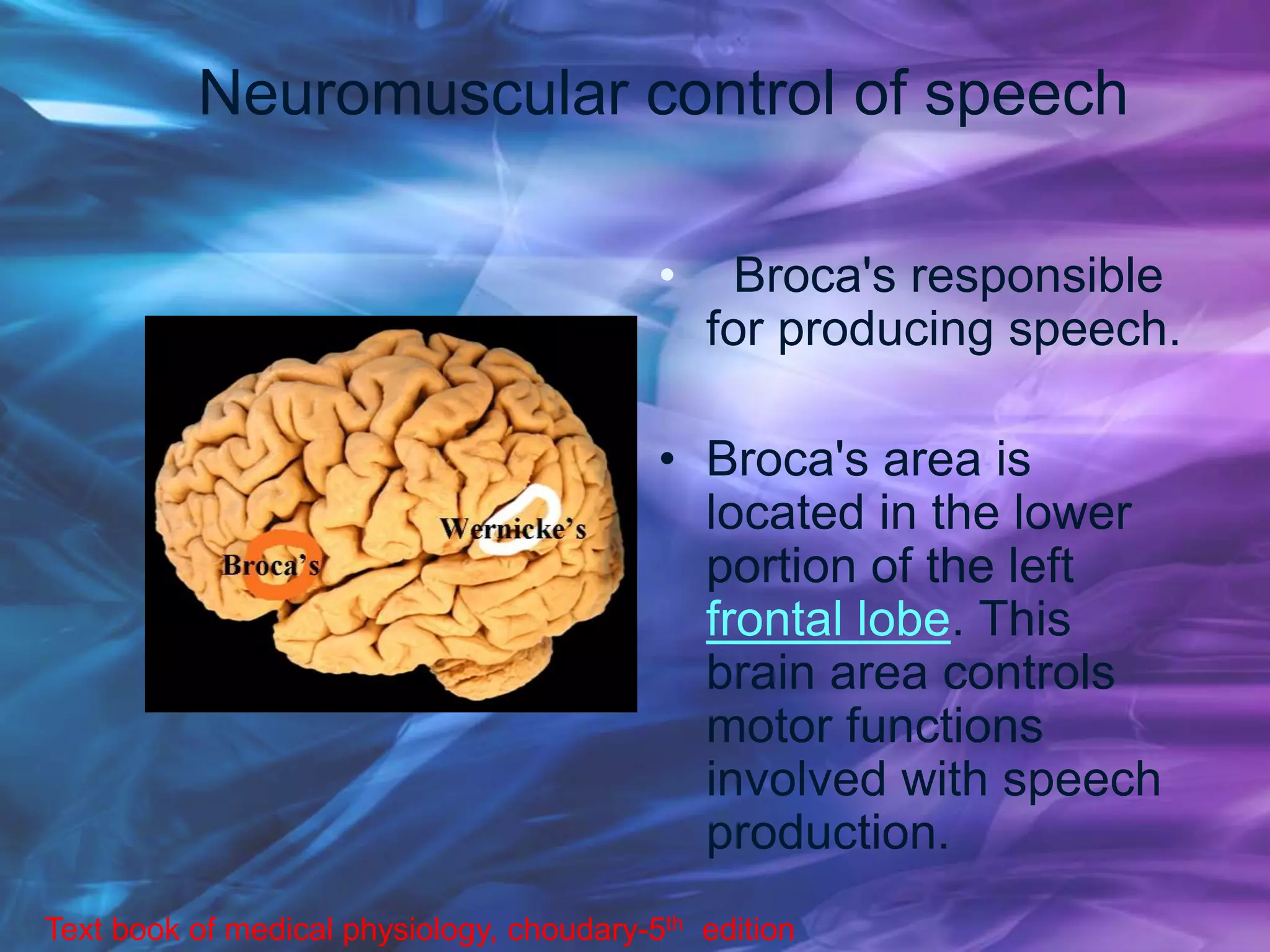
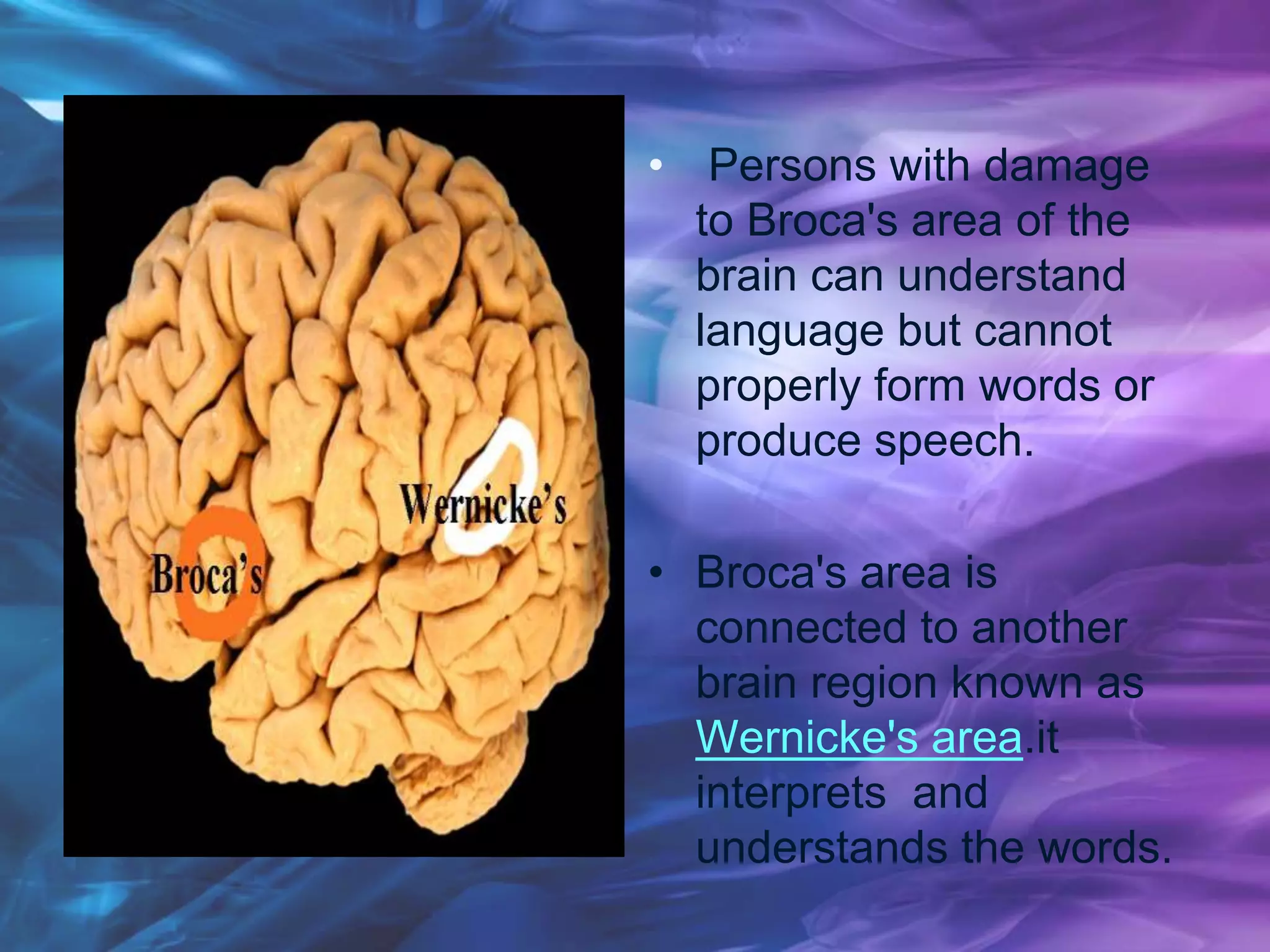
• Broca's responsible
for producing speech.
• Broca's area is
located in the lower
portion of the left
frontal lobe. This
brain area controls
motor functions
involved with speech
production.
Text book of medical physiology, choudary-5th edition
Neuromuscular control of speech
• Persons with damage
to Broca's area of the
brain can understand
language but cannot
properly form words or
produce speech.
• Broca's area is
connected to another
brain region known as
Wernicke's area.it
interprets and
understands the words.
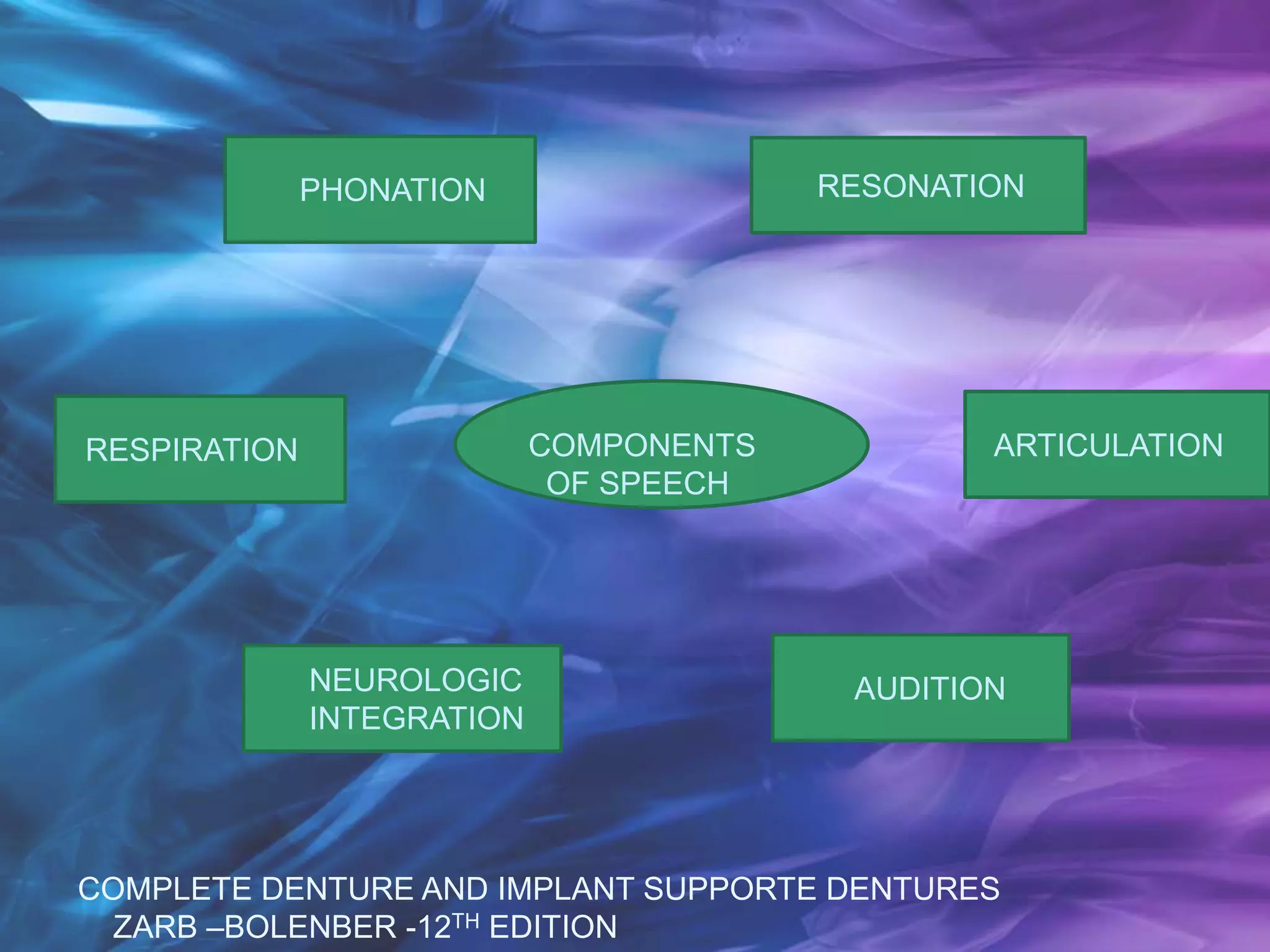
COMPONENTS
OF SPEECH
RESPIRATION
RESONATION
ARTICULATION
PHONATION
NEUROLOGIC
INTEGRATION
AUDITION
COMPLETE DENTURE AND IMPLANT SUPPORTE DENTURES
ZARB –BOLENBER -12TH EDITION
RESPIRATION
• The speech process is initiated by the energy
inherent in a stream of air in normal speech
• During exhalation, a continuous stream of air
with sufficient volume and pressure, under
adequate voluntary control, for phonation.
• The stream of air is modified in its course from
the lungs by the maxillofacial structures and
gives rise to the sound symbols which we
recognize as speech.
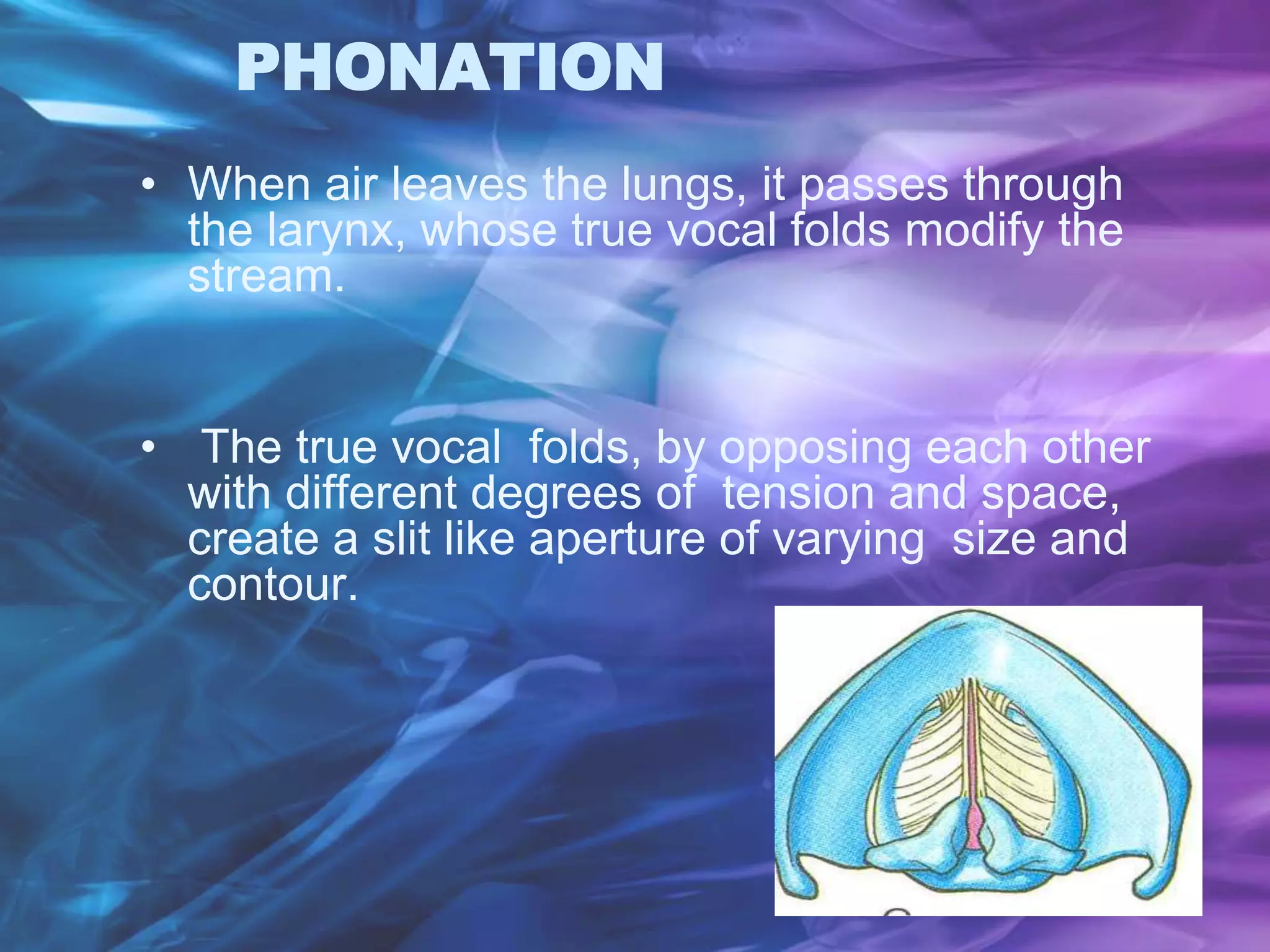
PHONATION
• When air leaves the lungs, it passes through
the larynx, whose true vocal folds modify the
stream.
• The true vocal folds, by opposing each other
with different degrees of tension and space,
create a slit like aperture of varying size and
contour.
RESONATION
• It is the resonators that give the characteristic
quality to the voice.
• The resonating structures are the air
sinuses, organ surfaces and cavities, such as
the pharynx, oral cavity, nasal cavity, and
chest wall.
• The resonating structures contribute no
energy to the stream of air; they act to
conserve and concentrate the energy
already present in the laryngeal tone, rather
than to let it dissipate into the tissues.
ARTICULATION
• It is the function of the articulatory
mechanism to break up and modify the
laryngeal tones and to create new
sounds within the oral cavity.
• So, the final action of the articulatory
apparatus is to articulate, that is to join
in a sequence all the sounds which
have been synthesized into symbols.
• Without the articulatory capacity, the
sounds produced would be only of
variable pitch, volume, and quality,
like a vowel sound.
NEURAL INTEGRATION
• Speech is a learned function, and
adequate hearing and vision and a
normal nervous system is required
for its full development.
• When the speech function comes
into conflict with other vital functions
of the maxillofacial structures, it is
speech that suffers.
AUDITION
• Audition, or the ability to receive acoustic
signals, is vital for normal speech. Hearing
permits receptions and interpretation of
acoustic signals and allows the speaker to
monitor and control speech output.
• Compromised hearing can preclude accurate
feedback and hence, affect speech. Speech
development and subsequent speech
therapy is hampered in patient with hearing
impairments.
SURD
• The surd is any voiceless sound and is
produced by separation of the vocal
folds (glottis open) with no marginal
vibration.
• The sound is made by frictions of the air
stream as it posses through the appropriate
cavities;
• The initial 'h' sound as in huh and the
voiceless
sibilants, z, sh and zh pronounced initially
areCharles M.Heartwell -5th edition
Sonants
• Sonants are voiced sounds and include all vowels
and vowel like sounds.
• They are produced by vibration of some portions of
vocal folds.
• The vowels require minimum articulation.
• The tip of the tongue lie on the floor of the mouth
either in contact with or close to the lingual surface of
the lower anterior teeth.
Consonants
• Consonants are articulated speech
sounds, and require articulation to
constrict, divert, or stop the air stream at
the proper place and time to produce the
desired sound.
• Consonants are produced as a result of
the airstream being impeded,diverted or
interrupted before it is released such as
p,g,m,b,s,t,r and z
• may be either voiced sounds or breathed
sounds,which are produced without vocal
cord vibration
Different valve positions from which consonants are produced
• Bilabial
• Labiodental
• Linguodental
• Lingeoalveolar
• Linguopalatal
• Linguovelar
Out of the above six valves, five valves are affected by teeth position
COMPLETE DENTURE AND IMPLANT SUPPORTED DENTURES
ZARB –BOLENBER -12TH EDITION
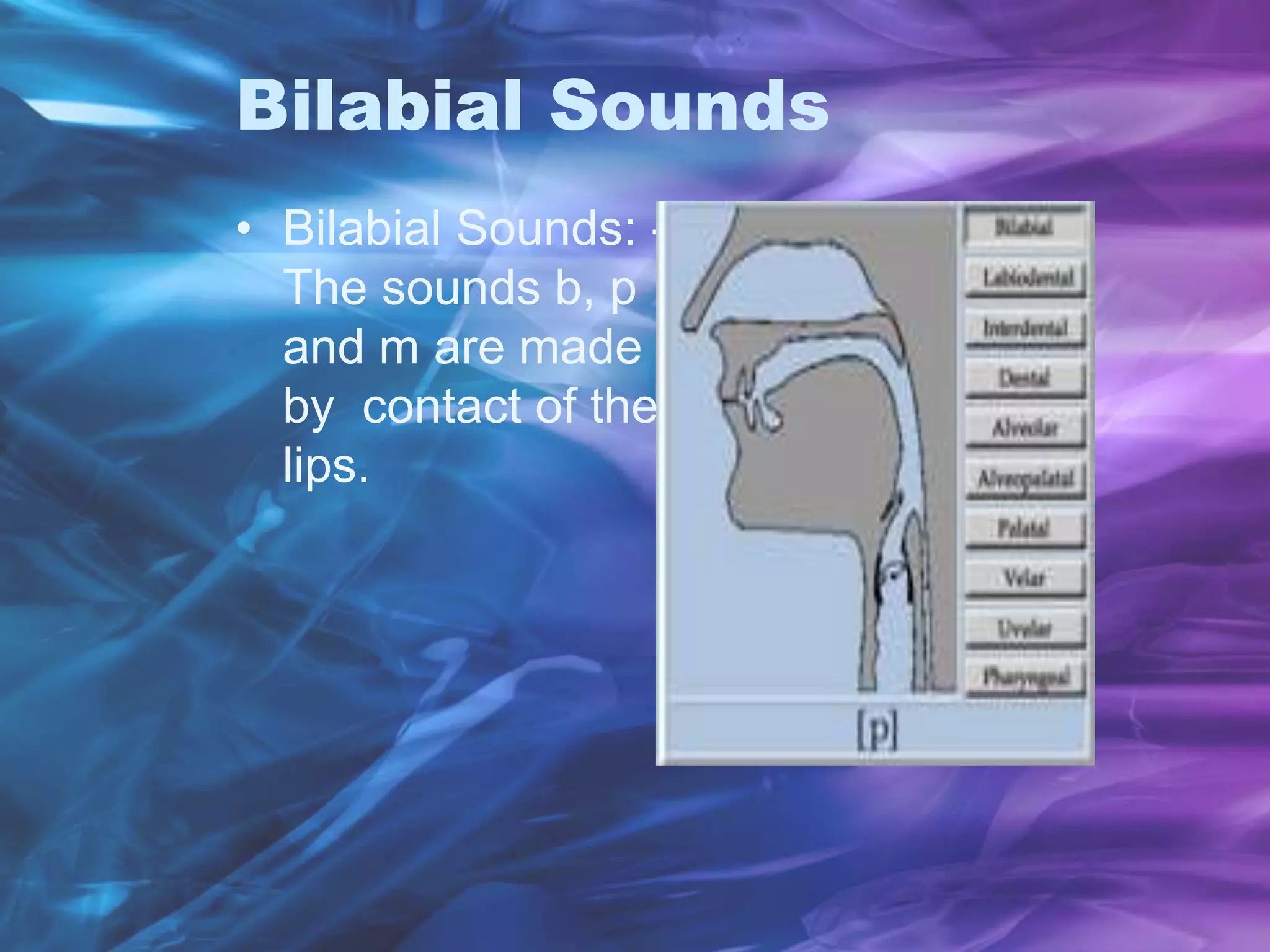
Bilabial Sounds
• Bilabial Sounds: -
The sounds b, p
and m are made
by contact of the
lips.
• Insufficient support of lips by teeth and /
or denture base can cause these sounds
to be defective.
• Therefore, the anterior-posterior position of
the anterior teeth and the thickness of the
labial flange can affect the production of
these sounds
• An incorrect vertical dimension of
occlusion (VDO) or teeth positioning
hindering proper lip closure, might
influence these sounds.
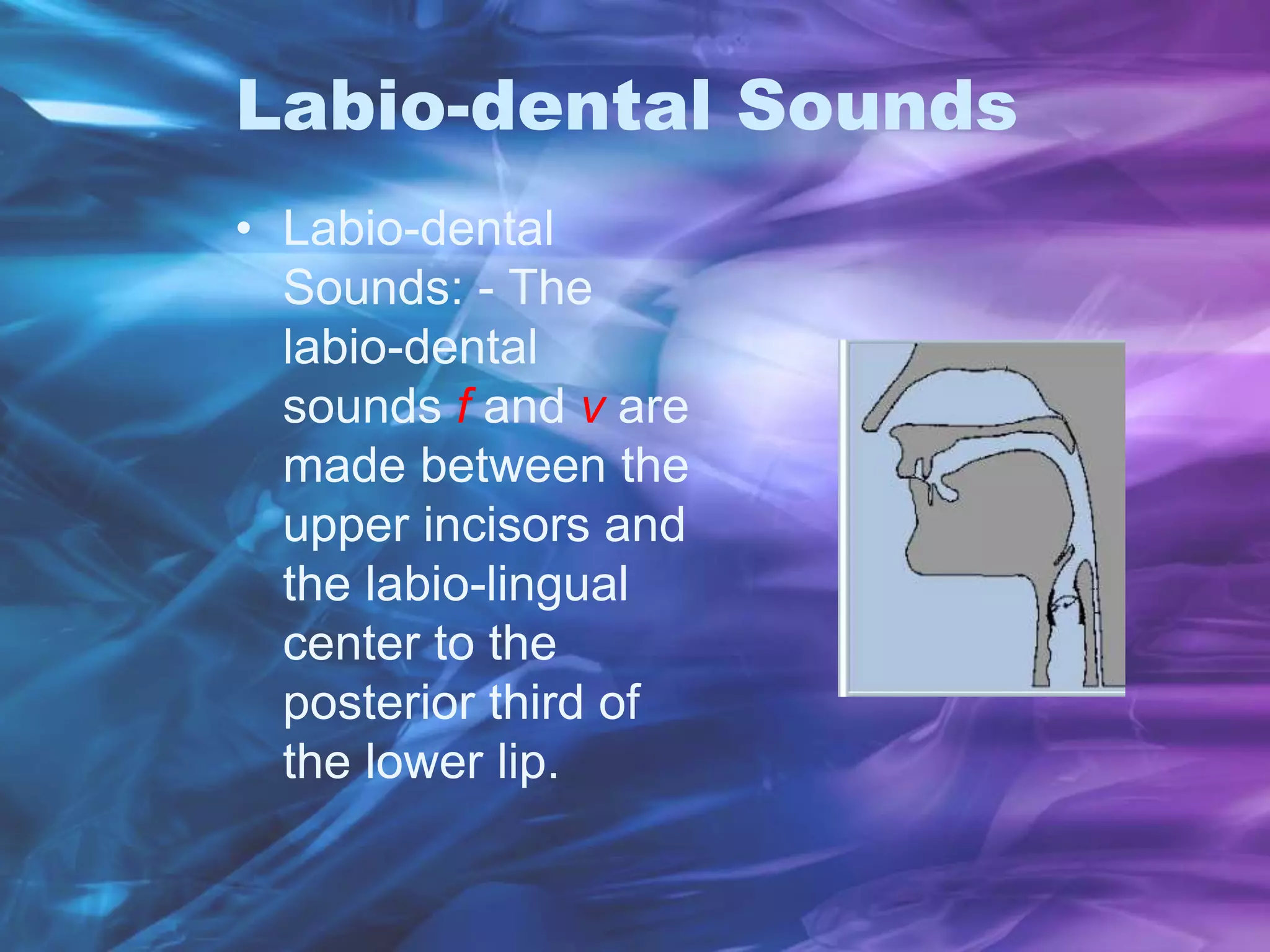
Labio-dental Sounds
• Labio-dental
Sounds: - The
labio-dental
sounds f and v are
made between the
upper incisors and
the labio-lingual
center to the
posterior third of
the lower lip.
• If the upper anterior teeth are too short (set
too high up), the v sound will be more like an
f. If they are too long (set too far down), the f
will sound more like a v.
• If upper teeth touch the labial side of the
lower lip while these sounds are made, the
upper teeth are too far forward or the lower
teeth are too far back in the mouth.
If the upper anterior teeth are set too
far back in mouth, they will contact
the lingual side of the lower lip when
f and v sounds are made
This may also occur if the lower
anterior teeth are too far forward in
relation to the lower anterior teeth
Linguodental Sounds
Dental sounds (eg.
Th in this)are made
with the tip of the
tongue extending
slightly between the
upper and lower
anterior teeth.
This sound is actually
made closer to the
alveolus(the ridge)
than to the tip of the
teeth
• Careful observation of the amount of
tongue that can be seen with the words
this, that, these and those will provide
information about the labiolingual position
of the anterior teeth
• If about 3mm of the tip of tongue is not
visible, the anterior teeth are probably too
far forward or there may be an excessive
vertical overlap
• If more than 6mm of the tongue extends
out between the teeth when such th
sounds are made, the teeth are probably
too far lingual
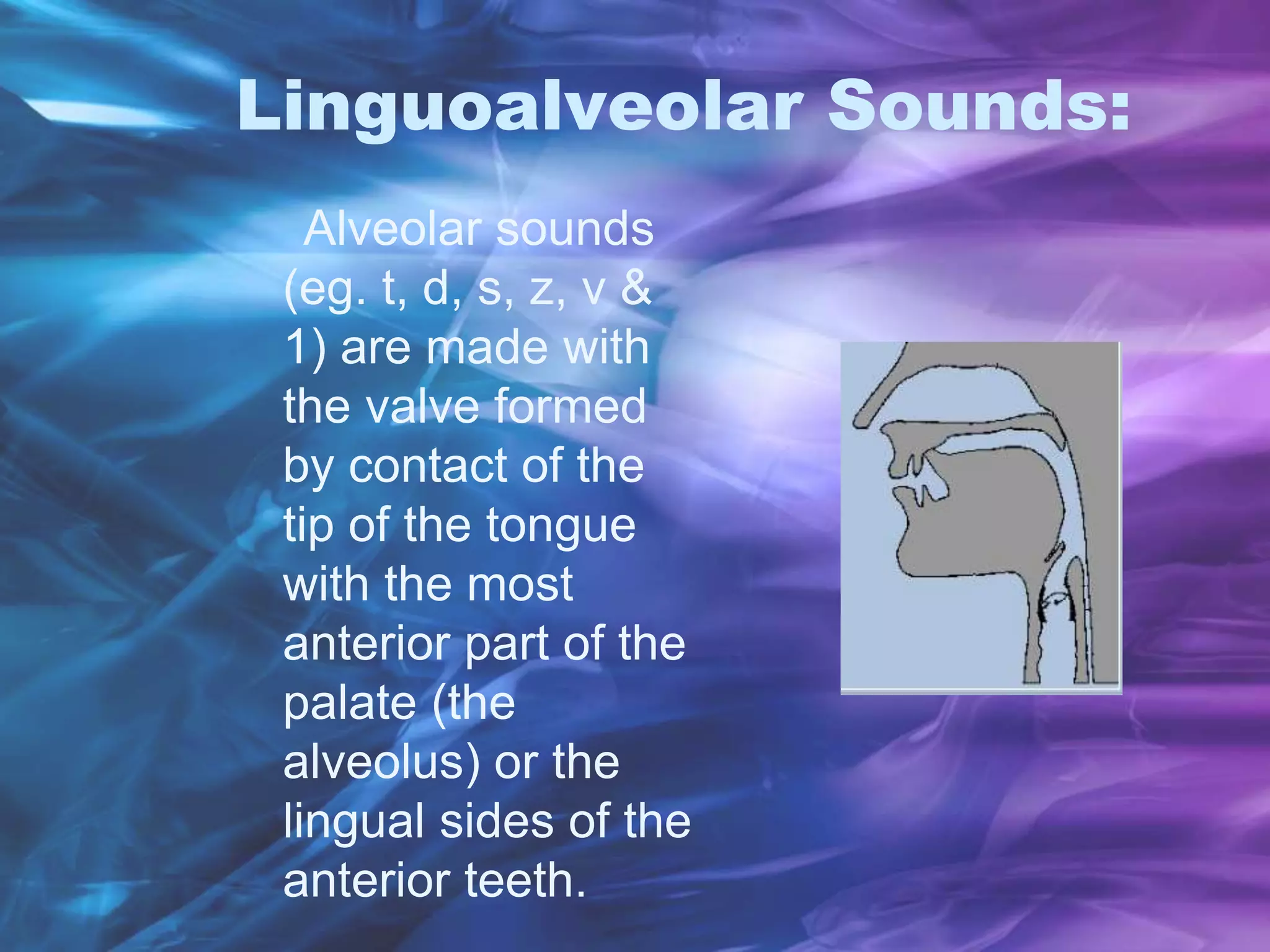
Linguoalveolar Sounds:
Alveolar sounds
(eg. t, d, s, z, v &
1) are made with
the valve formed
by contact of the
tip of the tongue
with the most
anterior part of the
palate (the
alveolus) or the
lingual sides of the
anterior teeth.
• The sibilants (sharp sounds) s, z, sh, ch &
j (with ch & j ) are alveolar sounds,
because the tongue and alveolus forms
the controlling valve.
• The important observations when these
sounds are produced is the relationship of
the anterior teeth to each other.
• The upper and lower incisors should
approach end to end but not touch
The ‘s’ Sound
From dental point of view, the ‘s’ sound
is the most interesting one because
its articulation is mainly influenced by
the teeth and palatal part of the
maxillary prosthesis
following are the phonetic properties of s
sound
 Articulatory characteristics
• The tip of tongue is placed far forward,
coming close to but never touching the
upper front incisors
• A saggital groove is made in the upper front
part of the tongue ,with a small cross-
sectional area
• The tongue dorsum is flat
• Normally, the mandible will move forward
and upward, with the teeth almost in contact
Acoustic characteristics
• The comparatively strong sound
energy is concentrated to a high
frequency range, with a steep energy
cut-off at about 3-4kHz
Auditory characteristics
• The sound is fairly loud, with a light,
sibilant(sharp) quality
• The s sounds can be considered dental and
alveolar speech sounds because they are
produced equally well with two different tongue
positions
• Most people make the s sound with the tip of
tongue against the alveolus in the area of the
rugae, but with a small space for air to escape
between the tongue and alveolus
• A sharp s requires accuracy of the
neuromuscular control system for the
creation of the groove and directing
of the air jet
• If the opening is too small, a whistle will
result.
• If the space is too broad and thin, the S
sound will be developed as sh, somewhat
like a lisp.
• The frequent cause of undesired whistles
with dentures is a posterior arch form that
is too narrow.
Let ‘speech’ be your guide Earl
Pound
JPD 1977:38;482-489
• Establishing vertical dimension of occlusion
• While repeating (three thirty three) there
should be enough space for the tip of the
tongue to protrude between the anterior
teeth
• While repeating fifty five , the incisal edge of
the maxillary incisor should contact the
vermillion border of the lower lip
• When the patient repeats the words
MISSISIPPI and EMMA ,the teeth should
not contact.
Spectral analysis of ‘s’ sound
with changing angulation of the
maxillary central incisor
Runte C, Tawana D,Dirksen D, Runte B,
Lamprecht-Dinnesen A, Bollmann F,
Seifert E,Danesh G IJP 2002;15: 254-258
• Concluded that the maxillary incisor
position influences /s/ sound production.
Displacement of the maxillary incisors
must be considered a cause of immediate
changes in /s/ sound distortion.
• Therefore, denture teeth should be
placed in the original tooth position
as accurately as possible. Results
also indicate that neuromuscular
reactions are more important for
initial speech sound distortions than
are aerodynamic changes in the
anterior speech sound producing
areas.
Linguopalatal and
linguovelar sounds
• The truly palatal sounds (e.g. those in
year,she,vision and onion) present less
problem for dentures
• The velar sounds (k,g and ng) have no
effect on dentures except when the
posterior palatal seal extension
encroaches on soft palate
FACTORS IN
DENTURE
DESIGN AFFECTING
SPEECH
CLINICAL DENTAL PROSTHETICS
Fenn, Liddelow, Ginisons 2nd edition
The vowel sounds
• The tip of the tongue, in all the vowel
sounds, lies on the floor of the mouth
either in contact with or close to the
lingual surfaces of the lower anterior
teeth and gums.
• The application of this in denture
construction is that the lower anterior
teeth should be set so that they do not
impede the tongue positioning for these
sounds.
• i.e. they should not be set lingual to
the alveolar ridge. The upper
denture base must be kept thin, and
the posterior should merge into the
soft tissue in order to avoid irritating
the dorsum of the tongue, which
might occur if this surface of the
denture were allowed to remain thick
and square edged
Denture thickness and
peripheral outline
• One of the reasons for loss of tone and
incorrect articulation of speech is the
decrease of air volume and loss of tongue
space in the oral cavity resulting from unduly
thick denture bases.
• Any interference with the freedom of tongue
,lips these movements may result in
indistinct speech, especially if the function of
the lips is in any way hindered.
• CLINICAL DENTAL PROSTHETICSFenn, Liddelow, Ginisons 2nd edition
• The production of the palatolingual (T, D)
group of sounds involves contact between
the tongue, and either the palate, the
alveolar process, or the teeth.
• With the consonants T and D, the tongue
makes firm contact with the anterior part of
the hard palate, and is suddenly drawn
downwards, producing an explosive sound;
any thickening of the denture base in this
region may cause incorrect formation of
these sounds.
• In the case of the S, C (soft) and Z
sounds, a slit like channel is formed
between the tongue and palate.
• Through which the air hisses. If artificial
rugae are too pronounced, or the
denture base too thick in this area, the
air channel will be obstructed and a
noticeable lisp may occur as a result.
Vertical dimension
• The formation of the bilabials, P, B and
M requires that the lips make contact to
check the air stream.
• With P and B, the lips part quite forcibly
so that the resultant sound is produced
with an explosive effect, whereas in the
M sound lip contact is passive.
• For this reason M can be used as an
aid in obtaining the correct vertical
height since a strained appearance
during lip contact, or the inability to
make contact, indicates that the
record blocks are occluding
prematurely.
The speaking method in measuring
vertical dimension
Silverman JPD1953Meyer M ;3:193-199
• When the sounds like ch, s ,j are pronounced , the
upper and the lower teeth reach their closest relation
without contact. This minimum amount of space is
called the silverman”s speaking space.
This space is measured before the loss of the remaining
natural teeth to give us the patient natural V.D. which
can be recorded and used at later dates.
Closest speaking space should be reproduced in full
dentures as in the natural dentition. This space is
also the means of proving that , VD must not be
increased.
Occlusal plane
• The labiodentals, F and V are produced by the air
stream
being forced through a narrow gap between the
lower lip
and the incisal edges of the upper anterior teeth.
If the occlusal plane is set too high the correct
positioning
of the lower lip may be difficult. If, on the other hand,
the
plane is too low, the lip will overlap the labial surfaces
of the upper teeth to a greater extent than is required
for
normal phonation and the sound might be affected.
Anteroposterior position of
the incisors
• In setting the upper anterior teeth,
consideration of their labio palatal
position is necessary for the correct
formation of the labiodentals F and
V.
• If they are placed too far palatally
the contact of the lower lip with the
incisal and labial surfaces may be
difficult, so
• If the anterior teeth are placed too far
back some effect may be noticed on
the quality of the linguopalatals S, C
(soft) and Z, resulting in a lisp due to
the tongue making contact with the
teeth prematurely.
Post-dam area
• Errors of construction in this region involve the vowels
and the palatolingual consonants K, NG, G and
C(hard).
In the latter group the air blast is checked by the base
of the tongue being raised upwards and backwards to
make contact with the soft palate.
A denture which has a thick base in the post dam area,
or a posterior edge finished square instead of
chamfered, will probably irritate the dorsum of the
tongue, impeding speech and possibly producing a
feeling of nausea.
• Indirectly, the postdam seal
influences articulation of speech.
• If it is inadequate the denture may
become unseated during the
formation of those sounds that have
a explosive effect.
Width of dental arch
• If the teeth are set to an arch which is
too narrow the tongue will be cramped,
thus affecting the size and shape of
the air channel
• this results in faulty articulation of
consonants such as T, D, S, N, K, C,
where the lateral margins of the tongue
make contact with the palatal surfaces
of the upper posterior teeth.
Relationship of the upper
and lower anterior teeth
• The chief concern is that of the S
sound which requires near contact of
the upper and lower incisors so that
the air stream is allowed to escape
through a slight opening between the
teeth.
• In abnormal protrusive and retrusive
jaw relationships, some difficulty may
be experienced in the formation of
this sound, and it will probably
necessitate adjustment of the upper
and lower anterior teeth
anteroposteriorly so that
approximation can be brought about
successfully. The consonants Ch, J
and Z require a similar air channel in
their formation.
POST –
INSERTION
SPEECH
DIFFICULTIES
• When complete dentures are worn for the
first time there is always some temporary
alteration in speech owing to the
thickness of the denture covering the
palate, necessitating slightly altered
positions of the tongue.
Patients usually adapt readily to moderate
changes in denture shape, and problems
with speech which are apparent at the
delivery stage are not often present at the
review.
• Adaptation occurs rapidly over the first few
days, but if distortions of speech persist
after 30 days a change to the denture
has to be made.
• However, that adaptation of speech
patterns back to normal is prolonged when
the patient has a hearing impediment, and
not all patients will admit to such a
disability.
TONGUE SPACE
• Restriction of the tongue space may
give rise to the following complaints:
(1) the patient feels that the dentures are
a
'mouthful';
(2) the patient has difficulty in speaking;
(3) the lower denture feels loose all the
time;
(4) the tip or sides of the tongue feel sore.
Tongue space is most likely to be
restricted anteriorly by the setting of the
upper incisors in the wrong relationship to
the incisive papilla, and posteriorly by
the setting of the upper posterior teeth 'on
the ridge' and the lower posterior teeth
lingual to the ridge.
• Difficulty with speech, is often associated with
the placement of the anterior teeth on the
ridge instead of in front of it.
• The anterior tooth position can be very
quickly checked by measuring from the
middle of the incisive papilla depression, on
the fitting surface of the denture, to the labial
surfaces of the incisors.
• The horizontal distance between these two
points should be approximately 1 cm. If it is
less than 7 mm it is safe to assume that there
is restriction of the anterior part of the tongue
space.
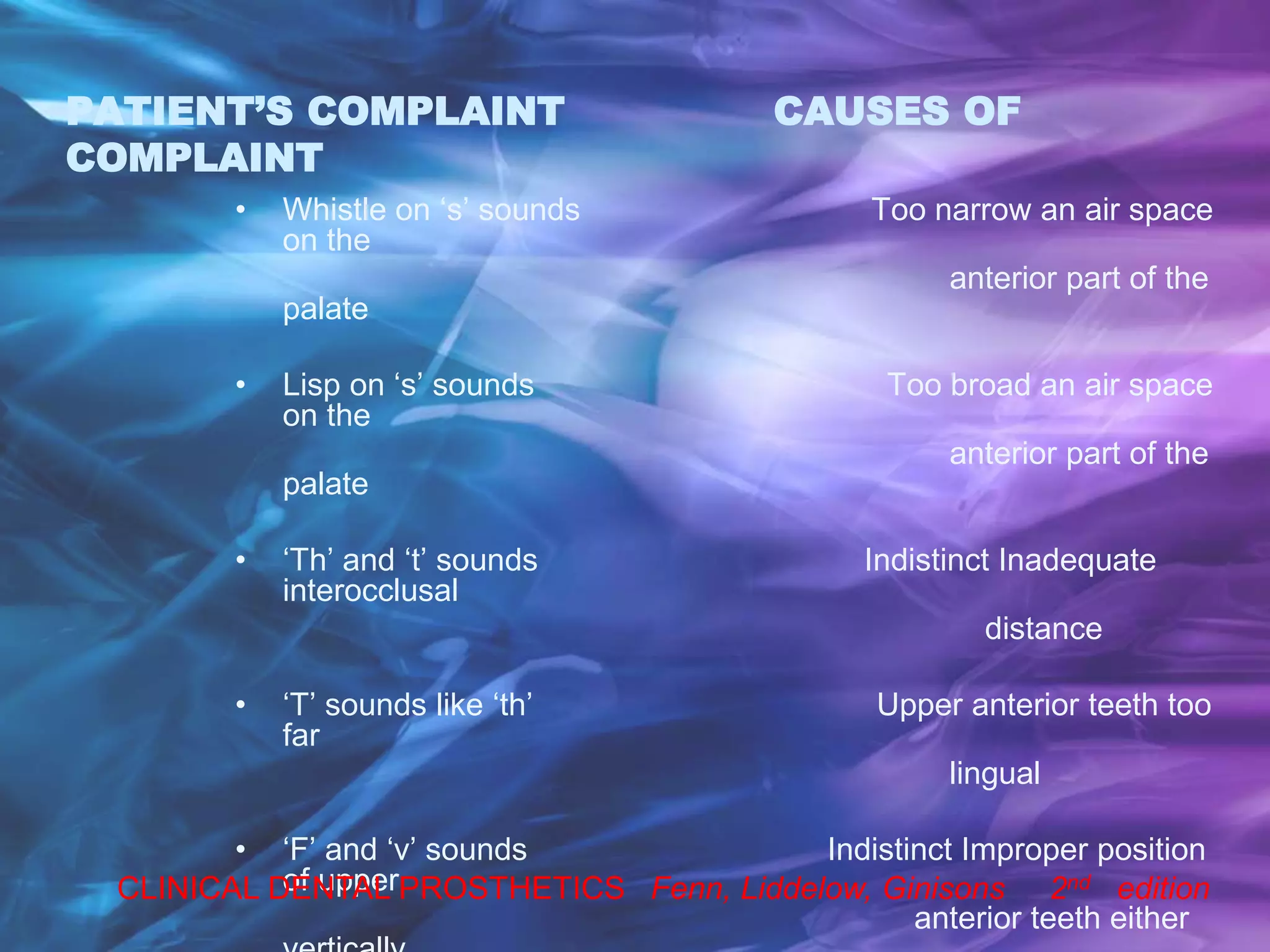
PATIENT’S COMPLAINT CAUSES OF
COMPLAINT
• Whistle on ‘s’ sounds Too narrow an air space
on the
anterior part of the
palate
• Lisp on ‘s’ sounds Too broad an air space
on the
anterior part of the
palate
• ‘Th’ and ‘t’ sounds Indistinct Inadequate
interocclusal
distance
• ‘T’ sounds like ‘th’ Upper anterior teeth too
far
lingual
• ‘F’ and ‘v’ sounds Indistinct Improper position
of upper
anterior teeth either
CLINICAL DENTAL PROSTHETICS Fenn, Liddelow, Ginisons 2nd edition
Special consideration in
implant prosthodontics
• Speech problems with maxillary fixed implant
prostheses are frequently reported,mostly during
the first several weeks after delivery but may
persist over several months
• Sibilants specially s have been most commonly
affected sound
• Space left between the alveolar ridge and a
fixed maxillary prosthesis and air passing
through it may be the cause of the higher error
rate for linguoalveolar and linguopalatal stops
and fricatives
• Patients who receive an immediate
loaded implant-supported prosthesis
after wearing a denture for a long
period,should be informed about the
possibility of a 3-6 month speech
adaptation period
References
• CLINICAL DENTAL PROSTHETICS Fenn, Liddelow, Ginisons
2nd edition.
• Runte C, Tawana D,Dirksen D, Runte B, Lamprecht-Dinnesen A,
Bollmann F, Seifert E,Danesh G
IJP 2002;15: 254-258
• Let ‘speech’ be your guide Earl Pound
JPD 1977:38;482-489
• COMPLETE DENTURE AND IMPLANT SUPPORTED DENTURES
ZARB –BOLENBER -12TH and 13th editions
• M. Heartwell 5th edition
Thank you

Mastication, degluttition and speech

  • 1.
    Mastication, Degluttition and Speech Presentedby: Dr Sakshi I yr PG Department of Prosthodontics
  • 2.
  • 3.
    Digestive System • Functions Ingestion –Mastication – Deglutition – Digestion – Absorption of nutrients – Elimination of indigestible/undigested food products
  • 4.
    From Mouth toStomach • Mastication (chewing): – Mixes food with saliva - • Amylase = enzyme that can catalyze the partial digestion of starch. • Deglutition (swallowing): – Involves 3 phases: • Oral phase is voluntary. • Pharyngeal and Esophageal phases are involuntary. – Cannot be stopped. – Larynx is raised. – Epiglottis covers the entrance to respiratory tract
  • 5.
    MASTICATION Mastication of foodis the initial stage in the process of digestion. Large pieces of food are reduced to smaller for swallowing. The food is broken apart and the surface area increased for the efficient action of digestive enzymes and to facilitate solubilisation of food substances in saliva to stimulate taste receptors.
  • 6.
  • 7.
  • 8.
    Action of musclesduring masticatory movements • Opening / Depressor jaw muscles – mylohyoid – digastric – inferior lateral pterygoid • Closing / elevator jaw muscles – medial pterygoid – superficial masseter – temporalis
  • 9.
    Chewing reflex Presence ofbolus causes inhibition of elevator muscles of jaw ,causing lower jaw to drop. The drop in turn initiates a stretch reflex of the jaw muscles leading to rebound contraction. This automatically raises the jaw to cause closure of the teeth compressing the bolus against the linings of mouth. This inhibits jaw muscles once again allowing the jaw to drop and rebound another time ; this is repeated again and again.
  • 11.
  • 12.
    Types of JawReflexes: • Jaw Closing Reflex / Jaw Jerk Reflex • Jaw Opening Reflex • Jaw Unloading Reflex • Tooth Contact Reflexes
  • 13.
    Jaw Opening Reflex: •It is a polysynaptic reflex. • consists of reciprocal inhibition of antagonists, rather than direct excitation of opener • occurs as a result of mechanical or electrical stimulation of the lips, oral mucosa or teeth. • After stimulation, opening movement occurs due to inhibition of activity in the mandibular elevators without simultaneous contraction of the depressors .
  • 15.
    Jaw Closing Reflex/ Jaw Jerk Reflex: • monosynaptic reflex generated by stretching muscle spindles in the masseter muscle. • Its latent time period is 6ms between the stimulus and the movement. • Demonstration: A sharp downward tap on the chin when the mandible is held loosely in the rest position results in contraction of the elevator muscles to bring the teeth into occlusion.
  • 16.
    Muscle spindle inthe massetor suddenly stretched Afferent nerve activity is generated in the spindles afferent impulses passed to the mesencephalic nucleus in the brain stem Afferent fibres synapse with the efferent motor neuron leading back to the fibres of the massetor Muscle will contract
  • 17.
    • This reflexalso counteracts the force of the gravity which would act to lower the jaw and separate the articular surface of the temporomandibular joint. • As all the elevator muscles are maintained in a mild state of the of contraction called muscle tone.
  • 19.
    Jaw Unloading Reflex •protective reflex that occurs when the jaw is suddenly unloaded e.g: When a stone comes inside mouth with food while mastication. • On sudden encounter with the hard object, mastication is stopped. This is due to reflex inhibition of elevators & reflex excitement of jaw depressors due to receptors in periodontal ligament and protects teeth from damage.
  • 20.
    Tooth Contact Reflex: Reflexchanges that occur in the elevator muscles when the upper & lower teeth are snapped together ( mechano-receptors in the pdl , fire a burst of impulses ) . the elevator muscles are stimulated.
  • 21.
    Mastication : Thecrushing & grinding • opening stroke • closing stroke / fast stroke • power stroke - puncture-crushing - tooth-tooth contact -buccal phase / phase I -lingual phase / phase II
  • 22.
    MASTICATORY MOVEMENTS – Movements – Chewingstroke Tooth contact • Forces of mastication • Role of periodontal fibres • Role of saliva • Muscle activity
  • 23.
    Chewing Stroke  Rhythmic Opening and closing of the jaw is in cyclic movement.  Chewing stroke is divided into  Opening movement  Closing movement a) crushing phase b) grinding phase Management of temporomandibular disorders and occlusion- Jeffery P. Okeson (5 edition)
  • 24.
    Opening phase • Duringopening phase there is initial rotation of the mandible for the first 20-27mm of interincisal distance. • Thereafter there is translatory or bodily shift of the mandible anteriorly and in downward direction.
  • 25.
    Opening • Start fromstatic intercuspal position, where jaw movement pauses for 194 ms in chewing cycle, • muscle activity begins in the ipsilateral inferior head of the lateral pterygoid muscle • Follow closely by the action of the contralateral inferior lateral pterygoid muscles.
  • 26.
    Opening • Early inthe opening phase, digastric muscles become active and remain until maximum opening position. • During the opening phase, masseter, temporalis, medial pterygoid, and superior head of lateral pterygoid muscles are inactive.
  • 27.
    Closing Phase 1) Crushingphase Starts when the mandible starts closing. At this point buccal cusp of maxillary teeth are under the buccal cusp of mandibular teeth. As the mandible closes, the bolus of food is trapped. Jeffery P .Okeson (5 edition)
  • 28.
    2) Grinding phase •Bolus gets trapped between the cusps and is ground • Bolus is trapped by the buccinator buccally and by the tongue lingually.
  • 29.
    Mandibular movements in frontalplane A cyclic movement pattern is seen when the mandibular movements are traced along the frontal plane. Management of temporomandibular disorders and occlusion- Jeffery P.Okeson (5 ed)
  • 30.
    TOOTH CONTACT • Infinal stages of mastication, just before swallowing tooth contact occurs during every stroke. • Gliding contact Centric contact • Average length of time for tooth contact during mastication is 194 msec.
  • 31.
    Occlusal condition influences theentire chewing stroke Tall cusps and deep fossae promote a predominantly vertical chewing stroke . – Flattened or worn teeth encourage a broader chewing stroke area. Management of temporomandibular disorders and occlusion- Jeffery P.Okeson (5 edition)
  • 32.
    FORCES OF MASTICATION •Varies from individual to individual. • Maximum amount of force applied to the molar is usually several times that can be applied to the incisors. for the molars is 91-198lb for the incisors is 29-51lb • The individuals can increase their maximum biting force over time with practice and exercise.
  • 33.
    • The forcegenerated during routine mastication of food is about 70 to 150 N • The maximum biting force is around 500 to 700 N
  • 34.
    • When theopposite teeth contact on inclines that is during the lateral movements , the horizontal forces are applied to the teeth ( as the periodontal fibres are not properly aligned to control them . so ,some areas are compressed and others are elongated.)
  • 35.
    Role of periodontalfibres • PDL, is a group of specialized connective tissue fibers that essentially attach a tooth to the alveolar bone • These fibers help the tooth withstand the naturally substantial compressive forces which occur during chewing and remain embedded in the bone.
  • 36.
    • The periodontalfibres have the mechanoreceptors that respond to the forces applied to the tooth and send impulses to the brainstem. • The alveolar crest fibers prevent extrusion of tooth and resist lateral tooth movements.
  • 37.
    ROLE OF SOFTTISSUE • LIPS: – Guide and control intake. – Seal off the oral cavity. • TONGUE: – Maneuvering the food within the oral cavity. – Initiates the breaking of food. – Pushes food to occlusal surfaces of teeth.
  • 38.
    TONGUE – During openingphase repositions the crushed food. – Divides food into portions that require more chewing and portions that are to be swallowed . – After eating ,the tongue sweeps the teeth to remove any food residue that has been trapped in the oral cavity.
  • 39.
    Buccinator muscle • Itrepositions food from buccal side. • Forms a boundary and limits the food and brings it back on the occlusal table for further grinding. • Gray’s Anatomy-38th edition
  • 40.
    Muscle activity  Thegeneral pattern of muscle activity during chewing cycle.  Closing muscles are inactive during jaw opening.  Activity of the jaw closing muscles increases slowly as the teeth begin to interdigitate or as soon as food is encountered between the teeth.
  • 41.
    •The combined effortsof the Lateral Pterygoid and digastric muscles provide jaw opening The Lateral Pterygoids advance the condyles, thereby opening the mouth (depressing the mandible), with the assistance of the Digastric muscle.
  • 42.
    SIDE TO SIDEGRINDING MOVEMENT • In normal chewing function, the mandible opens, and then, while initiating closing, there is a shift slightly to the side of the bolus, due to the orientation of the masseter and medial pterygoid.
  • 43.
    Medial and lateralpterygoid act together to protrude the mandible
  • 44.
    ELEVATION OF MANDIBLEBY TEMPORALIS
  • 45.
    Neurological control duringmastication • Coordination between – sensory feed back from peripheral organ – CPG :Central Pattern Generator neuron in brain stem – higher center – jaw reflexes
  • 46.
    Motoneuronal Excitation • Duringthe jaw-opening phase of mastication, – rhythmic inhibition occurs to inhibit the stretch reflex. • This postsynaptic hyperpolarization appears to be responsible for the phasic inhibition of the stretch reflex during jaw-opening • Moto-neuron pool is inhibited during chewing. • The muscle spindle feedback is mainly controlled by cyclical changes in the membrane potential of jaw- closing motoneurons.
  • 47.
    Reflex modulation • neuroncircuits are modulated at the level of primary afferent or interneurons. • modulation of sensory transmission occur through neurons in the trigeminal main sensory nucleus in the sub-nucleus oralis, and in the inter-trigeminal area which lies between the sensory and motor nuclei.
  • 48.
    Reflex modulation • Duringthe masticatory cycle the excitability of the jaw-opening reflex interneurons is inhibited – which receive inputs from low-threshold mechano-sensitive fields in the face or oral cavity. – most of the neuron with high threshold fields are very excitable during fast and slow jaw closing and relatively unexcitable during jaw opening. • Modulation of sensory transmission through the subnucleus caudalis is not phase modulated.
  • 49.
  • 50.
  • 51.
    MASTICATION WITH COMPLETE DENTURE •The biting force of subjects with complete denture is only one fourth than that of subjects with natural teeth. • Patient comfort and mastication may be impaired due to the elicited excess flow of the saliva for a few days after the placement of new complete denture. COMPLETE DENTURE AND IMPLANT SUPPORTED DENTURES ZARB –BOLENBER - 12TH EDITION
  • 52.
    • Patient shouldbegin chewing relatively soft food that requires less mastication and also ready for swallowing with a simple push of the tongue against the palate. This will make the patient confident in stabilising the denture • when biting with the denture ,patients should be instructed to place the food between their teeth towards the corner of the mouth then the food should be pushed inward and upwards as this will tend to seat the denture .
  • 53.
    • So ,learning with new denture requires at least 6-8 weeks as the memory patterns are established for the muscle of mastication.
  • 54.
  • 55.
     Deglutition isthe act of swallowing, through which a food or liquid bolus is transported from the mouth through the pharynx and esophagus into the stomach.  Normal deglutition is a smooth coordinated process that involves a complex series of voluntary and involuntary neuromuscular contractions and typically is divided into four distinct phases:  Preparatory phase Oral Pharyngeal Esophageal
  • 56.
    Preparatory phase • Theaverage tooth contact during swallowing lasts about 683msec. • It is more than three times longer than the duration of mastication. • Definition--It consists of a reflex sequence of muscle contraction that propels ingested materials and pooled saliva from the mouth to the stomach.
  • 57.
    PREPARATORY PHASE Bolus isprepared ↓ Positioned on the dorsum of the tongue ↓ The tongue tip pressed against the palatal aspect of the maxillary incisors or against the anterior hard palate ↓ Bolus is located in depression of the tongue ↓ Tongue raised laterally against the buccal teeth and palatal mucosa ↓ Posteriorly the pharyngeal part of the tongue arches up to meet the soft palate
  • 58.
    ORAL PHASE It isa Voluntary phase It includes the collection of chewed food into a bolus by tongue. Chewed food goes from mouth to pharynx. Gray’s Anatomy-38th edition
  • 59.
    – collection ofchewed food into a bolus by tongue. – bolus pressed against palate. – lips sealed, teeth brought together. – reflex contraction of tongue pushes food backwards down into pharynx.
  • 60.
    PHARYNGEAL PHASE • Foodgoes from pharynx to esophagus – pharyngeal muscles contract & push food by peristalsis – soft palate lifts & seals off nasal passages – epiglottis blocks entrance to trachea
  • 61.
    ESOPHAGEAL PHASE • Foodtravels down esophagus to stomach. • bolus moved through the esophagus. Smooth muscles contract behind the bolus to prevent it from being squeezed back into the mouth.
  • 62.
    • Peristalsis refersto the symmetrical contraction and relaxation of muscles which propagates in a wave down the muscular tube. • which pushes the digested food forward. and take about 8 seconds to reach the lower esophageal sphincter which opens to admit the entry of the bolus into the stomach
  • 63.
    Food propulsion When thefood is propelled from the oral cavity to the esophagus Peristaltic wave starts in the whole esophagus This propels the bolus towards the stomach Due to pressure difference, the valve of lower esophageal sphincter opens and food enters the stomach.
  • 64.
    CONTROL OF SWALLOWING •Preparatory and oral phases are under voluntary control. • The pharyngeal and esophageal phases are involuntary. • Organization of the swallowing motor sequence depends on the activity of brain stem neurons that belong to a functionally defined swallowing center (Textbook of medical physiology- Guyton (10th edition)
  • 65.
    Importance of swallowing inprosthodontics • As the process of swallowing completes, it brings the mandible to its most retruded position and therefore helpful in recording the centric relation in edentulous patients. • Immediately after swallowing, mandible tends to come into maximal intercuspal position, therefore it is important in recording “vertical jaw relations”. • COMPLETE DENTURE AND IMPLANT SUPPORTED DENTURES ZARB –BOLENBER -12TH EDITION
  • 66.
  • 67.
    INTRODUCTION Definition-"Speech is theuse of systematized vocalization to express verbal symbols or words." (GPT-7) • Speech in matured man is learned habitual neuromuscular pattern which makes use of anatomical structures designed primarily for respiration and deglutition.
  • 68.
    • speech asthe basic and fundamental means of communication became the cornerstone for the establishment and organization of society.
  • 69.
    Larynx • The larynxis a respiratory organ, set in the respiratory tract between the pharynx and trachea. • Although phonation is important in man, the main function of the larynx is to provide a protective sphincter for the air passages. • The larynx lies below the hyoid bone in the midline of the neck at the level of C 4-6 vertebrae.
  • 70.
    Grays Anatomy –40th edition
  • 71.
    Speech production • Controllingthe airstream that is initiated in the lungs and passes through the larynx and vocal cords produces all speech sounds • Subtle adjustments in the airflow contribute to variations of pitch and intensity of the voice
  • 72.
    MECHANISM OF VOICE PRODUCTION •The pre-requisites for sound are a source of energy and a vibrator . The source of energy for the voice is air in the lungs. The vibrator for the voice are the vocal folds in the larynx. • The larynx, pharynx, nasal cavity all act as cavity resonators to reinforce the original sound wave. This reinforcement is augmented by the change of shape and size of these cavities permitted by neuromuscular control.
  • 73.
    lungs: filled withair contraction of rib cage forces air from the lungs into the trachea -trachea (windpipe): conveys air to the vocal tract (the volume of air determines the amplitude of the sound ) Text book of medical physiology, choudary-5th edition
  • 74.
    Vocal cords tense,pressed together air pressure cause the vibration of the vocal ligament phonation
  • 75.
    Speech is composedof two mechanical functions: SPEECH Phonation Articulation achieved by the larynx achieved by structures of mouth
  • 76.
    • During normalbreathing, the folds are wide open to allow easy passage of air. During phonation, the folds move together so that passage of air between them will cause vibration. The pitch of the vibration is determined mainly by the degree of stretch of the folds but also by how tightly the folds are approximated to one another and by the mass of their edges. Human embrology-7th edition
  • 77.
    • The threemajor organs of articulation are the lips, tongue, and soft palate . • They alter the sound wave as it passes through the mouth and shapes the flow of air and voice into speech sounds, that is, vowels and consonants. • The resonators include the mouth, the nose and associated nasal sinuses, the pharynx.
  • 78.
    • Broca's responsible forproducing speech. • Broca's area is located in the lower portion of the left frontal lobe. This brain area controls motor functions involved with speech production. Text book of medical physiology, choudary-5th edition Neuromuscular control of speech
  • 79.
    • Persons withdamage to Broca's area of the brain can understand language but cannot properly form words or produce speech. • Broca's area is connected to another brain region known as Wernicke's area.it interprets and understands the words.
  • 80.
  • 81.
    RESPIRATION • The speechprocess is initiated by the energy inherent in a stream of air in normal speech • During exhalation, a continuous stream of air with sufficient volume and pressure, under adequate voluntary control, for phonation. • The stream of air is modified in its course from the lungs by the maxillofacial structures and gives rise to the sound symbols which we recognize as speech.
  • 82.
    PHONATION • When airleaves the lungs, it passes through the larynx, whose true vocal folds modify the stream. • The true vocal folds, by opposing each other with different degrees of tension and space, create a slit like aperture of varying size and contour.
  • 83.
    RESONATION • It isthe resonators that give the characteristic quality to the voice. • The resonating structures are the air sinuses, organ surfaces and cavities, such as the pharynx, oral cavity, nasal cavity, and chest wall. • The resonating structures contribute no energy to the stream of air; they act to conserve and concentrate the energy already present in the laryngeal tone, rather than to let it dissipate into the tissues.
  • 84.
    ARTICULATION • It isthe function of the articulatory mechanism to break up and modify the laryngeal tones and to create new sounds within the oral cavity. • So, the final action of the articulatory apparatus is to articulate, that is to join in a sequence all the sounds which have been synthesized into symbols.
  • 85.
    • Without thearticulatory capacity, the sounds produced would be only of variable pitch, volume, and quality, like a vowel sound.
  • 86.
    NEURAL INTEGRATION • Speechis a learned function, and adequate hearing and vision and a normal nervous system is required for its full development. • When the speech function comes into conflict with other vital functions of the maxillofacial structures, it is speech that suffers.
  • 87.
    AUDITION • Audition, orthe ability to receive acoustic signals, is vital for normal speech. Hearing permits receptions and interpretation of acoustic signals and allows the speaker to monitor and control speech output. • Compromised hearing can preclude accurate feedback and hence, affect speech. Speech development and subsequent speech therapy is hampered in patient with hearing impairments.
  • 88.
    SURD • The surdis any voiceless sound and is produced by separation of the vocal folds (glottis open) with no marginal vibration. • The sound is made by frictions of the air stream as it posses through the appropriate cavities; • The initial 'h' sound as in huh and the voiceless sibilants, z, sh and zh pronounced initially areCharles M.Heartwell -5th edition
  • 89.
    Sonants • Sonants arevoiced sounds and include all vowels and vowel like sounds. • They are produced by vibration of some portions of vocal folds. • The vowels require minimum articulation. • The tip of the tongue lie on the floor of the mouth either in contact with or close to the lingual surface of the lower anterior teeth.
  • 90.
    Consonants • Consonants arearticulated speech sounds, and require articulation to constrict, divert, or stop the air stream at the proper place and time to produce the desired sound. • Consonants are produced as a result of the airstream being impeded,diverted or interrupted before it is released such as p,g,m,b,s,t,r and z • may be either voiced sounds or breathed sounds,which are produced without vocal cord vibration
  • 91.
    Different valve positionsfrom which consonants are produced • Bilabial • Labiodental • Linguodental • Lingeoalveolar • Linguopalatal • Linguovelar Out of the above six valves, five valves are affected by teeth position COMPLETE DENTURE AND IMPLANT SUPPORTED DENTURES ZARB –BOLENBER -12TH EDITION
  • 92.
    Bilabial Sounds • BilabialSounds: - The sounds b, p and m are made by contact of the lips.
  • 93.
    • Insufficient supportof lips by teeth and / or denture base can cause these sounds to be defective. • Therefore, the anterior-posterior position of the anterior teeth and the thickness of the labial flange can affect the production of these sounds • An incorrect vertical dimension of occlusion (VDO) or teeth positioning hindering proper lip closure, might influence these sounds.
  • 94.
    Labio-dental Sounds • Labio-dental Sounds:- The labio-dental sounds f and v are made between the upper incisors and the labio-lingual center to the posterior third of the lower lip.
  • 95.
    • If theupper anterior teeth are too short (set too high up), the v sound will be more like an f. If they are too long (set too far down), the f will sound more like a v. • If upper teeth touch the labial side of the lower lip while these sounds are made, the upper teeth are too far forward or the lower teeth are too far back in the mouth.
  • 96.
    If the upperanterior teeth are set too far back in mouth, they will contact the lingual side of the lower lip when f and v sounds are made This may also occur if the lower anterior teeth are too far forward in relation to the lower anterior teeth
  • 97.
    Linguodental Sounds Dental sounds(eg. Th in this)are made with the tip of the tongue extending slightly between the upper and lower anterior teeth. This sound is actually made closer to the alveolus(the ridge) than to the tip of the teeth
  • 98.
    • Careful observationof the amount of tongue that can be seen with the words this, that, these and those will provide information about the labiolingual position of the anterior teeth • If about 3mm of the tip of tongue is not visible, the anterior teeth are probably too far forward or there may be an excessive vertical overlap • If more than 6mm of the tongue extends out between the teeth when such th sounds are made, the teeth are probably too far lingual
  • 99.
    Linguoalveolar Sounds: Alveolar sounds (eg.t, d, s, z, v & 1) are made with the valve formed by contact of the tip of the tongue with the most anterior part of the palate (the alveolus) or the lingual sides of the anterior teeth.
  • 100.
    • The sibilants(sharp sounds) s, z, sh, ch & j (with ch & j ) are alveolar sounds, because the tongue and alveolus forms the controlling valve. • The important observations when these sounds are produced is the relationship of the anterior teeth to each other. • The upper and lower incisors should approach end to end but not touch
  • 101.
    The ‘s’ Sound Fromdental point of view, the ‘s’ sound is the most interesting one because its articulation is mainly influenced by the teeth and palatal part of the maxillary prosthesis
  • 102.
    following are thephonetic properties of s sound  Articulatory characteristics • The tip of tongue is placed far forward, coming close to but never touching the upper front incisors • A saggital groove is made in the upper front part of the tongue ,with a small cross- sectional area • The tongue dorsum is flat • Normally, the mandible will move forward and upward, with the teeth almost in contact
  • 103.
    Acoustic characteristics • Thecomparatively strong sound energy is concentrated to a high frequency range, with a steep energy cut-off at about 3-4kHz
  • 104.
    Auditory characteristics • Thesound is fairly loud, with a light, sibilant(sharp) quality • The s sounds can be considered dental and alveolar speech sounds because they are produced equally well with two different tongue positions • Most people make the s sound with the tip of tongue against the alveolus in the area of the rugae, but with a small space for air to escape between the tongue and alveolus
  • 105.
    • A sharps requires accuracy of the neuromuscular control system for the creation of the groove and directing of the air jet
  • 106.
    • If theopening is too small, a whistle will result. • If the space is too broad and thin, the S sound will be developed as sh, somewhat like a lisp. • The frequent cause of undesired whistles with dentures is a posterior arch form that is too narrow.
  • 107.
    Let ‘speech’ beyour guide Earl Pound JPD 1977:38;482-489 • Establishing vertical dimension of occlusion • While repeating (three thirty three) there should be enough space for the tip of the tongue to protrude between the anterior teeth • While repeating fifty five , the incisal edge of the maxillary incisor should contact the vermillion border of the lower lip • When the patient repeats the words MISSISIPPI and EMMA ,the teeth should not contact.
  • 108.
    Spectral analysis of‘s’ sound with changing angulation of the maxillary central incisor Runte C, Tawana D,Dirksen D, Runte B, Lamprecht-Dinnesen A, Bollmann F, Seifert E,Danesh G IJP 2002;15: 254-258 • Concluded that the maxillary incisor position influences /s/ sound production. Displacement of the maxillary incisors must be considered a cause of immediate changes in /s/ sound distortion.
  • 109.
    • Therefore, dentureteeth should be placed in the original tooth position as accurately as possible. Results also indicate that neuromuscular reactions are more important for initial speech sound distortions than are aerodynamic changes in the anterior speech sound producing areas.
  • 110.
    Linguopalatal and linguovelar sounds •The truly palatal sounds (e.g. those in year,she,vision and onion) present less problem for dentures • The velar sounds (k,g and ng) have no effect on dentures except when the posterior palatal seal extension encroaches on soft palate
  • 111.
    FACTORS IN DENTURE DESIGN AFFECTING SPEECH CLINICALDENTAL PROSTHETICS Fenn, Liddelow, Ginisons 2nd edition
  • 112.
    The vowel sounds •The tip of the tongue, in all the vowel sounds, lies on the floor of the mouth either in contact with or close to the lingual surfaces of the lower anterior teeth and gums. • The application of this in denture construction is that the lower anterior teeth should be set so that they do not impede the tongue positioning for these sounds.
  • 113.
    • i.e. theyshould not be set lingual to the alveolar ridge. The upper denture base must be kept thin, and the posterior should merge into the soft tissue in order to avoid irritating the dorsum of the tongue, which might occur if this surface of the denture were allowed to remain thick and square edged
  • 114.
    Denture thickness and peripheraloutline • One of the reasons for loss of tone and incorrect articulation of speech is the decrease of air volume and loss of tongue space in the oral cavity resulting from unduly thick denture bases. • Any interference with the freedom of tongue ,lips these movements may result in indistinct speech, especially if the function of the lips is in any way hindered. • CLINICAL DENTAL PROSTHETICSFenn, Liddelow, Ginisons 2nd edition
  • 115.
    • The productionof the palatolingual (T, D) group of sounds involves contact between the tongue, and either the palate, the alveolar process, or the teeth. • With the consonants T and D, the tongue makes firm contact with the anterior part of the hard palate, and is suddenly drawn downwards, producing an explosive sound; any thickening of the denture base in this region may cause incorrect formation of these sounds.
  • 116.
    • In thecase of the S, C (soft) and Z sounds, a slit like channel is formed between the tongue and palate. • Through which the air hisses. If artificial rugae are too pronounced, or the denture base too thick in this area, the air channel will be obstructed and a noticeable lisp may occur as a result.
  • 117.
    Vertical dimension • Theformation of the bilabials, P, B and M requires that the lips make contact to check the air stream. • With P and B, the lips part quite forcibly so that the resultant sound is produced with an explosive effect, whereas in the M sound lip contact is passive.
  • 118.
    • For thisreason M can be used as an aid in obtaining the correct vertical height since a strained appearance during lip contact, or the inability to make contact, indicates that the record blocks are occluding prematurely.
  • 119.
    The speaking methodin measuring vertical dimension Silverman JPD1953Meyer M ;3:193-199 • When the sounds like ch, s ,j are pronounced , the upper and the lower teeth reach their closest relation without contact. This minimum amount of space is called the silverman”s speaking space. This space is measured before the loss of the remaining natural teeth to give us the patient natural V.D. which can be recorded and used at later dates. Closest speaking space should be reproduced in full dentures as in the natural dentition. This space is also the means of proving that , VD must not be increased.
  • 120.
    Occlusal plane • Thelabiodentals, F and V are produced by the air stream being forced through a narrow gap between the lower lip and the incisal edges of the upper anterior teeth. If the occlusal plane is set too high the correct positioning of the lower lip may be difficult. If, on the other hand, the plane is too low, the lip will overlap the labial surfaces of the upper teeth to a greater extent than is required for normal phonation and the sound might be affected.
  • 121.
    Anteroposterior position of theincisors • In setting the upper anterior teeth, consideration of their labio palatal position is necessary for the correct formation of the labiodentals F and V. • If they are placed too far palatally the contact of the lower lip with the incisal and labial surfaces may be difficult, so
  • 122.
    • If theanterior teeth are placed too far back some effect may be noticed on the quality of the linguopalatals S, C (soft) and Z, resulting in a lisp due to the tongue making contact with the teeth prematurely.
  • 123.
    Post-dam area • Errorsof construction in this region involve the vowels and the palatolingual consonants K, NG, G and C(hard). In the latter group the air blast is checked by the base of the tongue being raised upwards and backwards to make contact with the soft palate. A denture which has a thick base in the post dam area, or a posterior edge finished square instead of chamfered, will probably irritate the dorsum of the tongue, impeding speech and possibly producing a feeling of nausea.
  • 124.
    • Indirectly, thepostdam seal influences articulation of speech. • If it is inadequate the denture may become unseated during the formation of those sounds that have a explosive effect.
  • 125.
    Width of dentalarch • If the teeth are set to an arch which is too narrow the tongue will be cramped, thus affecting the size and shape of the air channel • this results in faulty articulation of consonants such as T, D, S, N, K, C, where the lateral margins of the tongue make contact with the palatal surfaces of the upper posterior teeth.
  • 126.
    Relationship of theupper and lower anterior teeth • The chief concern is that of the S sound which requires near contact of the upper and lower incisors so that the air stream is allowed to escape through a slight opening between the teeth.
  • 127.
    • In abnormalprotrusive and retrusive jaw relationships, some difficulty may be experienced in the formation of this sound, and it will probably necessitate adjustment of the upper and lower anterior teeth anteroposteriorly so that approximation can be brought about successfully. The consonants Ch, J and Z require a similar air channel in their formation.
  • 128.
  • 129.
    • When completedentures are worn for the first time there is always some temporary alteration in speech owing to the thickness of the denture covering the palate, necessitating slightly altered positions of the tongue. Patients usually adapt readily to moderate changes in denture shape, and problems with speech which are apparent at the delivery stage are not often present at the review.
  • 130.
    • Adaptation occursrapidly over the first few days, but if distortions of speech persist after 30 days a change to the denture has to be made. • However, that adaptation of speech patterns back to normal is prolonged when the patient has a hearing impediment, and not all patients will admit to such a disability.
  • 131.
    TONGUE SPACE • Restrictionof the tongue space may give rise to the following complaints: (1) the patient feels that the dentures are a 'mouthful'; (2) the patient has difficulty in speaking; (3) the lower denture feels loose all the time; (4) the tip or sides of the tongue feel sore.
  • 132.
    Tongue space ismost likely to be restricted anteriorly by the setting of the upper incisors in the wrong relationship to the incisive papilla, and posteriorly by the setting of the upper posterior teeth 'on the ridge' and the lower posterior teeth lingual to the ridge.
  • 133.
    • Difficulty withspeech, is often associated with the placement of the anterior teeth on the ridge instead of in front of it. • The anterior tooth position can be very quickly checked by measuring from the middle of the incisive papilla depression, on the fitting surface of the denture, to the labial surfaces of the incisors. • The horizontal distance between these two points should be approximately 1 cm. If it is less than 7 mm it is safe to assume that there is restriction of the anterior part of the tongue space.
  • 134.
    PATIENT’S COMPLAINT CAUSESOF COMPLAINT • Whistle on ‘s’ sounds Too narrow an air space on the anterior part of the palate • Lisp on ‘s’ sounds Too broad an air space on the anterior part of the palate • ‘Th’ and ‘t’ sounds Indistinct Inadequate interocclusal distance • ‘T’ sounds like ‘th’ Upper anterior teeth too far lingual • ‘F’ and ‘v’ sounds Indistinct Improper position of upper anterior teeth either CLINICAL DENTAL PROSTHETICS Fenn, Liddelow, Ginisons 2nd edition
  • 135.
    Special consideration in implantprosthodontics • Speech problems with maxillary fixed implant prostheses are frequently reported,mostly during the first several weeks after delivery but may persist over several months • Sibilants specially s have been most commonly affected sound • Space left between the alveolar ridge and a fixed maxillary prosthesis and air passing through it may be the cause of the higher error rate for linguoalveolar and linguopalatal stops and fricatives
  • 136.
    • Patients whoreceive an immediate loaded implant-supported prosthesis after wearing a denture for a long period,should be informed about the possibility of a 3-6 month speech adaptation period
  • 137.
    References • CLINICAL DENTALPROSTHETICS Fenn, Liddelow, Ginisons 2nd edition. • Runte C, Tawana D,Dirksen D, Runte B, Lamprecht-Dinnesen A, Bollmann F, Seifert E,Danesh G IJP 2002;15: 254-258 • Let ‘speech’ be your guide Earl Pound JPD 1977:38;482-489 • COMPLETE DENTURE AND IMPLANT SUPPORTED DENTURES ZARB –BOLENBER -12TH and 13th editions • M. Heartwell 5th edition
  • 138.