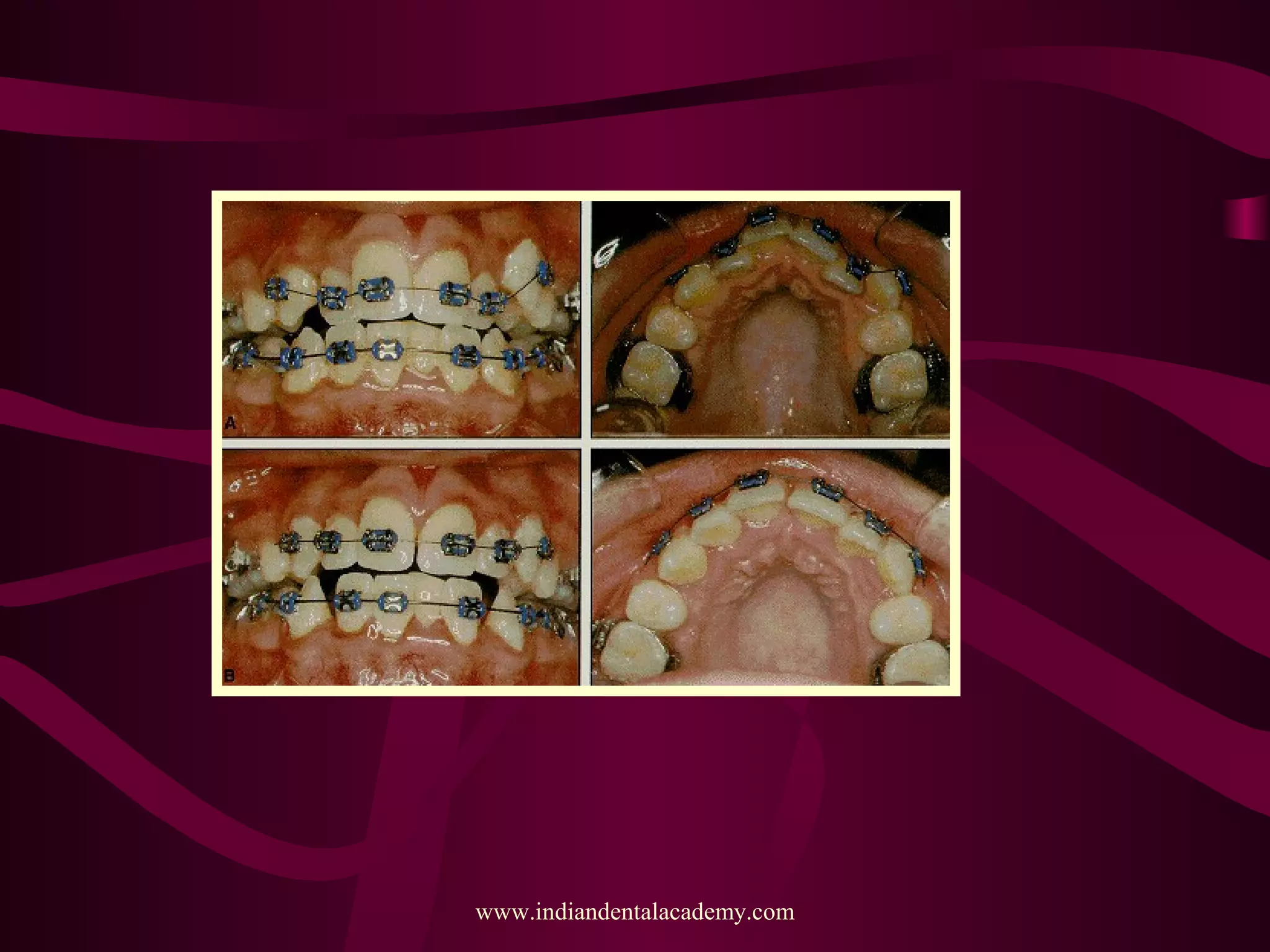
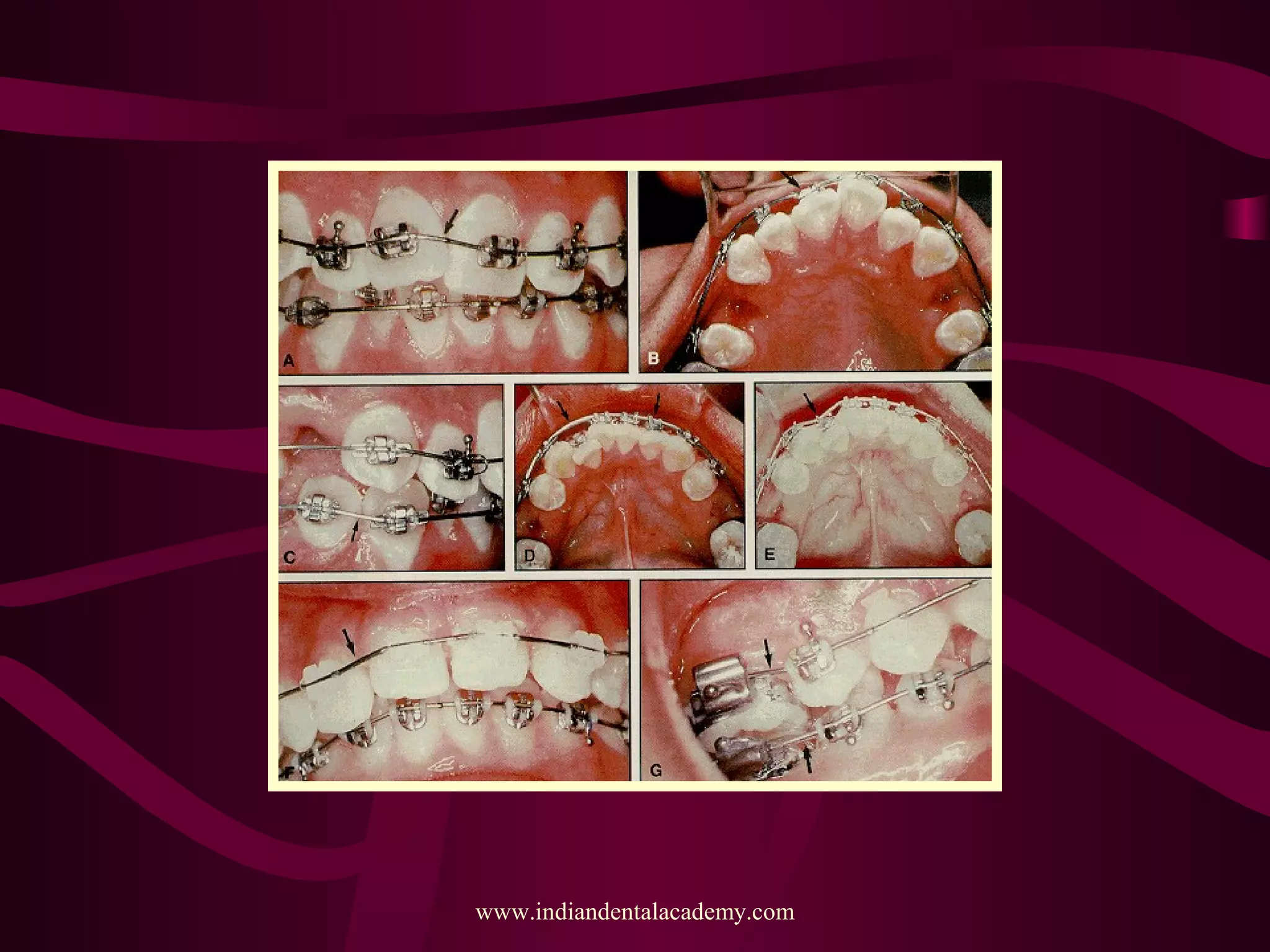
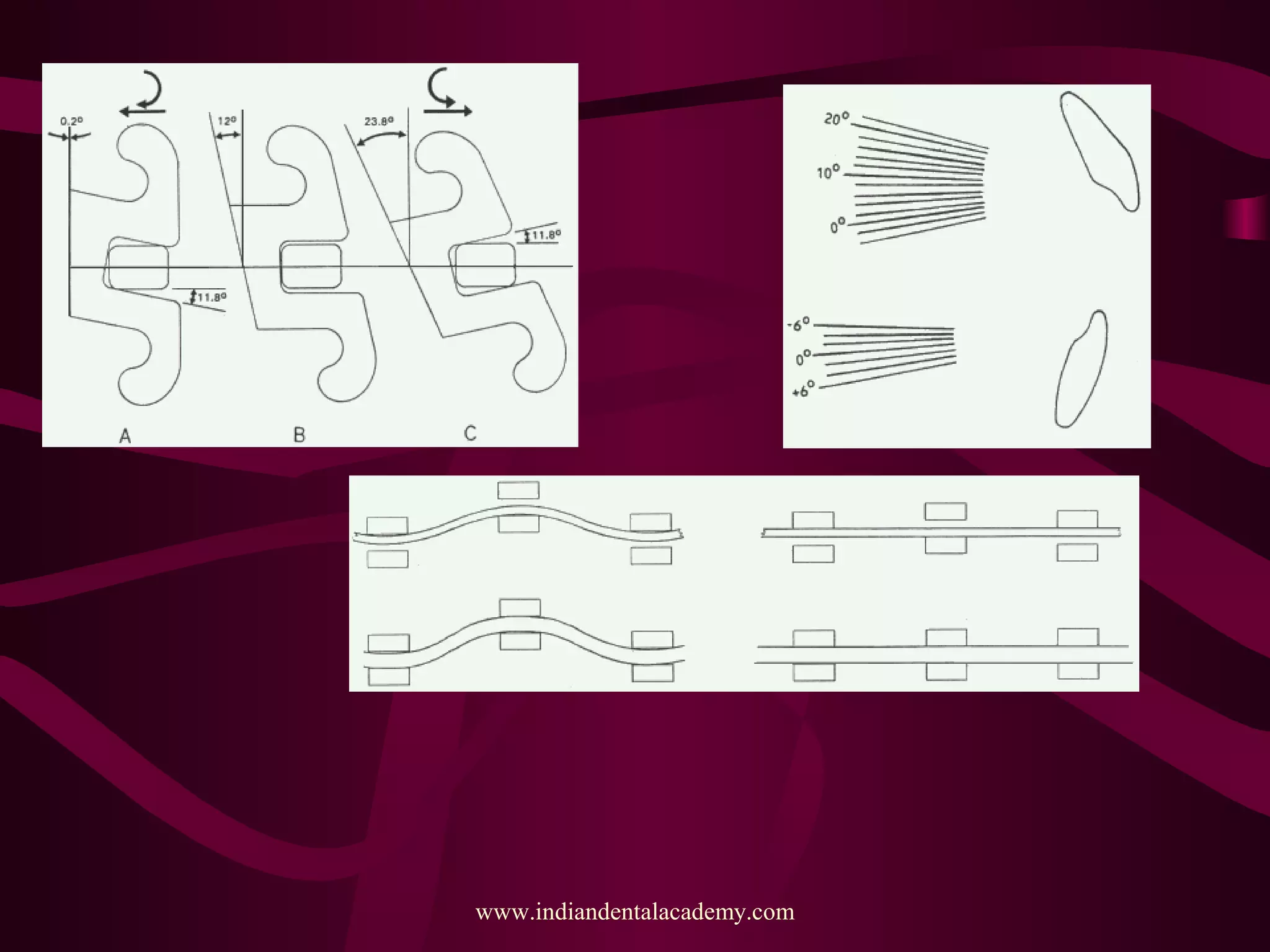
CONTROL
OF
TIP AND TORQUETIP AND TORQUE
IN
VARIOUS STAGES
www.indiandentalacademy.com
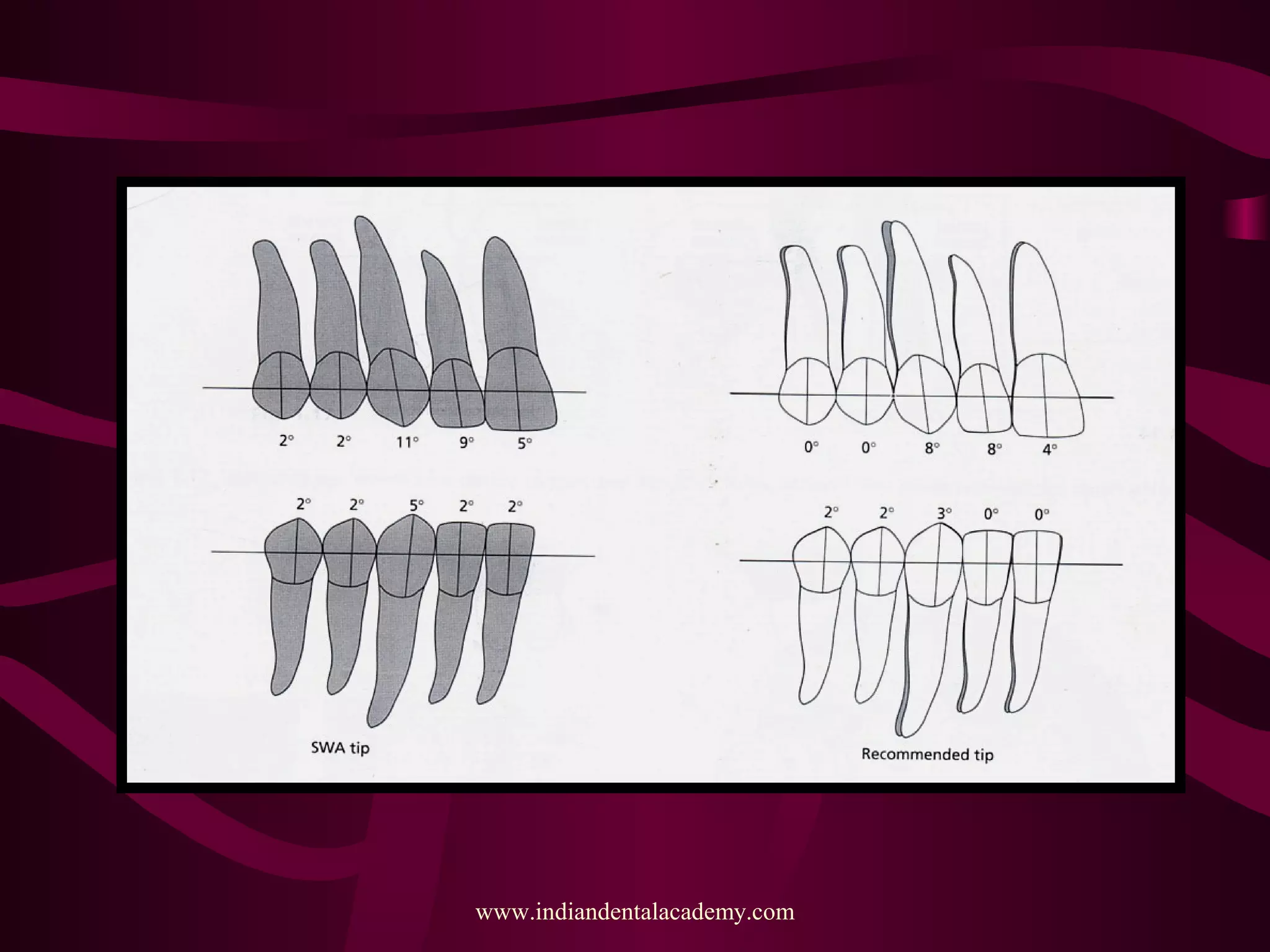
TIP
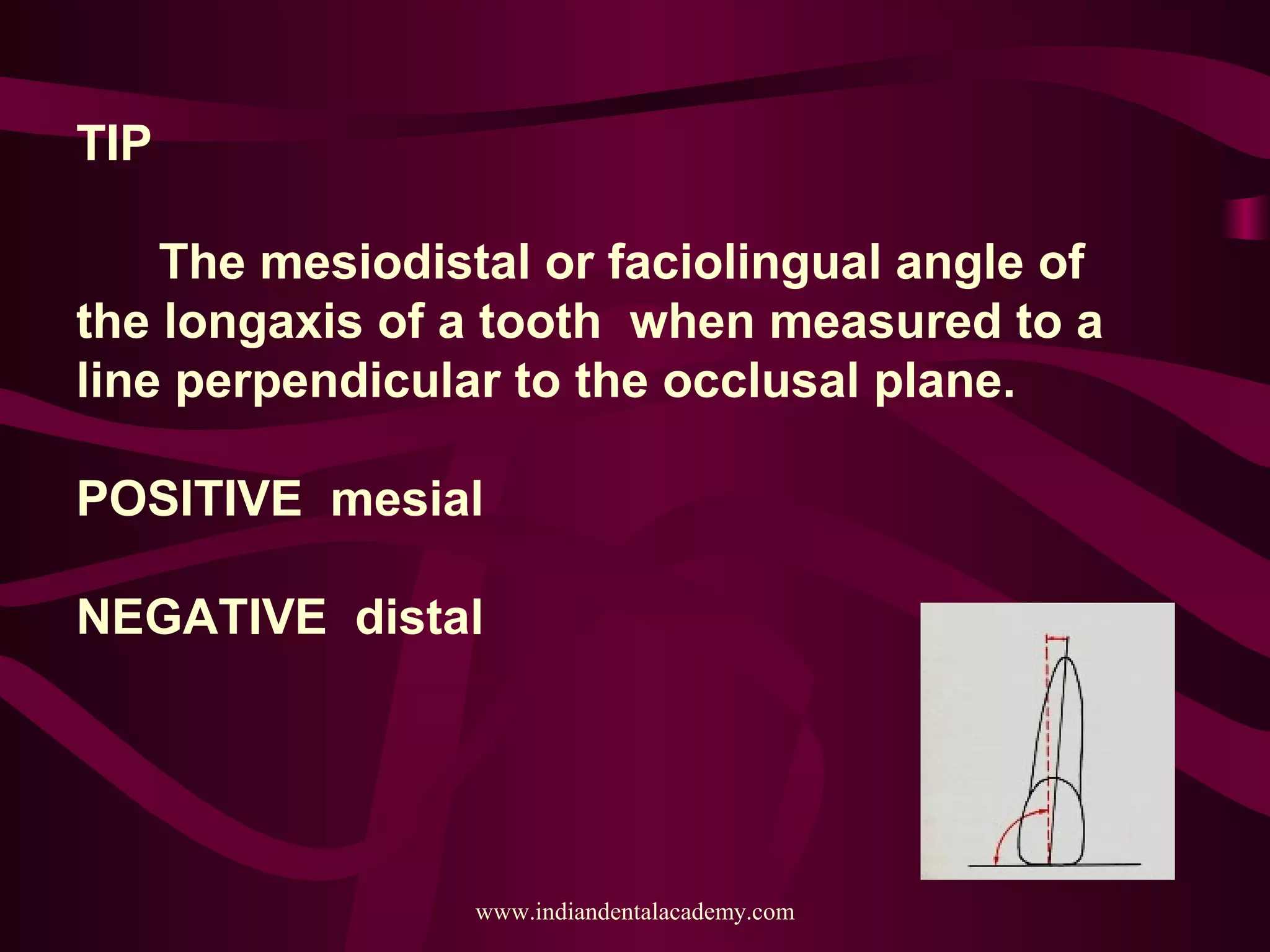
The mesiodistal or faciolingual angle of
the longaxis of a tooth when measured to a
line perpendicular to the occlusal plane.
POSITIVE mesial
NEGATIVE distal
www.indiandentalacademy.com
~Wheelerswww.indiandentalacademy.com
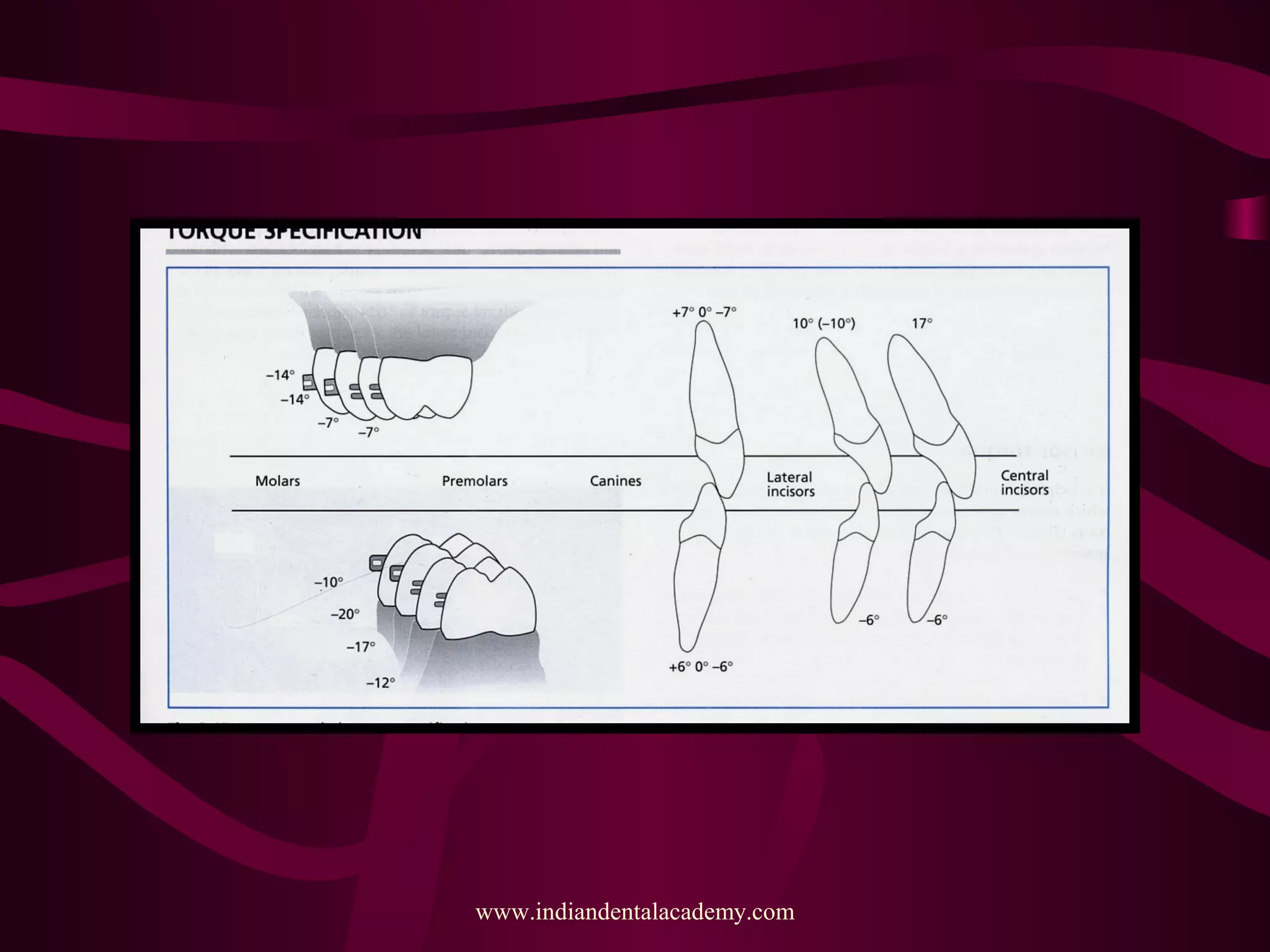
TORQUE
The force system transmitted by and through a
structural or machine member, capable of producing
pure rotational displacement about a longitudinal axis
is known as TORQUE.
www.indiandentalacademy.com
The resultant of a torsional force system is a
COUPLE, therefore the terms torque and couple used
interchangebly.
In engineering terms torque is the more
correct term to describe a distributed force system carried
by a shaft from one location to another within a structure
or machine.
www.indiandentalacademy.com
In orthodontics, torque is often associated with the
angulations of long axes of teeth and pertains to the
positioning of root apices with respect to crowns
The generation of torque at an activation site
results in the delivery of a torsional force system to the
dentition. The action-reaction counterpart of the
desired torque is that exerted by the dentition on the
appliance and the wire must carry it to the anchorage
site.
www.indiandentalacademy.com
In engineering terminology a shaft is a slender
member providing mechanical means by which, through
rotational motion about an axis, power may be
transmitted from one location to another.
Torque is the resultant of an internal distribution of
shearing stress on a shaft cross section and is
transmitted longitudinally within the member
unchanged between locations of force system input or
output.
www.indiandentalacademy.com
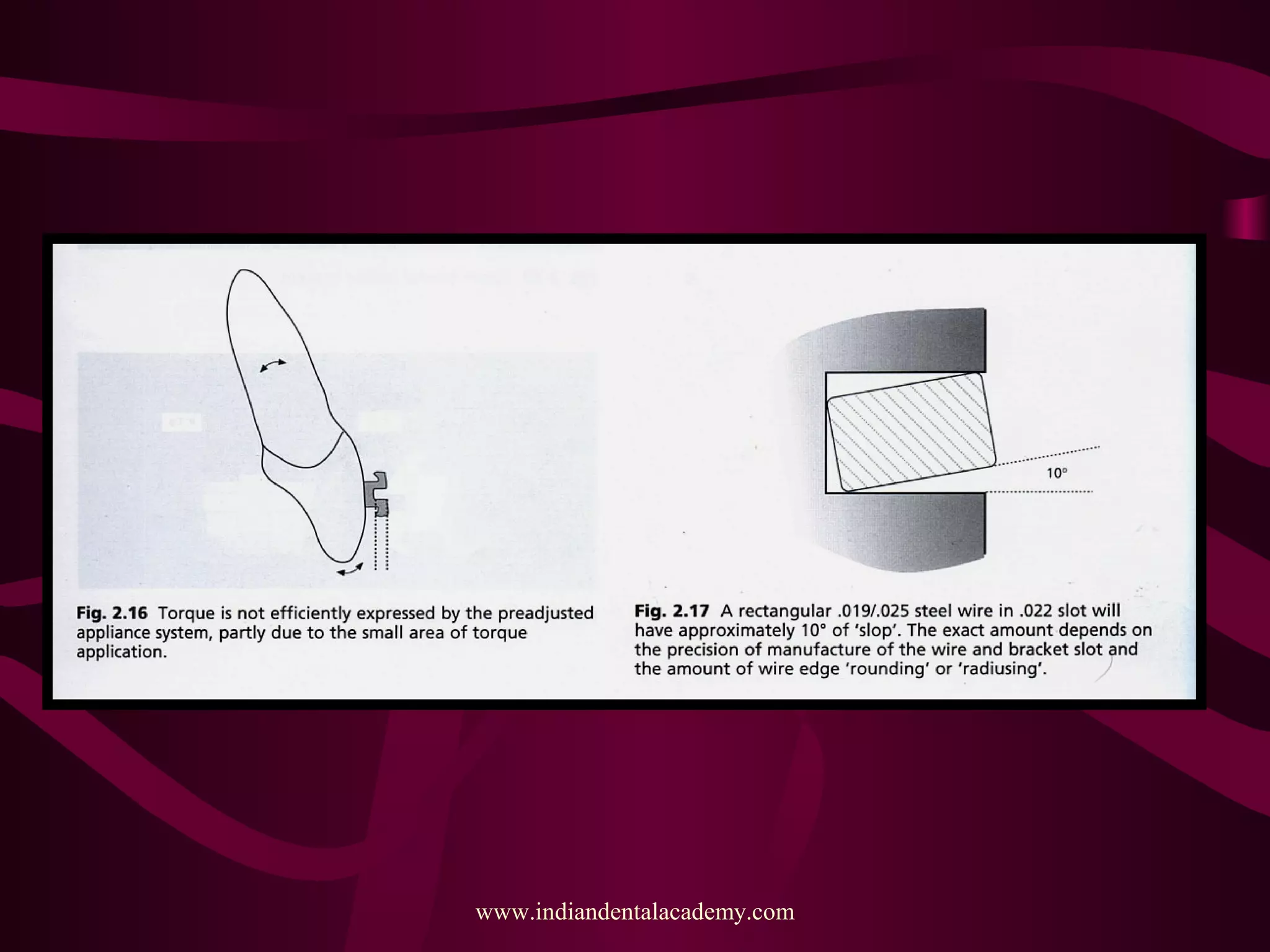
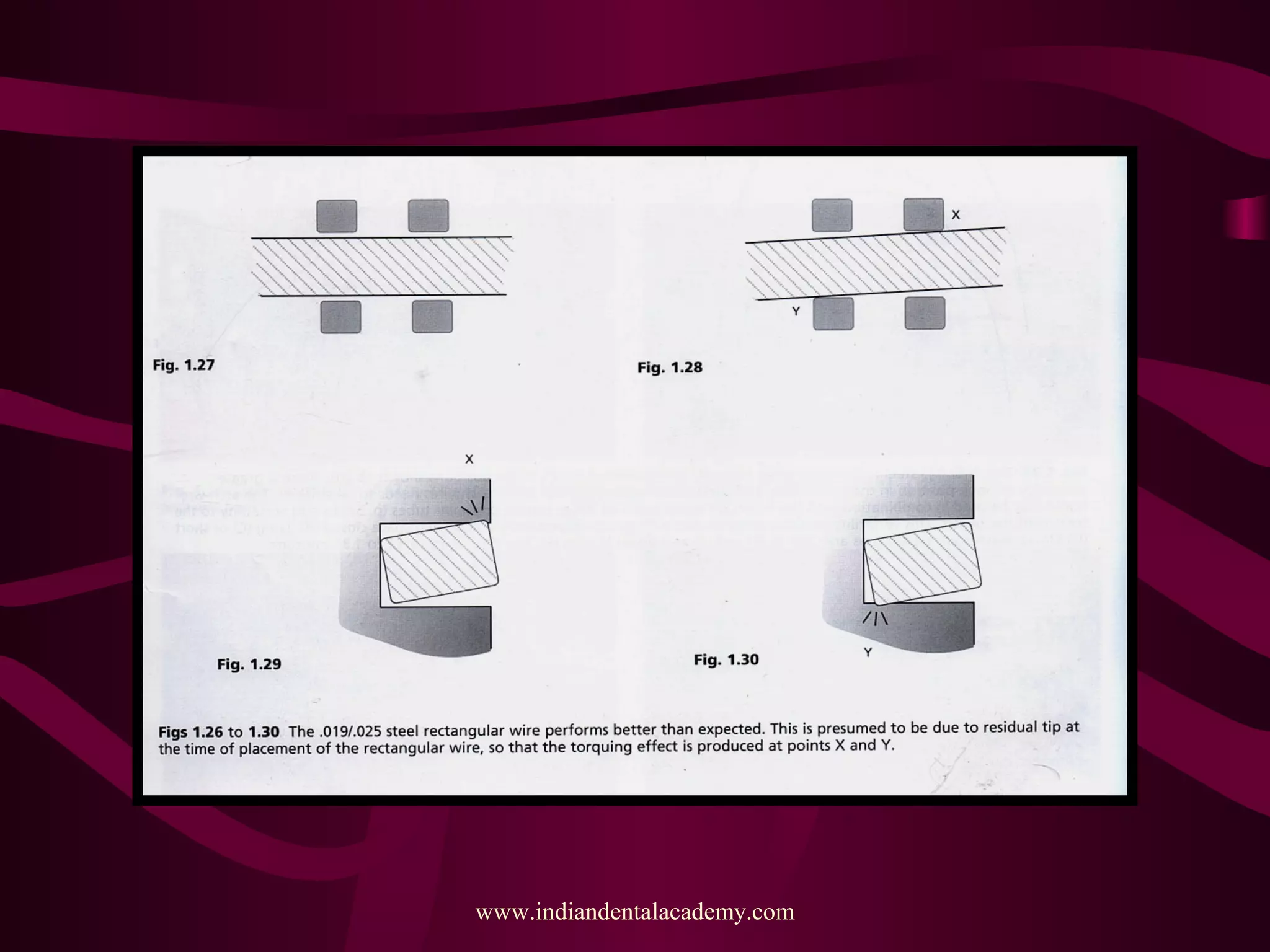
Third –order action potential is achieved
through the presence in the passive state of an angular
differential between the wire cross section and the
bracket slot at each anterior location where torque
transfer is desired.
The longitudinal dimension of the wire
shaft seems to be controlled by the mesio-distal arch
dimensions in the anterior segment
www.indiandentalacademy.com
The wire must fill the brackets that is
diagonal dimension of the wire cross-section must
exceed the occluso-gingival width of the bracket slot
in order to maintain a twist activation.
Generally one of the two orthodontic
displacements is attempted in these mechanics, bodily
movement or root movement.
www.indiandentalacademy.com
True third-order clearances depend upon the
actual wire and slot dimensions and in effet upon the
stiffness of the bracket slot. In response to the third-order
activation the slot will open slightly as the wire attempts to
deactivate, torsionally within it.
WHOLE SEGMENT TORQUE=
WORKING STIFFNESS><IND. TWIST-CLEARANCE
www.indiandentalacademy.com
In the absence of vertical constraint the
twist activation causes downward movement of the
anterior portion of the arch-wire in the clinical
situation the existence of localised stiffness results in
the development of in extrusive force exerted by the
wire upon the anterior brackets.
www.indiandentalacademy.com
PREADJUSTED EDGEWISE
APPLIANCE
~Reed Holdaway alter bracket slots
Angulated brackets on bandstrip material
Flat archwire with artistic bends
~Ivan Lee
Milling of torque in face of bracket slot
www.indiandentalacademy.com
~Jarabak
Artistic tipping ~bracket angulation
Torque~milling the slot in the face of bracket
~ANDREWS
120 Nonorthodontic individual models
Six Keys of Occlusion
www.indiandentalacademy.com
~Raymond Begg
Free mesiodistal tipping, only vertical slot
Artistic positioning of teeth
Modifications in Wire Bending
Uprighting springs~tipping
Torquing auxiliaries
www.indiandentalacademy.com
~Edgewise
First Order Bend
Second Order bend
Third order Bend
www.indiandentalacademy.com
ANDREWS
~Established the long-axis of the tooth
~Selection of a bracket site on the tooth
~Inclinations were related to Andrews plane
~Bi-concave structure of the bracket
~Level & parallel slot line-up-idealised
position
www.indiandentalacademy.com
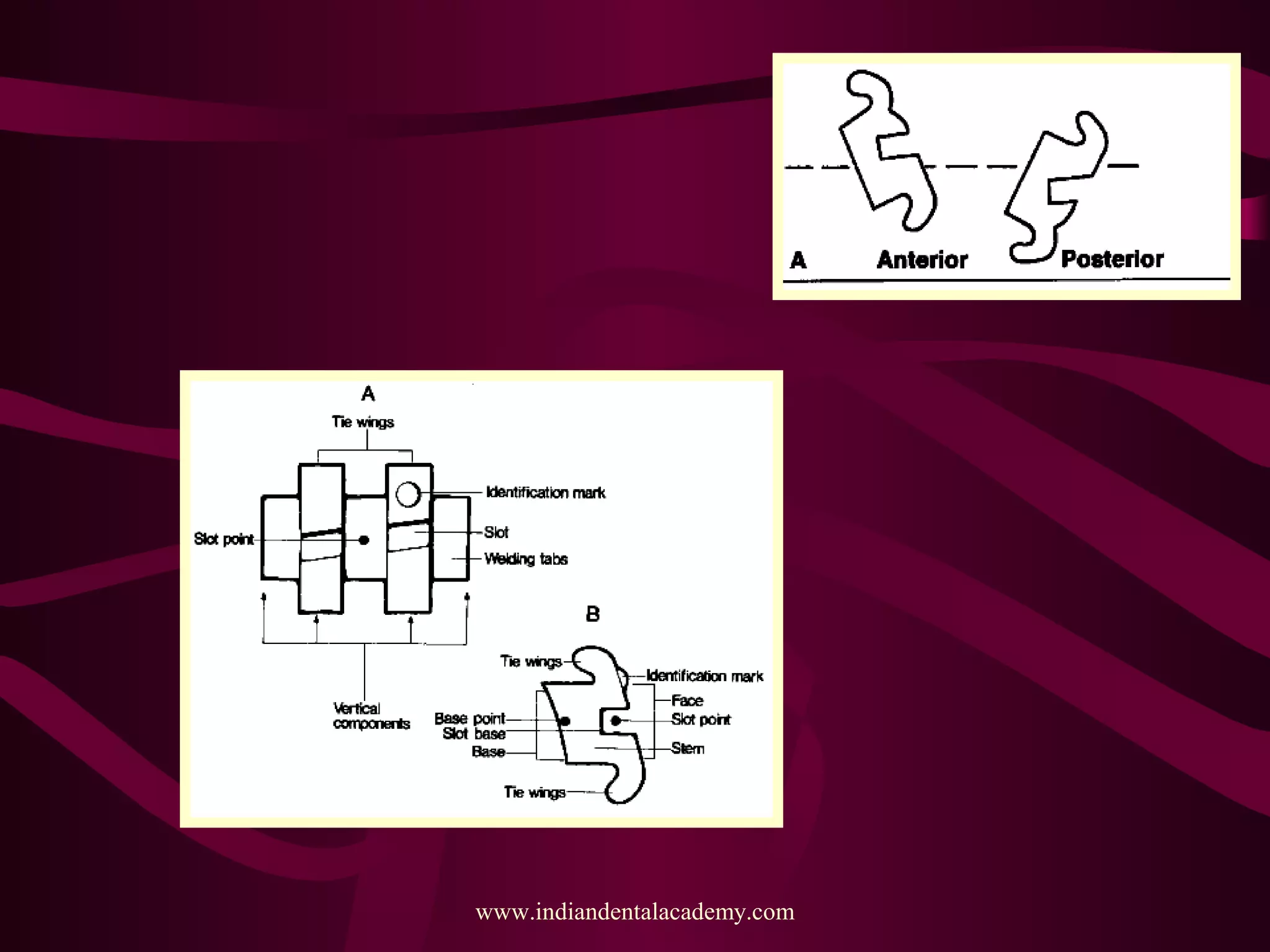
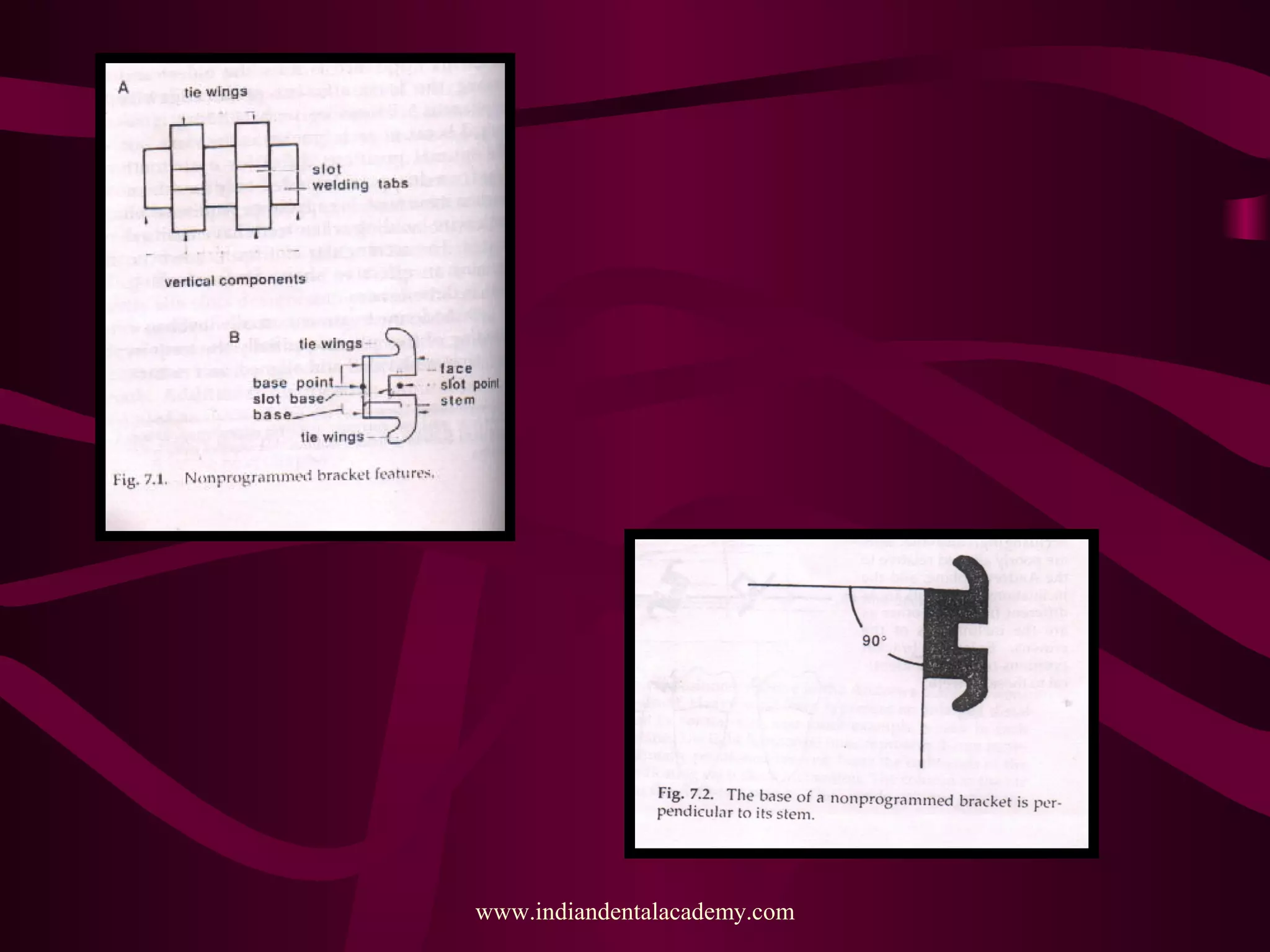
NON PROGRAMMED APPLIANCE
~Base is perpendicular to stem
~Base-point-slot point distance is same on all
brackets
~Deficient landmarks(LAQ-crown,root, incisal
edges, marginal ridges, contact
points)Angulation
~Inclination landmarks-LA
~Wire Bending-primary, secondary & tertiarywww.indiandentalacademy.com
www.indiandentalacademy.com
PARTLY PROGRAMMED
APPLIANCE
~Slot inclination
~Slot angulation
~Prominence-eliminate 1 order bends
~Horizontal base curvature
www.indiandentalacademy.com
FULLY PROGRAMMED APPLIANCE
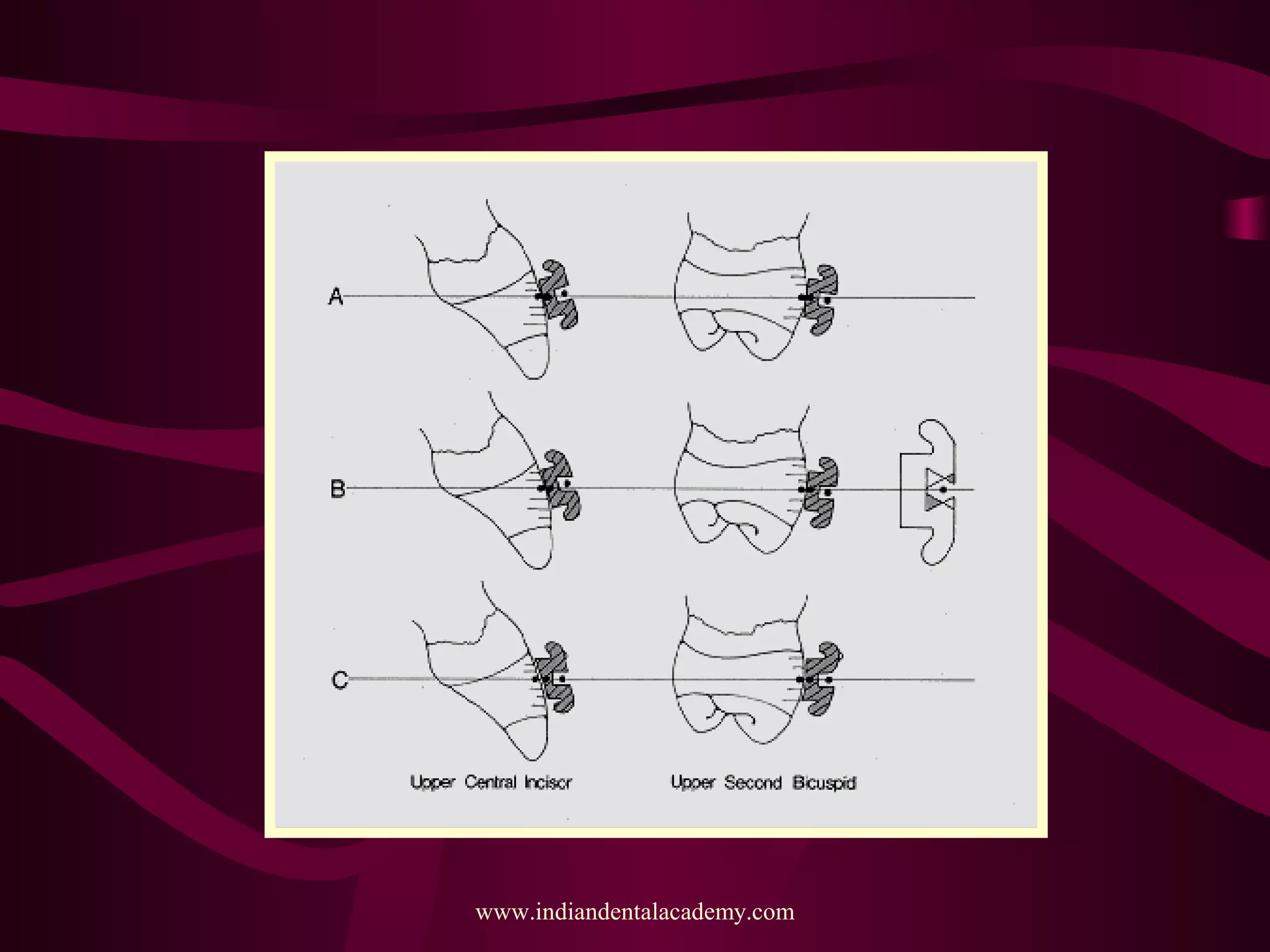
~Slot siting feautures
- The mid-transverse planes of the slot, stem
and crown must be same
-Base of bracket must have same inclination as
the facial plane of the crown at the FA point
-Each bracket’s inclined base must be
contoured to match the curvature of the crown
www.indiandentalacademy.com
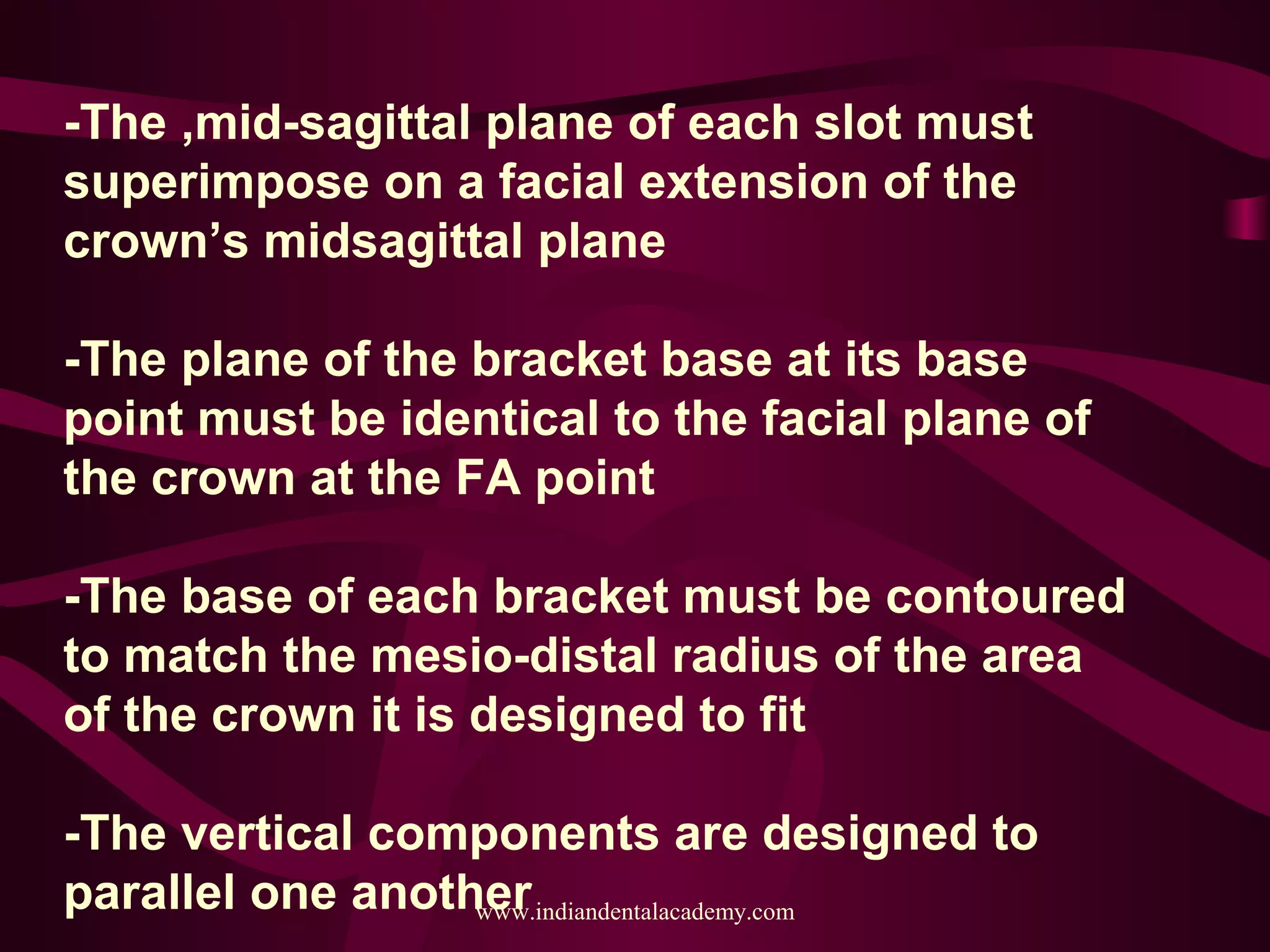
-The ,mid-sagittal plane of each slot must
superimpose on a facial extension of the
crown’s midsagittal plane
-The plane of the bracket base at its base
point must be identical to the facial plane of
the crown at the FA point
-The base of each bracket must be contoured
to match the mesio-distal radius of the area
of the crown it is designed to fit
-The vertical components are designed to
parallel one anotherwww.indiandentalacademy.com
www.indiandentalacademy.com
-Within an arch all slot points have the same
distance between them & crown’s embrasure
line
-Asymmetrical tie wings
-Bracket design for lip comfort
www.indiandentalacademy.com
FULLY PROGRAMMED
TRANSLATION BRACKETS
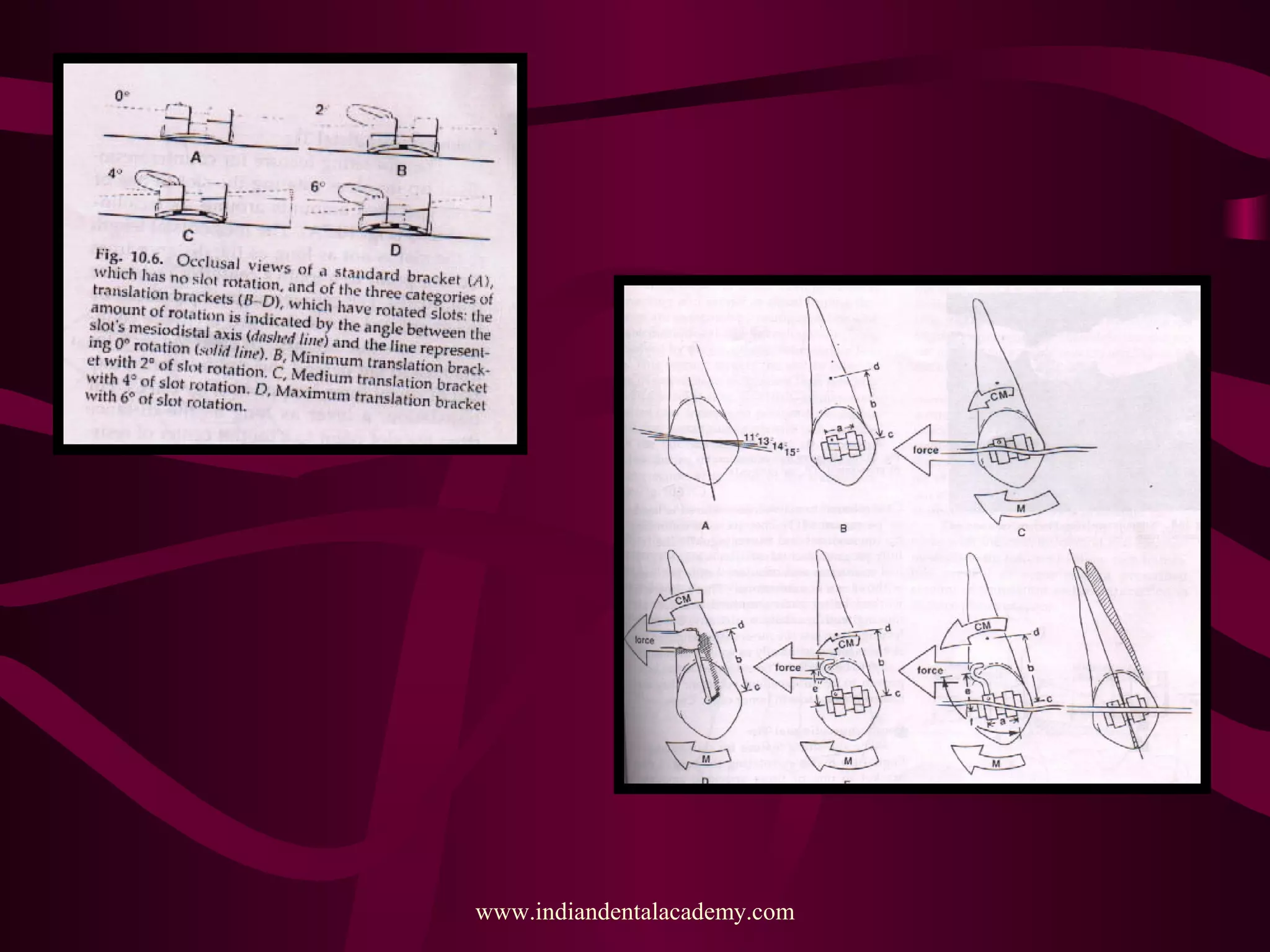
-Counter-rotation (2, 4 & 6)
~Countermesiodistal tip(2,3,4 to 13,14,15)
-Power arm
-Counterbuccolingual tip-molars
www.indiandentalacademy.com
SIX
KEYS
www.indiandentalacademy.com
ROTH
~Devised in 1975
~Andrews idea was a total concept-the
guidance system
~Move teeth in straight line vectors from
mal-position to final position by translation
~High inventory
~Anchorage loss
-Mesial tip, ANB 5 differencewww.indiandentalacademy.com
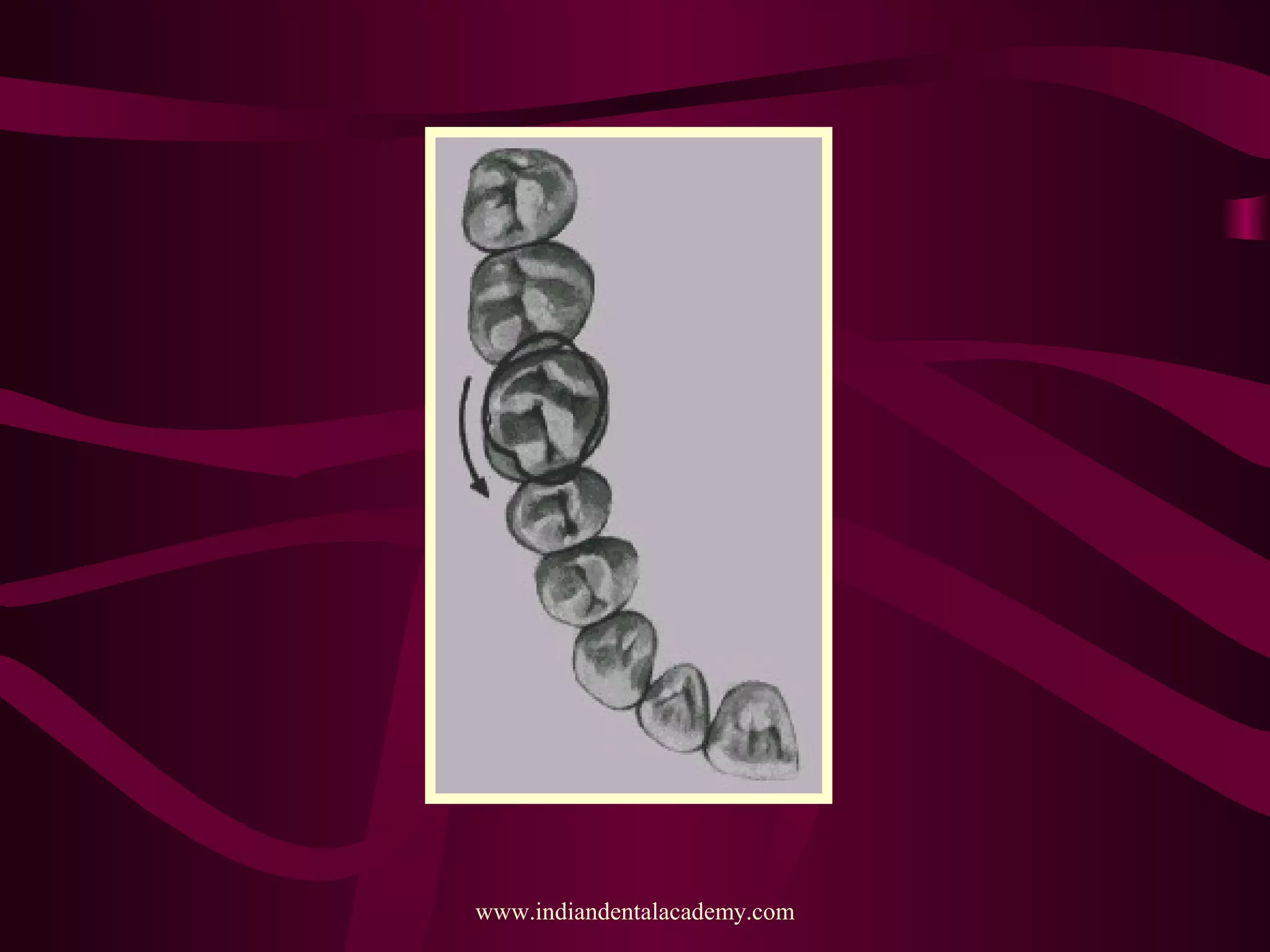
-Over-rotation of upper molars
-Upright position of upper pre-molras
-Distal rotation of lower buccal segments
~Overcorrection
-To attempt to treat to an ideal occlusion
-To undertreat the tooth positions
-To overcorrect the tooth positions
www.indiandentalacademy.com
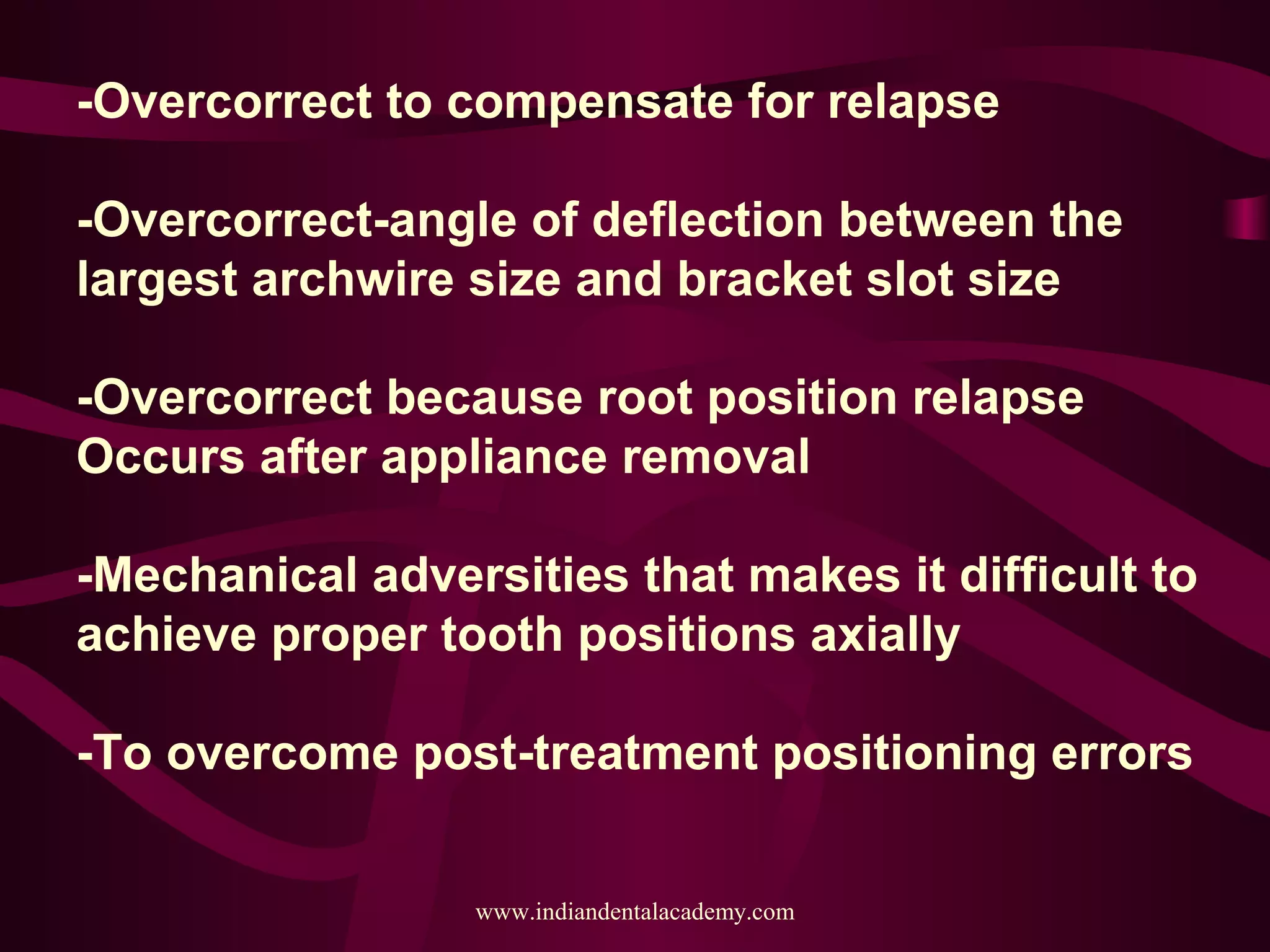
-Overcorrect to compensate for relapse
-Overcorrect-angle of deflection between the
largest archwire size and bracket slot size
-Overcorrect because root position relapse
Occurs after appliance removal
-Mechanical adversities that makes it difficult to
achieve proper tooth positions axially
-To overcome post-treatment positioning errors
www.indiandentalacademy.com
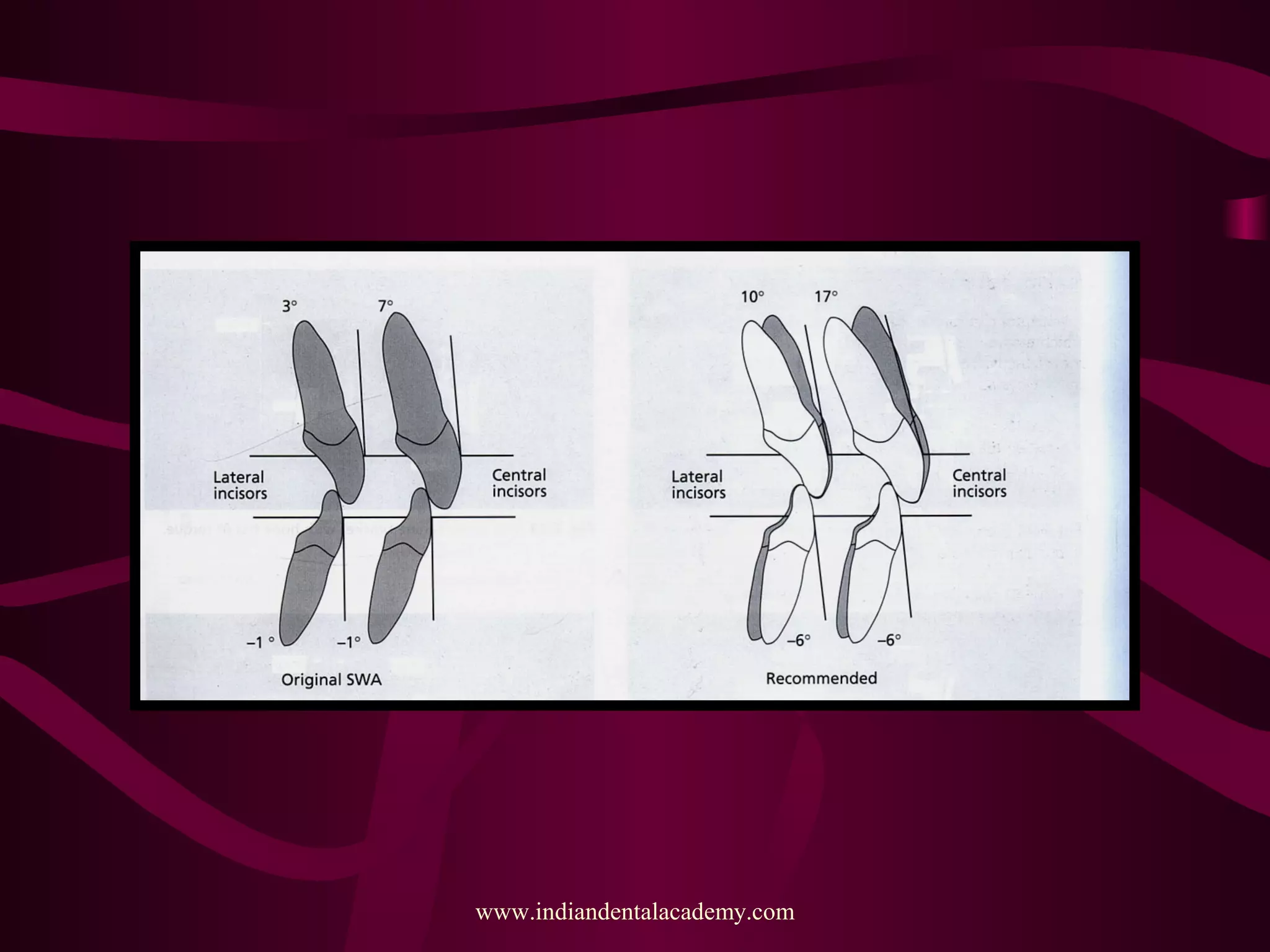
ROTH SWA
www.indiandentalacademy.com
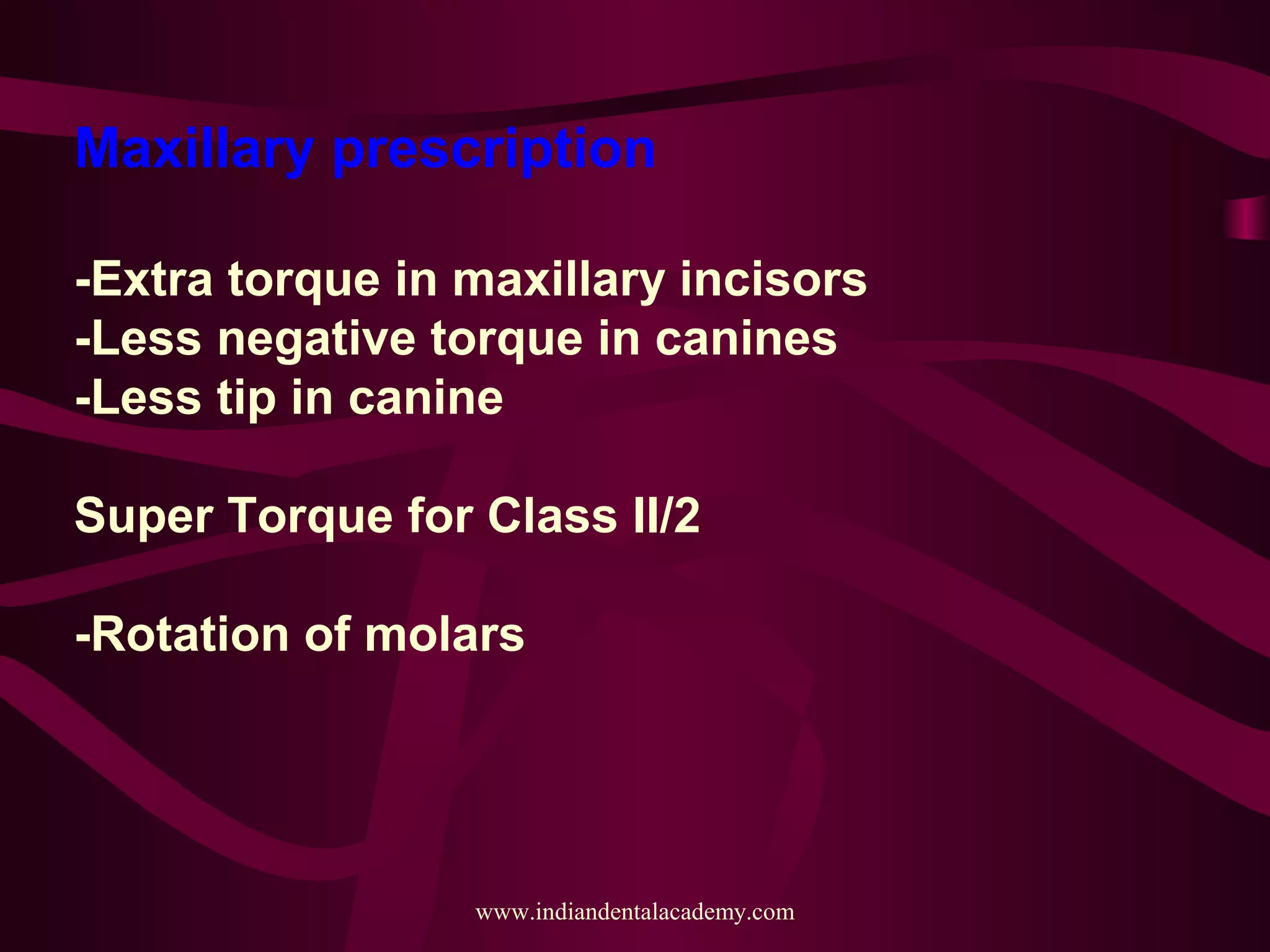
Maxillary prescription
-Extra torque in maxillary incisors
-Less negative torque in canines
-Less tip in canine
Super Torque for Class II/2
-Rotation of molars
www.indiandentalacademy.com
Mandibular prescription
-Canine- 7 tip & 2 distal rotation
-Entire lower buccal segment 3 distal tip
and 4 distal rotation
-Similar torque for molars
~Archwires
~Root position-overcorrection
~Appliance configuration
www.indiandentalacademy.com
ATTRACT
STARFIRE
www.indiandentalacademy.com
FUCTIONAL OCCLUSION-Rx Objectives
1. Pleasing facial esthetics, evaluated by soft
tissue and skeletal measurements
cephalometrically.
2. Molar relation and tooth alignment, evaluated by
Angle's description of anatomical occlusion.
3. Functional occlusion, evaluated gnathologically
on an articulator.
4. Stability of postreatment tooth positions and
alignment.
5. Comfort, efficiency, and longevity of the
dentition, supporting structures, and the
temporomandibular joints.
www.indiandentalacademy.com
GNATHOLOGICAL CONCEPT
www.indiandentalacademy.com
TIP VALUES
www.indiandentalacademy.com
TORQUE VALUES
www.indiandentalacademy.com
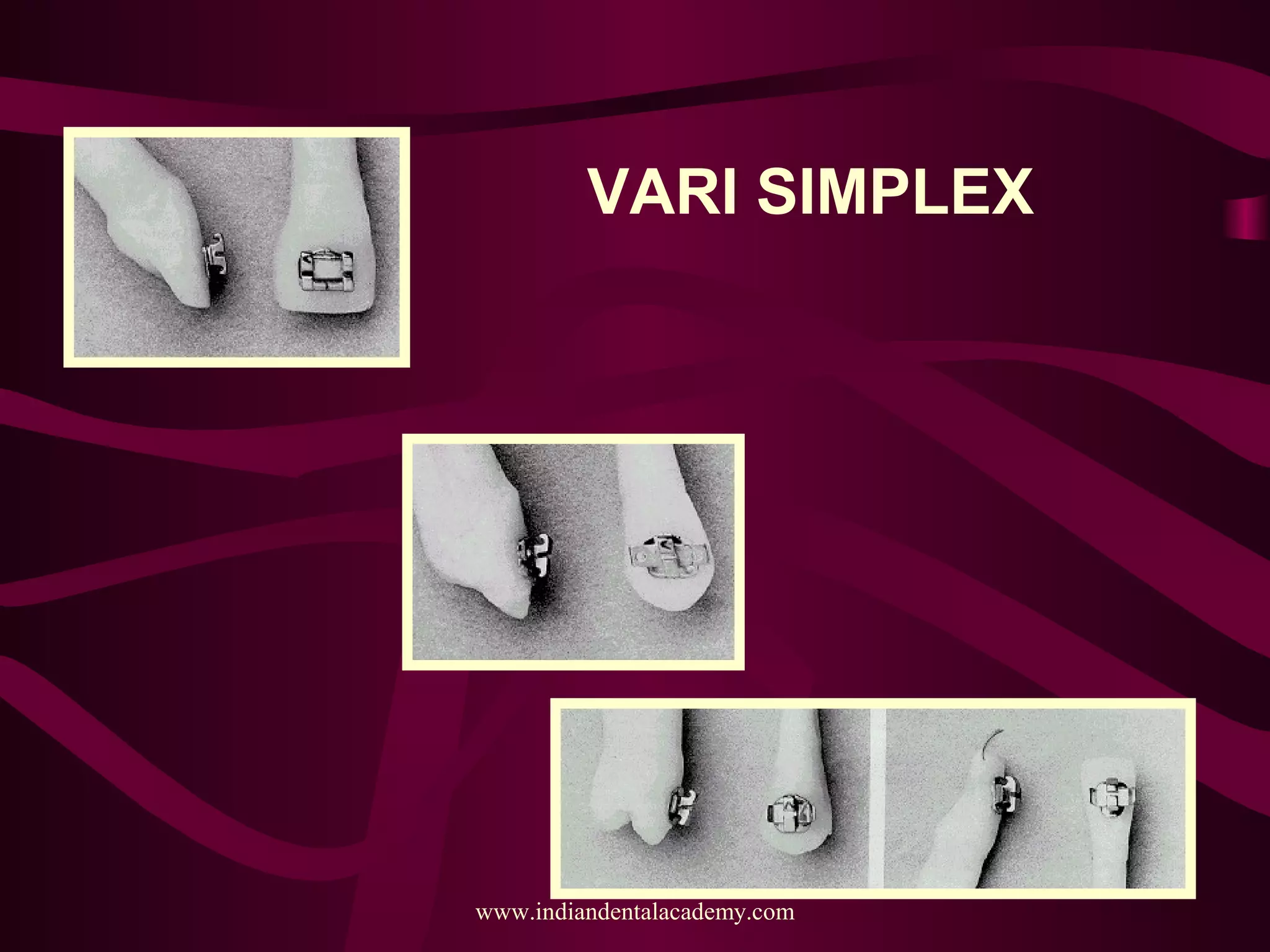
VARI SIMPLEX
www.indiandentalacademy.com
BRACKET ANGULATIONS
Banding Bonding
(Incisal edge (Long axis
reference) reference)
Maxillary Arch
Centrals 3° 5°
Laterals 6° 8°
Cuspids 6° 10°
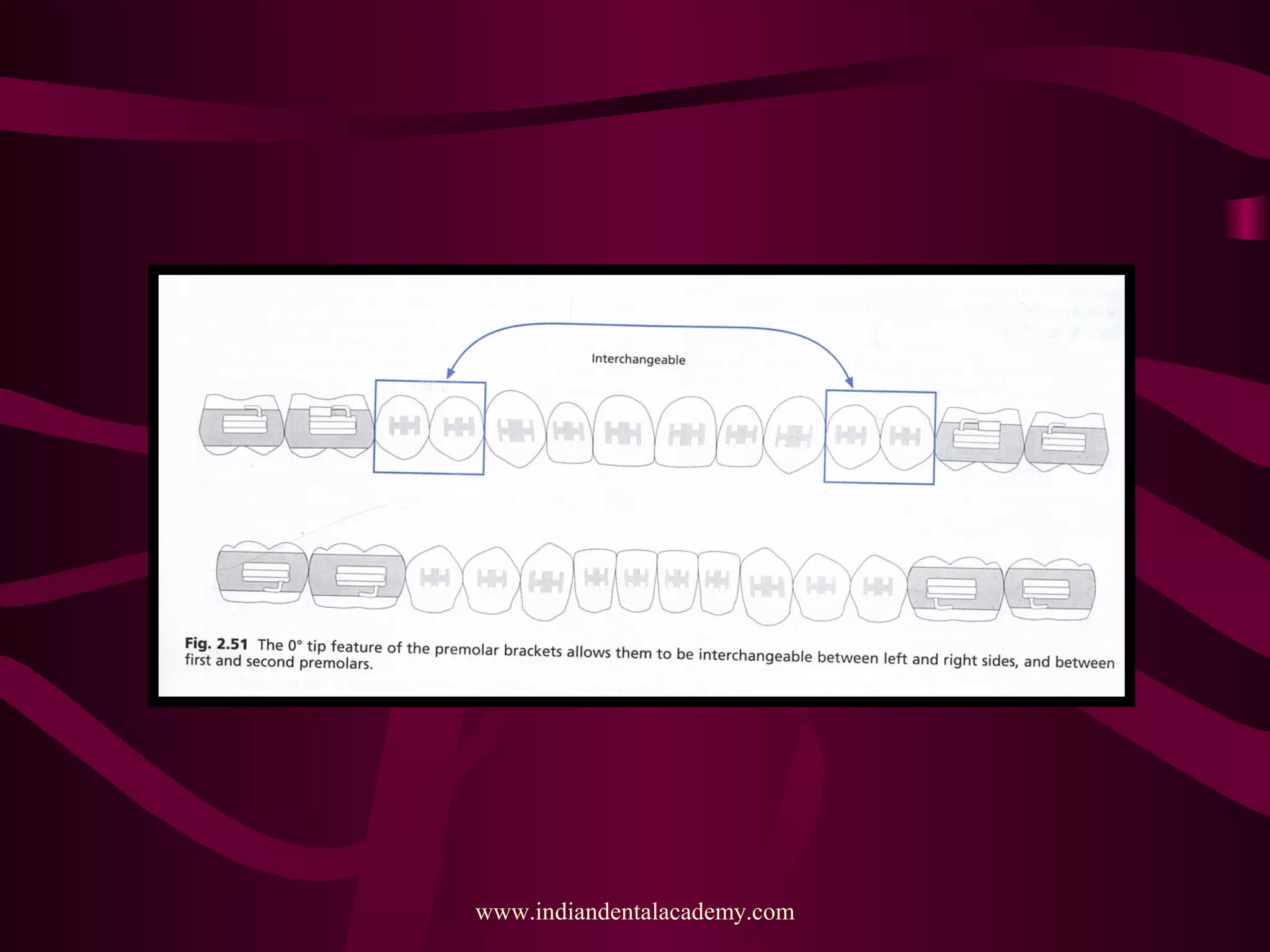
Bicuspids and
Molars 0° 0°
Mandibular Arch
Centrals 2° 2°
Laterals 2° 2°
Cuspids 6° 6°
Bicuspids 0° 0°
1st Molars – 6° – 6°
2nd Molars 0° 0°
www.indiandentalacademy.com
BRACKET TORQUES
Maxillary Arch
Centrals 14°
Laterals 7°
Cuspids – 3°
Bicuspids – 7°
Molars – 10°
Mandibular Arch
Incisors – 5°
Cuspids – 7°
1st Bicuspids – 11°
2nd Bicuspids – 17°
1st Molars – 22°
2nd Molars 0° or – 27°
www.indiandentalacademy.com
Nonextraction
1. Multistrand .017" ´ .025" D-Rect
(mandibular arch) and .0175" Respond
(maxillary arch)
2. Occasionally, an .016" SS round or an .
016" ´ .022" SS rectangular wire may be
used to further eliminate rotations
3. .017" ´ .025" SS ideal finishing archwire
It is important to remember with
nonextraction treatment in the mandibular
arch that every arch should be rectangular,
if possible, so that anterior torque control
can be achieved.
www.indiandentalacademy.com
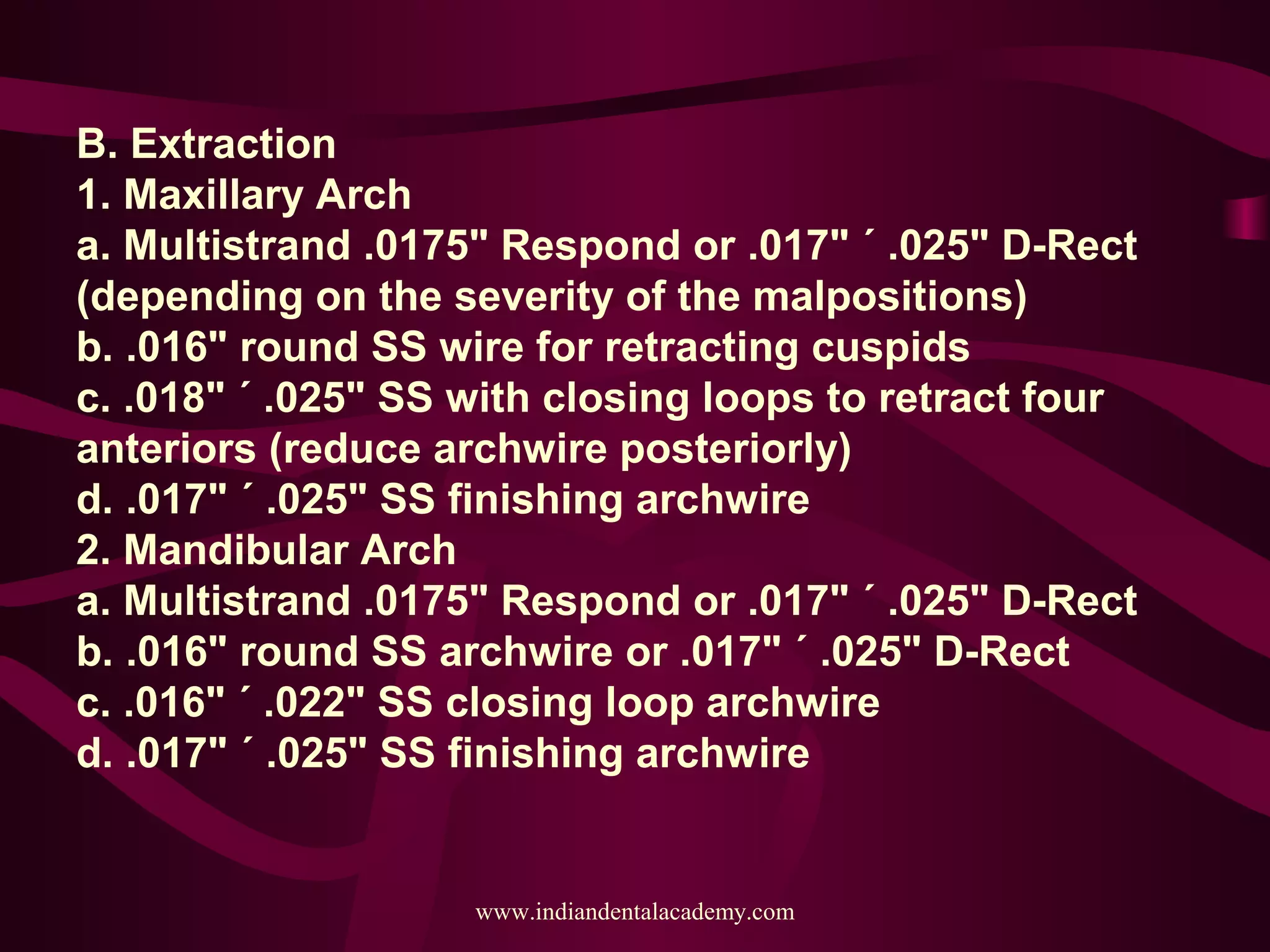
B. Extraction
1. Maxillary Arch
a. Multistrand .0175" Respond or .017" ´ .025" D-Rect
(depending on the severity of the malpositions)
b. .016" round SS wire for retracting cuspids
c. .018" ´ .025" SS with closing loops to retract four
anteriors (reduce archwire posteriorly)
d. .017" ´ .025" SS finishing archwire
2. Mandibular Arch
a. Multistrand .0175" Respond or .017" ´ .025" D-Rect
b. .016" round SS archwire or .017" ´ .025" D-Rect
c. .016" ´ .022" SS closing loop archwire
d. .017" ´ .025" SS finishing archwire
www.indiandentalacademy.com
STAGES OF COMPREHENSIVE TREATMENT
~Alignment & leveling
~Correction of Molar-relationship &
Space closure
~Finishing
www.indiandentalacademy.com
ALIGNMENT
~Initial archwires=light forces
~Tipping tooth movements
~Free movement of archwires within the
brackets
~Rectangular archwires-???
www.indiandentalacademy.com
~Archwire material
~Size of the archwire
~Distance bteween the attachments
Slot 18 / 22
~Niti
~Multistranded SS wires
~SS with loops
www.indiandentalacademy.com
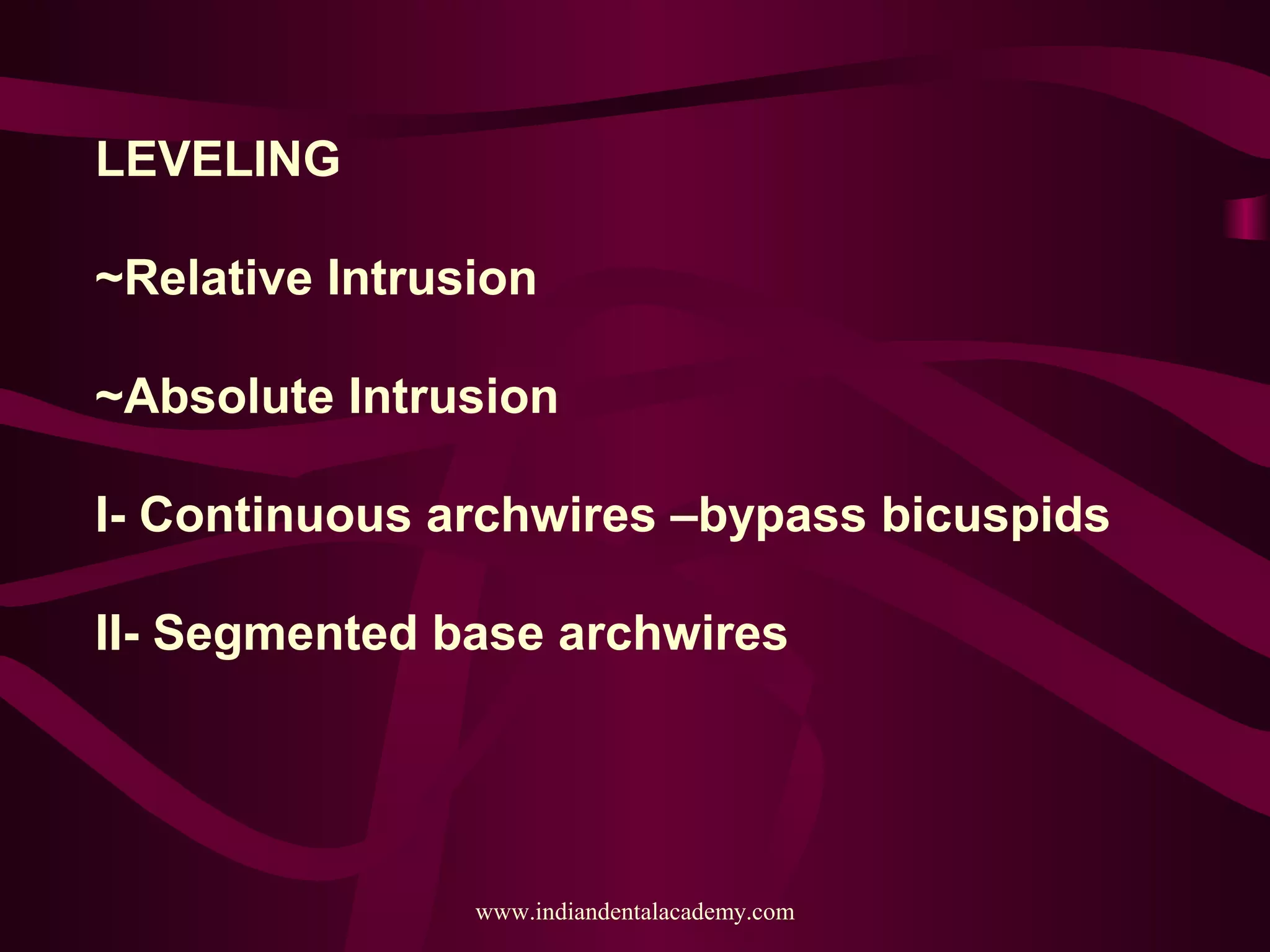
LEVELING
~Relative Intrusion
~Absolute Intrusion
I- Continuous archwires –bypass bicuspids
II- Segmented base archwires
www.indiandentalacademy.com
Bypass arches
-Begg Stage I archwires
-Mulligan similar to Begg
-Rickett’s utility arch
16><16 in 018 slot
www.indiandentalacademy.com
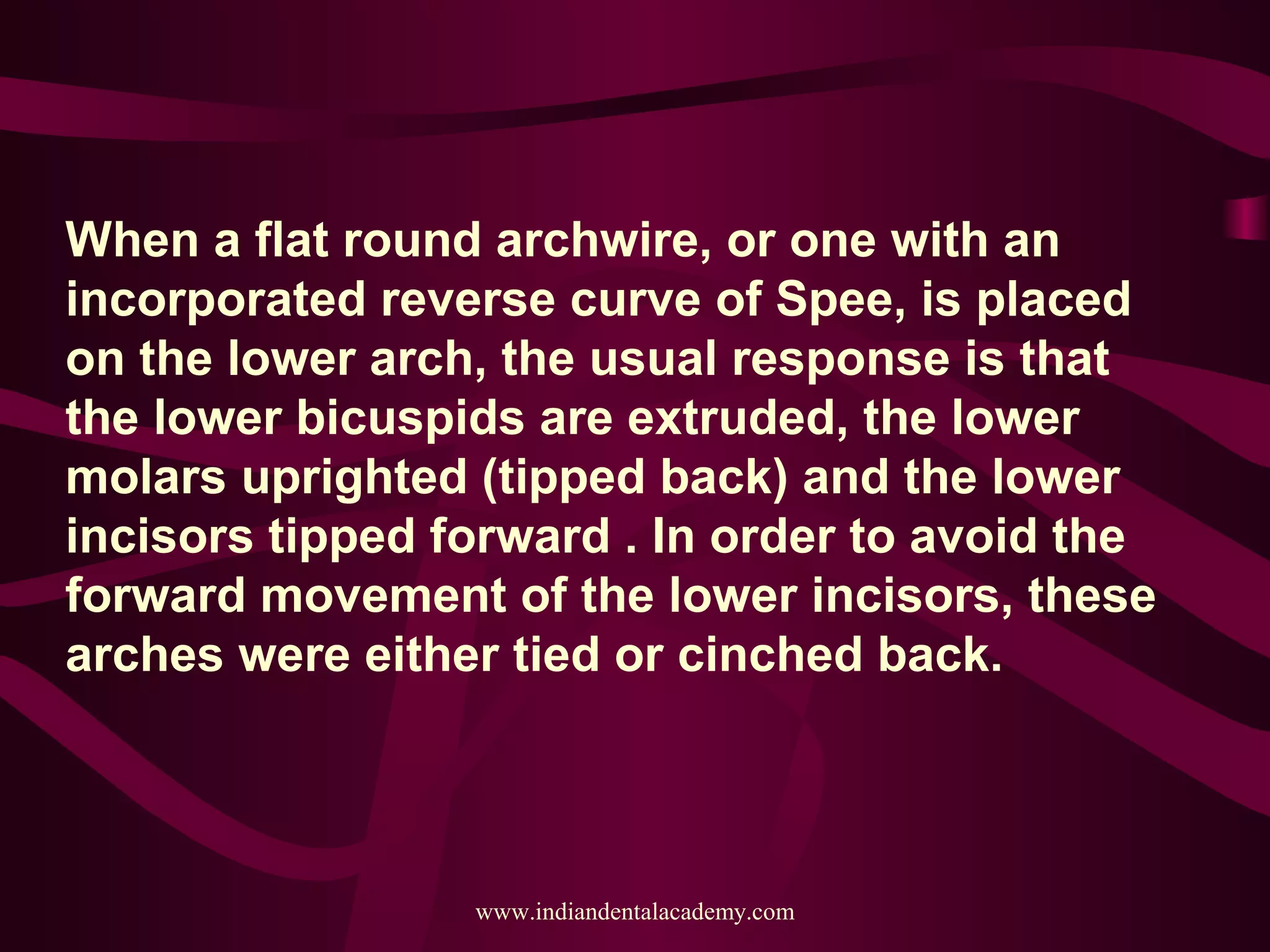
When a flat round archwire, or one with an
incorporated reverse curve of Spee, is placed
on the lower arch, the usual response is that
the lower bicuspids are extruded, the lower
molars uprighted (tipped back) and the lower
incisors tipped forward . In order to avoid the
forward movement of the lower incisors, these
arches were either tied or cinched back.
www.indiandentalacademy.com
However, as the reverse curve of Spee in the
round arches expressed itself, the roots of
the lower incisors were thrown against the
dense cortical bone of the lingual planum of
the symphysis. This acted as an anchor
which resulted in the same forward
movement of the lower incisors, but also
effected a forward movement of the lower
molars .
www.indiandentalacademy.com
CRITEREA FOR INTRUSION
~Light Continuous forces
~Small diameter wire
~Long span
~018 / 022 slot – 016 size
www.indiandentalacademy.com
SEGMENTED ARCHES
~Bypass arch in auxiliary tube
Rectangular wire
18><25 SS wire with helix /
17><25 TMA without helix
~Centre of Resistance
Bodily movement without tipping
www.indiandentalacademy.com
DR. BRANDT Can there be tipping with a
rectangular wire in an edgewise bracket?
DR. BURSTONE Tipping can occur with an
edgewise appliance. Any play between the
bracket and a rectangular archwire can
allow for tipping. Thus, play is increased by
using narrower brackets, undersized wires,
or bending the wire to allow tipping to
occur. Many loop designs also allow tipping
to occur.
www.indiandentalacademy.com
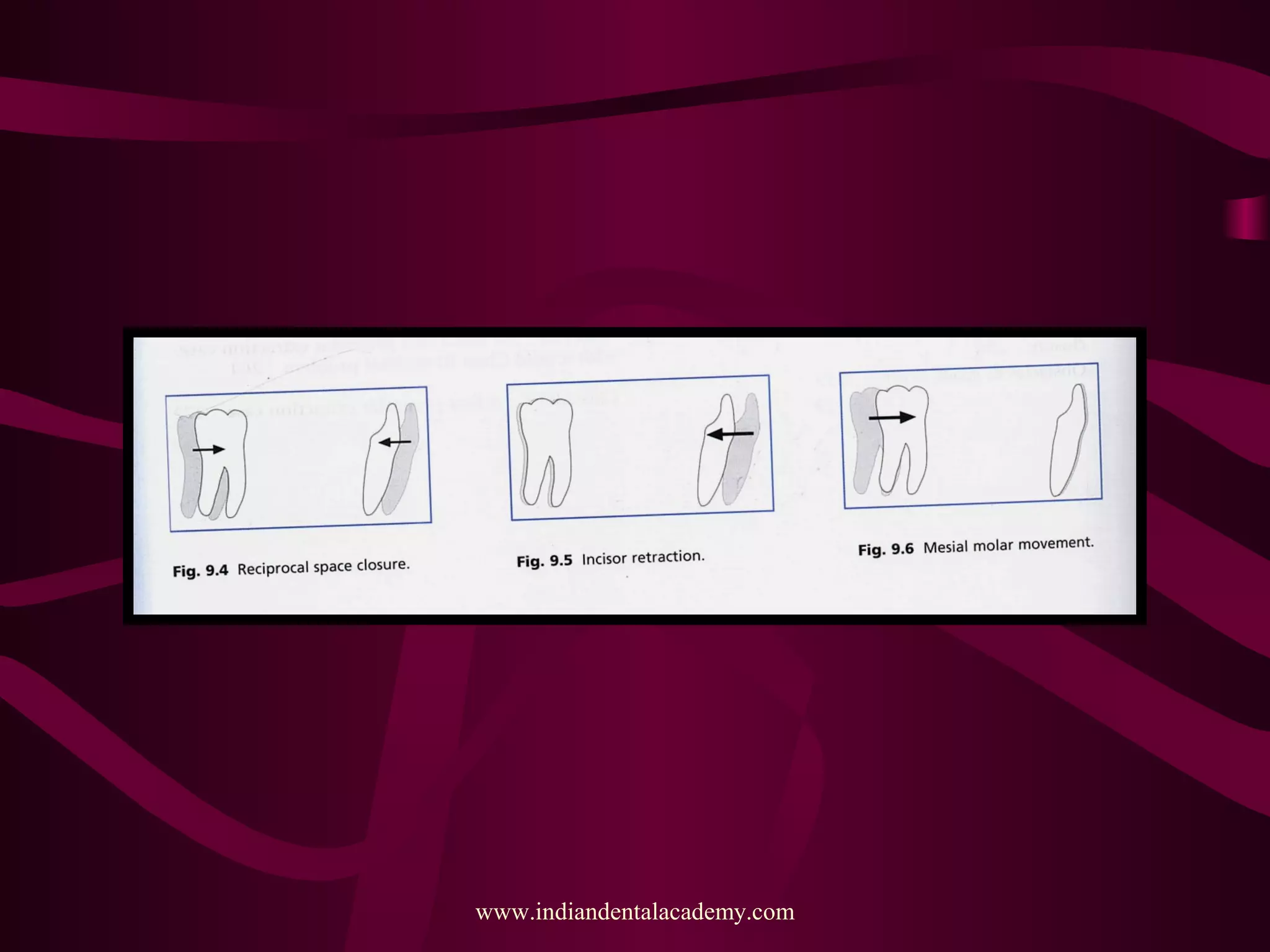
SPACE CLOSURE
~Canine => Incisors
-Friction mechanics
-Frictionless mechanics
Maximum Anchorage
Moderate Anchorage
Minimum Anchorage
www.indiandentalacademy.com
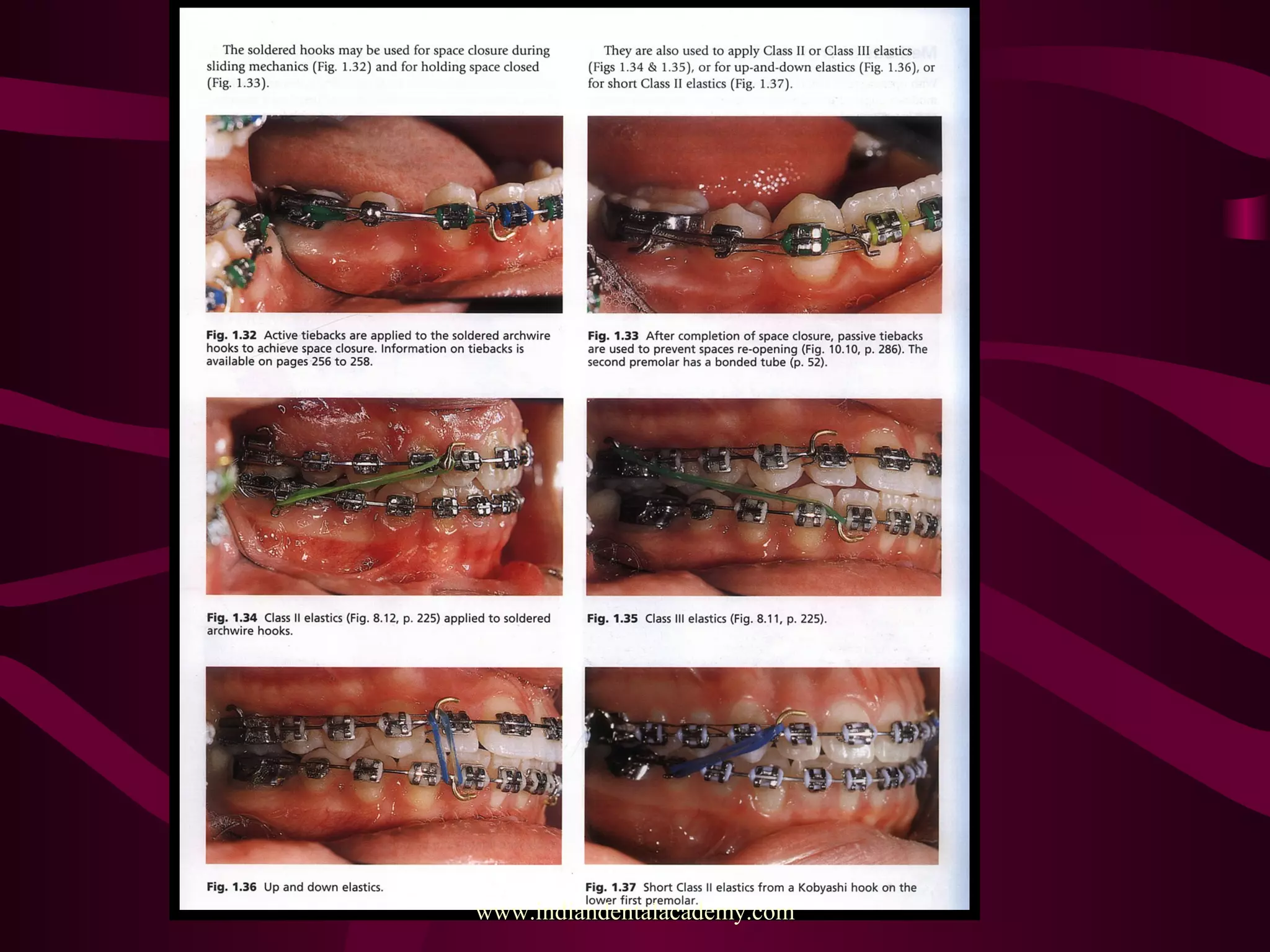
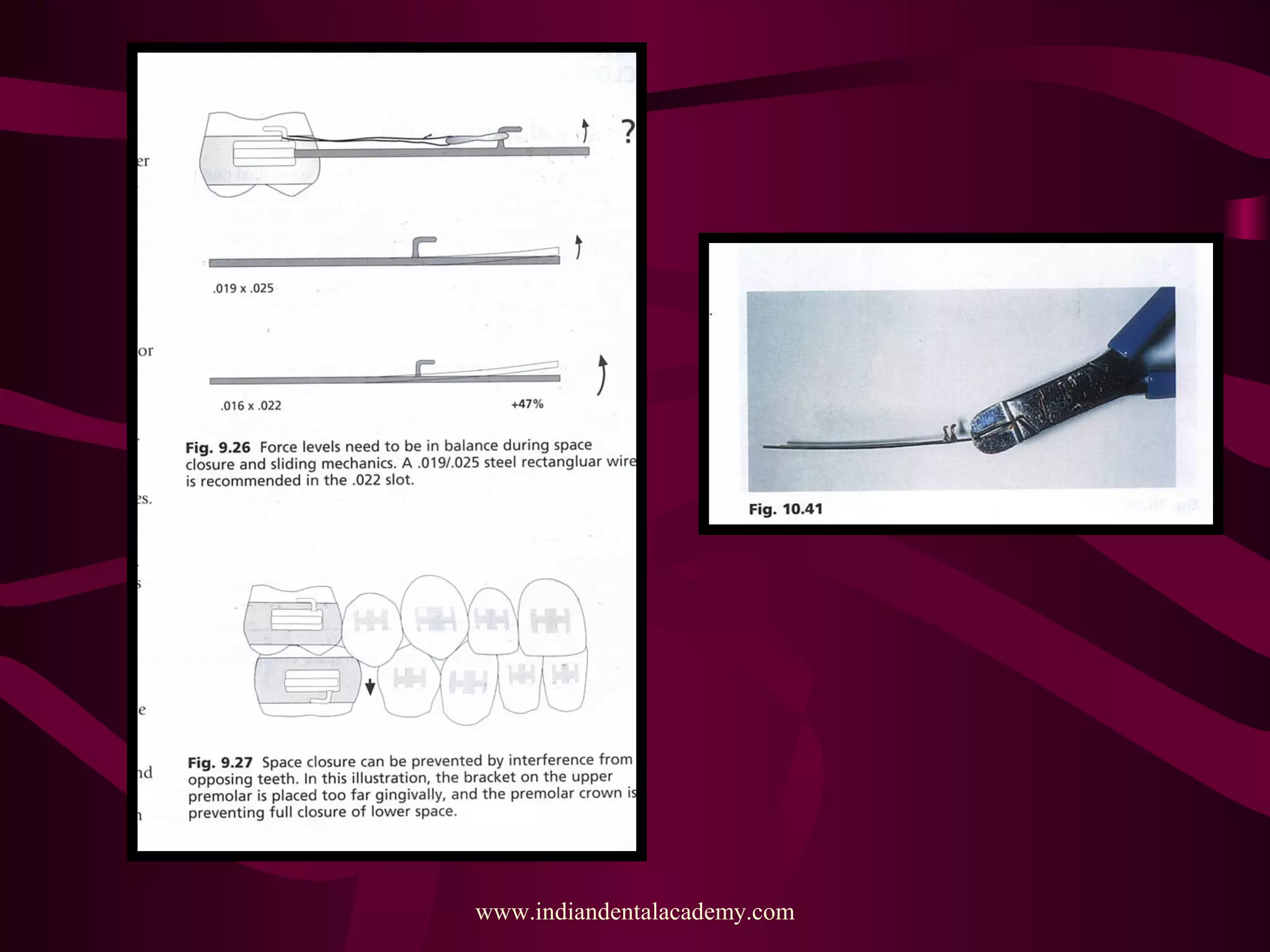
FRICTION MECHANICS-SLIDING MECHANICS
-Canine lacebacks-009 ligature wire
-Active tiebacks
-Closed NiTi coil springs
-Elastomeres
www.indiandentalacademy.com
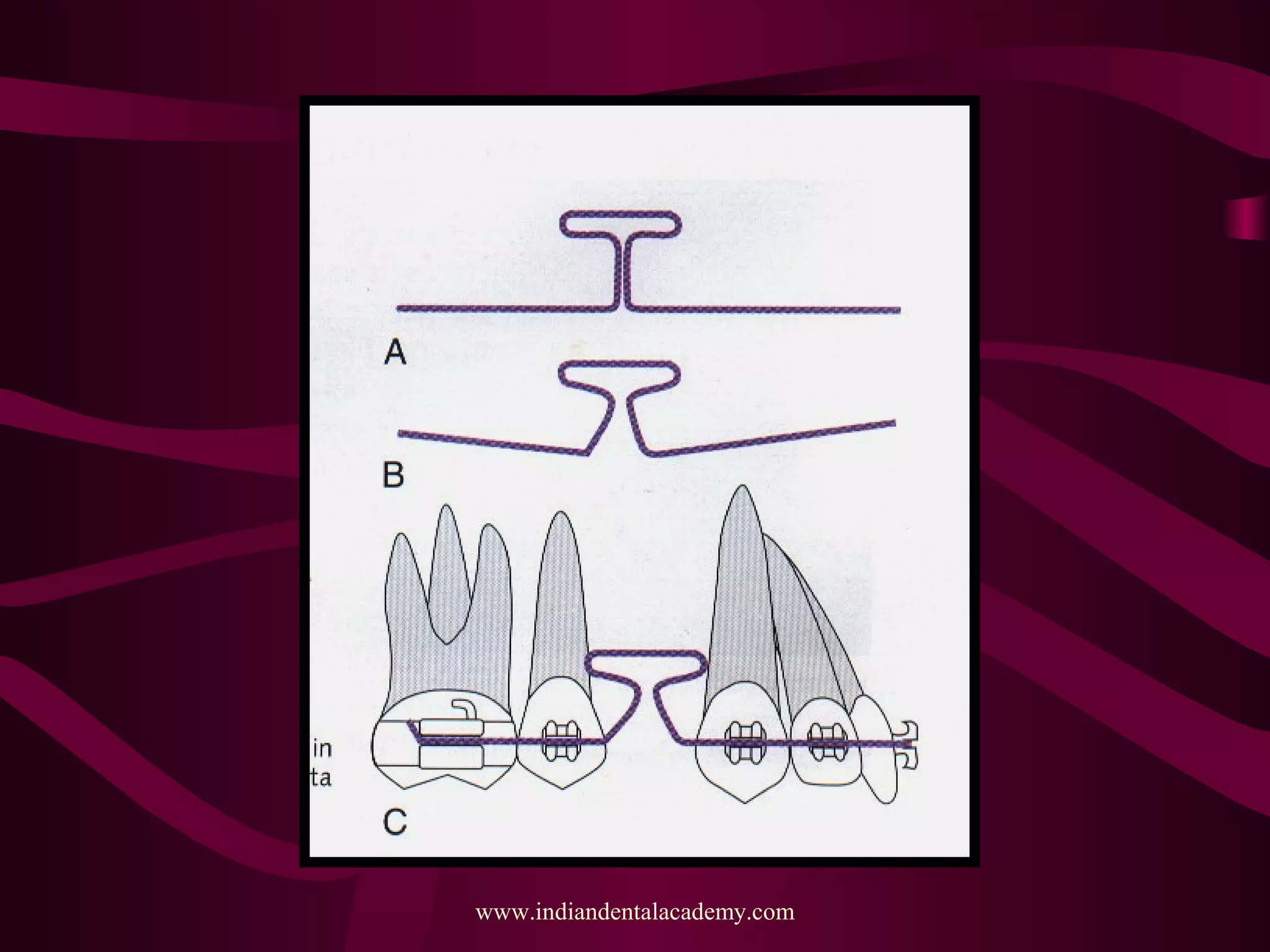
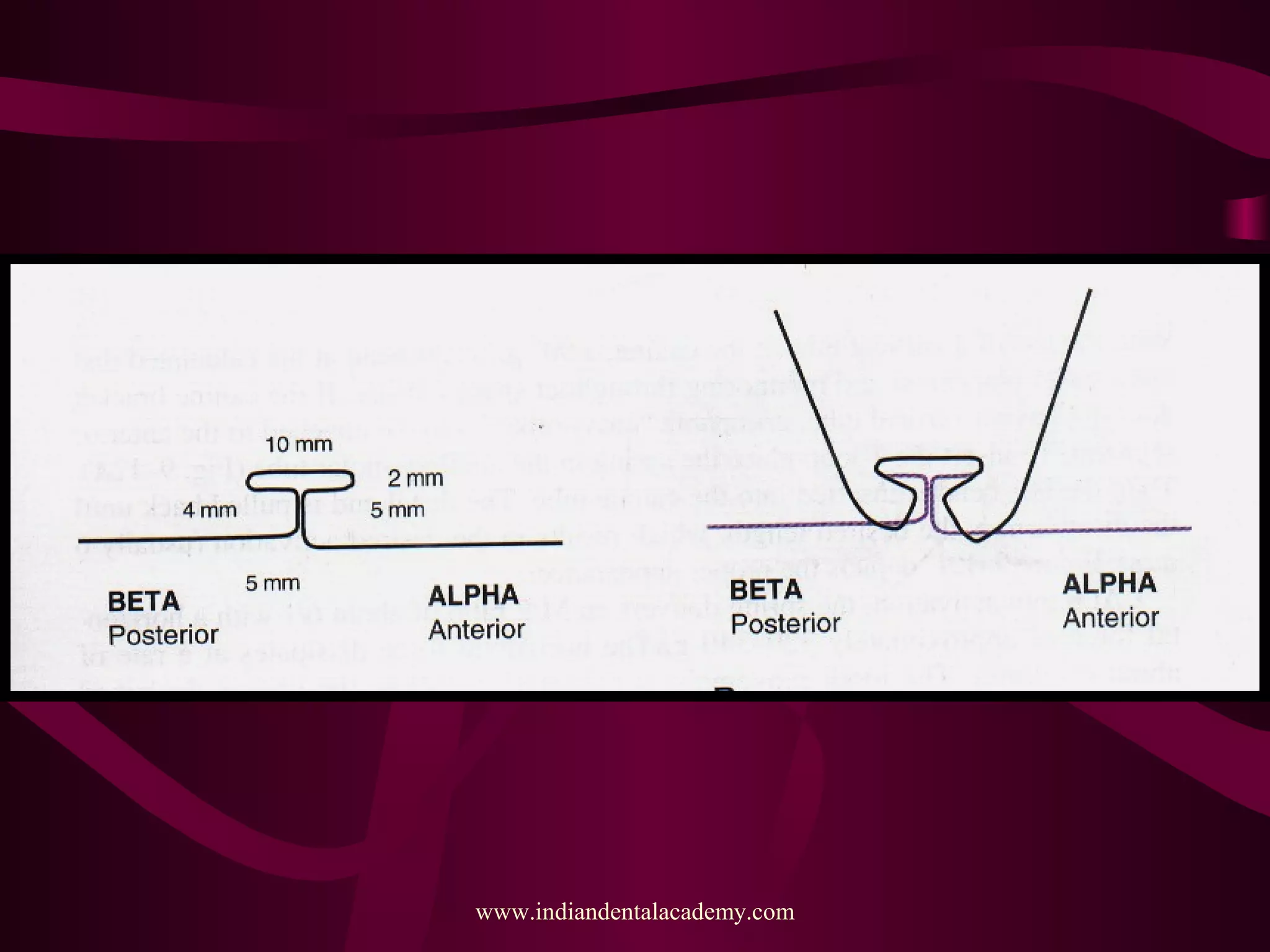
FRICTIONLESS MECHANICS
~Closing loops
Size of the archwire & slot
Distance between the attachments
Interbracket distance
Closing loop = Tooth movement & root apices
together
Vertical loop prevents tipping
Closed loop more effective
www.indiandentalacademy.com
~Gable bend at the extraction site ensures
root paralleling moments
~16><22 wire 40-45 degrees on each side-
018 slot
~Location of the loop distal to the tooth to
be retracted as against the extraction site
~Fail-safe mechanism
www.indiandentalacademy.com
SEGMENTED MECHANICS
~Reduces friction
~Anti-tip, anti-rotation bends incorp. In spring
~Activated by cinching behind the molar
~Anchorage reinforced
~Not fail safe
www.indiandentalacademy.com
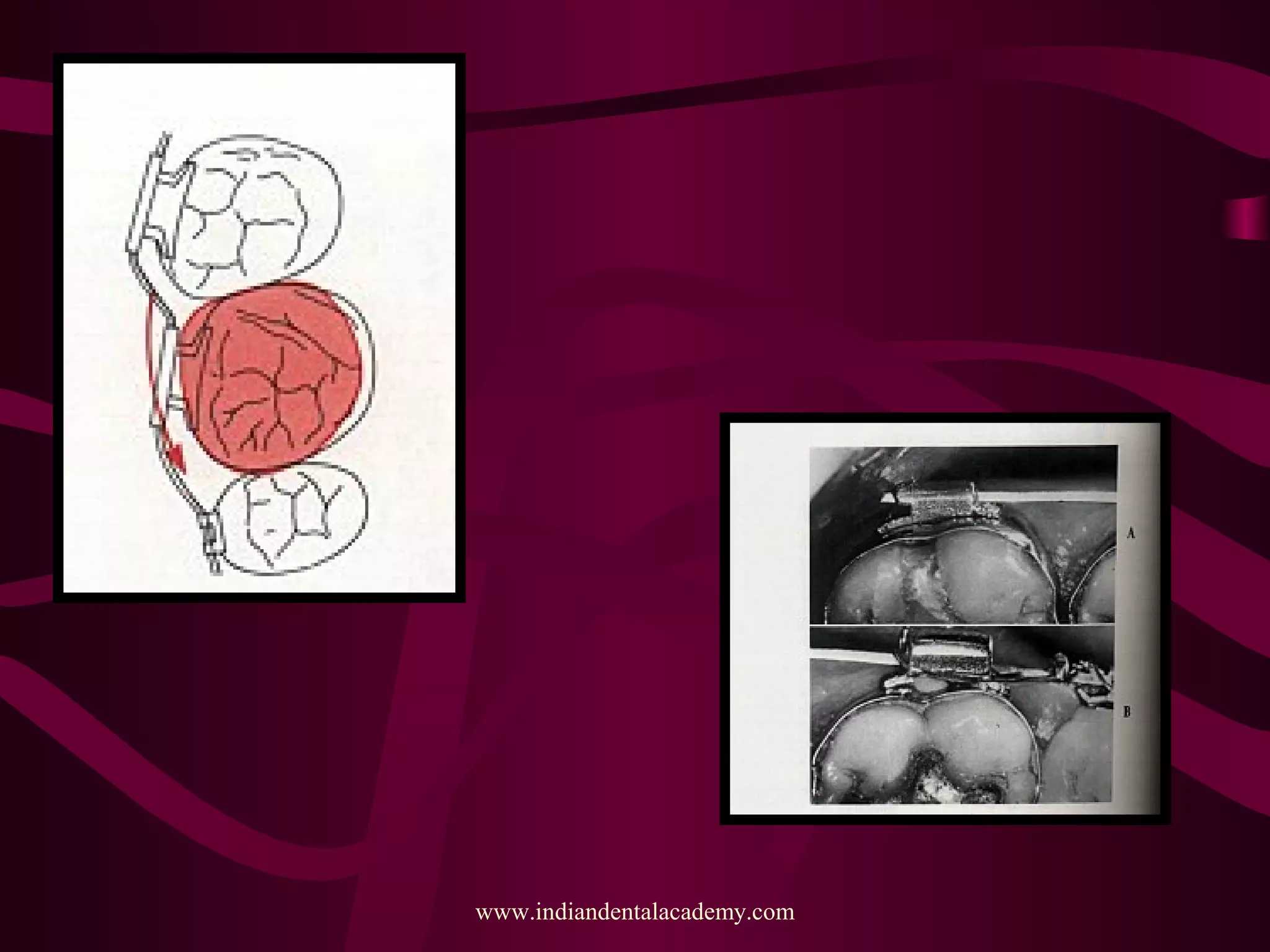
Correction of Molar Relationship
~Distalising maxillary molars without
protruding the anteriors
~Mesialising lower molars
-Elastics only-not recommended
www.indiandentalacademy.com
FINISHING
~Root paralleling
Uprighting springs in Begg
Full sized archwires in PAE
17><25 / 18><25 AW in 018 slot
19><25 / 21><25 AW in 022 slot
Cinching
www.indiandentalacademy.com
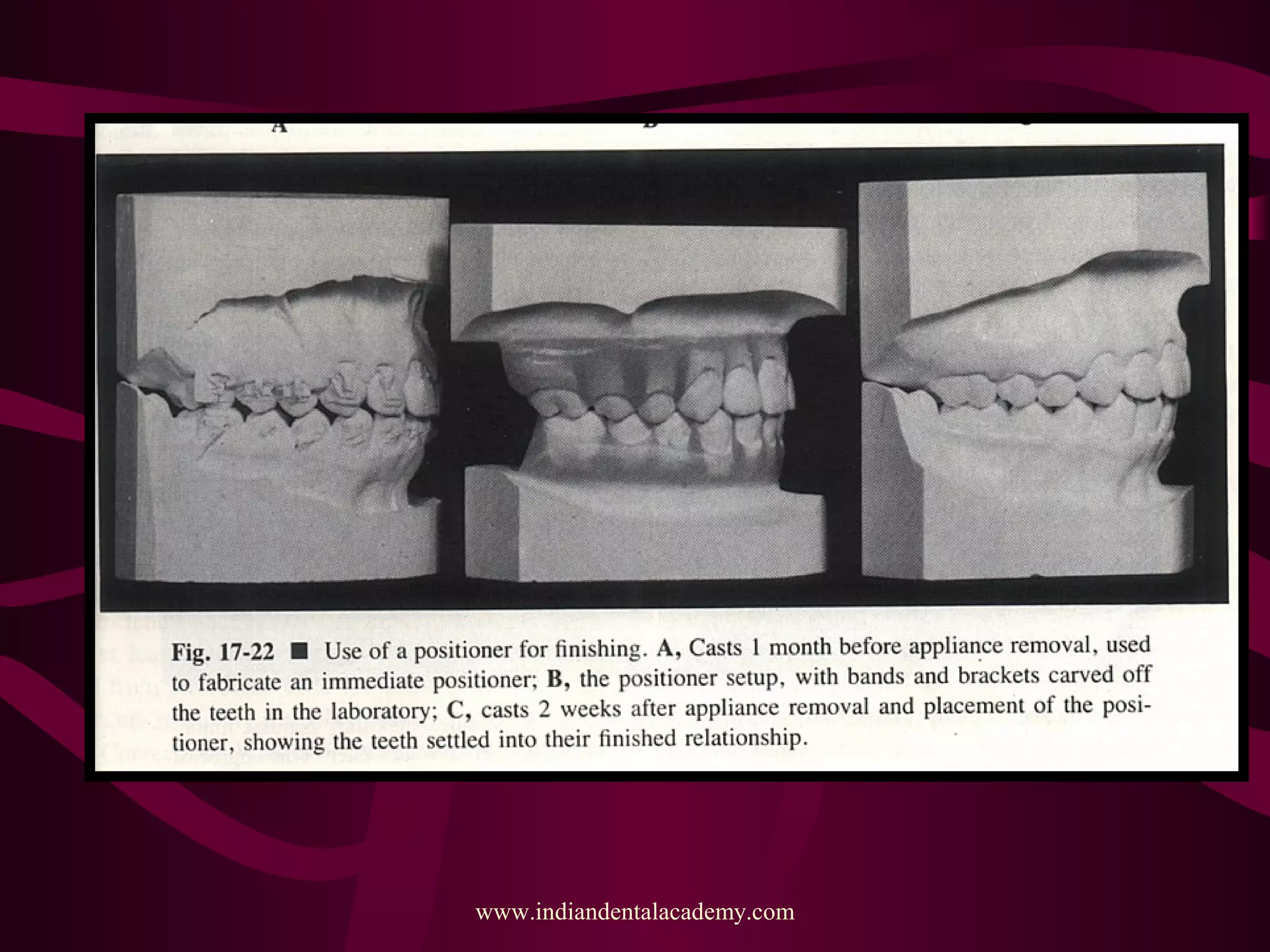
FINISHING
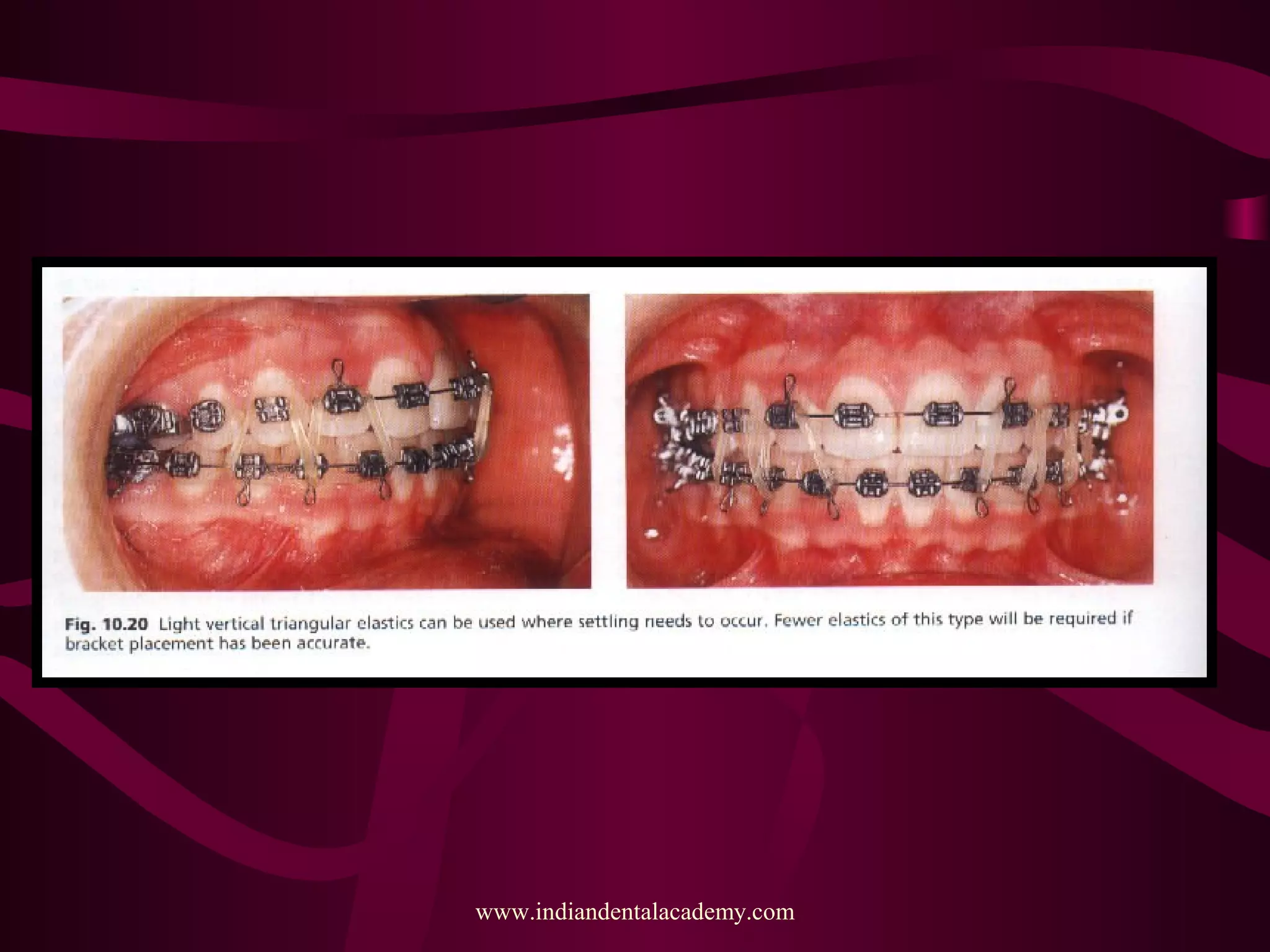
~Settling
-Replacing rectangular wire with round wires
and allowing the occlusion to settle on its own
-Laced vertical elastics
-Tooth positioner after band, bracket removal
www.indiandentalacademy.com
Neo-sentalloy
www.indiandentalacademy.com
BROUSSARD TWO FORCE SYSTEM
. If the patient is banded with .018
edgewise channels, the combination-
loop archwire should, be .016 ´ .022 or .
017 ´ .022, while if .022 brackets are
being used, the combination-loop
archwire should be .018 ´ .025 or .021 ´ .
025.
www.indiandentalacademy.com
It is suggested that the combination-loop
archwire should have lingual root torque
(labial crown torque) incorporated in the
anterior segment to prevent any rolling or
rabbiting of the maxillary anterior teeth
during retraction
www.indiandentalacademy.com
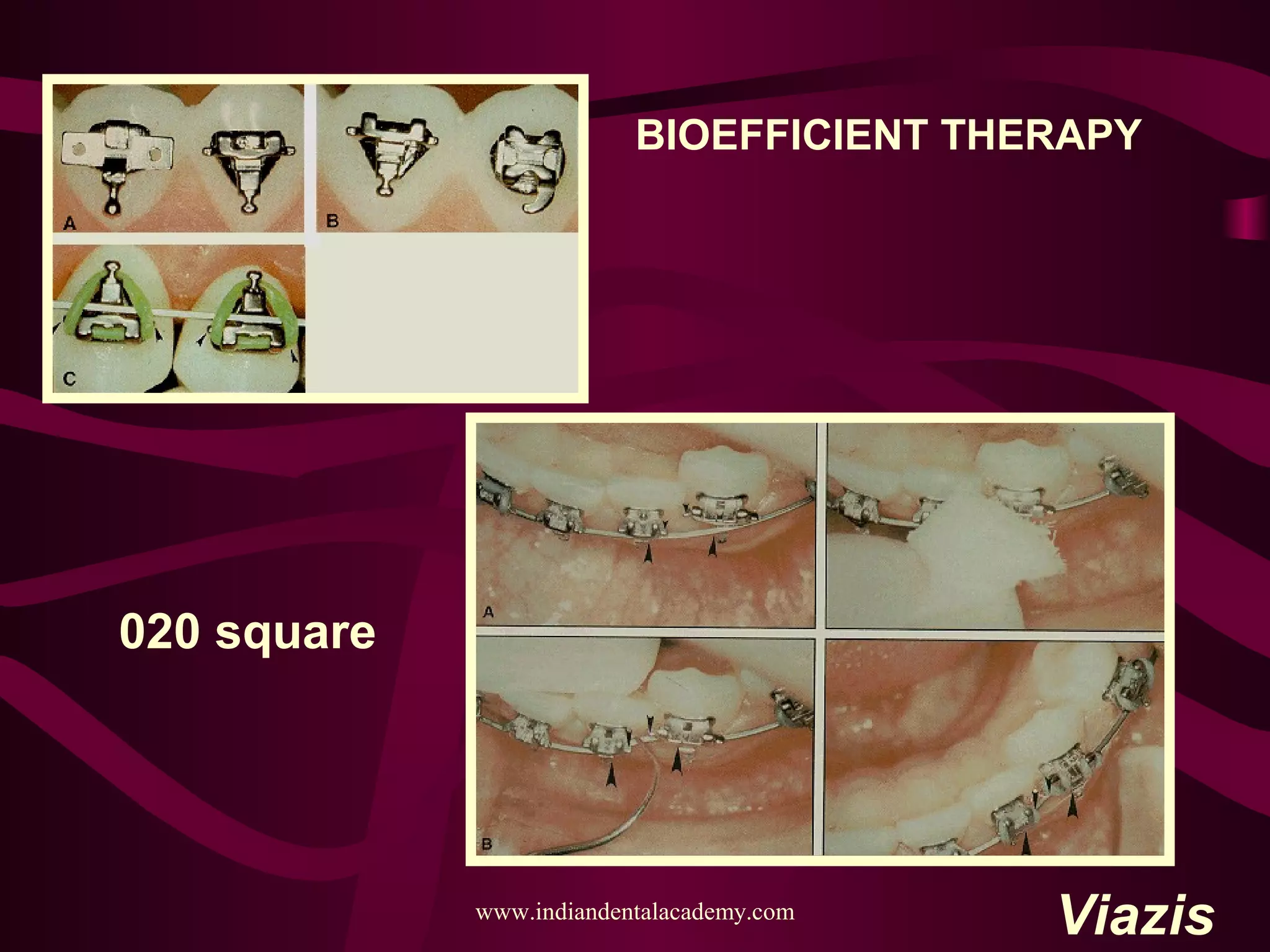
BIOEFFICIENT THERAPY
Viazis
020 square
www.indiandentalacademy.com
M T
www.indiandentalacademy.com
LETS RIDE THE
WINDS OF
CHANGE
www.indiandentalacademy.com
THANK YOU
www.indiandentalacademy.com

Tip and torque