www.indiandentalacademy.comwww.indiandentalacademy.com
CONTENTSCONTENTS
 CLASSICAL BEGGCLASSICAL BEGG
 EVOLUTION OF REFINED BEGGEVOLUTION OF REFINED BEGG
 APPLIANCE DESIGNAPPLIANCE DESIGN
 STAGE -ISTAGE -I
 STAGE -II AND PRE STAGE – IIISTAGE -II AND PRE STAGE – III
 STAGE – IIISTAGE – III
 VARIOUS AUXILLARIESVARIOUS AUXILLARIES
 FINISHING AND DETAILINGFINISHING AND DETAILING
 CONCLUSIONCONCLUSIONwww.indiandentalacademy.comwww.indiandentalacademy.com
EVOLUTION OFEVOLUTION OF
BEGG TECHNIQUEBEGG TECHNIQUE
www.indiandentalacademy.comwww.indiandentalacademy.com
HISTORICAL PERSPECTIVEHISTORICAL PERSPECTIVE
 Dr. Begg’s experienceDr. Begg’s experience withwith thethe
edgewise appliance under the dictumedgewise appliance under the dictum
of non-extraction approach taught byof non-extraction approach taught by
Dr. Angle was disappointingDr. Angle was disappointing due todue to
slow tooth movementsslow tooth movements, too far, too far
forwardly positioned teethforwardly positioned teeth and anand an
unpleasant facial profileunpleasant facial profile at the end ofat the end of
treatment.treatment.
www.indiandentalacademy.comwww.indiandentalacademy.com
NEED THE MOTHER OFNEED THE MOTHER OF
INVENTIONSINVENTIONS
 He developed his technique due to theHe developed his technique due to the
peculiar needs of his practice, whereinpeculiar needs of his practice, wherein
patientspatients with severe malocclusions had towith severe malocclusions had to
travel long distancestravel long distances to undergoto undergo
treatment.treatment.
 He always wanted an appliance whichHe always wanted an appliance which
would exertwould exert light continuous forceslight continuous forces overover
extended periods of time.extended periods of time.
 Hence heHence he modified the ribbon arch bracketmodified the ribbon arch bracket
and used it with the light round wire toand used it with the light round wire to
develop the classical Begg technique.develop the classical Begg technique.
www.indiandentalacademy.comwww.indiandentalacademy.com
MODIFIED RIBBON ARCH BRACKETMODIFIED RIBBON ARCH BRACKET
www.indiandentalacademy.comwww.indiandentalacademy.com
MODIFIED RIBBON ARCH BRACKETMODIFIED RIBBON ARCH BRACKET
www.indiandentalacademy.comwww.indiandentalacademy.com
CLASSICAL BEGGCLASSICAL BEGG
www.indiandentalacademy.comwww.indiandentalacademy.com
CONCEPTSCONCEPTS
 His studies onHis studies on Attritional occlusionAttritional occlusion
convinced him that extractions wereconvinced him that extractions were
essential in most patients to makeessential in most patients to make
up for the lack of attrition in modernup for the lack of attrition in modern
man.man.
 He also introduced the concept ofHe also introduced the concept of
differential forcesdifferential forces to move differentto move different
segments of teeth based on Storeysegments of teeth based on Storey
and Smith’s work.and Smith’s work.
www.indiandentalacademy.comwww.indiandentalacademy.com
MATERIAL ADVANCEMENTSMATERIAL ADVANCEMENTS
 He kept close tabs withHe kept close tabs with
advancements in metallurgy and hisadvancements in metallurgy and his
association withassociation with A.J. WilcockA.J. Wilcock lead tolead to
the development ofthe development of high tensilehigh tensile
stainless steel light wires.stainless steel light wires.
 In fact these wires were only a spin-In fact these wires were only a spin-
off from the metallurgical researchoff from the metallurgical research
equipment that was being developedequipment that was being developed
during the war time years.during the war time years.
www.indiandentalacademy.comwww.indiandentalacademy.com
DAWN OF A NEWDAWN OF A NEW
PHILOSOPHYPHILOSOPHY
 When he published his work in theWhen he published his work in the
AJO, it created aAJO, it created a sensationsensation. People. People
recognized that the appliance hadrecognized that the appliance had
some outstanding benefits.some outstanding benefits.
 UsingUsing light forceslight forces and onlyand only intra-oralintra-oral
anchorage,anchorage, it was very efficient init was very efficient in
moving the teeth. The appliancemoving the teeth. The appliance
couldcould act over long periods of timeact over long periods of time
and bring aboutand bring about pronounced toothpronounced tooth
movements.movements.
www.indiandentalacademy.comwww.indiandentalacademy.com
TEST OF TIMETEST OF TIME
 However, with time it was realizedHowever, with time it was realized
that thethat the same bracket wiresame bracket wire
combination was responsible forcombination was responsible for
some of the serious drawbackssome of the serious drawbacks of theof the
appliance.appliance.
 Many cliniciansMany clinicians diverged from thediverged from the
orthodox approachorthodox approach of the old school,of the old school,
while others tried towhile others tried to incorporateincorporate
contemporary treatment goals andcontemporary treatment goals and
strategies.strategies.
www.indiandentalacademy.comwww.indiandentalacademy.com
CLASSICAL BEGGCLASSICAL BEGG
ADVANTAGESADVANTAGES
 Light forcesLight forces
 Anchorage controlAnchorage control
 Quick correctionQuick correction
 Efficient uprightingEfficient uprighting
 Less demands onLess demands on
patient cooperationpatient cooperation
 Low costLow cost
DISADVANTAGESDISADVANTAGES
 No precise controlNo precise control
 Posterior root torque isPosterior root torque is
difficultdifficult
 True intrusion is less likelyTrue intrusion is less likely
 Poor rotational controlPoor rotational control
 Over use of class ii elasticsOver use of class ii elastics
 Uncontrolled tipping andUncontrolled tipping and
root resorptionroot resorption
 Heavy torque requirementHeavy torque requirement
 Over emphasis onOver emphasis on
extractionsextractions
 No fail safe mechanismNo fail safe mechanism
www.indiandentalacademy.comwww.indiandentalacademy.com
EVOLUTION OFEVOLUTION OF
REFINED BEGGREFINED BEGG
www.indiandentalacademy.comwww.indiandentalacademy.com
EVOLUTIONEVOLUTION
MODIFIED BEGGMODIFIED BEGG
 Change in theChange in the
shape of theshape of the
bracketbracket
Ex:Ex: Tip – edgeTip – edge
BEDDTIOTBEDDTIOT
C.A.T and otherC.A.T and other
CombinationCombination
bracketsbrackets
REFINED BEGGREFINED BEGG
 Use the same BeggUse the same Begg
bracketbracket
 Use of newer highUse of newer high
tensile wires andtensile wires and
auxillaries toauxillaries to
overcome theovercome the
drawbacks of thedrawbacks of the
classic techniqueclassic technique
www.indiandentalacademy.comwww.indiandentalacademy.com
REFINED BEGGREFINED BEGG
Refinements can be broadly classifiedRefinements can be broadly classified
under the following headings:under the following headings:
 CONCEPTUAL CHANGESCONCEPTUAL CHANGES
 HARDWARE ADVANCEMENTSHARDWARE ADVANCEMENTS
 MODIFICATION OF MECHANICSMODIFICATION OF MECHANICS
www.indiandentalacademy.comwww.indiandentalacademy.com
CONCEPTUALCONCEPTUAL
CHANGESCHANGES
1.1. Theoretical foundationTheoretical foundation
2.2. Treatment objectivesTreatment objectives
3.3. DiagnosisDiagnosis
4.4. Treatment planningTreatment planning
5.5. BiomechanicsBiomechanics
6.6. Arch-formsArch-forms
www.indiandentalacademy.comwww.indiandentalacademy.com
1. Conceptual changes1. Conceptual changes
 Attritional occlusionAttritional occlusion andand DifferentialDifferential
forcesforces are viewed in a neware viewed in a new
perspective.perspective.
www.indiandentalacademy.comwww.indiandentalacademy.com
2. Treatment objectives2. Treatment objectives
 Treatment objectives now includeTreatment objectives now include
Andrews 6 keys to normal occlusionAndrews 6 keys to normal occlusion
andand Gnathologic goals set by Roth.Gnathologic goals set by Roth.
www.indiandentalacademy.comwww.indiandentalacademy.com
3. Diagnosis3. Diagnosis
 Diagnosis is nowDiagnosis is now broad based,broad based,
involving skeletal, dental and softinvolving skeletal, dental and soft
tissue analysis, growth estimationtissue analysis, growth estimation
and VTOand VTO
www.indiandentalacademy.comwww.indiandentalacademy.com
4. Treatment planning4. Treatment planning
 Treatment planningTreatment planning varies accordingvaries according
to theto the facial patternfacial pattern and otherand other
individual requirements such asindividual requirements such as
controllingcontrolling incisor exposureincisor exposure..
 Treatment duringTreatment during mixed dentitionmixed dentition forfor
controlling and redirecting growthcontrolling and redirecting growth
withwith functional appliancesfunctional appliances eithereither
before or during fixed therapy arebefore or during fixed therapy are
considered.considered.
www.indiandentalacademy.comwww.indiandentalacademy.com
 UpperUpper molar distalizationmolar distalization byby
modifying the archwire is possible.modifying the archwire is possible.
 The molars are held back and theThe molars are held back and the
Leeway spaceLeeway space is utilizedis utilized for resolvingfor resolving
mild crowding in border line cases.mild crowding in border line cases.
www.indiandentalacademy.comwww.indiandentalacademy.com
 In the early days the rule of thumbIn the early days the rule of thumb
waswas to extractto extract when in doubt.when in doubt.
 Nowadays when in doubt we startNowadays when in doubt we start
the casethe case non-extraction.non-extraction.
 When extractions do becomeWhen extractions do become
necessary the choice of teeth isnecessary the choice of teeth is
dictated by the diagnosis …dictated by the diagnosis …
www.indiandentalacademy.comwww.indiandentalacademy.com
all first premolars,all first premolars,
2 1 1 2 3 48 7 6 5 4 3 5 6 7 8
2 1 1 2 3 48 7 6 5 4 3 5 6 7 8
www.indiandentalacademy.comwww.indiandentalacademy.com
all second premolarsall second premolars
2 1 1 2 3 48 7 6 5 4 3 5 6 7 8
2 1 1 2 3 48 7 6 5 4 3 5 6 7 8
www.indiandentalacademy.comwww.indiandentalacademy.com
all first molars,all first molars,
2 1 1 2 3 48 7 6 5 4 3 5 6 7 8
2 1 1 2 3 48 7 6 5 4 3 5 6 7 8
www.indiandentalacademy.comwww.indiandentalacademy.com
upper first premolars and lower secondupper first premolars and lower second
premolarspremolars
2 1 1 2 3 48 7 6 5 4 3 5 6 7 8
2 1 1 2 3 48 7 6 5 4 3 5 6 7 8
www.indiandentalacademy.comwww.indiandentalacademy.com
or vice versa,or vice versa,
2 1 1 2 3 48 7 6 5 4 3 5 6 7 8
2 1 1 2 3 48 7 6 5 4 3 5 6 7 8
www.indiandentalacademy.comwww.indiandentalacademy.com
asymmetric extractions,asymmetric extractions,
2 1 1 2 3 48 7 6 5 4 3 5 6 7 8
2 1 1 2 3 48 7 6 5 4 3 5 6 7 8
www.indiandentalacademy.comwww.indiandentalacademy.com
upper second molars and lower thirdupper second molars and lower third
molars,molars,
2 1 1 2 3 48 7 6 5 4 3 5 6 7 8
2 1 1 2 3 48 7 6 5 4 3 5 6 7 8
www.indiandentalacademy.comwww.indiandentalacademy.com
single arch premolar extractionssingle arch premolar extractions
2 1 1 2 3 48 7 6 5 4 3 5 6 7 8
2 1 1 2 3 48 7 6 5 4 3 5 6 7 8
www.indiandentalacademy.comwww.indiandentalacademy.com
a single lower incisor extractiona single lower incisor extraction
2 1 1 2 3 48 7 6 5 4 3 5 6 7 8
2 1 1 2 3 48 7 6 5 4 3 5 6 7 8
www.indiandentalacademy.comwww.indiandentalacademy.com
 Interproximal enamel reductionInterproximal enamel reduction is also ais also a
viable option in cases with excess toothviable option in cases with excess tooth
material.material.
www.indiandentalacademy.comwww.indiandentalacademy.com
5. Biomechanics5. Biomechanics
 The conventional methodThe conventional method tipped thetipped the
teeth uncontrollablyteeth uncontrollably thereby leadingthereby leading
to iatrogenic root resorption.to iatrogenic root resorption.
 Refined method aims at achievingRefined method aims at achieving
controlled tippingcontrolled tipping in the first andin the first and
second stages by using torquingsecond stages by using torquing
springs made with thin dimensionsprings made with thin dimension
high tensile premium and supremehigh tensile premium and supreme
wires.wires.
www.indiandentalacademy.comwww.indiandentalacademy.com
 Advantages of using torquingAdvantages of using torquing
auxillaries right from Stage Iauxillaries right from Stage I
– Prevents uncontrolled tippingPrevents uncontrolled tipping andand
related root resorption.related root resorption.
– MakeMake stage III short and simplestage III short and simple..
– ProvideProvide labial root torque for blocked inlabial root torque for blocked in
lateral incisorslateral incisors right from the beginning.right from the beginning.
– Enhances intrusion and retraction ofEnhances intrusion and retraction of
caninescanines which are touching the labialwhich are touching the labial
cortical plate.cortical plate.
www.indiandentalacademy.comwww.indiandentalacademy.com
6. Arch-forms6. Arch-forms
 Proper arch formProper arch form andand co-ordinationco-ordination
of upper and lower arch wires isof upper and lower arch wires is
checked at every stage.checked at every stage.
www.indiandentalacademy.comwww.indiandentalacademy.com
HARDWAREHARDWARE
ADVANCEMENTSADVANCEMENTS
1.1. AttachmentsAttachments
2.2. Arch WiresArch Wires
3.3. ElasticsElastics
4.4. Other ComponentsOther Components
www.indiandentalacademy.comwww.indiandentalacademy.com
1. Attachments1. Attachments
 Brackets:Brackets: Basic design remains theBasic design remains the
samesame
– Built in torque (Kameda)Built in torque (Kameda)
– Anti rotation (Mollenhauer)Anti rotation (Mollenhauer)
www.indiandentalacademy.comwww.indiandentalacademy.com
 Tubes:Tubes:
– Round / Oval / RectangularRound / Oval / Rectangular
– Built in distal offsetBuilt in distal offset
– Oval / Rectangular tubes are used to getOval / Rectangular tubes are used to get
better bucco-lingual control.better bucco-lingual control.
– Combination tubesCombination tubes
www.indiandentalacademy.comwww.indiandentalacademy.com
 Other attachmentsOther attachments
– Palatal bracketsPalatal brackets
– HooksHooks
– Lingual buttons, cleats or eyeletsLingual buttons, cleats or eyelets
– Additional round tubesAdditional round tubes
– Lingual and palatal sheathsLingual and palatal sheaths
www.indiandentalacademy.comwww.indiandentalacademy.com
2. Arch-wires2. Arch-wires
 Newer high grade Australian stainless steelNewer high grade Australian stainless steel
– PremiumPremium
– Premium plusPremium plus
– SupremeSupreme
 Decrowding is done withDecrowding is done with
– Thin premium plus / Supreme wiresThin premium plus / Supreme wires
– Multi stranded co-axial wiresMulti stranded co-axial wires
– Nickel titanium wiresNickel titanium wires
 Finishing is done withFinishing is done with
– Alpha titanium rectangular wiresAlpha titanium rectangular wires
 Braking is achieved withBraking is achieved with
– Combination / Tandem wiresCombination / Tandem wires
www.indiandentalacademy.comwww.indiandentalacademy.com
3. Elastics3. Elastics
 Ultra lightUltra light
– ““Roadrunner” of OrmcoRoadrunner” of Ormco
 LightLight
– Yellow elastics of T.P. OrthodonticsYellow elastics of T.P. Orthodontics
 Many configurations besides theMany configurations besides the
conventional class I and class II areconventional class I and class II are
usedused
– Check / distal vertical / box / M / W etc.Check / distal vertical / box / M / W etc.
www.indiandentalacademy.comwww.indiandentalacademy.com
4. Other Components4. Other Components
 By pass hooks and power pinsBy pass hooks and power pins
(Kameda)(Kameda)
 Trans palatal archesTrans palatal arches
 Jasper jumperJasper jumper
www.indiandentalacademy.comwww.indiandentalacademy.com
MODIFICATION OFMODIFICATION OF
MECHANICSMECHANICS
STAGE WISESTAGE WISE
MODIFICATIONSMODIFICATIONS
www.indiandentalacademy.comwww.indiandentalacademy.com
Stage IStage I
 Multi looped arch wiresMulti looped arch wires are avoidedare avoided
for decrowding, instead ultra finefor decrowding, instead ultra fine
Australian wires, coaxial steel or NiTiAustralian wires, coaxial steel or NiTi
wires are used along with 0.016 inchwires are used along with 0.016 inch
base wire.base wire.
 MAAMAA as an integral part of stage I.as an integral part of stage I.
 More importance toMore importance to incisor intrusion.incisor intrusion.
www.indiandentalacademy.comwww.indiandentalacademy.com
 Modified arch wiresModified arch wires such assuch as
– bypass wiresbypass wires
– Distalizing arch wiresDistalizing arch wires
are used when neededare used when needed
 Base wire is changed toBase wire is changed to 0.018”0.018” as soon asas soon as
the teeth permit for efficient incisorthe teeth permit for efficient incisor
intrusion, rotation control andintrusion, rotation control and
maintenance of the arch formmaintenance of the arch form
 Open bite casesOpen bite cases are started with 0.014”are started with 0.014”
arch wire.arch wire.
www.indiandentalacademy.comwww.indiandentalacademy.com
Stage IIStage II
 MAAMAA is continued for controlledis continued for controlled
tipping of anteriors.tipping of anteriors.
 Base wire may be changed toBase wire may be changed to 0.020”0.020”
size.size.
 Excessive tipping of incisors isExcessive tipping of incisors is
avoided by applying efficientavoided by applying efficient brakes.brakes.
 Kameda recommends to startKameda recommends to start
torquing incisorstorquing incisors from this stagefrom this stage
itself.itself.
www.indiandentalacademy.comwww.indiandentalacademy.com
Stage IIIStage III
 Base wire isBase wire is 0.020” premium0.020” premium forfor
resisting unfavourable side effects ofresisting unfavourable side effects of
torquing auxillaries and uprightingtorquing auxillaries and uprighting
springssprings
 Uprighting springs and torquingUprighting springs and torquing
auxillaries are made ofauxillaries are made of finer higherfiner higher
grade wires.grade wires.
www.indiandentalacademy.comwww.indiandentalacademy.com
 Prevention and correction of occlusalPrevention and correction of occlusal
displacement ofdisplacement of palatal cuspspalatal cusps isis
ensured.ensured.
 Second molarsSecond molars are banded andare banded and
included in the appliance for theirincluded in the appliance for their
proper positioning.proper positioning.
 HeadgearHeadgear can be used to reinforcecan be used to reinforce
anchorage if needed.anchorage if needed.
www.indiandentalacademy.comwww.indiandentalacademy.com
FinishingFinishing
 Rectangular wiresRectangular wires along withalong with staplesstaples andand
T-pinsT-pins can be used for maintaining orcan be used for maintaining or
improving theimproving the proper torque and tipproper torque and tip
 Different elastic configurationsDifferent elastic configurations with lighterwith lighter
round wires may be used to obtain around wires may be used to obtain a tighttight
buccal occlusionbuccal occlusion
 AA pre finishing cephalographpre finishing cephalograph is advised tois advised to
make sure completion of all corrections.make sure completion of all corrections.
www.indiandentalacademy.comwww.indiandentalacademy.com
RetentionRetention
 Conventional Begg did notConventional Begg did not
emphasize retention of lower teeth.emphasize retention of lower teeth.
 Nowadays it is an accepted practiceNowadays it is an accepted practice
to use ato use a removable Hawley’s plateremovable Hawley’s plate
with awith a fitted labial bowfitted labial bow or aor a fixedfixed
lingual retainerlingual retainer for maintaining thefor maintaining the
corrected lower anterior teeth tillcorrected lower anterior teeth till
relapse tendency due to continuedrelapse tendency due to continued
growth and / or third molars is ruledgrowth and / or third molars is ruled
out.out. www.indiandentalacademy.comwww.indiandentalacademy.com
What still remains…What still remains…
 Use ofUse of light forceslight forces..
 Crown tipping and root tipping areCrown tipping and root tipping are
kept separate forkept separate for efficient anchorageefficient anchorage
management.management.
 Differential forcesDifferential forces for differentialfor differential
movement of groups of teethmovement of groups of teeth
 Sequence of stagesSequence of stages and treatmentand treatment
steps remain same.steps remain same.
www.indiandentalacademy.comwww.indiandentalacademy.com
Use ofUse of light intra oral elasticslight intra oral elastics..
En-masse movement of teethEn-masse movement of teeth forfor
space closure.space closure.
Separation ofSeparation of root movingroot moving forcesforces
from arch wire forcesfrom arch wire forces
Over correctionOver correction of allof all
displacements.displacements.
www.indiandentalacademy.comwww.indiandentalacademy.com
APPLIANCEAPPLIANCE
CONSTRUCTIONCONSTRUCTION
www.indiandentalacademy.comwww.indiandentalacademy.com
Bracket designBracket design 0.020”
0.015”
0.045”
www.indiandentalacademy.comwww.indiandentalacademy.com
Anti-Rotation AdjustmentAnti-Rotation Adjustment
0.008”
0.008”
www.indiandentalacademy.comwww.indiandentalacademy.com
Anti-Rotation BracketAnti-Rotation Bracket
www.indiandentalacademy.comwww.indiandentalacademy.com
Built in TorqueBuilt in Torque
www.indiandentalacademy.comwww.indiandentalacademy.com
Molar TubesMolar Tubes
0.036”
0.072”
0.024”
5 mm
6 mm
www.indiandentalacademy.comwww.indiandentalacademy.com
Combination TubesCombination Tubes
0.036”
0.018”
0.025”
5.5 mm
6.2 mm
www.indiandentalacademy.comwww.indiandentalacademy.com
Placement of the attachmentsPlacement of the attachments
 HeightHeight
 Mesio-distal locationMesio-distal location
– BracketsBrackets
– Molar tubesMolar tubes
www.indiandentalacademy.comwww.indiandentalacademy.com
Bracket HeightsBracket Heights
Maxillary teethMaxillary teeth 77 66 55 44 33 22 11
Height (mm)Height (mm) 33 3.53.5 3.53.5 3.53.5 44 3.53.5 44
Height (mm)Height (mm) 33 3.53.5 3.53.5 3.53.5 44 44 44
Mandibular teethMandibular teeth 77 66 55 44 33 22 11
Maxillary AnteriorsMaxillary Anteriors 33 22 11
Height (mm)Height (mm) 3.53.5 33 44
Height (mm)Height (mm) 3.53.5 3.53.5 44
Mandibular AnteriorsMandibular Anteriors 33 22 11
www.indiandentalacademy.comwww.indiandentalacademy.com
Mesio-distal locationMesio-distal location
 BracketsBrackets
– Ideally placed along the long axisIdeally placed along the long axis
– Offseted in case of rotationsOffseted in case of rotations
 Molar tubesMolar tubes
– Mesial of the tube in line with mesio-Mesial of the tube in line with mesio-
buccal cusp tipbuccal cusp tip
www.indiandentalacademy.comwww.indiandentalacademy.com
Arch wiresArch wires
(in the order of increasing yield strength)(in the order of increasing yield strength)
 Australian wires formerly availableAustralian wires formerly available
– RegularRegular
– Regular plusRegular plus
– SpecialSpecial
– Special plusSpecial plus
 Newer grades of wiresNewer grades of wires
– Premium (P)Premium (P)
– Premium plus (P+)Premium plus (P+)
– Supreme (S)Supreme (S)
www.indiandentalacademy.comwww.indiandentalacademy.com
Availability of newer wiresAvailability of newer wires
WIREWIRE
SIZESIZE
(INCH)(INCH)
.008.008 .009.009 .010.010 .011.011 .012.012 .014.014 .016.016 .018.018 .020.020
PREMIUMPREMIUM ** ** ** ** ** ** ** ** **
PREMIUMPREMIUM
PLUSPLUS
** ** ** ** ** ** ** **
SUPREMESUPREME ** ** ** **
www.indiandentalacademy.comwww.indiandentalacademy.com
Mechanical propertiesMechanical properties
 Working rangeWorking range
 ResiliencyResiliency
 Zero stress relaxationZero stress relaxation
 FormabilityFormability
www.indiandentalacademy.comwww.indiandentalacademy.com
Stress-Strain GraphStress-Strain Graph
Supreme
Stainless Steel
TMA
NiTi
Resilience Formability
Strain
Stress
www.indiandentalacademy.comwww.indiandentalacademy.com
Clinical usage of new grade wiresClinical usage of new grade wires
 Depending on theDepending on the load deflectionload deflection
raterate desired the wire size will bedesired the wire size will be
decideddecided
 If the chances ofIf the chances of fracturefracture of an archof an arch
wire are high a slightlywire are high a slightly lower gradelower grade
may be preferredmay be preferred
www.indiandentalacademy.comwww.indiandentalacademy.com
 Considering these factorsConsidering these factors PremiumPremium
plus, Premiumplus, Premium oror at leastat least SpecialSpecial
plusplus grade wires are recommendedgrade wires are recommended
for making arch wires.for making arch wires.
 The other lower grade wires haveThe other lower grade wires have
almost become extinct in clinicalalmost become extinct in clinical
practice.practice.
www.indiandentalacademy.comwww.indiandentalacademy.com
Protocol for bending these wiresProtocol for bending these wires
 WarmWarm the wire by pulling betweenthe wire by pulling between
fingers before bending since thesefingers before bending since these
wires havewires have ductile brittle transitionductile brittle transition
temperature slightly above the roomtemperature slightly above the room
temperaturetemperature..
 Sharp bends are to be made aroundSharp bends are to be made around
thethe square beak.square beak. This provides aThis provides a
moment arm between the thumb andmoment arm between the thumb and
the wire gripping point thus reducingthe wire gripping point thus reducing
the applied stress.the applied stress.www.indiandentalacademy.comwww.indiandentalacademy.com
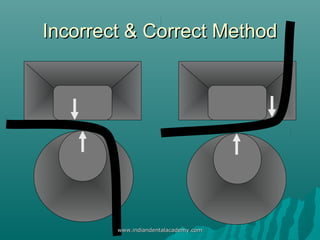
Incorrect & Correct MethodIncorrect & Correct Method
www.indiandentalacademy.comwww.indiandentalacademy.com
General considerationsGeneral considerations
 Arch form considerationsArch form considerations
 Cuspid circlesCuspid circles
– SizeSize
– LocationLocation
Antero-posteriorAntero-posterior
Occluso-gingivalOccluso-gingival
– PlanePlane
 Molar stopsMolar stops
www.indiandentalacademy.comwww.indiandentalacademy.com
12 O'clock 6 O'clock
EXIT ENTRY
www.indiandentalacademy.comwww.indiandentalacademy.com
 Anchor bendsAnchor bends
– LocationLocation
– Degree of bend forDegree of bend for
bite openingbite opening
 Anchor curvesAnchor curves
www.indiandentalacademy.comwww.indiandentalacademy.com
Location of biteLocation of bite
opening bendsopening bends
Anchor bend
Gable bend
Kameda”s modification
Hocevar”s modification
Anchor curve
www.indiandentalacademy.comwww.indiandentalacademy.com
 Arch wire ends-Arch wire ends-cinchcinch or notor not
 Arch wire stiffness-Arch wire stiffness-maximummaximum
 Cuspid tiesCuspid ties
 PinsPins
– Stage I pinsStage I pins
– Stage III pinsStage III pins
– High hat pinsHigh hat pins
– Hook pinsHook pins
– T pinsT pins
www.indiandentalacademy.comwww.indiandentalacademy.com
Stage wise modificationsStage wise modifications
www.indiandentalacademy.comwww.indiandentalacademy.com
STAGE ISTAGE I
 Objectives ofObjectives of conventional Beggconventional Begg
– AlignmentAlignment of teethof teeth
– Elimination ofElimination of cross bitescross bites
– Over biteOver bite correctioncorrection
– Over jetOver jet correctioncorrection
– Correction ofCorrection of arch formarch form
– Matching theMatching the midlinesmidlines
– AttainingAttaining class Iclass I molar and caninemolar and canine
relationrelation
www.indiandentalacademy.comwww.indiandentalacademy.com
STAGE I OF REFINED BEGGSTAGE I OF REFINED BEGG
 PrioritiesPriorities
– Overbite reductionOverbite reduction to precedeto precede overjetoverjet
reductionreduction
– Crowding to be relievedCrowding to be relieved so as to engageso as to engage
0.016 or 0.018 base wires into all the bracket0.016 or 0.018 base wires into all the bracket
slots for applying intrusive force to all teethslots for applying intrusive force to all teeth
evenly.evenly.
– IfIf canines are to be moved distallycanines are to be moved distally to relieveto relieve
crowding or if they are badly rotated theycrowding or if they are badly rotated they
receive priority over everything else initially.receive priority over everything else initially.
– Severely proclined or retroclinedSeverely proclined or retroclined incisorsincisors areare
to beto be brought to proper inclinationbrought to proper inclination beforebefore
applying higher intrusive forcesapplying higher intrusive forceswww.indiandentalacademy.comwww.indiandentalacademy.com
Sub stage I-ASub stage I-A
 Create spaceCreate space for decrowding orfor decrowding or closeclose existingexisting
spaces.spaces.
 Alignment of teethAlignment of teeth
– Labio-ligual movementsLabio-ligual movements
– Correction of rotationsCorrection of rotations
– Correction of anterior cross biteCorrection of anterior cross bite
 Improve upperImprove upper incisor inclinationincisor inclination toto +/- 10+/- 10oo
ofof
normal.normal.
 Molar rotationsMolar rotations andand posterior cross bitesposterior cross bites to beto be
corrected with TPA.corrected with TPA.
 Premolar rotationsPremolar rotations to be corrected using onlyto be corrected using only
palatal or lingual attachments.palatal or lingual attachments.
 Upper arch form in theUpper arch form in the canine area is broadenedcanine area is broadened,,
if narrow to facilitate mandibular advancementif narrow to facilitate mandibular advancement
for class II correction.for class II correction.
www.indiandentalacademy.comwww.indiandentalacademy.com
Sub stage I-BSub stage I-B
 Maximize incisor intrusionMaximize incisor intrusion andand minimize molarminimize molar
extrusionextrusion during bite opening.during bite opening.
 ToTo achieve controlled tippingachieve controlled tipping of upper incisorsof upper incisors
during retraction.during retraction.
 Prevent uncontrolled tippingPrevent uncontrolled tipping of lower incisorsof lower incisors
during bite opening.during bite opening.
 ApplyApply root controlroot control for correction of extreme labio-for correction of extreme labio-
lingual movements such as blocked in laterallingual movements such as blocked in lateral
incisors.incisors.
 Control the mandibular planeControl the mandibular plane angle.angle.
 MatchMatch skeletal and dentalskeletal and dental midlinesmidlines..
 Correct inter arch relationship toCorrect inter arch relationship to Class IClass I..
 PremolarPremolar displacements anddisplacements and rotations arerotations are
correctedcorrected if they are bonded.if they are bonded.www.indiandentalacademy.comwww.indiandentalacademy.com
Arch form and
rotational
control
Arch wire
selection
Anterior
overbite and
effect of
elastics
Spaces to be
opened or
closed
Alignment of
teeth
www.indiandentalacademy.comwww.indiandentalacademy.com
Arch wires in Stage-IArch wires in Stage-I
 ForFor closing spacesclosing spaces or foror for decrowdingdecrowding thethe
teeth have to slide over the wire, henceteeth have to slide over the wire, hence
thinner wiresthinner wires (0.014 / 0.016) are used.(0.014 / 0.016) are used.
 AlignmentAlignment of teeth is done withof teeth is done with sectionalsectional
NiTi wires, multi stranded or thinNiTi wires, multi stranded or thin
stainless steel wiresstainless steel wires tied piggy back overtied piggy back over
aa rigid base wirerigid base wire with smallwith small verticalvertical
offsetsoffsets for the malposed teeth.for the malposed teeth.
www.indiandentalacademy.comwww.indiandentalacademy.com
 InIn average or deep biteaverage or deep bite cases 0.018”cases 0.018”
premium or premium plus wires arepremium or premium plus wires are
used.used.
– Provides adequateProvides adequate intrusive forceintrusive force on upperon upper
incisorsincisors
– ResistsResists lingual rollinglingual rolling of lower molarsof lower molars
 InIn anterior open biteanterior open bite cases the uppercases the upper
0.014” and lower 0.016” P/P+ wires are0.014” and lower 0.016” P/P+ wires are
used.used.
 To efficiently correct and maintain archTo efficiently correct and maintain arch
form and for better rotational control theform and for better rotational control the
base wire isbase wire is changed to 0.018changed to 0.018” as early” as early
as possible.as possible. www.indiandentalacademy.comwww.indiandentalacademy.com
SUB STAGE I-ASUB STAGE I-A
 Alignment of crowded anterior teethAlignment of crowded anterior teeth
– Decline in the use of multi looped wires due toDecline in the use of multi looped wires due to
Inadequate orInadequate or uneven bite openinguneven bite opening
Labial and buccalLabial and buccal flaringflaring of incisors andof incisors and
caninescanines
Loss of controlLoss of control over molar positionsover molar positions
Failure to maintain anchorageFailure to maintain anchorage
Wire bending needsWire bending needs skillskill and isand is timetime
consumingconsuming
Soft tissueSoft tissue irritationirritation
Difficult to adjustDifficult to adjust intra orallyintra orally
CanCan distort archdistort arch form, width and symmetryform, width and symmetry
DifficultDifficult to maintainto maintain oral hygieneoral hygienewww.indiandentalacademy.comwww.indiandentalacademy.com
www.indiandentalacademy.comwww.indiandentalacademy.com
 Arch wire strengthArch wire strength needed to negate theneeded to negate the
side effects of elasticsside effects of elastics
– Badly positioned caninesBadly positioned canines
Full length NiTi wireFull length NiTi wire alongalong with 0.014” S.Swith 0.014” S.S
base wirebase wire withwith anchor bendanchor bend but no cuspidbut no cuspid
circle tied piggy back.circle tied piggy back. Step up or step downStep up or step down
bendsbends are given if the base wire comes in theare given if the base wire comes in the
way of tooth movement.way of tooth movement.
Full length NiTi wireFull length NiTi wire without support from awithout support from a
S.S. wire can be used inS.S. wire can be used in open bite casesopen bite cases or ifor if
thethe caninescanines areare highly placedhighly placed..
www.indiandentalacademy.comwww.indiandentalacademy.com
 Amount ofAmount of canine distalizationcanine distalization
needed for decrowding andneeded for decrowding and cuspidcuspid
circle positioncircle position
– Mild crowding (0.5 mm)Mild crowding (0.5 mm)
KeptKept touching the canine bracketstouching the canine brackets on bothon both
sidessides
– Slightly more crowded (1 mm)Slightly more crowded (1 mm)
KeptKept 0.5 mm distal0.5 mm distal to the canine bracket onto the canine bracket on
either sideeither side
– More crowding (2mm)More crowding (2mm)
One orOne or both circles are omittedboth circles are omitted and elasticsand elastics
engaged on to high hat pins on the caninesengaged on to high hat pins on the canines
www.indiandentalacademy.comwww.indiandentalacademy.com
– If caninesIf canines tip distal excessivelytip distal excessively they arethey are
fitted withfitted with uprighting springsuprighting springs made ofmade of
0.010” supreme0.010” supreme wire.wire.
– If theIf the lower archlower arch is madeis made without cuspidwithout cuspid
circlescircles for bilateral canine movement,for bilateral canine movement,
molar stopsmolar stops are bentare bent mesial tomesial to thethe molarmolar
tube.tube.
– If both cuspid circles are omitted in theIf both cuspid circles are omitted in the
upper archupper arch, its, its ends are lightly bentends are lightly bent (not(not
tightly cinched) abouttightly cinched) about 1mm1mm away fromaway from
the distal ends of molar tubes whichthe distal ends of molar tubes which
provide for uprightingprovide for uprighting of the molars.of the molars.
www.indiandentalacademy.comwww.indiandentalacademy.com
– If onlyIf only one cuspid circle is omittedone cuspid circle is omitted
in thein the upper archupper arch, the wire is, the wire is
stabilized using a cuspid tie to thestabilized using a cuspid tie to the
circle on the other sidecircle on the other side. Under. Under
similar conditions in thesimilar conditions in the lower archlower arch,,
thethe molar stopmolar stop may still be requiredmay still be required
on theon the opposite sideopposite side for resistingfor resisting
forward molar movement.forward molar movement.
www.indiandentalacademy.comwww.indiandentalacademy.com
 Minimal crowding ofMinimal crowding of 1-2 mm1-2 mm can becan be
corrected by givingcorrected by giving horizontal offsethorizontal offset oror VV
bendsbends in a 0.016” or 0.014” S.S. wire.in a 0.016” or 0.014” S.S. wire.
 If crowding isIf crowding is more than 2 mmmore than 2 mm, more, more
flexible 0.014” or 0.016”flexible 0.014” or 0.016” NiTiNiTi, 0.0165, 0.0165 coco
axialaxial or 0.009”or 0.009” supremesupreme wires will bewires will be
required.required.
Amount of wire deflectionAmount of wire deflection
www.indiandentalacademy.comwww.indiandentalacademy.com
Considerations for choice of wireConsiderations for choice of wire
 Same diameterSame diameter coax wire exerts less forcecoax wire exerts less force
than a NiTi wire, whereas a S.S 0.009”than a NiTi wire, whereas a S.S 0.009”
supreme wire exerts more forcesupreme wire exerts more force than thethan the
0.014” NiTi.0.014” NiTi.
 NiTi wires have highest spring backNiTi wires have highest spring back. Coax. Coax
wires are most prone to deformation and S.Swires are most prone to deformation and S.S
under size wires have the least spring back.under size wires have the least spring back.
 S.S wires have the leastS.S wires have the least frictionfriction, NiTi wires, NiTi wires
have greater friction, while coax wires offerhave greater friction, while coax wires offer
maximum resistance to sliding.maximum resistance to sliding.
 NiTi wires are moreNiTi wires are more costcostly than the coax orly than the coax or
supreme wiressupreme wires
www.indiandentalacademy.comwww.indiandentalacademy.com
Amount of rotational controlAmount of rotational control
requiredrequired
 The arch wire shouldThe arch wire should fill the slotfill the slot asas
much as possible for rotationalmuch as possible for rotational
correctionscorrections
 0.014”0.014” NiTi or coax wiresNiTi or coax wires are theare the
best choice but they must bebest choice but they must be
supported by a stiff base wiresupported by a stiff base wire
 If aIf a 0.009” supreme wire0.009” supreme wire is used, itis used, it
wouldwould require exaggerated horizontalrequire exaggerated horizontal
offsetsoffsets
www.indiandentalacademy.comwww.indiandentalacademy.com
Indication for using a single loopIndication for using a single loop
 When aWhen a single incisor is out of thesingle incisor is out of the
archarch while all the remaining ones andwhile all the remaining ones and
the other side canine are well alignedthe other side canine are well aligned
but tipped towards the crowdedbut tipped towards the crowded
incisorincisor
 A single loop is made in the 0.014 orA single loop is made in the 0.014 or
0.016” arch wire with the0.016” arch wire with the cuspidcuspid
circle abutting the caninecircle abutting the canine and aand a stopstop
abutting the lateral incisorabutting the lateral incisor..
www.indiandentalacademy.comwww.indiandentalacademy.com
Indication for using a single loopIndication for using a single loop
www.indiandentalacademy.comwww.indiandentalacademy.com
Anterior open biteAnterior open bite
 Upper 0.014” S.S if incisor extrusionUpper 0.014” S.S if incisor extrusion
is needed withis needed with mild anchor bendsmild anchor bends
balanced by suitable class II elasticsbalanced by suitable class II elastics
 Lower 0.016” S.S wire is used.Lower 0.016” S.S wire is used.
www.indiandentalacademy.comwww.indiandentalacademy.com
Over correction of rotationsOver correction of rotations
 As one proceeds to stiffer wiresAs one proceeds to stiffer wires
forcing the wireforcing the wire into anti rotationinto anti rotation
brackets may lead tobrackets may lead to bond failurebond failure
 Hence, rotated teeth should beHence, rotated teeth should be
corrected at each visit on the lessercorrected at each visit on the lesser
dimension wires by usingdimension wires by using rotationrotation
modulesmodules, so that bigger size wires, so that bigger size wires
can be easily engaged in thecan be easily engaged in the
subsequent visits.subsequent visits.
www.indiandentalacademy.comwww.indiandentalacademy.com
Closing of anterior spacingClosing of anterior spacing
 Cuspid circlesCuspid circles should be keptshould be kept 2 mm2 mm
mesialmesial to the bracket and must beto the bracket and must be
rolled mesially as spaces close.rolled mesially as spaces close.
Keeping them too far mesially mayKeeping them too far mesially may
lead to round tripping but is valid iflead to round tripping but is valid if
canines are to be moved mesiallycanines are to be moved mesially
 Intrusion takes up some spaceIntrusion takes up some space,,
hence active space closure shouldhence active space closure should
not be done until intrusion isnot be done until intrusion is
achieved.achieved.
www.indiandentalacademy.comwww.indiandentalacademy.com
Improving the inclination of upperImproving the inclination of upper
incisorsincisors
 Severely proclined teethSeverely proclined teeth are first retractedare first retracted
with class I or II elastics along withwith class I or II elastics along with
mild/moderate anchor bendsmild/moderate anchor bends
 Retroclined incisorsRetroclined incisors are allowed to uprightare allowed to upright
under the effect of anchor bends, byunder the effect of anchor bends, by
avoiding class II elasticsavoiding class II elastics. Loops against. Loops against
the molar tubes can be used if activethe molar tubes can be used if active
proclination is required.proclination is required.
www.indiandentalacademy.comwww.indiandentalacademy.com
Molar correctionMolar correction
 Rotated molarsRotated molars are corrected withare corrected with
appropriateappropriate toe-intoe-in oror toe-outtoe-out bends in abends in a
0.016” S.S wire0.016” S.S wire
 MildMild bucco-lingualbucco-lingual displacements can bedisplacements can be
corrected bycorrected by arch wire expansion orarch wire expansion or
contractioncontraction
 More than 2mmMore than 2mm corrections are to becorrections are to be
attempted with aattempted with a TPA, Quad helix, NiTiTPA, Quad helix, NiTi
expanderexpander or aor a removable expansionremovable expansion
applianceappliance
www.indiandentalacademy.comwww.indiandentalacademy.com
Premolar derotationsPremolar derotations
 Can be achieved byCan be achieved by tying only thetying only the
palatal or lingual attachmentspalatal or lingual attachments..
 Those requiring the use ofThose requiring the use of rotationalrotational
springssprings in the brackets are differedin the brackets are differed
toto sub stage IBsub stage IB, because the springs, because the springs
would hinder a free sliding of thewould hinder a free sliding of the
arch wire, which is an essential partarch wire, which is an essential part
of the sub stage IAof the sub stage IA
www.indiandentalacademy.comwww.indiandentalacademy.com
Pins used in sub stage I APins used in sub stage I A
 Well positioned incisorsWell positioned incisors can receivecan receive stage Istage I
pinspins which allow free tipping of teethwhich allow free tipping of teeth
either to open or close spaceseither to open or close spaces
 High hat pinsHigh hat pins are used on canines if theyare used on canines if they
are to be moved distally for decrowding,are to be moved distally for decrowding,
which facilitatewhich facilitate engagement of class IIengagement of class II
elasticselastics
 If aIf a piggy back sectional wirepiggy back sectional wire is to beis to be
pinned thepinned the hook pinshook pins are used.are used.
www.indiandentalacademy.comwww.indiandentalacademy.com
SUB STAGE I BSUB STAGE I B
 It forms theIt forms the major partmajor part of the firstof the first
stagestage
 Arch wires used areArch wires used are 0.018” P/P+0.018” P/P+
 The elastics employed are mostlyThe elastics employed are mostly classclass
II light or ultra lightII light or ultra light
 StepsSteps
– Bite openingBite opening
– Elimination ofElimination of overjetoverjet with controlledwith controlled
tippingtipping
– Controlling theControlling the mandibular planemandibular plane angleangle
– CorrectingCorrecting midlinemidline discrepancydiscrepancy
– Correcting the inter-arch relation toCorrecting the inter-arch relation to class Iclass Iwww.indiandentalacademy.comwww.indiandentalacademy.com
Bite openingBite opening
 True intrusionTrue intrusion of incisors andof incisors and
avoiding molar extrusion are ofavoiding molar extrusion are of
prime importanceprime importance
 TheThe interplay of intrusive and elasticinterplay of intrusive and elastic
forcesforces determines the magnitude anddetermines the magnitude and
direction of the net resultant forcedirection of the net resultant force
 TheThe site for placing bite openingsite for placing bite opening
bendsbends is yet another importantis yet another important
considerationconsideration
www.indiandentalacademy.comwww.indiandentalacademy.com
Strategies for bite openingStrategies for bite opening
 Initially when incisors areInitially when incisors are severelyseverely
proclinedproclined
– Intrusive force=45gmsIntrusive force=45gms
– Class II force=60gmsClass II force=60gms
 As inclination improvesAs inclination improves
– Intrusive force=60gmsIntrusive force=60gms
– Class II force=30gmsClass II force=30gms
 ApplyingApplying class I forceclass I force fromfrom powerpower
armsarms soldered gingival to the molarsoldered gingival to the molar
tube is yet another optiontube is yet another option
www.indiandentalacademy.comwww.indiandentalacademy.com
Controlling the net resultantControlling the net resultant
forceforce
 As they become more uprightAs they become more upright
– Elastic forceElastic force is appliedis applied moremore
obliquelyobliquely downwards from TPAdownwards from TPA
– Intrusive force is increasedIntrusive force is increased byby
increasingincreasing anchor bendsanchor bends fromfrom 3030oo
toto
5050oo
on a 0.016” and later on aon a 0.016” and later on a
0.018” S.S. wire0.018” S.S. wire
www.indiandentalacademy.comwww.indiandentalacademy.com
– Class II elastic force is reducedClass II elastic force is reduced byby
over stretchingover stretching them before use,them before use,
using them over extended periodsusing them over extended periods
(3-5 days) or by switching from(3-5 days) or by switching from
yellow (5/16”) to theyellow (5/16”) to the Road runnerRoad runner
(3/8”) elastics.(3/8”) elastics.
– Elastic force vectorElastic force vector isis changed fromchanged from
class II to class Iclass II to class I andand laterlater engagedengaged
from the TPAfrom the TPA as the situationas the situation
demands.demands.
www.indiandentalacademy.comwww.indiandentalacademy.com
Control of force vectorControl of force vector
www.indiandentalacademy.comwww.indiandentalacademy.com
Modifications for uniformModifications for uniform
intrusionintrusion
 Gingival curveGingival curve in the incisor segmentin the incisor segment
– Recommended by Dr. SwainRecommended by Dr. Swain
 Vertical step-up bendsVertical step-up bends 4-5 mm in height4-5 mm in height andand
placedplaced 2-3 mm mesial2-3 mm mesial to the molar tubeto the molar tube
– Recommended by Dr. JayadeRecommended by Dr. Jayade
– In actual clinical situation it is better to placeIn actual clinical situation it is better to place
themthem 5mm mesial5mm mesial to the tube, as the bend movesto the tube, as the bend moves
2mm distally on engagement within the slot2mm distally on engagement within the slot
– Placing incisal segment occlusallyPlacing incisal segment occlusally to negateto negate
extrusion of canineextrusion of canine
 Reinforcing vertical anchorage byReinforcing vertical anchorage by includingincluding
second molarssecond molars in extreme deep bite cases.in extreme deep bite cases.
www.indiandentalacademy.comwww.indiandentalacademy.com
Gingival curve & Step-up bendGingival curve & Step-up bend
www.indiandentalacademy.comwww.indiandentalacademy.com
 Use ofUse of elastics from TPAelastics from TPA
– Lingual sheathsLingual sheaths to be weldedto be welded on upperon upper
molar bandsmolar bands
– Four additional bracketsFour additional brackets to be bondedto be bonded
on theon the palatalpalatal aspect of incisors withaspect of incisors with
their slots facing incisallytheir slots facing incisally
– Sectional 0.016” wireSectional 0.016” wire to be engagedto be engaged
– High hat pinsHigh hat pins to be used for elasticto be used for elastic
engagementengagement
www.indiandentalacademy.comwww.indiandentalacademy.com
 Predicting thePredicting the net intrusive forcenet intrusive force
vectorvector
– Lateral cephalographLateral cephalograph taken withtaken with bariumbarium
coated palatal elasticscoated palatal elastics engaged from theengaged from the
TPATPA
www.indiandentalacademy.comwww.indiandentalacademy.com
Elimination of overjetElimination of overjet
 Attaining anAttaining an edge to edge incisoredge to edge incisor
relationrelation
 Attempt to achieveAttempt to achieve controlled tippingcontrolled tipping
is emphasizedis emphasized
– Higher intrusive forceHigher intrusive force
– LeastLeast possiblepossible elastic forceelastic force
– M/F ratioM/F ratio is kept close tois kept close to 8:18:1
– MAA auxillaryMAA auxillary is used to provide theis used to provide the
counter balancing momentcounter balancing moment
www.indiandentalacademy.comwww.indiandentalacademy.com
Preventing uncontrolled tipping ofPreventing uncontrolled tipping of
lower incisorslower incisors
 Lower incisorLower incisor brackets are bondedbrackets are bonded
more gingivallymore gingivally
 Less anchor bendLess anchor bend in the lower archin the lower arch
wirewire
 MAAMAA withwith labial root torquelabial root torque
 Arch wire ends areArch wire ends are cinched tightcinched tight
www.indiandentalacademy.comwww.indiandentalacademy.com
Root control of teeth with extremeRoot control of teeth with extreme
labio-lingual displacementslabio-lingual displacements
 MAAMAA for in standing incisorsfor in standing incisors
 Jenner’s auxillaryJenner’s auxillary for lingual rootfor lingual root
movement of canines with prominentmovement of canines with prominent
root eminencesroot eminences
 Spec auxillarySpec auxillary for reciprocal rootfor reciprocal root
movements of adjacent teethmovements of adjacent teeth
www.indiandentalacademy.comwww.indiandentalacademy.com
Controlling the mandibular planeControlling the mandibular plane
 Strong anchor bendsStrong anchor bends andand heavy classheavy class
II elasticsII elastics are to be avoidedare to be avoided
 Adjuncts such asAdjuncts such as TPATPA andand high pullhigh pull
head gearhead gear can prevent extrusion ofcan prevent extrusion of
upper molarsupper molars
 Bite blocksBite blocks can be used to preventcan be used to prevent
extrusion of upper and lower molarsextrusion of upper and lower molars
www.indiandentalacademy.comwww.indiandentalacademy.com
Correcting midlineCorrecting midline
discrepancydiscrepancy
 Uneven class I or II elastic forceUneven class I or II elastic force withwith
stronger elastic force on the side to whichstronger elastic force on the side to which
the midline has to move are usedthe midline has to move are used
 0.018” premium plus Base wire0.018” premium plus Base wire is to beis to be
used to prevent unwanted canting ofused to prevent unwanted canting of
occlusal plane due to uneven elastic forceocclusal plane due to uneven elastic force
 If both upper and lower midlines are to beIf both upper and lower midlines are to be
moved reciprocallymoved reciprocally diagonal elasticsdiagonal elastics areare
usedused
 If only lower midline is to be correctedIf only lower midline is to be corrected
unilateral class I elasticsunilateral class I elastics are used. For moreare used. For more
correction ancorrection an uprighting spring is engageduprighting spring is engaged
on the opposite canineon the opposite canine which supplementswhich supplements
with a pushing forcewith a pushing force
www.indiandentalacademy.comwww.indiandentalacademy.com
Correcting inter-arch relation toCorrecting inter-arch relation to
Class IClass I
 In aIn a growing childgrowing child the class II correction isthe class II correction is
achieved byachieved by encouraging mandibularencouraging mandibular
growthgrowth with a functional appliancewith a functional appliance
 Class II elasticsClass II elastics are said to have aare said to have a
functional appliance like effectfunctional appliance like effect
 InIn adultsadults mesial movement of the lowermesial movement of the lower
molars is achieved with class II elasticsmolars is achieved with class II elastics
alonealone
 In selected cases class II molar relationIn selected cases class II molar relation
is corrected byis corrected by Distalizing upper molarsDistalizing upper molars
www.indiandentalacademy.comwww.indiandentalacademy.com
Pins in stage I BPins in stage I B
 Mollenhauer observed thatMollenhauer observed that excessexcess
freedomfreedom offered byoffered by stage I pinsstage I pins doesdoes
more harm than goodmore harm than good most of themost of the
time .time .
 HenceHence stage III pinsstage III pins can be used forcan be used for
engaging the arch wire inengaging the arch wire in wellwell
aligned teethaligned teeth with good contactswith good contacts
www.indiandentalacademy.comwww.indiandentalacademy.com
Check list at the end of stage ICheck list at the end of stage I
 Edge to edge incisorEdge to edge incisor relationrelation
 Matching midlinesMatching midlines
 Class IClass I molarmolar andand caninecanine relationrelation
 RotationsRotations are slightlyare slightly overover correctedcorrected
 Co-ordinatedCo-ordinated upper and lowerupper and lower arch formsarch forms
 Corrected molar rotationsCorrected molar rotations and labio-lingualand labio-lingual
displacementsdisplacements
 MaintainMaintain goodgood controlcontrol overover root positionsroot positions
and the mandibular plane angleand the mandibular plane angle
www.indiandentalacademy.comwww.indiandentalacademy.com
STAGE II AND PRE STAGE IIISTAGE II AND PRE STAGE III
 ObjectivesObjectives
 Arch wiresArch wires in stage IIin stage II
 Controlled tippingControlled tipping of incisorsof incisors
 Braking mechanicsBraking mechanics for protracting posteriorsfor protracting posteriors
 ElasticsElastics used in stage IIused in stage II
 PinsPins used in stage IIused in stage II
 DurationDuration of stage IIof stage II
 RotationsRotations of premolarsof premolars
 Check listCheck list at the end of stage IIat the end of stage II
 Pre stage IIIPre stage III
www.indiandentalacademy.comwww.indiandentalacademy.com
ObjectivesObjectives
 ToTo maintain all corrections achievedmaintain all corrections achieved
in stage Iin stage I
 ToTo close all extraction spacesclose all extraction spaces
 In additionIn addition
– Controlled tippingControlled tipping during retraction withduring retraction with
MAAMAA used for lingual root torqueused for lingual root torque
– Use ofUse of efficient brakesefficient brakes for posteriorfor posterior
protractionprotraction
– Correction ofCorrection of cross bitescross bites andand rotationsrotations ofof
premolarspremolars
www.indiandentalacademy.comwww.indiandentalacademy.com
 Arch wires used in stage IIArch wires used in stage II
– UsuallyUsually 0.018” P/P+ or 0.020” P0.018” P/P+ or 0.020” P wireswires
are usedare used
– TheThe heavy 0.020” arch wiresheavy 0.020” arch wires are goodare good
for maintaining rotation correction, deepfor maintaining rotation correction, deep
bite correction and the arch formbite correction and the arch form
www.indiandentalacademy.comwww.indiandentalacademy.com
 Braking mechanicsBraking mechanics
– Passive uprighting springsPassive uprighting springs made inmade in 0.018”0.018”
wire are used as braking springswire are used as braking springs
– Angulated T pinsAngulated T pins help in maintaining thehelp in maintaining the
tipping already brought about and preventtipping already brought about and prevent
further tippingfurther tipping
– Two spurTwo spur oror four spurfour spur torquing auxillariestorquing auxillaries
oror MAAMAA made withmade with 0.010”0.010” oror 0.011”0.011” wirewire
over aover a 0.020” base wire0.020” base wire can be usedcan be used
– Combination wiresCombination wires also can be used.also can be used.
www.indiandentalacademy.comwww.indiandentalacademy.com
 ElasticsElastics
– Various configurationsVarious configurations are used as perare used as per
thethe individual patient’s requirementindividual patient’s requirement
– Class I/Class II/Class IIIClass I/Class II/Class III
– Check /BoxCheck /Box
– ‘‘M’ / ‘W’ / triangularM’ / ‘W’ / triangular
– Cross elasticsCross elastics
www.indiandentalacademy.comwww.indiandentalacademy.com
Check list at the end of stage IICheck list at the end of stage II
 AllAll spaces to be closedspaces to be closed
 AllAll teethteeth areare well alignedwell aligned
 RotationsRotations areare over correctedover corrected
 Edge to edge incisorEdge to edge incisor relationrelation
 Class I or super class IClass I or super class I canine andcanine and
molar relation are to be attainedmolar relation are to be attained
www.indiandentalacademy.comwww.indiandentalacademy.com
Pre stage IIIPre stage III
 Most of the cases require pre stage IIIMost of the cases require pre stage III
adjustments since theadjustments since the premolars are at apremolars are at a
different leveldifferent level as they are not engaged toas they are not engaged to
the arch wire until the spaces are closed.the arch wire until the spaces are closed.
 AA horizontal offsethorizontal offset is made between theis made between the
premolar and molar. Apremolar and molar. A mild verticalmild vertical
adjustmentadjustment is also made at the same sightis also made at the same sight
so as to engage the premolar brackets.so as to engage the premolar brackets.
 A complete set ofA complete set of recordsrecords are taken toare taken to
check for the root positionscheck for the root positions which are towhich are to
be corrected in stage IIIbe corrected in stage III
www.indiandentalacademy.comwww.indiandentalacademy.com
Stage IIIStage III
 ObjectivesObjectives
– ToTo maintain corrections achievedmaintain corrections achieved in thein the
first two stagesfirst two stages
– ToTo achieve desired root positionsachieve desired root positions
 Additional objectivesAdditional objectives
– ToTo carefully monitor anchoragecarefully monitor anchorage
requirements and reinforcerequirements and reinforce them ifthem if
neededneeded
– ToTo correct the positions of second molarscorrect the positions of second molars,,
whenever requiredwhenever required
– ToTo monitor for root resorptionmonitor for root resorption,, para-para-
functional habitsfunctional habits andand cuspalcuspal
interferencesinterferences..
www.indiandentalacademy.comwww.indiandentalacademy.com
Problems encountered in Stage IIIProblems encountered in Stage III
 SagittalSagittal
– Mesial movementMesial movement of entire dentition orof entire dentition or
individual crownsindividual crowns
Class II / Bimax / Rotations / CrowdingClass II / Bimax / Rotations / Crowding
reverts backreverts back
– Spaces openingSpaces opening at extraction siteat extraction site
www.indiandentalacademy.comwww.indiandentalacademy.com
 VerticalVertical
– Anterior deep biteAnterior deep bite reverts partially or fullyreverts partially or fully
– Posterior open bitePosterior open bite may develop in secondmay develop in second
premolar or first molar extraction casespremolar or first molar extraction cases
 TransverseTransverse
– Buccal flaringBuccal flaring of posteriors leading toof posteriors leading to
functional disturbancesfunctional disturbances
 Root resorptionRoot resorption
www.indiandentalacademy.comwww.indiandentalacademy.com
Methods to overcomeMethods to overcome
problemsproblems
 Minimise need for root movementsMinimise need for root movements
– Proper diagnosisProper diagnosis andand careful extractioncareful extraction
planplan
– Use ofUse of efficient brakingefficient braking mechanismmechanism
– Controlled tippingControlled tipping of teeth in the first twoof teeth in the first two
stagesstages
– Use ofUse of heavy base wiresheavy base wires
– UsingUsing lighter auxillaries and uprightinglighter auxillaries and uprighting
springssprings
– Use ofUse of light class II elasticslight class II elastics
– Reinforcement of anchorageReinforcement of anchorage
– Over correctionOver correction of all movements at endof all movements at end
of stage IIof stage II www.indiandentalacademy.comwww.indiandentalacademy.com
Various torquing auxillariesVarious torquing auxillaries
 SpurSpur auxillaries (2,4,6)auxillaries (2,4,6)
 UdderUdder arch for labial root torquearch for labial root torque
 Mouse trapMouse trap for lingual root torquefor lingual root torque
 Van der HydtVan der Hydt
 KitchtonKitchton
 Anterior root torquingAnterior root torquing
 Single root torquingSingle root torquing
 ReciprocalReciprocal
 Reverse torquingReverse torquing
 Buccal root torque on molarsBuccal root torque on molars
 Jenner auxillaryJenner auxillary for labial root torque onfor labial root torque on
lateral incisorslateral incisors
www.indiandentalacademy.comwww.indiandentalacademy.com
Uprighting springsUprighting springs
 Mini – 0.5 mm diameterMini – 0.5 mm diameter
 Midi – 0.9 mm diameterMidi – 0.9 mm diameter
 Maxi – 1.5 mm diameterMaxi – 1.5 mm diameter
www.indiandentalacademy.comwww.indiandentalacademy.com
FinishingFinishing
 ObjectivesObjectives
– Intra archIntra arch
ProperProper facio lingualfacio lingual positioningpositioning
GoodGood inter dental contactsinter dental contacts
WellWell aligned marginal ridgesaligned marginal ridges
Flat curve of speeFlat curve of spee
ProperProper tip and torquetip and torque of all teethof all teeth
ProperProper arch formarch form
Maintainence of lowerMaintainence of lower inter canineinter canine
widthwidth
www.indiandentalacademy.comwww.indiandentalacademy.com
– Inter archInter arch
NormalNormal overjetoverjet andand overbiteoverbite
Class IClass I canine, premolar and molarcanine, premolar and molar
relationsrelations
Tight inter digitationTight inter digitation of posteriorof posterior
occlusionocclusion
– FunctionalFunctional
MatchMatch CO-CRCO-CR without any anterior orwithout any anterior or
lateral glidelateral glide
NoNo cuspal interferencescuspal interferences
Canine and incisor guidanceCanine and incisor guidance
Healthy and well functioningHealthy and well functioning TMJTMJ
– Control of etiologic factorsControl of etiologic factors
www.indiandentalacademy.comwww.indiandentalacademy.com
conclusionconclusion
 Every appliance system has its ownEvery appliance system has its own
benefits and drawbacks. A wise thingbenefits and drawbacks. A wise thing
to do is to make a system whichto do is to make a system which
integrates the best of all.integrates the best of all.
 Finally in the end it looks like allFinally in the end it looks like all
these refinements are an attempt tothese refinements are an attempt to
incorporate contemporary edgeincorporate contemporary edge
wise principles into Beggwise principles into Begg
mechanotherapy so as to make themechanotherapy so as to make the
best of both worldsbest of both worlds
www.indiandentalacademy.comwww.indiandentalacademy.com

Refinements in begg technique

  • 1.
  • 2.
    CONTENTSCONTENTS  CLASSICAL BEGGCLASSICALBEGG  EVOLUTION OF REFINED BEGGEVOLUTION OF REFINED BEGG  APPLIANCE DESIGNAPPLIANCE DESIGN  STAGE -ISTAGE -I  STAGE -II AND PRE STAGE – IIISTAGE -II AND PRE STAGE – III  STAGE – IIISTAGE – III  VARIOUS AUXILLARIESVARIOUS AUXILLARIES  FINISHING AND DETAILINGFINISHING AND DETAILING  CONCLUSIONCONCLUSIONwww.indiandentalacademy.comwww.indiandentalacademy.com
  • 3.
    EVOLUTION OFEVOLUTION OF BEGGTECHNIQUEBEGG TECHNIQUE www.indiandentalacademy.comwww.indiandentalacademy.com
  • 4.
    HISTORICAL PERSPECTIVEHISTORICAL PERSPECTIVE Dr. Begg’s experienceDr. Begg’s experience withwith thethe edgewise appliance under the dictumedgewise appliance under the dictum of non-extraction approach taught byof non-extraction approach taught by Dr. Angle was disappointingDr. Angle was disappointing due todue to slow tooth movementsslow tooth movements, too far, too far forwardly positioned teethforwardly positioned teeth and anand an unpleasant facial profileunpleasant facial profile at the end ofat the end of treatment.treatment. www.indiandentalacademy.comwww.indiandentalacademy.com
  • 5.
    NEED THE MOTHEROFNEED THE MOTHER OF INVENTIONSINVENTIONS  He developed his technique due to theHe developed his technique due to the peculiar needs of his practice, whereinpeculiar needs of his practice, wherein patientspatients with severe malocclusions had towith severe malocclusions had to travel long distancestravel long distances to undergoto undergo treatment.treatment.  He always wanted an appliance whichHe always wanted an appliance which would exertwould exert light continuous forceslight continuous forces overover extended periods of time.extended periods of time.  Hence heHence he modified the ribbon arch bracketmodified the ribbon arch bracket and used it with the light round wire toand used it with the light round wire to develop the classical Begg technique.develop the classical Begg technique. www.indiandentalacademy.comwww.indiandentalacademy.com
  • 6.
    MODIFIED RIBBON ARCHBRACKETMODIFIED RIBBON ARCH BRACKET www.indiandentalacademy.comwww.indiandentalacademy.com
  • 7.
    MODIFIED RIBBON ARCHBRACKETMODIFIED RIBBON ARCH BRACKET www.indiandentalacademy.comwww.indiandentalacademy.com
  • 8.
  • 9.
    CONCEPTSCONCEPTS  His studiesonHis studies on Attritional occlusionAttritional occlusion convinced him that extractions wereconvinced him that extractions were essential in most patients to makeessential in most patients to make up for the lack of attrition in modernup for the lack of attrition in modern man.man.  He also introduced the concept ofHe also introduced the concept of differential forcesdifferential forces to move differentto move different segments of teeth based on Storeysegments of teeth based on Storey and Smith’s work.and Smith’s work. www.indiandentalacademy.comwww.indiandentalacademy.com
  • 10.
    MATERIAL ADVANCEMENTSMATERIAL ADVANCEMENTS He kept close tabs withHe kept close tabs with advancements in metallurgy and hisadvancements in metallurgy and his association withassociation with A.J. WilcockA.J. Wilcock lead tolead to the development ofthe development of high tensilehigh tensile stainless steel light wires.stainless steel light wires.  In fact these wires were only a spin-In fact these wires were only a spin- off from the metallurgical researchoff from the metallurgical research equipment that was being developedequipment that was being developed during the war time years.during the war time years. www.indiandentalacademy.comwww.indiandentalacademy.com
  • 11.
    DAWN OF ANEWDAWN OF A NEW PHILOSOPHYPHILOSOPHY  When he published his work in theWhen he published his work in the AJO, it created aAJO, it created a sensationsensation. People. People recognized that the appliance hadrecognized that the appliance had some outstanding benefits.some outstanding benefits.  UsingUsing light forceslight forces and onlyand only intra-oralintra-oral anchorage,anchorage, it was very efficient init was very efficient in moving the teeth. The appliancemoving the teeth. The appliance couldcould act over long periods of timeact over long periods of time and bring aboutand bring about pronounced toothpronounced tooth movements.movements. www.indiandentalacademy.comwww.indiandentalacademy.com
  • 12.
    TEST OF TIMETESTOF TIME  However, with time it was realizedHowever, with time it was realized that thethat the same bracket wiresame bracket wire combination was responsible forcombination was responsible for some of the serious drawbackssome of the serious drawbacks of theof the appliance.appliance.  Many cliniciansMany clinicians diverged from thediverged from the orthodox approachorthodox approach of the old school,of the old school, while others tried towhile others tried to incorporateincorporate contemporary treatment goals andcontemporary treatment goals and strategies.strategies. www.indiandentalacademy.comwww.indiandentalacademy.com
  • 13.
    CLASSICAL BEGGCLASSICAL BEGG ADVANTAGESADVANTAGES Light forcesLight forces  Anchorage controlAnchorage control  Quick correctionQuick correction  Efficient uprightingEfficient uprighting  Less demands onLess demands on patient cooperationpatient cooperation  Low costLow cost DISADVANTAGESDISADVANTAGES  No precise controlNo precise control  Posterior root torque isPosterior root torque is difficultdifficult  True intrusion is less likelyTrue intrusion is less likely  Poor rotational controlPoor rotational control  Over use of class ii elasticsOver use of class ii elastics  Uncontrolled tipping andUncontrolled tipping and root resorptionroot resorption  Heavy torque requirementHeavy torque requirement  Over emphasis onOver emphasis on extractionsextractions  No fail safe mechanismNo fail safe mechanism www.indiandentalacademy.comwww.indiandentalacademy.com
  • 14.
    EVOLUTION OFEVOLUTION OF REFINEDBEGGREFINED BEGG www.indiandentalacademy.comwww.indiandentalacademy.com
  • 15.
    EVOLUTIONEVOLUTION MODIFIED BEGGMODIFIED BEGG Change in theChange in the shape of theshape of the bracketbracket Ex:Ex: Tip – edgeTip – edge BEDDTIOTBEDDTIOT C.A.T and otherC.A.T and other CombinationCombination bracketsbrackets REFINED BEGGREFINED BEGG  Use the same BeggUse the same Begg bracketbracket  Use of newer highUse of newer high tensile wires andtensile wires and auxillaries toauxillaries to overcome theovercome the drawbacks of thedrawbacks of the classic techniqueclassic technique www.indiandentalacademy.comwww.indiandentalacademy.com
  • 16.
    REFINED BEGGREFINED BEGG Refinementscan be broadly classifiedRefinements can be broadly classified under the following headings:under the following headings:  CONCEPTUAL CHANGESCONCEPTUAL CHANGES  HARDWARE ADVANCEMENTSHARDWARE ADVANCEMENTS  MODIFICATION OF MECHANICSMODIFICATION OF MECHANICS www.indiandentalacademy.comwww.indiandentalacademy.com
  • 17.
    CONCEPTUALCONCEPTUAL CHANGESCHANGES 1.1. Theoretical foundationTheoreticalfoundation 2.2. Treatment objectivesTreatment objectives 3.3. DiagnosisDiagnosis 4.4. Treatment planningTreatment planning 5.5. BiomechanicsBiomechanics 6.6. Arch-formsArch-forms www.indiandentalacademy.comwww.indiandentalacademy.com
  • 18.
    1. Conceptual changes1.Conceptual changes  Attritional occlusionAttritional occlusion andand DifferentialDifferential forcesforces are viewed in a neware viewed in a new perspective.perspective. www.indiandentalacademy.comwww.indiandentalacademy.com
  • 19.
    2. Treatment objectives2.Treatment objectives  Treatment objectives now includeTreatment objectives now include Andrews 6 keys to normal occlusionAndrews 6 keys to normal occlusion andand Gnathologic goals set by Roth.Gnathologic goals set by Roth. www.indiandentalacademy.comwww.indiandentalacademy.com
  • 20.
    3. Diagnosis3. Diagnosis Diagnosis is nowDiagnosis is now broad based,broad based, involving skeletal, dental and softinvolving skeletal, dental and soft tissue analysis, growth estimationtissue analysis, growth estimation and VTOand VTO www.indiandentalacademy.comwww.indiandentalacademy.com
  • 21.
    4. Treatment planning4.Treatment planning  Treatment planningTreatment planning varies accordingvaries according to theto the facial patternfacial pattern and otherand other individual requirements such asindividual requirements such as controllingcontrolling incisor exposureincisor exposure..  Treatment duringTreatment during mixed dentitionmixed dentition forfor controlling and redirecting growthcontrolling and redirecting growth withwith functional appliancesfunctional appliances eithereither before or during fixed therapy arebefore or during fixed therapy are considered.considered. www.indiandentalacademy.comwww.indiandentalacademy.com
  • 22.
     UpperUpper molardistalizationmolar distalization byby modifying the archwire is possible.modifying the archwire is possible.  The molars are held back and theThe molars are held back and the Leeway spaceLeeway space is utilizedis utilized for resolvingfor resolving mild crowding in border line cases.mild crowding in border line cases. www.indiandentalacademy.comwww.indiandentalacademy.com
  • 23.
     In theearly days the rule of thumbIn the early days the rule of thumb waswas to extractto extract when in doubt.when in doubt.  Nowadays when in doubt we startNowadays when in doubt we start the casethe case non-extraction.non-extraction.  When extractions do becomeWhen extractions do become necessary the choice of teeth isnecessary the choice of teeth is dictated by the diagnosis …dictated by the diagnosis … www.indiandentalacademy.comwww.indiandentalacademy.com
  • 24.
    all first premolars,allfirst premolars, 2 1 1 2 3 48 7 6 5 4 3 5 6 7 8 2 1 1 2 3 48 7 6 5 4 3 5 6 7 8 www.indiandentalacademy.comwww.indiandentalacademy.com
  • 25.
    all second premolarsallsecond premolars 2 1 1 2 3 48 7 6 5 4 3 5 6 7 8 2 1 1 2 3 48 7 6 5 4 3 5 6 7 8 www.indiandentalacademy.comwww.indiandentalacademy.com
  • 26.
    all first molars,allfirst molars, 2 1 1 2 3 48 7 6 5 4 3 5 6 7 8 2 1 1 2 3 48 7 6 5 4 3 5 6 7 8 www.indiandentalacademy.comwww.indiandentalacademy.com
  • 27.
    upper first premolarsand lower secondupper first premolars and lower second premolarspremolars 2 1 1 2 3 48 7 6 5 4 3 5 6 7 8 2 1 1 2 3 48 7 6 5 4 3 5 6 7 8 www.indiandentalacademy.comwww.indiandentalacademy.com
  • 28.
    or vice versa,orvice versa, 2 1 1 2 3 48 7 6 5 4 3 5 6 7 8 2 1 1 2 3 48 7 6 5 4 3 5 6 7 8 www.indiandentalacademy.comwww.indiandentalacademy.com
  • 29.
    asymmetric extractions,asymmetric extractions, 21 1 2 3 48 7 6 5 4 3 5 6 7 8 2 1 1 2 3 48 7 6 5 4 3 5 6 7 8 www.indiandentalacademy.comwww.indiandentalacademy.com
  • 30.
    upper second molarsand lower thirdupper second molars and lower third molars,molars, 2 1 1 2 3 48 7 6 5 4 3 5 6 7 8 2 1 1 2 3 48 7 6 5 4 3 5 6 7 8 www.indiandentalacademy.comwww.indiandentalacademy.com
  • 31.
    single arch premolarextractionssingle arch premolar extractions 2 1 1 2 3 48 7 6 5 4 3 5 6 7 8 2 1 1 2 3 48 7 6 5 4 3 5 6 7 8 www.indiandentalacademy.comwww.indiandentalacademy.com
  • 32.
    a single lowerincisor extractiona single lower incisor extraction 2 1 1 2 3 48 7 6 5 4 3 5 6 7 8 2 1 1 2 3 48 7 6 5 4 3 5 6 7 8 www.indiandentalacademy.comwww.indiandentalacademy.com
  • 33.
     Interproximal enamelreductionInterproximal enamel reduction is also ais also a viable option in cases with excess toothviable option in cases with excess tooth material.material. www.indiandentalacademy.comwww.indiandentalacademy.com
  • 34.
    5. Biomechanics5. Biomechanics The conventional methodThe conventional method tipped thetipped the teeth uncontrollablyteeth uncontrollably thereby leadingthereby leading to iatrogenic root resorption.to iatrogenic root resorption.  Refined method aims at achievingRefined method aims at achieving controlled tippingcontrolled tipping in the first andin the first and second stages by using torquingsecond stages by using torquing springs made with thin dimensionsprings made with thin dimension high tensile premium and supremehigh tensile premium and supreme wires.wires. www.indiandentalacademy.comwww.indiandentalacademy.com
  • 35.
     Advantages ofusing torquingAdvantages of using torquing auxillaries right from Stage Iauxillaries right from Stage I – Prevents uncontrolled tippingPrevents uncontrolled tipping andand related root resorption.related root resorption. – MakeMake stage III short and simplestage III short and simple.. – ProvideProvide labial root torque for blocked inlabial root torque for blocked in lateral incisorslateral incisors right from the beginning.right from the beginning. – Enhances intrusion and retraction ofEnhances intrusion and retraction of caninescanines which are touching the labialwhich are touching the labial cortical plate.cortical plate. www.indiandentalacademy.comwww.indiandentalacademy.com
  • 36.
    6. Arch-forms6. Arch-forms Proper arch formProper arch form andand co-ordinationco-ordination of upper and lower arch wires isof upper and lower arch wires is checked at every stage.checked at every stage. www.indiandentalacademy.comwww.indiandentalacademy.com
  • 37.
    HARDWAREHARDWARE ADVANCEMENTSADVANCEMENTS 1.1. AttachmentsAttachments 2.2. ArchWiresArch Wires 3.3. ElasticsElastics 4.4. Other ComponentsOther Components www.indiandentalacademy.comwww.indiandentalacademy.com
  • 38.
    1. Attachments1. Attachments Brackets:Brackets: Basic design remains theBasic design remains the samesame – Built in torque (Kameda)Built in torque (Kameda) – Anti rotation (Mollenhauer)Anti rotation (Mollenhauer) www.indiandentalacademy.comwww.indiandentalacademy.com
  • 39.
     Tubes:Tubes: – Round/ Oval / RectangularRound / Oval / Rectangular – Built in distal offsetBuilt in distal offset – Oval / Rectangular tubes are used to getOval / Rectangular tubes are used to get better bucco-lingual control.better bucco-lingual control. – Combination tubesCombination tubes www.indiandentalacademy.comwww.indiandentalacademy.com
  • 40.
     Other attachmentsOtherattachments – Palatal bracketsPalatal brackets – HooksHooks – Lingual buttons, cleats or eyeletsLingual buttons, cleats or eyelets – Additional round tubesAdditional round tubes – Lingual and palatal sheathsLingual and palatal sheaths www.indiandentalacademy.comwww.indiandentalacademy.com
  • 41.
    2. Arch-wires2. Arch-wires Newer high grade Australian stainless steelNewer high grade Australian stainless steel – PremiumPremium – Premium plusPremium plus – SupremeSupreme  Decrowding is done withDecrowding is done with – Thin premium plus / Supreme wiresThin premium plus / Supreme wires – Multi stranded co-axial wiresMulti stranded co-axial wires – Nickel titanium wiresNickel titanium wires  Finishing is done withFinishing is done with – Alpha titanium rectangular wiresAlpha titanium rectangular wires  Braking is achieved withBraking is achieved with – Combination / Tandem wiresCombination / Tandem wires www.indiandentalacademy.comwww.indiandentalacademy.com
  • 42.
    3. Elastics3. Elastics Ultra lightUltra light – ““Roadrunner” of OrmcoRoadrunner” of Ormco  LightLight – Yellow elastics of T.P. OrthodonticsYellow elastics of T.P. Orthodontics  Many configurations besides theMany configurations besides the conventional class I and class II areconventional class I and class II are usedused – Check / distal vertical / box / M / W etc.Check / distal vertical / box / M / W etc. www.indiandentalacademy.comwww.indiandentalacademy.com
  • 43.
    4. Other Components4.Other Components  By pass hooks and power pinsBy pass hooks and power pins (Kameda)(Kameda)  Trans palatal archesTrans palatal arches  Jasper jumperJasper jumper www.indiandentalacademy.comwww.indiandentalacademy.com
  • 44.
    MODIFICATION OFMODIFICATION OF MECHANICSMECHANICS STAGEWISESTAGE WISE MODIFICATIONSMODIFICATIONS www.indiandentalacademy.comwww.indiandentalacademy.com
  • 45.
    Stage IStage I Multi looped arch wiresMulti looped arch wires are avoidedare avoided for decrowding, instead ultra finefor decrowding, instead ultra fine Australian wires, coaxial steel or NiTiAustralian wires, coaxial steel or NiTi wires are used along with 0.016 inchwires are used along with 0.016 inch base wire.base wire.  MAAMAA as an integral part of stage I.as an integral part of stage I.  More importance toMore importance to incisor intrusion.incisor intrusion. www.indiandentalacademy.comwww.indiandentalacademy.com
  • 46.
     Modified archwiresModified arch wires such assuch as – bypass wiresbypass wires – Distalizing arch wiresDistalizing arch wires are used when neededare used when needed  Base wire is changed toBase wire is changed to 0.018”0.018” as soon asas soon as the teeth permit for efficient incisorthe teeth permit for efficient incisor intrusion, rotation control andintrusion, rotation control and maintenance of the arch formmaintenance of the arch form  Open bite casesOpen bite cases are started with 0.014”are started with 0.014” arch wire.arch wire. www.indiandentalacademy.comwww.indiandentalacademy.com
  • 47.
    Stage IIStage II MAAMAA is continued for controlledis continued for controlled tipping of anteriors.tipping of anteriors.  Base wire may be changed toBase wire may be changed to 0.020”0.020” size.size.  Excessive tipping of incisors isExcessive tipping of incisors is avoided by applying efficientavoided by applying efficient brakes.brakes.  Kameda recommends to startKameda recommends to start torquing incisorstorquing incisors from this stagefrom this stage itself.itself. www.indiandentalacademy.comwww.indiandentalacademy.com
  • 48.
    Stage IIIStage III Base wire isBase wire is 0.020” premium0.020” premium forfor resisting unfavourable side effects ofresisting unfavourable side effects of torquing auxillaries and uprightingtorquing auxillaries and uprighting springssprings  Uprighting springs and torquingUprighting springs and torquing auxillaries are made ofauxillaries are made of finer higherfiner higher grade wires.grade wires. www.indiandentalacademy.comwww.indiandentalacademy.com
  • 49.
     Prevention andcorrection of occlusalPrevention and correction of occlusal displacement ofdisplacement of palatal cuspspalatal cusps isis ensured.ensured.  Second molarsSecond molars are banded andare banded and included in the appliance for theirincluded in the appliance for their proper positioning.proper positioning.  HeadgearHeadgear can be used to reinforcecan be used to reinforce anchorage if needed.anchorage if needed. www.indiandentalacademy.comwww.indiandentalacademy.com
  • 50.
    FinishingFinishing  Rectangular wiresRectangularwires along withalong with staplesstaples andand T-pinsT-pins can be used for maintaining orcan be used for maintaining or improving theimproving the proper torque and tipproper torque and tip  Different elastic configurationsDifferent elastic configurations with lighterwith lighter round wires may be used to obtain around wires may be used to obtain a tighttight buccal occlusionbuccal occlusion  AA pre finishing cephalographpre finishing cephalograph is advised tois advised to make sure completion of all corrections.make sure completion of all corrections. www.indiandentalacademy.comwww.indiandentalacademy.com
  • 51.
    RetentionRetention  Conventional Beggdid notConventional Begg did not emphasize retention of lower teeth.emphasize retention of lower teeth.  Nowadays it is an accepted practiceNowadays it is an accepted practice to use ato use a removable Hawley’s plateremovable Hawley’s plate with awith a fitted labial bowfitted labial bow or aor a fixedfixed lingual retainerlingual retainer for maintaining thefor maintaining the corrected lower anterior teeth tillcorrected lower anterior teeth till relapse tendency due to continuedrelapse tendency due to continued growth and / or third molars is ruledgrowth and / or third molars is ruled out.out. www.indiandentalacademy.comwww.indiandentalacademy.com
  • 52.
    What still remains…Whatstill remains…  Use ofUse of light forceslight forces..  Crown tipping and root tipping areCrown tipping and root tipping are kept separate forkept separate for efficient anchorageefficient anchorage management.management.  Differential forcesDifferential forces for differentialfor differential movement of groups of teethmovement of groups of teeth  Sequence of stagesSequence of stages and treatmentand treatment steps remain same.steps remain same. www.indiandentalacademy.comwww.indiandentalacademy.com
  • 53.
    Use ofUse oflight intra oral elasticslight intra oral elastics.. En-masse movement of teethEn-masse movement of teeth forfor space closure.space closure. Separation ofSeparation of root movingroot moving forcesforces from arch wire forcesfrom arch wire forces Over correctionOver correction of allof all displacements.displacements. www.indiandentalacademy.comwww.indiandentalacademy.com
  • 54.
  • 55.
    Bracket designBracket design0.020” 0.015” 0.045” www.indiandentalacademy.comwww.indiandentalacademy.com
  • 56.
  • 57.
  • 58.
    Built in TorqueBuiltin Torque www.indiandentalacademy.comwww.indiandentalacademy.com
  • 59.
    Molar TubesMolar Tubes 0.036” 0.072” 0.024” 5mm 6 mm www.indiandentalacademy.comwww.indiandentalacademy.com
  • 60.
    Combination TubesCombination Tubes 0.036” 0.018” 0.025” 5.5mm 6.2 mm www.indiandentalacademy.comwww.indiandentalacademy.com
  • 61.
    Placement of theattachmentsPlacement of the attachments  HeightHeight  Mesio-distal locationMesio-distal location – BracketsBrackets – Molar tubesMolar tubes www.indiandentalacademy.comwww.indiandentalacademy.com
  • 62.
    Bracket HeightsBracket Heights MaxillaryteethMaxillary teeth 77 66 55 44 33 22 11 Height (mm)Height (mm) 33 3.53.5 3.53.5 3.53.5 44 3.53.5 44 Height (mm)Height (mm) 33 3.53.5 3.53.5 3.53.5 44 44 44 Mandibular teethMandibular teeth 77 66 55 44 33 22 11 Maxillary AnteriorsMaxillary Anteriors 33 22 11 Height (mm)Height (mm) 3.53.5 33 44 Height (mm)Height (mm) 3.53.5 3.53.5 44 Mandibular AnteriorsMandibular Anteriors 33 22 11 www.indiandentalacademy.comwww.indiandentalacademy.com
  • 63.
    Mesio-distal locationMesio-distal location BracketsBrackets – Ideally placed along the long axisIdeally placed along the long axis – Offseted in case of rotationsOffseted in case of rotations  Molar tubesMolar tubes – Mesial of the tube in line with mesio-Mesial of the tube in line with mesio- buccal cusp tipbuccal cusp tip www.indiandentalacademy.comwww.indiandentalacademy.com
  • 64.
    Arch wiresArch wires (inthe order of increasing yield strength)(in the order of increasing yield strength)  Australian wires formerly availableAustralian wires formerly available – RegularRegular – Regular plusRegular plus – SpecialSpecial – Special plusSpecial plus  Newer grades of wiresNewer grades of wires – Premium (P)Premium (P) – Premium plus (P+)Premium plus (P+) – Supreme (S)Supreme (S) www.indiandentalacademy.comwww.indiandentalacademy.com
  • 65.
    Availability of newerwiresAvailability of newer wires WIREWIRE SIZESIZE (INCH)(INCH) .008.008 .009.009 .010.010 .011.011 .012.012 .014.014 .016.016 .018.018 .020.020 PREMIUMPREMIUM ** ** ** ** ** ** ** ** ** PREMIUMPREMIUM PLUSPLUS ** ** ** ** ** ** ** ** SUPREMESUPREME ** ** ** ** www.indiandentalacademy.comwww.indiandentalacademy.com
  • 66.
    Mechanical propertiesMechanical properties Working rangeWorking range  ResiliencyResiliency  Zero stress relaxationZero stress relaxation  FormabilityFormability www.indiandentalacademy.comwww.indiandentalacademy.com
  • 67.
    Stress-Strain GraphStress-Strain Graph Supreme StainlessSteel TMA NiTi Resilience Formability Strain Stress www.indiandentalacademy.comwww.indiandentalacademy.com
  • 68.
    Clinical usage ofnew grade wiresClinical usage of new grade wires  Depending on theDepending on the load deflectionload deflection raterate desired the wire size will bedesired the wire size will be decideddecided  If the chances ofIf the chances of fracturefracture of an archof an arch wire are high a slightlywire are high a slightly lower gradelower grade may be preferredmay be preferred www.indiandentalacademy.comwww.indiandentalacademy.com
  • 69.
     Considering thesefactorsConsidering these factors PremiumPremium plus, Premiumplus, Premium oror at leastat least SpecialSpecial plusplus grade wires are recommendedgrade wires are recommended for making arch wires.for making arch wires.  The other lower grade wires haveThe other lower grade wires have almost become extinct in clinicalalmost become extinct in clinical practice.practice. www.indiandentalacademy.comwww.indiandentalacademy.com
  • 70.
    Protocol for bendingthese wiresProtocol for bending these wires  WarmWarm the wire by pulling betweenthe wire by pulling between fingers before bending since thesefingers before bending since these wires havewires have ductile brittle transitionductile brittle transition temperature slightly above the roomtemperature slightly above the room temperaturetemperature..  Sharp bends are to be made aroundSharp bends are to be made around thethe square beak.square beak. This provides aThis provides a moment arm between the thumb andmoment arm between the thumb and the wire gripping point thus reducingthe wire gripping point thus reducing the applied stress.the applied stress.www.indiandentalacademy.comwww.indiandentalacademy.com
  • 71.
    Incorrect & CorrectMethodIncorrect & Correct Method www.indiandentalacademy.comwww.indiandentalacademy.com
  • 72.
    General considerationsGeneral considerations Arch form considerationsArch form considerations  Cuspid circlesCuspid circles – SizeSize – LocationLocation Antero-posteriorAntero-posterior Occluso-gingivalOccluso-gingival – PlanePlane  Molar stopsMolar stops www.indiandentalacademy.comwww.indiandentalacademy.com
  • 73.
  • 74.
    12 O'clock 6O'clock EXIT ENTRY www.indiandentalacademy.comwww.indiandentalacademy.com
  • 75.
     Anchor bendsAnchorbends – LocationLocation – Degree of bend forDegree of bend for bite openingbite opening  Anchor curvesAnchor curves www.indiandentalacademy.comwww.indiandentalacademy.com
  • 76.
    Location of biteLocationof bite opening bendsopening bends Anchor bend Gable bend Kameda”s modification Hocevar”s modification Anchor curve www.indiandentalacademy.comwww.indiandentalacademy.com
  • 77.
     Arch wireends-Arch wire ends-cinchcinch or notor not  Arch wire stiffness-Arch wire stiffness-maximummaximum  Cuspid tiesCuspid ties  PinsPins – Stage I pinsStage I pins – Stage III pinsStage III pins – High hat pinsHigh hat pins – Hook pinsHook pins – T pinsT pins www.indiandentalacademy.comwww.indiandentalacademy.com
  • 78.
    Stage wise modificationsStagewise modifications www.indiandentalacademy.comwww.indiandentalacademy.com
  • 79.
    STAGE ISTAGE I Objectives ofObjectives of conventional Beggconventional Begg – AlignmentAlignment of teethof teeth – Elimination ofElimination of cross bitescross bites – Over biteOver bite correctioncorrection – Over jetOver jet correctioncorrection – Correction ofCorrection of arch formarch form – Matching theMatching the midlinesmidlines – AttainingAttaining class Iclass I molar and caninemolar and canine relationrelation www.indiandentalacademy.comwww.indiandentalacademy.com
  • 80.
    STAGE I OFREFINED BEGGSTAGE I OF REFINED BEGG  PrioritiesPriorities – Overbite reductionOverbite reduction to precedeto precede overjetoverjet reductionreduction – Crowding to be relievedCrowding to be relieved so as to engageso as to engage 0.016 or 0.018 base wires into all the bracket0.016 or 0.018 base wires into all the bracket slots for applying intrusive force to all teethslots for applying intrusive force to all teeth evenly.evenly. – IfIf canines are to be moved distallycanines are to be moved distally to relieveto relieve crowding or if they are badly rotated theycrowding or if they are badly rotated they receive priority over everything else initially.receive priority over everything else initially. – Severely proclined or retroclinedSeverely proclined or retroclined incisorsincisors areare to beto be brought to proper inclinationbrought to proper inclination beforebefore applying higher intrusive forcesapplying higher intrusive forceswww.indiandentalacademy.comwww.indiandentalacademy.com
  • 81.
    Sub stage I-ASubstage I-A  Create spaceCreate space for decrowding orfor decrowding or closeclose existingexisting spaces.spaces.  Alignment of teethAlignment of teeth – Labio-ligual movementsLabio-ligual movements – Correction of rotationsCorrection of rotations – Correction of anterior cross biteCorrection of anterior cross bite  Improve upperImprove upper incisor inclinationincisor inclination toto +/- 10+/- 10oo ofof normal.normal.  Molar rotationsMolar rotations andand posterior cross bitesposterior cross bites to beto be corrected with TPA.corrected with TPA.  Premolar rotationsPremolar rotations to be corrected using onlyto be corrected using only palatal or lingual attachments.palatal or lingual attachments.  Upper arch form in theUpper arch form in the canine area is broadenedcanine area is broadened,, if narrow to facilitate mandibular advancementif narrow to facilitate mandibular advancement for class II correction.for class II correction. www.indiandentalacademy.comwww.indiandentalacademy.com
  • 82.
    Sub stage I-BSubstage I-B  Maximize incisor intrusionMaximize incisor intrusion andand minimize molarminimize molar extrusionextrusion during bite opening.during bite opening.  ToTo achieve controlled tippingachieve controlled tipping of upper incisorsof upper incisors during retraction.during retraction.  Prevent uncontrolled tippingPrevent uncontrolled tipping of lower incisorsof lower incisors during bite opening.during bite opening.  ApplyApply root controlroot control for correction of extreme labio-for correction of extreme labio- lingual movements such as blocked in laterallingual movements such as blocked in lateral incisors.incisors.  Control the mandibular planeControl the mandibular plane angle.angle.  MatchMatch skeletal and dentalskeletal and dental midlinesmidlines..  Correct inter arch relationship toCorrect inter arch relationship to Class IClass I..  PremolarPremolar displacements anddisplacements and rotations arerotations are correctedcorrected if they are bonded.if they are bonded.www.indiandentalacademy.comwww.indiandentalacademy.com
  • 83.
    Arch form and rotational control Archwire selection Anterior overbite and effect of elastics Spaces to be opened or closed Alignment of teeth www.indiandentalacademy.comwww.indiandentalacademy.com
  • 84.
    Arch wires inStage-IArch wires in Stage-I  ForFor closing spacesclosing spaces or foror for decrowdingdecrowding thethe teeth have to slide over the wire, henceteeth have to slide over the wire, hence thinner wiresthinner wires (0.014 / 0.016) are used.(0.014 / 0.016) are used.  AlignmentAlignment of teeth is done withof teeth is done with sectionalsectional NiTi wires, multi stranded or thinNiTi wires, multi stranded or thin stainless steel wiresstainless steel wires tied piggy back overtied piggy back over aa rigid base wirerigid base wire with smallwith small verticalvertical offsetsoffsets for the malposed teeth.for the malposed teeth. www.indiandentalacademy.comwww.indiandentalacademy.com
  • 85.
     InIn averageor deep biteaverage or deep bite cases 0.018”cases 0.018” premium or premium plus wires arepremium or premium plus wires are used.used. – Provides adequateProvides adequate intrusive forceintrusive force on upperon upper incisorsincisors – ResistsResists lingual rollinglingual rolling of lower molarsof lower molars  InIn anterior open biteanterior open bite cases the uppercases the upper 0.014” and lower 0.016” P/P+ wires are0.014” and lower 0.016” P/P+ wires are used.used.  To efficiently correct and maintain archTo efficiently correct and maintain arch form and for better rotational control theform and for better rotational control the base wire isbase wire is changed to 0.018changed to 0.018” as early” as early as possible.as possible. www.indiandentalacademy.comwww.indiandentalacademy.com
  • 86.
    SUB STAGE I-ASUBSTAGE I-A  Alignment of crowded anterior teethAlignment of crowded anterior teeth – Decline in the use of multi looped wires due toDecline in the use of multi looped wires due to Inadequate orInadequate or uneven bite openinguneven bite opening Labial and buccalLabial and buccal flaringflaring of incisors andof incisors and caninescanines Loss of controlLoss of control over molar positionsover molar positions Failure to maintain anchorageFailure to maintain anchorage Wire bending needsWire bending needs skillskill and isand is timetime consumingconsuming Soft tissueSoft tissue irritationirritation Difficult to adjustDifficult to adjust intra orallyintra orally CanCan distort archdistort arch form, width and symmetryform, width and symmetry DifficultDifficult to maintainto maintain oral hygieneoral hygienewww.indiandentalacademy.comwww.indiandentalacademy.com
  • 87.
  • 88.
     Arch wirestrengthArch wire strength needed to negate theneeded to negate the side effects of elasticsside effects of elastics – Badly positioned caninesBadly positioned canines Full length NiTi wireFull length NiTi wire alongalong with 0.014” S.Swith 0.014” S.S base wirebase wire withwith anchor bendanchor bend but no cuspidbut no cuspid circle tied piggy back.circle tied piggy back. Step up or step downStep up or step down bendsbends are given if the base wire comes in theare given if the base wire comes in the way of tooth movement.way of tooth movement. Full length NiTi wireFull length NiTi wire without support from awithout support from a S.S. wire can be used inS.S. wire can be used in open bite casesopen bite cases or ifor if thethe caninescanines areare highly placedhighly placed.. www.indiandentalacademy.comwww.indiandentalacademy.com
  • 89.
     Amount ofAmountof canine distalizationcanine distalization needed for decrowding andneeded for decrowding and cuspidcuspid circle positioncircle position – Mild crowding (0.5 mm)Mild crowding (0.5 mm) KeptKept touching the canine bracketstouching the canine brackets on bothon both sidessides – Slightly more crowded (1 mm)Slightly more crowded (1 mm) KeptKept 0.5 mm distal0.5 mm distal to the canine bracket onto the canine bracket on either sideeither side – More crowding (2mm)More crowding (2mm) One orOne or both circles are omittedboth circles are omitted and elasticsand elastics engaged on to high hat pins on the caninesengaged on to high hat pins on the canines www.indiandentalacademy.comwww.indiandentalacademy.com
  • 90.
    – If caninesIfcanines tip distal excessivelytip distal excessively they arethey are fitted withfitted with uprighting springsuprighting springs made ofmade of 0.010” supreme0.010” supreme wire.wire. – If theIf the lower archlower arch is madeis made without cuspidwithout cuspid circlescircles for bilateral canine movement,for bilateral canine movement, molar stopsmolar stops are bentare bent mesial tomesial to thethe molarmolar tube.tube. – If both cuspid circles are omitted in theIf both cuspid circles are omitted in the upper archupper arch, its, its ends are lightly bentends are lightly bent (not(not tightly cinched) abouttightly cinched) about 1mm1mm away fromaway from the distal ends of molar tubes whichthe distal ends of molar tubes which provide for uprightingprovide for uprighting of the molars.of the molars. www.indiandentalacademy.comwww.indiandentalacademy.com
  • 91.
    – If onlyIfonly one cuspid circle is omittedone cuspid circle is omitted in thein the upper archupper arch, the wire is, the wire is stabilized using a cuspid tie to thestabilized using a cuspid tie to the circle on the other sidecircle on the other side. Under. Under similar conditions in thesimilar conditions in the lower archlower arch,, thethe molar stopmolar stop may still be requiredmay still be required on theon the opposite sideopposite side for resistingfor resisting forward molar movement.forward molar movement. www.indiandentalacademy.comwww.indiandentalacademy.com
  • 92.
     Minimal crowdingofMinimal crowding of 1-2 mm1-2 mm can becan be corrected by givingcorrected by giving horizontal offsethorizontal offset oror VV bendsbends in a 0.016” or 0.014” S.S. wire.in a 0.016” or 0.014” S.S. wire.  If crowding isIf crowding is more than 2 mmmore than 2 mm, more, more flexible 0.014” or 0.016”flexible 0.014” or 0.016” NiTiNiTi, 0.0165, 0.0165 coco axialaxial or 0.009”or 0.009” supremesupreme wires will bewires will be required.required. Amount of wire deflectionAmount of wire deflection www.indiandentalacademy.comwww.indiandentalacademy.com
  • 93.
  • 94.
    Considerations for choiceof wireConsiderations for choice of wire  Same diameterSame diameter coax wire exerts less forcecoax wire exerts less force than a NiTi wire, whereas a S.S 0.009”than a NiTi wire, whereas a S.S 0.009” supreme wire exerts more forcesupreme wire exerts more force than thethan the 0.014” NiTi.0.014” NiTi.  NiTi wires have highest spring backNiTi wires have highest spring back. Coax. Coax wires are most prone to deformation and S.Swires are most prone to deformation and S.S under size wires have the least spring back.under size wires have the least spring back.  S.S wires have the leastS.S wires have the least frictionfriction, NiTi wires, NiTi wires have greater friction, while coax wires offerhave greater friction, while coax wires offer maximum resistance to sliding.maximum resistance to sliding.  NiTi wires are moreNiTi wires are more costcostly than the coax orly than the coax or supreme wiressupreme wires www.indiandentalacademy.comwww.indiandentalacademy.com
  • 95.
    Amount of rotationalcontrolAmount of rotational control requiredrequired  The arch wire shouldThe arch wire should fill the slotfill the slot asas much as possible for rotationalmuch as possible for rotational correctionscorrections  0.014”0.014” NiTi or coax wiresNiTi or coax wires are theare the best choice but they must bebest choice but they must be supported by a stiff base wiresupported by a stiff base wire  If aIf a 0.009” supreme wire0.009” supreme wire is used, itis used, it wouldwould require exaggerated horizontalrequire exaggerated horizontal offsetsoffsets www.indiandentalacademy.comwww.indiandentalacademy.com
  • 96.
    Indication for usinga single loopIndication for using a single loop  When aWhen a single incisor is out of thesingle incisor is out of the archarch while all the remaining ones andwhile all the remaining ones and the other side canine are well alignedthe other side canine are well aligned but tipped towards the crowdedbut tipped towards the crowded incisorincisor  A single loop is made in the 0.014 orA single loop is made in the 0.014 or 0.016” arch wire with the0.016” arch wire with the cuspidcuspid circle abutting the caninecircle abutting the canine and aand a stopstop abutting the lateral incisorabutting the lateral incisor.. www.indiandentalacademy.comwww.indiandentalacademy.com
  • 97.
    Indication for usinga single loopIndication for using a single loop www.indiandentalacademy.comwww.indiandentalacademy.com
  • 98.
    Anterior open biteAnterioropen bite  Upper 0.014” S.S if incisor extrusionUpper 0.014” S.S if incisor extrusion is needed withis needed with mild anchor bendsmild anchor bends balanced by suitable class II elasticsbalanced by suitable class II elastics  Lower 0.016” S.S wire is used.Lower 0.016” S.S wire is used. www.indiandentalacademy.comwww.indiandentalacademy.com
  • 99.
    Over correction ofrotationsOver correction of rotations  As one proceeds to stiffer wiresAs one proceeds to stiffer wires forcing the wireforcing the wire into anti rotationinto anti rotation brackets may lead tobrackets may lead to bond failurebond failure  Hence, rotated teeth should beHence, rotated teeth should be corrected at each visit on the lessercorrected at each visit on the lesser dimension wires by usingdimension wires by using rotationrotation modulesmodules, so that bigger size wires, so that bigger size wires can be easily engaged in thecan be easily engaged in the subsequent visits.subsequent visits. www.indiandentalacademy.comwww.indiandentalacademy.com
  • 100.
    Closing of anteriorspacingClosing of anterior spacing  Cuspid circlesCuspid circles should be keptshould be kept 2 mm2 mm mesialmesial to the bracket and must beto the bracket and must be rolled mesially as spaces close.rolled mesially as spaces close. Keeping them too far mesially mayKeeping them too far mesially may lead to round tripping but is valid iflead to round tripping but is valid if canines are to be moved mesiallycanines are to be moved mesially  Intrusion takes up some spaceIntrusion takes up some space,, hence active space closure shouldhence active space closure should not be done until intrusion isnot be done until intrusion is achieved.achieved. www.indiandentalacademy.comwww.indiandentalacademy.com
  • 101.
    Improving the inclinationof upperImproving the inclination of upper incisorsincisors  Severely proclined teethSeverely proclined teeth are first retractedare first retracted with class I or II elastics along withwith class I or II elastics along with mild/moderate anchor bendsmild/moderate anchor bends  Retroclined incisorsRetroclined incisors are allowed to uprightare allowed to upright under the effect of anchor bends, byunder the effect of anchor bends, by avoiding class II elasticsavoiding class II elastics. Loops against. Loops against the molar tubes can be used if activethe molar tubes can be used if active proclination is required.proclination is required. www.indiandentalacademy.comwww.indiandentalacademy.com
  • 102.
    Molar correctionMolar correction Rotated molarsRotated molars are corrected withare corrected with appropriateappropriate toe-intoe-in oror toe-outtoe-out bends in abends in a 0.016” S.S wire0.016” S.S wire  MildMild bucco-lingualbucco-lingual displacements can bedisplacements can be corrected bycorrected by arch wire expansion orarch wire expansion or contractioncontraction  More than 2mmMore than 2mm corrections are to becorrections are to be attempted with aattempted with a TPA, Quad helix, NiTiTPA, Quad helix, NiTi expanderexpander or aor a removable expansionremovable expansion applianceappliance www.indiandentalacademy.comwww.indiandentalacademy.com
  • 103.
  • 104.
    Premolar derotationsPremolar derotations Can be achieved byCan be achieved by tying only thetying only the palatal or lingual attachmentspalatal or lingual attachments..  Those requiring the use ofThose requiring the use of rotationalrotational springssprings in the brackets are differedin the brackets are differed toto sub stage IBsub stage IB, because the springs, because the springs would hinder a free sliding of thewould hinder a free sliding of the arch wire, which is an essential partarch wire, which is an essential part of the sub stage IAof the sub stage IA www.indiandentalacademy.comwww.indiandentalacademy.com
  • 105.
    Pins used insub stage I APins used in sub stage I A  Well positioned incisorsWell positioned incisors can receivecan receive stage Istage I pinspins which allow free tipping of teethwhich allow free tipping of teeth either to open or close spaceseither to open or close spaces  High hat pinsHigh hat pins are used on canines if theyare used on canines if they are to be moved distally for decrowding,are to be moved distally for decrowding, which facilitatewhich facilitate engagement of class IIengagement of class II elasticselastics  If aIf a piggy back sectional wirepiggy back sectional wire is to beis to be pinned thepinned the hook pinshook pins are used.are used. www.indiandentalacademy.comwww.indiandentalacademy.com
  • 106.
    SUB STAGE IBSUB STAGE I B  It forms theIt forms the major partmajor part of the firstof the first stagestage  Arch wires used areArch wires used are 0.018” P/P+0.018” P/P+  The elastics employed are mostlyThe elastics employed are mostly classclass II light or ultra lightII light or ultra light  StepsSteps – Bite openingBite opening – Elimination ofElimination of overjetoverjet with controlledwith controlled tippingtipping – Controlling theControlling the mandibular planemandibular plane angleangle – CorrectingCorrecting midlinemidline discrepancydiscrepancy – Correcting the inter-arch relation toCorrecting the inter-arch relation to class Iclass Iwww.indiandentalacademy.comwww.indiandentalacademy.com
  • 107.
    Bite openingBite opening True intrusionTrue intrusion of incisors andof incisors and avoiding molar extrusion are ofavoiding molar extrusion are of prime importanceprime importance  TheThe interplay of intrusive and elasticinterplay of intrusive and elastic forcesforces determines the magnitude anddetermines the magnitude and direction of the net resultant forcedirection of the net resultant force  TheThe site for placing bite openingsite for placing bite opening bendsbends is yet another importantis yet another important considerationconsideration www.indiandentalacademy.comwww.indiandentalacademy.com
  • 108.
    Strategies for biteopeningStrategies for bite opening  Initially when incisors areInitially when incisors are severelyseverely proclinedproclined – Intrusive force=45gmsIntrusive force=45gms – Class II force=60gmsClass II force=60gms  As inclination improvesAs inclination improves – Intrusive force=60gmsIntrusive force=60gms – Class II force=30gmsClass II force=30gms  ApplyingApplying class I forceclass I force fromfrom powerpower armsarms soldered gingival to the molarsoldered gingival to the molar tube is yet another optiontube is yet another option www.indiandentalacademy.comwww.indiandentalacademy.com
  • 109.
    Controlling the netresultantControlling the net resultant forceforce  As they become more uprightAs they become more upright – Elastic forceElastic force is appliedis applied moremore obliquelyobliquely downwards from TPAdownwards from TPA – Intrusive force is increasedIntrusive force is increased byby increasingincreasing anchor bendsanchor bends fromfrom 3030oo toto 5050oo on a 0.016” and later on aon a 0.016” and later on a 0.018” S.S. wire0.018” S.S. wire www.indiandentalacademy.comwww.indiandentalacademy.com
  • 110.
    – Class IIelastic force is reducedClass II elastic force is reduced byby over stretchingover stretching them before use,them before use, using them over extended periodsusing them over extended periods (3-5 days) or by switching from(3-5 days) or by switching from yellow (5/16”) to theyellow (5/16”) to the Road runnerRoad runner (3/8”) elastics.(3/8”) elastics. – Elastic force vectorElastic force vector isis changed fromchanged from class II to class Iclass II to class I andand laterlater engagedengaged from the TPAfrom the TPA as the situationas the situation demands.demands. www.indiandentalacademy.comwww.indiandentalacademy.com
  • 111.
    Control of forcevectorControl of force vector www.indiandentalacademy.comwww.indiandentalacademy.com
  • 112.
  • 113.
    Modifications for uniformModificationsfor uniform intrusionintrusion  Gingival curveGingival curve in the incisor segmentin the incisor segment – Recommended by Dr. SwainRecommended by Dr. Swain  Vertical step-up bendsVertical step-up bends 4-5 mm in height4-5 mm in height andand placedplaced 2-3 mm mesial2-3 mm mesial to the molar tubeto the molar tube – Recommended by Dr. JayadeRecommended by Dr. Jayade – In actual clinical situation it is better to placeIn actual clinical situation it is better to place themthem 5mm mesial5mm mesial to the tube, as the bend movesto the tube, as the bend moves 2mm distally on engagement within the slot2mm distally on engagement within the slot – Placing incisal segment occlusallyPlacing incisal segment occlusally to negateto negate extrusion of canineextrusion of canine  Reinforcing vertical anchorage byReinforcing vertical anchorage by includingincluding second molarssecond molars in extreme deep bite cases.in extreme deep bite cases. www.indiandentalacademy.comwww.indiandentalacademy.com
  • 114.
    Gingival curve &Step-up bendGingival curve & Step-up bend www.indiandentalacademy.comwww.indiandentalacademy.com
  • 115.
     Use ofUseof elastics from TPAelastics from TPA – Lingual sheathsLingual sheaths to be weldedto be welded on upperon upper molar bandsmolar bands – Four additional bracketsFour additional brackets to be bondedto be bonded on theon the palatalpalatal aspect of incisors withaspect of incisors with their slots facing incisallytheir slots facing incisally – Sectional 0.016” wireSectional 0.016” wire to be engagedto be engaged – High hat pinsHigh hat pins to be used for elasticto be used for elastic engagementengagement www.indiandentalacademy.comwww.indiandentalacademy.com
  • 116.
  • 117.
     Predicting thePredictingthe net intrusive forcenet intrusive force vectorvector – Lateral cephalographLateral cephalograph taken withtaken with bariumbarium coated palatal elasticscoated palatal elastics engaged from theengaged from the TPATPA www.indiandentalacademy.comwww.indiandentalacademy.com
  • 118.
    Elimination of overjetEliminationof overjet  Attaining anAttaining an edge to edge incisoredge to edge incisor relationrelation  Attempt to achieveAttempt to achieve controlled tippingcontrolled tipping is emphasizedis emphasized – Higher intrusive forceHigher intrusive force – LeastLeast possiblepossible elastic forceelastic force – M/F ratioM/F ratio is kept close tois kept close to 8:18:1 – MAA auxillaryMAA auxillary is used to provide theis used to provide the counter balancing momentcounter balancing moment www.indiandentalacademy.comwww.indiandentalacademy.com
  • 119.
    Preventing uncontrolled tippingofPreventing uncontrolled tipping of lower incisorslower incisors  Lower incisorLower incisor brackets are bondedbrackets are bonded more gingivallymore gingivally  Less anchor bendLess anchor bend in the lower archin the lower arch wirewire  MAAMAA withwith labial root torquelabial root torque  Arch wire ends areArch wire ends are cinched tightcinched tight www.indiandentalacademy.comwww.indiandentalacademy.com
  • 120.
    Root control ofteeth with extremeRoot control of teeth with extreme labio-lingual displacementslabio-lingual displacements  MAAMAA for in standing incisorsfor in standing incisors  Jenner’s auxillaryJenner’s auxillary for lingual rootfor lingual root movement of canines with prominentmovement of canines with prominent root eminencesroot eminences  Spec auxillarySpec auxillary for reciprocal rootfor reciprocal root movements of adjacent teethmovements of adjacent teeth www.indiandentalacademy.comwww.indiandentalacademy.com
  • 121.
    Controlling the mandibularplaneControlling the mandibular plane  Strong anchor bendsStrong anchor bends andand heavy classheavy class II elasticsII elastics are to be avoidedare to be avoided  Adjuncts such asAdjuncts such as TPATPA andand high pullhigh pull head gearhead gear can prevent extrusion ofcan prevent extrusion of upper molarsupper molars  Bite blocksBite blocks can be used to preventcan be used to prevent extrusion of upper and lower molarsextrusion of upper and lower molars www.indiandentalacademy.comwww.indiandentalacademy.com
  • 122.
    Correcting midlineCorrecting midline discrepancydiscrepancy Uneven class I or II elastic forceUneven class I or II elastic force withwith stronger elastic force on the side to whichstronger elastic force on the side to which the midline has to move are usedthe midline has to move are used  0.018” premium plus Base wire0.018” premium plus Base wire is to beis to be used to prevent unwanted canting ofused to prevent unwanted canting of occlusal plane due to uneven elastic forceocclusal plane due to uneven elastic force  If both upper and lower midlines are to beIf both upper and lower midlines are to be moved reciprocallymoved reciprocally diagonal elasticsdiagonal elastics areare usedused  If only lower midline is to be correctedIf only lower midline is to be corrected unilateral class I elasticsunilateral class I elastics are used. For moreare used. For more correction ancorrection an uprighting spring is engageduprighting spring is engaged on the opposite canineon the opposite canine which supplementswhich supplements with a pushing forcewith a pushing force www.indiandentalacademy.comwww.indiandentalacademy.com
  • 123.
    Correcting inter-arch relationtoCorrecting inter-arch relation to Class IClass I  In aIn a growing childgrowing child the class II correction isthe class II correction is achieved byachieved by encouraging mandibularencouraging mandibular growthgrowth with a functional appliancewith a functional appliance  Class II elasticsClass II elastics are said to have aare said to have a functional appliance like effectfunctional appliance like effect  InIn adultsadults mesial movement of the lowermesial movement of the lower molars is achieved with class II elasticsmolars is achieved with class II elastics alonealone  In selected cases class II molar relationIn selected cases class II molar relation is corrected byis corrected by Distalizing upper molarsDistalizing upper molars www.indiandentalacademy.comwww.indiandentalacademy.com
  • 124.
    Pins in stageI BPins in stage I B  Mollenhauer observed thatMollenhauer observed that excessexcess freedomfreedom offered byoffered by stage I pinsstage I pins doesdoes more harm than goodmore harm than good most of themost of the time .time .  HenceHence stage III pinsstage III pins can be used forcan be used for engaging the arch wire inengaging the arch wire in wellwell aligned teethaligned teeth with good contactswith good contacts www.indiandentalacademy.comwww.indiandentalacademy.com
  • 125.
    Check list atthe end of stage ICheck list at the end of stage I  Edge to edge incisorEdge to edge incisor relationrelation  Matching midlinesMatching midlines  Class IClass I molarmolar andand caninecanine relationrelation  RotationsRotations are slightlyare slightly overover correctedcorrected  Co-ordinatedCo-ordinated upper and lowerupper and lower arch formsarch forms  Corrected molar rotationsCorrected molar rotations and labio-lingualand labio-lingual displacementsdisplacements  MaintainMaintain goodgood controlcontrol overover root positionsroot positions and the mandibular plane angleand the mandibular plane angle www.indiandentalacademy.comwww.indiandentalacademy.com
  • 126.
    STAGE II ANDPRE STAGE IIISTAGE II AND PRE STAGE III  ObjectivesObjectives  Arch wiresArch wires in stage IIin stage II  Controlled tippingControlled tipping of incisorsof incisors  Braking mechanicsBraking mechanics for protracting posteriorsfor protracting posteriors  ElasticsElastics used in stage IIused in stage II  PinsPins used in stage IIused in stage II  DurationDuration of stage IIof stage II  RotationsRotations of premolarsof premolars  Check listCheck list at the end of stage IIat the end of stage II  Pre stage IIIPre stage III www.indiandentalacademy.comwww.indiandentalacademy.com
  • 127.
    ObjectivesObjectives  ToTo maintainall corrections achievedmaintain all corrections achieved in stage Iin stage I  ToTo close all extraction spacesclose all extraction spaces  In additionIn addition – Controlled tippingControlled tipping during retraction withduring retraction with MAAMAA used for lingual root torqueused for lingual root torque – Use ofUse of efficient brakesefficient brakes for posteriorfor posterior protractionprotraction – Correction ofCorrection of cross bitescross bites andand rotationsrotations ofof premolarspremolars www.indiandentalacademy.comwww.indiandentalacademy.com
  • 128.
     Arch wiresused in stage IIArch wires used in stage II – UsuallyUsually 0.018” P/P+ or 0.020” P0.018” P/P+ or 0.020” P wireswires are usedare used – TheThe heavy 0.020” arch wiresheavy 0.020” arch wires are goodare good for maintaining rotation correction, deepfor maintaining rotation correction, deep bite correction and the arch formbite correction and the arch form www.indiandentalacademy.comwww.indiandentalacademy.com
  • 129.
     Braking mechanicsBrakingmechanics – Passive uprighting springsPassive uprighting springs made inmade in 0.018”0.018” wire are used as braking springswire are used as braking springs – Angulated T pinsAngulated T pins help in maintaining thehelp in maintaining the tipping already brought about and preventtipping already brought about and prevent further tippingfurther tipping – Two spurTwo spur oror four spurfour spur torquing auxillariestorquing auxillaries oror MAAMAA made withmade with 0.010”0.010” oror 0.011”0.011” wirewire over aover a 0.020” base wire0.020” base wire can be usedcan be used – Combination wiresCombination wires also can be used.also can be used. www.indiandentalacademy.comwww.indiandentalacademy.com
  • 130.
  • 131.
     ElasticsElastics – VariousconfigurationsVarious configurations are used as perare used as per thethe individual patient’s requirementindividual patient’s requirement – Class I/Class II/Class IIIClass I/Class II/Class III – Check /BoxCheck /Box – ‘‘M’ / ‘W’ / triangularM’ / ‘W’ / triangular – Cross elasticsCross elastics www.indiandentalacademy.comwww.indiandentalacademy.com
  • 132.
    Check list atthe end of stage IICheck list at the end of stage II  AllAll spaces to be closedspaces to be closed  AllAll teethteeth areare well alignedwell aligned  RotationsRotations areare over correctedover corrected  Edge to edge incisorEdge to edge incisor relationrelation  Class I or super class IClass I or super class I canine andcanine and molar relation are to be attainedmolar relation are to be attained www.indiandentalacademy.comwww.indiandentalacademy.com
  • 133.
    Pre stage IIIPrestage III  Most of the cases require pre stage IIIMost of the cases require pre stage III adjustments since theadjustments since the premolars are at apremolars are at a different leveldifferent level as they are not engaged toas they are not engaged to the arch wire until the spaces are closed.the arch wire until the spaces are closed.  AA horizontal offsethorizontal offset is made between theis made between the premolar and molar. Apremolar and molar. A mild verticalmild vertical adjustmentadjustment is also made at the same sightis also made at the same sight so as to engage the premolar brackets.so as to engage the premolar brackets.  A complete set ofA complete set of recordsrecords are taken toare taken to check for the root positionscheck for the root positions which are towhich are to be corrected in stage IIIbe corrected in stage III www.indiandentalacademy.comwww.indiandentalacademy.com
  • 134.
    Stage IIIStage III ObjectivesObjectives – ToTo maintain corrections achievedmaintain corrections achieved in thein the first two stagesfirst two stages – ToTo achieve desired root positionsachieve desired root positions  Additional objectivesAdditional objectives – ToTo carefully monitor anchoragecarefully monitor anchorage requirements and reinforcerequirements and reinforce them ifthem if neededneeded – ToTo correct the positions of second molarscorrect the positions of second molars,, whenever requiredwhenever required – ToTo monitor for root resorptionmonitor for root resorption,, para-para- functional habitsfunctional habits andand cuspalcuspal interferencesinterferences.. www.indiandentalacademy.comwww.indiandentalacademy.com
  • 135.
    Problems encountered inStage IIIProblems encountered in Stage III  SagittalSagittal – Mesial movementMesial movement of entire dentition orof entire dentition or individual crownsindividual crowns Class II / Bimax / Rotations / CrowdingClass II / Bimax / Rotations / Crowding reverts backreverts back – Spaces openingSpaces opening at extraction siteat extraction site www.indiandentalacademy.comwww.indiandentalacademy.com
  • 136.
     VerticalVertical – Anteriordeep biteAnterior deep bite reverts partially or fullyreverts partially or fully – Posterior open bitePosterior open bite may develop in secondmay develop in second premolar or first molar extraction casespremolar or first molar extraction cases  TransverseTransverse – Buccal flaringBuccal flaring of posteriors leading toof posteriors leading to functional disturbancesfunctional disturbances  Root resorptionRoot resorption www.indiandentalacademy.comwww.indiandentalacademy.com
  • 137.
    Methods to overcomeMethodsto overcome problemsproblems  Minimise need for root movementsMinimise need for root movements – Proper diagnosisProper diagnosis andand careful extractioncareful extraction planplan – Use ofUse of efficient brakingefficient braking mechanismmechanism – Controlled tippingControlled tipping of teeth in the first twoof teeth in the first two stagesstages – Use ofUse of heavy base wiresheavy base wires – UsingUsing lighter auxillaries and uprightinglighter auxillaries and uprighting springssprings – Use ofUse of light class II elasticslight class II elastics – Reinforcement of anchorageReinforcement of anchorage – Over correctionOver correction of all movements at endof all movements at end of stage IIof stage II www.indiandentalacademy.comwww.indiandentalacademy.com
  • 138.
    Various torquing auxillariesVarioustorquing auxillaries  SpurSpur auxillaries (2,4,6)auxillaries (2,4,6)  UdderUdder arch for labial root torquearch for labial root torque  Mouse trapMouse trap for lingual root torquefor lingual root torque  Van der HydtVan der Hydt  KitchtonKitchton  Anterior root torquingAnterior root torquing  Single root torquingSingle root torquing  ReciprocalReciprocal  Reverse torquingReverse torquing  Buccal root torque on molarsBuccal root torque on molars  Jenner auxillaryJenner auxillary for labial root torque onfor labial root torque on lateral incisorslateral incisors www.indiandentalacademy.comwww.indiandentalacademy.com
  • 139.
  • 140.
  • 141.
  • 142.
    Uprighting springsUprighting springs Mini – 0.5 mm diameterMini – 0.5 mm diameter  Midi – 0.9 mm diameterMidi – 0.9 mm diameter  Maxi – 1.5 mm diameterMaxi – 1.5 mm diameter www.indiandentalacademy.comwww.indiandentalacademy.com
  • 143.
  • 144.
    FinishingFinishing  ObjectivesObjectives – IntraarchIntra arch ProperProper facio lingualfacio lingual positioningpositioning GoodGood inter dental contactsinter dental contacts WellWell aligned marginal ridgesaligned marginal ridges Flat curve of speeFlat curve of spee ProperProper tip and torquetip and torque of all teethof all teeth ProperProper arch formarch form Maintainence of lowerMaintainence of lower inter canineinter canine widthwidth www.indiandentalacademy.comwww.indiandentalacademy.com
  • 145.
    – Inter archInterarch NormalNormal overjetoverjet andand overbiteoverbite Class IClass I canine, premolar and molarcanine, premolar and molar relationsrelations Tight inter digitationTight inter digitation of posteriorof posterior occlusionocclusion – FunctionalFunctional MatchMatch CO-CRCO-CR without any anterior orwithout any anterior or lateral glidelateral glide NoNo cuspal interferencescuspal interferences Canine and incisor guidanceCanine and incisor guidance Healthy and well functioningHealthy and well functioning TMJTMJ – Control of etiologic factorsControl of etiologic factors www.indiandentalacademy.comwww.indiandentalacademy.com
  • 146.
  • 147.
  • 148.
    conclusionconclusion  Every appliancesystem has its ownEvery appliance system has its own benefits and drawbacks. A wise thingbenefits and drawbacks. A wise thing to do is to make a system whichto do is to make a system which integrates the best of all.integrates the best of all.  Finally in the end it looks like allFinally in the end it looks like all these refinements are an attempt tothese refinements are an attempt to incorporate contemporary edgeincorporate contemporary edge wise principles into Beggwise principles into Begg mechanotherapy so as to make themechanotherapy so as to make the best of both worldsbest of both worlds www.indiandentalacademy.comwww.indiandentalacademy.com