What do you  expect  from your teacher?? Funny classes  Easy exams Learning new vocabulary Help you to participate in class No homework And the winner is… “ Going to computer  room ”
Now… what does your teacher  expect  from you???? Good attitude Participation Work at home I insist on  GOOD ATTITUDE   26≠1  or  26 & 1
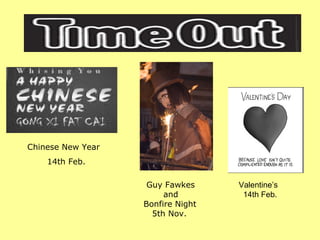
1) Special occasions and dates Hogmanay  New Year’s (Scotland)   Poppy Day 11th Nov. Pancake Day Last day before   Lent
Chinese New Year 14th Feb. Guy Fawkes    and   Bonfire Night   5th Nov.  Valentine’s  14th Feb.
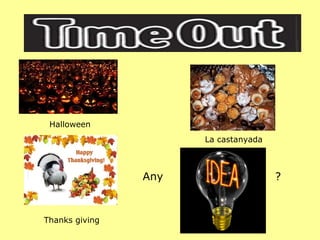
Halloween La castanyada Thanks giving Any  ?
Any volunteer???
2) Let’s talk  about prepositions IN  / ON /  AT Preposition of  TIME IN Use 'in'  months and years and periods of time : in January  in 1978  in the twenties  Use 'in'  a period of time in the future: in a few weeks  in a couple of days
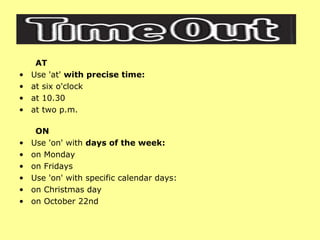
AT Use 'at'  with precise time: at six o'clock  at 10.30  at two p.m.  ON Use 'on' with  days of the week: on Monday  on Fridays  Use 'on' with specific calendar days: on Christmas day  on October 22nd
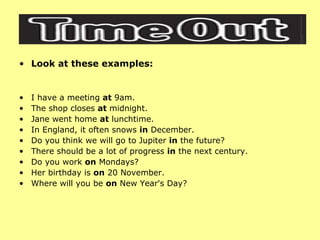
Look at these examples: I have a meeting  at  9am.  The shop closes  at  midnight.  Jane went home  at  lunchtime.  In England, it often snows  in  December.  Do you think we will go to Jupiter  in  the future?  There should be a lot of progress  in  the next century.  Do you work  on  Mondays?  Her birthday is  on  20 November.  Where will you be  on  New Year's Day?
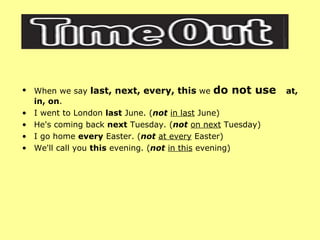
When we say  last, next, every, this  we  do not use  at, in, on . I went to London  last  June. ( not   in last  June)  He's coming back  next  Tuesday. ( not   on next  Tuesday)  I go home  every  Easter. ( not   at every  Easter)  We'll call you  this  evening. ( not   in this  evening)
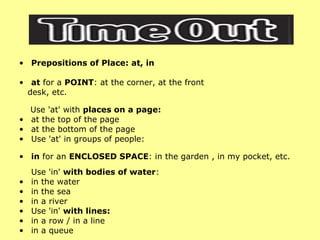
Prepositions of Place: at, in at  for a  POINT : at the corner, at the front  desk, etc.  Use 'at' with  places on a page: at the top of the page  at the bottom of the page  Use 'at' in groups of people: in  for an  ENCLOSED SPACE : in the garden , in my pocket, etc. Use 'in'  with bodies of water : in the water  in the sea  in a river  Use 'in'  with lines: in a row / in a line  in a queue
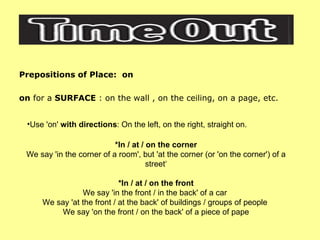
Prepositions of Place:  on on  for a  SURFACE  : on the wall , on the ceiling, on a page, etc. Use 'on'  with directions : On the left, on the right, straight on. *In / at / on the corner We say 'in the corner of a room', but 'at the corner (or 'on the corner') of a street‘ *In / at / on the front We say 'in the front / in the back' of a car  We say 'at the front / at the back' of buildings / groups of people  We say 'on the front / on the back' of a piece of pape
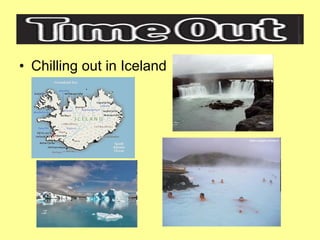
Chilling out in Iceland
Idioms  (natural manner of speaking to a native speaker of a language) Idioms from the text Feel down, their spirits raise, fall in love. Here you are  some more: A Chip On Your Shoulder :  Being upset for something that happened in the past.  A  Piece of Cake :  A task that can be accomplished very easily. Actions Speak Louder Than Words:  It's better to actually do something than just talk about it.  All Greek to me:  Meaningless and incomprehensible like someone who cannot read, speak, or understand any of the Greek language would be.
A Bird In The Hand Is Worth Two In The Bush:  Having something that is certain is much better than taking a risk for more, because chances are you might lose everything.  Crack Someone Up:  To make someone laugh. Cry Over Spilt Milk : When you complain about a loss from the past.  Blue Moon:  A rare event or occurance.   Break A Leg:  A superstitious way to say 'good luck' without saying 'good luck', but rather the opposite.  Get Over It:  To move beyond something that is bothering  . Keep your chin up : To remain joyful in a tough situation. Last but not least:  An introduction phrase to let the audience know that the last person mentioned is no less important than those introduced before him/her.
Revision of verb tenses…. I KNOW… AGAINNNN!!!
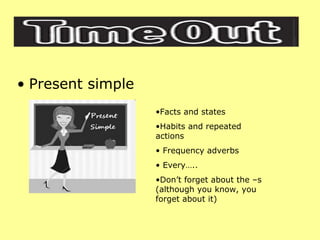
Present simple Facts and states Habits and repeated  actions Frequency adverbs Every….. Don’t forget about the –s (although you know, you forget about it)
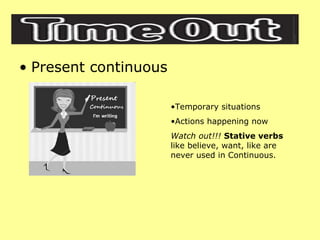
Present continuous Temporary situations Actions happening now Watch out!!!  Stative verbs  like believe, want, like are never used in Continuous.
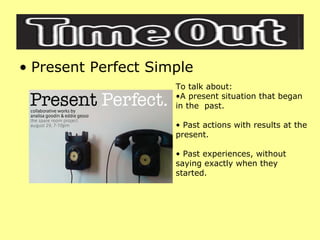
Present Perfect Simple To talk about: A present situation that began in the  past. Past actions with results at the present. Past experiences, without saying exactly when they started.
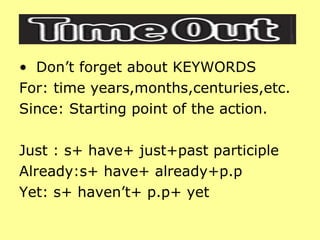
Don’t forget about KEYWORDS For: time years,months,centuries,etc.  Since: Starting point of the action. Just : s+ have+ just+past participle Already:s+ have+ already+p.p Yet: s+ haven’t+ p.p+ yet
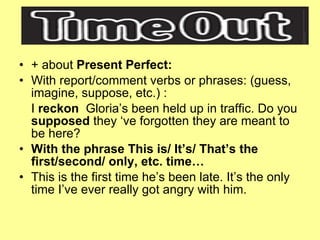
+ about  Present Perfect: With report/comment verbs or phrases: (guess, imagine, suppose, etc.) : I  reckon  Gloria’s been held up in traffic. Do you  supposed  they ‘ve forgotten they are meant to be here? With the phrase This is/ It’s/ That’s the first/second/ only, etc. time… This is the first time he’s been late. It’s the only time I’ve ever really got angry with him.
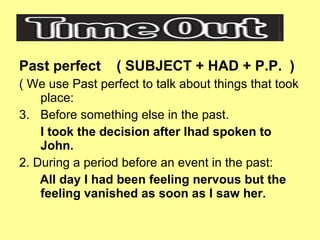
Past perfect  ( SUBJECT + HAD + P.P.  ) ( We use Past perfect to talk about things that took place: Before something else in the past. I took the decision after Ihad spoken to John. 2. During a period before an event in the past: All day I had been feeling nervous but the feeling vanished as soon as I saw her.
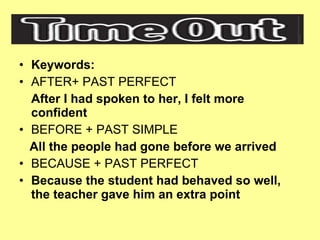
Keywords: AFTER+ PAST PERFECT  After I had spoken to her, I felt more confident BEFORE + PAST SIMPLE All the people had gone before we arrived BECAUSE + PAST PERFECT Because the student had behaved so well, the teacher gave him an extra point
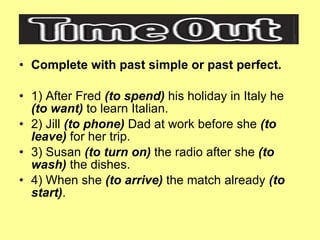
Complete with past simple or past perfect. 1) After Fred  (to spend)  his holiday in Italy he  (to want)  to learn Italian. 2) Jill  (to phone)  Dad at work before she  (to leave)  for her trip. 3) Susan  (to turn on)  the radio after she  (to wash)  the dishes. 4) When she  (to arrive)  the match already  (to start) .
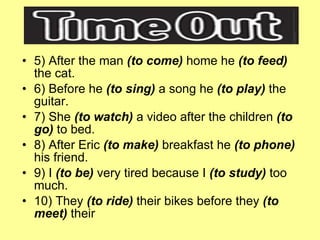
5) After the man  (to come)  home he  (to feed)  the cat. 6) Before he  (to sing)  a song he  (to play)  the guitar. 7) She  (to watch)  a video after the children  (to go)  to bed. 8) After Eric  (to make)  breakfast he  (to phone)  his friend. 9) I  (to be)  very tired because I  (to study)  too much. 10) They  (to ride)  their bikes before they  (to meet)  their
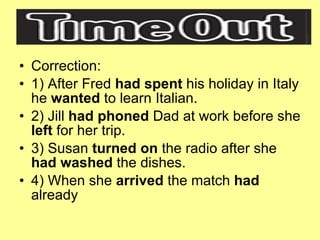
Correction: 1) After Fred  had spent  his holiday in Italy he  wanted  to learn Italian. 2) Jill  had phoned  Dad at work before she  left  for her trip. 3) Susan  turned on  the radio after she  had washed  the dishes. 4) When she  arrived  the match  had  already
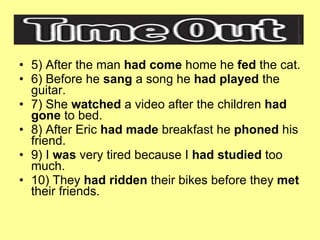
5) After the man  had come  home he  fed  the cat. 6) Before he  sang  a song he  had played  the guitar. 7) She  watched  a video after the children  had gone  to bed. 8) After Eric  had made  breakfast he  phoned  his friend. 9) I  was  very tired because I  had studied  too much. 10) They  had ridden  their bikes before they  met  their friends.
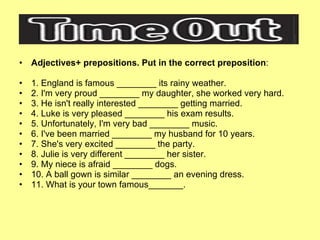
Adjectives+ prepositions. Put in the correct preposition : 1. England is famous ________ its rainy weather. 2. I'm very proud ________ my daughter, she worked very hard. 3. He isn't really interested ________ getting married. 4. Luke is very pleased ________ his exam results. 5. Unfortunately, I'm very bad ________ music. 6. I've been married ________ my husband for 10 years. 7. She's very excited ________ the party. 8. Julie is very different ________ her sister. 9. My niece is afraid ________ dogs. 10. A ball gown is similar ________ an evening dress. 11. What is your town famous_______.
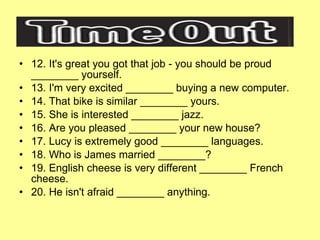
12. It's great you got that job - you should be proud ________ yourself. 13. I'm very excited ________ buying a new computer. 14. That bike is similar ________ yours. 15. She is interested ________ jazz. 16. Are you pleased ________ your new house? 17. Lucy is extremely good ________ languages. 18. Who is James married ________? 19. English cheese is very different ________ French cheese. 20. He isn't afraid ________ anything.
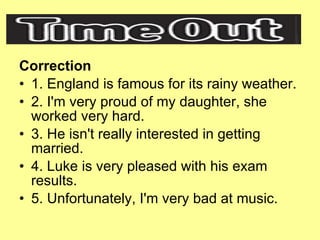
Correction 1. England is famous for its rainy weather. 2. I'm very proud of my daughter, she worked very hard. 3. He isn't really interested in getting married. 4. Luke is very pleased with his exam results. 5. Unfortunately, I'm very bad at music.
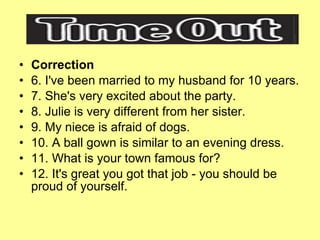
Correction 6. I've been married to my husband for 10 years. 7. She's very excited about the party. 8. Julie is very different from her sister. 9. My niece is afraid of dogs. 10. A ball gown is similar to an evening dress. 11. What is your town famous for? 12. It's great you got that job - you should be proud of yourself.
Correction 13. I'm very excited about buying a new computer. 14. That bike is similar to yours. 15. She is interested in jazz. 16. Are you pleased with your new house? 17. Lucy is extremely good at languages. 18. Who is James married to? 19. English cheese is very different from French cheese. 20. He isn't afraid of anything.

Timeout unit1 2011

  • 1.
    What do you expect from your teacher?? Funny classes Easy exams Learning new vocabulary Help you to participate in class No homework And the winner is… “ Going to computer room ”
  • 2.
    Now… what doesyour teacher expect from you???? Good attitude Participation Work at home I insist on GOOD ATTITUDE 26≠1 or 26 & 1
  • 3.
    1) Special occasionsand dates Hogmanay New Year’s (Scotland) Poppy Day 11th Nov. Pancake Day Last day before Lent
  • 4.
    Chinese New Year14th Feb. Guy Fawkes and Bonfire Night 5th Nov. Valentine’s 14th Feb.
  • 5.
    Halloween La castanyadaThanks giving Any ?
  • 6.
  • 7.
    2) Let’s talk about prepositions IN / ON / AT Preposition of TIME IN Use 'in' months and years and periods of time : in January in 1978 in the twenties Use 'in' a period of time in the future: in a few weeks in a couple of days
  • 8.
    AT Use 'at' with precise time: at six o'clock at 10.30 at two p.m. ON Use 'on' with days of the week: on Monday on Fridays Use 'on' with specific calendar days: on Christmas day on October 22nd
  • 9.
    Look at theseexamples: I have a meeting at 9am. The shop closes at midnight. Jane went home at lunchtime. In England, it often snows in December. Do you think we will go to Jupiter in the future? There should be a lot of progress in the next century. Do you work on Mondays? Her birthday is on 20 November. Where will you be on New Year's Day?
  • 10.
    When we say last, next, every, this we do not use at, in, on . I went to London last June. ( not in last June) He's coming back next Tuesday. ( not on next Tuesday) I go home every Easter. ( not at every Easter) We'll call you this evening. ( not in this evening)
  • 11.
    Prepositions of Place:at, in at for a POINT : at the corner, at the front desk, etc. Use 'at' with places on a page: at the top of the page at the bottom of the page Use 'at' in groups of people: in for an ENCLOSED SPACE : in the garden , in my pocket, etc. Use 'in' with bodies of water : in the water in the sea in a river Use 'in' with lines: in a row / in a line in a queue
  • 12.
    Prepositions of Place: on on for a SURFACE : on the wall , on the ceiling, on a page, etc. Use 'on' with directions : On the left, on the right, straight on. *In / at / on the corner We say 'in the corner of a room', but 'at the corner (or 'on the corner') of a street‘ *In / at / on the front We say 'in the front / in the back' of a car We say 'at the front / at the back' of buildings / groups of people We say 'on the front / on the back' of a piece of pape
  • 13.
  • 14.
    Idioms (naturalmanner of speaking to a native speaker of a language) Idioms from the text Feel down, their spirits raise, fall in love. Here you are some more: A Chip On Your Shoulder : Being upset for something that happened in the past. A Piece of Cake : A task that can be accomplished very easily. Actions Speak Louder Than Words: It's better to actually do something than just talk about it. All Greek to me: Meaningless and incomprehensible like someone who cannot read, speak, or understand any of the Greek language would be.
  • 15.
    A Bird InThe Hand Is Worth Two In The Bush: Having something that is certain is much better than taking a risk for more, because chances are you might lose everything. Crack Someone Up: To make someone laugh. Cry Over Spilt Milk : When you complain about a loss from the past. Blue Moon: A rare event or occurance. Break A Leg: A superstitious way to say 'good luck' without saying 'good luck', but rather the opposite. Get Over It: To move beyond something that is bothering . Keep your chin up : To remain joyful in a tough situation. Last but not least: An introduction phrase to let the audience know that the last person mentioned is no less important than those introduced before him/her.
  • 16.
    Revision of verbtenses…. I KNOW… AGAINNNN!!!
  • 17.
    Present simple Factsand states Habits and repeated actions Frequency adverbs Every….. Don’t forget about the –s (although you know, you forget about it)
  • 18.
    Present continuous Temporarysituations Actions happening now Watch out!!! Stative verbs like believe, want, like are never used in Continuous.
  • 19.
    Present Perfect SimpleTo talk about: A present situation that began in the past. Past actions with results at the present. Past experiences, without saying exactly when they started.
  • 20.
    Don’t forget aboutKEYWORDS For: time years,months,centuries,etc. Since: Starting point of the action. Just : s+ have+ just+past participle Already:s+ have+ already+p.p Yet: s+ haven’t+ p.p+ yet
  • 21.
    + about Present Perfect: With report/comment verbs or phrases: (guess, imagine, suppose, etc.) : I reckon Gloria’s been held up in traffic. Do you supposed they ‘ve forgotten they are meant to be here? With the phrase This is/ It’s/ That’s the first/second/ only, etc. time… This is the first time he’s been late. It’s the only time I’ve ever really got angry with him.
  • 22.
    Past perfect ( SUBJECT + HAD + P.P. ) ( We use Past perfect to talk about things that took place: Before something else in the past. I took the decision after Ihad spoken to John. 2. During a period before an event in the past: All day I had been feeling nervous but the feeling vanished as soon as I saw her.
  • 23.
    Keywords: AFTER+ PASTPERFECT After I had spoken to her, I felt more confident BEFORE + PAST SIMPLE All the people had gone before we arrived BECAUSE + PAST PERFECT Because the student had behaved so well, the teacher gave him an extra point
  • 24.
    Complete with pastsimple or past perfect. 1) After Fred (to spend) his holiday in Italy he (to want) to learn Italian. 2) Jill (to phone) Dad at work before she (to leave) for her trip. 3) Susan (to turn on) the radio after she (to wash) the dishes. 4) When she (to arrive) the match already (to start) .
  • 25.
    5) After theman (to come) home he (to feed) the cat. 6) Before he (to sing) a song he (to play) the guitar. 7) She (to watch) a video after the children (to go) to bed. 8) After Eric (to make) breakfast he (to phone) his friend. 9) I (to be) very tired because I (to study) too much. 10) They (to ride) their bikes before they (to meet) their
  • 26.
    Correction: 1) AfterFred had spent his holiday in Italy he wanted to learn Italian. 2) Jill had phoned Dad at work before she left for her trip. 3) Susan turned on the radio after she had washed the dishes. 4) When she arrived the match had already
  • 27.
    5) After theman had come home he fed the cat. 6) Before he sang a song he had played the guitar. 7) She watched a video after the children had gone to bed. 8) After Eric had made breakfast he phoned his friend. 9) I was very tired because I had studied too much. 10) They had ridden their bikes before they met their friends.
  • 28.
    Adjectives+ prepositions. Putin the correct preposition : 1. England is famous ________ its rainy weather. 2. I'm very proud ________ my daughter, she worked very hard. 3. He isn't really interested ________ getting married. 4. Luke is very pleased ________ his exam results. 5. Unfortunately, I'm very bad ________ music. 6. I've been married ________ my husband for 10 years. 7. She's very excited ________ the party. 8. Julie is very different ________ her sister. 9. My niece is afraid ________ dogs. 10. A ball gown is similar ________ an evening dress. 11. What is your town famous_______.
  • 29.
    12. It's greatyou got that job - you should be proud ________ yourself. 13. I'm very excited ________ buying a new computer. 14. That bike is similar ________ yours. 15. She is interested ________ jazz. 16. Are you pleased ________ your new house? 17. Lucy is extremely good ________ languages. 18. Who is James married ________? 19. English cheese is very different ________ French cheese. 20. He isn't afraid ________ anything.
  • 30.
    Correction 1. Englandis famous for its rainy weather. 2. I'm very proud of my daughter, she worked very hard. 3. He isn't really interested in getting married. 4. Luke is very pleased with his exam results. 5. Unfortunately, I'm very bad at music.
  • 31.
    Correction 6. I'vebeen married to my husband for 10 years. 7. She's very excited about the party. 8. Julie is very different from her sister. 9. My niece is afraid of dogs. 10. A ball gown is similar to an evening dress. 11. What is your town famous for? 12. It's great you got that job - you should be proud of yourself.
  • 32.
    Correction 13. I'mvery excited about buying a new computer. 14. That bike is similar to yours. 15. She is interested in jazz. 16. Are you pleased with your new house? 17. Lucy is extremely good at languages. 18. Who is James married to? 19. English cheese is very different from French cheese. 20. He isn't afraid of anything.