MARKET LEADER Elementary level   By D.Cotton,   D.Falvey,   &S. kent
 
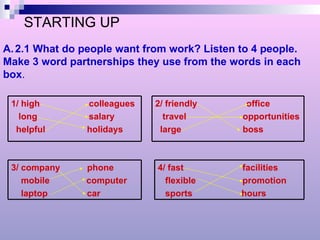
STARTING UP 2.1 What do people want from work? Listen to 4 people. Make 3 word partnerships they use from the words in each  box . 1/ high  colleagues long  salary helpful  holidays 2/ friendly  office travel  opportunities large  boss 3/ company  phone  mobile  computer laptop  car 4/ fast  facilities flexible  promotion sports  hours
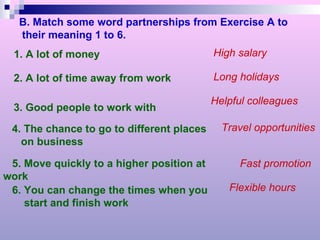
B. Match some word partnerships from Exercise A to their meaning 1 to 6. 1. A lot of money 2. A lot of time away from work 3. Good people to work with 4. The chance to go to different places on business 5. Move quickly to a higher position at work 6. You can change the times when you  start and finish work High salary Long holidays Helpful colleagues Travel opportunities Fast promotion Flexible hours
C. what do you want from work? Use the word partnerships  from Exercise A and make a list. In pairs, compare your lists and choose the five most important things. Work in pairs.
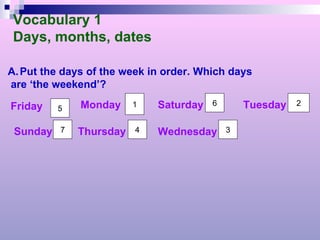
Vocabulary 1 Days, months, dates Put the days of the week in order. Which days  are ‘the weekend’? Friday  Sunday Monday  Thursday Saturday Wednesday Tuesday 5 1 4 7 3 6 2
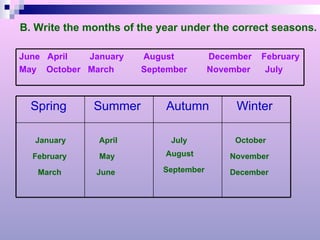
B. Write the months of the year under the correct seasons. January February  March April May June July August September October November December June  April  January  August  December  February May  October  March  September  November  July Winter  Autumn Summer  Spring
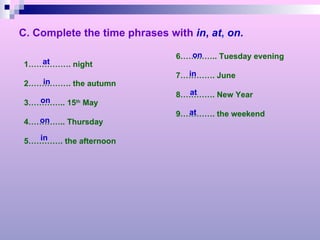
C. Complete the time phrases with   in ,  at ,   on . 1……………. night 2……………. the autumn 3………….. 15 th  May 4………….. Thursday 5…………. the afternoon 6………….. Tuesday evening 7…………. June 8…………. New Year 9…………. the weekend at in on on in on in at at
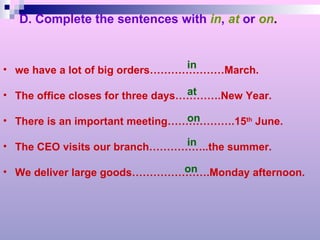
D. Complete the sentences with   in ,   at  or   on . we have a lot of big orders…………………March. The office closes for three days………….New Year. There is an important meeting……………….15 th  June. The CEO visits our branch……………..the summer. We deliver large goods………………….Monday afternoon. in at on in on
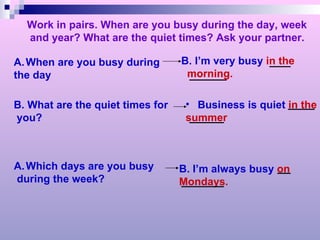
Work in pairs. When are you busy during the day, week and year? What are the quiet times? Ask your partner. When are you busy during  the day B. I’m very busy  in the morning. B. What are the quiet times for you? Business is quiet  in the summer Which days are you busy during the week? B. I’m always busy  on  Mondays.
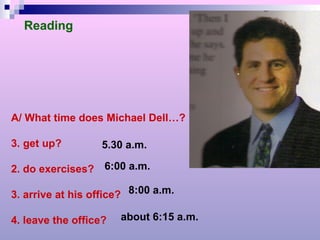
Reading A/ What time does Michael Dell…? get up?  2. do exercises? 3. arrive at his office? 4. leave the office? 5.30 a.m. 6:00 a.m. 8:00 a.m. about 6:15 a.m.
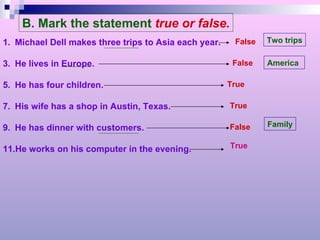
B. Mark the statement   true or false. Michael Dell makes three trips to Asia each year. He lives in Europe. He has four children. His wife has a shop in Austin, Texas. He has dinner with customers. He works on his computer in the evening. False False True True False Two trips America Family True
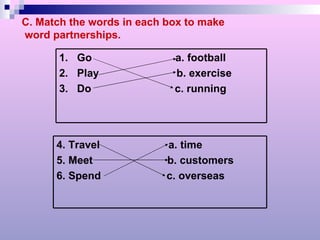
C. Match the words in each box to make word partnerships. 1.  Go  a. football 2.  Play  b. exercise 3.  Do  c. running 4. Travel  a. time 5. Meet  b. customers 6. Spend  c. overseas
Work in pairs. Tell about your day. I get up at………………… I leave home at……………………….. I go running…………………………….
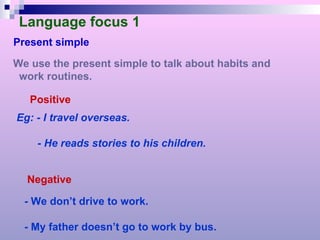
Language focus 1 Present simple We use the present simple to talk about habits and work routines. Eg: - I travel overseas. - He reads stories to his children. Positive - We don’t drive to work. - My father doesn’t go to work by bus. Negative
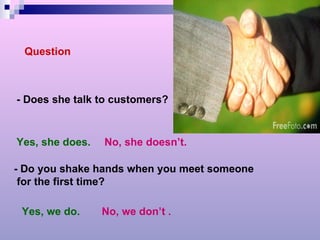
Question - Does she talk to customers? Yes, she does. No, she doesn’t. - Do you shake hands when you meet someone for the first time? Yes, we do. No, we don’t .
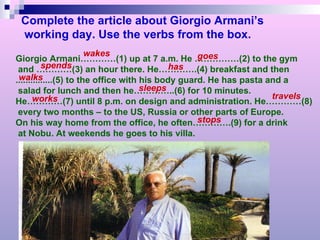
Complete the article about Giorgio Armani’s working day. Use the verbs from the box. Giorgio Armani…………(1) up at 7 a.m. He ……………(2) to the gym and …………(3) an hour there. He………….(4) breakfast and then ...............(5) to the office with his body guard. He has pasta and a salad for lunch and then he…………..(6) for 10 minutes. He…………(7) until 8 p.m. on design and administration. He…………(8) every two months – to the US, Russia or other parts of Europe. On his way home from the office, he often………….(9) for a drink at Nobu. At weekends he goes to his villa. wakes goes spends has walks sleeps works travels stops
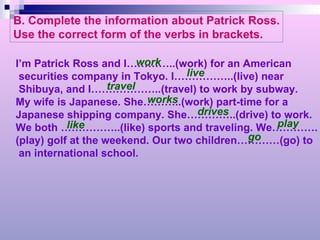
B. Complete the information about Patrick Ross. Use the correct form of the verbs in brackets. I’m Patrick Ross and I…………..(work) for an American securities company in Tokyo. I……………..(live) near Shibuya, and I………………..(travel) to work by subway. My wife is Japanese. She………..(work) part-time for a  Japanese shipping company. She…………..(drive) to work. We both ……………..(like) sports and traveling. We…………. (play) golf at the weekend. Our two children…………(go) to an international school. work live travel works drives like play go
C. Write a paragraph like the one in Exercise B about yourself.
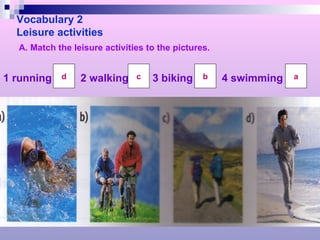
Vocabulary 2 Leisure activities 1 running 2 walking 3 biking 4 swimming d a b c A. Match the leisure activities to the pictures.
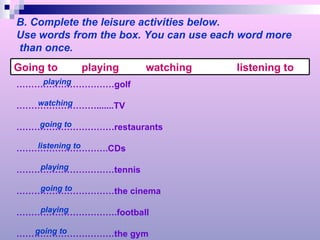
B. Complete the leisure activities below. Use words from the box. You can use each word more than once. …………………………… golf ……………………… .......TV …………………………… restaurants ………………………… .CDs …………………………… tennis …………………………… the cinema …………………………… .football …………………………… the gym playing watching going to listening to playing going to playing going to Going to  playing  watching  listening to
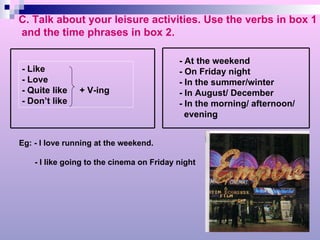
C. Talk about your leisure activities. Use the verbs in box 1 and the time phrases in box 2. Eg: - I love running at the weekend.  - I like going to the cinema on Friday night - At the weekend - On Friday night - In the summer/winter - In August/ December - In the morning/ afternoon/ evening - Like - Love  - Quite like  + V-ing - Don’t like
Language focus 2 Adverbs and expressions of frequency We often use adverbs and expressions of frequency with the present simple to say how often we do things. Adverbs of frequency often go before the main verb. Structure S +  adv of fre  + V + O Adverbs of frequency often go after the verb “to be”. Structure S + to be +  adv of fre  + O
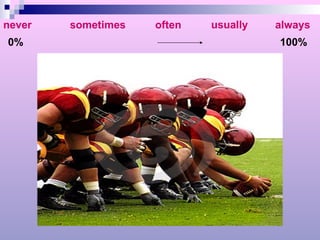
never sometimes often usually  always 0% 100%
Expressions of frequency go at the beginning or the end of a sentence. Eg: - Two nights a week he works late at the office. - He works from home once a month. Once a day/week/month/year Twice a day/week/month/year Every 2 years Four times a year Each year Every day Two nights a week
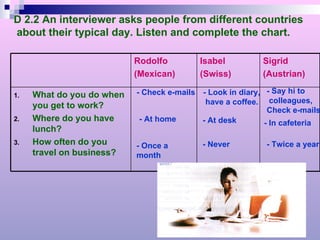
D 2.2 An interviewer asks people from different countries about their typical day. Listen and complete the chart. - Check e-mails - At home - Once a month - Look in diary, have a coffee. - At desk - Never - Say hi to  colleagues, Check e-mails - In cafeteria - Twice a year What do you do when you get to work? Where do you have lunch? How often do you travel on business? Sigrid (Austrian) Isabel (Swiss) Rodolfo (Mexican)
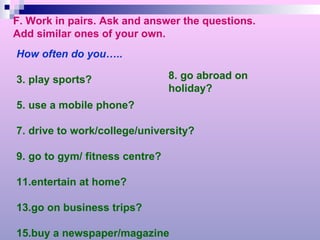
F. Work in pairs. Ask and answer the questions. Add similar ones of your own. How often do you….. play sports? use a mobile phone? drive to work/college/university? go to gym/ fitness centre? entertain at home? go on business trips? buy a newspaper/magazine 8. go abroad on holiday?
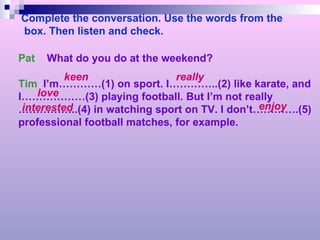
Complete the conversation. Use the words from the box. Then listen and check. Pat  What do you do at the weekend? Tim   I’m…………(1) on sport. I…………..(2) like karate, and I………………(3) playing football. But I’m not really …………… ..(4) in watching sport on TV. I don’t………….(5) professional football matches, for example. keen really love interested enjoy
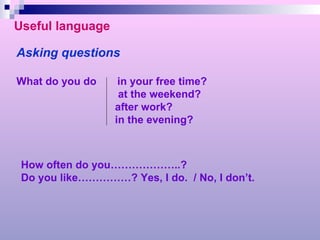
Useful language Asking questions What do you do  in your free time? at the weekend? after work? in the evening? How often do you………………..? Do you like……………? Yes, I do.  / No, I don’t.
Expressing feelings I like/love………… I’m keen on……………………. I really enjoy……………………….. I’m interested in………………………….. I don’t like…………………………….. He isn’t keen on………………… She doesn’t enjoy……………………. We aren’t interested in……………………..
 
Many thanks for your attention!

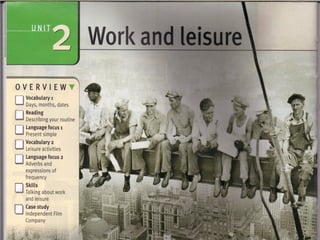
Unit 2

  • 1.
    MARKET LEADER Elementarylevel By D.Cotton, D.Falvey, &S. kent
  • 2.
  • 3.
    STARTING UP 2.1What do people want from work? Listen to 4 people. Make 3 word partnerships they use from the words in each box . 1/ high colleagues long salary helpful holidays 2/ friendly office travel opportunities large boss 3/ company phone mobile computer laptop car 4/ fast facilities flexible promotion sports hours
  • 4.
    B. Match someword partnerships from Exercise A to their meaning 1 to 6. 1. A lot of money 2. A lot of time away from work 3. Good people to work with 4. The chance to go to different places on business 5. Move quickly to a higher position at work 6. You can change the times when you start and finish work High salary Long holidays Helpful colleagues Travel opportunities Fast promotion Flexible hours
  • 5.
    C. what doyou want from work? Use the word partnerships from Exercise A and make a list. In pairs, compare your lists and choose the five most important things. Work in pairs.
  • 6.
    Vocabulary 1 Days,months, dates Put the days of the week in order. Which days are ‘the weekend’? Friday Sunday Monday Thursday Saturday Wednesday Tuesday 5 1 4 7 3 6 2
  • 7.
    B. Write themonths of the year under the correct seasons. January February March April May June July August September October November December June April January August December February May October March September November July Winter Autumn Summer Spring
  • 8.
    C. Complete thetime phrases with in , at , on . 1……………. night 2……………. the autumn 3………….. 15 th May 4………….. Thursday 5…………. the afternoon 6………….. Tuesday evening 7…………. June 8…………. New Year 9…………. the weekend at in on on in on in at at
  • 9.
    D. Complete thesentences with in , at or on . we have a lot of big orders…………………March. The office closes for three days………….New Year. There is an important meeting……………….15 th June. The CEO visits our branch……………..the summer. We deliver large goods………………….Monday afternoon. in at on in on
  • 10.
    Work in pairs.When are you busy during the day, week and year? What are the quiet times? Ask your partner. When are you busy during the day B. I’m very busy in the morning. B. What are the quiet times for you? Business is quiet in the summer Which days are you busy during the week? B. I’m always busy on Mondays.
  • 11.
    Reading A/ Whattime does Michael Dell…? get up? 2. do exercises? 3. arrive at his office? 4. leave the office? 5.30 a.m. 6:00 a.m. 8:00 a.m. about 6:15 a.m.
  • 12.
    B. Mark thestatement true or false. Michael Dell makes three trips to Asia each year. He lives in Europe. He has four children. His wife has a shop in Austin, Texas. He has dinner with customers. He works on his computer in the evening. False False True True False Two trips America Family True
  • 13.
    C. Match thewords in each box to make word partnerships. 1. Go a. football 2. Play b. exercise 3. Do c. running 4. Travel a. time 5. Meet b. customers 6. Spend c. overseas
  • 14.
    Work in pairs.Tell about your day. I get up at………………… I leave home at……………………….. I go running…………………………….
  • 15.
    Language focus 1Present simple We use the present simple to talk about habits and work routines. Eg: - I travel overseas. - He reads stories to his children. Positive - We don’t drive to work. - My father doesn’t go to work by bus. Negative
  • 16.
    Question - Doesshe talk to customers? Yes, she does. No, she doesn’t. - Do you shake hands when you meet someone for the first time? Yes, we do. No, we don’t .
  • 17.
    Complete the articleabout Giorgio Armani’s working day. Use the verbs from the box. Giorgio Armani…………(1) up at 7 a.m. He ……………(2) to the gym and …………(3) an hour there. He………….(4) breakfast and then ...............(5) to the office with his body guard. He has pasta and a salad for lunch and then he…………..(6) for 10 minutes. He…………(7) until 8 p.m. on design and administration. He…………(8) every two months – to the US, Russia or other parts of Europe. On his way home from the office, he often………….(9) for a drink at Nobu. At weekends he goes to his villa. wakes goes spends has walks sleeps works travels stops
  • 18.
    B. Complete theinformation about Patrick Ross. Use the correct form of the verbs in brackets. I’m Patrick Ross and I…………..(work) for an American securities company in Tokyo. I……………..(live) near Shibuya, and I………………..(travel) to work by subway. My wife is Japanese. She………..(work) part-time for a Japanese shipping company. She…………..(drive) to work. We both ……………..(like) sports and traveling. We…………. (play) golf at the weekend. Our two children…………(go) to an international school. work live travel works drives like play go
  • 19.
    C. Write aparagraph like the one in Exercise B about yourself.
  • 20.
    Vocabulary 2 Leisureactivities 1 running 2 walking 3 biking 4 swimming d a b c A. Match the leisure activities to the pictures.
  • 21.
    B. Complete theleisure activities below. Use words from the box. You can use each word more than once. …………………………… golf ……………………… .......TV …………………………… restaurants ………………………… .CDs …………………………… tennis …………………………… the cinema …………………………… .football …………………………… the gym playing watching going to listening to playing going to playing going to Going to playing watching listening to
  • 22.
    C. Talk aboutyour leisure activities. Use the verbs in box 1 and the time phrases in box 2. Eg: - I love running at the weekend. - I like going to the cinema on Friday night - At the weekend - On Friday night - In the summer/winter - In August/ December - In the morning/ afternoon/ evening - Like - Love - Quite like + V-ing - Don’t like
  • 23.
    Language focus 2Adverbs and expressions of frequency We often use adverbs and expressions of frequency with the present simple to say how often we do things. Adverbs of frequency often go before the main verb. Structure S + adv of fre + V + O Adverbs of frequency often go after the verb “to be”. Structure S + to be + adv of fre + O
  • 24.
    never sometimes oftenusually always 0% 100%
  • 25.
    Expressions of frequencygo at the beginning or the end of a sentence. Eg: - Two nights a week he works late at the office. - He works from home once a month. Once a day/week/month/year Twice a day/week/month/year Every 2 years Four times a year Each year Every day Two nights a week
  • 26.
    D 2.2 Aninterviewer asks people from different countries about their typical day. Listen and complete the chart. - Check e-mails - At home - Once a month - Look in diary, have a coffee. - At desk - Never - Say hi to colleagues, Check e-mails - In cafeteria - Twice a year What do you do when you get to work? Where do you have lunch? How often do you travel on business? Sigrid (Austrian) Isabel (Swiss) Rodolfo (Mexican)
  • 27.
    F. Work inpairs. Ask and answer the questions. Add similar ones of your own. How often do you….. play sports? use a mobile phone? drive to work/college/university? go to gym/ fitness centre? entertain at home? go on business trips? buy a newspaper/magazine 8. go abroad on holiday?
  • 28.
    Complete the conversation.Use the words from the box. Then listen and check. Pat What do you do at the weekend? Tim I’m…………(1) on sport. I…………..(2) like karate, and I………………(3) playing football. But I’m not really …………… ..(4) in watching sport on TV. I don’t………….(5) professional football matches, for example. keen really love interested enjoy
  • 29.
    Useful language Askingquestions What do you do in your free time? at the weekend? after work? in the evening? How often do you………………..? Do you like……………? Yes, I do. / No, I don’t.
  • 30.
    Expressing feelings Ilike/love………… I’m keen on……………………. I really enjoy……………………….. I’m interested in………………………….. I don’t like…………………………….. He isn’t keen on………………… She doesn’t enjoy……………………. We aren’t interested in……………………..
  • 31.
  • 32.
    Many thanks foryour attention!