Final project!(:
Unit 1...*Question forms*Prepositions of place, time and movement
Questionsforms...?Direct questions:Yes/no questions1. Most verbs need to use the auxiliary do/does/did to make questions.Ex…Did you do the homework yesterday?2. Verbs with be, can and have(got) don´t need the auxiliary do/does/did.ex…Have you got the ball?3. Negative yes/no questions expect a particular answer.Ex…Aren´t you going out with me?
Wh – questions1. Questions words(who, what, where, when, whose, why, which and how) come at the beginning of the question.Ex…When is your birthday?2. If who, what or which is the subject of the sentence, we don´t use the auxiliary do/does/did, and we use normal sentence word order.Ex…Who pay you the book?3. If there is a preposition, it comes at the end of the question.Ex…What were the history about?Alternative question(which expect the answer to be one of two options)There are two types: yes/no type and wh – type.Ex…Does she want to eat pizza or burger?      Which shirt do you like more, the pink or the black?
Indirect questionsCommon ways of starting indirect questions:*I’d like to know*Could you tell me*Would you mind telling me*Do you knowEx…Do you know if the class has been finished yet?Question tagsQuestion tags are short questions at the end of a statement.Ex…She loves him, doesn’t she?       He doesn’t have a dog, does he?
prepositions of place, time and movement!preposition of placeAT-> a point in space where something happens.Ex…At the beginning.IN-> something takes place inside.Ex…In the house.ON-> shows that something taking place is on something.Ex…On the street.
Preposition of timeAT-> clock times, points in time, weekends, holidays.Ex…At 8:00 O’clock.IN-> months, years, seasons, centuries, parts of the day, a point of time during a period.Ex…In the morning.ON-> specific days and dates.Ex…on New Year’s day.
Preposition of movementAT-> use it with “arrive”, to show the person/thing the action is aimed at.Ex…The airplane arrive at the airport.TO-> use it with verbs of movement(come, go, travel, run, send, take, walk, etc.)Ex…I’m going on a travel to Paris.INTO-> use it with verbs that mean “to move from outside to an inside areas”.Ex…I’m into my room.TOWARDS-> it means moving or pointing in a particular direction.Ex…The dog walk towards me.AT THE END-> final point or part.Ex…My room is at the end of the corridor.IN THE END->  it means finally after a long time.Ex…In the end of the movie, he die.
Unit 2...*Present simple and present continuous*Modifiers
Present simple and present continuous!Present simpleRoutines(often with adverbs of frequency like always, often, sometimes, never, once a week).Ex…Sam goes to walk everyday morning.Future meanings(after when, as soon as, if, until).Ex…Do the homework if you want to go out later.Permanent situationsEx…I come from Mexico.TimetablesEx…The theatre function starts at 10:00 a.m.Scientific factsEx…The sun rises in the east.State verbs(be, have, depend, know, think, understand, disagree, like, want, hear, love, see, smell, taste).Ex…This flower smells so well.
Present continuousActions happening nowEx…He is preparing the food.Changing situationsEx…My brother is getting bigger day after day.Temporary situationsEx…My grandmother is going to stay here this week.Future plansEx…What are you going to do on Christmas? Annoying habitsEx…George always scream at me.
Modifiers!Fairly: more than average, but less than very.Ex…Jessica is fairly thin.Quite: a little, or a lot but not completely.Ex…He’s quite attractive.Pretty: it’s stronger than quite. It suggest more than was expected.Ex…The house is pretty big.A bit: it’s used with the same meaning as little.ex…It’s a bit hot here.Really: it’s used to show emphasis. It’s also used with verbs.Ex…Hayley is really beautiful.Extremely/incredibly/terriblyThey are used in a similar way to very but are stronger than very.Ex…It was extremely hard.
Unit 3...*Types of comparison*Reflexives and own
types of comparison!To a higher degreeEx…The dog of Franck is smaller than Tony’s dog.To the same degreeEx…My house is as big as Elena’s house.To a lower degreeEx…He has less good grades than before.(not)as…asEx…Shakira is not as good as Beyonce.So…asEx…The cell phone is not so expensive as we think.
Reflexives and own!When the object is the same person/thing  as the subject.Ex…He hit himself with the ball.With by to mean alone.Ex…All my friends live by themselves.Without the help of others.Ex…She do the homework on her own.To mean alone.Ex…I don´t like to go to the cinema on my own.
Unit 3…*Narrative tenses*Time conjunctions
Narrative tenses!Past simpleFORM-> verb + -ed(remember there are many irregular verb forms)To talk about events in the past that are now finished.Ex…She made the cake the last week.To talk about habits in the past.Ex…Sara went to ballet on holidays.To talk about situations in the past.Ex…When I was a child, I went to guitar classes.In reported speech.Ex…He told me that he did the work.
Past continuousFORM-> was/were + -ingUse it to describe a longer continuous past action, which was in progress when another action happened.Ex…We were playing soccer out when it start raining.Past perfect simpleFORM-> had + past participleTo refer to a time earlier than another past time.Ex…When she went out to play, she had already done her homework.In reported speech.Ex…Sara said she had already made the food.
Past perfect continuousFORM-> had been + -ingUse it to talk about a longer continuous action which was going on before the main events happened.Ex…Before Jim finally decided to go to France, he had been thinking about it for months.
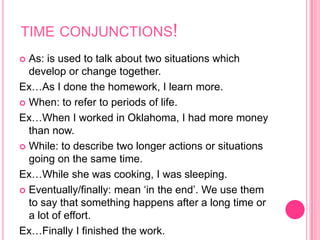
time conjunctions!As: is used to talk about two situations which develop or change together.Ex…As I done the homework, I learn more.When: to refer to periods of life.Ex…When I worked in Oklahoma, I had more money than now.While: to describe two longer actions or situations going on the same time.Ex…While she was cooking, I was sleeping.Eventually/finally: mean ‘in the end’. We use them to say that something happens after a long time or a lot of effort.Ex…Finally I finished the work.
At first/to begin with: refer to the beginning of a situation, to make a contrast with something different that happens later.Ex…She answer the easier questions of the exam to begin with it.As soon as: to talk about two actions or events that happen very quickly one after the other.Ex…As soon as I was walking, I saw my friend Tom.After/afterwards/after that: Ex…They are going to the cinema and after that they are going for a coffee.By the time: is used before a verb and means ‘not later than’.Ex…I will arrived to my house by the time you went to the office.
Unit 5...*Modals*used to and would
Modals!Can: we use can to ask for and give permission.Ex…Can I go to the party?Could: we use could to ask for permission when you are not sure what the answer will be.Ex…Could you come to my house?May: we use it to ask for or give permission in formal situations.Ex…You may have the day off today.
Ought to/should: we use them to talk about obligations and duties in the future, present and past.Ex…You ought to/should do more exercise to have a good health.Must: talk about present and future strong obligations and necessities that come from the speaker.Ex…She must study to pass the exam.Needn’t/don’t need/don’t have to: we use them to talk about a lack of obligation in the present or future.Ex…You don’t have to wake up early tomorrow.
used to and would!Used to: past habits that no longer exits.Ex…I used to play with the dolls, but now I don’t.      She used to make all the homework's, but now she doesn’t do it.Would: past habits and repeated actions.Ex…When I lived in Aguascalientes, I would see my cousins every day.      When David was teenager, He would go to a lot of parties.

Final Project!(:

  • 1.
    Finalproject!(:
  • 2.
    Unit 1...*Question forms*Prepositionsof place, time and movement
  • 3.
    Questionsforms...?Direct questions:Yes/no questions1.Most verbs need to use the auxiliary do/does/did to make questions.Ex…Did you do the homework yesterday?2. Verbs with be, can and have(got) don´t need the auxiliary do/does/did.ex…Have you got the ball?3. Negative yes/no questions expect a particular answer.Ex…Aren´t you going out with me?
  • 4.
    Wh – questions1.Questions words(who, what, where, when, whose, why, which and how) come at the beginning of the question.Ex…When is your birthday?2. If who, what or which is the subject of the sentence, we don´t use the auxiliary do/does/did, and we use normal sentence word order.Ex…Who pay you the book?3. If there is a preposition, it comes at the end of the question.Ex…What were the history about?Alternative question(which expect the answer to be one of two options)There are two types: yes/no type and wh – type.Ex…Does she want to eat pizza or burger? Which shirt do you like more, the pink or the black?
  • 5.
    Indirect questionsCommon waysof starting indirect questions:*I’d like to know*Could you tell me*Would you mind telling me*Do you knowEx…Do you know if the class has been finished yet?Question tagsQuestion tags are short questions at the end of a statement.Ex…She loves him, doesn’t she? He doesn’t have a dog, does he?
  • 6.
    prepositions of place,time and movement!preposition of placeAT-> a point in space where something happens.Ex…At the beginning.IN-> something takes place inside.Ex…In the house.ON-> shows that something taking place is on something.Ex…On the street.
  • 7.
    Preposition of timeAT->clock times, points in time, weekends, holidays.Ex…At 8:00 O’clock.IN-> months, years, seasons, centuries, parts of the day, a point of time during a period.Ex…In the morning.ON-> specific days and dates.Ex…on New Year’s day.
  • 8.
    Preposition of movementAT->use it with “arrive”, to show the person/thing the action is aimed at.Ex…The airplane arrive at the airport.TO-> use it with verbs of movement(come, go, travel, run, send, take, walk, etc.)Ex…I’m going on a travel to Paris.INTO-> use it with verbs that mean “to move from outside to an inside areas”.Ex…I’m into my room.TOWARDS-> it means moving or pointing in a particular direction.Ex…The dog walk towards me.AT THE END-> final point or part.Ex…My room is at the end of the corridor.IN THE END-> it means finally after a long time.Ex…In the end of the movie, he die.
  • 9.
    Unit 2...*Present simpleand present continuous*Modifiers
  • 10.
    Present simple andpresent continuous!Present simpleRoutines(often with adverbs of frequency like always, often, sometimes, never, once a week).Ex…Sam goes to walk everyday morning.Future meanings(after when, as soon as, if, until).Ex…Do the homework if you want to go out later.Permanent situationsEx…I come from Mexico.TimetablesEx…The theatre function starts at 10:00 a.m.Scientific factsEx…The sun rises in the east.State verbs(be, have, depend, know, think, understand, disagree, like, want, hear, love, see, smell, taste).Ex…This flower smells so well.
  • 11.
    Present continuousActions happeningnowEx…He is preparing the food.Changing situationsEx…My brother is getting bigger day after day.Temporary situationsEx…My grandmother is going to stay here this week.Future plansEx…What are you going to do on Christmas? Annoying habitsEx…George always scream at me.
  • 12.
    Modifiers!Fairly: more thanaverage, but less than very.Ex…Jessica is fairly thin.Quite: a little, or a lot but not completely.Ex…He’s quite attractive.Pretty: it’s stronger than quite. It suggest more than was expected.Ex…The house is pretty big.A bit: it’s used with the same meaning as little.ex…It’s a bit hot here.Really: it’s used to show emphasis. It’s also used with verbs.Ex…Hayley is really beautiful.Extremely/incredibly/terriblyThey are used in a similar way to very but are stronger than very.Ex…It was extremely hard.
  • 13.
    Unit 3...*Types ofcomparison*Reflexives and own
  • 14.
    types of comparison!Toa higher degreeEx…The dog of Franck is smaller than Tony’s dog.To the same degreeEx…My house is as big as Elena’s house.To a lower degreeEx…He has less good grades than before.(not)as…asEx…Shakira is not as good as Beyonce.So…asEx…The cell phone is not so expensive as we think.
  • 15.
    Reflexives and own!Whenthe object is the same person/thing as the subject.Ex…He hit himself with the ball.With by to mean alone.Ex…All my friends live by themselves.Without the help of others.Ex…She do the homework on her own.To mean alone.Ex…I don´t like to go to the cinema on my own.
  • 16.
  • 17.
    Narrative tenses!Past simpleFORM->verb + -ed(remember there are many irregular verb forms)To talk about events in the past that are now finished.Ex…She made the cake the last week.To talk about habits in the past.Ex…Sara went to ballet on holidays.To talk about situations in the past.Ex…When I was a child, I went to guitar classes.In reported speech.Ex…He told me that he did the work.
  • 18.
    Past continuousFORM-> was/were+ -ingUse it to describe a longer continuous past action, which was in progress when another action happened.Ex…We were playing soccer out when it start raining.Past perfect simpleFORM-> had + past participleTo refer to a time earlier than another past time.Ex…When she went out to play, she had already done her homework.In reported speech.Ex…Sara said she had already made the food.
  • 19.
    Past perfect continuousFORM->had been + -ingUse it to talk about a longer continuous action which was going on before the main events happened.Ex…Before Jim finally decided to go to France, he had been thinking about it for months.
  • 20.
    time conjunctions!As: isused to talk about two situations which develop or change together.Ex…As I done the homework, I learn more.When: to refer to periods of life.Ex…When I worked in Oklahoma, I had more money than now.While: to describe two longer actions or situations going on the same time.Ex…While she was cooking, I was sleeping.Eventually/finally: mean ‘in the end’. We use them to say that something happens after a long time or a lot of effort.Ex…Finally I finished the work.
  • 21.
    At first/to beginwith: refer to the beginning of a situation, to make a contrast with something different that happens later.Ex…She answer the easier questions of the exam to begin with it.As soon as: to talk about two actions or events that happen very quickly one after the other.Ex…As soon as I was walking, I saw my friend Tom.After/afterwards/after that: Ex…They are going to the cinema and after that they are going for a coffee.By the time: is used before a verb and means ‘not later than’.Ex…I will arrived to my house by the time you went to the office.
  • 22.
  • 23.
    Modals!Can: we usecan to ask for and give permission.Ex…Can I go to the party?Could: we use could to ask for permission when you are not sure what the answer will be.Ex…Could you come to my house?May: we use it to ask for or give permission in formal situations.Ex…You may have the day off today.
  • 24.
    Ought to/should: weuse them to talk about obligations and duties in the future, present and past.Ex…You ought to/should do more exercise to have a good health.Must: talk about present and future strong obligations and necessities that come from the speaker.Ex…She must study to pass the exam.Needn’t/don’t need/don’t have to: we use them to talk about a lack of obligation in the present or future.Ex…You don’t have to wake up early tomorrow.
  • 25.
    used to andwould!Used to: past habits that no longer exits.Ex…I used to play with the dolls, but now I don’t. She used to make all the homework's, but now she doesn’t do it.Would: past habits and repeated actions.Ex…When I lived in Aguascalientes, I would see my cousins every day. When David was teenager, He would go to a lot of parties.