BAR 702
LINKED HYBRID BY STEVEN HOLL
• MOUNIS
• RUKHSAR
• WASIM
What is geothermal energy?
• Geothermal energy is heat derived
within the sub-surface of the earth.
Water and/or steam carry the
geothermal energy to the Earth’s
surface. Depending on its
characteristics, geothermal energy
can be used for heating and cooling
purposes or be harnessed to
generate clean electricity. However,
for electricity, generation high or
medium temperature resources are
needed, which are usually located
close to tectonically active regions.
How is geothermal energy produced?
• To produce power from geothermal energy, wells are dug a mile deep
into underground reservoirs to access the steam and hot water there,
which can then be used to drive turbines connected to electricity
generators.
Types of Geothermal Power Plant.
• There are three types of geothermal power plants; dry steam, flash
and binary.
• Dry steam is the oldest form of geothermal technology and takes
steam out of the ground and uses it to directly drive a turbine.
• Flash plants use high-pressure hot water into cool, low-pressure
water
• Binary plants pass hot water through a secondary liquid with a lower
boiling point, which turns to vapors to drive the turbine.
• Linked Hybrid Project is a mixed use development in Beijing, China,
that consists of eight 60m tall residential towers and a 35m tall hotel
structure interconnected by elevated public bridges.
• The interconnecting bridges contain a swimming pool, café, fitness
room, art galleries, and other services. The development also has a film
archive (cinematheque), a kindergarten, parks, and other attractions.
• Built in 2003-2009
• Architect- Steven Holl Architects & Capital Group
• Location- Beijing, Republic of China
• 9 (8 Apartment towers + 1 Hotel tower) Concrete braced frame
towers with cantilevered floors at higher levels, contracted using steel
framing.
• Apartments towers -14 to 21 stories and are connected by 1 and 2
story bridges
• 8 Connecting Steel bridges (Sky Loop) serve as circulation while
allowing space for cafes, retail, galleries etc.
• 2 level underground parking garage
• Green Roof open to the public
• Grass covered pavillion along the building perimeter
houses a montessori school and kindergarten
• 2.4 million sq. foot (220,000 sq. Meters) development.
Building Info
DESIGN CONCEPT
• Pedestrian-oriented Linked Hybrid complex
• Public space (vary from commercial, residential, and
educational to recreational).
• Private urban development in China
• Porous urban space
• Because of the many passages through the project,
this project called "open city within a city“.
The complex is fascinating due to one of its most unique features:
from the 12th to the 18th floor, all the eight towers are connected
to one another via an open architectural ring. This ring, a skybridge,
flows diagonally from one tower to the other, creating a fluid
movement inspired by Matisse’s La Danse.
The linkage of the towers and the many gardens and open spaces
not only bring movement to the structure but also encourage
interaction among the inhabitants. The skybridge also provides a
breathtaking view of the ever-changing skyline of the beautiful city
that is Beijing.
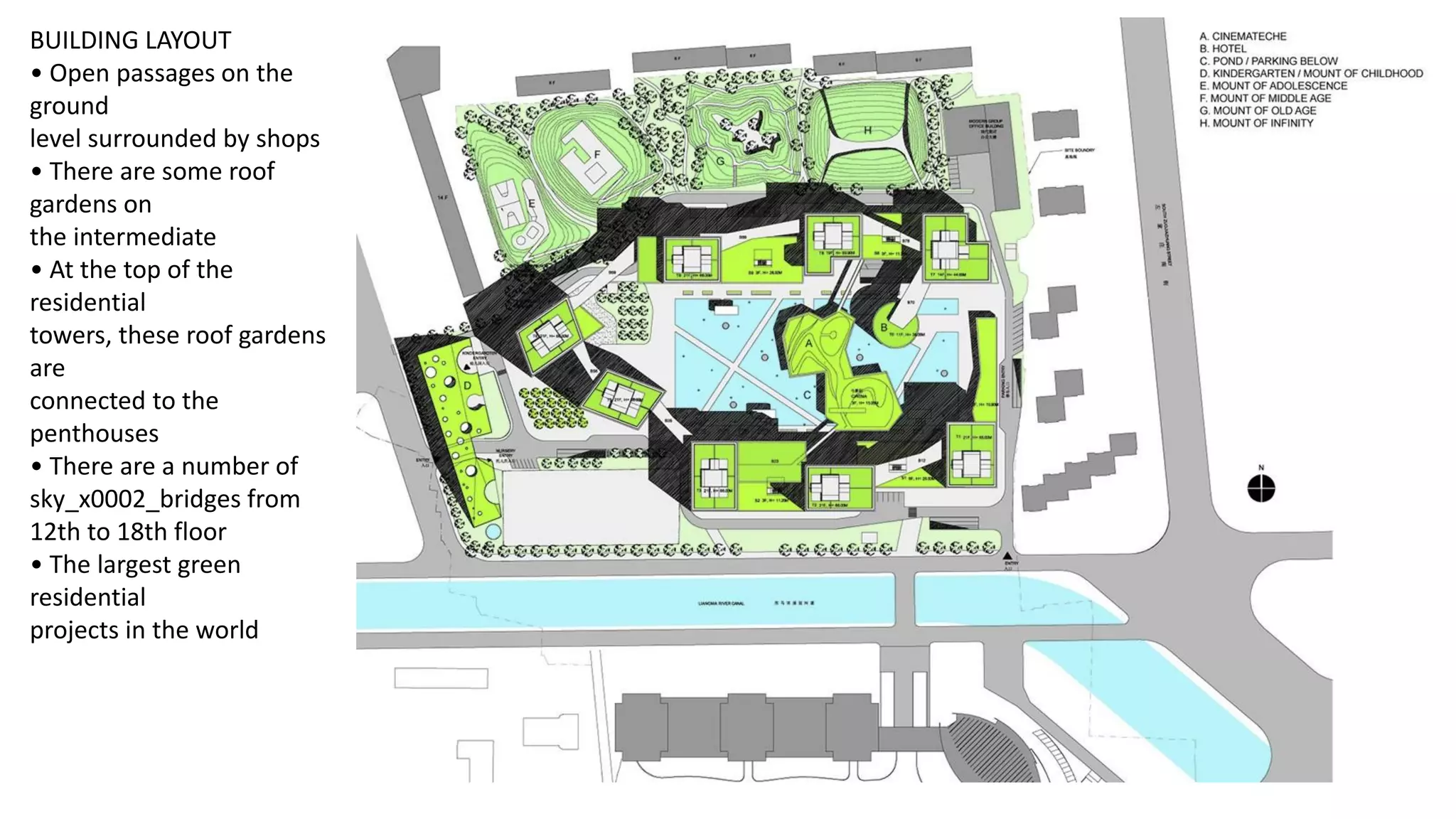
BUILDING LAYOUT
• Open passages on the
ground
level surrounded by shops
• There are some roof
gardens on
the intermediate
• At the top of the
residential
towers, these roof gardens
are
connected to the
penthouses
• There are a number of
sky_x0002_bridges from
12th to 18th floor
• The largest green
residential
projects in the world
BUILDING COMPONENTS-TOWERS.
• Towers have a central core of cast-in-place concrete shear
walls
• Four separate shear walls radiate off the core (a cross pattern),
separating it into four sections while forming “party” shear walls
for each unit
• Floors are cast-in-place beamless slabs with one large column
per unit.
BUILDING COMPONENTS-SKY-BRIDGES.
• Glazed bridges span 20m to 60m and are composed of steel
units of parallel trusses –a hybrid of Vierendeel and Pratt trusses
• Top and bottom chords are composed of wide flange steel
shapes with staggered vertical built-up steel members and
diagonal members.
• The trusses were also designed with a Vierendeel backbone that
moment connected the vertical and horizontal members to one
another while providing redundancy
• Wide flange steel beams support the metal deck and concrete
floor system.
Use of Geothermal Energy
In Linked Hybrid.
• Geo-thermal wells consists of
655 geothermal wells, 100
meters below the basement
foundation provide Linked
Hybrid with cooling in
summer and heating in
winter, and make it one of
the largest green residential
projects in the world
• The underground wells have taken the place of above-ground
space normally needed for cooling towers, increasing available
green areas, minimizing noise pollution and significantly
reducing the CO2 emissions created by traditional
heating/cooling methods. Linked Hybrid’s ground source heat
pump system shoulders 70% of the complex’s yearly heating
and cooling load.
Linked Hybrid makes use of a technique called displacement
ventilation, in which air that is slightly below desired
temperature in a room is released from the floor. The cooler
air displaces the warmer air, causing it to be released from the
room and resulting in a cooler overall space and a fresh
breathing environment.
Climate and Energy Concept Apartments.
• A Ground Source Heat Pump system, one of the largest in residential
construction, provides most of the heating and cooling loads. It is
comprised of 600 geothermal well, 100 meters deep underneath the
basement foundation.
• The large urban space in the
center of the project is activated
by a greywater recycling pond.
Also, gray water from all
apartment units are recycled and
reused for irrigation, toilet
flushing and pond water
rebalancing.
Based on the concept of a sustainable community, Linked Hybrid was developed by the Modern Green Development Co., Ltd.
Beijing, with Steven Holl Architects (USA) as the principal designer and Beijing Construction Engineering Group the general
construction contractor from 2003 to 2009.
The total project area is approximately 220,000 m2, and includes 644 apartments, public green spaces, hotel and public facilities.
The community consists of eight linked buildings, with each building having an independent entrance to adjacent buildings. The
centre of the buildings contains an open-air space that is accessible to all residents. By providing integrated and comprehensive
facilities in an “open city within a city” theme, this project was expected to provide residents with a human friendly environment.
When designing a sustainable community, it is necessary to consider the social, ecological and economic factors involved. More
specifically, with a reasonable project budget, the goal is to provide an enjoyable living environment for residents while reducing
pressure on the natural environment as much as possible. In particular, efficiently improving social communication is one of the most
important objectives in obtaining a sustainable community.
In designing Linked Hybrid, the architect Steven Holl resolved to remain within the urban context and persuaded the developer to
expand its program from being purely residential to one of mixed use containing a multiplex and hotel to attract non-residents. The
project advocates the creation of a vibrant environment through the combination of interesting aesthetics, sustainability, technology
and the exploratory development of urban interactive spaces. Linked Hybrid’s communicative attitude is expressed in the form
generated by the towers and sky-loop, creating a permeable interface between the central plaza and its surrounds.
The social impact of the project design was an important consideration at the design stage of the project, with a focus on the
comfort, convenience and safety of the residents of the community in order to have a better living environment. The design of the
social areas was an essential feature for this community, as it facilitates daily working, communication, entertainment and shopping
activities. This involved a particular focus on the reduction of travel time, as these daily activities are linked by transportation and is
especially important in Beijing with its heavy vehicular traffic.
Sustainable Design.
A number of green building technologies are utilised in
Linked Hybrid, including:
• A ground source heat pump system: to distribute underground geothermal energy throughout the facilities
• A solar power system
• A water recycling system
• A rain water recycling system
• The use sustainable materials for easy recycling
• A ceiling radiation system: using solar energy to heat water to adjust room temperature A displacement
ventilation system: using outside air to adjust room temperature and provide fresh air
•A noise reduction system
• An external thermal insulation system .An energy efficient façade and window system: to reduce heat
exchange and radiance
These technologies have been widely used in new green building construction projects, but very few projects
apply all these technologies at once, making Linked Hybrid one of the largest green residential community
projects in the world. The successful application of these technologies was realised through a careful
assessment of their practicability and reliability in being used together in this way. In doing this, the designers
considered the cost-effectiveness and social impact of the technologies on the project as well their feasibility
and ecological advantages.

geothermal energy linked hybrid

  • 1.
    BAR 702 LINKED HYBRIDBY STEVEN HOLL • MOUNIS • RUKHSAR • WASIM
  • 2.
    What is geothermalenergy? • Geothermal energy is heat derived within the sub-surface of the earth. Water and/or steam carry the geothermal energy to the Earth’s surface. Depending on its characteristics, geothermal energy can be used for heating and cooling purposes or be harnessed to generate clean electricity. However, for electricity, generation high or medium temperature resources are needed, which are usually located close to tectonically active regions.
  • 3.
    How is geothermalenergy produced? • To produce power from geothermal energy, wells are dug a mile deep into underground reservoirs to access the steam and hot water there, which can then be used to drive turbines connected to electricity generators.
  • 4.
    Types of GeothermalPower Plant. • There are three types of geothermal power plants; dry steam, flash and binary. • Dry steam is the oldest form of geothermal technology and takes steam out of the ground and uses it to directly drive a turbine. • Flash plants use high-pressure hot water into cool, low-pressure water • Binary plants pass hot water through a secondary liquid with a lower boiling point, which turns to vapors to drive the turbine.
  • 5.
    • Linked HybridProject is a mixed use development in Beijing, China, that consists of eight 60m tall residential towers and a 35m tall hotel structure interconnected by elevated public bridges. • The interconnecting bridges contain a swimming pool, café, fitness room, art galleries, and other services. The development also has a film archive (cinematheque), a kindergarten, parks, and other attractions. • Built in 2003-2009 • Architect- Steven Holl Architects & Capital Group • Location- Beijing, Republic of China • 9 (8 Apartment towers + 1 Hotel tower) Concrete braced frame towers with cantilevered floors at higher levels, contracted using steel framing. • Apartments towers -14 to 21 stories and are connected by 1 and 2 story bridges • 8 Connecting Steel bridges (Sky Loop) serve as circulation while allowing space for cafes, retail, galleries etc. • 2 level underground parking garage • Green Roof open to the public • Grass covered pavillion along the building perimeter houses a montessori school and kindergarten • 2.4 million sq. foot (220,000 sq. Meters) development. Building Info
  • 6.
    DESIGN CONCEPT • Pedestrian-orientedLinked Hybrid complex • Public space (vary from commercial, residential, and educational to recreational). • Private urban development in China • Porous urban space • Because of the many passages through the project, this project called "open city within a city“. The complex is fascinating due to one of its most unique features: from the 12th to the 18th floor, all the eight towers are connected to one another via an open architectural ring. This ring, a skybridge, flows diagonally from one tower to the other, creating a fluid movement inspired by Matisse’s La Danse. The linkage of the towers and the many gardens and open spaces not only bring movement to the structure but also encourage interaction among the inhabitants. The skybridge also provides a breathtaking view of the ever-changing skyline of the beautiful city that is Beijing.
  • 7.
    BUILDING LAYOUT • Openpassages on the ground level surrounded by shops • There are some roof gardens on the intermediate • At the top of the residential towers, these roof gardens are connected to the penthouses • There are a number of sky_x0002_bridges from 12th to 18th floor • The largest green residential projects in the world
  • 8.
    BUILDING COMPONENTS-TOWERS. • Towershave a central core of cast-in-place concrete shear walls • Four separate shear walls radiate off the core (a cross pattern), separating it into four sections while forming “party” shear walls for each unit • Floors are cast-in-place beamless slabs with one large column per unit. BUILDING COMPONENTS-SKY-BRIDGES. • Glazed bridges span 20m to 60m and are composed of steel units of parallel trusses –a hybrid of Vierendeel and Pratt trusses • Top and bottom chords are composed of wide flange steel shapes with staggered vertical built-up steel members and diagonal members. • The trusses were also designed with a Vierendeel backbone that moment connected the vertical and horizontal members to one another while providing redundancy • Wide flange steel beams support the metal deck and concrete floor system.
  • 9.
    Use of GeothermalEnergy In Linked Hybrid. • Geo-thermal wells consists of 655 geothermal wells, 100 meters below the basement foundation provide Linked Hybrid with cooling in summer and heating in winter, and make it one of the largest green residential projects in the world
  • 10.
    • The undergroundwells have taken the place of above-ground space normally needed for cooling towers, increasing available green areas, minimizing noise pollution and significantly reducing the CO2 emissions created by traditional heating/cooling methods. Linked Hybrid’s ground source heat pump system shoulders 70% of the complex’s yearly heating and cooling load.
  • 11.
    Linked Hybrid makesuse of a technique called displacement ventilation, in which air that is slightly below desired temperature in a room is released from the floor. The cooler air displaces the warmer air, causing it to be released from the room and resulting in a cooler overall space and a fresh breathing environment. Climate and Energy Concept Apartments.
  • 12.
    • A GroundSource Heat Pump system, one of the largest in residential construction, provides most of the heating and cooling loads. It is comprised of 600 geothermal well, 100 meters deep underneath the basement foundation.
  • 13.
    • The largeurban space in the center of the project is activated by a greywater recycling pond. Also, gray water from all apartment units are recycled and reused for irrigation, toilet flushing and pond water rebalancing.
  • 14.
    Based on theconcept of a sustainable community, Linked Hybrid was developed by the Modern Green Development Co., Ltd. Beijing, with Steven Holl Architects (USA) as the principal designer and Beijing Construction Engineering Group the general construction contractor from 2003 to 2009. The total project area is approximately 220,000 m2, and includes 644 apartments, public green spaces, hotel and public facilities. The community consists of eight linked buildings, with each building having an independent entrance to adjacent buildings. The centre of the buildings contains an open-air space that is accessible to all residents. By providing integrated and comprehensive facilities in an “open city within a city” theme, this project was expected to provide residents with a human friendly environment. When designing a sustainable community, it is necessary to consider the social, ecological and economic factors involved. More specifically, with a reasonable project budget, the goal is to provide an enjoyable living environment for residents while reducing pressure on the natural environment as much as possible. In particular, efficiently improving social communication is one of the most important objectives in obtaining a sustainable community. In designing Linked Hybrid, the architect Steven Holl resolved to remain within the urban context and persuaded the developer to expand its program from being purely residential to one of mixed use containing a multiplex and hotel to attract non-residents. The project advocates the creation of a vibrant environment through the combination of interesting aesthetics, sustainability, technology and the exploratory development of urban interactive spaces. Linked Hybrid’s communicative attitude is expressed in the form generated by the towers and sky-loop, creating a permeable interface between the central plaza and its surrounds. The social impact of the project design was an important consideration at the design stage of the project, with a focus on the comfort, convenience and safety of the residents of the community in order to have a better living environment. The design of the social areas was an essential feature for this community, as it facilitates daily working, communication, entertainment and shopping activities. This involved a particular focus on the reduction of travel time, as these daily activities are linked by transportation and is especially important in Beijing with its heavy vehicular traffic. Sustainable Design.
  • 17.
    A number ofgreen building technologies are utilised in Linked Hybrid, including: • A ground source heat pump system: to distribute underground geothermal energy throughout the facilities • A solar power system • A water recycling system • A rain water recycling system • The use sustainable materials for easy recycling • A ceiling radiation system: using solar energy to heat water to adjust room temperature A displacement ventilation system: using outside air to adjust room temperature and provide fresh air •A noise reduction system • An external thermal insulation system .An energy efficient façade and window system: to reduce heat exchange and radiance These technologies have been widely used in new green building construction projects, but very few projects apply all these technologies at once, making Linked Hybrid one of the largest green residential community projects in the world. The successful application of these technologies was realised through a careful assessment of their practicability and reliability in being used together in this way. In doing this, the designers considered the cost-effectiveness and social impact of the technologies on the project as well their feasibility and ecological advantages.