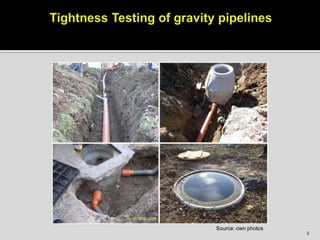
Source: own photos
1
 The test for water tightness is to be performed on the pipe before it is completely covered,
yet it has to be covered to such an extent as to prevent a change in position during the
test.
 Final backfilling of the trench may be started only after the entire pipeline has been
checked, the tightness tests have been performed, all measurements for earthworks and
pipe-laying works have been made, the pipeline has been appropriately secured and all
important points of the pipeline have been staked out as fixed points. The staked-out
points are to be recorded in separate as-built drawings.
 Regardless of the general acceptability in testing of separate system elements, having
considered most frequent leakage points (pipe saddle, house connections to revision &
collection chambers), it is highly recommended that system as a whole is being tested.
2
Leak tightness:
 Testing should include connections, manholes and inspection chambers.
Procedures and requirements for testing gravity pipelines:
 Testing with air;
 Testing with water.
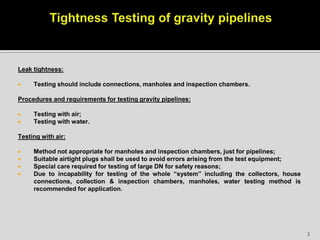
Testing with air:
 Method not appropriate for manholes and inspection chambers, just for pipelines;
 Suitable airtight plugs shall be used to avoid errors arising from the test equipment;
 Special care required for testing of large DN for safety reasons;
 Due to incapability for testing of the whole “system” including the collectors, house
connections, collection & inspection chambers, manholes, water testing method is
recommended for application.
3
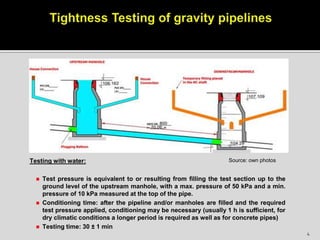
Testing with water:
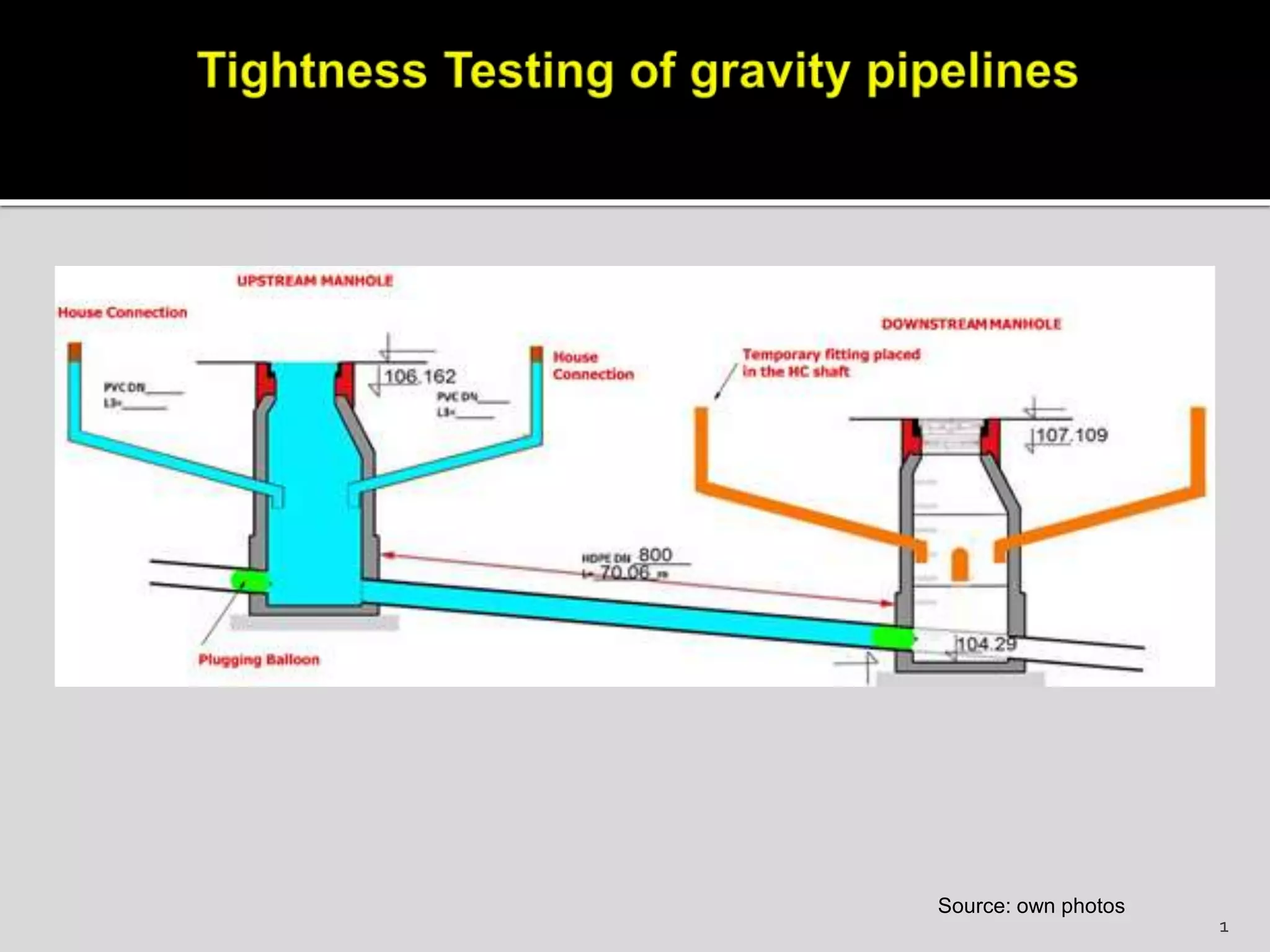
 Test pressure is equivalent to or resulting from filling the test section up to the
ground level of the upstream manhole, with a max. pressure of 50 kPa and a min.
pressure of 10 kPa measured at the top of the pipe.
 Conditioning time: after the pipeline and/or manholes are filled and the required
test pressure applied, conditioning may be necessary (usually 1 h is sufficient, for
dry climatic conditions a longer period is required as well as for concrete pipes)
 Testing time: 30 ± 1 min
Source: own photos
4
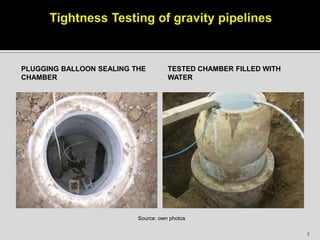
PLUGGING BALLOON SEALING THE
CHAMBER
TESTED CHAMBER FILLED WITH
WATER
Source: own photos
5
Source: own photos
6
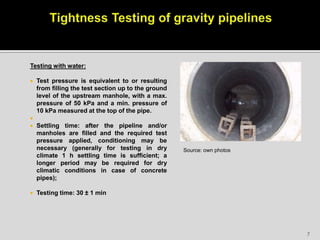
Testing with water:
 Test pressure is equivalent to or resulting
from filling the test section up to the ground
level of the upstream manhole, with a max.
pressure of 50 kPa and a min. pressure of
10 kPa measured at the top of the pipe.

 Settling time: after the pipeline and/or
manholes are filled and the required test
pressure applied, conditioning may be
necessary (generally for testing in dry
climate 1 h settling time is sufficient; a
longer period may be required for dry
climatic conditions in case of concrete
pipes);
 Testing time: 30 ± 1 min
Source: own photos
7
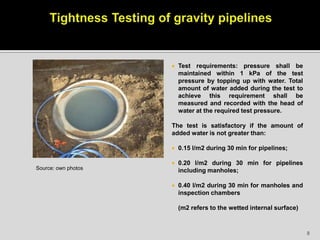
 Test requirements: pressure shall be
maintained within 1 kPa of the test
pressure by topping up with water. Total
amount of water added during the test to
achieve this requirement shall be
measured and recorded with the head of
water at the required test pressure.
The test is satisfactory if the amount of
added water is not greater than:
 0.15 l/m2 during 30 min for pipelines;
 0.20 l/m2 during 30 min for pipelines
including manholes;
 0.40 l/m2 during 30 min for manholes and
inspection chambers
(m2 refers to the wetted internal surface)
Source: own photos
8
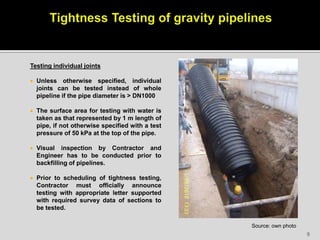
Testing individual joints
 Unless otherwise specified, individual
joints can be tested instead of whole
pipeline if the pipe diameter is > DN1000
 The surface area for testing with water is
taken as that represented by 1 m length of
pipe, if not otherwise specified with a test
pressure of 50 kPa at the top of the pipe.
 Visual inspection by Contractor and
Engineer has to be conducted prior to
backfilling of pipelines.
 Prior to scheduling of tightness testing,
Contractor must officially announce
testing with appropriate letter supported
with required survey data of sections to
be tested.
Source: own photo
9
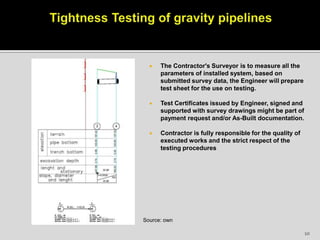
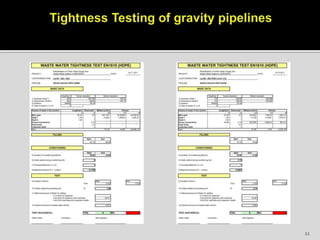
 The Contractor's Surveyor is to measure all the
parameters of installed system, based on
submitted survey data, the Engineer will prepare
test sheet for the use on testing.
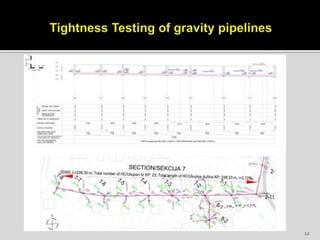
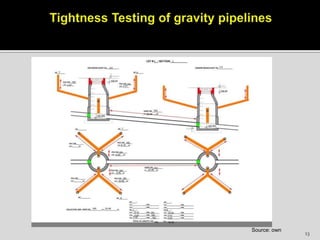
 Test Certificates issued by Engineer, signed and
supported with survey drawings might be part of
payment request and/or As-Built documentation.
 Contractor is fully responsible for the quality of
executed works and the strict respect of the
testing procedures
Source: own
10
11
12
Source: own
13

Tightness testing of gravity pipelines

  • 1.
  • 2.
     The testfor water tightness is to be performed on the pipe before it is completely covered, yet it has to be covered to such an extent as to prevent a change in position during the test.  Final backfilling of the trench may be started only after the entire pipeline has been checked, the tightness tests have been performed, all measurements for earthworks and pipe-laying works have been made, the pipeline has been appropriately secured and all important points of the pipeline have been staked out as fixed points. The staked-out points are to be recorded in separate as-built drawings.  Regardless of the general acceptability in testing of separate system elements, having considered most frequent leakage points (pipe saddle, house connections to revision & collection chambers), it is highly recommended that system as a whole is being tested. 2
  • 3.
    Leak tightness:  Testingshould include connections, manholes and inspection chambers. Procedures and requirements for testing gravity pipelines:  Testing with air;  Testing with water. Testing with air:  Method not appropriate for manholes and inspection chambers, just for pipelines;  Suitable airtight plugs shall be used to avoid errors arising from the test equipment;  Special care required for testing of large DN for safety reasons;  Due to incapability for testing of the whole “system” including the collectors, house connections, collection & inspection chambers, manholes, water testing method is recommended for application. 3
  • 4.
    Testing with water: Test pressure is equivalent to or resulting from filling the test section up to the ground level of the upstream manhole, with a max. pressure of 50 kPa and a min. pressure of 10 kPa measured at the top of the pipe.  Conditioning time: after the pipeline and/or manholes are filled and the required test pressure applied, conditioning may be necessary (usually 1 h is sufficient, for dry climatic conditions a longer period is required as well as for concrete pipes)  Testing time: 30 ± 1 min Source: own photos 4
  • 5.
    PLUGGING BALLOON SEALINGTHE CHAMBER TESTED CHAMBER FILLED WITH WATER Source: own photos 5
  • 6.
  • 7.
    Testing with water: Test pressure is equivalent to or resulting from filling the test section up to the ground level of the upstream manhole, with a max. pressure of 50 kPa and a min. pressure of 10 kPa measured at the top of the pipe.   Settling time: after the pipeline and/or manholes are filled and the required test pressure applied, conditioning may be necessary (generally for testing in dry climate 1 h settling time is sufficient; a longer period may be required for dry climatic conditions in case of concrete pipes);  Testing time: 30 ± 1 min Source: own photos 7
  • 8.
     Test requirements:pressure shall be maintained within 1 kPa of the test pressure by topping up with water. Total amount of water added during the test to achieve this requirement shall be measured and recorded with the head of water at the required test pressure. The test is satisfactory if the amount of added water is not greater than:  0.15 l/m2 during 30 min for pipelines;  0.20 l/m2 during 30 min for pipelines including manholes;  0.40 l/m2 during 30 min for manholes and inspection chambers (m2 refers to the wetted internal surface) Source: own photos 8
  • 9.
    Testing individual joints Unless otherwise specified, individual joints can be tested instead of whole pipeline if the pipe diameter is > DN1000  The surface area for testing with water is taken as that represented by 1 m length of pipe, if not otherwise specified with a test pressure of 50 kPa at the top of the pipe.  Visual inspection by Contractor and Engineer has to be conducted prior to backfilling of pipelines.  Prior to scheduling of tightness testing, Contractor must officially announce testing with appropriate letter supported with required survey data of sections to be tested. Source: own photo 9
  • 10.
     The Contractor'sSurveyor is to measure all the parameters of installed system, based on submitted survey data, the Engineer will prepare test sheet for the use on testing.  Test Certificates issued by Engineer, signed and supported with survey drawings might be part of payment request and/or As-Built documentation.  Contractor is fully responsible for the quality of executed works and the strict respect of the testing procedures Source: own 10
  • 11.
  • 12.
  • 13.