• Grammatical error is a term used in prescriptive grammar to describe an instance
of faulty, unconventional, or controversial usage, such as a ​misplaced
modifier or an inappropriate verb tense. Also called a usage error. We will
compare grammatical error with correctness.
• It's also known as: error, usage error, grammar error or mistake, bad grammar
• Grammatical errors are usually distinguished from (though sometimes confused
with) factual errors, logical fallacies, misspellings, typographical errors, and
faulty punctuation.
Grammatical Errors
That Kill Your Writing Credibility
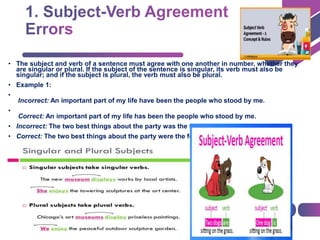
• The subject and verb of a sentence must agree with one another in number, whether they
are singular or plural. If the subject of the sentence is singular, its verb must also be
singular; and if the subject is plural, the verb must also be plural.
• Example 1:
•
Incorrect: An important part of my life have been the people who stood by me.
•
Correct: An important part of my life has been the people who stood by me.
• Incorrect: The two best things about the party was the food and the music.
• Correct: The two best things about the party were the food and the music.
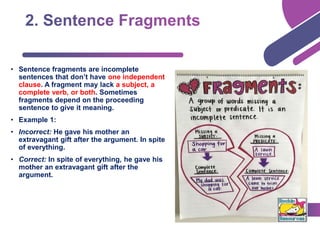
• Sentence fragments are incomplete
sentences that don’t have one independent
clause. A fragment may lack a subject, a
complete verb, or both. Sometimes
fragments depend on the proceeding
sentence to give it meaning.
• Example 1:
• Incorrect: He gave his mother an
extravagant gift after the argument. In spite
of everything.
• Correct: In spite of everything, he gave his
mother an extravagant gift after the
argument.
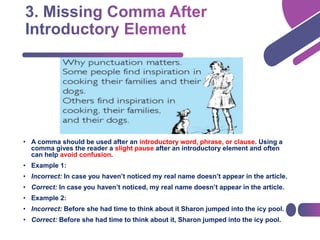
• A comma should be used after an introductory word, phrase, or clause. Using a
comma gives the reader a slight pause after an introductory element and often
can help avoid confusion.
• Example 1:
• Incorrect: In case you haven’t noticed my real name doesn’t appear in the article.
• Correct: In case you haven’t noticed, my real name doesn’t appear in the article.
• Example 2:
• Incorrect: Before she had time to think about it Sharon jumped into the icy pool.
• Correct: Before she had time to think about it, Sharon jumped into the icy pool.
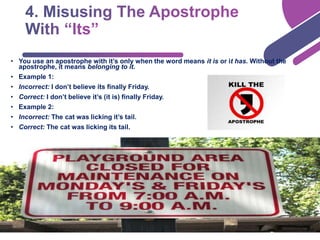
• You use an apostrophe with it’s only when the word means it is or it has. Without the
apostrophe, it means belonging to it.
• Example 1:
• Incorrect: I don’t believe its finally Friday.
• Correct: I don’t believe it’s (it is) finally Friday.
• Example 2:
• Incorrect: The cat was licking it’s tail.
• Correct: The cat was licking its tail.
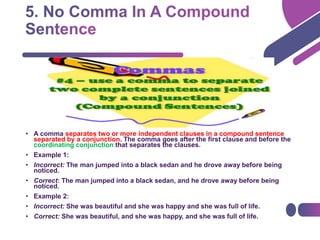
• A comma separates two or more independent clauses in a compound sentence
separated by a conjunction. The comma goes after the first clause and before the
coordinating conjunction that separates the clauses.
• Example 1:
• Incorrect: The man jumped into a black sedan and he drove away before being
noticed.
• Correct: The man jumped into a black sedan, and he drove away before being
noticed.
• Example 2:
• Incorrect: She was beautiful and she was happy and she was full of life.
• Correct: She was beautiful, and she was happy, and she was full of life.
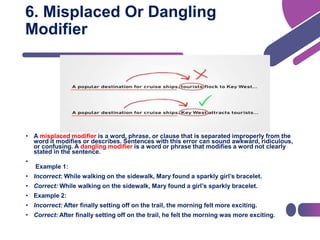
• A misplaced modifier is a word, phrase, or clause that is separated improperly from the
word it modifies or describes. Sentences with this error can sound awkward, ridiculous,
or confusing. A dangling modifier is a word or phrase that modifies a word not clearly
stated in the sentence.
•
Example 1:
• Incorrect: While walking on the sidewalk, Mary found a sparkly girl’s bracelet.
• Correct: While walking on the sidewalk, Mary found a girl’s sparkly bracelet.
• Example 2:
• Incorrect: After finally setting off on the trail, the morning felt more exciting.
• Correct: After finally setting off on the trail, he felt the morning was more exciting.
6. Misplaced Or Dangling
Modifier
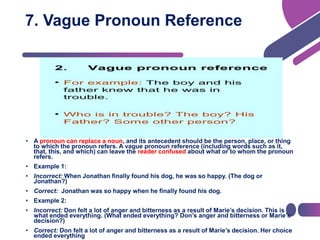
• A pronoun can replace a noun, and its antecedent should be the person, place, or thing
to which the pronoun refers. A vague pronoun reference (including words such as it,
that, this, and which) can leave the reader confused about what or to whom the pronoun
refers.
• Example 1:
• Incorrect: When Jonathan finally found his dog, he was so happy. (The dog or
Jonathan?)
• Correct: Jonathan was so happy when he finally found his dog.
• Example 2:
• Incorrect: Don felt a lot of anger and bitterness as a result of Marie’s decision. This is
what ended everything. (What ended everything? Don’s anger and bitterness or Marie’s
decision?)
• Correct: Don felt a lot of anger and bitterness as a result of Marie’s decision. Her choice
ended everything
7. Vague Pronoun Reference
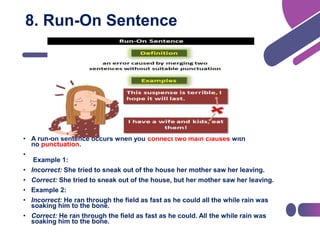
• A run-on sentence occurs when you connect two main clauses with
no punctuation.
•
Example 1:
• Incorrect: She tried to sneak out of the house her mother saw her leaving.
• Correct: She tried to sneak out of the house, but her mother saw her leaving.
• Example 2:
• Incorrect: He ran through the field as fast as he could all the while rain was
soaking him to the bone.
• Correct: He ran through the field as fast as he could. All the while rain was
soaking him to the bone.
8. Run-On Sentence
• A colon is used after a complete sentence to introduce a word, phrase, clause, list,
or quotation. The colon signals that what follows proves or explains the sentence
preceding the colon.
• Example 1:
• Incorrect: People move to Florida for: the warmer weather, the beach, and the
theme parks.
• Correct: People move to Florida for three reasons: the warmer weather, the beach,
and the theme parks.
9. Colon Mistakes
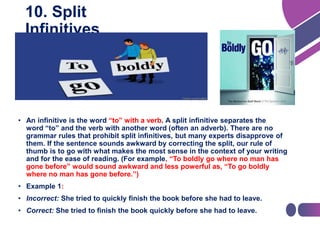
• An infinitive is the word “to” with a verb. A split infinitive separates the
word “to” and the verb with another word (often an adverb). There are no
grammar rules that prohibit split infinitives, but many experts disapprove of
them. If the sentence sounds awkward by correcting the split, our rule of
thumb is to go with what makes the most sense in the context of your writing
and for the ease of reading. (For example, “To boldly go where no man has
gone before” would sound awkward and less powerful as, “To go boldly
where no man has gone before.”)
• Example 1:
• Incorrect: She tried to quickly finish the book before she had to leave.
• Correct: She tried to finish the book quickly before she had to leave.
10. Split
Infinitives
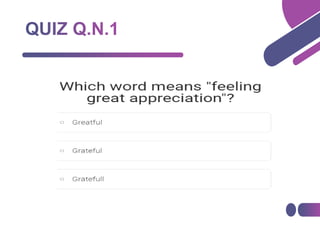
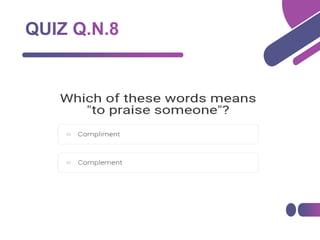
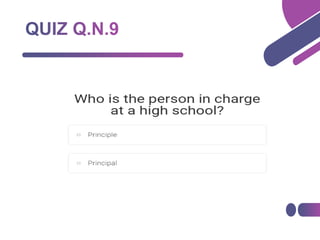
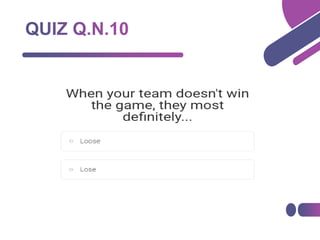
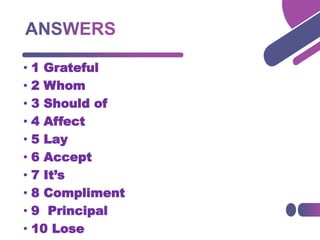
• 1 Grateful
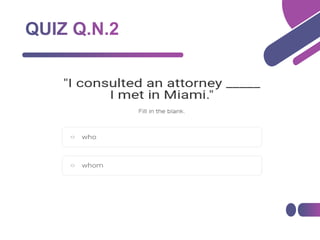
• 2 Whom
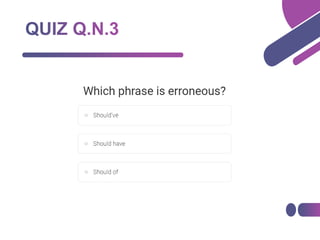
• 3 Should of
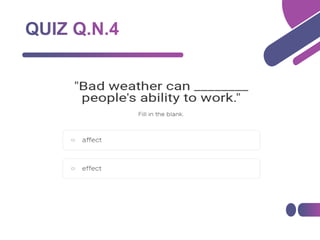
• 4 Affect
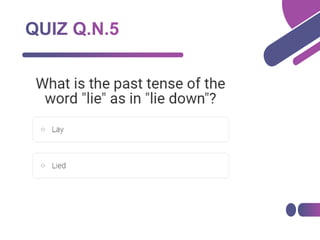
• 5 Lay
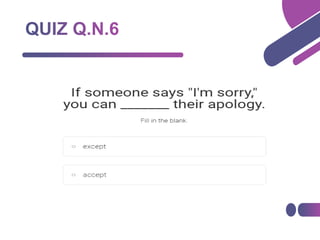
• 6 Accept
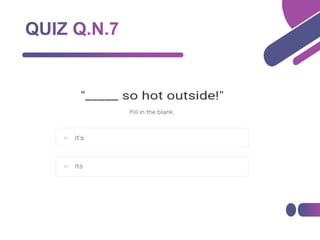
• 7 It’s
• 8 Compliment
• 9 Principal
• 10 Lose
Induction common grammatical errors

Induction common grammatical errors

  • 2.
    • Grammatical erroris a term used in prescriptive grammar to describe an instance of faulty, unconventional, or controversial usage, such as a ​misplaced modifier or an inappropriate verb tense. Also called a usage error. We will compare grammatical error with correctness. • It's also known as: error, usage error, grammar error or mistake, bad grammar • Grammatical errors are usually distinguished from (though sometimes confused with) factual errors, logical fallacies, misspellings, typographical errors, and faulty punctuation. Grammatical Errors That Kill Your Writing Credibility
  • 3.
    • The subjectand verb of a sentence must agree with one another in number, whether they are singular or plural. If the subject of the sentence is singular, its verb must also be singular; and if the subject is plural, the verb must also be plural. • Example 1: • Incorrect: An important part of my life have been the people who stood by me. • Correct: An important part of my life has been the people who stood by me. • Incorrect: The two best things about the party was the food and the music. • Correct: The two best things about the party were the food and the music.
  • 4.
    • Sentence fragmentsare incomplete sentences that don’t have one independent clause. A fragment may lack a subject, a complete verb, or both. Sometimes fragments depend on the proceeding sentence to give it meaning. • Example 1: • Incorrect: He gave his mother an extravagant gift after the argument. In spite of everything. • Correct: In spite of everything, he gave his mother an extravagant gift after the argument.
  • 5.
    • A commashould be used after an introductory word, phrase, or clause. Using a comma gives the reader a slight pause after an introductory element and often can help avoid confusion. • Example 1: • Incorrect: In case you haven’t noticed my real name doesn’t appear in the article. • Correct: In case you haven’t noticed, my real name doesn’t appear in the article. • Example 2: • Incorrect: Before she had time to think about it Sharon jumped into the icy pool. • Correct: Before she had time to think about it, Sharon jumped into the icy pool.
  • 6.
    • You usean apostrophe with it’s only when the word means it is or it has. Without the apostrophe, it means belonging to it. • Example 1: • Incorrect: I don’t believe its finally Friday. • Correct: I don’t believe it’s (it is) finally Friday. • Example 2: • Incorrect: The cat was licking it’s tail. • Correct: The cat was licking its tail.
  • 7.
    • A commaseparates two or more independent clauses in a compound sentence separated by a conjunction. The comma goes after the first clause and before the coordinating conjunction that separates the clauses. • Example 1: • Incorrect: The man jumped into a black sedan and he drove away before being noticed. • Correct: The man jumped into a black sedan, and he drove away before being noticed. • Example 2: • Incorrect: She was beautiful and she was happy and she was full of life. • Correct: She was beautiful, and she was happy, and she was full of life.
  • 8.
    • A misplacedmodifier is a word, phrase, or clause that is separated improperly from the word it modifies or describes. Sentences with this error can sound awkward, ridiculous, or confusing. A dangling modifier is a word or phrase that modifies a word not clearly stated in the sentence. • Example 1: • Incorrect: While walking on the sidewalk, Mary found a sparkly girl’s bracelet. • Correct: While walking on the sidewalk, Mary found a girl’s sparkly bracelet. • Example 2: • Incorrect: After finally setting off on the trail, the morning felt more exciting. • Correct: After finally setting off on the trail, he felt the morning was more exciting. 6. Misplaced Or Dangling Modifier
  • 9.
    • A pronouncan replace a noun, and its antecedent should be the person, place, or thing to which the pronoun refers. A vague pronoun reference (including words such as it, that, this, and which) can leave the reader confused about what or to whom the pronoun refers. • Example 1: • Incorrect: When Jonathan finally found his dog, he was so happy. (The dog or Jonathan?) • Correct: Jonathan was so happy when he finally found his dog. • Example 2: • Incorrect: Don felt a lot of anger and bitterness as a result of Marie’s decision. This is what ended everything. (What ended everything? Don’s anger and bitterness or Marie’s decision?) • Correct: Don felt a lot of anger and bitterness as a result of Marie’s decision. Her choice ended everything 7. Vague Pronoun Reference
  • 10.
    • A run-onsentence occurs when you connect two main clauses with no punctuation. • Example 1: • Incorrect: She tried to sneak out of the house her mother saw her leaving. • Correct: She tried to sneak out of the house, but her mother saw her leaving. • Example 2: • Incorrect: He ran through the field as fast as he could all the while rain was soaking him to the bone. • Correct: He ran through the field as fast as he could. All the while rain was soaking him to the bone. 8. Run-On Sentence
  • 11.
    • A colonis used after a complete sentence to introduce a word, phrase, clause, list, or quotation. The colon signals that what follows proves or explains the sentence preceding the colon. • Example 1: • Incorrect: People move to Florida for: the warmer weather, the beach, and the theme parks. • Correct: People move to Florida for three reasons: the warmer weather, the beach, and the theme parks. 9. Colon Mistakes
  • 12.
    • An infinitiveis the word “to” with a verb. A split infinitive separates the word “to” and the verb with another word (often an adverb). There are no grammar rules that prohibit split infinitives, but many experts disapprove of them. If the sentence sounds awkward by correcting the split, our rule of thumb is to go with what makes the most sense in the context of your writing and for the ease of reading. (For example, “To boldly go where no man has gone before” would sound awkward and less powerful as, “To go boldly where no man has gone before.”) • Example 1: • Incorrect: She tried to quickly finish the book before she had to leave. • Correct: She tried to finish the book quickly before she had to leave. 10. Split Infinitives
  • 23.
    • 1 Grateful •2 Whom • 3 Should of • 4 Affect • 5 Lay • 6 Accept • 7 It’s • 8 Compliment • 9 Principal • 10 Lose