Thyroid Gland Embryology
and Physiology
KALEAB TESFAYE MOGES
Development of the thyroid gland
• The first endocrine gland to develop
• Starts @ 24 days => endodermal thickening at the floor of the mouth
• Thickening will become a pouch=> thyroid primordium
• Then descends caudally connected with the tongue via the thyroglossal duct
• Initially it is hollow, later proliferates into a solid mass of cells
• Divides into right and left lobes connected via the isthmus
• Will be @ the level of the 2nd and 3rd tracheal ring
• By the 7th week will have the definitive shape and location, @ this stage the
thyroglossal duct will degenerate
• Proximal end of the duct will remain as a blind pit in the tongue as foramen cecum
• Pyramidal lobe distal remnant of the thyroglossal duct, 50% of people
• The parachromafin cells (c-cells), arise from the neural crest cells of the 4th pharyngeal
pouch
• @ 11th week the thyroid follicles form and iodine concentration and hormone
synthesis starts
• Adult level @ 35th week
Congenital abnormalities
1) Thyroglossal cyst
• During 5th week should start to obliterate and disappear @ 8th week
• Can occur anywhere along the migration path of the gland
• 80% are juxta-position to the hyoid bone
• Usually asymptomatic
• Symptomatic when infected
• Dx
• is clinical, 1-2 cm mid line mass, well defined, moves with tongue protrusion
• Imaging is not necessary
• Mx
• Sistrunk operation (cystectomy + resection of body of the hyoid bone)
• 1% may contain malignancy, 85% of which is papillary ca., others are squamous and
Hurthle cell ca, Medullary does not occur
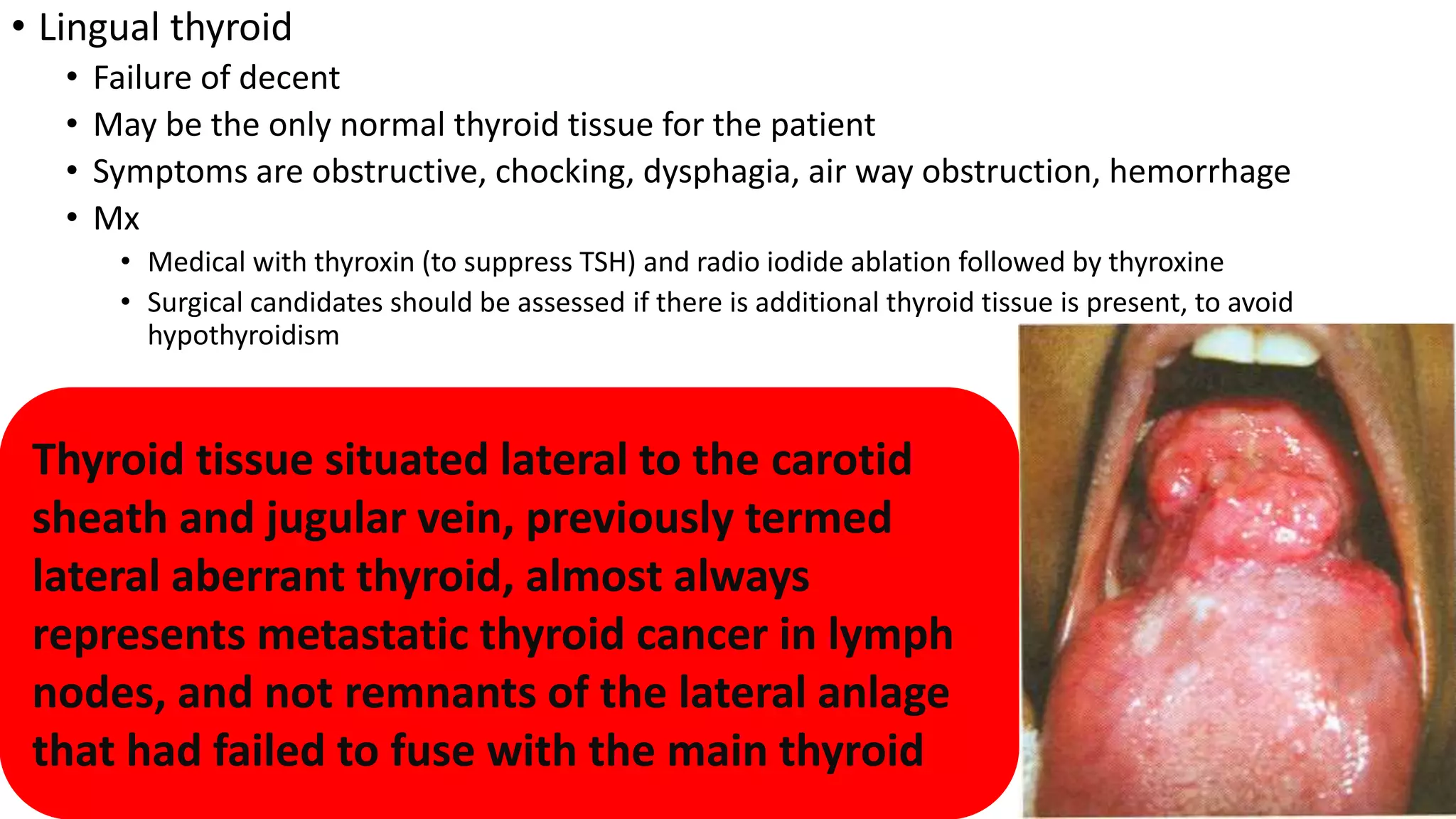
• Lingual thyroid
• Failure of decent
• May be the only normal thyroid tissue for the patient
• Symptoms are obstructive, chocking, dysphagia, air way obstruction, hemorrhage
• Mx
• Medical with thyroxin (to suppress TSH) and radio iodide ablation followed by thyroxine
• Surgical candidates should be assessed if there is additional thyroid tissue is present, to avoid
hypothyroidism
Thyroid tissue situated lateral to the carotid
sheath and jugular vein, previously termed
lateral aberrant thyroid, almost always
represents metastatic thyroid cancer in lymph
nodes, and not remnants of the lateral anlage
that had failed to fuse with the main thyroid
Physiology
• 2 biochemically active hormones
• T4 (thyroxine) produced @ a rate of 80-100mcg/day
• T3 (triiodothyronine)
• 1 biologically inactive hormone
• rT3/reverse T3
• T4 is produced by the thyroid only
• T3 is produced by the thyroid plus by peripheral conversion of T4 via
deiodenation
• Gland contains large quantities of T3 and T4, released quickly when stimulated,
not synthesized de novo
Physiology cont..
Iodine economy
• Only obtained from iodine containing foods
• Iodine rich food
• Seafood
• vegitatables
• Sea salt < iodinated salt (45-80 mcg/g)
• Daily requirement/day
• infants <6 months 110 mcg
• infants <12 months 130 mcg
• children <8 years 90 mcg
• children <13 years 120 mcg
• adults 150 mcg
• pregnant 220 mcg
• lactating women 290 mcg
• Iodine deficiency, defined by
urine iodine excretion
• 50 to 99 mcg/L mild
• 20 to 49 mcg/L moderate
• <20 mcg/L sever
Steps in Thyroid hormone synthesis
1. Iodide transport
• ATP dependent Na/I transporter, at the basolateral membrane of follicular cells
• Transport is against concentration and electrical gradient
2. Oxidation
• By thyroid peroxidase, requires H2O2
• Iodide to iodine
3. Organification
• Iodination of tyrosine residues of thyroglobulin
• MIT and DIT
4. Coupling
• by thyroid peroxidase
• DIT + DIT = T4
• DIT + MIT = T3
• Stored in the colloid bound to thyroglobulin
• Thyroglobulin
• Large (660 kilo Dalton) glycoprotein
• Contains 6 MIT, 4 DIT, 2 T4 and 0.2 T3/ molecule
• Hormone release
• Thyroglobulin is resorbed from colloid to follicular cells as droplets
• Droplets fuse with lysosomes to form phagosomes
• This leads to hydrolization => T3, T4, Amino acids => excreted
• Iodine is recycled back
• Extra-thyroidal T3 production
• 80% of T3 is from peripheral conversion (deiodenation)
• 3 types of deiodinase enzymes
• Type I, 35% of T3 production
• Found in the thyroid liver and kidney
• PTU sensitive
• Type II, 65% of T3 production
• Found in muscle brain pituitary skin placenta
• Not inhibited by PTU
• Type III, produces reverse T3/rT3
Type II
Increases with hypothyroidism
Decreases with hyperthyroidism
Thyroid
• Mostly secreted is T4 but T3 is the most potent and 80% peripherally converted
• Hypothalamus => thyroid releasing hormone => anterior pituitary => TSH => T4
co secreted with TBG (in a 1:1 ratio) and T3
• Thyroid hormones feed back to inhibit TRH and TSH production
• Out of the total T4 and T3 only 0.01% is free (unbound)
• Best initial test is a TSH
• Normal euthyroid
• Elevated hypothyroid
• Low hyperthyroid
• TBG if normal level but patient is hyper thyroid, it is due to intake of exogenous
T4/3 b/c TBG is co-secreated in a 1:1 ratio with T4
• U/S to see nodules and cysts
• Anti microsomal Ab. For Hashimoto’s
• Increased TBG in pregnancy and OCP
• Decreased TBG in nephrotic syndrome and CLD
• Radio active Iodine uptake test (RAIU)
• Functional status of the gland
• Shows uptake
• 24 and 48 hrs. scan is taken
• Low TSH + high T4/3 + increased RAIU => primary hyperthyroidism
• “ + “ + decreased RAIU => THYROIDITIS/ exogenous TH
• “ + low T4/3 + “ => secondary hypothyroidism
• eg. Sheehan’s
Euthyroid sick syndrome
• Normal TSH and very low free T3
• Occurs in sepsis patients with multiple organ failure or patient in ICU
• Sepsis => suppress conversion of T4 to T3 => inhibiting catabolic state
• Do nothing treat the underlining cause
Hyperthyroidism
Grave’s
• most common cause
• Women more common, young –middle aged
• Autoimmunity => antibodies that attach at the TSH receptor and act like TSH (TSI
or thyroid stimulating immunoglobulin )
• Ab. Present in 95% of the cases
• After Rx, proptosis gets worse NOT ALWAYS b/c the autoantibody is this disease is
different
• Other autoimmne associated with grave’s disease (pernicious anemia, mystenia
gravis, DM)
Grave’s
• Diffuse goiter
• Exopthalmus
• Myopathy (proximal)
• Tremor
• Decreased sleep
• Heat intolerance
• Wt. loss
• Myxoedema (non pitting edema below the knee also occurs in hypothyroidism)
• Diarrhea
• CHF (high out put)
• Palmar erythema
• Thyroid acropathy (clubbing)
“NO SPECS” scheme for staging Grave’s opthalmopathy
Grave’s
Lab.
• Low TSH
• T4 is elevated
• RAIU to differentiate if Dx is in question
• In graves uptake is increased diffused
• Thyroiditis decreased uptake
• Toxic nodular goiter localized uptake
• TSI 95% +ve
Rx
Immediate Rx
propranolol decrease adrenergic Sx
anti thyroid PTU or metimazole
DOSE is adjusted by trial and error to make patient clinically
and Lab. Euthyroid
Long term
RAI ablation
after clinically and lab. Euthyroid
eventually develop hypothyroidism
90% in 5years time
follow up is necessary every 6mo
NOT given before correction b/c
hyperthyroidism will be exacerbated
TMG
• Sequel of simple goiter after 5-10 years
• Usually elderly patient
• No opthalmopathy
• Cardiac manifestation
• Arrhythmia Afib
• CHF
• Rx is make it euthyroid and surgery
• Or Radio iodide
Thyroid storm
• Delirium, coma, hyperpyrexia,
• Usually patients with graves with poor management
• Surgery, sepsis, trauma => initiates it
• Clinical Dx
Rx combination of
• Antithyroid Metimazole or PTU
• Beta blockers
• Dexamethasone
• Iodine (b/c it will cause down regulation of production and increased uptake of I)
• IV fluids b/c of the hypotension
• Temperature correction => cooling blanket
Hypothyroidism
• Usually primary 95%
• Hashimot’s being the most common
• Secndary
• Surgery
• Drugs => lithium, imiodarone
• Iodine deficiency
• Enzymatic abnormality (congenital)
• postRA ablation therapy
Clinical features
• Constipation
• Bilateral carpal tunnel syndrome
• Cold intolerance
• Pseudo/reversabel dementia (like alzimer’s)
• Increased wt.
• Dry coarse hair
• Decreased DTR
• Elevated cholesterol
Hypothyroidism
primary
• Elevated TSH
• Free T4 is low
Secondary and territory
• Low margin of normal TSH
• Low T4
Rx
Levothyroxine for life
Monitor clinically and TSH every 6mo
Hydrocortisone if secondary is suspected
Hashimotos’s
• Autoimmune => anti-thyroid globulin Ab.
• Lymphocytic infiltration of the gland
• Rubbery enlarged gland , may be symmetrical or asymmetrical
• Associated with other autoimmune diseases (pernicious anemia, myasthenia
gravis, DM, vitiligo)
• Mostly present with hypothyroidism, but initially may present with very mild
form of hyperthyroidism (Hashimoto’s toxicosis / Hashitoxicosis)
• Dx anti microsomal Ab.
• Mx is thyroxine for life
Myxedema coma
• Stupor, seizure, hypothermia
• Infection or cold exposure initiates it
• Rx
• High dose of T4 and T3 (exception b/c more potent and its an emergency
condition) liothyronine
• Steroids
• Warming blanket
• IV fluids

Thyroid gland embryology and physiology

  • 1.
    Thyroid Gland Embryology andPhysiology KALEAB TESFAYE MOGES
  • 2.
    Development of thethyroid gland • The first endocrine gland to develop • Starts @ 24 days => endodermal thickening at the floor of the mouth • Thickening will become a pouch=> thyroid primordium • Then descends caudally connected with the tongue via the thyroglossal duct • Initially it is hollow, later proliferates into a solid mass of cells • Divides into right and left lobes connected via the isthmus • Will be @ the level of the 2nd and 3rd tracheal ring • By the 7th week will have the definitive shape and location, @ this stage the thyroglossal duct will degenerate • Proximal end of the duct will remain as a blind pit in the tongue as foramen cecum • Pyramidal lobe distal remnant of the thyroglossal duct, 50% of people • The parachromafin cells (c-cells), arise from the neural crest cells of the 4th pharyngeal pouch
  • 3.
    • @ 11thweek the thyroid follicles form and iodine concentration and hormone synthesis starts • Adult level @ 35th week
  • 4.
    Congenital abnormalities 1) Thyroglossalcyst • During 5th week should start to obliterate and disappear @ 8th week • Can occur anywhere along the migration path of the gland • 80% are juxta-position to the hyoid bone • Usually asymptomatic • Symptomatic when infected • Dx • is clinical, 1-2 cm mid line mass, well defined, moves with tongue protrusion • Imaging is not necessary • Mx • Sistrunk operation (cystectomy + resection of body of the hyoid bone) • 1% may contain malignancy, 85% of which is papillary ca., others are squamous and Hurthle cell ca, Medullary does not occur
  • 5.
    • Lingual thyroid •Failure of decent • May be the only normal thyroid tissue for the patient • Symptoms are obstructive, chocking, dysphagia, air way obstruction, hemorrhage • Mx • Medical with thyroxin (to suppress TSH) and radio iodide ablation followed by thyroxine • Surgical candidates should be assessed if there is additional thyroid tissue is present, to avoid hypothyroidism Thyroid tissue situated lateral to the carotid sheath and jugular vein, previously termed lateral aberrant thyroid, almost always represents metastatic thyroid cancer in lymph nodes, and not remnants of the lateral anlage that had failed to fuse with the main thyroid
  • 6.
    Physiology • 2 biochemicallyactive hormones • T4 (thyroxine) produced @ a rate of 80-100mcg/day • T3 (triiodothyronine) • 1 biologically inactive hormone • rT3/reverse T3 • T4 is produced by the thyroid only • T3 is produced by the thyroid plus by peripheral conversion of T4 via deiodenation • Gland contains large quantities of T3 and T4, released quickly when stimulated, not synthesized de novo
  • 7.
    Physiology cont.. Iodine economy •Only obtained from iodine containing foods • Iodine rich food • Seafood • vegitatables • Sea salt < iodinated salt (45-80 mcg/g) • Daily requirement/day • infants <6 months 110 mcg • infants <12 months 130 mcg • children <8 years 90 mcg • children <13 years 120 mcg • adults 150 mcg • pregnant 220 mcg • lactating women 290 mcg • Iodine deficiency, defined by urine iodine excretion • 50 to 99 mcg/L mild • 20 to 49 mcg/L moderate • <20 mcg/L sever
  • 8.
    Steps in Thyroidhormone synthesis 1. Iodide transport • ATP dependent Na/I transporter, at the basolateral membrane of follicular cells • Transport is against concentration and electrical gradient 2. Oxidation • By thyroid peroxidase, requires H2O2 • Iodide to iodine 3. Organification • Iodination of tyrosine residues of thyroglobulin • MIT and DIT 4. Coupling • by thyroid peroxidase • DIT + DIT = T4 • DIT + MIT = T3 • Stored in the colloid bound to thyroglobulin
  • 9.
    • Thyroglobulin • Large(660 kilo Dalton) glycoprotein • Contains 6 MIT, 4 DIT, 2 T4 and 0.2 T3/ molecule • Hormone release • Thyroglobulin is resorbed from colloid to follicular cells as droplets • Droplets fuse with lysosomes to form phagosomes • This leads to hydrolization => T3, T4, Amino acids => excreted • Iodine is recycled back • Extra-thyroidal T3 production • 80% of T3 is from peripheral conversion (deiodenation) • 3 types of deiodinase enzymes • Type I, 35% of T3 production • Found in the thyroid liver and kidney • PTU sensitive • Type II, 65% of T3 production • Found in muscle brain pituitary skin placenta • Not inhibited by PTU • Type III, produces reverse T3/rT3 Type II Increases with hypothyroidism Decreases with hyperthyroidism
  • 10.
    Thyroid • Mostly secretedis T4 but T3 is the most potent and 80% peripherally converted • Hypothalamus => thyroid releasing hormone => anterior pituitary => TSH => T4 co secreted with TBG (in a 1:1 ratio) and T3 • Thyroid hormones feed back to inhibit TRH and TSH production • Out of the total T4 and T3 only 0.01% is free (unbound) • Best initial test is a TSH • Normal euthyroid • Elevated hypothyroid • Low hyperthyroid • TBG if normal level but patient is hyper thyroid, it is due to intake of exogenous T4/3 b/c TBG is co-secreated in a 1:1 ratio with T4
  • 12.
    • U/S tosee nodules and cysts • Anti microsomal Ab. For Hashimoto’s • Increased TBG in pregnancy and OCP • Decreased TBG in nephrotic syndrome and CLD • Radio active Iodine uptake test (RAIU) • Functional status of the gland • Shows uptake • 24 and 48 hrs. scan is taken • Low TSH + high T4/3 + increased RAIU => primary hyperthyroidism • “ + “ + decreased RAIU => THYROIDITIS/ exogenous TH • “ + low T4/3 + “ => secondary hypothyroidism • eg. Sheehan’s
  • 13.
    Euthyroid sick syndrome •Normal TSH and very low free T3 • Occurs in sepsis patients with multiple organ failure or patient in ICU • Sepsis => suppress conversion of T4 to T3 => inhibiting catabolic state • Do nothing treat the underlining cause
  • 14.
    Hyperthyroidism Grave’s • most commoncause • Women more common, young –middle aged • Autoimmunity => antibodies that attach at the TSH receptor and act like TSH (TSI or thyroid stimulating immunoglobulin ) • Ab. Present in 95% of the cases • After Rx, proptosis gets worse NOT ALWAYS b/c the autoantibody is this disease is different • Other autoimmne associated with grave’s disease (pernicious anemia, mystenia gravis, DM)
  • 15.
    Grave’s • Diffuse goiter •Exopthalmus • Myopathy (proximal) • Tremor • Decreased sleep • Heat intolerance • Wt. loss • Myxoedema (non pitting edema below the knee also occurs in hypothyroidism) • Diarrhea • CHF (high out put) • Palmar erythema • Thyroid acropathy (clubbing) “NO SPECS” scheme for staging Grave’s opthalmopathy
  • 16.
    Grave’s Lab. • Low TSH •T4 is elevated • RAIU to differentiate if Dx is in question • In graves uptake is increased diffused • Thyroiditis decreased uptake • Toxic nodular goiter localized uptake • TSI 95% +ve Rx Immediate Rx propranolol decrease adrenergic Sx anti thyroid PTU or metimazole DOSE is adjusted by trial and error to make patient clinically and Lab. Euthyroid Long term RAI ablation after clinically and lab. Euthyroid eventually develop hypothyroidism 90% in 5years time follow up is necessary every 6mo NOT given before correction b/c hyperthyroidism will be exacerbated
  • 17.
    TMG • Sequel ofsimple goiter after 5-10 years • Usually elderly patient • No opthalmopathy • Cardiac manifestation • Arrhythmia Afib • CHF • Rx is make it euthyroid and surgery • Or Radio iodide
  • 18.
    Thyroid storm • Delirium,coma, hyperpyrexia, • Usually patients with graves with poor management • Surgery, sepsis, trauma => initiates it • Clinical Dx Rx combination of • Antithyroid Metimazole or PTU • Beta blockers • Dexamethasone • Iodine (b/c it will cause down regulation of production and increased uptake of I) • IV fluids b/c of the hypotension • Temperature correction => cooling blanket
  • 19.
    Hypothyroidism • Usually primary95% • Hashimot’s being the most common • Secndary • Surgery • Drugs => lithium, imiodarone • Iodine deficiency • Enzymatic abnormality (congenital) • postRA ablation therapy Clinical features • Constipation • Bilateral carpal tunnel syndrome • Cold intolerance • Pseudo/reversabel dementia (like alzimer’s) • Increased wt. • Dry coarse hair • Decreased DTR • Elevated cholesterol
  • 20.
    Hypothyroidism primary • Elevated TSH •Free T4 is low Secondary and territory • Low margin of normal TSH • Low T4 Rx Levothyroxine for life Monitor clinically and TSH every 6mo Hydrocortisone if secondary is suspected
  • 21.
    Hashimotos’s • Autoimmune =>anti-thyroid globulin Ab. • Lymphocytic infiltration of the gland • Rubbery enlarged gland , may be symmetrical or asymmetrical • Associated with other autoimmune diseases (pernicious anemia, myasthenia gravis, DM, vitiligo) • Mostly present with hypothyroidism, but initially may present with very mild form of hyperthyroidism (Hashimoto’s toxicosis / Hashitoxicosis) • Dx anti microsomal Ab. • Mx is thyroxine for life
  • 22.
    Myxedema coma • Stupor,seizure, hypothermia • Infection or cold exposure initiates it • Rx • High dose of T4 and T3 (exception b/c more potent and its an emergency condition) liothyronine • Steroids • Warming blanket • IV fluids

Editor's Notes

  • #12 Palsma binding proteins include including thyroxine-binding globulin (TBG), transthyretin (TTR), and albumin After entry to the cell activated receptor can either stimulate gene transcription or inhibt transcription
  • #15 Excess thyroid hormone causes an increase in the metabolic rate that is associated with increased total body heat production and cardiovascular activity (increased heart contractility, heart rate, vasodilation).
  • #16 The pathogenesis of Graves ophthalmopathy lies in the deposition of glycosaminoglycans (GAG) in the extraocular muscles and adipose and connective tissue of the retro-orbit, leading to T-cell activation. Thyrotoxicosis has been associated with dilated cardiomyopathy, right heart failure with pulmonary hypertension, and diastolic dysfunction
  • #17 PTU ADRS agranulocytosis => look for Sx of infection fever Agranulocytosis to PTU in a patient , if he switches to metimazole he is likely to develop the same ADRS b/c reactive to one , highly likely that he will be reactive to the other as a rule 100% reversible Rx of Grave’s + pregnancy NO METIMAZOLE Use PTU () and propranolol (SGA) Both at small dose If unresponsive Thyroidectomy in 2nd trimester
  • #19 Thyroid function studies do not distinguish thyrotoxicosis from thyroid storm Other triggering factors for thyroid storm Toxemia of pregnancy Diabetic ketoacidosis, hyperosmolar coma, and insulin-induced hypoglycemia Thyroidectomy Discontinuation of antithyroid medication Radioactive iodine Vigorous palpation of the thyroid gland in hyperthyroid patients
  • #20 DTR the relaxation phase is delayed Teritery is from hypothalamus low TRH Myxoedema is due to GAG deposition in the tissues => heart, GI, Subclinical hypothyroidism normal T4 +slightly elevated TSH
  • #21 TSH normalization takes 6 weeks after Rx has been started Cortisone b/c if concomitant adrenal insufficiency they will go in to adrenal crisis
  • #23 Myxedema coma is a complicated state of hypothyrodism having a high mortality rate, despite intensive treatment. Hx of poorly managed or poor compliant Pt. with hypothyroidism