
7TH FIVE YEAR PLAN
GENERAL ECONOMICS DIVISION (GED)
PLANNING COMMISSION
GOVERNMENT OF THE PEOPLE’S REPUBLIC OF BANGLADESH 1
GROUP MEMBER
 Sheikh Wali-Al Kabir FH-003
 Sara Hanan Chudhury SK-14
 Asif Rafsan SH- 018
 Mahmudul Islam FH- 020
 Syadur Rahaman SH-027
 Arif Hasan SH-031
2
THE HISTORY OF DEVELOPMENT OF THE FIVE YEAR PLAN (FYP)
 Bangabandhu Sheikh Mujibur Rahman the father of the nation, dreamt of a 'Shonar Bangla' where the common citizens of the
country live in prosperity and have equitable access to quality education, healthcare, rule of law and employment opportunities. He
dreamt of a country that was prosperous, was free of poverty, provided equal opportunities for all, where social justice prevailed
and there was social protection for the poor and vulnerable against downside risks.
 The Awami League-led alliance resurrected that dream in 2008 to drive the country's sustainable development agenda by striking
the right balance between equitable national economic progress and human development. For the first time in the country's
history, such a comprehensive and audacious vision, steeped in through the success of a new development pagadigm – The Five
Year Plan (FYP)
 The country has moved up to low middle income status but, more importantly, by human development indicators, achieved a level
of development commonly predicted for twice its per capita income.
 The 7th FYP has been formulated with full recognition that the 'outlier' phenomenon (differing from all other members of a
particular group or set Bangladesh has emerged as a shining example for countries throughout the world as it continues to defy
traditional, linear development models and innovate a novel, alternative pathway for socioeconomic progress. ) is not merely a blip
on the development path but rather a sustainable occurrence chartering a new development trajectory.
3
WHAT IS 7TH FYP
 We made remarkable progress in raising incomes, reducing poverty and improving social indicators.
 The Government’s Vision 2021 defines several economic and social outcomes for Bangladesh to achieve by
2021. To convert this Vision into long-term development targets, a Perspective Plan 2010-2021 was prepared.
The targets of Vision 2021 and the associated Perspective Plan 2010-2021 were to be achieved through the
implementation of two five-year plans, the Sixth Five Year Plan (2011-15) and the Seventh Five Year Plan (2016-
2020). The 6th FYP made solid progress in increasing per capita income and reducing poverty through a
strategy of pro-poor economic growth.
 Without deviating from the main thrust of the 6th FYP, the 7th FYP articulates new strategies, institutions
and policies, while strengthening existing ones, to complete the remaining agenda of achieving the social and
economic outcomes of the Vision 2021 and the Perspective Plan.
ACHIEVEMENTS OF THE FYP
5
 GDP growth which held steady at 6% for a number of years and recently moved up to 6.5%
 per capita income increased from $619 to $1,314
 poverty and extreme poverty have both exhibited significant reduction, falling below 25% and around 12 % respectively,
 child mortality 48 per 1000 live births
GOALS AND TARGETS OF THE 7TH FYP
(1) Income & Poverty:
 Attaining average real GDP growth rate
of 7.4% per year over the Plan period
 Reduction in the head-count poverty
ratio by 6.2 percentage points
 Reduction in extreme poverty by about
4.0 percentage points
 Creating good jobs for the large pool of
under-employed and new labour force
entrants by increasing the share of
employment in the manufacturing
sector from 15 percent to 20 percent
(2) Sector Development
Significant growth of the agriculture,
industry and service sectors
Increase the contribution of the
manufacturing sector to 21% of GDP by
FY20
Substantial improvement of exports to
$54.1 billion by FY20
Achieving a Trade-GDP ratio of 50% by
FY20
GOALS AND TARGETS OF THE 7TH FYP
(4) Urban Development:
 Infrastructural investment and civic
facilities in peri-urban growth centres
especially around Special Economic Zones
 Inclusive housing and other civic services
for urban inhabitants including for people
living in informal settlements and slums
 Inclusive urban planning based on
sustainable land use planning and zoning
 Increased productivity, access to finance,
and policy support for urban micro-small
and medium enterprises
(3) Macroeconomic Development
Total revenue to be raised from 10.7%
of GDP to 16.1% by FY20
Government spending to be increased
to 21.1% of GDP by FY20
GOALS AND TARGETS OF THE 7TH FYP
(5) Human Resource Development (Education, Health and
Population)
 Achieving 100 percent net enrolment rate for primary and
secondary education
 Percentage of cohort reaching grade 5 to be increased to 100
from current 80 percent
 Under 5 mortality rate to be reduced to 37 per 1000 live birth
 Maternal Mortality Ratio to be reduced to 105 per 100,000 live
births
 Immunization, measles (percent of children under 12 months)
to be increased to 100 percent
 Reduce proportion of underweight children among under-five
children to 20 percent
 Births attended by skilled health staff to be increased to 65
percent
(6) Water and Sanitation
Safe drinking water for all
Proportion of urban population
with access to sanitary latrines to
be increased to 100 percent
Proportion of rural population
with access to sanitary latrines to
be raised to 90 percent
GOALS AND TARGETS OF THE 7TH FYP
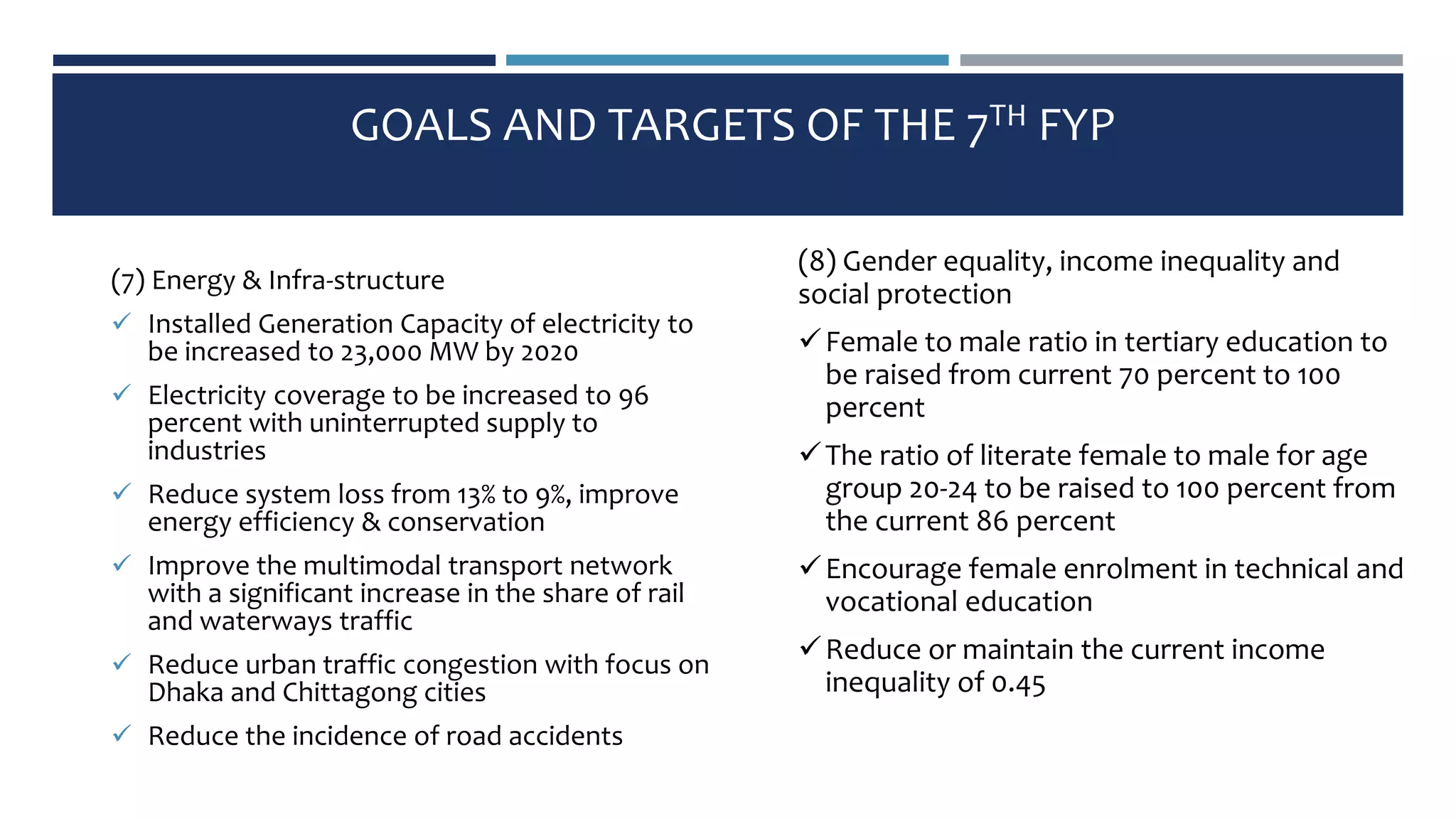
(7) Energy & Infra-structure
 Installed Generation Capacity of electricity to
be increased to 23,000 MW by 2020
 Electricity coverage to be increased to 96
percent with uninterrupted supply to
industries
 Reduce system loss from 13% to 9%, improve
energy efficiency & conservation
 Improve the multimodal transport network
with a significant increase in the share of rail
and waterways traffic
 Reduce urban traffic congestion with focus on
Dhaka and Chittagong cities
 Reduce the incidence of road accidents
(8) Gender equality, income inequality and
social protection
Female to male ratio in tertiary education to
be raised from current 70 percent to 100
percent
The ratio of literate female to male for age
group 20-24 to be raised to 100 percent from
the current 86 percent
Encourage female enrolment in technical and
vocational education
Reduce or maintain the current income
inequality of 0.45
GOALS AND TARGETS OF THE 7TH FYP
(10) ICT Development
 Improve tele density to 100%, internet penetration to 100% and
broadband coverage to 50%
 All primary schools to have at least 1 and all secondary schools to have
at least 3 multimedia classrooms; 30% of primary schools and 100% of all
secondary schools to have an ICT laboratory
 25% Community Health Clinics provide teleconsultation with specialists
in urban areas
 All G2P cash transfers and most P2G and B2G payments done digitally
 Most vital government services are made available at all Digital Centres,
through the national portal and over mobile devices; 100% of citizens
and residents have digital ID that is used in service delivery
 Social media is regularly used for communication with various demand
and supply side stakeholders
 Open government data and big data analysis are regularly used in
public decision support. Increase domestic ICT earnings to $2 billion and
export earnings to $2 billion; 1 million trained HR for the ICT industry
 Spending on Research and Development to constitute 1 % of GDP
 Robust cyber security measures are institutionalized
(9) Environmental Sustainability
 Increase productive forest coverage to 20 percent
 Improve air quality in Dhaka and other large cities and
enact Clean Air Act
 Promote Zero discharge of industrial effluents
 Urban wetlands are restored and protected in line with
Wetland Conservation Act
 At least 15% of the wetland in peak dry season is
protected as aquatic sanctuary
 500 meter wide permanent green belt established and
protected along the coast
 Land zoning for sustainable land/water use completed
 Environmental, Climate Change and disaster risk
reduction considerations are integrated into project
design, budgetary allocations and implementation
process
 Canals and natural water flows of Dhaka and other
major cities restoredrevenue to be raised from 10.7% of
GDP to 16.1% by FY20
7TH FIVE YEAR PLAN TARGETS
Targets
Base Year
2010
Progress under 6th
FYP 2015
7th FYP
2020
Real GDP Growth(%) 6.1 6.5 8
Head Count Poverty(%) 31.5 24.8 18.6
Growth in agriculture(%) 6.15 3.04 3.34
Growth in industry(%) 7.03 9.6 10.9
Growth in services(%) 5.53 5.83 6.49
Total Revenue(% of GDP) 9.98 10.7 16.1
NBR Tax Revenue (% of
GDP)
8.03 9.0 13.7
Fiscal Deficit(% of GDP) 3.3 4.7 4.7
Continued……
THE THEME OF THE 7TH FYP
'ACCELERATING GROWTH, EMPOWERING CITIZENS'.
 The average growth rate is projected at 7.4% over the seventh plan period.
 The 7th plan seeks to raise the GDP growth rate progressively from 6.5% in FY2015 to 8% by FY
2020.
 It is estimated that some 12.9 million additional jobs will be available during the five years of the
7th FYP, including 2 million jobs abroad for migrant workers.
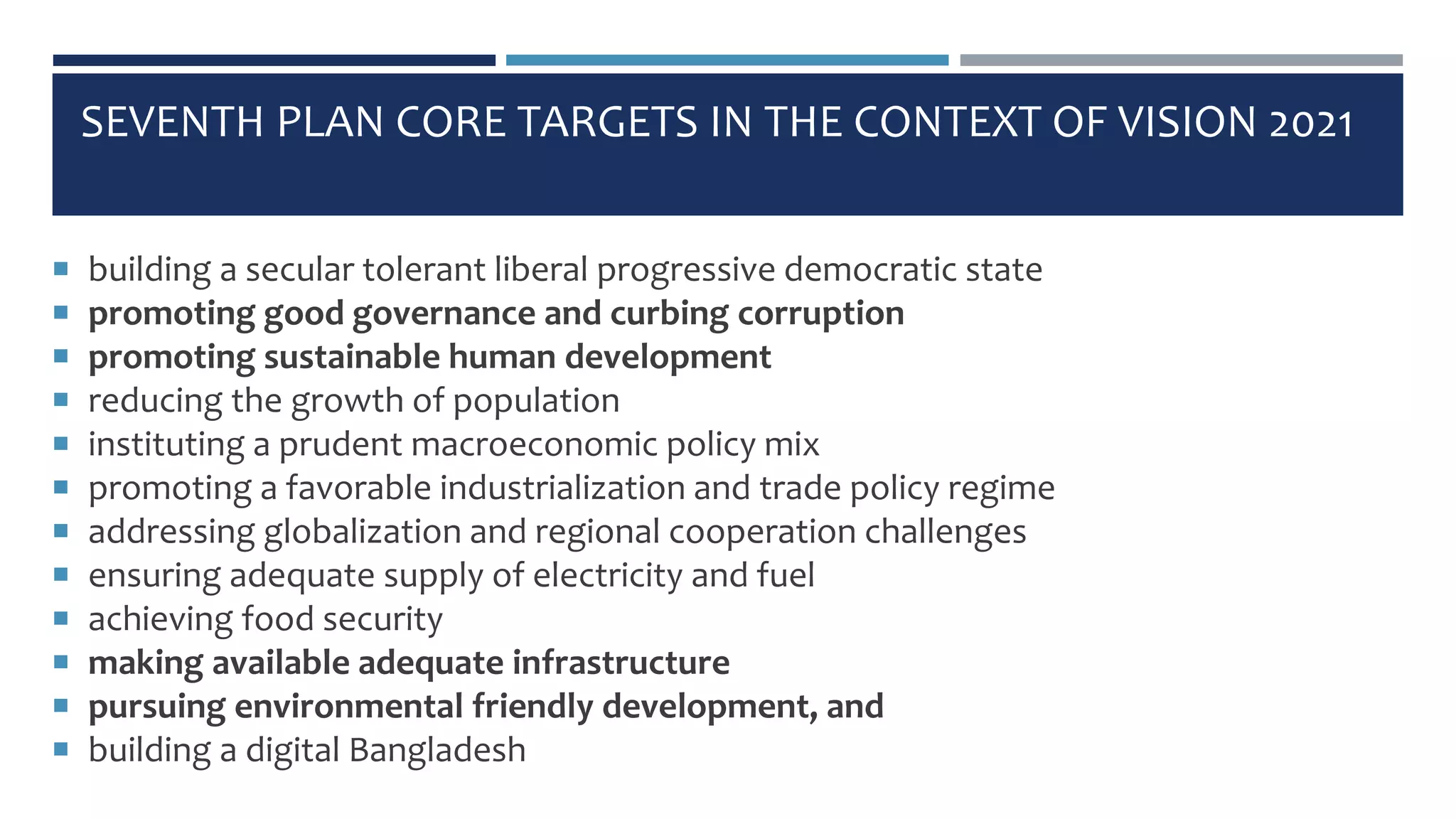
SEVENTH PLAN CORE TARGETS IN THE CONTEXT OF VISION 2021
 building a secular tolerant liberal progressive democratic state
 promoting good governance and curbing corruption
 promoting sustainable human development
 reducing the growth of population
 instituting a prudent macroeconomic policy mix
 promoting a favorable industrialization and trade policy regime
 addressing globalization and regional cooperation challenges
 ensuring adequate supply of electricity and fuel
 achieving food security
 making available adequate infrastructure
 pursuing environmental friendly development, and
 building a digital Bangladesh
GOVERNMENT APPROVED 7TH FIVE YEAR PLAN (2016-20) AIMING TO
EMPOWER PEOPLE BY
 creating employment and skill development opportunities,
 supplying credit for SME development
 and many other ways for people to be more productive.
 Along with growth, the 7th Plan will emphasize
 social protection,
 urban transition and
 sustainable development pathway resilient to disaster and climate change.
7TH FIVE YEAR PLAN IS PREPARED IN AN INCLUSIVE PLANNING
FRAMEWORK FOCUSING ON
 pro-poor economic growth,
 sustainable development and risk resilience with the vision of
 Accelerating Growth with Equity and empowering citizen.
 The drafted plan aims to raise the country's economic growth to 8 percent by the terminal year of its
implementation period FY 2020.
 The proposed plan also set a target to reduce moderate poverty to 18.6 percent by FY20 and
 extreme poverty to 8.9 percent by FY20.
KEY FEATURE
 GENERAL PUBLIC SERVICES & PUBLIC ORDER AND SAFETY
STRENGTHENING PUBLIC ADMINISTRATION, PUBLIC INSTITUTIONS AND GOVERNANCE .
 INDUSTRIAL AND ECONOMIC SERVICES STRATEGY FOR MANUFACTURING
SECTOR DEVELOPMENT WITH EXPORT-LED GROWTH STRATEGY FOR BOOSTING THE SERVICES SECTOR
 AGRICULTURE
 POWER AND ENERGY
 TRANSPORT AND COMMUNICATION TRANSPORT AND COMMUNICATION DEVELOPMENT STRATEGY
 LOCAL GOVERNMENT AND RURAL DEVELOPMENT STRATEGY FOR LOCAL GOVERNMENT AND RURAL
DEVELOPMENT
 ENVIRONMENT AND CLIMATE CHANGE SUSTAINABLE DEVELOPMENT: ENVIRONMENT AND CLIMATE CHANGE
 HOUSING AND COMMUNITY AMENITIES
 HEALTH
 EDUCATION AND TECHNOLOGY
 RECREATION, CULTURE AND RELIGION
 SOCIAL PROTECTION
16
KEY FEATURE
 SECTOR 11: EDUCATION AND TECHNOLOGY
 EDUCATION SECTOR DEVELOPMENT STRATEGY
 DIGITAL BANGLADESH AND INFORMATION COMMUNICATIONS TECHNOLOGY (ICT)
 SECTOR 12: RECREATION, CULTURE AND RELIGION
 ROLE OF SPORTS, CULTURE AND RELIGION IN HUMAN RESOURCE DEVELOPMENT
 SECTOR 13: SOCIAL PROTECTION
 SOCIAL PROTECTION, SOCIAL WELFARE AND SOCIAL INCLUSION .
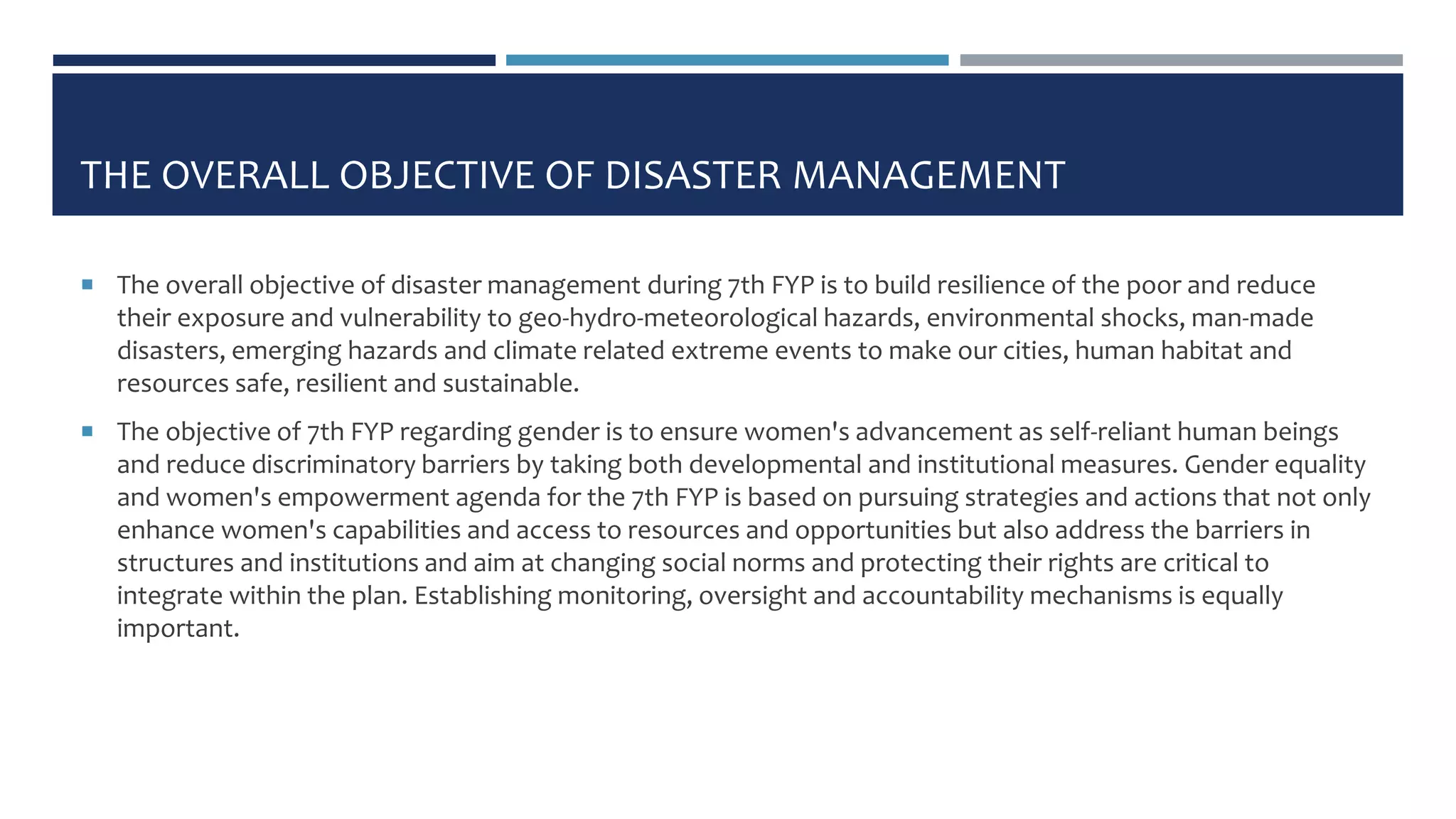
THE OVERALL OBJECTIVE OF DISASTER MANAGEMENT
 The overall objective of disaster management during 7th FYP is to build resilience of the poor and reduce
their exposure and vulnerability to geo-hydro-meteorological hazards, environmental shocks, man-made
disasters, emerging hazards and climate related extreme events to make our cities, human habitat and
resources safe, resilient and sustainable.
 The objective of 7th FYP regarding gender is to ensure women's advancement as self-reliant human beings
and reduce discriminatory barriers by taking both developmental and institutional measures. Gender equality
and women's empowerment agenda for the 7th FYP is based on pursuing strategies and actions that not only
enhance women's capabilities and access to resources and opportunities but also address the barriers in
structures and institutions and aim at changing social norms and protecting their rights are critical to
integrate within the plan. Establishing monitoring, oversight and accountability mechanisms is equally
important.
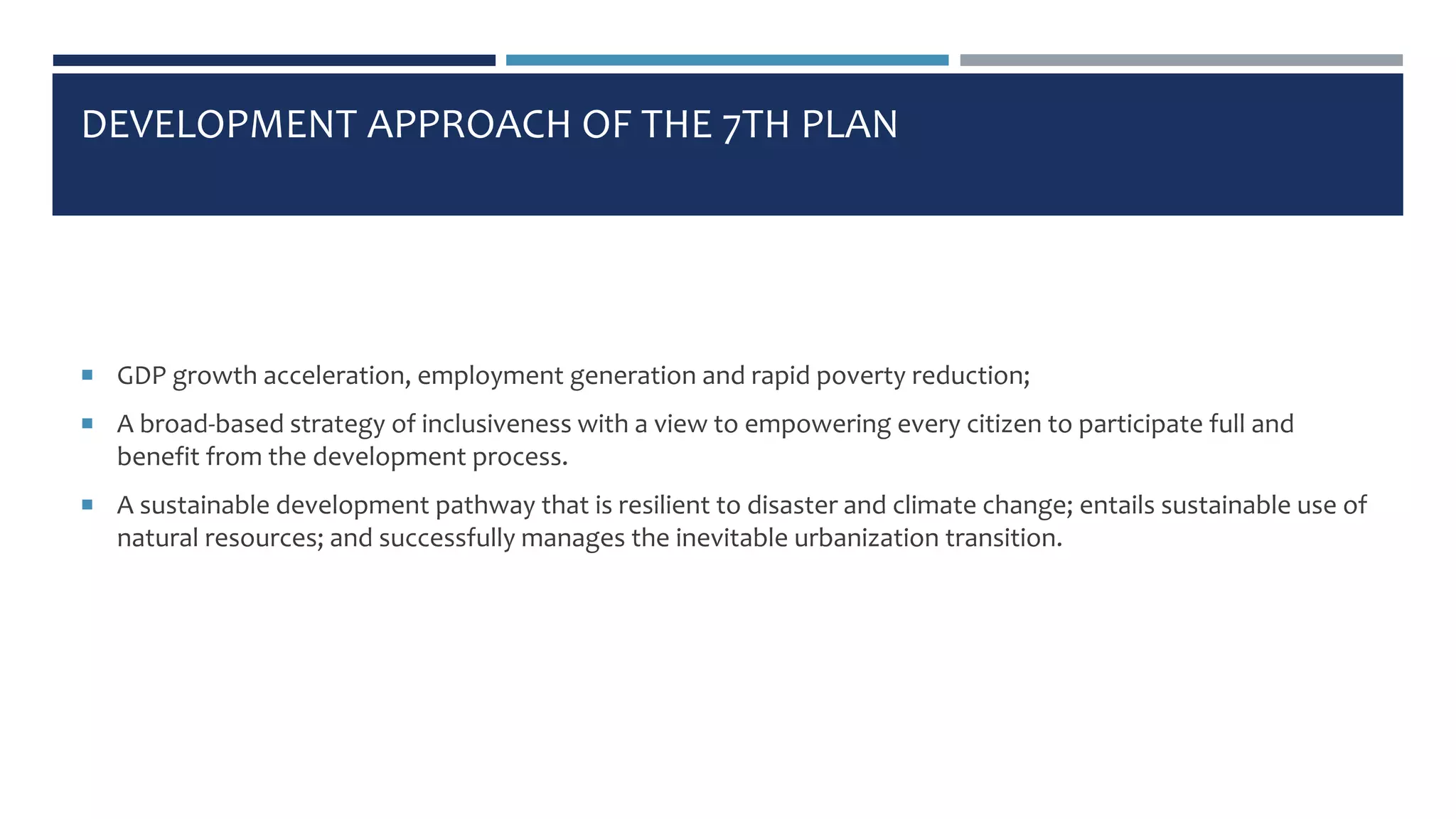
DEVELOPMENT APPROACH OF THE 7TH PLAN
 GDP growth acceleration, employment generation and rapid poverty reduction;
 A broad-based strategy of inclusiveness with a view to empowering every citizen to participate full and
benefit from the development process.
 A sustainable development pathway that is resilient to disaster and climate change; entails sustainable use of
natural resources; and successfully manages the inevitable urbanization transition.
DISASTER ACTION PLAN THROUGH ICT ,BD
 For whom it has been taken?
 which areas has been concerned?
 By whom ICT plans will be governed and how?
 What types of ICT tools will be taken to reduce vulnerability of communities?
 Finally what are major focused area for the agencies under ministry of science and technology in disaster
management through ICT ?
CONCERNED OBJECT
AERIAL VIEW OF THE FLOOD AFFECTED BRAHMANBARIA AREA, SOME 172KMS SOUTHEAST OF
DHAKA, 28 JULY 2004
BY WHOM ICT PLANS WILL BE GOVERNED?
HOW THEY WILL GOVERN ?
 Comprehensive Program
 Proactive Approaches
24
WHAT TYPES OF ICT TOOLS WILL BE TAKEN TO REDUCE
VULNERABILITY OF COMMUNITIES?
 Remote sensing and forecasting
1 installation of geostationary satellite
2 improvement of internal capacity to analyse satellite data
3 investment in ‘automated weather station’,
 Early warning and disaster recovery
1 amending related rules of ICT tools used in disaster management
2 leverage ‘location based service’
WHAT TYPES OF ICT TOOLS WILL BE TAKEN TO REDUCE
VULNERABILITY OF COMMUNITIES?
 Satellite-based network
1 incorporation of GPS tech into radio receiver
2 promotion of email, internet and devices for 1st responders
 GIS-based modelling
1 mainstreaming the model into development planning
GREEN ICT
GREEN ICT
1. Meet the demand for environmental skills and expertise at all levels
2. Minimize the environmental impact of icts in public administration
3. Minimize ict–related disposal
LEVERAGE COMMUNITY RADIO
WHAT ARE MAJOR FOCUSED AREA OF AGENCIES UNDER MO
SC AND TECH IN DISASTER MANAGEMENT THROUGH ICT?
 Establishing energy efficient green technology based Bangladesh Environmental Specimen Bank.
 Research and development for innovation of environment friendly sustainable technology for the
economically constrained communities.
 Inculcate scientific attitude among the people
 Special Focus on Marine Resources
SUSTAINABLE DEVELOPMENT: ENVIRONMENT AND CLIMATE CHANGE
 Therefore, the present Seventh Plan’s articulation of a sustainable development
strategy involves a large array of actions under three key themes:
I. Climate Change Management and Resilience (comprised of adaptation and
mitigation)
II. Environmental Management
III. Disaster Management
31
KEY OBJECTIVES
1. To attain good governance in environmental sustainability
2. To eradicate extreme poverty and achieve national food security
3. To address environmental health
4. To ensure cities are sustainable and more efficient, with development following appropriately
structured plans.
5. To preserve agricultural land and to ensure production growth for food security with minimum
environmental degradation
6. To reduce potential economic losses due to Climate Change (particularly from floods, drought
and salinity)
32
KEY OBJECTIVES
7. To preserve agricultural land and to ensure production growth for food security with minimum
environmental degradation
8. To meet national air and water quality standards.
9. To achieve tree cover over 20% of the land surface (with tree density > 70%) and ecologically
healthy native forests are restored and protected in all public forest lands (about 16% of land)
10. To ensure no new extinctions of globally and nationally threatened species
11. To meet energy demands of development through a low carbon strategy
33
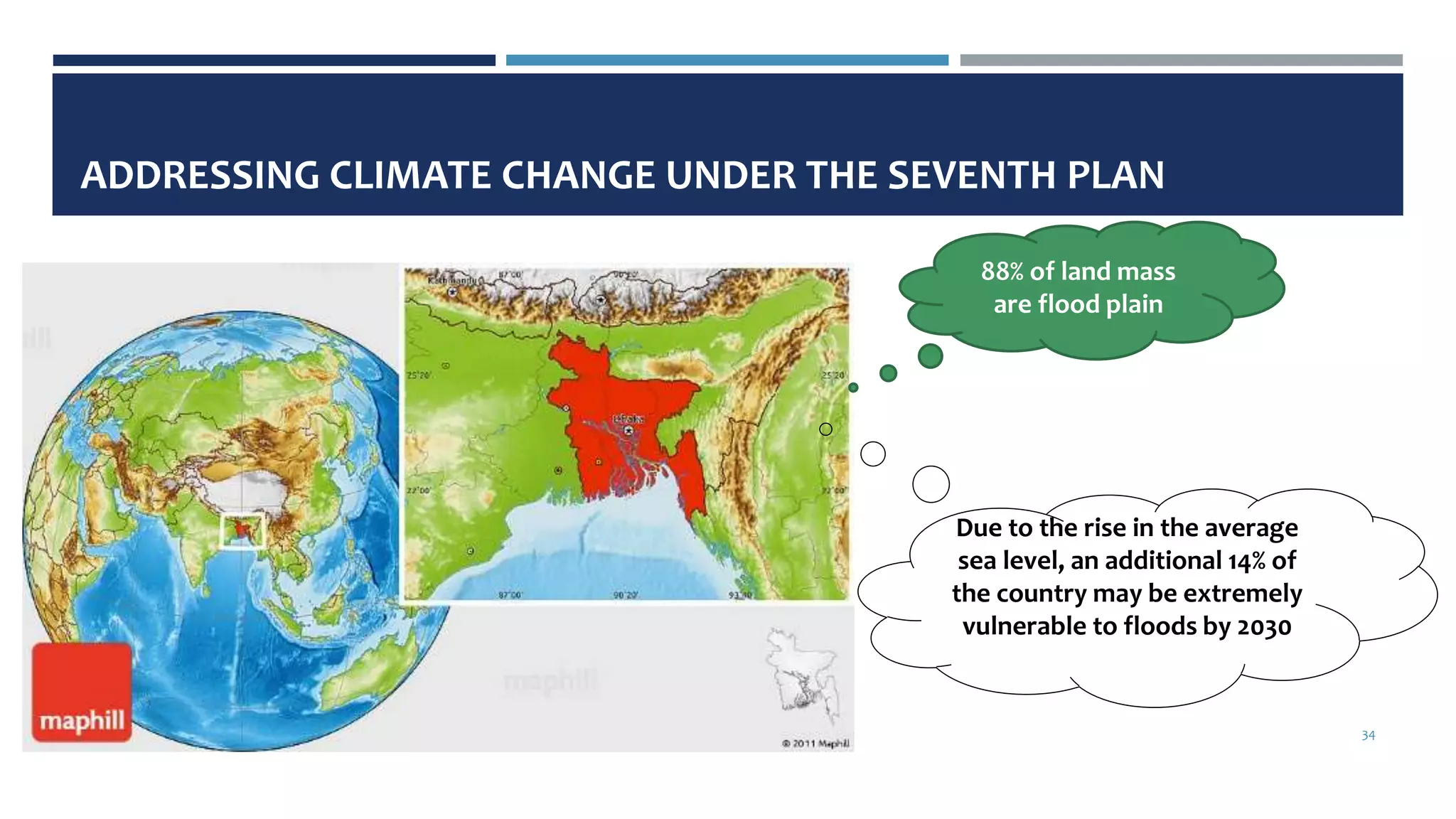
ADDRESSING CLIMATE CHANGE UNDER THE SEVENTH PLAN
34
88% of land mass
are flood plain
Due to the rise in the average
sea level, an additional 14% of
the country may be extremely
vulnerable to floods by 2030
MOST CLIMATE VULNERABLE ZONE
35
Climate Change Management and Resilience (comprised of adaptation and
mitigation)
 As in the Sixth Plan, Climate Change Management under the Seventh Plan will be addressed on two fronts:
1. Climate Change Adaptation
2. Climate Change Mitigation
36
CLIMATE CHANGE ADAPTATION(CCA) CONTEXT OF BANGLADESH:
The consequences of climate change
1. Food insecurity
2. Human health
3. Damage to infrastructure
4. Stress to urbanization
5. Damage to Industries
6. Economic Impacts
7. Loss of livelihoods leading to migration
8. Poverty and Inequity
9. Gender sensitivity to disasters and climate change
37
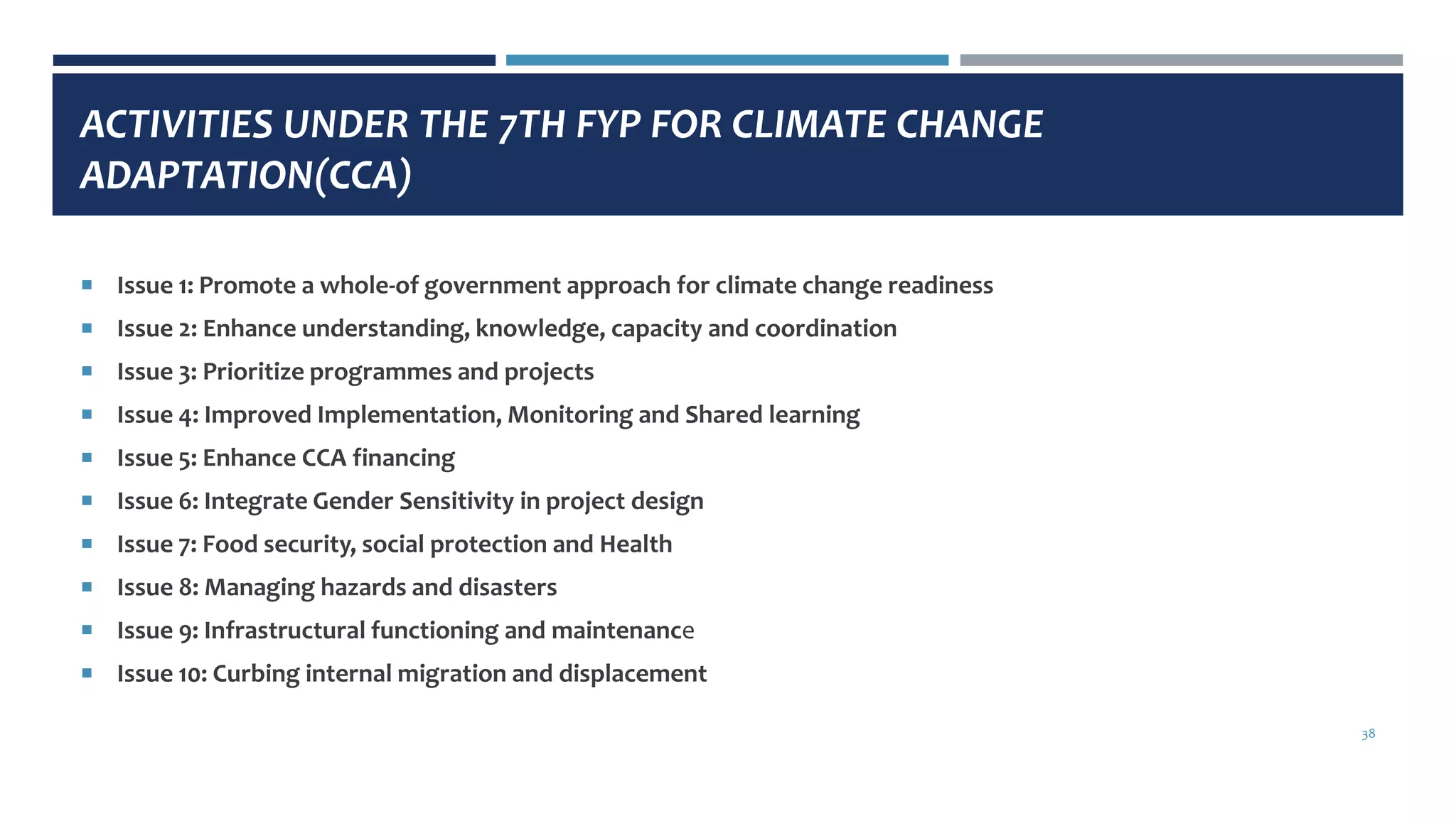
ACTIVITIES UNDER THE 7TH FYP FOR CLIMATE CHANGE
ADAPTATION(CCA)
 Issue 1: Promote a whole-of government approach for climate change readiness
 Issue 2: Enhance understanding, knowledge, capacity and coordination
 Issue 3: Prioritize programmes and projects
 Issue 4: Improved Implementation, Monitoring and Shared learning
 Issue 5: Enhance CCA financing
 Issue 6: Integrate Gender Sensitivity in project design
 Issue 7: Food security, social protection and Health
 Issue 8: Managing hazards and disasters
 Issue 9: Infrastructural functioning and maintenance
 Issue 10: Curbing internal migration and displacement
38
CLIMATE CHANGE MITIGATION (CCM)
 Issue 1: Enhance understanding on LCD
 Issue 2: Improve capacity in analysing available opportunities
 Issue 3: Enhance capacity of energy saving sectors
 Issue 4: Improvement in Coordination and Communication among Institutions
 Issue 5: Ensuring investment in research and innovation
 Issue 6: Other Activities
39
INTERNAL ENVIRONMENTAL MANAGEMENT
 Pollution
• Air pollution
• Water pollution
• Industrial pollution
• Noise Pollution
• Solid Waste
• Hazardous & Toxic waste
• Hospital Waste
 Rapid Urbanization
 Environmental Risk to health
 Natural resource management
 Environmental Governance
 Extent of Forest and Biodiversity Problems
40
DELTA PLAN
41
DISASTER MANAGEMENT IN 7TH FYP
Accelerating growth, EMPOWERING citizen:
 Disaster risk reduction and management for the poor and vulnerable population.
42
DM CONTEXT IN BANGLADESH
 Prone to several hazards like flood, cyclone, earthquake etc.
 Loss of 1.8% GDP from 1990-2008.
 Significant development over the last decade.
 Through DRR programs, voluntarism, safety net,
community resilience building etc.
43
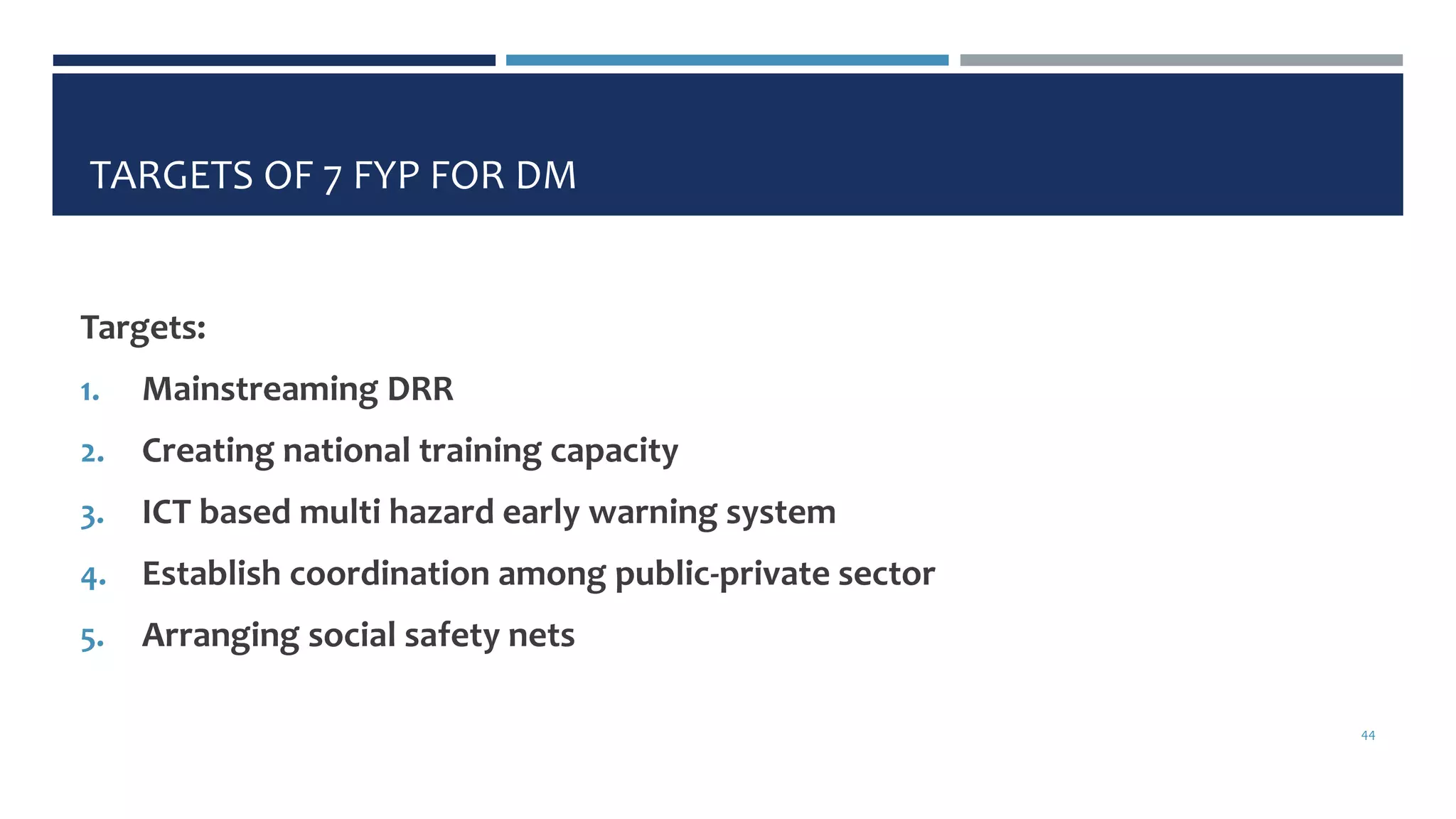
TARGETS OF 7 FYP FOR DM
Targets:
1. Mainstreaming DRR
2. Creating national training capacity
3. ICT based multi hazard early warning system
4. Establish coordination among public-private sector
5. Arranging social safety nets
44
GOALS OF 7TH FYP FOR DM
4 broader goals and one cross cutting category.
 Goal 1: Mainstreaming DRR and CCA
 Goal 2: Making strategies of DRR
 Goal 3: Better disaster preparedness, warning and response
 Goal 4: Effective post disaster recovery and response
45
IMPLEMENTATION CHALLENGES OF DM
 Whole of government approach
 Mainstreaming
 Policy and plan implementation
 Decentralization
 Technical assistance etc.
46
47

DRR Component Incorporate With 7FYP Bangladesh Govt.

  • 1.
    7TH FIVE YEARPLAN GENERAL ECONOMICS DIVISION (GED) PLANNING COMMISSION GOVERNMENT OF THE PEOPLE’S REPUBLIC OF BANGLADESH 1
  • 2.
    GROUP MEMBER  SheikhWali-Al Kabir FH-003  Sara Hanan Chudhury SK-14  Asif Rafsan SH- 018  Mahmudul Islam FH- 020  Syadur Rahaman SH-027  Arif Hasan SH-031 2
  • 3.
    THE HISTORY OFDEVELOPMENT OF THE FIVE YEAR PLAN (FYP)  Bangabandhu Sheikh Mujibur Rahman the father of the nation, dreamt of a 'Shonar Bangla' where the common citizens of the country live in prosperity and have equitable access to quality education, healthcare, rule of law and employment opportunities. He dreamt of a country that was prosperous, was free of poverty, provided equal opportunities for all, where social justice prevailed and there was social protection for the poor and vulnerable against downside risks.  The Awami League-led alliance resurrected that dream in 2008 to drive the country's sustainable development agenda by striking the right balance between equitable national economic progress and human development. For the first time in the country's history, such a comprehensive and audacious vision, steeped in through the success of a new development pagadigm – The Five Year Plan (FYP)  The country has moved up to low middle income status but, more importantly, by human development indicators, achieved a level of development commonly predicted for twice its per capita income.  The 7th FYP has been formulated with full recognition that the 'outlier' phenomenon (differing from all other members of a particular group or set Bangladesh has emerged as a shining example for countries throughout the world as it continues to defy traditional, linear development models and innovate a novel, alternative pathway for socioeconomic progress. ) is not merely a blip on the development path but rather a sustainable occurrence chartering a new development trajectory. 3
  • 4.
    WHAT IS 7THFYP  We made remarkable progress in raising incomes, reducing poverty and improving social indicators.  The Government’s Vision 2021 defines several economic and social outcomes for Bangladesh to achieve by 2021. To convert this Vision into long-term development targets, a Perspective Plan 2010-2021 was prepared. The targets of Vision 2021 and the associated Perspective Plan 2010-2021 were to be achieved through the implementation of two five-year plans, the Sixth Five Year Plan (2011-15) and the Seventh Five Year Plan (2016- 2020). The 6th FYP made solid progress in increasing per capita income and reducing poverty through a strategy of pro-poor economic growth.  Without deviating from the main thrust of the 6th FYP, the 7th FYP articulates new strategies, institutions and policies, while strengthening existing ones, to complete the remaining agenda of achieving the social and economic outcomes of the Vision 2021 and the Perspective Plan.
  • 5.
    ACHIEVEMENTS OF THEFYP 5  GDP growth which held steady at 6% for a number of years and recently moved up to 6.5%  per capita income increased from $619 to $1,314  poverty and extreme poverty have both exhibited significant reduction, falling below 25% and around 12 % respectively,  child mortality 48 per 1000 live births
  • 6.
    GOALS AND TARGETSOF THE 7TH FYP (1) Income & Poverty:  Attaining average real GDP growth rate of 7.4% per year over the Plan period  Reduction in the head-count poverty ratio by 6.2 percentage points  Reduction in extreme poverty by about 4.0 percentage points  Creating good jobs for the large pool of under-employed and new labour force entrants by increasing the share of employment in the manufacturing sector from 15 percent to 20 percent (2) Sector Development Significant growth of the agriculture, industry and service sectors Increase the contribution of the manufacturing sector to 21% of GDP by FY20 Substantial improvement of exports to $54.1 billion by FY20 Achieving a Trade-GDP ratio of 50% by FY20
  • 7.
    GOALS AND TARGETSOF THE 7TH FYP (4) Urban Development:  Infrastructural investment and civic facilities in peri-urban growth centres especially around Special Economic Zones  Inclusive housing and other civic services for urban inhabitants including for people living in informal settlements and slums  Inclusive urban planning based on sustainable land use planning and zoning  Increased productivity, access to finance, and policy support for urban micro-small and medium enterprises (3) Macroeconomic Development Total revenue to be raised from 10.7% of GDP to 16.1% by FY20 Government spending to be increased to 21.1% of GDP by FY20
  • 8.
    GOALS AND TARGETSOF THE 7TH FYP (5) Human Resource Development (Education, Health and Population)  Achieving 100 percent net enrolment rate for primary and secondary education  Percentage of cohort reaching grade 5 to be increased to 100 from current 80 percent  Under 5 mortality rate to be reduced to 37 per 1000 live birth  Maternal Mortality Ratio to be reduced to 105 per 100,000 live births  Immunization, measles (percent of children under 12 months) to be increased to 100 percent  Reduce proportion of underweight children among under-five children to 20 percent  Births attended by skilled health staff to be increased to 65 percent (6) Water and Sanitation Safe drinking water for all Proportion of urban population with access to sanitary latrines to be increased to 100 percent Proportion of rural population with access to sanitary latrines to be raised to 90 percent
  • 9.
    GOALS AND TARGETSOF THE 7TH FYP (7) Energy & Infra-structure  Installed Generation Capacity of electricity to be increased to 23,000 MW by 2020  Electricity coverage to be increased to 96 percent with uninterrupted supply to industries  Reduce system loss from 13% to 9%, improve energy efficiency & conservation  Improve the multimodal transport network with a significant increase in the share of rail and waterways traffic  Reduce urban traffic congestion with focus on Dhaka and Chittagong cities  Reduce the incidence of road accidents (8) Gender equality, income inequality and social protection Female to male ratio in tertiary education to be raised from current 70 percent to 100 percent The ratio of literate female to male for age group 20-24 to be raised to 100 percent from the current 86 percent Encourage female enrolment in technical and vocational education Reduce or maintain the current income inequality of 0.45
  • 10.
    GOALS AND TARGETSOF THE 7TH FYP (10) ICT Development  Improve tele density to 100%, internet penetration to 100% and broadband coverage to 50%  All primary schools to have at least 1 and all secondary schools to have at least 3 multimedia classrooms; 30% of primary schools and 100% of all secondary schools to have an ICT laboratory  25% Community Health Clinics provide teleconsultation with specialists in urban areas  All G2P cash transfers and most P2G and B2G payments done digitally  Most vital government services are made available at all Digital Centres, through the national portal and over mobile devices; 100% of citizens and residents have digital ID that is used in service delivery  Social media is regularly used for communication with various demand and supply side stakeholders  Open government data and big data analysis are regularly used in public decision support. Increase domestic ICT earnings to $2 billion and export earnings to $2 billion; 1 million trained HR for the ICT industry  Spending on Research and Development to constitute 1 % of GDP  Robust cyber security measures are institutionalized (9) Environmental Sustainability  Increase productive forest coverage to 20 percent  Improve air quality in Dhaka and other large cities and enact Clean Air Act  Promote Zero discharge of industrial effluents  Urban wetlands are restored and protected in line with Wetland Conservation Act  At least 15% of the wetland in peak dry season is protected as aquatic sanctuary  500 meter wide permanent green belt established and protected along the coast  Land zoning for sustainable land/water use completed  Environmental, Climate Change and disaster risk reduction considerations are integrated into project design, budgetary allocations and implementation process  Canals and natural water flows of Dhaka and other major cities restoredrevenue to be raised from 10.7% of GDP to 16.1% by FY20
  • 11.
    7TH FIVE YEARPLAN TARGETS Targets Base Year 2010 Progress under 6th FYP 2015 7th FYP 2020 Real GDP Growth(%) 6.1 6.5 8 Head Count Poverty(%) 31.5 24.8 18.6 Growth in agriculture(%) 6.15 3.04 3.34 Growth in industry(%) 7.03 9.6 10.9 Growth in services(%) 5.53 5.83 6.49 Total Revenue(% of GDP) 9.98 10.7 16.1 NBR Tax Revenue (% of GDP) 8.03 9.0 13.7 Fiscal Deficit(% of GDP) 3.3 4.7 4.7 Continued……
  • 12.
    THE THEME OFTHE 7TH FYP 'ACCELERATING GROWTH, EMPOWERING CITIZENS'.  The average growth rate is projected at 7.4% over the seventh plan period.  The 7th plan seeks to raise the GDP growth rate progressively from 6.5% in FY2015 to 8% by FY 2020.  It is estimated that some 12.9 million additional jobs will be available during the five years of the 7th FYP, including 2 million jobs abroad for migrant workers.
  • 13.
    SEVENTH PLAN CORETARGETS IN THE CONTEXT OF VISION 2021  building a secular tolerant liberal progressive democratic state  promoting good governance and curbing corruption  promoting sustainable human development  reducing the growth of population  instituting a prudent macroeconomic policy mix  promoting a favorable industrialization and trade policy regime  addressing globalization and regional cooperation challenges  ensuring adequate supply of electricity and fuel  achieving food security  making available adequate infrastructure  pursuing environmental friendly development, and  building a digital Bangladesh
  • 14.
    GOVERNMENT APPROVED 7THFIVE YEAR PLAN (2016-20) AIMING TO EMPOWER PEOPLE BY  creating employment and skill development opportunities,  supplying credit for SME development  and many other ways for people to be more productive.  Along with growth, the 7th Plan will emphasize  social protection,  urban transition and  sustainable development pathway resilient to disaster and climate change.
  • 15.
    7TH FIVE YEARPLAN IS PREPARED IN AN INCLUSIVE PLANNING FRAMEWORK FOCUSING ON  pro-poor economic growth,  sustainable development and risk resilience with the vision of  Accelerating Growth with Equity and empowering citizen.  The drafted plan aims to raise the country's economic growth to 8 percent by the terminal year of its implementation period FY 2020.  The proposed plan also set a target to reduce moderate poverty to 18.6 percent by FY20 and  extreme poverty to 8.9 percent by FY20.
  • 16.
    KEY FEATURE  GENERALPUBLIC SERVICES & PUBLIC ORDER AND SAFETY STRENGTHENING PUBLIC ADMINISTRATION, PUBLIC INSTITUTIONS AND GOVERNANCE .  INDUSTRIAL AND ECONOMIC SERVICES STRATEGY FOR MANUFACTURING SECTOR DEVELOPMENT WITH EXPORT-LED GROWTH STRATEGY FOR BOOSTING THE SERVICES SECTOR  AGRICULTURE  POWER AND ENERGY  TRANSPORT AND COMMUNICATION TRANSPORT AND COMMUNICATION DEVELOPMENT STRATEGY  LOCAL GOVERNMENT AND RURAL DEVELOPMENT STRATEGY FOR LOCAL GOVERNMENT AND RURAL DEVELOPMENT  ENVIRONMENT AND CLIMATE CHANGE SUSTAINABLE DEVELOPMENT: ENVIRONMENT AND CLIMATE CHANGE  HOUSING AND COMMUNITY AMENITIES  HEALTH  EDUCATION AND TECHNOLOGY  RECREATION, CULTURE AND RELIGION  SOCIAL PROTECTION 16
  • 17.
    KEY FEATURE  SECTOR11: EDUCATION AND TECHNOLOGY  EDUCATION SECTOR DEVELOPMENT STRATEGY  DIGITAL BANGLADESH AND INFORMATION COMMUNICATIONS TECHNOLOGY (ICT)  SECTOR 12: RECREATION, CULTURE AND RELIGION  ROLE OF SPORTS, CULTURE AND RELIGION IN HUMAN RESOURCE DEVELOPMENT  SECTOR 13: SOCIAL PROTECTION  SOCIAL PROTECTION, SOCIAL WELFARE AND SOCIAL INCLUSION .
  • 18.
    THE OVERALL OBJECTIVEOF DISASTER MANAGEMENT  The overall objective of disaster management during 7th FYP is to build resilience of the poor and reduce their exposure and vulnerability to geo-hydro-meteorological hazards, environmental shocks, man-made disasters, emerging hazards and climate related extreme events to make our cities, human habitat and resources safe, resilient and sustainable.  The objective of 7th FYP regarding gender is to ensure women's advancement as self-reliant human beings and reduce discriminatory barriers by taking both developmental and institutional measures. Gender equality and women's empowerment agenda for the 7th FYP is based on pursuing strategies and actions that not only enhance women's capabilities and access to resources and opportunities but also address the barriers in structures and institutions and aim at changing social norms and protecting their rights are critical to integrate within the plan. Establishing monitoring, oversight and accountability mechanisms is equally important.
  • 19.
    DEVELOPMENT APPROACH OFTHE 7TH PLAN  GDP growth acceleration, employment generation and rapid poverty reduction;  A broad-based strategy of inclusiveness with a view to empowering every citizen to participate full and benefit from the development process.  A sustainable development pathway that is resilient to disaster and climate change; entails sustainable use of natural resources; and successfully manages the inevitable urbanization transition.
  • 20.
    DISASTER ACTION PLANTHROUGH ICT ,BD  For whom it has been taken?  which areas has been concerned?  By whom ICT plans will be governed and how?  What types of ICT tools will be taken to reduce vulnerability of communities?  Finally what are major focused area for the agencies under ministry of science and technology in disaster management through ICT ?
  • 21.
  • 22.
    AERIAL VIEW OFTHE FLOOD AFFECTED BRAHMANBARIA AREA, SOME 172KMS SOUTHEAST OF DHAKA, 28 JULY 2004
  • 23.
    BY WHOM ICTPLANS WILL BE GOVERNED?
  • 24.
    HOW THEY WILLGOVERN ?  Comprehensive Program  Proactive Approaches 24
  • 25.
    WHAT TYPES OFICT TOOLS WILL BE TAKEN TO REDUCE VULNERABILITY OF COMMUNITIES?  Remote sensing and forecasting 1 installation of geostationary satellite 2 improvement of internal capacity to analyse satellite data 3 investment in ‘automated weather station’,  Early warning and disaster recovery 1 amending related rules of ICT tools used in disaster management 2 leverage ‘location based service’
  • 26.
    WHAT TYPES OFICT TOOLS WILL BE TAKEN TO REDUCE VULNERABILITY OF COMMUNITIES?  Satellite-based network 1 incorporation of GPS tech into radio receiver 2 promotion of email, internet and devices for 1st responders  GIS-based modelling 1 mainstreaming the model into development planning
  • 27.
  • 28.
    GREEN ICT 1. Meetthe demand for environmental skills and expertise at all levels 2. Minimize the environmental impact of icts in public administration 3. Minimize ict–related disposal
  • 29.
  • 30.
    WHAT ARE MAJORFOCUSED AREA OF AGENCIES UNDER MO SC AND TECH IN DISASTER MANAGEMENT THROUGH ICT?  Establishing energy efficient green technology based Bangladesh Environmental Specimen Bank.  Research and development for innovation of environment friendly sustainable technology for the economically constrained communities.  Inculcate scientific attitude among the people  Special Focus on Marine Resources
  • 31.
    SUSTAINABLE DEVELOPMENT: ENVIRONMENTAND CLIMATE CHANGE  Therefore, the present Seventh Plan’s articulation of a sustainable development strategy involves a large array of actions under three key themes: I. Climate Change Management and Resilience (comprised of adaptation and mitigation) II. Environmental Management III. Disaster Management 31
  • 32.
    KEY OBJECTIVES 1. Toattain good governance in environmental sustainability 2. To eradicate extreme poverty and achieve national food security 3. To address environmental health 4. To ensure cities are sustainable and more efficient, with development following appropriately structured plans. 5. To preserve agricultural land and to ensure production growth for food security with minimum environmental degradation 6. To reduce potential economic losses due to Climate Change (particularly from floods, drought and salinity) 32
  • 33.
    KEY OBJECTIVES 7. Topreserve agricultural land and to ensure production growth for food security with minimum environmental degradation 8. To meet national air and water quality standards. 9. To achieve tree cover over 20% of the land surface (with tree density > 70%) and ecologically healthy native forests are restored and protected in all public forest lands (about 16% of land) 10. To ensure no new extinctions of globally and nationally threatened species 11. To meet energy demands of development through a low carbon strategy 33
  • 34.
    ADDRESSING CLIMATE CHANGEUNDER THE SEVENTH PLAN 34 88% of land mass are flood plain Due to the rise in the average sea level, an additional 14% of the country may be extremely vulnerable to floods by 2030
  • 35.
  • 36.
    Climate Change Managementand Resilience (comprised of adaptation and mitigation)  As in the Sixth Plan, Climate Change Management under the Seventh Plan will be addressed on two fronts: 1. Climate Change Adaptation 2. Climate Change Mitigation 36
  • 37.
    CLIMATE CHANGE ADAPTATION(CCA)CONTEXT OF BANGLADESH: The consequences of climate change 1. Food insecurity 2. Human health 3. Damage to infrastructure 4. Stress to urbanization 5. Damage to Industries 6. Economic Impacts 7. Loss of livelihoods leading to migration 8. Poverty and Inequity 9. Gender sensitivity to disasters and climate change 37
  • 38.
    ACTIVITIES UNDER THE7TH FYP FOR CLIMATE CHANGE ADAPTATION(CCA)  Issue 1: Promote a whole-of government approach for climate change readiness  Issue 2: Enhance understanding, knowledge, capacity and coordination  Issue 3: Prioritize programmes and projects  Issue 4: Improved Implementation, Monitoring and Shared learning  Issue 5: Enhance CCA financing  Issue 6: Integrate Gender Sensitivity in project design  Issue 7: Food security, social protection and Health  Issue 8: Managing hazards and disasters  Issue 9: Infrastructural functioning and maintenance  Issue 10: Curbing internal migration and displacement 38
  • 39.
    CLIMATE CHANGE MITIGATION(CCM)  Issue 1: Enhance understanding on LCD  Issue 2: Improve capacity in analysing available opportunities  Issue 3: Enhance capacity of energy saving sectors  Issue 4: Improvement in Coordination and Communication among Institutions  Issue 5: Ensuring investment in research and innovation  Issue 6: Other Activities 39
  • 40.
    INTERNAL ENVIRONMENTAL MANAGEMENT Pollution • Air pollution • Water pollution • Industrial pollution • Noise Pollution • Solid Waste • Hazardous & Toxic waste • Hospital Waste  Rapid Urbanization  Environmental Risk to health  Natural resource management  Environmental Governance  Extent of Forest and Biodiversity Problems 40
  • 41.
  • 42.
    DISASTER MANAGEMENT IN7TH FYP Accelerating growth, EMPOWERING citizen:  Disaster risk reduction and management for the poor and vulnerable population. 42
  • 43.
    DM CONTEXT INBANGLADESH  Prone to several hazards like flood, cyclone, earthquake etc.  Loss of 1.8% GDP from 1990-2008.  Significant development over the last decade.  Through DRR programs, voluntarism, safety net, community resilience building etc. 43
  • 44.
    TARGETS OF 7FYP FOR DM Targets: 1. Mainstreaming DRR 2. Creating national training capacity 3. ICT based multi hazard early warning system 4. Establish coordination among public-private sector 5. Arranging social safety nets 44
  • 45.
    GOALS OF 7THFYP FOR DM 4 broader goals and one cross cutting category.  Goal 1: Mainstreaming DRR and CCA  Goal 2: Making strategies of DRR  Goal 3: Better disaster preparedness, warning and response  Goal 4: Effective post disaster recovery and response 45
  • 46.
    IMPLEMENTATION CHALLENGES OFDM  Whole of government approach  Mainstreaming  Policy and plan implementation  Decentralization  Technical assistance etc. 46
  • 47.

Editor's Notes

  • #32 These actions are aligned with the overall framework and strategies of NSDS, and are broadly consistent with the scope of the post-2015 SDGs. This chapter is focused on Climate Change Management and Resilience and Environmental Management mostly. With the global commitment of post 2015 development agenda is SDG appropriate policy and institutional capacity building for sustainable land water management, biodiversity conservation, forest ecosystem restoration, climate resilient development and disaster management are crucial at all levels of government, especially with a greater emphasis at the local government level where most of the programmes are to be implemented.